ANALISIS OF THE TENDER PROCESS FOR TRADITIONAL GENERAL CONTRACTING IN SARAWAK MALAYSIA
TSEN SOO FUI
This research project is submitted to the Faculty of Engineering, University Malaysia Sarawak in partial fulfillment of the requirements
for the degree of Bachelor of Engineering with Honours (Civil Engineering)
Faculty OF Engineering
UNIVERSITY MALAYSIA SARAWAK 2006
UNIVERSITI MALAYSIA SARAWAK BORANG PENYERAHAN TESIS
Judul: Analysis of the Tender Process for Traditional General Contracting in Sarawak, Malaysia
Sesi Pengajian: 2005-2006
Saya TSEN SOO FUI
(HURUF BESAR)
mengaku membenarkan tesis* ini disimpan di Pusat Khidmat Maklumat Akademik, Universiti Malaysia Sarawak (UNIMAS) dengan syarat-syarat kegunaan seperti berikut:
1. Hakmilik kertas projek adalah di bawah nama penulis melainkan penulisan sebagai projek bersama dan dibiayai oleh UNIMAS, hakmiliknya adalah kepunyaan UNIMAS.
2. Naskhah salinan di dalam bentuk kertas atau mikro hanya boleh dibuat dengan kebenaran bertulis daripada penulis.
3. Pusat Khidmat Maklumat Akademik, UNIMAS dibenarkan membuat salinan untuk tujuan pengajian sahaja.
4. Kertas projek hanya boleh diterbitkan dengan kebenaran penulis. Bayaran royalti adalah mengikut kadar yang dipersetujui kelak.
5. Pusat Khidmat Maklumat Akademik, UNIMAS dibenarkan membuat salinan tesis ini sabagai bahan rujukan pertukaran antara institusi pengajian tinggi.
6. ** Sila tandakan ( ) di kotak berkenaan:
SULIT (Mengandungi maklumat yang berdarjah keselamatan atau kepentingan Malaysia seperti yang termaktub di dalam AKTA RAHSIA RASMI 1972).
TERHAD (Mengandungi maklumat TERHAD yang telah ditentukan oleh organisasi/
badan di mana penyelidikan dijalankan).
TIDAK TERHAD
Disahkan oleh
(TANDATANGAN PENULIS) (TANDATANGAN PENYELIA)
Alamat Tetap:
168, Taman Mimpi, Jalan Stapok, Mdm. Ting Sim Nee
93150 Kuching, Sarawak, Malaysia. ( Nama Penyelia )
Tarikh: Tarikh:
CATATAN * Tesis dimaksudkan sebagai tesis bagi Ijazah Doktor Falsafah, Sarjana dan Sarjana Muda
** Jika tesis ini SULIT atau TERHAD, sila lampirkan surat daripada pihak berkuasa/ organisasi berkenaan dengan menyertakan sekali sebab dan tempoh tesis ini perlu dikelaskan sebagai SULIT atau TERHAD.
APPROVAL SHEET
This project report attached hereto, entitled “Analysis of the Tender Process for Traditional General Contracting in Sarawak, Malaysia” is prepared and submitted by Tsen Soo Fui in partial fulfilment of Bachelor’s Degree with Honours in Civil Engineering is hereby accepted.
____________________________ ______________________
(Mdm. Ting Sim Nee) Date Project Supervisor
Dedicated to my beloved parents, family members and friends
iii
ACKNOWLEDGEMENT
I would like to express my gratitude and heartfelt thanks especially to my project supervisor Mdm. Ting Sim Nee for her advice, guidance, encouragement and comments over the progress of carrying out the research works and writing up this final year project.
My gratitude also goes to all the interview respondents from the construction industry for their esteem viewpoints, constructive criticisms and sound suggestions. The time they spent in the research interview is much appreciated.
Acknowledgement is not complete without thanking my fellow course mates and friends for their moral support, constructive criticisms and beneficial suggestions.
Last but not least, to my parents and sisters for their support, encouragement and understanding throughout this research, thank you very much.
ABSTRACT
Traditional General Contracting is the most common type of contracting known in the Sarawak construction industry, as it has been the main form of contract procurement for quite sometime. As our industry is growing, the tender process itself for Traditional General Contracting has not gone through much improvement since then to suit the local necessity. This thesis investigates on the problems that could occur in every stage of the tender process and to see if there are rooms for improvement. The improvement is necessary so as to optimize the tender process to meet the objective of a construction contract. Interviews were conducted to the major players in the tender process for Traditional General Contracting. The data obtained from interviews was analysed and summarized to propose a theoretical model of good practices in the tender process for Traditional General Contracting.
v
ABSTRAK
Kontrak Umum Tradisional atau Traditional General Contracting adalah sejenis perjanjian yang biasa dalam industri pembinaan Sarawak, kerana ia telah lama wujud sebagain kontrak perolehan utama. Industri pembinaan kita sedang membangun, tetapi proses tender untuk Kontrak Umum Tradisional belum mengalami kemajuan yang memberangsangkan bagi penyesuaian dengan keperluan tempatan. Tesis ini bertujuan bagi mengkaji masalah yang mungkin timbul dalam setiap peringkat proses tender dan menentukan sama ada wujudnya peluang untuk permajuan. Permajuan ini adalah mustahak untuk mengoptimumkan proses tender agar ia dapat mencapai objektif sesuatu kontrak pembinaan. Temuramah telah dijalankan dengan kakitangan utama dalam proses tender Kontrak Umum Tradisional. Data yang diperolehi dari temuramah telah dianalisasi dan dirumuskan untuk mencadangkan satu model teori untuk praktis baik yang harus dijalankan dalam proses tender Kontrak Umum Tradisional.
TABLE OF CONTENTS
CONTENT Page
TITLE i
DEDICATION ii
ACKNOWLEDGEMENT iii
ABSTRACT iv
ABSTRAK v
TABLE OF CONTENTS vi
LIST OF TABLES xiii
LIST OF FIGURES xvi
CHAPTER 1: INTRODUCTION
1.1 Background 1
1.2 Principal Activities in Tender Process 6
1.3 Problem Statement 9
1.4 Aim and Objectives 10
1.5 Scope of Study 11
vii CHAPTER 2: LITERATURE REVIEW
2.1 Tender Process for Traditional General Contracting 12
2.2 Tender Procedure 13
2.2.1 Favourable and Competitive Pricing
between Main Contractors 14
2.3 Tender Documents 14
2.3.1 Disputes Due to Poor Quality of
Tender Documents 15
2.4 Invitation to Tender 16
2.4.1 Site Visiting 16
2.4.2 Standard Form of Conditions 17
2.4.3 Extension of Tender Period 17
2.5 Tender Submission 17
2.5.1 Large Tender Submission in Open Tendering 19 2.5.2 Qualified Tenders and Alternative Bids 19
2.6 Evaluation/ Assessment of Tender 20
2.6.1 Assessment System 20
2.6.2 Over Reliance on Tender Price 20
2.6.3 Arithmetic Correction of the Tender 21
2.7 Acceptance of Tender 21
2.7.1 Failure to Notify Results 21
2.7.2 Penalty of Indecision 22
CHAPTER 3: METHODOLOGY
3.1 General 23
3.2 Background Studies 24
3.3 Interview Questionnaire 25
3.3.1 Organization and Project Introduction 26 3.3.2 Interview Questionnaires for Client
and Consultant 27
3.3.3 Interview Questionnaires for Contractor 35
3.4 SWOT Analysis 41
3.5 Analysis of the Interview Results and
Recommendations 43
CHAPTER 4: RESULTS
4.1 General 44
4.2 The Tender Process for Client 45
4.2.1 Organisation and Project Introduction 45
4.2.2 Tendering Procedures 45
4.2.3 Tender Documents 46
4.2.4 Invitation to Tender 46
4.2.5 Submission & Receipt of Tender 48
4.2.6 Evaluation/Assessment of Tender 48
4.2.7 Acceptance of Tender 50
4.2.8 Overview of the Questionnaires 51
ix
4.3 The Tender Process for Consultant 54
4.3.1 Organisation and Project Introduction 54
4.3.2 Tendering Procedures 54
4.3.3 Tender Documents 55
4.3.4 Invitation to Tender 56
4.3.5 Submission & Receipt of Tender 56
4.3.6 Evaluation/Assessment of Tender 57
4.3.7 Acceptance of Tender 58
4.3.8 Overview of the Questionnaires 58
4.4 The Tender Process for Contractor 61
4.4.1 Organisation and Project Introduction 61
4.4.2 Tendering Documents 61
4.4.3 Invitation to Tender 63
4.4.4 Evaluation/Assessment of Tender 63
4.4.5 Acceptance of Tender 64
4.4.6 Overview of the Questionnaires 64
CHAPTER 5: DISCUSSION AND RECOMMENDATIONS
5.1 Analysis of the Interview Questionnire 68
5.2 Tender Procedure 70
5.2.1 Favourable and Competitive Pricing
between Main Contractors 70
5.2.2 Alternative Tender Procedures to
Shortlist Potential Tenderers 71
5.2.3 Absence of Competition in Alternative
Tender Procedures 72
5.3 Tender Documents 74
5.3.1 Good Quality of Tender Document to
Avoid Disputes 74
5.3.2 Bills of Quantities as Compulsory Document 75 5.3.3 Lack of Professionalism in Documents
Preparation 75
5.3.4 Checklist for Tenderer 77
5.4 Invitation to Tender 77
5.4.1 Large Tender Submission in Open Tendering 77 5.4.2 Site Visit for Clearer Scope of Work 79 5.4.3 Standard Form of Tender Conditions 79
5.4.4 Extension of Tender Period 80
5.5 Submission and Receipt of Tender 81
5.5.1 Standard Method of Measurement (SMM) 81
5.5.2 Proposal of Alternative Bid 81
5.5.3 Qualified of the Tender 82
5.6 EVALUATION/ASSESSMENT OF TENDER 82
5.6.1 Qualification-based Selection 82
5.6.2 Tender Assessment Criteria 82
xi
5.6.3 Tender Interview 83
5.7 ACCEPTANCE OF TENDER 85
5.7.1 Tender Results Should Be Published 85
5.7.2 Penalty of Indecision 85
5.8 OVERVIEW 86
5.8.1 Clients Taking a More Active Part in
Tender Process 86
5.8.2 The Procurement Trend 86
CHAPTER 6: CONCLUSION 90
REFERENCES 93
APPENDIX A Letter of Support 94
APPENDIX B Interview Questionnaires: Employer
(Jabatan Kerja Raya, JKR) 96
APPENDIX C Interview Questionnaires: Employer
(Jabatan Kerja Raya, JKR) 106
APPENDIX D Interview Questionnaires: Employer
(Land Custody and Development Authority,
LCDA) 116
APPENDIX E Interview Questionnaires: Employer
(Naim Cendera Sdn. Bhd.) 126
APPENDIX F Interview Questionnaires: Consultant
(Jurutera Minsar Consult Sdn. Bhd.) 136 APPENDIX G Interview Questionnaires: Consultant
(PUBM Quantity Surveyors Sdn. Bhd.) 146 APPENDIX H Interview Questionnaires: Consultant
(PEB Consulting QS Sdn. Bhd.) 156
APPENDIX I Interview Questionnaires: Contractor
(Hock Seng Lee Berhad) 167
APPENDIX J Interview Questionnaires: Contractor
(Hock Peng Furniture & General Contractor) 174 APPENDIX K Interview Questionnaires: Contractor
(Sim Hung Eng Construction Sdn Bhd) 182
xiii
LIST OF TABLES
TABLES Page
4.1a Tender Procedure 45
4.1b Tender Procedure 46
4.2 Tender Documents 46
4.3a: Invitation to Tender 46
4.3b: Invitation to Tender 47
4.4: Submission & Receipt of Tender 48
4.5a Evaluation/Assessment of Tender 48
4.5b Evaluation/Assessment of Tender 49
4.5c Evaluation/Assessment of Tender 50
4.7a Overview of the Questionnaires 51
4.7b Overview of the Questionnaires 52
4.7c Overview of the Questionnaires 53
4.8 Tender Procedure 54
4.9 Tender Documents 55
4.10 Invitation to Tender 56
4.11 Submission & Receipt of Tender 56
4.12 Evaluation/Assessment of Tender 57
4.13 Acceptance of Tender 58
4.14a Overview of the Questionnaires 58
4.14b Overview of the Questionnaires 59
4.14c Overview of the Questionnaires 60
4.15a Tender Documents 61
4.15b Tender Documents 62
4.16a Invitation to Tender 62
4.16b Invitation to Tender 63
4.17 Evaluation/Assessment of Tender 63
4.18 Acceptance of Tender 64
4.19a Overview of the Questionnaires 64
4.19b Overview of the Questionnaires 65
4.19c Overview of the Questionnaires 66
4.19d Overview of the Questionnaires 67
5.1a Issues in the Tender Process of Traditional General
Contracting 69
5.1b Issues in the Tender Process of Traditional General
Contracting 70
5.2a Summary of the Discussion- Theoretical Model of Good Practice of the Tender Process for Traditional
General Contract in Sarawak 87
xv
5.2b Summary of the Discussion- Theoretical Model of Good Practice of the Tender Process for Traditional
General Contract in Sarawak 88
5.2c Summary of the Discussion- Theoretical Model of Good Practice of the Tender Process for Traditional
General Contract in Sarawak 89
LIST OF FIGURES
FIGURES PAGE
1.1 The Contracting Process 2
1.2 The Traditional Procurement Method 3
3.1 Overview of Interview Questionnaire 25
3.2 Interview Questionnaires for Organisation
and Project Introduction 26
3.3a Interview Questionnaires for Client and Consultant 27 3.3b Interview Questionnaires for Client and Consultant 28 3.3c Interview Questionnaires for Client and Consultant 29 3.3d Interview Questionnaires for Client and Consultant 30 3.3e Interview Questionnaires for Client and Consultant 31 3.3f Interview Questionnaires for Client and Consultant 32 3.3g Interview Questionnaires for Client and Consultant 33 3.3h Interview Questionnaires for Client and Consultant 34
3.4a Interview Questionnaires for Contractor 35
3.4b Interview Questionnaires for Contractor 36
3.4c Interview Questionnaires for Contractor 37
3.4d Interview Questionnaires for Contractor 38
xvii
3.4e Interview Questionnaires for Contractor 39
3.4f Interview Questionnaires for Contractor 40
3.4g Interview Questionnaires for Contractor 41
3.5 Research Methodology Overview 43
CHAPTER 1
INTRODUCTION
1.1 BACKGROUND
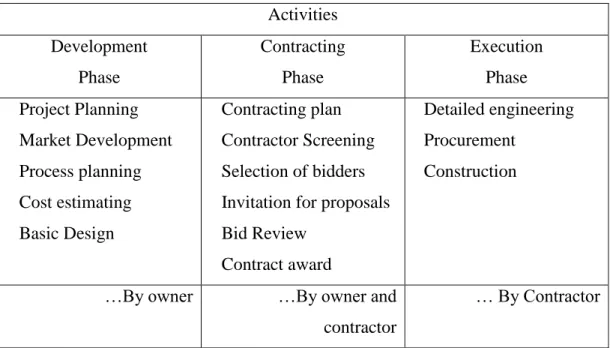
The construction of a civil engineering project can be divided into three significant phases namely Development Phase, Contracting Phase and Execution Phase (Ritz, 1994) as shown in figure 1.1. As part of the initial stages of contracting phase, one of the principal tasks of the project team is to develop the contract strategy to be adopted. During the development of this strategy, consideration will have to be given to the route for procuring the construction contract to realize the project objectives. Thus, an early decision on the preferred method of contract procurement is essential as it will determine the amount of pre-contract work such as design, detailing, tender documentation, and financing (Singh, 2002). The bidding, proposing, and contracting process play a key role in total construction project management. This process is the lifeblood of the engineering-construction industry. Until client and contractor have reached an agreement in contract, no steps are taken to construct the facility (Ritz, 1994).
2 Activities Development
Phase
Contracting Phase
Execution Phase Project Planning
Market Development Process planning Cost estimating Basic Design
Contracting plan Contractor Screening Selection of bidders Invitation for proposals Bid Review
Contract award
Detailed engineering Procurement
Construction
…By owner …By owner and
contractor
… By Contractor
Figure 1.1: The Contracting Process
(Source: Ritz, 1994, Total Construction Project Management)
There are a few types of procurement method in the local construction namely:
Traditional General Contracting (TGC);
‘Package Deal’ Type of Contracts;
Management Contract (MC);
Build, Operate and Transfer (BOT) Contracts; and
Miscellaneous Types of Contracting.
According to Singh (2002), Traditional General Contracting is the most common type of contracting known in the engineering and construction industry in Malaysia, as it has been the main form of contract procurement for quite sometime. It is also known as General Contract or Design-Bid-Build Contract in the local industry. Obviously, it is based upon the rigid separation of design and construction.
As per Potts (1995), the stages involve in TGC are namely:
i) Inception and Feasibility;
ii) Design;
iii) Tendering;
iv) Construction;
v) Handover and Maintenance;
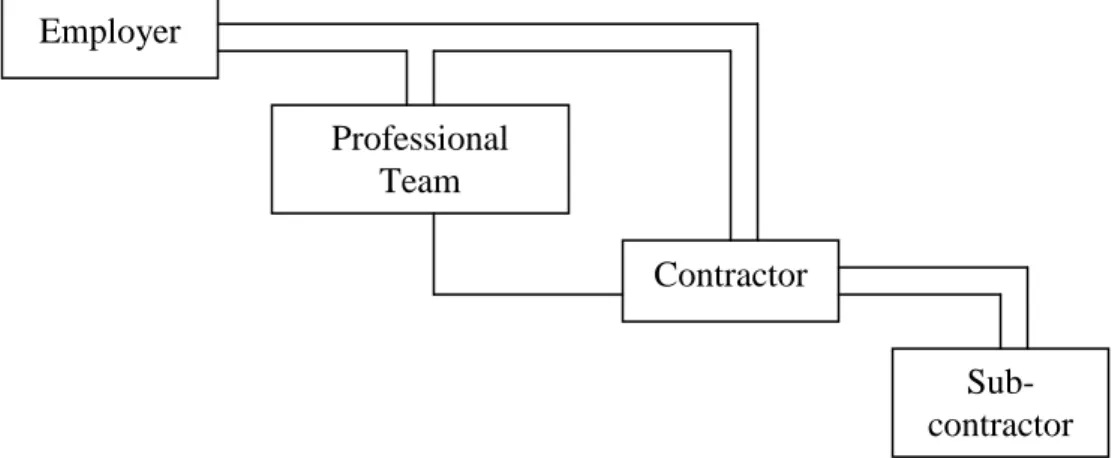
Figure 1.2 shows the relationship among the major players in traditional procurement method. The employer, usually after undertaking a feasibility study, appoints a team of consultants (led by architect/ engineers) to undertake the detailed design. The design team prepares detailed drawing, specifications and often Bills of Quantities. The tender documents are prepared for invitation of tender and the contract being evaluated and awarded, usually to the contractor with the lowest bid. The contractor then manages the construction aspects, usually using sub-contractors.
Figure 1.2: The Traditional Procurement Method
(Source: Brook, 1993, Estimating and Tendering for Construction Work)
Employer
Professional Team
Contractor
Sub- contractor
4
The tendering stage of a project is one that is markedly influenced by the method of contract procurement selected by the employer, whether it is by Traditional General Contracting or any other methods. Selection of contract procurement method is very much based on the nature of various activities involve in the realization of the project. In the tendering stage, tender process must be properly and well-outlined. The tender process meanwhile is described as the process whereby a contractor is selected to carry out work and the basis of settlement of an offer on which a contract will be agreed on (Ritz, 1994).
A tender therefore is defined as an offer by contractor to employer in competition and/or negotiation to do work or supply goods at a fixed price which, if accepted by the employer, will form a binding contract between the parties (http://www.capegateway.gov.za/eng/tenders/tenders). Getting goods or services is also known as ‘procurement’. In other words, it is an offer to carry out construction work at a price, which is a bid in accordance with the conditions set down in the tender documents.
As mentioned by Brook (1993), the purpose of client in tender stage is to select a suitable contractor who can supply a product for the lowest possible price, and can demonstrate the following:
A reputation for good quality workmanship and efficient organization;
The ability to complete on time;
A strong financial standing with a good business record; and
The expertise suited to the size and type of project.
The contractor brings together all the diverse elements and inputs of the construction process into a single, coordinated effort and assumes full, centralized responsibility for the delivery of the finishes job constructed in accordance with the contract documents. Thus, the main contractor is fully responsible to the owner for the performance of the sub-contractors and other third parties to the construction contract (Seals, 1991).
Before the more procedural aspects of tendering process are delved into, a brief assessment of each tendering procedure mode is required to be undertaken.
According to Brook (1993), there are three tendering procedure modes:
Competition Mode
Negotiation Mode
Hybrid Mode
Over the years, Competition mode has been the main strand running through the innumerable tender exercises undertaken especially on the local scene. As per Seals (1991), the Competitive bidding of public projects is normally required by law and is a standard procedure for public agencies. When bidding a project, the contractor estimates how much the structure will cost using the architect- engineer’s drawings and specifications as the basis for the calculations. To this cost it adds what seems to be a responsible profit and guarantees to do the entire job for the stated price. Price amounts quoted by the bidding contractors most often constitute the principal basis for selection of the successful contractor, the low bidder usually receiving the contract. Therefore, Competitive bidding is the