CHAPTER II
THEORETICAL REVIEW
A. Learning Strategy
1. The Definition of Learning Strategy
Learning strategy is needed as a way to achieve the maximum result in
learning. The efficient learning can be achieved if the students use the
learning strategy well. There are many different definitions of learning
strategy made by experts. Tsan (2008: 84) says that learning strategy is a
specific action or technique that learners use in learning.
Another definition of learning strategy is stated by Scarcella and
Oxford (in Oxford, 2003: 2). It is explained that learning strategy is
specific actions, behaviors, steps, or techniques that used by students to
enhance their own learning. Richards and Platt (in Hismanoglu: 2000: 2)
also explained that learning strategy is intentional behavior and thoughts
used by learners during learning so it will help them understand, learn, or
remember new information.
Based on the explanation above it can be simplified that learning
strategies are specific actions, behaviors, steps, or techniques that used by
students which can help them to understand, learn, or remember new
2. The Importance of Learning Strategies in Learning Language
Learning strategies are very important in learning language. It is
because learning strategies will help the students mastering a language
well. Based on Hismanoglu (2000: 8), learning strategies are good
indicators of how learners approach tasks or problems encountered during
the process of language learning. Fedderholdt (in Hismanoglu: 8) also
stated that language learners capable of using a wide variety of learning
strategies appropriately can improve their language skills in a better way.
The importance of learning strategies in learning language is also
delivered by Oxford (2003:1). Oxford states that learning strategies are
especially important for language learning because learning strategy are
tools for active, self-directed movement, which is essential for developing
communicative competence. The similar idea stated by Clouston (in
Hismanoglu: 2000: 8), learning strategies contribute to the development of
the communicative competence of the students
From the explanation above, it can be concluded that learning
strategies are very important for the students in learning Language. They
can help them improve their language skills in a better way. They also
work as essential tools in developing communicative competence. In
addition, language learning strategies are the important thing to make the
3. The System of Learning Strategies
Based on the explanation above it is clear that in learning language,
learning strategies are very important in order to help the students develop
their understanding that can make them good language learner. In fact,
learning strategies work together as a system that will support each other
to bring satisfactory result when they are implemented by ones while
learning a language.
In order to understand the system of learning strategy thoroughly, the
very nature of system is “a set of connected things or parts forming a
complex whole, in particular” (http://www.webopedia.com)
In this case, the kinds of learning strategies are divided into two major
classes: direct and indirect strategies. Direct strategy is learning strategy
used directly in dealing with a new language. Indirect strategy is learning
strategy which supports and manages language learning without directly
involving the target language, Oxford (2003: 12-13).
Furthermore, those two classes are divided into six groups namely:
memory, cognitive, and compensatory under directs strategy, and
metacognitive, affective and also social under indirect strategy. All the
strategies above seem to be simple but representative as the system of
learning strategy that bonded interrelated in the learner’s framework of
B. Reading
1. The Definition of Reading
As human knowledge that always evolve after reading, the definition
of reading also becomes more complex. The terms of reading have
different definitions for different groups of people in order to suit their
different needs and purposes for reading. Many experts have proposed the
definition and explanation of reading. Alyousef (2006: 64) stated that
reading is an interactive process between a reader and a text which leads to
automaticity (reading fluency). In this process the reader interacts
dynamically with the text as she/he tries to elicit the meaning and where
various kinds of knowledge are being used.
Another definition of reading comes from Tarigan. Tarigan (1994: 7)
explains that reading is a process carried out and used by a reader to
acquire message which is conveyed by a writer through words or symbols,
and the meaning of the words could be seen and known by the reader.
Rumelhart (in Leu and Kinzer, 1987: 9) also stated that reading is a
process of understanding written language. It begins with a flutter of
patterns on the retina and ends (when successful) with defined idea about
the author’s intended message.
From the explanation above, it can be concluded that reading is an
interactive process between a reader and a text in order to understand and
2. The Importance of Reading for The Students
Reading is one of English skills which are very important because it is
a way that helps people gets much information which are written in
English. Reading is also very important skill for the students. Harmer
(1998: 68) says that there are some reasons why reading is important for
the students. Firstly, many of them want to be able to read text in English
either for their careers, for study purposes or simply for pleasure.
Secondly, reading English text also provide good model for English
writing. Thirdly, reading English text also provides opportunities to study
language: vocabulary, grammar, punctuation, and the way students
construct sentences, paragraphs and text. Lastly, good reading texts can
introduce interesting topics, stimulate discussion, excite imaginative
responses and be the springboard for well-rounded, fascinating lesson.
3. Reading Comprehension
Reading comprehension is often identified as the primary goal or the
essence of reading. Reading comprehension is very important for the
students because if the students do not understand what they have read,
they can’t catch the idea of the writer through reading. Acording to Tinker
(in Yahya, 2010: 85), reading comprehension is not just reading with aloud
voice reading to establish and understand the meaning of words, sentence,
just reads loudly, but can’t understand the content of the passage. It means
he/ she fails in comprehending the passage.
Reading comprehension is not reading without understanding the idea
of the text. Sweet and Snow (in Gilani, 2012: 84) stated that reading
comprehension is the constructing meaning which is acceptable and
accurate by connecting what has been read to what the students already
know and thinks about all of this information until it is recognize.
Another definition of reading comprehension is also stated by
Kustaryo (in Yahya, 2010: 85). It is said that reading comprehension is an
active thinking process, this is not only depends on comprehension skill
but also the students’ experience and prior knowledge comprehension
involves understanding the vocabulary, seeing the relationship among
words and concepts, making judgment and evaluating. Furthermore, he
stated that reading comprehension understands what have been read.
From the point of views above, it can be concluded that reading
comprehension is an ability to comprehend the message of printed or
written material.
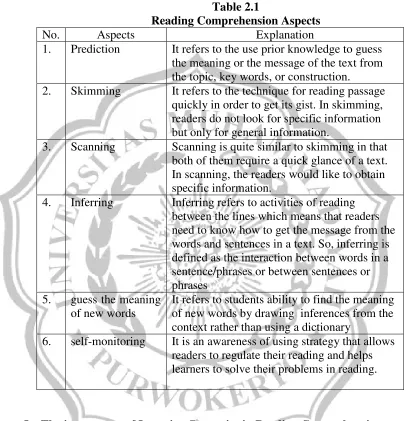
4. Reading Comprehension Aspects
There are some aspects of reading comprehension that have to be
known. It will support the success in comprehending reading material.
an important contribution in reading comprehension. The explanation is
as follows:
Table 2.1
Reading Comprehension Aspects
No. Aspects Explanation
1. Prediction It refers to the use prior knowledge to guess
the meaning or the message of the text from the topic, key words, or construction.
2. Skimming It refers to the technique for reading passage
quickly in order to get its gist. In skimming, readers do not look for specific information but only for general information.
3. Scanning Scanning is quite similar to skimming in that
both of them require a quick glance of a text. In scanning, the readers would like to obtain specific information.
4. Inferring Inferring refers to activities of reading
between the lines which means that readers need to know how to get the message from the words and sentences in a text. So, inferring is defined as the interaction between words in a sentence/phrases or between sentences or phrases
5. guess the meaning
of new words
It refers to students ability to find the meaning of new words by drawing inferences from the context rather than using a dictionary
6. self-monitoring It is an awareness of using strategy that allows
readers to regulate their reading and helps learners to solve their problems in reading.
5. The importance of Learning Strategies in Reading Comprehension
It has been stated before that reading is very important for the
students in learning English. It helps the students get much information
which are written in English. It also provides opportunities for the
way students construct sentences, paragraphs and text. Reading is also
provides good model to other skills.
Reading comprehension is not only reading with aloud voice but
understands the content of the passage. That is why reading
comprehension becomes the primary goal of reading. Unfortunately, to
understand the content of English text is not easy for the students. Firstly,
it because English is only foreign language in Indonesia so that they only
have limited time to practice English. Secondly, because of the students’
limitation of English, most of students only translate the meaning of
words or sentences directly without seeing the context.
In line with the fact above, learning strategies influence the students
to reach success reading comprehension. Wenden and Rubin (1987) in
Gilani (2012: 83) said that learning strategies help students to keep,
achieve, or evaluate information. Learning strategies also has a function
to improve students reading comprehension, motivation and the
willingness to obtain more information. Similarly,Oxford (1990: 12)
stated that learning strategies will facilitate reading activity by making
reading activity become enjoyable and easier so that the attainment of
new information will be more effective. It is added that learning
strategies in reading are specific actions which learners can take to ensure
that information can be obtained more quickly and easily as well as be
maximally, the students can improve their reading comprehension in a
better way.
C. The Focus of Learning Strategies in this research
It has been explained before that the kinds of learning strategies are
divided into two major classes: direct and indirect strategy. It also has
been stated that language learning strategies are like a system that its
element support each other. Below is the language learning strategies in
reading comprehension that proposed as the aspects of the questionnaire
of this research. By analyzing each indicator of learning strategy below,
it can be shown how often the students implemented language learning
strategies in reading comprehension of English text.
1. Direct Strategies
Direct strategies are the strategies used directly in dealing with a
new language. According to Li (2010: 02), the direct strategies are
beneficial to the students because they help store and recover
information. These strategies help learners produce language even
when there is gap in knowledge. They also help to understand and use
the new language. The three strategies that belong to the direct
a. Memory Strategy
Memory strategy is used for storage of information. Oxford
(2013: 13) states that memory strategy helps learners link one L2
item or concept with another butdoes not necessarily involve deep
understanding. Memory strategy enables learners to learn and
retrieve information in an orderly string when they read English
text. For example: using prior knowledge, using new words and
remembering difficult vocabularies of the text.
b. Cognitive Strategy
Cognitive strategy refers to the guiding procedure that
students used to help them complete less-structure task or a
method that is employed for managing the overall learning process
(Thue 2008: 86). Cognitive strategy can also be defined as how
knowledge about language is stored in memory and how the
process reading ultimately results in automatic language
comprehension and production.
Cognitive strategy enables the learner to manipulate the
language material in direct ways when they read text, e.g., through
reasoning, analysis, note-taking, translation, recombination,
auditory representation, key word, elaboration, summarizing,
synthesizing, outlining and reorganizing information to develop
c. Compensatory Strategy
Compensatory strategies help the students to overcome
knowledge limitation in reading comprehension (Thue, 2008: 86).
In the other words, compensatory strategy is the method that helps
the learner makes up for missing knowledge. For the examples:
guessing from the context in reading, using synonyms of the
missing words and using gesture to express words.
2. Indirect Strategy
Indirect strategy is used for general management of reading
comprehension. Indirect strategy works together with the direct
strategy. It helps learner regulate the learning process. Indirect
strategy supports and manages reading comprehension activity
without direct engagement. The three strategies that belong to direct
strategy are:
a. Metacognitive strategy
Metacognitive strategy is administrative action taken in
reading which include planning for comprehending the text,
thinking about the process of comprehending the text,
self-management, self-monitoring, directed attention, observing,
correcting of one‘s comprehension or production, direct attention
metacognitive strategy is the knowledge about the strategy usage
(O‘Malley et al., 1985: 18).
b. Affective Strategy
Affective strategy is the method that identifies one’s mood
and anxiety level (Thue: 2008: 86). Affective strategy is
concerned with the learner’s emotional needs such as talking
about feelings, rewarding oneself for good performance and
positive self-talk in reading comprehension.
c. Social Strategy
Social strategy is the method that helps the learner to work
with others (Thue 2008: 86). The examples are: asking questions
to get verification, asking for clarification of a confusing point,
asking for help in doing a language task, talking with a
native-speaking conversation partner, and exploring cultural and social