1
AN ANALYSIS ON FACTORS INFLUENCING STUDENTS’ LOW ENGLISH LEARNING ACHIEVEMENT
Chairunnisa, Rahayu Apriliaswati, Eni Rosnija
English Education Study Program of Language and Arts Education Departmment FKIP Universitas Tanjungpura, Pontianak
Email: [email protected]
Abstract: This research was aimed to investigate the most dominant internal and external factor influencing students’ low English learning achievement. To achieve the purpose of this study, a descriptive research was conducted at SMKN 2 Pontianak with the sample of this study was the eleventh grade students of XI TSM class in Academic Year 2015/2016 which was chosen by using purposive sampling technique. The findings of this research revealed that (1) Negative attitude was found to be the most dominant internal factor influencing students’ low English learning achievement with the percentage was 78,86% and classified as strong influence. (2) Of the two external factor, unsupportive school environment was found to be the most dominant one with the percentage was 62,38% and also classified as strong influence and followed by lack of family support with the percentage was 40,12% which was classified as weak. To conclude, negative attitude which was supported negatively by the unsupportive school environment had a strong negative influence to the teaching learning process which consequently resulted in students’ low achievement.
Keywords : Internal Factors, External Factors, Low Achievement
Abstrak: Penelitian ini bertujuan untuk mengetahui faktor internal dan eksternal yang paling dominan dalam mempengaruhi rendahnya hasil belajar siswa pada pelajaran bahasa Inggris. Untuk mencapai tujuan penelitian ini, sebuah penelitian deskriptif dilakukan di SMKN 2 Pontianak dengan subjek penelitian adalah siswa kelas XI TSM pada Tahun Ajaran 2015/2016 yang dipilih menggunakan teknik purposive sampling. Hasil dari penelitian ini mengungkapkan bahwa (1)Sikap negatif merupakan faktor internal yang paling dominan dalam mempengaruhi rendahnya hasil belajar siswa pada pelajaran bahasa Inggris dengan persentase sebesar 78,86% dan digolongkan sebagai pengaruh yang kuat. (2) Dari dua eksternal faktor, lingkungan sekolah yang tidak mendukung merupakan faktor eksternal yang paling dominan dengan persentase sebesar 63,38% dan juga digolongkan sebagai pengaruh kuat dan diikuti oleh kurangnya dukungan dari keluarga dengan persentase sebesar 40,12% yang digolongkan sebagai pengaruh lemah. Dapat disimpulkan bahwa sikap negatif yang didukung oleh lingkungan sekolah yang tidak mendukung memiliki pengaruh negatif yang kuat pada proses belajar mengajar yang berakibat pada rendahnya hasil belajar siswa.
2
ne of the parameters or guidelines that is used to measure whether or not the students have mastered the materials of the learning object is the students’ learning achievement. Students’ learning achievement can be varied, including good and bad. Every teacher expects their students to achieve good learning achievement since it indicates that the teaching learning process is successful. However, what are expected by the teachers do not really happen. English is an important language to learn, but this does not necessarily mean that it is a simple language to master. There are many problems that the students faced in learning English which caused them got low achievement. The problems that take part in students’ learning proces are caused by many factors that come from inside and outside the students. Those factors can be broadly categorized as internal and external factors (Slameto, 2010). Internal factors are factors which come from inside the students. While external factors are fctors which come from outside the student.
Learning English requires students to consider not only the external factors but also internal factors. Johnson (2006) stated that, it is increasingly obvious that the internal factors can overtake the externals in their realm of influence. Even when the externals are at the perfect position, internal factors can alter success. In this study, the internal factors consist of anxiety, demotivation, negative attitude, and low self esteem. While the external factors consist of lack of family support and unsupportive school environment factor. Those factors might exist in English class which can affect negatively to students’ learning process. For example, many students are passive and shy to participate in classroom activities. One of the reasons to take into consideration might be their anxiety about making mistakes. As what Riasti (2011) stated that students may feel anxious due to problems related to negative evaluation such as fear of correction and fear of making mistake. Senior high school students really care about how they are viewed by teachers and classmates and they are not willing to be laughed at by others in the class. Therefore, they will see mistakes in English learning as threats to them. As the result, they will try to protect themselves by avoiding answering questions or giving their ideas in class.
3
out dated and in-efficient course and teaching methods. These problems make the students easy to get bored and sometimes lose their willingness and interest toward English subject. Therefore, it is not suprising that students’ English achievement, after their study for five years or even more, is considered still low.
Besides, based on writer’s observation to the eleventh grade students of SMKN 2 Pontianak in academic year 2015/2016, the students showed negative attitude toward their English teacher. They did not pay attention when their English teacher was explaining the lesson, they were busy using their mobile phones, they talked to their friends and even fell asleep during class. As what Melhim (2009) in Gömleksiz (2010) stated that when the student does not like or respect the teacher, they will not be able to go through the periods when the teacher is teaching. Moreover, all of the students got low score for the midterm test. They did not pass the minimum standard score for English subject in that school, that is 70. The mean score of English midterm score of each classes were ranged from 36,07 to 52,24.
There have been several studies conducted to explore the factors influencing students’ low achievement. Sa’ad and Usman (2014), who conducted a descriptive research on the secondary school students in Dutse metropolis of Jigawa state, revealed that the causes of poor performance in English language were the dominance of mother tongue, inadequate facilities and instructional media/materials, negative attitude of students toward learning English language and improper use of methods of teaching by teachers. Furthermore, a study conducted by Souriyavongsa et.al (2013) entitled “Factors Cause Students Low English Language Learning” revealed that the English teachers were not well trained, they could not perform well and influenced the interest of the students. Majority of students lacked of confidence to use the language because they were afraid of making mistakes and also the classroom was too crowded.
Based on the background explained above, the writer also conducted a research to investigate the factors influencing students’ low English learning achievement. However, in this research, the writer focused on the most dominant internal and external factors influencing student’s low English achievement to the eleventh grade students of SMKN 2 Pontianak in academic year 2015/2016. Among the factors investigated, the writer focused on the most dominant factor because dominant factor is considered as the most influential factor influencing students’ achievement. This research is important to conduct because having a better understanding about the factors that really have a big influence in students’ English learning process can be one of efforts to be aware of the existance of negative factors that come from both inside and outside the students.
METHOD Research Design
4
design to be applied to investigate the the most dominant internal and external factors influencing students’ low learning achievement.
Population and Sample
The population of this research was the eleventh grade students of SMKN 2 Pontianak in academic year 2015/2016 with the total population were 272 students. The writer used purposive sampling technique to select the sample. According to Best & Khan (2006), purposive sampling allows the researcher to select those participants who provide the richest information, those who are the most interesting, and those who manifest the characteristics of most interest to the researcher. Of the nine classes, the researcher took class XI TSM which consists of 28 students as the sample because this class represented the students who had low scores. This class had the lowest mean score with the highest score was 58 and the lowest score was 20. Therefore, the sample of this study was the students of XI TSM.
Technique and Tools of Data Collection
To answer the research questions, the writer needs to consider the suitable technique and tools of data collection. The indirect communication technique was used in order to collect the data about students’ internal and external factors. The tool used in this research was questionnaire. The writer adopted and adapted some questionnaires from some journals and then combined and edited the questionnaire items from the journals in order to make it more suitable and relevant with the purpose of this research. The questionnaire consists of 32 statements. Each internal factor contributes 5 items, so the total number are 20 items. While for each external factor contributes 6 items. So, the total number for external factors are 12. Questionnaire items number 1-20 are used to see students’ internal factors: anxiety, demotivation, negative attitude, low self esteem. Then, the questionnaire items number 21-32 are used to see students’ external factors: lack of family support family and unsupportive school environment factor. The questionnaire was distributed to the students and they had to answer the questions based on their own condition/situation.
Technique of Data Analysis
5
Table 1. Score Interpretation Criteria
Range Classification
0% - 20% Very weak
21% - 40% Weak
41% - 60% Enough
61% - 80% Strong
81% - 100% Very Strong
Score interpretation criteria is used to help the writer interprets the percentage and to see the level of influence of the most dominant factor. The researcher only classifies the percentage of the most dominant factor based on its classification to see how influential the factor is. The higher the percentage, the stronger the influence will be.
FINDINGS AND DISCUSSION
Findings
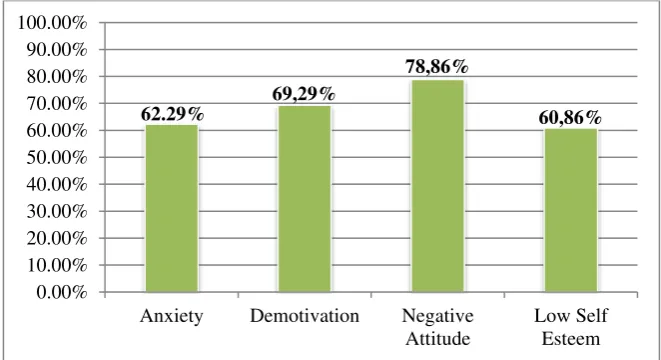
To answer the first research question, “What is the most dominant internal factor influencing students’ low English learning achievement ?”, the writer analyzed students’ answers from the questionnaire number 1 to 20. Students’ answers were analyzed in order to determine the most dominant internal factor. The percentages of internal factors were described in the following chart:
Graphic 1. The Percentages of Each Internal Factor
Graphic 1 above shows that the most dominant internal factor was negative attitude with high percentage (78,86%), followed by demotivation (69,29%), anxiety (62,29%), while low self esteem came last (60,86%). Graphic 1 makes it clear that the most dominant factor and the three other factors have slightly
62.29%
69,29%
78,86%
60,86%
0.00% 10.00% 20.00% 30.00% 40.00% 50.00% 60.00% 70.00% 80.00% 90.00% 100.00%
Anxiety Demotivation Negative
Attitude
6
different percentages in influencing students’ low achievement. It indicates that the students experianced those factors during the English learning proces and each factor played its role which led to some negative effects on students’ learning. Since the focus of this study is on the most dominant factor, so the writer emphasizes the result only on students’ negative attitude. Based on the score interpretation criteria, negative attitude which was found to be the most dominant internal factor was classified as strong influence. Strong means that the factor has more power to influence or give negative effects on students’ learning. The explanation why negative attitude was classified as strong because it showed a
high percentage which indicated that many students experianced, felt or agreed
that the statements about negetive attitude in the questionnaire truly represent their own condition. The higher the percentage, the more the students agreed with the statement. Therefore, in this case, negative attitude had a strong negative influence on students learning process which consequently resulted in students’ low achievement.
To answer the second research question, “What is the most dominant
external factor influencing students’ low English learning achievement ?”, the
writer analyzed students’ answers from the questionnaire number 21 to 32. Students’ answers were analyzed in order to determine the most dominant external factor. The percentages of external factors can be seen in the following chart:
Graphic 2. The Percentages of External Factors
The results shown in graphic 2 above show that the most dominant external factor came from unsupportive school environment factor with the percentage was 62,38% and followed by lack of family support (40,12%). Both unsupportive school environment factor and lack of family support did exist and contributed such negative effects on students’ learning process. Nevertheless, the negative factors that influenced students’ low achievement worked on a different level. Based on the score interpretation criteria, lack of family support was classified as weak, while unsupportive school environment factor which was found to be the most dominant external factor was classified as strong. It was weak because the factor had a little power to give effects on students’ learning and
40,12%
62,38%
0.00% 10.00% 20.00% 30.00% 40.00% 50.00% 60.00% 70.00% 80.00% 90.00% 100.00%
Lack of Family Support
7
only a few students experianced a condition where they lacked of family support. In contrast, unsupportive school environment had more power to give a strong negative influence on students learning process.
Discussion
This research is aimed to investigate the most dominant internal and external factor influencing students’ low English learning achievement. Reffering to the first research question, the result revealed that negative attitude was rated as the most dominant internal factor influencing students’ low achievement with high percentage (78,86%), followed by demotivation (69,29%), anxiety (62,29%), and low self esteem (60,86%). These four internal factors had slightly different percentages in influencing students’ low achievement which indicated that the factors did exist and contributed such negative effects on students’ learning process which then resulted in students’ low achievement.
Based on the score interpretation criteria, negative attitude which was found to be the most dominant internal factor was classified as strong influence. The possible explanation why negative attitude was classified as strong in influencing students’ low achievement because it showed a high percentage which indicated that many students experianced, felt or agreed that the statements about negative attitude in the questionnaire truly represent their own condition. Negative attitude that students brought to class had infuenced their learning. Based on the data gathered from the questionnaire, most of the students did not like studying English. The difficulties in learning English, not fun and enjoyable learning process became problems which then affected students' attitude toward English and the reduction of their motivation levels.
Furthermore, negative attitude was also shown toward their English teacher. Most of the students admitted that they did not pay attention when their English teacher was explaining the lesson. As what Melhim (2009) in Gömleksiz (2010)
stated that when the student does not like or respect the teacher, they will not be able to go through the periods when the teacher is teaching. The finding of the present study was in line with the existing research finding by Zainol et al. (2012). The result revealed that the students had negative attitude towards learning English. The students showed negative behaviors in the English classes by not paying attention to the teachers’ explanation. This could be due to the belief among the EFL learners that learning English was not needed and important.
8
Furthermore, anxiety and low self esteem also took part in the English learning process which led to some negative effects on students’ learning. Most of the students experianced a feeling of anxiety, although the degree of this feeling might vary from one student to another. Based on the data gathered, factors like lack of preparation and fear of being laughed by other students were the causes of their anxiety. The students who felt anxious in learning would find their study less enjoyable. Riasti (2011) stated that when the students feel anxious, there is a high chance for the student to make mistakes which will result in being ridiculed by classmates and being evaluated by the teacher. As the result, the students will have a new problem since that condition can decrease students’ self esteem. As what theory proposed by MacyIntyre (1998) in Riasti (2011) stated that the existance of learning anxiety disturbs one’s self esteem and self confidence.
Regarding to the second research question, the result of current study revealed that the most dominant external factor influencing students’ low English learning achievement came from unsupportive school environment factor with the percentage was 62,38% and followed by lack of family support (40,12%). Both unsupportive school environment factor and lack of family support did exist and contributed such negative effects on students’ learning process. However, those negative factors worked on a different level. Based on the score interpretation criteria, lack of family support was classified as weak in influencing students’ achievement, while unsupportive school environment was classified as strong influence.
In the present research, unsupportive school environment factor was divided into teacher’s uninteresting teaching method, poor relationship between teacher and students and negative peer influence. Among the three parts of unsupportive school environment, based on the data gathered, the part that influence students’ low achievement the most was the teacher’s uninteresting teaching method. Majority of the students (71,43%) agreed that their English teacher did not present materials in an interesting way and admitted that their English teacher had a monotonous teaching style. However, when it came to teacher-students relationship, the result gathered from the questionnaire indicated that most of the students had good relationship with their teacher.
9 CONCLUSION AND SUGGESTIONS
Conclusion
This research is aimed to investigate the most dominant internal and external factor influencing students’ low English learning achievement. The findings of this study revealed that, first, negative attitude was found to be the most dominant internal factor influencing students’ low English learning achievement with the percentage was 78,86% and classified as strong influence. From the computation, it was found that another internal factors, anxiety and demotivation were also classified as strong influence ranging from 62,29%-69,29%. Unlike the three previous factors, low self esteem was classified as enough as it reached 60,86%. Based on students’ responses to the questionnaire, the possible explanation why the students had negative attitude could be possibly due to the difficulties in learning English, not interesting, not fun and enjoyable learning process and also the belief of what they have learned about English at school was not useful and important because they did not feel the need of English language to their daily life. Second, unsupportive school environment was found to be the most dominant external factor influencing students’ low English learning achievement with the percentage was 62,38% and followed by lack of family support (40,12%). Both unsupportive school environment and lack of family support did exist and contributed such negative effects on students’ learning process. Nevertheless, the negative effects that influenced students low achievement worked on a different level. Negative attitude that students brought to class and unsupportive school environment factor especially uninteresting/ monotonous teaching method applied by the teacher seemed to be a perfect combination in influencing poor English learning and low achievement. Since teacher played a main role in teaching learning process, it is important to understand how negative attitudes in learning English can be avoided to develop students’ interest and positive attitude. Using a variety of techniques and strategies can be done to deliver effective language learning and shape students’ attitudes positively towards English learning. However, it is noteworthy that teacher is not the only one who is responsible for the students’ attitude because the real one comes from within each student. Therefore, both teacher and students should try to develop and maintain positive attitude toward English in order to learn effectively throughout the learning process.
Suggestions
10
students’ anxiety and boost the confidence of the students because they feel less anxious when they express their ideas in a cooperative way than being asked individually to answer questions in front of the class. (3) Teachers should give students’ tasks with proper difficulty to let them have experiences of success. Positive experience in learning can increase students’ self-confidence in using English and strengthen their motivation to learn it. (4) Students can help themselves set clear goals by defining why they need to learn English. Having clear goals in learning will ensure that students’ efforts are not useless and it can enhance students’ motivation to learn and develop positive attitude toward English learning. (5) Further research may explore more factors in a larger group with the additional of tool of data collection, such as interview. This will shed more light on this issue. Furthermore, provide new teaching technique to develop students’ positive attitude toward English will be an interesting research topic.
BIBLIOGRAPHY
Best, John W., & Kahn James V.(2006). Research in Education (10th edition). Boston:
Pearson.
Du, Xiaoyan. (2009). The Affective Filter in Second Language Teaching. Asian Journal Science, 5(8), 162-164.
Gömleksiz, M.N. (2010). An evaluation of students’ attitudes toward English language learning in terms of several variables. Procedia Social and Behavioral Sciences,
9(2010), 913–918.
Johnson, B.J. (2006). Foreign Language Learning: An Exploratory Study on The External and Internal Influences Affecting Success. Thesis. Unpublished. Faculty of Baylor University.
Knupfer, N. N. & McLellan, H. (1996). Descriptive research methodologies. In D. H. Jonassen (Ed.), Handbook of research for educational communications and
technology (pp. 1196-1212). New York: Macmillan.
Ming, et al. (2011). Attitudes and Motivation of Malaysian Secondary Students towards learning English as a Second Language: A Case Study. The Southeast Asian Journal of English Language Studies, 17(1), 40 – 54.
Riasati, M. J. (2011). Language Learning Anxiety from EFL Learners’ Perspective.
Middle-East Journal of ScientificResearch, 7(6), 907-914.
Sa’ad, T.U., & Rabiu Usman. (2011). The Causes of Poor Performance in English
Language among Senior Secondary School Students in Dutse Metropolis of Jigawa State, Nigeria. Journal of Research & Method in Education, 4(5), 41-47. Shahzad, et al. (2011). Identification of the Causes of Students’ Low Achievement in the
Subject of English. Asian Social Science, 7(2), 168-171.
Slameto. (2010). Belajar dan Faktor-Faktor Yang Mempengaruhinya. Jakarta: Rineka Cipta.
Souriyavongsa, et al. (2013). Factors Causes Students Low English Language Learning: A Case Study in the National University of Laos. International Journal of English Language Education, 1(1), 179-192.
Zainol, A., Pour-Mohammadi, M., Alzwari, H. (2012). EFL Students’ Attitudes towards Learning English Language: The Case of Libyan Secondary School Students.