O R I G I N A L A R T I C L E
Correction of Overstatement and Omission
in Direct-to-Consumer Prescription Drug
Advertising
Kathryn J. Aikin1, Kevin R. Betts1, Amie C. O’Donoghue1, Douglas J. Rupert2, Philip K. Lee2, Jacqueline B. Amoozegar2, & Brian G. Southwell2
1 Office of Prescription Drug Promotion, U.S. Food and Drug Administration, Silver Spring, MD 20993, USA 2 Center for Communication Science, RTI International, Research Triangle Park, NC 27709, USA
Little experimental evidence exists regarding corrective television advertising as a remedy for misleading direct-to-consumer prescription drug ads. We examined how exposure to an ad for a fictitious prescription drug that appeared to offer benefits and risks superior to normative standards for asthma medication (i.e., a simulated violative ad) and a corre-sponding corrective ad shaped viewer perceptions, understanding, and intended behavior. Through an experiment with 1,057 participants, we found that a corrective ad counteracted viewer belief of an overstatement of efficacy claim, but was less successful in counteracting omission of risk. Corrective ad exposure also affected general viewer perceptions of, and intended behaviors toward, the drug.
Keywords:Misinformation, DTC Advertising, Prescription Drugs, Corrective Advertising, Television Advertising.
doi:10.1111/jcom.12167
Corrective advertising emerged in public debate in the United States in the early 1970s as a potential remedy for deceptive advertising (Mazis, McNeill, & Bernhardt, 1983). In the late 1970s, the sponsor of Listerine mouthwash ads produced corrective ads in response to requests by the Federal Trade Commission (FTC), highlighting the use of corrective ads as a policy move for the first time on a national stage (Mazis et al., 1983). Although corrective advertising appeared infrequently in the 1980s and 1990s, federal agencies have demonstrated a renewed consideration of corrective advertising in recent years (Darke, Ashworth, & Ritchie, 2008; Fintor, 2002; Mazis, 2001; Palumbo & Mullins, 2002). In the past decade, in fact, policymakers have requested corrective ads to counteract some prominent campaigns that were in violation of advertising laws
(i.e., so-called violative ads). In 2009, for example, Bayer HealthCare Pharmaceuticals, Whippany, NJ, USA produced corrective direct-to-consumer (DTC) advertising for Yaz, a birth control pill, following a warning letter from the Food and Drug Adminis-tration (FDA) regarding misleading claims (Singer, 2009). Such scrutiny of misleading ads and consideration of corrective remedy highlights an important intersection of public policy and communication research and points to the importance of examining corrective ads within the DTC sphere.
The varying salience of correction as a focal point of public policy attention in the United States partly explains the history of research in this arena, with much of the available literature appearing in the 1970s and early 1980s. Recently, researchers have investigated possibilities for correction of tobacco-related claims (e.g., Smith et al., 2011; Tangari, Burton, Andrews, & Netemeyer, 2007; Tangari, Kees, Andrews, & Bur-ton, 2010). Smith et al. (2011), for example, drew from U.S. Federal Court proceedings to test the ability of corrective statements that had been proposed by various par-ties in the case to address misperceptions about the hazards of smoking. They found that each of the various corrective print advertisements overturned misperceptions to some extent. Beyond tobacco print advertisements, another opportunity to assess corrective advertising effects lies in DTC prescription drug television advertising, a prominent feature of the U.S. advertising environment and the focus of the present article.
Available literature generally suggests that mass media content can counteract existing misperceptions stemming from previous media exposure to some extent. For example, Green and Donahue (2011) assessed whether they could overturn impres-sions formed by exposure to portions of news articles that later turn out to be false and found some degree of corrective effect. Although participants could grasp the idea that they had encountered misinformation previously, Green and Donahue also concluded that people can continue to harbor a range of beliefs resulting from that initial media exposure even after subsequent information counters some of the initial presentation. Although corrective messages may counteract consumers’ false beliefs, we need more research as to exactly what corrective outcomes are most likely.
To explore the ways corrective advertising affects viewers in the context of DTC prescription drug advertising on television, it is important to acknowledge the intended outcome of corrective ads. For Misra (1992), primary among corrective outcomes is the simple understanding that an advertiser explicitly made a false or misleading claim in past advertising. In line with this idea, following the early 1970s discussion of corrective ads as potential solution to misinformation, a number of early studies focused on viewer knowledge and awareness of corrective intent by an advertiser (e.g., Bernhardt, Kinnear, & Mazis, 1986).
Importantly, though, reported exposure to actual corrective ads—assessed in terms of reported memory for “a newspaper or magazine ad about a government agency action involving STP” (p. 155)—was generally low. The authors conclude from these results that awareness of problems involving STP advertising likely arose from a vari-ety of sources including, but not exclusively, corrective ads. Other types of publicity regarding the requested corrective action, such as news coverage of the call for cor-rection, might have informed general perceptions of STP advertising—a possibility also noted by Tyebjee (1982). Such possibilities complicate the study of corrective ads specifically by means of cross-sectional public opinion surveys.
Research on corrective effects also faces other measurement constraints. Mazis et al. (1983) studied memory for corrective messages in ads. In a field study, they studied memory for Listerine ads with and without a corrective statement added. General recall for all ads was comparable but memory for the specific corrective mes-sage (involving Listerine’s inability to combat colds) was relatively low, as less than 20% of respondents remembered that ad claim. These early studies suggest that gen-eral, or what we might call gist, memory as to the general existence of a corrective ad likely differs from memory for specific corrective messages; it is possible to demon-strate the former without accomplishing the latter (e.g., Southwell et al., 2010). Add to these results, the viewer tendency toward miscomprehension of specific corrective messages that Jacoby, Nelson, and Hoyer (1981, 1982) found, and it is clear that we cannot assume that all people who see any corrective ad will understand the ad as an explicit effort to correct past deception,per se, or that all misleading ad elements will be equally affected by corrective efforts.
Beyond awareness of past deception, a number of studies have assessed the per-sistence of, or changes in, beliefs, attitudes, and intentions toward products following corrective efforts in which previously presented messages are explicitly countered and labeled as erroneous or false (e.g., Darke et al., 2008; Dyer & Kuehl, 1978; Kassarjian, Carlson, & Rosin, 1975; Mizerski, Allison, & Calvert, 1980; Smith et al., 2011; Tangari et al., 2010; Wilkie, McNeill, & Mazis, 1984). Results vary with regard to these out-comes. Although studies such as that by Mizerski et al. (1980) have pointed to limited or no effect of corrective ads on outcomes such as purchase intention, many correc-tive advertising studies have suggested that such advertising can affect product beliefs or general attitude toward the product (e.g., Kassarjian et al., 1975; Smith et al., 2011; Tangari et al., 2010).
Some studies have also found direct evidence for corrective effect (e.g., Kassarjian et al., 1975). Wilkie et al. (1984) review early evidence that corrective ads can, in fact, curtail belief in false advertising claims, at least in the context of print advertising. A classic example of the early experimental work is a paper by Dyer and Kuehl (1974), who found that corrective advertising could counteract false claims in soft drink and suntan lotion advertising.
A key concept that appears amenable to corrective information exposure isrisk
perception, an important element for informed decision-making by consumers.
Biener, Bogen, and Connolly (2007) assessed consumer response to claims regard-ing the relative safety of potentially reduced exposure tobacco products (known as PREPs) compared with cigarettes. Those participants who received corrective information were less likely to think that PREPs were safer than cigarettes compared to those who only saw the marketing claims without the corrective information, although the demonstrated effects were modest.
The results of other recent studies that have focused on the potential to counter-act previously promoted claims by the tobacco industry (Smith et al., 2011; Tangari et al., 2007, 2010) also offer relevant nuance, as they suggest belief reduction through corrective efforts, rather than belief elimination, as a possibility. Tangari et al. (2010) found that presentation of corrective advertising can diminish the likelihood of accep-tance of various erroneous beliefs identified in a recent Phillip Morris lawsuit (U.S. v. Philip Morris USA Inc., Richmond, VA, USA) in which the court called for correc-tive remedy. The researchers employed belief strength as an outcome measure, rather than simple dichotomous acceptance or rejection of a belief, and their results suggest diminishment of erroneous beliefs rather than complete eradication,per se.
This study adds to the existing literature by investigating how consumers inter-pret and respond to violative and explicitly corrective television advertising in the context of prescription drugs. We specifically investigate the effects of experimentally controlled exposure to a DTC prescription drug ad that simulated violative content (violative ad), a DTC ad that simulated the correction of the violative content (cor-rective ad), or a sequence of the violative ad followed by the cor(cor-rective ad, to simulate real-world exposure to corrective advertising. In the corrective ad developed for this study, the main actor explicitly refers to an FDA request to correct previous ad claims; such an ad is different than a promotional spot into which a short generic disclaimer has been added to the original ad. Thus, our corrective ad had potential to solicit viewer attention and encourage misperception correction by adding a credible source. The following three research questions guided our investigation.
Research Question 1: How does exposure to a violative ad affect consumer perceptions of, and intended behavior toward, an advertised prescription drug?
Research Question 2: How does exposure to a corrective ad affect consumer perceptions of, and intended behavior toward, an advertised prescription drug?
Method
Participants
A total of 1,057 adults from GfK’s KnowledgePanel® participated in the experiment. Knowledge Panel® is a nationally representative online panel of individuals aged 13 or older recruited through a combination of random-digit dialing and address-based sampling. We restricted the study population to noninstitutionalized adults aged 18 or older who self-identified as being diagnosed with asthma.
Recruited participants ranged in age from 18 to 92 and represented a wide range of races and ethnicities, although they were primarily females (60%, 637/1,057), White (78%, 824/1,057), non-Hispanic (86%, 910/1,057), and age 45 or older (56%, 593/1,057). Relatively few recruited participants had less than a high school degree (4%, 45/1,057) or had a household income of more than $100,000 (15%, 157/1,057). Before our final analysis, we employed weighting to ensure the study conditions each reflected the distribution of asthma patients on the national GfK panel; the postweighting distribution of demographic characteristics varied slightly from the unweighted distribution (e.g., the overall weighted percentage of those with less than a high school degree was 3% rather than 4%).
Procedure
This study was reviewed and received an exemption from the corresponding author’s Human Subjects Institutional Review Board. We randomly assigned participants to one of four experimental arms: exposure to only the violative ad (N=247), exposure to the violative ad and then to the corrective ad (N=270), corrective ad exposure only (N=306), or exposure to a reminder ad containing the product name but no drug risk or benefit information (i.e., a control arm;N=234).1Participants saw each ad for their study condition twice via an online study questionnaire interface.
Stimuli
Through consultation with healthcare professionals, we created and branded a fic-titious and realistic prescription drug, designed to treat asthma, calledAstimalon. We then developed and produced three corresponding television ads—a violative ad, a corrective ad, and a brand reminder ad—that were comparable to current DTC television ads in the United States in production quality. This was verified by a sep-arate pretest of 649 independent participants, also from the GfK panel, in which a majority of viewers agreed that the advertising was of “high” quality and similar to national television ads produced for major commercial brands. As the control arm, the reminder ad included only the prescription drug’s name and logo without any addi-tional information about the product’s purpose, risks, or benefits. At the conclusion of the study, we informed participants that Astimalon was not a real prescription drug.
efficacy, as a controller medication such as Astimalon is not typically designed tostop
attacksonce they are occurring. The ad also noted that “[s]ide effects of Astimalon
can include mood changes, dizziness, runny nose, stomach pain, and tiredness.” That represented anomission of risks, as the full list of risks for our fictitious medication (developed to parallel those for existing drugs in this category) was more extensive. The corrective ad explicitly corrected the overstatement claims in the violative ad, noting that “Astimalon can prevent asthma symptoms, but it can’t cure asthma,” “Astimalon is not a substitute for a rescue inhaler and cannot stop an asthma attack once it begins,” and “[y]ou should carry your rescue inhaler with you at all times.” The corrective ad also addressed the omission of risk in the violative ad, noting “[w]e said that Astimalon can cause mood changes,” and that “[w]hat we did not say is that some of these changes can be serious, including agitation, aggressive behavior, anxi-ety, irritability, unusual dreams, hallucinations, depression, difficulty falling asleep or staying sleep, sleep walking, and suicidal thoughts and behavior.” The corrective ad also asked viewers to “[t]ell your doctor if you experience any of these changes.”
Measures
We assessedviolative claim recognition by allowing participants to identify which violative claims they recognized as having heard from a list of four possible claims (including two actual claims from the violative ad, two claims that were not in the ad, and a “none of the above” response option). We measuredviolative claim perceived
accuracywith a 6-point Likert item in conjunction with each presented claim (e.g.,
“How accurate and truthful is the following statement?” 1=not at all accurate,
6=very accurate). Cronbach’s alpha across the two claims was low (α =0.32) and
thus we analyzed perceived accuracy of each claim individually. Ourviolative ad
truthfulness perceptionsmeasure comprised two 6-point Likert items (“The first ad I
saw could mislead viewers” and “The first ad I saw was truthful” 1=strongly disagree,
6=strongly agree;α =0.67).
We measuredcorrective claim recognitionby allowing participants to identify cor-rective claims from a list of four possible claims (including the two actual corcor-rective claims, two claims not in the corrective ad, and a “none of the above” option). Accu-rate responses to a closed-ended question (e.g., “Which of the following choices best summarizes what the statement displayed below means?”) then indicatedcorrective
claim comprehensionfor each of the two corrective claims.
We assessedbenefit recallandrisk recallwith open-ended questions, i.e., “Based on the ad(s), what are the benefits of Astimalon?” and “Based on the ad(s), what are the side effects of Astimalon?” We then coded responses, as described later. We measured
perceived drug efficacywith items assessing likelihood and magnitude, analyzed
sep-arately: “In your opinion, if 100 people take Astimalon, for how many will the drug work?” (0–100) and “In your opinion, if you took Astimalon, how effective do you think Astimalon would be in helping your asthma?” (1=not at all effective, 6=very
effective).Perceived riskcomprised two items, analyzed separately, assessing likelihood
any side effects?” (0–100) and “In your opinion, if Astimalon did cause you to have side effects, how serious would they be?” (1=not at all serious, 6=very serious). We measuredperceived comparative drug efficacywith: “Do you think Astimalon would be less effective or more effective than other asthma drugs?” (1=less effective, 6=more
effective). The following item assessedperceived comparative drug risk: “Do you think
the side effects of Astimalon would be worse or better than other asthma drugs?”
(1=worse, 6=better).
To measure attitude toward using the product, we used two 6-point semantic differential scales with Good-Bad and Useful-Not Useful anchor points (α =0.89). We assessedbehavioral intentionswith five 6-point Likert items (e.g., “Based on the ad(s), please rate how likely or unlikely are you to do each of the following behaviors: Ask your doctor for more information about Astimalon,” 1=not at all likely, 6=very
likely; combined intention measure wasα =0.89, although we also present individual
item results).
Our use of open-ended questions, such as asking for drug benefit or risk recall, required us to code participants’ responses into meaningful categories for quantita-tive analysis, such as counting distinct benefits or risks mentioned. Three independent coders coded a set of 20 participant responses. Using Krippendorff ’s alpha as our intercoder reliability measure (Hayes & Krippendorff, 2007), we achieved an alpha of at least .70 for all coded variables presented.
Analysis
We conducted analyses in SAS version 9.3, SPSS version 21.0, and SUDAAN version 11.0.1. We used SUDAAN to calculate and populate main condition comparisons using weighted data, SPSS to examine composite variable reliability, and a combi-nation of SUDAAN and SAS survey procedures to conduct supplemental analyses. We applied study-specific survey weights in the final results to ensure condition and sample comparability to the KnowledgePanel® demographic distribution. In light of our experimental data, analysis of variance (ANOVA) and t-tests permitted us to examine potential relationships implied by our central research questions. For each outcome, we conducted an overall test of the relationship between the independent and dependent variables and assessed condition-specific comparisons to determine whether individual experimental groups differed. We treated participants who did not answer a particular measure as missing and excluded them from relevant analysis. We conservatively used a Bonferroni adjustment to acknowledge multiple compar-isons by adopting a significance threshold ofp<.00167 rather than .05 for pairwise condition comparisons.
Results
predicted accurate recognition of a violative claim, F(3, 1056)=69.39, p<.001. Participants who viewed only a violative ad were significantly more likely to iden-tify the violative claims accurately than those who viewed the corrective ad only, t(551)=11.09, p<.001,d=0.96, for example, or those who viewed a reminder ad only, t(479)=11.64, p<.001,d=1.07. Participants who viewed only a corrective ad recognized fewer violative claims than those who viewed both the violative and corrective ads, t(574)=7.98,p<.001, d=0.67. Moreover, exposure to a cor-rective ad predicted recognition of corcor-rective claims about the advertised drug, F(3, 1056)=173.1, p<.001. Participants who viewed only a violative ad recog-nized significantly fewer corrective claims than those who viewed the corrective ad only, t(551)=14.805, p<.001, d=1.259, or the violative and corrective ads, t(515)=15.749, p<.001, d=1.386. Participants in the reminder ad condition appropriately recognized the least number of corrective claims as compared with participants who saw the violative ad only, t(479)=2.419, p=.016, d=0.221, the corrective ad only,t(538)=16.448,p<.001,d=1.421, or the violative and corrective ads,t(502)=17.320,p<.001,d=1.54. Participants who saw only a corrective ad did not significantly differ in corrective claim recognition from those who viewed both violative and corrective ads,p>.0167.
Assurance of corrective claim comprehension
Generally, comprehension of the two corrective claims was high among all partic-ipants, as all participants read the corrective claim eventually in the questionnaire even if not exposed to it in the ad. In all study conditions, the majority of participants chose the correct interpretation of both corrective claims when asked about their comprehension of each claim, suggesting the corrective language was clear. Exper-imental conditions did differ in comprehension of corrective claims. Ad exposure predicted both Corrective Claim #1 comprehension, F(3, 824)=11.02, p=.012, and Corrective Claim #2 comprehension, F(3, 732)=12.61, p=0.006, and those who viewed the corrective ad demonstrated highest comprehension of the three conditions (p<.001 for relevant pairwise comparisons). Seeing only the corrective ad might have slightly enhanced comprehension of the corrective claims by focusing attention on those claims prior to seeing the survey question. Nonetheless, most participants were able to comprehend the language in the corrective claims; more than 70% of each condition comprehended the first claim and more than 60% of each condition comprehended the second claim.
Perceived violative claim accuracy
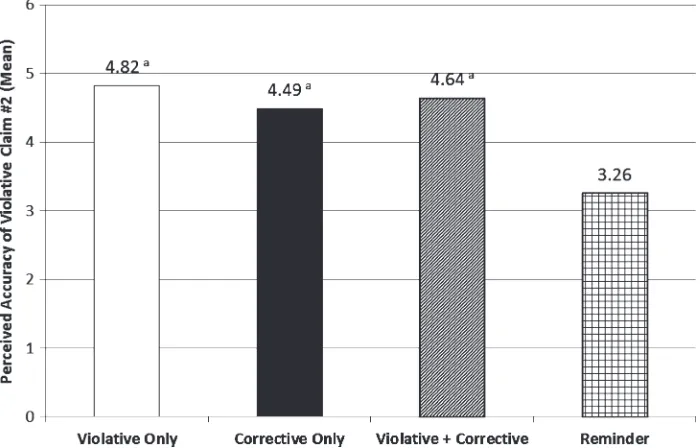
Figure 1 Mean perceived violative claim accuracy: overstatement of benefit. Matching super-script indicates statistical equivalence,p>.01.
and corrective ads together,t(513)=6.64,p<.001,d=0.46, the corrective ad alone, t(549)=11.79,p<.001,d=1.01, or the reminder ad,t(477)=4.98,p<.001,d=0.46. By contrast, participants who viewed the violative ad alone were more likely to rate the second violative claim as accurate compared to those in the reminder ad con-dition, t(461)=8.79, p<.001,d=0.82. Participants viewing a corrective ad and a violative ad did not differ significantly from those seeing only the violative ad in their belief about the claim in which risk was omitted,p>.0167. In other words, the most apparent effect of exposure to a corrective ad on violative claim belief (relative to exposure to the original violative claim) appears to be in the case of explicit overstate-ment of benefit. Corrective ad effect on belief of a claim thatomitskey information is less clear.
Violative ad truthfulness perceptions
Exposure to a corrective ad predicted the perceived general truthfulness of the viola-tive ad,F(1, 516)=102.64,p<.001. Specifically, participants who were exposed only to a violative ad perceived the violative ad as significantly more truthful and less likely to mislead viewers than those who viewed both the violative and corrective ads, M=4.17 versus 2.76,t(515)=10.131,p<.001,d=0.892. These findings suggest that individuals who are exposed only to violative ads are likely to perceive those ads as truthful and unlikely to mislead viewers. Individuals who are subsequently exposed to a corrective ad are relatively more likely to perceive the violative ad as less truthful and even misleading.
Benefit recall
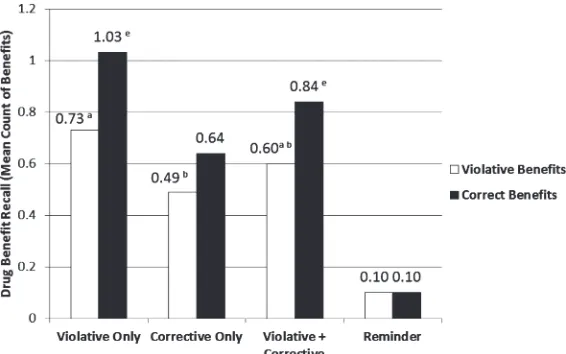
We asked participants to report any benefits they remembered from the ad(s) and then coded both their recollection of inappropriately advertised benefits (such as Asti-malon’s ability to stop asthma attacks in progress) and correct benefits (such as the fact that Astimalon only has to be taken once a day). Experimental condition predicted both unaided recall of incorrect benefits, or benefits matching those inappropriately mentioned in the violative ad,F(3, 984)=39.85,p<.001, as well as number of correct drug benefits,F(3, 984)=88.19,p<.001 (Figure 3).
As anticipated, participants who viewed only a violative ad recalled significantly more violative benefits than those who viewed the corrective ad only,t(526)=2.582, p=.010,d=0.234. Participants who viewed only a violative ad did not have signifi-cantly different benefit recall than those who viewed both the violative and corrective ads,p>.0167. Participants who viewed the reminder ad reported significantly fewer violative benefits than participants who viewed the violative ad only,t(432)=7.622, p<.001,d=0.790, the corrective ad only,t(491)=6.938,p<.001,d=0.632, or the violative and corrective ads,t(455)=7.488,p<.001,d=0.728.
Figure 3 Benefit recall: mean count of benefits. Matching superscript indicates statistical equivalence,p>.01.
p>.0167. Participants in the reminder ad condition also were less likely to accurately report Astimalon benefits.
These findings suggest that the violative ad made Astimalon benefits salient for participants (relative to participants who did not see that ad). The corrective ad also made benefits relatively salient as compared with the effects of the reminder ad, although participants who viewed the violative ad generally recalled the most benefits of Astimalon overall.
Risk recall
We asked participants about risks of Astimalon that they could recall. Ad exposure predicted risk recall, F(3, 976)=263.52, p<.001. Participants who viewed only a violative ad recalled significantly fewer risks than participants who viewed only the corrective ad, t(524)=7.863, p<.001,d=0.693. Moreover, participants seeing the corrective ad and the violative ad tended to recall more risks associated with Astimalon than participants who viewed only a violative ad,t(495)=7.69,p<.0001, d=0.732. The corrective ad appears to have made risks more salient than the violative ad.
Perceived efficacy
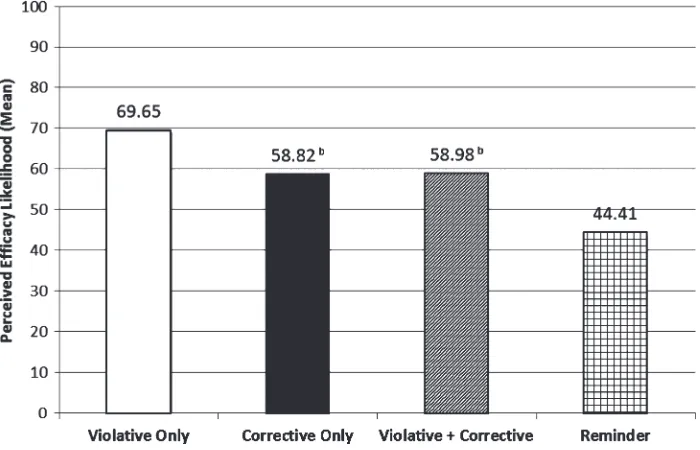
Figure 4 Mean perceived efficacy likelihood. Matching superscript letters indicate statistical equivalence,p>.01.
who viewed the corrective ad only,t(541)=4.156, p<.001,d=0.357, the violative and corrective ads in combination,t(511)=4.077,p<.001,d=0.360, or a reminder ad only,t(471)=7.902,p<.001,d=0.746. There was no difference between partici-pants who viewed only a corrective ad and those who viewed both the violative and corrective ads,p>.0167. Participants who saw only a reminder ad perceived the drug as least likely to be effective with regard to asthma, as compared with those who saw only a corrective ad,t(521)=4.339,p<.001,d=0.389, and those who saw both the violative and corrective ads,t(492)=4.375,p<.001,d=0.401.
Ad exposure also predicted perceived magnitude of the drug’s efficacy, F(3, 1045)=16.07, p<.001 (Figure 5). Participants who viewed only a violative ad perceived the drug as more likely to produce strong effects than those who viewed the corrective ad only,t(550)=4.861, p<.001,d=0.414, the violative and correc-tive ads in combination,t(511)=4.694,p<.001,d=0.414, or a reminder ad only, t(473)=6.316,p<.001,d=0.586. Participants who viewed only a reminder ad did not significantly differ in efficacy magnitude perceptions than participants who viewed only the corrective ad or both violative and corrective ads,p>.0167.
Perceived risk
Figure 5 Mean perceived efficacy magnitude. Matching superscript letters indicate statistical equivalence,p>.01.
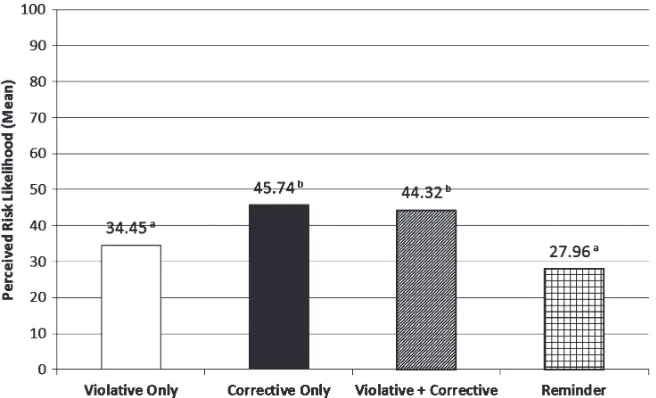
Figure 6 Mean perceived risk likelihood. Matching superscript letters indicate statistical equivalence,p>.01.
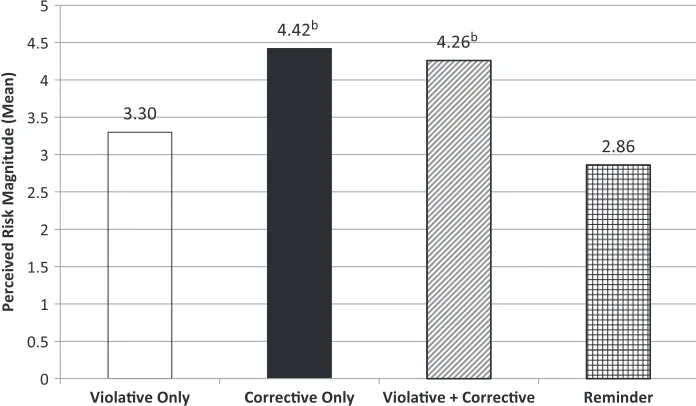
Figure 7 Mean perceived risk magnitude. Matching superscript letters indicate statistical equivalence,p>.01.
p<.001,d=0.521, and participants who viewed both the violative and corrective ads, t(491)=5.265,p<.001,d=0.474.
Ad exposure also predicted perceived drug risk magnitude, F(3, 1042)=51.69, p<.001 (Figure 7). Participants who viewed only a violative ad perceived the drug’s risks as significantly less serious than those who viewed only the corrective ad, t(546)=6.87,p<.001,d=0.597, or the violative and corrective ads in combination, t(509)=5.532, p<.001, d=0.490. In contrast, participants who viewed only a violative ad perceived the risks as significantly more serious than those who viewed only a reminder ad,t(476)=2.700,p=.007,d=0.248. Participants who viewed only a reminder ad also perceived the drug’s risks as significantly less serious than par-ticipants who viewed only the corrective ad,t(530)=11.038,p<.001,d=0.960, or both the violative and corrective ads,t(493)=9.125,p<.001,d=0.820. Participants who viewed only a corrective ad did not have significantly different risk magnitude perceptions than those who viewed both violative and corrective ads.
Perceived comparative efficacy
the violative and corrective ads,p>.0167. There was also no significant difference in perceived comparative efficacy among participants who saw only the corrective ad as compared with those who saw the violative and corrective ads,p>.0167.
Perceived comparative risk
Ad exposure also predicted the perceived comparative risk that viewers associated with Astimalon relative to other prescription drugs for asthma,F(3, 1050)=23.47, p<.001. Participants who viewed only a violative ad perceived the drug’s side effects as significantly better (i.e., less serious) than other asthma drugs as compared with participants who viewed only the corrective ad,t(547)=7.533,p<.001,d=0.643, or the violative and corrective ads,t(510)=5.497,p<.001,d=0.490. Participants who viewed only a violative ad did not significantly differ in perceived comparative risk from participants who viewed only the reminder ad,p>.0167. There was no signif-icant difference in perceived comparative risk among participants who viewed only the corrective ad as compared with those who saw the violative and corrective ads, p>.0167.
Attitude toward using product
We found that ad exposure predicted participant attitude toward using Astimalon, F(3, 1055)=17.03,p<.001. Participants who viewed only a violative ad had a more positive attitude (i.e., were more likely to indicate that using the drug would be good and/or useful) than participants who viewed only the corrective ad,t(550)=6.720, p<.001,d=0.573, the violative and corrective ads,t(514)=5.441,p<.001,d=0.479, or only a reminder ad,t(479)=4.844,p<.001,d=0.441. Participants who viewed only a reminder ad did not have a significantly different attitude toward using the drug than participants who viewed only the corrective ad or the violative and corrective ads, p>.0167. There was also no significant difference in attitude toward using the drug among participants who viewed only the corrective ad as compared with those who viewed both the violative and corrective ads,p>.0167.
Behavioral intentions
We examined behavioral intentions both as individual items and as an aggregate index. Ad exposure predicted a participant’s intentions to discuss the drug with their physician, F(3, 1049)=5.12,p=.002, to request a prescription for the drug from their physician, F(3, 1052)=7.24,p<.001, and to take the drug if their physician prescribed it to them,F(3, 1048)=22.79,p<.001 (Figure 8). We also see effects for intentions to look for information about the drug on the Internet,F(3, 1054)=8.60, p<.001, and to talk with a friend or family member about the drug,F(3, 1048)=5.13, p=.002.
have significantly weaker behavioral intentions than participants who viewed only the violative ad,p>.0167. Participants who viewed only the violative ad had significantly stronger intentions to take the drug if their physician prescribed it than participants who viewed both the violative and corrective ads, t(510)=6.037,p<.001,d=0.534. More striking differences emerge when we look at the aggregate measure of behavioral intention, which we might appropriately consider as an index aggregating intention across individual behaviors. For the composite intention score, we see a significant difference not only between participants who viewed only a violative ad and participants who viewed only a corrective ad, but we also see a difference between participants who viewed only a violative ad and participants who viewed both a violative and corrective ad. Participants who viewed only a violative ad are more likely to intend to act positively toward Astimalon in the future compared with participants who viewed a violative and corrective ad, M=3.26 versus 2.73, t(515)=3.018, p=.003, d=0.265. Corrective ad exposure appears to curb overall behavioral intention relative to violative ad exposure.
Discussion
Overall, study results suggest that overstatement of efficacy and omission of risk claims can affect viewer perception of the drug’s efficacy, risks, and benefits. Such claims can also encourage people to express intention to use (or seek more information about) the product.
Aside from violative ad effect, the central question of our investigation concerns the potential corrective remedy of misinformation through television advertising. Our efforts to correct viewer misperceptions and to counteract violative advertising appear to have been successful. Exposure to a corrective television ad that focused specifically on two particular violative claims clearly affected a robust array of viewer perceptions. Participants who viewed the corrective ad after having first viewed the violative ad in question tended to see the drug as being riskier in terms of the likelihood and magnitude of side effects, for example, and also generally expressed a less positive attitude toward using the drug.
The corrective ad also appears to have affected belief in the accuracy of at least one specific violative claim. Participants who viewed a violative ad and a corrective ad in combination reported less belief in the overstated claim that Astimalon can act fast to address the symptoms of an asthma attack. At the same time, the effect of cor-rective advertising was less clear with regard to omission of risk. Participants who viewed only a violative ad and participants who viewed a violative and a corrective ad in combination did not significantly differ in their acceptance of the original claim in the violative ad as to the list of side effects associated with Astimalon. This was an
omissionof a relatively long list of additional side effects that the violative ad should
Over and above belief in specific claim accuracy, participants who viewed a correc-tive ad in combination with a violacorrec-tive ad reported different general risk and benefit perceptions. Participants who viewed the corrective ad in addition to the violative ad mentioned more potential side effects, for example. Moreover, the overall risk asso-ciated with Astimalon was higher among participants who viewed a corrective ad in combination with a violative ad as compared with participants who viewed only a violative ad. In other words, corrective exposure appears to add knowledge and perceptions regarding risk, even if it is not clear to what extent it adjusts viewer per-ceptions of claims that are flawed because of omission,per se.
These results also suggest some potential for a corrective ad to temper intentions to act with regard to the prescription drug after viewing the ad. The distinction between participants who viewed a violative ad and participants who viewed a combination of a violative ad and corrective ad is most apparent with regard to intention to take the drug if prescribed. The study findings did not yield evidence of significant differ-ences between participants exposed to the violative ad and participants exposed to a combination of a violative ad and a corrective ad for a number of other behavioral dimensions, such as likelihood of seeking more information about the drug, but there appears to be some effect of the corrective ad when we aggregated individual intention questions into an overall measure.
We have focused on the comparison of participants who viewed a violative ad against those who viewed that violative ad and a corrective ad. However, we also can note that participants whoonlyviewed the corrective ad differed on many outcomes relative to those who viewed only the violative ad (and even relative to those who viewed the violative and corrective ads or those who viewed only the reminder ad in some cases).
This array of results also highlights the possibility that corrective advertising can have different effects and that all such effects might not be equally likely for all adver-tising. Moreover, these results suggest that corrective advertising might not always simply return viewers to the perceptions they would have had after viewing only a brand reminder ad. Although in a number of cases participants who viewed a correc-tive ad did not differ significantly from participants who viewed only a reminder ad, there also were some cases in which participants in those conditions did differ. For example, participants who viewed a corrective ad reported greater perceived compar-ative risk associated with Astimalon than participants who viewed only a reminder ad.
Contribution to existing knowledge
than correction of omission of important information. In addition to complement-ing prior research that examined attitudes toward the product (e.g., Kassarjian et al., 1975; Smith et al., 2011; Tangari et al., 2010), examining the impact of realistic claims that may influence benefit and risk perceptions has special relevance for DTC ads. In many cases, violative claims will be conceptually different depending on whether they involve the benefits or the risks of the product. This is a unique concern for DTC ads and emphasizes the importance of studying this particular ad category.
Our specific results also shed light on the prospects for television ads to offer corrective remedy. Whereas some researchers have found relatively low levels of com-prehension of corrective messages among consumers (e.g., Jacoby et al., 1982), the majority of respondents in this study correctly interpreted corrective messages when given the opportunity. The straightforward and clear framing of the corrective mes-sages in the stimuli, in which an actress explicitly notes the intent to “correct” previous claims, may have contributed to this result. Our manipulation presented study partic-ipants with a relatively direct set of contrasts. The violative ad in question promoted a prescription drug while overstating efficacy and omitting important discussion of risks, whereas the corrective message explicitly emphasized the intended correction of specific statements made in another ad. Participants generally reported comprehen-sion of the corrective intention of the ad and responded to that correction, suggesting that clearly corrective ads can counteract the effects of violative claims in DTC advertising.
The results of this study also suggest that the practice of corrective advertising is useful for correcting misleading drug impressions. This type of remedy is not an auto-matic requirement under the Federal Food, Drug, and Cosmetic Act. These results suggest that although not required, this remedy is useful for correcting false and mis-leading impressions. Regulators should therefore continue to use this remedy when appropriate, providing consumers with important information about these products.
Study limitations
These results present a robust number of statistically and substantively significant effects of corrective advertising. Our experimental design, realistic stimuli, and ade-quate sample size allowed us to answer our general research questions in a useful way. Nonetheless, the study has a number of limitations that we also should note.
measures are self-reported and do not include evidence of actual behavior subsequent to the study, a possibility constrained by the fact that the advertised drug was ficti-tious. In addition, the study focused on a single illness population (i.e., asthmatics). We chose this condition because it is advertised directly to consumers and few, if any, over-the-counter treatments exist. Second, we wanted to choose a condition that had not previously been the subject of DTC corrective advertising to control for prior exposure effects. Asthma met all of these criteria. Despite this, the evidence may only be generalizable to this population. Although there is no immediately obvious theo-retical reason why this illness population would differ from the general population in their tendency to engage risk and benefit information in advertising, and the type of misleading information presented in our ad is typical of violations in other DTC prod-uct categories, we should remain open to the possibility. We also administered this study online and, due to requirements for video presentation, only included individ-uals with access to broadband Internet;post hocweighting cannot necessarily account for such systematic exclusion. We also lacked control over the exact circumstances in which people participated. For example, when an individual completes a study in-person, we often can verify that they were truly exposed to the stimuli. Although we used strategies to ensure exposure (such as delaying when people had access to the “Next” button to advance through the survey), we have no way of knowing if a participant was actually watching the ad as opposed to, for example, stepping away from his or her computer, looking at a mobile phone, or watching television.
Our final data also suggested some ostensible constraints that warrant comment. Survey duration times revealed that a small number of participants had the survey open for multiple days after opening the invitation. There may have been long lags between stimuli exposure and survey completion for some participants. In addition, because we randomly assigned people into all four conditions (using SPSS Dimen-sions software), we had somewhat unequal group sizes at the end of the recruitment. Moreover, we considered anyone who did not complete at least two thirds of the sur-vey an incomplete participant and did not allow them to contribute to the final sample. As a result, our final experimental group sizes varied somewhat. Nonetheless, survey completion timing and unequal condition sizes were unlikely to have biased results in support of documented relationships. We had sufficient power to assess our main research questions and those who took longer for survey completion do not appear to have answered in a markedly different way.
should engage the question of whether similarity between violative and corrective ads in appearance and format constrain effects, for example.
Despite these limitations, the study results affirm that corrective advertising has effects on consumer perceptions of DTC ad claims. The effects are multifaceted and are more apparent for some types of claims and on some outcomes than others. Nevertheless, experimental evidence indicates that corrective television advertising can affect consumer perceptions and counteract some effects of violative claims in DTC prescription drug advertising.
Conclusion
Our experimental data offer substantive evidence in support of the contention that television advertising explicitly designed to correct viewer beliefs about the risks and benefits of a prescription drug can be successful. Although future work can explore whether dimensions of corrective advertising (such as the impact of time between the violative and corrective ads) influence corrective effects, the generalizability of our results beyond asthma, and variations of timing and the form of the corrective, our study nonetheless offers crucial evidence suggesting that a corrective ad featuring the same actors and setting as a violative ad and shown in close conjunction to the viola-tive ad can adjust viewer perceptions relaviola-tive to that violaviola-tive ad. Our study also offers an important foundation for future research in highlighting a potential distinction between instances of overstatement with regard to prescription drug benefits versus omission of key facts about drug risks. Participants who viewed a violative ad and a corrective ad in combination tended to report weaker belief in the overstated claim that Astimalon can act fast to address the symptoms of an asthma attack than those who viewed only the violative ad, and were able to recall more risks. At the same time, participants who viewed both a violative and a corrective ad together did not differ in their accuracy ratings from those who saw only a violative ad when risk was omitted, demonstrating that the effect of corrective advertising on claim belief is less clear with regard to omission of risk. Future work on the correction of misinformation should investigate whether overstatement is easier to correct than omission. Regardless, our results suggest that corrective advertising appears to be a viable remedy for advertising regulation to combat some forms of misinformation.
Note
1 Panelists were excluded from the study for one of two reasons: (a) they were unable to view the study’s video stimuli or (b) they skipped more than 50% of the study questionnaire. A relatively greater number of panelists from theReminder Adcondition were excluded for both of these reasons, which resulted in somewhat unequal sample sizes between
References
Bernhardt, K. L., Kinnear, T. C., & Mazis, M. B. (1986). A field study of corrective advertising effectiveness.Journal of Public Policy & Marketing,5, 146–162.
Biener, L., Bogen, K., & Connolly, G. (2007). Impact of corrective health information on consumers’ perceptions of “reduced exposure” tobacco products.Tobacco Control,16, 306–311.
Darke, P. R., Ashworth, L., & Ritchie, R. J. B. (2008). Damage from corrective advertising: Causes and cures.Journal of Marketing,72(6), 81–97.
Dyer, R. F., & Kuehl, P. G. (1974). The “corrective advertising” remedy of the FTC: An experimental evaluation.Journal of Marketing,38, 48–54.
Dyer, R. F., & Kuehl, P. G. (1978). A longitudinal study of corrective advertising.Journal of Marketing Research,15, 39–48.
Fintor, L. (2002). Direct-to-consumer marketing: How has it fared?Journal of the National Cancer Institute,94, 329–331.
Green, M. C., & Donahue, J. K. (2011). Persistence of belief change in the face of deception: The effect of factual stories revealed to be false.Media Psychology,14(3), 312–331. Hayes, A. F., & Krippendorff, K. (2007). Answering the call for a standard reliability measure
for coding data.Communication Methods and Measures,1, 77–89.
Jacoby, J., Nelson, M. C., & Hoyer, W. D. (1981). Correcting corrective advertising.Advances in Consumer Research,8, 416–418.
Jacoby, J., Nelson, M. C., & Hoyer, W. D. (1982). Corrective advertising and affirmative disclosure statements: Their potential for confusing and misleading the consumer. Journal of Marketing,46, 61–72.
Kassarjian, H. H., Carlson, C. J., & Rosin, P. E. (1975). A corrective advertising study. Advances in Consumer Research,2, 631–642.
Mazis, M. B. (2001). FTC v Novartis: The return of corrective advertising?Journal of Public Policy & Marketing,20(1), 114–122.
Mazis, M. B., McNeill, D. L., & Bernhardt, K. L. (1983). Day-after recall of Listerine corrective commercials.Journal of Public Policy & Marketing,2, 29–37.
Misra, S. (1992). Is conventional debriefing adequate? An ethical issue in consumer research. Journal of the Academy of Marketing Science,20(3), 269–273.
Mizerski, R. W., Allison, N. K., & Calvert, S. (1980). A controlled field study of corrective advertising using multiple exposures and a commercial medium.Journal of Marketing Research,17, 341–348.
Palumbo, F. B., & Mullins, C. D. (2002). The development of direct-to-consumer prescription drug advertising regulation.Food and Drug Law Journal,57, 423–443.
Singer, N. (2009, February 11). A birth control pill that promised too much.The New York Times, p. B1.
Smith, P., Bansal-Travers, M., O’Connor, R., Brown, A., Banthin, C., Guardino-Colket, S., & Cummings, K. M. (2011). Correcting over 50 years of tobacco industry misinformation. American Journal of Preventive Medicine,40, 690–698.
Southwell, B. G., Gilkerson, N. D., Depue, J. B., Shelton, A. K., Friedenberg, L. M., & Koutstaal, W. (2010). Aging and the questionable validity of recognition-based exposure measurement.Communication Research,37(5), 603–619.
and differences between adults and adolescents.Journal of Public Policy & Marketing,26, 60–74.
Tangari, A. H., Kees, J., Andrews, J. C., & Burton, S. (2010). Can corrective ad statements based on U.S. v. Philip Morris USA Inc. affect consumer beliefs about smoking?Journal of Public Policy & Marketing,29, 153–169.
Tyebjee, T. T. (1982). The role of publicity in FTC corrective advertising remedies.Journal of Marketing & Public Policy,1, 111–121.