The power of being heard: The bene
fi
ts of
‘
perspective-giving
’
in the context of
intergroup con
fl
ict
Emile G. Bruneau
⁎
, Rebecca Saxe
Department of Brain and Cognitive Sciences, MIT, Cambridge, MA 02139, USA
a b s t r a c t
a r t i c l e
i n f o
Article history: Received 7 June 2011 Revised 15 February 2012 Available online xxxx
Keywords: Perspective-taking Perspective-giving Israeli
Palestinian Intervention Intergroup conflict
Although hundreds of dialogue programs geared towards conflict resolution are offered every year, there have been few scientific studies of their effectiveness. Across 2 studies we examined the effect of controlled, dyadic interactions on attitudes towards the‘other’in members of groups involved in ideological conflict. Study 1 involved Mexican immigrants and White Americans in Arizona, and Study 2 involved Israelis and Palestinians in the Middle East. Cross-group dyads interacted via video and text in a brief, structured, face-to-face exchange: one person was assigned to write about the difficulties of life in their society (‘perspective-giving’), and the second person was assigned to accurately summarize the statement of thefirst person (‘perspective-taking’). Positive changes in attitudes towards the outgroup were greater for Mexican immigrants and Palestinians after perspective-giving and for White Americans and Israelis after perspective-taking. For Palestinians, perspective-giving to an Israeli effectively changed attitudes towards Israelis, while a control condition in which they wrote an essay on the same topic without interacting had no effect on attitudes, illustrating the critical role ofbeing heard. Thus, the effects of dialogue for conflict resolution depend on an interaction between dialogue condition and participants' group membership, which may reflect power asymmetries.
© 2012 Elsevier Inc. All rights reserved.
Introduction
The modern socio-political landscape is characterized by intergroup conflicts, ranging from contentious but largely nonviolent conflicts within societies (Black and White Americans, immigrants and non-immigrants in the U.S.) to violent and apparently intractable conflicts between neighbors (Indians and Pakistanis, Bosnians and Serbs, Israelis and Palestinians). One impediment to the resolution of these conflicts is the uncompromising psychological biases that affect members of both sides of a conflict (Bar-Tal, 2007; Ehrlinger, Gilovich, & Ross, 2005; Krueger & Funder, 2004; Lilienfeld, Ammirati, & Landfield, 2009; Nadler & Shnabel, 2008). Groups experience severe lapses in trust and failures in empathy towards each other (Bruneau, Dufour, & Saxe, 2012; Cikara, Bruneau, & Saxe, 2011; Nadler & Liviatan, 2006; Tam, Hewstone, Kenworthy, & Cairns, 2009); each group tends to see the other as motivated by self-interest and ideology, unwilling to hear or recognize the truth (Pronin, 2007; Pronin, Gilovich, & Ross, 2004). The perception that the other side is unreasonable and closed-minded leads individuals on each side to choose coercive actions, rather than co-operative negotiations (Kennedy & Pronin, 2008). In an effort to sur-mount the psychological barriers that exist between groups, a host of conflict resolution programs has emerged.
Conflict resolution and‘debiasing’efforts: The contact hypothesis
Many conflict resolution programs are informed by‘Contact Theory’ (Allport, 1979). Contact Theory proposes that positive intergroup contact should decrease stereotypes and increase positive attitudes to-wards an out-group, particularly if three key conditions are met: 1. both groups have equal status in the contact environment; 2. the groups work towards a common goal; and 3. the intergroup contact is sanc-tioned by some authority. Meta-analyses of conflict resolution and prej-udice reduction programs generally support this theory: intergroup contact is effective in reducing intergroup hostility and negative stereo-types, especially when the three conditions are met (Pettigrew & Tropp, 2006). One caveat, though, is that the positive effects of contact are largely one-sided: while effective for members of a dominant group, intergroup contact is generally ineffective for members of the non-dominant group (e.g. Black versus White Americans (Tropp & Pettigrew, 2005)).
Perspective-taking
A second theme common to conflict resolution programs is perspective-taking. Perspective-taking activities generally ask partici-pants to‘step in the shoes’of a representative member of a different group in order to induce empathy for that outgroup as a whole. The effects of perspective-taking have been examined in controlled experi-mental settings. For example, participants have been asked to transport themselves in a wheelchair or shadow a wheelchair-bound person for a Journal of Experimental Social Psychology xxx (2012) xxx–xxx
⁎Corresponding author at: Massachusetts Institute of Technology, Department of Brain and Cognitive Sciences, 43 Vassar Street, 46-4021, Cambridge, MA 02139, USA. Fax: +1 617 324 2890.
E-mail address:[email protected](E.G. Bruneau).
YJESP-02843; No. of pages: 12; 4C:
0022-1031/$–see front matter © 2012 Elsevier Inc. All rights reserved. doi:10.1016/j.jesp.2012.02.017
Contents lists available atSciVerse ScienceDirect
Journal of Experimental Social Psychology
j o u r n a l h o m e p a g e : w w w . e l s e v i e r . c o m / l o c a t e / j e s p
day (Clore & Jeffery, 1972), or to write about a‘day in the life’of an elderly man (Galinsky & Ku, 2004; Galinsky & Moskowitz, 2000), or to watch or listen to recorded accounts of women with AIDS, the home-less, racial minorities and even convicted murderers (Batson et al., 1997; Dovidio et al., 2004; Galinsky & Moskowitz, 2000; Vescio, Sechrist, & Paolucci, 2003). Each of these activities can lead to improve-ments in attitudes towards the target group.
Controlled studies of perspective-taking usually focus on marginal-ized or stigmatmarginal-ized groups, rather than groups with whom the partici-pants are involved in active conflict; some authors have expressed doubts about whether perspective-taking could work in the context of active ethnic conflict (Batson & Ahmad, 2009). In fact, perspective-taking sometimes has the opposite, ironic, effect: White Canadians who anticipated being blamed for the plight of Native Canadians responded negatively to perspective-taking while watching a docu-mentary about the difficulties faced by a Native Canadian woman, resulting in maintenance of stereotypes and a decreased willingness to meet a First Nations person (Vorauer & Sasaki, 2009), and the positive effects of a radio soap opera depicting conciliatory behaviors between different ethnic groups in the Democratic Republic of Congo were eliminated when participants were also exposed to the other sides' views in a radio talk show (Paluck, 2010).
Another limitation of most studies of perspective-taking is that they are asymmetric: people from an empowered or majority group are asked to take the perspective of a stigmatized or minority group member, but not vice versa. By contrast, this type of activity is common-ly conducted symmetricalcommon-ly in conflict resolution programs that emphasize group parity in the program environment (i.e. members of both groups engage in the same activities). In spite of this common practice, theoretical considerations suggest that perspective-taking might not be equally beneficial, in both directions across a power divide. There are at least three reasons that dominant group members could benefit from perspective-taking which would not apply to stigmatized or minority groups. First, spontaneous levels of perspective-taking are lower for individuals with more power, so instructing those individuals to take the other's perspective may provide novel information (Galinsky, Magee, Inesi, & Gruenfeld, 2006). If members of disempow-ered groups are more likely to be already perspective-taking, then explicitly instructing them to do so in an intervention would have less effect. Second, dominant group members have a need to be perceived as moral, by themselves and others (Shnabel, Nadler, Ullrich, Dovidio, & Carmi, 2009). Playing the role of the virtuous, tolerant and sympa-thetic listener could fulfill this need (especially if not threatened by expectations of blame (Vorauer & Sasaki, 2009)). Third, one proposed mechanism by which perspective-taking improves attitudes is through self-other merging (Davis, Conklin, Smith, & Luce, 1996; Galinsky, Ku, & Wang, 2005). However, self-other merging may actually be threatening and aversive to members of disempowered groups who are strongly identified with their group. Thus, members of non-dominant groups (e.g. Palestinians) often react especially negatively when asked to consider the perspective of the dominant group (e.g. Israelis) (Bruneau & Saxe, 2010; Sagy, Kaplan, & Adwan, 2002). For these rea-sons, asking members of a non-dominant group to take the perspective of members of the dominant group could have no benefit, or even result in more negative attitudes towards the dominant outgroup.
In sum, in the context of real ideological conflict, the effectiveness of perspective-taking for improving intergroup attitudes has not been empirically tested, especially for participants from the non-dominant/ disempowered group. One goal of the present study was to do just this: within the context of two conflicts that differed over a number of dimensions, we sought to determine the effectiveness of perspective-taking for members of the empowered and disempowered groups. Based on prior successes of perspective-taking towards stigmatized groups, we were cautiously optimistic that encouraging participants to engage in a particularly virtuous form of perspective-taking (actively listening to an opposing viewpoint) would be beneficial for members of
the empowered group in a conflict. On the other hand, we hypothesized that perspective-taking would not benefit members of disempowered groups. But if perspective-taking and intergroup contact both fail to im-prove attitudes of non-dominant group members towards the domi-nant group, what could provide an effective intervention for the disempowered?
‘Perspective-giving’
To date, few studies have investigated how members of non-dominant groups respond to interventions aimed at inter-group recon-ciliation or conflict resolution; when examined, attitudes of non-dominant group members have proven resistant to positive change (Cole et al., 2003; Tropp & Pettigrew, 2005). In our view, a key psycho-logical difference between dominant and non-dominant groups that must be addressed by effective interventions is that the latter often feel disempowered, objectified and voiceless (Said, 1978; Shnabel & Nadler, 2008). Qualitative interviews conducted after inter-group dialogue programs support this view, and suggest that members of non-dominant groups may benefit from exercising their voices: Arab Israelis express a specific need to share their perspectives, and be lis-tened to, by Jewish Israelis in these encounters, whereas Jewish Israelis do not express this desire (Halabi, 2004). If so, an effective way to ad-dress this need would be to provide a chance for members of the disem-powered group to speak to an individual from the dominant group, and (critically) feel ‘heard’. Since this activity is the complement of perspective-taking, we call it“perspective-giving.”
Although self-expression is part of the intuitive repertoire of many dialogue-based conflict resolution programs, the effect of ‘feeling heard’on intergroup attitudes has not previously been investigated em-pirically. We hypothesized that‘perspective giving’is actually an impor-tant mechanism of the success of these programs, especially for individuals from non-dominant groups. That is, considering a needs-based model of reconciliation (Shnabel et al., 2009),‘perspective-giving’ would be well tailored to the needs of members of disempowered and non-dominant groups, whereas‘perspective-taking’would be better tailored to the needs of dominant group members.
Present research
The current study aimed to examine, in a controlled experimental setting, the conditions under which a brief dialogue-based intervention could improve inter-group attitudes, in individuals from groups involved in active and asymmetric conflict. Specifically, we sought to test 1) a novel method for inducing‘perspective-taking’in an experi-mental context, 2) a novel experiexperi-mental intervention, which we termed ‘perspective-giving’, and 3) how the effects of these interventions depend on group membership.
In two studies, we implemented‘perspective-taking’and‘ perspec-tive-giving’as assigned roles in a brief structured dyadic interaction, via a video and text-based‘chat’interface, with a member of the other group. Participants were assigned either to the role of Sender (i.e. perspective-giving) or Responder (i.e. perspective-taking) (the interac-tion partner was always a confederate from the other group). The Send-er wrote a brief description of the difficulties and challenges experienced by members of their group, and the Responder then sent back a summary of the Sender's statement, in their own words, without expressing their own evaluations, beliefs or experiences. Describing the difficulties and challenges experienced by the outgroup in one's own words is a novel and robust implementation of“perspective-taking”, requiring the Responder to at least partially get‘inside’the Sender's de-scription. On the other hand, reading the Responder's restatement pro-vides the Sender with an experience of“being heard”by the Responder. The studies took place in two regions currently dealing with active intergroup conflict. Study 1 took place in Phoenix, Arizona 6 months after the passage of the controversial anti-immigration bill, SB1070. E.G. Bruneau, R. Saxe / Journal of Experimental Social Psychology xxx (2012) xxx–xxx
At the time of passage, over 70% of White Arizonans supported the bill and over 70% of Hispanic Americans opposed it (Hanson, 2010). Study 2 took place in the Middle East 2 1/2 years after the end of the 2nd In-tifada (Palestinian uprising) and 6 months after the Israeli invasion of Gaza, when intergroup tension was very high and hope for an Israeli– Palestinian peace agreement was very low (Telhami, 2009).
Across these two different conflicts, we predicted that members of the dominant group would benefit from perspective-taking, resulting in a positive change in attitudes towards the non-dominant group, while members of the non-dominant group would not benefit from perspective-taking. On the other hand, we predicted that members of disempowered groups would respond more positively to “perspec-tive-giving”(expressing oneself and being heard). Here we report two randomized controlled quantitative evaluations of these hypotheses.
Study 1
Study 1 tested the effect of taking and perspective-giving on attitudes of White Americans and Mexican immigrants towards the other group. The prediction for this study was that the effectiveness of the interaction (operationalized as positive attitude change towards the outgroup) would depend upon group membership: perspective-taking would be more effective than perspective-giving for the dominant group (White Americans), and perspective-giving would be more effective than perspective-taking for the non-dominant group (Mexican immigrants).
Methods
Participants
White Americans (n= 47 (22 f), mean age 33± 9 s.d.) and Mexican immigrants (n= 76 (43 f), mean age 33± 11 s.d.) in Phoenix, Arizona were recruited for a study on“the effectiveness of online translation tools at fostering communication between people who speak different languages”(Fig. 1). Participants were recruited usingflyers posted at a community group that serves Mexican immigrants (recruiting native Spanish speakers) and on Craigslist (recruiting native English speakers). No one was turned away from the study: Spanish-speaking Caucasian participants showed up for the study at the site for Mexican immigrants, and native English-speaking non-Caucasian participants showed up for the study at the site for White participants. Every individual who responded to the recruitment participated in the study and was paid, but only data from Mexican immigrant Spanish-speaking participants and Caucasian American English-speaking participants were used for the analysis. Thefinal samples included forty-seven White American and seventy-six Mexican immigrant participants, who were randomly assigned to one of two groups: 1. Sender (perspective-giving) or 2. Responder (perspective-taking).
The Mexican immigrants in the study includedfirst-generation im-migrants (~2/3 of the participants) and second-generation children of immigrants (~1/3 of the participants); a large majority of the immi-grants were undocumented (more specific descriptive statistics about documentation were not collected due to the delicate nature of the issue). Written literacy, even in Spanish, was very poor for the popula-tion as a whole, particularly for the older (first-generation) participants; median education level was‘Some High School’. When necessary, the research assistant took dictation from the participants. None of the
Mexican immigrant participants had ever taken a course in experimen-tal psychology, nor had they ever participated in a research study. The White participants had more education (median education was‘Some College’) and all werefluent in written English, and computer-literate. All participants were paid $20 US for participating in the study.
Procedure
Caucasian American participants arrived to the research site at the Phoenix Public Library and Mexican immigrant participants arrived to the research site at the community group (Neighborhood Ministries) campus; all participantsfilled out a consent form, and were then briefed on the experiment by the investigator. The study was described as follows:“When information is translated from one language into anoth-er, the message is often distorted. But people are often able to see through surface changes and get the‘general idea’behind the message, even if the translation is not exact. In the present study we are trying to see if an online translator can be used to allow people who speak differ-ent languages to communicate effectively with each other about social issues.
During the study, you will also be answering some survey questions as part of an ongoing program aimed at comparing general attitudes and beliefs across different cultural and ethnic groups. If you volunteer to participate in this study, we will ask you to do the following things:
Study #1 (communication across a language divide):
You will be asked to write your thoughts on an issue in English, and read someone else's thoughts on the issue written in their native language and then translated into English.
Study #2 (attitudes and beliefs survey):
During this experiment you will indicate your opinion on a series of questions about your beliefs, values and attitudes. The questions will be asked in two sections, one at the beginning of the study, and one at the end.”
The questionnaires and the interaction used different fonts and layouts, to encourage perception of the‘studies’as unrelated.
Participants were then directed to a laptop computer to begin the experiment. A research assistantfluent in English (for Caucasians) or Spanish (for Mexican immigrants) was on-hand to answer any ques-tions and to help with reading and writing for low-literacy participants. When not answering a question, the assistant remained far enough away so that he/she could not see the computer screen.
Measures
Each version of the questionnaire included the same dependent measures designed to survey general attitudes towards out-group members across 4 dimensions: general attitudes (2 items), perceptions of outgroup bias (4) (adapted from (Ehrlinger et al., 2005)), empathy (2), and warmth (1). The outgroup version of each of the dependent measures below was used:
1. (Attitude) Mexican immigrants/White Americans are generally ignorant and selfish. (reverse scored)
2. (Attitude) Mexican immigrants/White Americans are generally thoughtful and honest.
3. (Perception of Outgroup Bias) When forming their opinions about U.S. immigration law, the average Mexican immigrant/White American is motivated by self-interest. (reverse scored)
4. (Perception of Outgroup Bias) When forming their opinions about U.S. immigration law, the average Mexican immigrant/White American is motivated by a biased perspective on the issues. (reverse scored) 5. (Perception of Outgroup Bias) When forming their opinions about U.S.
immigration law, the average Mexican immigrant/White American is motivated by careful consideration of the facts.
Fig. 1.Experimental design: Arizona. Participants for the Arizona study came in on one occasion for the study and completed surveys, which including the dependent measures, both immediately before and immediately after an online (video- and text-based) interaction.
E.G. Bruneau, R. Saxe / Journal of Experimental Social Psychology xxx (2012) xxx–xxx
6. (Perception of Outgroup Bias) When forming their opinions about U.S. immigration law, the average Mexican immigrant/White American is motivated by logical analysis of costs and benefits. 7. (Empathy) The suffering of Mexican immigrants/White Americans
is something that really concerns me.
8. (Empathy) If I saw an illegal immigrant/White American grieving over a lost family member, I would think about myself in that situation. 9. (Warmth) Indicate how warm or cold you feel towards Mexican
immigrants/White Americans.
All of the measures (alpha= 0.6) were averaged within each dimen-sion, and a single‘attitudes towards the outgroup’score was obtained by averaging scores across all dimensions. The nine dependent mea-sures were embedded among 50fillers (e.g. questions on trait empathy and morality) and presented as a computer-based questionnaire writ-ten in the participants' native language; each question was answered using a continuous slider (e.g. from“completely agree”to“completely disagree”, converted to a 100 point scale). Thefiller questions included all items from 2 personality measures: the Moral Foundation Question-naire (MFQ) (Graham, Haidt, & Nosek, 2009) and the Social Dominance Orientation (SDO5) scale (Pratto & Sidanius, 1996), as well as questions about other groups (e.g. a feeling thermometer about Arabs). In all, par-ticipants answered 56 questions per questionnaire, 34 of which were repeated in both questionnaires: 9 dependent measures, 10 items from the MFQ, 4 items from the SDO scale, and 11 questions about other groups (e.g. Arabs, African Americans). As a control measure, a single “attitude towards Arabs” measure was created by averaging across 4 items relating to Arabs: warmth (1 item), perceptions of out-group bias (2 items), and general attitudes (1 item).
Part I: Questionnaire
The initial questionnaire began with questions measuring gender, age, political, social and religious conservatism (each separately an-swered on 9-point Likert scales anchored at‘very liberal’and‘very con-servative’), and religious and ethnic identities. Participants were then presented with thefirst questionnaire (9 dependent measures, control items assessing attitudes towards Arabs, andfiller items). Question order was randomized for each participant. All questions were answered using a continuous slider, so participants could not recall exact responses to repeated questions across the questionnaires.
Part II: Interaction
Following thefirst questionnaire, participants were given written instructions for the second part of the study: a dyadic interaction in which each person plays the role of either a Sender (‘perspective-giving’ condition) or a Responder (‘perspective-taking’condition). Participants read full descriptions of the roles that each person would play (for full text of these instructions, see Supplementary Materials), summarized as follows: the Sender would“write on one or two of the most difficult problems or greatest barriers facing people from your ethnic group in this country”, and send this short essay to the Responder. The Respond-er would translate the SendRespond-er's essay using Google Translate, and write a summary of the translated essay in their own words (without reveal-ing their own thoughts, beliefs or evaluation), and send it back to the Sender, where it would again be translated. Afterwards, participants would assess the effectiveness of the online translation tool (consistent with the experimental cover story).
Participants were then informed of the role they were assigned (ei-ther Sender or Responder), and of the identity of their interaction part-ner (an English-speaking White American for all Spanish-speaking Mexican immigrant participants, and vice versa). Interactions were conducted over a live video interface (Skype); audio was disabled and all communication was conducted through a text chat window. The whole interaction lasted 20 to 30 min. For both the Sending and Responding participants, the outgroup interaction partner was actually an outgroup (White American or Hispanic) confederate of the study
who had training in the task; confederates in the Sending condition wrote from standard scripts, constructed from the essays written by thefirst 5 participants from each group in the Sending condition, and then balanced for length and tone (for the full text of the confederate scripts, see Supplementary Materials).
Part III: Questionnaire
Immediately after the interaction, participants completed a second questionnaire, which included the same dependent measures, the same control items assessing attitudes towards Arabs, andfiller items (half repeated from thefirst questionnaire and half novel). Question order was randomized. In order to decrease suspicion of repeating items, participants were told that the questions on each questionnaire were being chosen at random by the computer from a large bank of questions; therefore some of the questions they saw in the second ques-tionnaire would be similar to those they had seen previously, some would be the same, and some would be different. After the question-naire, participants were paid and debriefed. No participant expressed suspicion that the interaction and questionnaire were related or part of a single study, or concern about the repetition of some items in the
first and second questionnaire. Demand characteristics therefore were unlikely to be accountable for the observed effects.
Results
As we predicted, the effects of these brief interactions were asym-metric (Table 1). For Mexican Immigrants, there was more positive change in the Sender than the Receiver condition for all but one of the items (8/9 items, sign test, two-tailed pb0.05); on the other hand, for White Americans there was more positive change in the Responder than the Sender condition for all but one of the items (8/9 items, sign test, two-tailed pb0.05).
For White Americans both conditions were generally effective, but perspective-taking (Responder condition) produced more positive changes in attitudes towards Mexican immigrants. Perspective-taking resulted in positive attitude change in 79% of participants (mean change=6.8 ± 1.4 (sem) on a 100-point scale; one-sample t-test, t(23)=5.1, pb0.001), while perspective-giving resulted in positive at-titude change in 70% of participants (mean change=2.9 ± 1.2 (sem); one-sample t-test, t(22) = 2.5, pb0.05). On average, perspective-taking produced a larger positive change in attitudes than perspective-giving for White Americans (independent-samplest-test, unequal variance, t(44.3) = 2.2, pb0.05).
By contrast, for Mexican immigrants the perspective-giving condition was more effective, resulting in overall positive attitude change in 63% of participants (mean change=1.5±1.9 (sem); t(34)=0.8, p=0.44), while the perspective-taking condition resulted in positive attitude change in only 37% of participants (mean change=−4.2±1.5 (sem); t(40)=−5.1, pb0.001). Thus perspective-giving was more effective than perspective-taking (independent-samples t-test, t(68.6)=2.2, pb0.05). The efficacy of the giving versus perspective-taking intervention showed a significant interaction with the participant's group membership (between-subjects ANOVA, F(1,119)=7.4, pb0.01,
Fig. 2).
Attitudes towards a control group (Arabs) did not change signifi -cantly for either condition in either group (no main effects or interac-tions, in a mixed ANOVA of pre- versus post-intervention survey, interaction-type and group, all p > 0.15). Self-reported anxiety levels assessed immediately after the interaction were similar across condi-tions within both groups (p> 0.1 for both paired-samples t-tests).
Study 2
To determine if the asymmetric positive effects of the interventions extended to intergroup conflicts that differ in region and severity, we conducted a second study in the context of one of the most salient E.G. Bruneau, R. Saxe / Journal of Experimental Social Psychology xxx (2012) xxx–xxx
conflicts in the world today: the conflict in the Middle East between Israelis and Palestinians. This study expanded on Study 1 in two ways. First, in addition to perspective-taking and perspective-giving, Study 2 included a control condition that involved reading about the outgroup, and writing an essay about one's own group's experiences (i.e. the information-exchange elements of a dyadic interaction) but not actively listening to or being heard by a member of the other group. Second, attitudes towards the outgroup were assessed both immediately after and also 1 week following the intervention to determine the duration of attitude change (Fig. 3).
Study 2 also extended Study 1 by assessing attitudes about the inter-action and interinter-action partner. These ratings were used as continuous regressors to determine if different aspects of the interaction helped to explain the variances in responses towards the outgroup. Finally, Study 2 allowed us to address an ambiguity that was present in Study 1. In Arizona, attitudes towards the ideological conflict over immigra-tion among White Americans was rather heterogeneous; therefore the script used by the White confederates did not reflect the views of all the White participants in Study 1. In Study 2, attitudes towards the
conflict were more homogeneous for Israelis and Palestinians: when responding to the prompt,“What are one or two of the issues that make life in your country most difficult”, Palestinians wrote about some aspect of“the occupation”, and Israelis wrote about“security is-sues”relating to the conflict. Thus, in Study 2 the script used by confed-erates in the Sending condition was more similar to the essays written by all of the real Israeli participants than it was for White Americans in Study 1.
Methods
Participants
Participants were recruited simultaneously in Ramallah (Palesti-nians, n = 65 (29 f), mean age = 24 ± 2 s.d.) and Tel Aviv (Israelis, n = 59 (26 f), mean age = 24 ± 4 s.d.) for“an MIT psychology study” conducted in English that“may include a brief internet-based interac-tion with members of other cultures”. Palestinian and Israeli partici-pants were each randomly assigned to one of three groups: 1. Sender (perspective-giving), 2. Responder (perspective-taking) and 3. Control. Participants were paid 60 Israeli Shekels ($15 US) for par-ticipating in each session of the two-session study ($30 US total).
Procedure
Israeli participants arrived to the research site in Tel Aviv and Pales-tinian participants arrived to the research site in Ramallah; all partici-pants filled out a consent form, and were then briefed on the experiment by the investigator. None of the Palestinian participants had taken a course in experimental psychology, and none had ever par-ticipated in a psychology study. The study was described as follows: “You will take part in two separate studies. Thefirst is designed to un-derstand similarities and differences in beliefs, values and attitudes in people from different cultures. We will be looking at stability and vari-ability in beliefs over time, so we will break this questionnaire into 3 parts, given over two different days. The purpose of the second study, which will occur only once on thefirst day, is to understand how people Table 1
Raw average scores for Study 1 by group and intervention. Higher numbers indicate more positive attitudes towards the outgroup.
Att1 Att2 POGB1 POGB2 POGB3 POGB4 Emp1 Emp2 FT
Pre-intervention attitudes towards the outgroup
Hisp. P-take 53.5 57.4 33.3 33.2 57.8 63.6 59.0 79.1 72.5
P-give 55.7 55.2 33.4 30.5 55.7 62.1 67.2 76.2 68.2
White P-take 66.6 51.6 31.4 42.6 33.0 50.2 49.4 74.6 49.7
P-give 82.8 64.7 42.9 46.7 41.6 51.7 59.8 88.3 70.5
Post-intervention attitudes towards the outgroup
Hisp. P-take 49.4 57.4 35.7 32.4 54.3 57.6 59.1 75.4 61.3
P-give 57.2 58.8 36.7 44.3 57.4 65.0 65.4 74.4 70.5
White P-take 66.5 65.8 37.3 41.0 45.1 51.2 60.3 76.4 59.3
P-give 84.1 68.6 42.3 44.4 53.2 52.6 68.2 86.5 74.0
Change (post-intervention−pre-intervention) in attitudes towards the outgroup
Hisp. P-take −4.1 0.1 2.4 −0.8 −3.5 −5.9 0.1 −3.7 −11.2
P-give 2.7 3.6 3.3 1.8 1.7 2.9 −1.8 −1.8 2.3
White P-take −0.1 14.2 5.9 −1.6 12.1 1.1 10.9 1.8 9.6
P-give 1.2 3.8 −0.6 −2.4 11.5 0.9 8.4 −1.8 3.3
Fig. 2.Change in attitudes towards the out-group in White Arizonans and Mexican immi-grants depends upon group membership and intervention type. Each bar of the graph rep-resents average within-subject changes in attitude towards the out-group, averaged across all dimensions, for each condition (Listen= perspective-taking; Speak =perspec-tive-giving). Differences in attitudes towards the outgroup were determined in White and Mexican immigrant participants in Arizona by comparing attitudes immediately be-fore the interaction to attitudes immediately after to the interaction. Error bars represent S.E.M. *'s within a bar indicate significant change in attitudes towards the outgroup within a condition (one-samplet-test); *'s between bars indicate significant differences between conditions (two-samplet-test). * =pb0.05, **=pb0.005.
Fig. 3.Experimental design: Middle East. Participants for the Middle East study came in on two separate occasions for the study and took surveys, which included the dependent measures, immediately before, immediately after, and then 1 week after an online interaction.
E.G. Bruneau, R. Saxe / Journal of Experimental Social Psychology xxx (2012) xxx–xxx
communicate with others about social issues. In particular, we are inter-ested in how people from different cultures present their point of view, and how people understand and communicate the views of others.
Study #1:
You will be seated in front of a computer display. An experimenter will give you instructions on the experimental task. During the ex-periment you will indicate your opinion on a series of questions about your beliefs, values and attitudes. At the end of the series of questions, you will perform a sorting task. You will complete anoth-er set of questions and anothanoth-er sorting task at the end of the session (after Study #2), and the last set of questions you will complete 1–2 weeks later.
Study #2:
You will be asked to either write your thoughts on an issue, read someone else's thoughts on the issue, or both. You will then be asked your opinion of the other person's communication skills and strategies.
Thefirst session (first two parts of Study #1 and Study #2) will take 1 hour, and the second session (third part of Study #1) will take place 1–2 weeks later and will take 20 minutes.”
Participants were told that the study was being conducted with mul-tiple cultural groups around the world. The questionnaire used different fonts and layouts to encourage perception of the two‘studies’as unre-lated. Participants were then directed to a laptop computer to begin the experiment. A research assistantfluent in Arabic (for Palestinians) or Hebrew (for Israelis) was on-hand to answer any questions. When not answering a question, the assistant remained far enough away so that he/she could not see the computer screen. The entire study was conducted in English.
Measures
Initial attitudes towards the outgroup were measured using nine key items, similar to those given in Study 1, assessing attitudes (2 item), trust (2 items) (Nadler & Liviatan, 2006), perceptions of out-group bias (2 items), empathy towards the outout-group (2 items), and warmth (1 item).
1. (Attitude) If I had a chance to introduce Palestinian/Israeli visitors to my friends and neighbors, I would be pleased to do so.
2. (Attitude) Palestinians/Israelis are more violent by nature than Israelis/Palestinians. (reverse scored)
3. (Trust) I believe that the Palestinians/Israelis are adhering, and will adhere, to written agreements towards a lasting solution in the Middle East.
4. (Trust) I do not believe in the peaceful intentions of the Palestinians/ Israelis. (reverse scored)
5. (Perception of Bias) When considering issues related to the
con-flict in the Middle East, the average Palestinian/Israeli is motivated by: ideology. (reverse scored)
6. (Perception of Bias) When considering issues related to the conflict in the Middle East, the average Palestinian/Israeli is motivated by: evaluation of available data on the issues.
7. (Empathy) I feel as sad when I see a Palestinian/Israeli suffering as when I see an Israeli Jew/Palestinian suffering.
8. (Empathy) When I see a Palestinian/Israeli grieving over a lost family member, I think about myself in that situation.
9. (Warmth) Indicate how warm or cold you feel towards Palestinians/ Israelis.
All of the measures (alpha= 0.7) were averaged to yield a single score for‘attitude towards the outgroup’. For each participant, any item that deviated by 90 points or more between sessions was discarded (representing ~4% of the data points).
In each questionnaire, the 9 key items were embedded among 50
filler items. Thefiller questions included all items from 3 personality measures: the Balanced Emotional Empathy Scale (BEES) (Mehrabian & Blum, 1996), the Social Dominance Orientation (SDO5) scale, and the Right-Wing Authoritarian (RWA) scale (Altemeyer, 1981), as well as attitude measures about relatively neutral groups (e.g. White Amer-icans). A random subset of questions from eachfiller scale was pre-sented on each section of the questionnaire. A mood question (anchored at‘relaxed’and‘anxious’) was given at the beginning of each questionnaire. All questions were answered using a continuous slider, so participants could not recall their exact responses to repeated questions across the questionnaires.
Part I: Questionnaire
The questionnaire given prior to the intervention was preceded by questions to assess gender and age, political, social and religious conser-vatism (assessed separately using 9-point Likert scales anchored at ‘very liberal’and‘very conservative’), and religious and ethnic identi-ties. Participants were then presented with thefirst version of the ques-tionnaire (9 dependent measures and 50filler items); question order was randomized for each participant.
Part II: Dyadic interaction
The written instructions for the interaction were similar to Study 1 (for full text of the instructions see Supplementary Materials), with a slight variation in the essay topic: the Sender was instructed to write on“one or two of the issues that makes life in your country most diffi -cult, and the psychological effects it has on the people living there”, and the Responder was instructed to summarize what the Sender wrote, but to avoid including their own attitudes, beliefs or evaluations. The interactions were all conducted in English (for examples of the scripts and complete sample interactions, see Supplementary Mate-rials), and lasted approximately 20 min.
After hearing the instructions, participants were assigned a role (Sender or Responder) and told the identity of their interaction partner (a member of the opposite group). Participants were given the opportu-nity to withdraw from the study rather than participate in the interac-tion. Three Palestinians chose to withdraw rather than interact with an Israeli.
In the Control condition, participants were instructed to read an essay by a member of the opposite group about“one or two of the is-sues that makes life in your country most difficult, and the psycholog-ical effects it has on the people living there”and then to write their own essay on the same topic. Similar to Study 1, Israeli and Palestin-ian confederate scripts were created and verified by a separate group of volunteers prior to the study: we asked 3 or 4 members of each group who were not part of the study to respond to the question,“ De-scribe one or two of the most difficult aspects of life in your country and explain the psychological effect these difficulties have on the people living there”(the same question given to participants). We then created a composite of their responses, matched across group pairs (paragraph by paragraph), for length, semantic content and general tone. The scripts were then shown to another set of group members for further feedback, to ensure that they were perceived as fairly representing the views of each group. The out-group essay was the same script used by the out-group confederate in the Sender role.
Part III: Questionnaire
Following the intervention, each participant rated the interaction and their interaction partner by answering the following questions:
1.“How effectively did the other person describe the concerns of their community?”(for Responders and Control) or“How effectively did the other person summarize the concerns of your community?” (for Senders).
E.G. Bruneau, R. Saxe / Journal of Experimental Social Psychology xxx (2012) xxx–xxx
2.“How empathetic did the other person seem?”(for Senders and Responders only)
3.“How likable did the other person seem?” (for Senders and Responders only)
4.“How typical of his or her group did the other person seem?”(for Senders and Responders only)
5.“Would you be willing to talk more about these issues with this person in the future?”(for all conditions)
Question 4 was included to ensure that participants viewed the con-federates and the scripts as typical of the other group, not as extreme outliers. The remaining questions were included to test whether
participants' satisfaction with the interaction, and feelings about their interaction partner, would predict attitude change towards the other group.
After these evaluation questions, participants then completed a sec-ond questionnaire, which included the same 9 dependent measures, and 50filler items (some repeated from thefirst two questionnaires and some novel); question order was randomized across versions of the questionnaire and between participants. In order to decrease suspi-cion of repeating items, participants were told that the questions on each questionnaire were being chosen at random by the computer from a large bank of questions; therefore some of the questions they saw in the second (and third) questionnaire would be similar to those Table 2
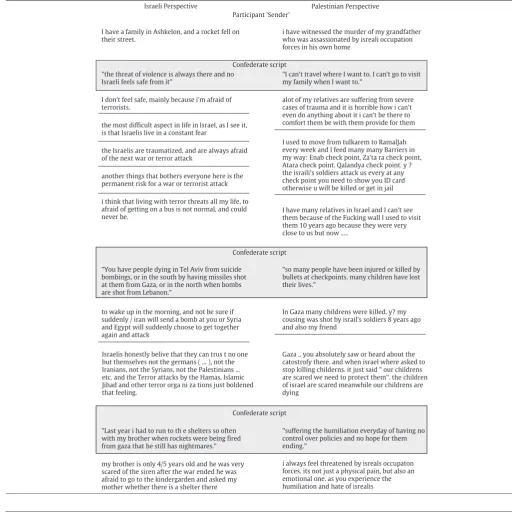
Excerpts from participants' statements in the‘Sender condition’, and, for comparison, from the confederates' scripts representing the perspective of each group. As these samples indicate, participants were willing to discuss intense personal experiences relevant to the conflict, with content and tone that was similar to the confederate scripts.
Israeli Perspective Palestinian Perspective Participant 'Sender'
I have a family in Ashkelon, and a rocket fell on their street.
i have witnessed the murder of my grandfather who was assassionated by isreali occupation forces in his own home
Confederate script "the threat of violence is always there and no
Israeli feels safe from it"
"I can't travel where I want to. I can't go to visit my family when I want to."
I don't feel safe, mainly because i'm afraid of terrorists.
alot of my relatives are suffering from severe cases of trauma and it is horrible how i can’t even do anything about it i can’t be there to comfort them be with them provide for them the most difficult aspect in life in Israel, as I see it,
is that Israelis live in a constant fear
I used to move from tulkarem to RamalJah every week and I feed many many Barriers in my way: Enab check point, Za'ta ra check point, Atara check point. Qalandya check point. y ? the israili's soldiers attack us every at any check point you need to show you ID card otherwise u will be killed or get in jail the Israelis are traumatized, and are always afraid
of the next war or terror attack
another things that bothers everyone here is the permanent risk for a war or terrorist attack
i think that living with terror threats all my life, to afraid of getting on a bus is not normal, and could
never be. I have many relatives in Israel and I can’t seethem because of the Fucking wall I used to visit them 10 years ago because they were very close to us but now ...
Confederate script
"You have people dying in Tel Aviv from suicide bombings, or in the south by having missiles shot at them from Gaza, or in the north when bombs are shot from Lebanon."
"so many people have been injured or killed by bullets at checkpoints. many children have lost their lives."
to wake up in the morning, and not be sure if suddenly / iran will send a bomb at you or Syria and Egypt will suddenly choose to get together again and attack
In Gaza many childrens were killed. y? my cousing was shot by israil's soldiers 8 years ago and also my friend
Israelis honestly belive that they can trus t no one but themselves not the germans ( ... ), not the Iranians, not the Syrians, not the Palestinians ... etc. and the Terror attacks by the Hamas, Islamic Jihad and other terror orga ni za tions just boldened that feeling.
Gaza .. you absolutely saw or heard about the catostrofy there. and when israel where asked to stop killing childerns. it just said " our childrens are scared we need to protect them". the children of israel are scared meanwhile our childrens are dying
Confederate script
"Last year i had to run to th e shelters so often with my brother when rockets were being fired from gaza that he still has nightmares."
"suffering the humiliation everyday of having no control over policies and no hope for them ending."
my brother is only 4/5 years old and he was very scared of the siren after the war ended he was afraid to go to the kindergarden and asked my mother whether there is a shelter there
i always feel threatened by isreals occupaton forces. its not just a physical pain, but also an emotional one. as you experience the humiliation and hate of isrealis E.G. Bruneau, R. Saxe / Journal of Experimental Social Psychology xxx (2012) xxx–xxx
they had seen previously, some would be the same, and some would be different. In debriefing, participants in the Sender/Responder conditions expressed no awareness of the Control condition (and vice versa), or why these conditions would be used or compared. Once informed of the groups involved the conditions of the study, participants did not guess which condition would be most effective within their own group, or how this would differ across groups.
Part IV: Questionnaire
One week later, the participants returned for a third questionnaire, again containing the 9 key items and 50filler items (some repeated from thefirst two questionnaires and some novel); question order was again randomized across versions of the questionnaire and between participants. Participants were then fully debriefed about the purpose of the study, and paid.
Results
Interactions
Participants in both groups and for all three conditions were highly engaged in the task, and participants perceived their interaction
partners (confederates) to be representative of their respective groups: on a scale of 100, mean ratings from‘not at all’to‘completely’typical of his group were 56± 29 s.d. for Palestinian confederates and 65± 22 for Israeli confederates. Importantly, confederates within each group were rated equally typical across each condition (perspective-taking and perspective-giving) (both p-values > 0.2), and within each condition, confederates from each group were judged to be equally representative of their groups (both p-values > 0.4). This suggests that the confederate scripts and behaviors were balanced across groups between conditions, and were within the expected range of intergroup interactions.
Although the specific topic of the essays was left open (“the most difficult aspect of life in your country”), Israeli and Palestinian partici-pants in the Sender role wrote about topics relevant to the conflict, as expected. All but one Israeli and all but one Palestinian wrote about some aspect of the Israeli–Palestinian conflict (for full sample interac-tions see Supplementary Table 1). Approximately half of all Israeli par-ticipants wrote specifically about the threat of terrorism, and the problems stemming from the societal fear of war. The most commonly mentioned terms were:‘rockets’,‘Iran’and ‘Hamas’. For Palestinian participants in the Sender role, the most commonly invoked concepts were‘occupation’and ‘checkpoints’. In addition, approximately 25% Table 3
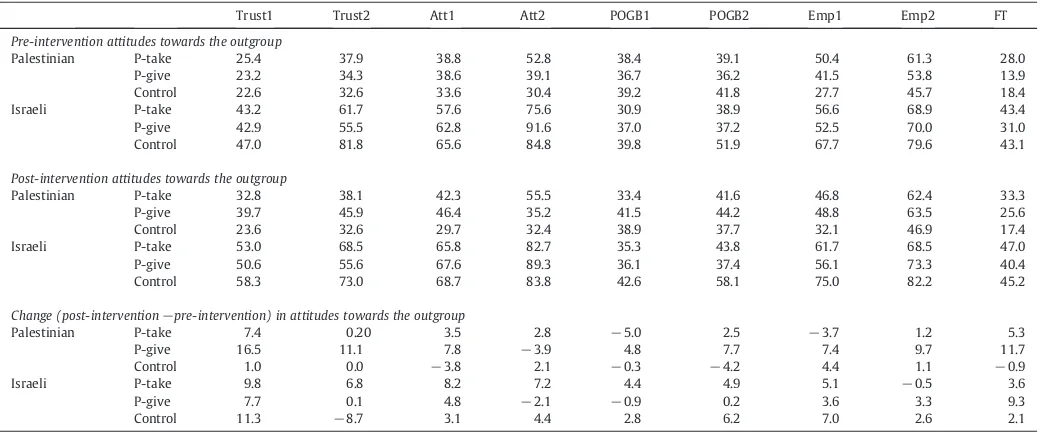
Raw average scores for Study 2 by group and intervention. Higher numbers indicate more positive attitudes towards the outgroup.
Trust1 Trust2 Att1 Att2 POGB1 POGB2 Emp1 Emp2 FT
Pre-intervention attitudes towards the outgroup
Palestinian P-take 25.4 37.9 38.8 52.8 38.4 39.1 50.4 61.3 28.0
P-give 23.2 34.3 38.6 39.1 36.7 36.2 41.5 53.8 13.9
Control 22.6 32.6 33.6 30.4 39.2 41.8 27.7 45.7 18.4
Israeli P-take 43.2 61.7 57.6 75.6 30.9 38.9 56.6 68.9 43.4
P-give 42.9 55.5 62.8 91.6 37.0 37.2 52.5 70.0 31.0
Control 47.0 81.8 65.6 84.8 39.8 51.9 67.7 79.6 43.1
Post-intervention attitudes towards the outgroup
Palestinian P-take 32.8 38.1 42.3 55.5 33.4 41.6 46.8 62.4 33.3
P-give 39.7 45.9 46.4 35.2 41.5 44.2 48.8 63.5 25.6
Control 23.6 32.6 29.7 32.4 38.9 37.7 32.1 46.9 17.4
Israeli P-take 53.0 68.5 65.8 82.7 35.3 43.8 61.7 68.5 47.0
P-give 50.6 55.6 67.6 89.3 36.1 37.4 56.1 73.3 40.4
Control 58.3 73.0 68.7 83.8 42.6 58.1 75.0 82.2 45.2
Change (post-intervention−pre-intervention) in attitudes towards the outgroup
Palestinian P-take 7.4 0.20 3.5 2.8 −5.0 2.5 −3.7 1.2 5.3
P-give 16.5 11.1 7.8 −3.9 4.8 7.7 7.4 9.7 11.7
Control 1.0 0.0 −3.8 2.1 −0.3 −4.2 4.4 1.1 −0.9
Israeli P-take 9.8 6.8 8.2 7.2 4.4 4.9 5.1 −0.5 3.6
P-give 7.7 0.1 4.8 −2.1 −0.9 0.2 3.6 3.3 9.3
Control 11.3 −8.7 3.1 4.4 2.8 6.2 7.0 2.6 2.1
Fig. 4.Change in attitudes towards the out-group in Israelis and Palestinians depends upon group membership and intervention type. Each bar of the graph represents average within-subject changes in attitude towards the out-group, averaged across all dimensions, for each condition (Listen=perspective-taking; Speak = perspective-giving). Difference in attitudes towards the outgroup was determined in Israelis and Palestinians by comparing attitudes (A) immediately before the interaction to immediately afterwards, and (B) immediately before the intervention to 1 week after the interaction. Error bars represent S.E.M. *'s within a bar indicate significant change in attitudes towards the outgroup within a condition (one-sample t-test); *'s between bars indicate significant differences between conditions (two-samplet-test). *= pb0.05, **=pb0.005.
E.G. Bruneau, R. Saxe / Journal of Experimental Social Psychology xxx (2012) xxx–xxx
of Palestinians mentioned each of the following topics:‘the separation wall’,‘appropriation of Palestinian land by Israel’,‘lack of a viable Pales-tinian state’,‘lack of freedom of movement’, and the‘killing of Palesti-nians by Israel’(see Table 2for sample responses). Particularly for Palestinians in the Sender role, many of the essays invoked very per-sonal and extremely emotional experiences (e.g.‘my grandfather was murdered’,‘my brother lost his arm’,‘Israel denied a permit to my com-pany’). Topics discussed by both sides were very similar to those in-voked by the confederate scripts (for samples of the dialogues, see Supplementary Materials).
Participants in the Control condition wrote on the same topics as participants in the Sender condition, and in at least as much detail. In fact, Palestinians in the Control condition wrote longer essays (mean words = 305 ± 185 s.d.) than those in the Sender condition (238 ± 185), although this difference did not reach significance (t(44) = 1.5, p = 0.15). Similarly, Israelis wrote as much in the Con-trol condition (223 ± 100) as in the Sender condition (249 ± 112) (t(34) = 0.7, p = 0.47).
During debriefing, none of the members of either group indicated suspicion of the hypotheses of the study, or the link between the questionnaires and the interaction.
Attitude change
As predicted, the effects of the interventions were again asymmetric, replicating the results of Study 1 (Table 3). For Israelis, all types of interac-tion led to some positive changes in attitudes towards Palestinians, but only the perspective-taking condition (Responder role) led to significant overall change. Positive attitude change occurred in 79% of Israelis after
perspective-taking (mean change=5.6±2.1 (sem); t(18)=2.6,
pb0.05), in 60% of Israelis after perspective-giving (mean change=2.9 ±2.0 (sem); t(19)=1.4, p=0.17) and in 75% of Israelis in the control condition (mean change=3.4±1.7 (sem); t(19)=2.0, p=0.06).
For Palestinians, on the other hand, the only condition in which a majority of participants showed a positive change in attitudes towards
Israelis was the perspective-giving condition (72%; mean
change=8.2 ± 2.6 (sem); t(21)=3.1, pb0.005). There was positive change in 50% of Palestinians after perspective-taking (mean change=1.5 ± 2.0 (sem); t(19)=0.7, p =0.47) and in 42% of Palesti-nians in the Control condition (mean change=−0.05 ± 2.1 (sem); t(23)=0.2, p =0.81). Overall, there was no significant difference be-tween the interaction conditions for Israeli participants, but Palestinian attitudes changed more in the perspective-giving condition than either the perspective-taking (independent-samples t-test, equal variance, t(40)=2.0, pb0.05) or Control conditions (t(44) =2.6, pb0.05). Con-sequently, there was a significant interaction between group (Palestin-ian, Israeli) and the effectiveness of the interventions (Sender, Responder, Control, (F(2,119) = 3.2, pb0.05) in a between-subjects ANOVA), and no main effects of either group or intervention condition (Fig. 4A).
Across items, for Palestinians the greatest change was in the Sender condition, compared to either the Responder or Control conditions, for 8/9 items (Fisher's Exact test, pb0.005). Similarly, a repeated-measures item analysis found that greater positive change in the Sender condition was reliable across items, in Palestinian participants (F(2) = 9.2, p = 0.001). Change was more variable for Israelis across items (4/9 items showed the greatest change for Responders, p > 0.3).
For the individual dependent measures, perspective-giving led to significant change in attitudes for Palestinians on the items measuring Empathy (both items averaged) (t(21)= 2.5, pb0.05) and Trust (both items averaged) (t(21)> 2.2, pb0.05; one samplet-test), while change in Warmth was marginally significant (t(22) = 1.9, p =0.07). For Israe-lis in the perspective-giving condition, Warmth also changed signifi -cantly (t(19)= 2.6, pb0.05). On the other hand, Israelis in the perspective-taking condition changed significantly in the (averaged) Attitude items (t(18)= 2.2, pb0.05), and the (averaged) Trust mea-sures showed a marginal effect (t(18)= 1.8, p = 0.10). There were no
other significant effects for individual items, for any of the other condi-tions for either group.
The effect of the interventions was not due to changes in overall anxiety. Self-reported mood (from ‘anxious’ to ‘relaxed’) did not change for either group or for any intervention condition (no main ef-fects or interactions, in a mixed ANOVA of pre- versus post- interven-tion survey, interacinterven-tion-type and group, all p > 0.05).
Predictors of attitude change
Wefirst asked whether any demographic or individual differences measures could predict which participants would show the strongest change in attitude. Thus we compared changes in attitudes, for each group and each condition, by age, gender, and scores on three personal-ity scales: the BEES, SDO and RWA (included as thefiller items in the questionnaires). See Supplementary Table 3 for results of all correla-tions with these measure. We found evidence for two relacorrela-tionships. For Palestinians in the perspective-taking condition, positive change in attitudes was negatively correlated with BEES (Pearson r =−0.54, pb0.05). For Israelis in the perspective-giving condition, attitude change was greater for males than females (t(18) =3.9, pb0.05). No other individual differences predicted attitude change in any condition. Then we asked whether change in attitudes would be predicted by individuals' initial attitudes towards the outgroup, prior to the interac-tion. For example, we were interested in whether the greatest change was observed in individuals who were already most liberal and posi-tively oriented towards the other group. In both groups, positive atti-tude change was negatively correlated with initial attiatti-tudes (Israelis, r =−0.42, pb0.001; Palestinians, r =−0.24, pb0.05). That is, partici-pants with initially more positive attitudes towards the outgroup were not the ones showing greatest positive change. No group approached the top of the scale (Table 3) in their attitudes towards the other group, on any scale. Nevertheless, since individuals with more initial bias had more“room”to change their attitudes, these re-sults should be interpreted with caution.
Finally, we examined whether the quality of the interaction itself
predicted attitude change for the perspective-taking and
perspective-giving conditions. Immediately after the interaction, par-ticipants rated how well they felt their interaction partner performed their task (i.e. how well they expressed themselves as a Sender, or how well they summarized as a Responder), how empathetic and lik-able the interaction partner was, and how willing they would be to meet and talk with their interaction partner again. For full results of these means and correlations, see Supplementary Materials Tables 2 and 3. For Israelis in the Responder role (perspective-taking), positive change in attitude towards Palestinians correlated both with their rating of how empathetic (Pearson r = 0.65, pb.005) they felt their interaction partner was and how willing they were to meet the part-ner again (Pearson r = 0.52, pb.05). None of the ratings predicted change in attitudes for Israelis in the Sender role or the Control con-dition. For Palestinians in the Sender role (perspective-giving), posi-tive change in attitude towards Israelis correlated with ratings of their partner's Performance (Pearson r = 0.45, pb0.05). No other rat-ing predicted Palestinian attitude change, in any condition.
Durability of attitude change
For both groups, changes in attitudes towards the out-group were transient: 1 week after the intervention, no significant effect remained (Fig. 4B). The limited temporal effect is perhaps disappointing but not surprising, given the very brief interaction. Future studies should test whether a longer intervention (e.g. multiple interactions) can create more enduring effects.
Discussion
When cross-group dialogue was divided into its component parts, White Americans showed greater positive attitude change towards E.G. Bruneau, R. Saxe / Journal of Experimental Social Psychology xxx (2012) xxx–xxx
Mexican immigrants after perspective-taking, and Mexican immi-grants showed greater positive attitude change towards White Amer-icans after perspective-giving. Israelis and Palestinians presented a similar asymmetry: Israelis showed more positive change in attitudes after perspective-taking, while Palestinians showed a positive change in attitudes only after perspective-giving. These two conflicts differ on many dimensions, including religion, ethnicity, language, history, duration, lethality and current intensity. One shared aspect of these conflicts is the asymmetry of power between the two groups. We sug-gest that perspective-taking is more likely to improve attitudes of empowered towards disempowered groups, whereas perspective-giving is more likely to improve attitudes of disempowered towards relatively empowered groups.
Perspective-taking
Perspective-taking has been established as a method to improve attitudes towards other groups, and has been implemented across a range of modalities including writing a “day in the life” story (Galinsky & Moskowitz, 2000), listening to an audio narrative (Batson, Chang, Orr, & Rowland, 2002; Batson et al., 1997), watching a video about an outgroup member (Vescio et al., 2003; Vorauer & Sasaki, 2009), or role-playing (Clore & Jeffery, 1972; Stewart, Laduke, Bracht, Sweet, & Gamarel, 2003). The present study implemented perspective-taking through a real-time interaction, via video and text based chat interface, with active listening instructions. The results extend the current literature in a number of ways. First, we demonstrate that perspective-taking can effectively alter attitudes not just towards unfamiliar outgroups, but towards antagonistic outgroups. Second, and encouragingly, wefind that positive attitude change is not limited to the dominant group members who are initially most sympathetic to the non-dominant group. It is interesting to consider this result in light of a previous studyfinding that active perspective-taking among the European Canadians who had high initial prejudice towards Native Canadians led to some negative, or ironic, effects (Vorauer & Sasaki, 2009). Compared to taking an“objective stance”, active perspective tak-ing towards the plight of Native Canadians led to increased meta-perceptions of racism, and fear of blame, especially in those individuals who initially perceived that their group (White Canadians) was viewed negatively by the target (Native Canadian). In the present study, White Americans and Israelis listened to opposing perspectives, and were ac-tively engaged in summarizing those views. We suggest that active lis-tening in a dialogue paradigm has two benefits:first, virtuous active listening which is witnessed by the other group may fulfill the need of dominant group members to be perceived as moral (Shnabel et al., 2009) and to improve the dominant group's reputation (Brown, González, Zagefka, Manzi, &Čehajić, 2008). Second, because the confed-erate scripts were delibconfed-erately partially exculpating (e.g.“I know not all Israelis are like this”), our paradigm may have decreased expectations of being blamed and meta-perceptions of bias, therefore mitigating defensive reactions.
An interesting question for future research will be to disentangle the roles that the information exchange (i.e. reading the other's side's view) versus engaging in active listening (i.e. accurately summarizing the other side's view) played in the perspective-taking condition. In Study 2, the control condition, which included a similar information exchange without the active listening instructions, led to marginal positive change in Israelis, only marginally less than the full perspective-taking condition. Future studies will need to determine what role the modality and quality of engagement have on the effectiveness of perspective-taking, particularly for members of the dominant group with the most negative initial views.
The present research also sets limits on the efficacy of perspective-taking. Perspective-taking effectively improved attitudes towards an outgroup, but only for members of dominant groups; members of non-dominant groups showed either no positive response to perspective-taking (Palestinians), or a pronounced negative response
(Mexican immigrants), illustrating the “dark side” of perspective-taking (Galinsky et al., 2005; Paluck, 2010).
Perspective-giving
A needs-based model of group reconciliation suggests that the psy-chological requirements of empowered and disempowered groups are distinct, and should be separately addressed in a successful reconcilia-tion effort (Shnabel & Nadler, 2008; Shnabel et al., 2009). The quantita-tive results from the present study suggest that the need to express oneself is particularly important for some groups: perspective-giving was a more effective intervention than perspective-taking for non-dominant or disempowered group members. Positive attitude change in the perspective-giving condition was particularly striking for Palesti-nians. Positive change in attitudes towards Israelis occurred despite the fact that participants had immediately previously been writing about the ways in which they suffered in the face of Israeli occupation, and despite the fact that the Responder confederates only summarized the Palestinian Senders' own views, without endorsing or supporting those views.
Senders, in the perspective-giving condition, were given the oppor-tunity to express their views, and feel“heard”by a member of the out-group. Two pieces of our evidence suggest that feeling heard was key to the success of the intervention. First, change in attitudes towards Israe-lis was correlated in Palestinians with how effectively they felt that the interaction partner summarized their views (but not with how empa-thetic or likable they thought their interaction partner was). Second, writing on the same topic in the absence of an interaction partner (Con-trol condition) did not generate the same change in attitudes towards the outgroup, despite the fact that Palestinian participants in the Con-trol condition wrote at least as much as the participants in the Sender role. Thus, even though participants in the Control condition experi-enced both the information about the other group's experience (matched to the Responder condition), and the chance to express their own views of the conflict (matched to the Sender condition), they showed no positive change in attitudes towards the other group, suggesting that the interactive nature of dialogue, even in this minimal experimentally controlled context, is a powerful driver of positive atti-tude change. Future studies should test the role of feeling heard, specif-ically by a member of the conflict group, by comparing conditions in which the Sender writes to a partner who does not respond, and to a partner from another group who is not involved in the conflict.
Mechanism of action
For perspective-taking, it has been suggested that positive attitude change is mediated by merging of the self with the other person, which can result in a decrease of stereotypes across group boundaries (Davis et al., 1996; Galinsky et al., 2005). By this process, members of the outgroup would come to be viewed more positively, and become more approachable after perspective-taking. Our results support this view for Israelis in the perspective-taking condition: change in attitudes correlated positively both with how empathetic their interaction part-ner seemed, and with the participants' willingness to meet the partpart-ner again. Perspective-giving showed a completely different profile: posi-tive attitude change was not predicted by traits of the partner, for either group, nor did it correlate with an increased willingness to meet about the issues again. Instead, attitude change by perspective-giving was predicted (in Palestinians only) by ratings of how effectively the inter-action partner summarized the participants' statement. These data sug-gest that the mechanisms that drive positive attitude changes after perspective-taking and perspective-giving are distinct.
Although the current study was not designed to identify the specific cognitive or emotional mediators of‘feeling heard’, some general mech-anisms can be excluded. Previous work has shown that the effect of intergroup contact on reducing prejudice is mediated by reducing anx-iety (Islam & Hewstone, 1993; Paolini, Hewstone, Cairns, & Voci, 2004). E.G. Bruneau, R. Saxe / Journal of Experimental Social Psychology xxx (2012) xxx–xxx