INTRODUCTION
DNA polymorphic markers can be functioned as candidate genes in selecting quantitative traits. Marker-assisted selection (MAS) combined with the traditional method of selection could be an eff ective way to be placed into the application of improving quantitative traits. This aid could increase the accuracy of selection and reduce interval generation, therefore accelerating selection responses (Drögemüller et al., 2001). Wu et al. (2005) stated that candidate genes of MAS might be de-fi ned as the genes that are able to response biologically to the desired traits (functional) or the genes that are closely linked to those of functional genes. The results of
Kappa-Casein Genotypic Frequencies in Holstein-Friesian Dairy Ca
Ʀ
le
in West Java Province
A. Anggraenia *, C. Sumantrib #, A. Farajallahc #, & E. Andreasd #
aIndonesian Research Institute for Animal Production Jln. Veteran III, Desa Banjarwaru, Ciawi – Bogor 16002
bDepartment of Animal Science and Technology, Faculty of Animal Science, Bogor Agricultural University cDepartment of Biology, Faculty of Science, Bogor Agricultural University
dPostgraduate of Faculty of Animal Science, Bogor Agricultural University # Jln. Agatis, Kampus IPB Darmaga, Bogor 16680
(Received 19-03-2010; accepted 11-07-2010)
ABSTRACT
Kappa casein (ĸ-cn) gene as one of the four casein genes commonly has two variant alleles. B allele is positively correlated with milk proteins, so potentially be used as MAS to improve milk protein content. This study aimed to identify genetic variation of the ĸ-casein gene in Holstein-Friesian (HF) from several dairy regions in West Java. Blood samples were taken through jugular vein of lactating heifers and cows, from intensive managements under the Local Government Dairy Breeding Station - Cikole (BBPT Cikole-SP) (82 hds), Embryo Transfer Station (BET) (50 hds), and Eco Farm of Animal Science Faculty of Bogor Agricultural University (EcoFarm) (20 hds); as well as from semi-intensive managements of small dairy farmers under the supervision of the North Lembang Cooperative Unit (KPSBU Lembang) in two villages of Cilumber (98 hds) and Pasar Kemis (92 hds). Blood samples were also taken via cocsigalis vein of AI (active and non active) HF bulls at the two National AI Stations in Lembang (25 hds) and Singosari (32 hds). Identifi cation of genetic variation was by applying PCR-RFLP method. Three genotypes were identifi ed, namely AA, AB, and BB, re-sulting two alleles of A and B. Results entirely showed that the frequencies of the BB HF female were very low, with the range of 0%-6% (vs AA genotype= 10%-54% and AB genotype= 46%-85%), despite of the relatively high frequency of the B allele over the A allele (23%-48% vs. 52%-77%). The low frequency of the observed BB females might be due to the limited AI active BB bulls used for services by the two national AI stations (0%-4%).
Key words: ĸ-Cn gene, BB genotype, milk protein, HF dairy ca le
* Correspondence author:
Indonesian Research Institute for Animal Production Jln. Veteran III, Desa Banjarwaru, Ciawi – Bogor 16002 e-mail: [email protected]
identifi cation can present variant genotypes of a number of loci (genes), making available information for genetic parameters in a population such as the frequencies of allel and genotype within breed of livestocks (Dogru & Ozdemir, 2009).
Milk proteins are mainly divided into two fractions. The fi rst is soluble fraction, named by whey protein, constituting the α-lacto albumen and β-lacto globulin. The second is insoluble fraction, named by whole casein. Casein in dairy caƦ le is the main component of milk pro-teins constituting approximately 78%-82% milk propro-teins. Genetic polymorphism in milk protein genes can result in protein variants that diff er in one or more amino acids, which are especially of interest when they are associated with protein composition, protein contents and milk production traits (Martin et al., 2002; BoeƦ cher et al., 2004; Molina, 2006). Bovine casein is encoded by a 200 kb DNA fragment located at the chromosome 6/BTA 6q31 arranged in the order of αS1, αS2, β and κ-casein
fragment spans the 13 kb DNA sequence (Lien & Rogne, 1993). The casein genes are tightly linked and inherited as a cluster so that taking a potential value and playing an important role in MAS for milk traits and protein percentages (Lien & Rogne, 1993).
The kappa casein or κ-Cn of bovine constitutes ap-proximately 12% of the whole milk casein. The overall length of the κ-Cn gene is close to 13 kb, in the chromo-some 6q31. The κ-Cn is considerably diff erent from other caseins in structure and other properties (Azevedo et al., 2008). The genetic polymorphism of the κ-Cn gene in ruminant has been well documented providing caƦ le (Pinders et al., 1991; Rij njkels et al., 1997), buff aloes (Pipalia et al., 2001; Otaviano et al., 2005; Patel et al., 2007; Riaz et al., 2008), goats (Angiolillo et al., 2002; Yahyaoui et al., 2003; Prinzenberg et al., 2005; Kiplagat et al., 2010), sheep (Moioli et al., 2007) and yak (Prinzenberg et al., 2008). Eleven variant alleles of the κ-Cn gene have been identifi ed in caƦ le, namely A, B, C, D, E, F, G, H, Al, and J (Soria et al., 2003). However, only two alleles, namely A and B alleles, are the most commonly identifi ed in Bos taurus dairy caƦ les (Beata et al., 2008). The A and B variants diff er in the amino acids 136 and 148. For the respective A and B alleles, threonine is replaced by isoleucine at position 136, while at position 148, aspartic acid is replaced by alanine respectively (Pinders et al., 1991).
The bovine protein variants have received con-siderable research interest in recent years because of possible associations between milk protein genotypes and economically important traits in dairy caƦ le. Many researches have indicated that certain milk protein variants may be associated with milk composition, milk proteins and cheese production (Robitaille et al., 2002; Comin et al., 2008; Heck et al., 2009). Therefore, milk protein genes could be useful as genetic markers for additional selection criteria in dairy caƦ le breeding. The casein fraction of milk proteins signifi cantly infl uenced the composition and physico-chemical properties of the milk (Bovenhuis et al., 1992). Further, particular studies on the bovine κ-Cn variants resulted in its considerable association to lactation performance and had a major in-fl uence on milk composition, milk protein contents and its processing properties (Bovenhuis et al., 1992; Verdier-Metz et al., 2001; BoeƦ cher et al., 2004; Kűbarsepp et al., 2005).
The Indonesian government policy in fulfi lling the domestic fresh milk demand has taken place the main priority to develope Holstein-Friesian dairy breed, beside of a small number of the development of some Bos taurus dairy breeds and their crossbred. The maintenance of pure HF has been expected to produce high enough milk yield for individual lactating cow, so that the important consideration of imported HF bulls for producing frozen semen mainly based consideration on the high value of ETA for milk production. Protein is one of essential milk components as the source of nutritious food, therefore it was necessary to know how many cows with the BB genotype of the κ-Cn gene could contribute signifi cantly to the protein content of the milk produced.
This research was aimed to know the frequencies of both genotype and allele of the κ-CN gene in HF heifers and cows under the two diff erent research locations, both from government dairy breeding stations and a number of small dairy farmers in some central dairy area in West Java. This study was also to know how large the contribution of AI active HF bulls at the two national AI stations aff ected the frequency of the BB genotype cows in West Java Province.
MATERIALS AND METHODS
Animal and Blood Samplings
The study was performed on a total of 332 heifer and cow of Holstein-Friesian (HF). These animals were reared under two diff erent managements, the fi rst under an intensive management at the government breeding stasions and the second under a semi intensive manage-ment from a number of small dairy farmers under the supervision of the Milk Cooperative Unit of KPSBU Lembang. These two research locations were located in some dairy central areas in West Java. The fi rst loca-tion was provided for the Local Government Dairy CaƦ le Breeding and Development Station named as BPPT-SP Cikole in Lembang District (82 hds), Embryo Transfer Station (BET) of Cipelang in Bogor District (50 hds), and Ecofarm of Faculty of Anim Science of Bogor Agricultural University (20 hds). The second location was provided for a number of small dairy farmers from the two villages of Cilumber (89 hds) and Pasar Kemis (92 hds) in the Cilumber Subdistrict, Lembang Regency, under the supervision of Milk Cooperative Unit in the North Lembang (KPSBU Lembang).
About 5 ml blood was collected in K3-EDTA coated sterile vaccutainers and stored in a freezer until used for DNA extraction. Blood samples were collected via vena jugularis from all those HF heifers and cows. Blood samples were also collected via vena cocsigalis from HF males both actively used (bulls) and candidates (young sires) artifi cial insemination (AI) at the two AI Stations in Lembang (25 hds) and in Singosari (32 hds). The purpose of collecting blood from these HF males was to add more information over the contribution of the actively used AI bulls to the frequency distribution of genotypes and alleles of the к-Cn gene in the HF females investigated.
DNA Extraction
The solution was mixed well and the nuclear pellet was obtained by spinning and discarding the supernatant.
The nuclear pellet was suspended in lysis buff er (10 mM Tris base, 400 mM NaCl and 2 mM sodium EDTA) pH 8.2, with 20% sodium dodecyl sulfate (SDS) and pro-teinase K (10 mg/ml), and incubated overnight in a shak-ing water-bath at 37 °C. Nucleic acids were extracted once with phenol, saturated with Tris-EDTA (TE) buff er (10 mM Tris, 10 mM NaCl and 1mM EDTA), followed by extraction with phenolchloroform-isoamyl alcohol (25:24:1) until there was no protein at the interface. This was followed by extraction with chloroformisoamyl alcohol (24:1). To each extraction, equal volume of the solvent was added, followed by thorough mixing and centrifugation for 10 min. at 2000 rpm. The top layer was carefully transferred to another Falcon tube for the next extraction.
To the fi nal aqueous phase, 0.1 volumes of 2.5 M Na acetate and 2.5 volume of cold 95% ethanol were added. The tubes were agitated gently to mix the liquids and a fl uff y white ball of DNA was formed. The DNA was picked up with a heat-sealed Pasteur pipeƦ e and washed briefl y in 70% ethanol. The DNA was fi nally dissolved in an appropriate volume of 1x TE buff er. DNA concentrations were determined and diluted to the working concentration of 50 ng/μl, which is suitable for polymerase chain reaction.
Polymerase Chain Reaction (PCR)
Analysis of PCR was done as followed: 2 μl 50 ng DNA sample, 0.25 μl 50 ng the kappa-casein (the к-Cn) gene primer, primer forward (F) with the following sequence DNA 5’ AAA TCC CTA CCA TCA ATA CC and 0.25 μl primer reverse (R) with the sequence DNA 5’ CTT CTT TGA TGT CTC CTT AG, 1.25 μl 15 mM MgCl2, 1 μl 2 mM dNTPs dan 0.25 μl 4 Unit AmpliTaq gold DNA polymerase and added with 7.75 μl milique water steril up to completing the total volume 12.75 μl. That tube was put into PCR machine under the programs as followed: 1st stape, denaturation process at 94 oC for 10 minutes. Second stape, denaturation process at 94oC for 30 seconds, followed by annealing process (recombine) at 55 oC for 30 seconds then followed by extention process at 72oC for 1 minute. All the processes at 2nd stapes were done up to 40 times. Third stape, adding extention at 72 oC for 5 minutes.
Polymerase Chain Reaction-Restriction Fragment Length Polymorphism (PCR-RFLP)
Analysis of PCR-RFLP was done in such a way that PCR product was cut by Pst I restriction enzyme. An amount of 4 μl DNA from PCR product, 0.5 μl 5 unit of Pst I, 0.5 μl 10x low buff er were taken into a 0.5 ml ep-pendorf tube, added sterilized milique water up to the total volume 10 μl, and incubated at 37 oC for 60 min-utes. Elecrophoresis was carried out on a gel PAGE 1% at 200 volt, for 60 minutes and coloured by silver nitrate for 20 minutes.
Genotype Frequencies of the Kappa Casein Gene
The genotype frequencies of the к-Cn gene were calculated by dividing a number of the animal with a certain genotype over the total number of the three genotypes (AA, AB, and BB).
Data Analysis
Diversity of genotypes of each individu can be determined from the banding DNA found in genes. Each DNA fragment length compared to the length of the corresponding DNA (markers), then calculated the allelic frequency. The allele frequencies calculated using the formula Nei & Kumar (2000):
Xi = (2nii + Σnij ) / (2n) Description:
Xi = frequency of allele i-th
nii = number of individuals of genotype ii nij = number of individuals of genotype ij n = number of samples
RESULTS AND DISCUSSION
Amplifi cation
The currently existing advance technology of polymerase chain reaction (PCR) makes possible to amplify segments of the genome containing genotypic (allelic) variations be identifi ed by the RFLP method. The PCR-RFLP technique has been used to study the frequency of the κ-Cn genotypes (alleles) in bovines as well as for dairy caƦ le (Alipanah et al., 2005; Azevedo et al., 2008). Identifi cation of the variant genotypes of the
κ-Cn gene in this study was also performed through the PCR-RFLP method. The DNA fragment amplifi ed from the AA and BB genotypes were characterized by the presence of the only one fragment, corresponding to the fragment lengths of 152 bp and 183 bp respectively. The AB genotype, therefore, resulted in two restriction sites, constituting of 152 bp and 183 bp. The paƦ erns of the three possible κ-Cn genotypes were shown in Figure 1.
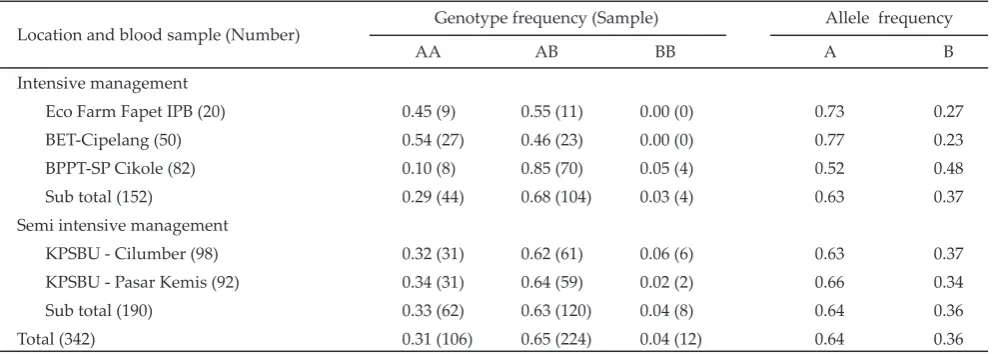
to that in BPPT-SP Cikole of whose the BB frequencies were very low, 6% and 2% respectively.
The origin of the totally 50 HF heifers and cows genotyped for their к-Cn gene in BET Cipelang were imported from Australia and New Zealand. According to the main function of BET Cipelang, each animal would be functioned as donors and candidates for producing embryos. None of these animals was identi-fi ed having the BB genotype implied that if the embryos they would produced be grown up to a mature age to re-produce embryos, then it would gave a large impact for the increasing number of off springs with the AA and AB genotypes. The low BB frequency at the Eco Farm on the other side might be due to bulls countinously mated for females in this farm was only one HF bull that was identiƐ ed having the AA genotype of the κ-Cn gene. Under such this mating caused of resulting higher extence in producing the AA and AB off springs. Table 1 also showed that the BB HF females at the small dairy farmers both in Cilumber (6%) and Pasar Kemis (2%) villages were very low.
A limited number of the BB HF females both in the BPPT-SP Cikole and small dairy farmers in KPSBU-Lembang resulted in the low frequency of the BB geno-type compared to those of the AA and AB genogeno-types.
The BB genotype frequencies in BPPT-SP= 5% and KPSBU= 4% were lesser compared to either the AB genotype (BPPT-SP= 85%; KPSBU= 63%) or the genotype AA (BPPT-SP= 10%; KPSBU= 31%). This situation could be becoming an initial indication for a limited number of the BB genotype HF females in central dairy regions in West Java.
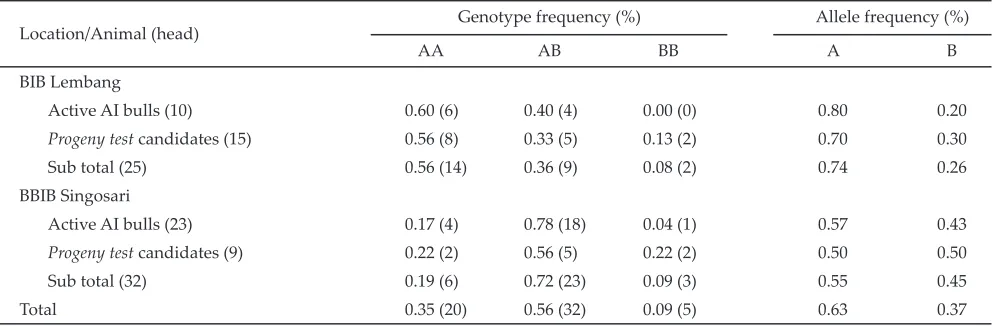
Both BPPT-SP Cikole and KPSBU-Lembang applied artifi cially insemination (AI) mating system to mate their HF females. Frozen semens were mostly bought from the two National AI Breeding Stations of BIB Lembang in West Java and BBIB Singosari in East Java, whereas in a small number of frozen semens were directly im-ported from some countries such as Canada and France. Therefore variant genotypes of the κ-Cn gene of the HF bulls in these two AI stations could give a large impact on the variant genotypes of the HF females they mated. Table 2 illustrated that for a total number of 32 HF males reared in BBIB Singosari, 23 head of them were as the AI active bulls, however only one bull was having the BB genotype. Even, from the total 10 number of the AI active HF bulls in BIB Lembang, none of them was with the BB genotype (0%). Based on such this situation, it can be known that the total BB frequency of the κ-Cn gene both at BIB Lembang (0,26) and BIBB Singosari Figure 1. The RFLP paƦ erns of the k-casein gene aƐ er digestion with Pst I on the 6% acrylamide gel. No. 1, 2, 3, 5, 7, 10, and 12. AA;
No 4, 6, 8, and 11. AB; and No 9. BB; and M. Marker 100 pb ladder
Location and blood sample (Number) Genotype frequency (Sample) Allele frequency
AA AB BB A B
Intensive management
Eco Farm Fapet IPB (20) 0.45 (9) 0.55 (11) 0.00 (0) 0.73 0.27
BET-Cipelang (50) 0.54 (27) 0.46 (23) 0.00 (0) 0.77 0.23
BPPT-SP Cikole (82) 0.10 (8) 0.85 (70) 0.05 (4) 0.52 0.48
Sub total (152) 0.29 (44) 0.68 (104) 0.03 (4) 0.63 0.37
Semi intensive management
KPSBU - Cilumber (98) 0.32 (31) 0.62 (61) 0.06 (6) 0.63 0.37
KPSBU - Pasar Kemis (92) 0.34 (31) 0.64 (59) 0.02 (2) 0.66 0.34
Sub total (190) 0.33 (62) 0.63 (120) 0.04 (8) 0.64 0.36
Total (342) 0.31 (106) 0.65 (224) 0.04 (12) 0.64 0.36
(0.45) was seemingly suffi cient enough. However, almost all of them were possed by non active AI (young) males, so they would not given yet any contribution to increase the BB genotype females studied.
Variant Alleles of the Kappa Casein Gene
Due to the only three variant genotypes of AA, AB and BB of the κ-Cn gene were identifed in the HF males and females, so only two variant alleles, namely A and B were identifi ed from these animals (Tabel 1 dan 2). Genetic variation among A and B alleles of the
κ-Cn gene is well known due to the existing two-point mutation on the fourth exon (Eigel et al., 1984; Lien & Roghe, 1993). Variants A and B diff er in amino acid 136 and 148 at which at the position 136 the amino acid of Thr/ACC is changed by Ile (ATC) and at the position 148 that of Asp (GTA) is changed for Ala (GCT) (Pinders et al., 1991). The three of AA, AB, and BB genotypes iden-tifi ed in this result were accordance to other previous studies reporting the two variant A and B alleles of the
κ-Cn gene as the two common alleles in Bos taurus dairy breeds (Beata et al., 2008).
The frequencies of the A and B alleles of the
κ-Cn gene among locations was quietly wide (Table 1 and 2). For HF females under small dairy farmers at KPSBU Lembang, it was generally found that the A allele was higher compared to the B allele, both in Cilumber (0.63 vs 0.37) and Pasar Kemis (0.66 vs 0.34) villages. Contrastly, HF females at BPPT-SP Cikole had the frequencies of the A and B alleles almost similar (0.52 vs 0.48). However, all of observated HF females had a higher frequency for the A allele over the B (0.64 vs 0.36). The occurence of much higher the A allele than the B allele was also found for the active and non active AI males at the two AI stations of BIB Lembang (0.74 vs 0.26) and BBIB Singosari (0.63 vs 0.37). With regarding to the lower BB genotype females at Ecofarm, the reason for the lower frequency of the B allele over the A allele (0.27 vs 0.73) was that only one bull continously used for mating females and this bull was identifi ed for the AA genotype.
In general, the A allele frequency of the κ-Cn gene of HF dairy caƦ les identifi ed in this study was still lower compared to that in some countries such as USA, Europe and Japan of which having a higher A allele frequency at a range of 0.8-0.9 (Swaisgood, 1992). This was due to the main purpose to develope dairy caƦ le for high milk yield, at which the A allele is more related to higher milk yield, while the B allele closely associ-ated with high protein yield. In relassoci-ated to this, it could partly be understood for the higher A allele frequency in HF females in this study as almost all active AI HF bulls used for mating were with the AA genotype (the A allele). This was can be associated with decision for the imported HF bull policy mainly based on high values of Estimated TransmiƦ ing Ability (ETA) of their milk yield. Van Eenennaam & Medrano (1991) stated dairy breeds (Bos taurus) could change largely on the allele frequencies of the κ-Cn gene by the way of exploiting superioriry of lactation traits. It was reported that ani-mals with high fat yield such as Jersey and Brown Swiss were generally with a high frequency of the A allele (0.67-0.86), in contrast, high milking dairy breeds such as Holstein, Guernsey and Milking Shorthorn commonly having a low frequency of the B allele (0.11-0.27). It was further explained that a consistent selection on lactation traits either for milk yield or milk composition could ef-fectively change locus frequencies of the κ-Cn gene from time to time. Selection on lactation traits for around two decades (1964-1990) in Holstein was reported decreasing the B allele of the κ-Cn gene from 0.20 to 0.18, on the contrary, selection on milk fat in Brown Swiss resulted in the increasing B allele from 0.59 to 0.67. A higher gene frequency of the A variant vs B (0.73 vs 0.27), as already reported in Holstein-Friesian (BoeƦ cher et al., 2004; Kübarsepp et al., 2005). An interesting latitude trend for the κ-Cn gene was observed in European caƦ le breeds with highest frequencies related to the κ-Cn variant A in North Western Europe (Jann et al., 2004).
CONCLUSION
Genotyping к-casein gene in HF dairy caƦ le re-sulted in three variant genotypes, namely the AA, AB
Location/Animal (head) Genotype frequency (%) Allele frequency (%)
AA AB BB A B
BIB Lembang
Active AI bulls (10) 0.60 (6) 0.40 (4) 0.00 (0) 0.80 0.20
Progeny test candidates (15) 0.56 (8) 0.33 (5) 0.13 (2) 0.70 0.30
Sub total (25) 0.56 (14) 0.36 (9) 0.08 (2) 0.74 0.26
BBIB Singosari
Active AI bulls (23) 0.17 (4) 0.78 (18) 0.04 (1) 0.57 0.43
Progeny test candidates (9) 0.22 (2) 0.56 (5) 0.22 (2) 0.50 0.50
Sub total (32) 0.19 (6) 0.72 (23) 0.09 (3) 0.55 0.45
Total 0.35 (20) 0.56 (32) 0.09 (5) 0.63 0.37
and BB genotypes, so two variant alleles were identifi ed, namely the A and B alleles. The BB genotype HF females in this study were identifi ed at a very low frequency in the range of 0%-6%. None of HF females genotyped in both BET Cipelang and Eco Farm had the BB genotype of the к-casein gene. The occasion of the BB HF females both in the BPPT-SP Cikole and small dairy farmers in KPSBU-Lembang at a very low frequency (2%-5%) contrasted to the AA and AB genotypes (10%-34% and 46%-85% respectively) was mainly due to the limited number of the active AI HF bulls with the BB genotype reared in the two national AI stations. All of this fi nding could be a possible indication for a small number of the BB genotype HF females in some central dairy region in West Java.
REFERENCES
Alipanah, M.,L. Kalashnikova, & G. Rodionov. 2005. Kappa-Kasein genotypic frequencies in Russian breeds Black and Red Pied caƦ le. Iran. J. Biotechnol. 3:191-194.
Angiolillo, A.,M. H. Yahyaoui, A. Sanchez, F. Pilla, & J. M. Folch. 2002. Characterization of new genetic variant in the caprine k-casein gene. J. Dairy Sci. 85: 2679-2680.
Azevedo, A.L. S., C. S. Nascimento, R. S. Steinberg, M. R. S. Carvalho, M. G. C. D. Peixoto, R. L. Teodoro, R. S. Verneque, S. E. F. Guimarães, & M. A. Machado. 2008. Genetic polymorphism of the kappa-casein gene in Brazilian caƦ le. Genet. Mol. Res.7: 623-630.
Beata, S., N. Wojciech, & W. Ewa. 2008. Relations between kappa-casein polymorphism (CSN3) and milk perfor-mance traits in heifer cows. J. Cent. Eur. Agric. 9: 641-644. BoeƦ cher, P. J., A. Caroli, A. Stella, S. Chessa, E. Budelli, F.
Canavesi, S. Ghiroldi, & G. Pagnacco. 2004. Eff ects
of casein haplotypes on milk production traits in Italian Holstein and Brown Swiss caƦ le. J. Dairy Sci. 87:4311-4317.
Bovenhuis, H.,J. A. M. van Arendonk, & S. Kerver. 1992. Associations between milk protein polymorphism and milk production traits. J. Dairy Sci.75:2549-2559.
Comin, A., M. Cassandro, S. Chessa, M. Ojala, R. Dal ZoƦ o, M. De Marchi, P. Carnier, L. Gallo, G. Pagnacco, & G. BiƦ ante. 2008. Eff ects of composite β- and κ-casein genotypes on milk coagulation, quality, and yield traits in Italian Holstein cows.J. Dairy Sci. 91:4022-4027.
Dogru, U.& M. Ozdemir. 2009. Genotyping of kappa-casein locus by PCR-RFLP in Brown Swiss caƦ le breed. J Anim. and Vet. Advances. 8:779-781.
Drögemüller, C,.A. Bader, H. Kuiper, T. Leeb, J. L. Williams, & O. Distl. 2001. Assignment of the bovine runt-related transcription factor 1 gene (RUNX1) to bovine chromo-some 23q21 by fl uorescence in situ hybridization and radiation hybrid mapping. Cytogenet. Cell Genet. 94:248–249.
Eigel, W.N., J. F. Butler, C. A. Ernstrom, H. M. Farrell, V. R. Harwalkar, R. Jennes, & R. McL Whitney. 1984. Nomenclature of proteins of cow’s milk. J.Dairy Sci. 67:1599-1631.
Heck, J. M. L., A. Schennink, H. J. F. van Valenberg , H. Bovenhuis, M. H. P. W. Visker, J. A. M. van Arendonk, & A. C. M. van Hooij donk. 2009. Eff ects of milk protein variatns on the protein composition of bovine milk. J. Dairy Sci. 92:1192-1202.
Jann, O., Ibeagha-Awemu, C. E-Özbeyaz, P. Zaragoza, J. L. Williams, P. Ajmone-Marsan, J. A. Lenstra, K. Moazami-Goudarzi, & G. Erhardt. 2004. Geographic distribution of haplotype diversity at the bovine casein locus. Genet. Sel.
Evol.36: 243-257.
Kiplagat, S.K., M. Agaba, I. S. Kosgey, M. Okeyo, D. Indetie, O. HanoƦ e, & M. K. Limo. 2010. Genetic polymorphism of kappa-casein gene in indigenous Eastern Africa goat populations. Int. J. Genet. and Mol. Biol. 2: 001-005. Kűbarsepp, I., M. Henno, H. Viinalass, & D. Sabre. 2005.
Eff ect of κ-casein and β-lactoglobulin genotypes on the milk rennet coagulation properties. Agr. Res. 1: 55–64. Lien, S.& S. Rogne. 1993. Bovine casein haplotypes: number
frequencies and applicability as genetic markers. Anim. Genet.24: 373-376.
Martin, P.,M. Szymanowska, L. Zwierzchowski, & C. Leroux. 2002. The impact of genetic polymorphisms on the pro-tein composition of ruminants milks. Reprod. Nutr. Dev. 42:433–459.
Moioli, B.,D. M. Andrea, & F. Pilla. 2007. Candidate genes aff ecting sheep and goat milk quality. Small Rumin. Res. 68: 179–192.
Molina, L. H., J. Kramm, C. Brito, B. Carrillo, M. Pinto, & A. Ferrando. 2006. Protein composition of milk from Holstein-Friesian dairy cows and its relationship with the genetic variants A and B of κ-casein and β-lactoglobulin (Part I.). Int. J. Dairy Technol. 59:183–187.
Nei, M., & S. Kumar. 2000. Molecular Evolution and Phylogenetics. Oxford University Press, New York. Otaviano, A.R., H. Tonhati, J. A. D. Sena, & M. F. C. Munoz.
2005. Kappa-casein gene study with molecular markers in female buff aloes (Bubalus bubalis). Genet. Mol. Bio. 28:237–241.
Patel, R.K., J. B. Chauhan, K. M. Singh, & K. J. Soni. 2007. Genotyping and alleleic frequencies of κ-CN and β-LG in Indian river buff alo bulls. Buff alo Bull. 26: 63-66.
Pinders, J.,B. N. Perryc, J. Skidmoraend, & D. Sawa. 1991. Analysis of polymorphism in the bovine casein genes by use of the polymerase chain reaction. Anim. Genet. 22:11-20.
Pipalia, D.L., D. D. Ladani, B. P. Brahmkshtri, D. N. Rank, C. G. Joshi, P. H. Vataliya, & J. V. Solanki. 2001. Kappa-ca-sein genotyping of Indian buff alo breed using PCR-RFLP. Buff alo J. 2:195-202.
Prinzenberg, E.M., K. Gutscher, S. Chessa, A. Caroli, & G. Erhardt. 2005. Caprine kappa-Casein (CSN3) polymor-phism: New developments in molecular knowledge J. Dairy Sci. 88: 1490-1498.
Prinzenberg, E. M., H. Jianlin,& G. Erhardt. 2008. Genetic variation in the -Casein gene (CSN3) of Chinese yak (Bos grunniens) and phylogenetic analysis of CSN3 sequences in the Genus Bos. J. Dairy Sci. 91:1198-1203
Riaz, M.N., N. A. Malik, F. Nasreen, & J. A. Qureshi. 2008. Moleculer marker assisted study of kappa-casein gene in NILI-RAVI (Buff alo) breed of Pakistan. Pakistan Vet. J. 28: 103-106.
Rij nkels, M.,P. M. Kooiman, H. A. deBoer, & F. R. Pieper. 1997. Organization of the bovine casein gene locus. Mammalian Genome. 8:148-152.
Robitaille, G.,M. BriƦ en, J. Morisset, & D. Petitclerc. 2002. Quantitative analysis of ß-lactoglobulin A & B genetic variants in milk of cows ß-Lactoglobulin AB throughout lactation. J. Dairy Sci. 69: 651-654.
Sambrook, J., E. F. Fritsch, & T. Maniatis. 1989. Molecular Cloning Laboratory Manual. 3rd Ed. Cold Spring Harbour Lab. Press, New York.
Soria, L.A., G. M. Iglesias, M. J. Huguet, & S. L. Mirande. 2003. A PCR-RFLP test to detect allelic variants of the bovine kappa-casein gene. Anim. Biotechnol. 14: 1-5. Swaisgood, H. E. 1992. Chemistry of Caseins. In Advanced
polymorphisms in California dairy caƦ le. J. Dairy Sci. 74:1730-1740.
Verdier-Metz I.,J. B. Coulon, & P. Pradel. 2001. Relationship between milk fat and protein contents and cheese yield. Anim. Res. 50:365–371.
Wu, C. H., L. Yeh, H. Huang, L. Arminski, J. Castro-Alvear, Y. Chen, Z. Hu, P. Kourtesis, R. S. Ledley, B. E. Suzek, C. R. Vinayaka, J. Zhang, & W. C. Barker. 2005. The Protein Information Resource.Nucleic Acids Res. 31: 345-347. Yahyaoui, M.H, A. Angiolillo, F. Pilla, A. Sanchez, & J. M.