Althea Medical Journal. 2015;2(1) 54 AMJ March, 2015
Correlation between Folate Intake during Pregnancy and Preterm
Labor in Mothers with 0-9 Months Old Babies
Gufi George Stefanus1, Siti Nur Fatimah2, Eppy Darmadi Achmad3
1Faculty of Medicine, Universitas Padjadjaran, 2Department of Medical Nutrition, Faculty of
Medicine, Universitas Padjadjaran 3Department of Obstetri&Gynecology , Faculty of Medicine,
Universitas Padjadjaran/Dr. Hasan Sadikin General Hospital, Bandung
Abstract
Background: Nutritional factors such as folate intake are important during pregnancy. Satisfying nutritional needs of pregnant mothers is necessary to avoid complications during pregnancy such as preterm labor, High infant mortality rate in Indonesia is still high. This study aimed to study the relationship between folate intake during pregnancy and preterm labor.
Methods: This study used a cross-sectional analytic approach by using semi-quantitative Food Frequency Questionnaire, as an instrument on mothers with 0−9 months old babies living in the villages of Sayang and Hegarmanah, Jatinangor, Sumedang, Indonesia.
Results: Ninety mothers participated in this study. The result indicated that 25.55% respondents had low folate intake and high incidence of preterm labor (16.67%). Significant association was found between folate intake during pregnancy and preterm labor (p=0.019). Maternal age was not a confounding factor in this study.
Conclusions: There is an association between folate intake during pregnancy and preterm labor in mothers living in the villages of Sayang and Hegarmanah, Jatinangor, Sumedang, Indonesia.
Key words: Babies 0−9 months, folate, preterm labor
Correspondence: Gufi George Stefanus, Faculty of Medicine, Universitas Padjadjaran, Jalan Raya Bandung-Sumedang Km.21, Jatinangor, Sumedang, Indonesia, Phone: +6285692448500 Email: [email protected]
Introduction
Prematurity cases in Indonesia are considered high at 600,000 out of 4.3 million births each year. Among these cases, 5% of the cases course are death causing increase of Infant
Mortality Rate (IMR) in Indonesia.1 In the year 2007, Indonesian IMR is at 34:1000 live birth and the highest in ASEAN.2 These lead
for a need in an integrated effort to reduce
IMR in Indonesia especially to achieve the
target for Millennium Development Goals (MDG) at 23:1000 live births in 2015. Such method can be achieved by satisfying the nutritional need of the pregnant mother.3
Nutritional requirement of a pregnant woman will increase according to the need of cellular proliferation to support fetal growth and plasenta.4 One of the important nutrients
for pregnant women is folate. Folate is a vitamin B that plays a role in DNA synthesis and maturation of cells to support the growth and fetus development.5
Folate cannot be formed inside the body,
thus it is important for each individual to
fulfill the folate requirement by consuming
food which contains folate. Sources of folate are liver, green vegetable, nuts, and fruits.
Supplements and fortified food such as wheat
product can also contribute to folate content of the body.5,6
In Jatinangor, the number of high risk pregnancy women who were referred to a hospital was quite large and mostly happened in the villages of Sayang and Hegarmanah (unpublished data). Based on this reason, this study was conducted to study on the association between folate intake during pregnancy and preterm labor in the villages of Sayang and Hegarmanah.
Methods
This was an analytical cross-sectional study during the period of October to November 2012 in the Posyandu of Sayang and Hegarmanah village. Subjects were recruited with
Althea Medical Journal. 2015;2(1)
55
months old babies in Sayang and Hegarmanah
villages who filled the informed consent form
and brought Mother and Child Health book
(KIA) fulfilled the inclusion criteria. If KIA book was not filled completely then the subject would
be excluded. Data collection was conducted
with permission by Sumedang Regional
Development Planning Board, Sumedang
District Health Office, Jatinangor Health Centre and Health Research Ethics Committee of
Faculty of Medicine Universitas Padjadjaran. Semi quantitative Food Frequency Questionnare (SFFQ) was used as an instrument for interview to give insight on the mothers' pattern of folate intake during
pregnancy. Questionnaires were filled with list
of food types and frequency and also amount of intake in portion.
Data from SFFQ were converted from household measurement to Dietary Folate
Equivalent (DFE).6 Folate content of each
food was analyzed using USDA National
Nutrient Database for Standard Reference.8
The calculation determined total daily folate
intake and then the concentration would then
be compared to the Recommendation Dietary Allowance (RDA).9 Date of birth and the first
day of last menstrual period data from KIA
book would then be analyzed using Excel 2007
program so that accurate gestational age at birth could be retrieved. The analytical method used in this study was comparative categorical
hypothesis testing with unpaired fisher test by
cellular union using computer.
Results
The study was conducted on 90 mothers
who 31 of them live in the village of Sayang,
while 59 were in the village of Hegarmanah.
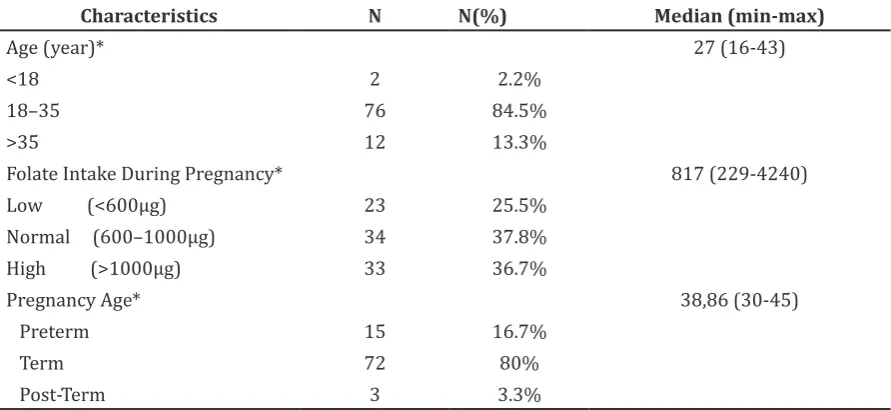
The subjects characteristics were presented as mother’s age, folate intake during pregnancy, and time of birth (Table 1).
Age group was determined from literature which explained that maternal age of below 18 years old and over 35 years old were one of the risk factors for preterm labor.10 From table 1,
Table 1 Characteristics of Subject
Characteristics N N(%) Median (min-max)
Age (year)* 27 (16-43)
<18 2 2.2%
18–35 76 84.5%
>35 12 13.3%
Folate Intake During Pregnancy* 817 (229-4240)
Low (<600μg) 23 25.5%
data distributionbased on Kolmogorov-Smirnov is not normal
Gufi George Stefanus, Siti Nur Fatimah, Eppy Darmadi Achmad: Correlation between Folate Intake during Pregnancy and Preterm Labor in Mothers with 0-9 Months Old Babies
Table 2 Association between Folate Intake During Pregnancy and Preterm Labor
Althea Medical Journal. 2015;2(1) 56 AMJ March, 2015
it can be seen that respondents who had risk factors for preterm labor amounted to 15.5%.
Data of folate intake can be classified into
three categories, which are low, normal, and high. Table 1 indicated that 25.5 % of respondents had low quality folate intake. This study also showed that 16.7% had pretermlabours. This number approaches the epidemiologic number of WHO on prematurity in Indonesia which is 15.45%.3
The alternative chi square test was performed to study the association between folate intake during pregnancy and preterm labor. A p-value of <0.05, indicated that there was an association between folate intake during pregnancy and preterm labor.
One confounder factor was analyzed, which was the age of the mother. A p value> 0.05 indicated that age of mother did not affect preterm labor frequencies which also concluded not as a confounder of this study.
Discussions
There are several similar studies in the association between serum folate level during pregnancy and risk of preterm labor conducted. From previous study conducted by Bodnaret al.11 and Hiroshi et al.12 there is an association
between serum folate and risk of preterm labor. Folate intake data collection was conducted after labor, that may cause a recall bias. Yet, nature of events that relies on questionnaire can be applicable up to a year.6 Confounder
which can affect preterm labor such as age of
mother has been identified and is excluded as
a confounder in this study.
According to this study, there is an association between folate intake during pregnancy and preterm labor of mothers with
0–9 months old babies in the villages of Sayang
and Hegarmanah.
References
1. Liu L, Johnson H. Country data and rankings
for preterm birth data Embargo Until May
2nd 2012.2012 [downloaded in 6 may 2012]; Available at: http://www.who. int/pmnch/media/news/2012/201204 borntoosoon_countryranking.pdf.
2. Rosita R. Profil kesehatan Indonesia 2010.
Jakarta: Kementerian Kesehatan Republik Indonesia. 2011. p.194.
3. United Nations Children’s Fund. Levels
& Trends in Child Mortality Report
2011. 2011. [downloaded in 6 May 2012]; Available at: http://www.unicef.
org/media/files/Child_Mortality_ Report_2011_Final.pdf
4. Ladipo O. Nutrition in pregnancy: mineral and vitamin supplements. Am J Clin Nutr.
2000;72:2808-908.
5. Murphy M. Folate (Folacin, Folic Acid). 2004 [downloaded in 30 april 2012]; Available at: http://ohioline.osu.edu/hyg-fact/5000/5553.html.
6. Whitney E, Rolfes S. Understanding Nutrition. 11th ed. Belmont California, USA: Thomson Wadsworth. 2008.
7. Wrieden W, Peace H, Armstrong J, Barton
K. A Short Review of Dietary Assesment
Methods Used in National and Scottish
Research Studies. Scotland:Working Group
on Monitoring Scottish Dietary Targets Workshop. 2003.
8. U.S. Department of Agriculture ARS. USDA National Nutrient Database for Standard
Reference, Release 23. Nutrient Data
Laboratory Home Page; 2010.
9. Shils ME, Shike M, Ross C, Caballero B, Cousins RJ. Modern Nutrition in Health
and Disease. 10thed. Philadelphia, United States of America: Lippincot
Williams&Wilkins. 2006. p.470–9.
10. The HealthPages . Risk factors for preterm birth. 2010 [downloaded in 3 december 2012]; Available at: http://www. issues4life.org/pdfs/iariskptb023.pdf 11. Bodnar L, Himes K, Venkataramanan R,
Chen JY, Evans RW, Meyer JL, et al.. Maternal
serum folate species in early pregnancy and risk of preterm birth. Am J Clin Nutr.
Table 3 Association between Maternal Age and Preterm Labor
Prematurity Total p value
Term+Post-Term (%) Preterm (%)
Maternal age No risk 64 (71.1%) 12 (13.3%) 76 (84.4%) 0.697
Risk 11 (12.2%) 3 (3.4%) 14 (15.6%)
Althea Medical Journal. 2015;2(1)
57
2010;92(4):864–71.
12. Ihara H, Watanabe T, Aoki Y, Nagamura Y, Totani M, Hashizume N. Dietary folate
intake and serum folate status in Japanese women of childbearing age. J Anal Bio-Sci.
2009;32(2):181–5.