The combined effects of a long-term experimental
drought and an extreme drought on the use of plant-water
sources in a Mediterranean forest
A D R IA B A R B E T A 1 , 2, M O N I C A M E JIA - C H A N G1 , 2, R O MÀO G A Y A1 , 2
, J O R D I V O L T A S3, T O D D E . D A W S O N4 and J O S E P P ENU E L A S~ 1 , 2
1
CSIC, Global Ecology Unit CREAF-CSIC-UAB, Cerdanyola del Valles (Catalonia) E-08193, Spain,2CREAF, Cerdanyola del Valles (Catalonia) E-08193, Spain,3Department of Crop and Forest Sciences–AGROTECNIO Center, University of Lleida,
Lleida, Catalunya, Spain,4Department of Integrative Biology, University of California at Berkeley, Berkeley, CA 94720-3140, USA
Abstract
Vegetation in water-limited ecosystems relies strongly on access to deep water reserves to withstand dry periods. Most of these ecosystems have shallow soils over deep groundwater reserves. Understanding the functioning and functional plasticity of species-specific root systems and the patterns of or differences in the use of water sources under more frequent or intense droughts is therefore necessary to properly predict the responses of seasonally dry ecosystems to future climate. We used stable isotopes to investigate the seasonal patterns of water uptake by a sclero-phyll forest on sloped terrain with shallow soils. We assessed the effect of a long-term experimental drought (12 years) and the added impact of an extreme natural drought that produced widespread tree mortality and crown defoliation. The dominant species,Quercus ilex,Arbutus unedoandPhillyrea latifolia, all have dimorphic root systems enabling them to access different water sources in space and time. The plants extracted water mainly from the soil in the cold and wet seasons but increased their use of groundwater during the summer drought. Interestingly, the plants subjected to the long-term experimental drought shifted water uptake toward deeper (10–35 cm) soil layers
during the wet season and reduced groundwater uptake in summer, indicating plasticity in the functional distribu-tion of fine roots that dampened the effect of our experimental drought over the long term. An extreme drought in 2011, however, further reduced the contribution of deep soil layers and groundwater to transpiration, which resulted in greater crown defoliation in the drought-affected plants. This study suggests that extreme droughts aggravate moderate but persistent drier conditions (simulated by our manipulation) and may lead to the depletion of water from groundwater reservoirs and weathered bedrock, threatening the preservation of these Mediterranean ecosys-tems in their current structures and compositions.
Keywords: Arbutus unedo, climate change, experimental drought, extreme drought, holm oak, Mediterranean forest, Phillyrea latifolia,Quercus ilex, stable isotopes, water uptake, water-use strategies
Received 10 July 2014 and accepted 25 September 2014
Introduction
The consequences of anthropogenic climatic change in the Mediterranean Basin include the ongoing increases in temperature coupled to a very likely notable reduc-tion in precipitareduc-tion in summer and spring for the
com-ing decades (Christensen et al., 2007). Some
Mediterranean forests have already adjusted and in some cases even adapted to seasonal drought and an irregular precipitation regime, but unprecedented duration, intensity and seasonality of future droughts predicted by general circulation models (GCMs) could have strong impacts on the vegetation and therefore the
structure and function of ecosystems that are beyond the tolerance of most plants. Indeed, the numbers of documented drought-induced tree mortalities and epi-sodes of forest decline in this region are growing (Pe~nuelaset al., 2000, 2013; Galianoet al., 2012). These
events may lead to community shifts (Mueller et al.,
2005) and may cascade to affect nutrient cycling, micro-climate and/or hydrology (Anderegget al., 2013a). The distribution of tree mortality, however, tends to be pat-chy across landscapes, indicating that certain individu-als or populations are more predisposed to death (Suarezet al., 2004). This disparity in the responses to climate is partly driven by the interspecific differences in the ability to cope with water stress and warm temperatures (Breshears et al., 2009; Carnicer et al., 2013a) but also by site characteristics (Lloret et al., 2004). Detailed knowledge of the diversity of different Correspondence: Adria Barbeta, tel. +34935811312; +34935814221,
fax +34935814151, e-mail: [email protected]
Adria Barbeta and Monica Mejıa-Chang contributed equally to the manuscript and share first authorship.
responses and plant strategies is necessary for under-standing the mechanisms behind tree mortality and for improving predictions of future forest declines or com-munity shifts.
The experimental manipulation of precipitation is useful for studying the effects of drought on forest declines (Wu et al., 2011). Such experiments in Medi-terranean forests have helped to identify the physio-logical, morphophysio-logical, structural (Ogaya & Pe~nuelas,
2006; Limousin et al., 2010) and temporal (Barbeta
et al., 2013; Martin-Stpaulet al., 2013) changes induced by drought. The projected increase in frequency of extreme droughts may imply a carry-over effect of multiple droughts, where plant resilience could be at risk (Anderegg et al., 2012), but more counter-intui-tively, structural changes caused by droughts seem to progressively enhance plant resistance (Lloret et al.,
2012; Barbeta et al., 2013). Consequently, long-term
experiments are desirable both to account for the accumulative effect of multiple droughts or to avoid overestimating the effects of drought on vegetation (Leuzingeret al., 2011).
The use of water by plants has been well studied in temperate ecosystems, but we still have limited knowl-edge about a wide range of processes, on scales of leaves to entire landscapes, within many water-limited ecosystems (Zeppel, 2013). The effects of increasing drought on the patterns of use of underground water in Mediterranean trees has not been extensively studied, although recent studies have characterized seasonal
patterns of water uptake in some Quercus species
(David et al., 2007; Nadezhdina et al., 2007; Kurz-Bes-son et al., 2014). The stable-isotope (d18O and d 2H)
composition of water is a powerful tool for tracing the
movement of water underground (Dawsonet al., 2002).
Isotopic fractionation does not occur during water absorption by roots (Ehleringer & Dawson, 1992; but see Lin & Sternberg, 1993 for exceptions), so the isoto-pic signature of xylem water can be used to determine a plant’s source of water at a given moment. Pools of underground water can have different isotopic signa-tures due to differences in the original water sources (precipitation at different times of the year or from dif-ferent source areas), and evaporation during and after rains can markedly change the isotopic composition of the soil water ((Brooks et al., 2009). Gradients in the compositions of H or O isotopes of the remaining soil in seasonally dry environments can also develop, with water in the surface layers becoming more enriched
(leading to more positive d values), and water in the
deeper layers becoming more depleted, in the heavy isotopes (Allison, 1982). Additionally, groundwater extracted from water tables or bedrock fractures can often have distinct signatures, reflecting the isotopic
composition of rainwater during either wet or cold sea-sons, when these pools are refilled by infiltration with little evaporation (Brooks et al., 2009). Isotopic signa-tures may also reflect the biased or weighted average of annual inputs of precipitation (Ehleringer & Dawson, 1992), the subsurface fractionation caused by water interacting with charged clays (Oerter et al., 2014) or unique redox chemical evolution (J. Oshun, W. E. Die-trich, T. E. Dawson, I. Fung, Submitted). These differ-ences in isotopic signatures have been successfully used to determine the sources of water of vegetation in the Mediterranean Basin (Davidet al., 2007; Westet al., 2012) and other biomes (Eggemeyeret al., 2009; Kukow-ski et al., 2013). Some studies have applied these tech-niques in short-term experimental droughts or under extreme natural droughts (Schwinninget al., 2005; West
et al., 2012; Anderegg et al., 2013b; Kukowski et al., 2013), but little is known about the accumulative effect of long-term experimental drought on the isotopic com-positions and sources of the water used by plants.
Some species in seasonally dry climates depend on access to groundwater for withstanding periods with-out precipitation (Dawson & Pate, 1996; Kurz-Besson
et al., 2014; David et al., 2007a; Eggemeyer et al., 2009; Zeppel, 2013; J. Oshun, W. E. Dietrich, T. E. Dawson, I. Fung, Submitted). Forests commonly occur on moun-tainsides in Mediterranean climatic zones (Carnicer
(Lloretet al., 2012; Barbetaet al., 2013), however, may mitigate the negative effects of drought.
We present the results of an ecohydrological study applying water stable-isotope techniques in a long-term experimental drought system established in 1998. A
forest dominated by Holm oaks (Quercus ilex L.) was
subjected to a 15% reduction in soil moisture [matching GCM predictions for the Mediterranean Basin (Chris-tensenet al., 2007)] that caused a drastic suppression of growth in the dominant speciesQ. ilexandArbutus une-doL. and an increase in mortality rates inQ. ilexbut not
Phillyrea latifoliaL. (Ogaya&Pe~nuelas, 2007). The effect size of the drought treatment, however, was dampened over time (Barbetaet al., 2013). The characterization of seasonal changes in plant-water sources is crucial for understanding the mechanisms underlying these spe-cies-specific responses to drought. Moreover, an extreme drought during the study period enabled us to investigate the causes of drought-induced mortality in this Holm oak forest. This study asked the following questions: (i) what are/were the sources of water for each plant species, and do they change over time? (ii) did the sources of water change after 12 years of exper-imental drought? (iii) does constant or excessive use of deeper water sources lead to the progressive depletion of groundwater under drought? (iv) how are water sources related to species-specific drought responses? and (v) is drought-induced mortality linked to changes in usage of particular water sources?
Materials and methods
Experimental site
The experimental site was established in 1998 at the Prades Holm oak forest in southern Catalonia (northeastern Iberian Peninsula) (41°210N, 1°20E) at 930 m a.s.l. on a south-facing slope (25% slope). The forest has a very dense multi-stem crown (18 366 stems ha 1) dominated by Q. ilex (3850 stems ha 1and 50 Mg ha 1), P. latifolia (12 683 stems ha 1 and 29 Mg ha 1) and A. unedo (667 stems ha 1 and 9 Mg ha 1), accompanied by other Mediterranean woody spe-cies that do not reach the upper canopy (e.g.,Erica arboreaL., Juniperus oxycedrusL. andCistus albidusL.) and the occasional isolated deciduous tree species (e.g., Sorbus torminalis L. Crantz andAcer monspessulanumL.). The canopy in the study plots did not exceed 4 m. This forest has been managed as a coppice for centuries but has not been significantly disturbed in the last 70 years.
The climate is typically Mediterranean. Since the beginning of the experiment (1998), the mean annual temperature has been 12.2°C and the mean annual precipitation has been 610 mm. Holm oak forests can occur at sites with a mean annual precipitation as low as 400–450 mm (Terradas, 1999).
The annual and seasonal distribution of precipitation is
irregu-lar, with annual precipitation ranging from 376 to 926 mm in the 12 years of the experiment. Spring and autumn are the wettest seasons, and summer droughts usually last 3 months, during which precipitation is ~10% of the annual total and coincides with the highest temperatures. Winters are relatively cold. January is the coldest month (mean temperature of 4.4°C), and the mean daily temperature is below 0°C an average of 8 days per winter. The soil is a Dystric Cambisol over Paleozoic schist and has a mean depth of ~35 cm. The mean annual precipitation is higher than that in the driest dis-tributional limit ofQ. ilex, but the topographic characteristics of the study site represent relatively xeric conditions due to the shallow soils and steep terrain.
The experimental system consisted of four 150-m2 plots delimited at the same altitude along the slope. Half the plots (randomly selected) received the drought treatment, and the other half faced natural conditions. Precipitation was partially excluded from the plots of the drought treatment by PVC strips suspended 0.5–0.8 m above the soil and covering
approximately 30% of the plot surfaces. A ditch 0.8 m in depth was excavated along the entire top edge of the plots to inter-cept runoff water. The water interinter-cepted by the strips and ditches was conducted around the plots, below their bottom edges. The strips were installed below the canopy and thus did not intercept light. Litter falling on the plastic strips was regularly transferred below them to ensure that differences in the content of soil nutrients among treatments and control plots were attributable only to the availability of water for the decomposition of this litter.
Sampling and environmental monitoring
The field work was initially planned for spring 2010 to winter 2011, with one sampling campaign each season. The extreme drought in the summer of 2011 offered the possibility of an extra campaign to monitor plant performance under intense water stress. In each of these campaigns, samples of xylem, bulk-soil and spring water were collected at midday (between 1100 and 1400). For the samples of xylem water, 3–4 sunlit
twigs per tree were cut, the bark and phloem were removed to prevent interference from the isotopes in the water of the leaves and the twigs were then transferred to borosilicate glass vials with PTFE/silicone septa tops (National Scientific Com-pany, Rockwood, USA). The vials were sealed with parafilm and stored in a portable cooler to prevent evaporation. In all four plots, the same five dominant individuals of A. unedo,
Q. ilex andP. latifoliawere sampled in each campaign. The samples of bulk soil were extracted with a soil corer from two layers (0–10 and 10–35 cm). The soil samples were also
should be comparable to that of the groundwater. The experi-mental site is high on a ridge on schist bedrock, so the ground-water may remain in rock fractures for a period of time after infiltration from the surface but without forming a water table.
We also measured the midday foliar water potential in each field campaign with a pressure chamber (PMS Instruments, Corvallis, USA) in the same plots and species where the water samples were collected and in dominant individuals that reached the upper canopy. Ten randomly selected dominant individuals per plot and species were sampled. The selected trees had no significant mechanical damage. Soil moisture was measured each campaign by time-domain reflectometry (Tek-tronix 1502C, Beaverton, USA) (Zegelin et al., 1989; Gray & Spies, 1995). Three stainless-steel cylindrical rods, 25 cm long, were vertically installed in the upper 25 cm of the soil at four randomly selected locations in each plot. The time-domain reflectometer was manually attached to the ends of the rods for each measurement. An automatic meteorological station installed between the plots monitored temperature, photosyn-thetically active radiation, air humidity and precipitation every 30 min. Both the Standardized Precipitation and Evapo-transpiration Index (SPEI) at different timescales (Vicente-Ser-ranoet al., 2013) and the mortality rates were calculated for the study plots using the same methodology described by Barbeta et al. (2013). Additionally, a visual evaluation of crown defoliation estimated the effect of the extreme drought in 2011. Defoliation was defined as the percentage of leaf loss in the assessable crown, using a sliding scale of 10%.
Isotopic analyses
The water in the soil and xylem samples was extracted by cryogenic vacuum distillation following West et al. (2006). The extraction system consisted of 10 extraction tubes con-nected with Ultra-TorrTM
fittings (Swagelok Company, Solon, USA) to 10 U-shaped collection tubes specifically designed for this system. The extraction tubes were submerged in a pot containing mineral oil maintained at 110°C, and the collection tubes were submerged in liquid nitrogen to freeze/capture the extracted water vapor for isotopic analy-sis. The extraction system was connected to a vacuum pump (model RV3; Edwards, Bolton, UK). The isotopic compositions (d18O and d2H) of the distilled water samples were determined using isotope ratio infrared spectroscopy (IRIS) with a Picarro L2120-i Analyzer (Picarro Inc., Santa Clara, USA). Residual organic compounds in the distilled water can interfere with the analyses of plant and soil sam-ples conducted with IRIS technology (West et al., 2010, 2011). The ChemCorrectTMpostprocessing software from Pic-arro, though, can determine the degree of contamination of each sample, and Picarro also offers a post-test correction for the isotopic composition of contaminated samples. To test the reliability of IRIS and therefore our data, we ana-lyzed a subset of plant and soil samples (104, including samples from other studies) using isotope ratio mass spec-trometry (IRMS), which is not affected by organic com-pounds. A detailed description of the methodology of IRMS
and IRIS analyses can be found in West et al. (2011) and Goldsmith et al. (2012) for both d 18O and d 2H. We then compared the isotopic compositions obtained by IRIS and IRMS and their postprocessing corrections and confirmed that IRIS was highly reliable for our samples. The discrep-ancies between the two methods remained below the instru-mental errors. Nonetheless, we discarded those samples with very high concentrations of organic compounds. The isotope ratios in this study are expressed as:
d18O ord2H¼ ½ðRsample RstandardÞ 1
where Rsample and Rstandard are the heavy/light isotope ratios (2H/H and18O/16O) of the sample and the standard (VSMOW, Vienna Standard Mean Ocean Water), respec-tively. The water extractions and isotopic analyses were conducted at the Department of Crop and Forest Sciences (University of Lleida, Catalonia, Spain) and at the Center for Stable Isotope Biogeochemistry (University of Califor-nia, Berkeley, USA).
Determining the sources of plant water and statistical analyses
The isotopic compositions of the xylem water and its potential sources can be directly compared by plotting both isotopes together (Goldsmithet al., 2012) but also by using the siar (sta-ble-isotope analysis in R) package in R (Parnell et al., 2010). These Bayesian mixing models estimate the most likely pro-portion of plant water taken up from each source, which is a suitable approach in our study because three different moni-tored sources contributed simultaneously to plant-water use. We applied these models to our data to infer the relative con-tribution of each water source to the xylem water, producing simulations of plausible contributing values from each source using Markov chain Monte Carlo (MCMC) methods. Stable-isotope mixing models are widely applied to the study of food webs but can also be used for determining plant-water sources. Our model inputs were the isotopic composition (d18O and d2H) and their standard errors for each potential source [shallow (0–10 cm) soil water, deep (10–35 cm) soil
isotopic signatures and crown defoliation were analyzed with generalized linear mixed models (GLMMs) of the MCMCglmm package in R (Hadfield, 2010) for including plot as a random factor. Furthermore, the MCMCglmm package allows fitting multi-response models, and we assessed the changes in soil-water isotopic composition fitting these multi-response models withd18O andd2H as dependent variables. We selected the model with the lowest DIC (deviance informa-tion criterion) when several combinainforma-tions of independent fac-tors and interactions were possible. All statistical analyses were conducted using R version 2.14.2 (R Core Development Team, 2012).
Results
Environmental data
The study was carried out between 2010 and 2011. The first year was slightly cooler and wetter than the 1975–
2011 average (11.0 vs. 11.8°C mean annual temperature and 687 vs. 663 mm annual precipitation), but 2011 was
slightly warmer and drier than average (13.1°C and
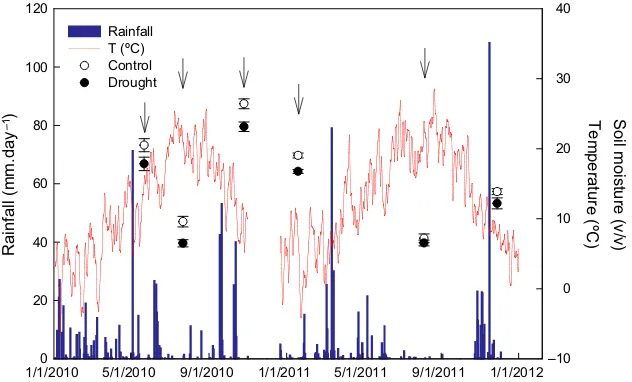
549 mm). More importantly, rainfall distribution
throughout the year differed between the 2 years. The seasonality of rainfall was typical for this site in 2010, with a wet spring and autumn and a summer drought that lasted 2 months. In contrast, 2011 had a wet March but afterward was generally very dry, with little precip-itation until the end of October. Total precipprecip-itation for 142 consecutive days was only 13 mm, without a single rainfall >3 mm, coinciding with the highest tempera-tures (Fig. 1). This period from April to September was the driest since 1975, as shown by the lowest September SPEI-6 and SPEI-3 for 1975–2011 (Figures S1 and S2).
The droughted plots during the study period had a
significantly lower soil-water content than the control plots (17.32 1.56 vs. 14.751.59%, pMCMC<0.05). Moreover, the droughted plots, which had been sub-jected to the treatment since 1998, had an average
reduction of 14.91.1% in total soil-water content
(pMCMC<0.01, for 1998–2011). Soil moisture ranged between 4.7 and 26.4% (v/v) during the period of study.
Midday foliar water potential
The plants in the drought treatment had significantly lower midday foliar water potentials (Ψmd) than the
plants in the control plots ( 3.10.29 vs.
2.80.28 MPa, F=5.43, n=6, P<0.05). Ψmd
dif-fered significantly across seasons (F=144.99,
P <0.001), becoming more negative in the extreme
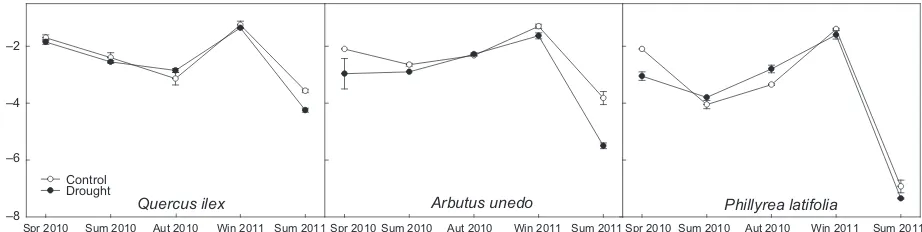
drought in 2011 (Fig. 2), and species (F=49.94,
P <0.001). The seasonal variation of Ψmd also differed significantly among species, as shown by the interac-tion between species and seasonal factors (F=12.04,
P <0.001), and the effect of the drought treatment also varied across seasons (F=3.52, P<0.05). Mean Ψmd was significantly lower inP. latifoliathan inQ. ilexand
A. unedo ( 3.710.46, 2.480.17, and 2.74 0.28, respectively, P <0.001, Tukey’s HSD test) but did not differ significantly between the latter two spe-cies.
Isotopic composition of plant-water sources
d18O and d2H in the soil water varied with depth and
season. Depth was negatively associated withd18O and d2H: the shallow (0
–10 cm) soil layer was significantly
1/1/2010 5/1/2010 9/1/2010 1/1/2011 5/1/2011 9/1/2011 1/1/2012
Rainf
all (mm.day
–1)
0 20 40 60 80 100 120
–10 0 10 20 30 40
Rainfall T (ºC) Control Drought
Temperatu
re (º
C)
Soil moisture (v
/v
)
Fig. 1 Daily precipitation and mean temperatures during the study period (2010–2011). Soil moisture in the control and drought plots.
more enriched in the heavier isotopes of O and H than the deep (10–35 cm) soil layer (posterior mean of the
effect (p.m.e.)= 0.12, pMCMC<0.001). The drought treatment did not affectd18O andd2H (pMCMC=0.51). The values ofd18O andd2H indicated the seasonal
pat-terns, being more depleted in autumn and winter than
in spring and both summers (winter p.m.e.= 0.84,
pMCMC<0.01; autumn p.m.e.= 1.19, pMCMC< 0.001; spring p.m.e.=2.04, pMCMC <0.001; summer
2010 p.m.e.=1.68, pMCMC<0.001; p.m.e. respect
isotopic ratios of summer 2011). Soil-water isotopic levels were significantly more enriched in heavier
iso-topes under the plastic strips (p.m.e.=0.76,
pMCMC<0.001). Water collected from a nearby spring, having an isotopic signature representative of the deeper water reserves, remained unchanged
throughout the seasons (d18O= 7.190.14 and
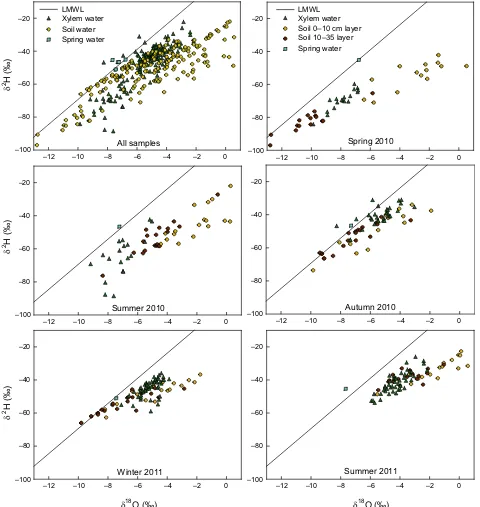
d2H= 47.341.29 &). Springwater samples fell along the local meteoric water line (Nealet al., 1992) (Fig. 3), indicating that it did not evaporate during infil-tration.
Determination of plant-water sources
The mixing model revealed that the canopy species in Prades forest took up water simultaneously from the three well-defined water pools; shallow soil (0–10 cm),
deep soil (10–35 cm) and groundwater. The largest
pro-portion was generally from shallow soil (38.71.5%),
followed by deep soil (31.231.4%) and groundwater
(30.101.5%). Water uptake, however, strongly varied
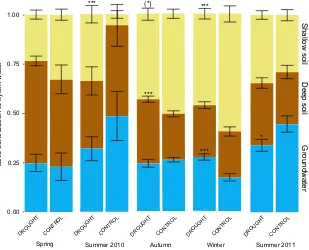
seasonally, as indicated both graphically (Fig. 3) and in the output of the siar models. The statistical assessment of these seasonal shifts of plant-water sources is sum-marized in Table S1. The shallow soil layer contributed the most to water uptake in autumn and winter (Table S1, Fig. 4), with significantly higher proportions than in the spring and summer of 2010. The contribution of the shallow soil to water uptake during the abnormally dry
summer in 2011, although lower than in the cold sea-sons, was higher than in the spring and summer of 2010 (Table S1). Deep soil (10–35 cm) was the main source of
water in the summer and spring of 2010, with lower rel-ative contributions in cold seasons and in summer 2011 (Fig. 4, Table S2 for statistics). Groundwater was the main water source in the summers of 2010 and 2011 (42.848.58 and 39.412.66%, respectively). The siar mixing models, however, attributed a contribution of approximately 25% of the total extracted water to this water pool, even in spring, autumn and winter when surface-soil water levels were high (Table S1, Fig. 4). The xylem samples to the upper left of the soil samples and near the LMWL in Fig. 3 (autumn and winter pan-els) indicate that in the cold seasons, the plants absorbed recent rainwater, which was not subject to iso-topic enrichment by evaporation from the soil surface. The seasonal patterns of water use did not differ signifi-cantly among the three species (Fig. 5, Table S2).
The long-term experimental drought treatment sig-nificantly affected the depth from which water was taken up in all seasons except for spring 2010 (Fig. 4, Table S2). These effects consisted of differences in the relative contribution of the water sources in response to the drought treatment. The shallow (0-10 cm) soil layer contributed relatively more water to the xylems of the droughted individuals during the summer of 2010 (33.834.47 vs. 5.581.94%, F=46.41, P <0.001,
ANOVA; Table S2, Fig. 4). This shallow soil layer, though,
contributed less water to the droughted individuals in
winter (44.912.17 vs. 59.714.06%, F=10.11,
P<0.01,ANOVA; Table S2, Fig. 4). In autumn, the deep (10–35 cm) soil layer contributed relatively more water
to the droughted individuals than to the control
indi-viduals (32.541.57 vs. 23.301.45%, F=17.68,
P<0.001, ANOVA; Fig. 4). During the extreme drought in the summer of 2011, the droughted individuals had reduced access to the deep water reserves (groundwa-ter) relative to the control individuals (33.952.99 vs.
Quercus ilex
Spr 2010 –2
–4
–6
–8
Sum 2010 Aut 2010 Win 2011 Sum 2011
Arbutus unedo
Spr 2010 Sum 2010 Aut 2010 Win 2011 Sum 2011 Midday leaf water potential (MPa)
Control Drought
Phillyrea latifolia
Spr 2010 Sum 2010 Aut 2010 Win 2011 Sum 2011
Fig. 2 Seasonal variation in midday foliar water potentials of the three species for control (open circles) and droughted (closed circles)
individuals. The droughted plants had significantly lower midday foliar water potentials (F=5.43,P<0.05, ANOVA). Differences
44.644.13%, F=4.33, P<0.05, ANOVA; Table S2,
Fig. 4). The proportion of groundwater uptake
remained<30% when the soil-water content was>15%.
The soil-water content was <10% in both summers,
coinciding with an increase in the proportion of groundwater taken up by the plants. The increase, how-ever, was higher in the control plants (Fig. 6).
Stem mortality rates and crown defoliation
The extreme drought in the summer of 2011 caused a significant increase in stem mortality rates relative to 2010 (F=5.23, P<0.05, ANOVA). Stem mortality rates were significantly higher in Q. ilex than in P. latifolia
(F=7.79, P<0.05, ANOVA; Fig. 7).Quercus ilex had the
18 O (per mil)
–12 –10 –8 –6 –4 –2 0
–100 –80 –60 –40 –20
Spring water LMWL Xylem water Soil water
X Data
–12 –10 –8 –6 –4 –2 0
–100 –80 –60 –40 –20
Soil 0–10 cm layer Soil 10–35 layer Xylem water LMWL
Spring water
All samples
X Data
–12 –10 –8 –6 –4 –2 0
–100 –80 –60 –40 –20
Spring 2010
X Data
–12 –10 –8 –6 –4 –2 0
–100 –80 –60 –40 –20
Summer 2010
δ18O (‰)
–12 –10 –8 –6 –4 –2 0
–100 –80 –60 –40 –20
Autumn 2010
δ18O (‰)
–12 –10 –8 –6 –4 –2 0
–100 –80 –60 –40 –20
Winter 2011 Summer 2011
δ
2 H (‰)
δ
2 H (‰)
δ
2 H (‰)
Fig. 3 Water isotopes for all samples of xylem (triangles), soil (circles) and spring (squares) water. All samples are plotted in the upper
second highest annual stem mortality rate in 2011 since the onset of the experiment in 1998, andP. latifoliahad the third highest rate for the same period.Arbutus unedo
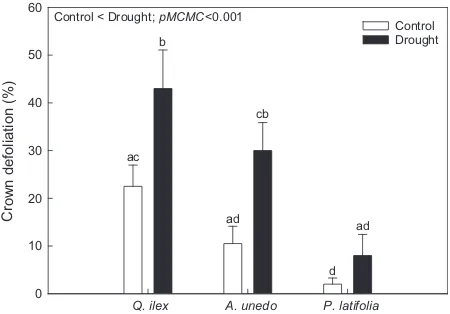
was not included in these analyses because of its low sample size. The percentages of crown defoliation following the drought in 2011 were generally
signifi-cantly higher in the drought treatments than in the
con-trol plots (p.m.e.=1.20, pMCMC<0.01, MCMCglmm;
Fig. 8), except for P. latifolia (6.0% difference between
treatments,P =0.84, ANOVAwith Tukey’s HSDpost-hoc
tests). Defoliation percentages for both Q. ilex and
A. unedo analyzed separately, however, were
signifi-0.00 0.25 0.50 0.75 1.00
Relative contribution to xylem water
CONTROL
DROUGHT DROUGHT CONTROL DROUGHT CONTROL DROUGHT CONTROL DROUGHT CONTROL
*
*** (*) ***
***
Spring Summer 2010 Autumn Winter Summer 2011
Shallow
soil
Deep soil
Groundw
ater
***
Fig. 4 Meancontributions of plant-water sources for each season in the control and drought treatments obtained by siar Bayesian
mix-ing models. The error bars are the standard errors of the means. The asterisks denote significance levels for the comparisons between the control and drought treatments performed by ANOVAs and Tukey’s HSD post-hoc tests (***P<0.001, **P<0.01, *P<0.05,
(*)P<0.1).
Spring 2010
Summer 2010 Autumn 2010 Winter 2011 Summer 2011
Percentage of groundwater uptake (%) 0 20 40 60 80
Q. ilex A. unedo P. latifolia
Fig. 5 Seasonal percentages of groundwater uptake in the three
species for each season. The errors bars are the standard errors of the means.
Soil moisture (v/v)
5 10 15 20 25 30
Percentage of groundw
a
ter uptake (%)
20 30 40 50 60 70
Control Drought
Fig. 6 Relationship between percentage of groundwater uptake
cantly higher in the drought plots (19.5% difference between treatments forA. unedo,P <0.01; 20.5% differ-ence between treatments for Q. ilex, P<0.01; ANOVA with Tukey’s HSDpost-hoctests; Fig. 8).
Discussion
This study investigated the combined effects of a long-term (12 years) experimental drought and an extreme natural drought on the patterns of water uptake by a
Holm oak forest growing on shallow soils over schist and so lacked access to a water table. The three species of trees studied have dimorphic root systems that enable access to different water sources in space and time but used water primarily from shallow soil layers but also water stored in the fractured schist. These find-ings are consistent with those of previous studies in other arid and semi-arid communities (Dawson & Pate, 1996; Davidet al., 2013; J. Oshun, W. E. Dietrich, T. E. Dawson, I. Fung, Submitted). Interestingly, the relative contribution of groundwater decreased in the drought treatment and during the extreme drought in 2011, sug-gesting that plant access to deeper groundwater pools had declined over time and in the extreme drought in 2011. This response was often coupled with a decrease inΨmd, hence suggesting that the plants were subjected
to high levels of drought-induced water stress. Recent studies have demonstrated the important role of deep water sources in the response to extreme droughts and their links to tree mortality and species-specific water-use strategies (Westet al., 2012; Anderegget al., 2013b; Kukowski et al., 2013), but the long timescale of this study allowed an assessment of the accumulative effect of experimental drought on root functioning and on the zones of water uptake that helped sustain this function-ing.
During seasons in which soil-water content was >15%, the soil-water pool (0
–10 and 10–35 cm soil
lay-ers combined) supported forest transpiration, with a contribution of at least 75% (Fig. 4). David et al.(2013) reported a contribution of soil water near 100% in win-ter in a more mesic savannah containingQ. suberoaks. The vegetation on the steep and shallow soils of our study site thus appeared to require a contribution to transpiration from the deeper groundwater, even dur-ing wet seasons. Likewise, the highest transpiration rates occurred in summer in the more mesic sites
(David et al., 2013), whereas stomatal conductance
decreases in spring and summer in the Prades Holm oak forest (Penuelas~ et al., 1998; Ogaya & Penuelas,~
2003), suggesting that the groundwater reserves may not be able to meet the high evaporative demand. The use of groundwater, though, increased in both sum-mers (Fig. 4), confirming that the allocation of growth to deep roots is an advantageous strategy for with-standing very dry periods (Canadellet al., 1996, 1999). The deeper (10–35 cm) soil horizon at our site supplied
most of the water that plants used in the relatively wet spring of 2010. The similar isotopic signatures of the xylem waters in the spring and summer of 2010 (Fig. 3) suggest that rainwater from late winter and spring was used throughout the dry season. This finding is further supported by the highest relative contribution of the
water from the deep (10–35 cm) soil horizon in the
2010 2011
Fig. 7 Stem mortality rates forQuercus ilexandPhillyrea latifolia
(2010 and 2011) calculated for the plots where the isotope sam-ples were collected. Different letters indicate significantly differ-ent stem mortality rates, which were assessed by ANOVAs (P<0.05).
Q. ilex A. unedo P. latifolia
Crown defoliation (%) Control < Drought; pMCMC<0.001
ac
Fig. 8 Crown defoliation (%) following the extreme drought in
2011 for each species and treatment for the plots where the iso-tope samples were collected. The error bars are the standard errors of the means (n=10). Different letters indicate significant
differences between group percentages, assessed by ANOVAs
summer of 2010 (Fig. 4) and by correlations between
drought indices and stem mortality (Barbeta et al.,
2013). The roots ofQ. ilexcan access bedrock fractures seeking moisture, especially in dry areas (Canadell
et al., 1999). We also observed this capacity in the tall shrubsA. unedoandP. latifolia, in agreement with prior observations of woody Mediterranean species (Cana-dell & Zedler, 1995; Westet al., 2012). In addition, the seasonal patterns of water uptake were consistent for the three plant species we studied (Fig. 5). This finding helps us to rule out the possibility of species-specific use of water sources, suggesting that the reported dis-parity in their physiological, morphological and demo-graphic responses to drought (Martınez-Vilalta et al., 2003; Ogaya & Pe~nuelas, 2006; Barbetaet al., 2012, 2013) cannot be directly attributed to rooting depth or sea-sonal patterns of water uptake, as similarly found in South African fynbos (Westet al., 2012).
The seasonal patterns of water uptake varied greatly in the three species. The differences we observed in the use of water sources between the drought and control treatments could be a short-term response to the lower availability of water. The effect of the drought treat-ment on soil moisture, however, was much weaker than that of the seasonal variation. Because we did not detect differences in plant-water sources between autumn and winter despite the different environmental conditions (highlighted by contrasting plant-water sta-tus (Fig. 2), the higher dependence of the droughted plants on water from the deep (10–35 cm) soil horizon
(Fig. 4) does not represent a transient response (sensu
Martin-Stpaul et al., 2013) but a persistent shift in the vertical distribution of fine roots induced by our long-term experiment. Furthermore, short-long-term experimen-tal drought may not affect the depth of water uptake in trembling aspens (Anderegget al., 2013b), although the water sources for this species varied little seasonally.
Quercus ilexhas less fine-root biomass in the top 10 cm of soil than in deeper layers (Canadellet al., 1999; Lopez
et al., 2001), arguably because the elevated soil tempera-tures in summer in Mediterranean ecosystems can dehy-drate or even kill fine roots. Consequently, the decrease in soil moisture induced by the drought treatment may have exacerbated this situation, favoring the production of fine roots in deeper soil layers. In contrast, the lower contribution of groundwater in droughted plants in the summer of 2011 relative to the summer of 2010 (Figs 4 and 6) may be a direct consequence of a decreased recharge of the groundwater or water that resides within the bedrock fractures during rainy seasons. The capacity of plants to redistribute their fine roots within the soil profile, based on our results, is evidence of phenotypic plasticity in a key trait of the plant-water relationship (root functional distribution). Understanding the limits
of species-specific plasticity for any trait or suite of traits is crucial for predicting the responses of species to envi-ronmental change (Matesanz & Valladares, 2013; Moritz & Agudo, 2013). Together with ecosystem structural changes (Lloret et al., 2012), species-specific responses are likely to help buffer plants against the negative effects of climate change. A dampening of the drought treatment has also been observed in our study system (Barbetaet al., 2013; Rosaset al., 2013); the effect of the drought treatment on tree growth tended to decrease over time. A shift in the distribution of fine roots would thus be another possible factor leading to a dampening pattern, along with other alterations such as reductions in foliar area (Ogaya & Penuelas, 2006; Limousin~ et al., 2009) and adjustments of xylem hydraulic properties (Martin-Stpaulet al., 2013).
The vegetation faced average meteorological condi-tions in the summer of 2010, but April to September
2011 was extraordinarily dry (Poyatos et al., 2013),
increasing tree mortality inQ. ilex(Fig. 7) and inducing
widespread crown defoliation, especially in A. unedo
andQ. ilex(Ogayaet al., 2014) (Fig. 8). The levels of soil moisture in the upper 25 cm, however, were not sub-stantially different between the summers of 2010 and 2011 (Fig. 1), andΨmd was more negative in the three
species in 2011 (Fig. 3). Plants extracted significantly
more water from the 10–35 cm soil horizon and less
from the 0-10 cm soil horizon during the moderate drought of 2010 than during the drier summer of 2011 (Fig. 4), suggesting that the drought-induced forest decline may have been associated with the lower con-tributions of deep soil-water reserves to the uptake of water by the trees. The characteristics of the geological substrate (Lloretet al., 2004), soil depth (Galianoet al., 2012) and soil-water storage capacity may thus interact with extreme droughts to determine the patchy land-scape of forest declines. Accordingly, the use of deep water reserves are likely required for the maintenance of transpiration and carbon assimilation during droughts in Mediterranean oaks (Canadellet al., 1996; Davidet al., 2007, 2013). The more anisohydricP. latifo-lia, however, was less affected by the acute drought in
2011 (Fig. 7), and its Ψmd and crown defoliation
species-specific seasonal patterns of transpiration rates should be combined with the depth of water uptake to obtain a complete picture of species-specific water use. Moreover, some of the species studied may be able to move water through roots at different depths (hydrau-lic lift and downward siphoning), which could mask the impossibility of the roots of the other species to reach deep water reserves.
The lack of hydraulic niche segregation among the co-occurring species in this Holm oak forest contrasts with the findings of other recent studies in other Medi-terranean systems (Araya et al., 2011; Pe~nuelas et al., 2011; Westet al., 2012). It implies that the three species could be competing for the same water resources in space. The seasonal resolution of our measurements, however, prevented us from assessing species-specific differences in the timing of water use. The projected increase in the recurrence of extreme droughts, though, could favor the more drought-resistantP. latifolia over
Q. ilexandA. unedo. Changes in the distribution of fine roots, as suggested by our data, could buffer the species against environmental change to some extent, but we also found that an extreme drought could cause
wide-spread defoliation and tree mortality in Q. ilex and
A. unedo(Ogayaet al., 2014) (Fig. 8), associated with a reduction in groundwater uptake by these species in the drought treatment. Long and intense periods of drought such as occurred during the summer of 2011 will thus likely threaten the preservation of this com-munity in its current structure and composition, and these effects will presumably be amplified by a larger depletion of deep water reserves after several extreme droughts (see Schwinning, 2010).
The impact of recent climatic changes and particu-larly more acute and prolonged droughts on ground-water reserves is not well understood (Brolsma et al., 2010; Anderegg et al., 2013a; Sch€afer et al., 2013). The present study suggests that extreme drought and mod-erate but persistent drier conditions (simulated by our manipulation) may lead to the depletion of water reser-voirs from groundwater and weathered bedrock in this system. Mortality and high defoliation levels may reduce canopy transpiration and interception, which could ultimately trigger an increase in groundwater recharge. Future studies should examine the ability of the impacts of future climate on vegetation to offset the effects of a decline in precipitation and an increase in surface evaporation on groundwater recharge.
Acknowledgements
This research was supported by the Spanish Government projects CGL2010-17172 and Consolider Ingenio Montes (CSD2008-00040), by the Catalan Government project SGR
2009-458 and the European Research Council Synergy grant ERC-2013-SyG-610028 IMBALANCE-P. A.B. acknowledges an FPI predoctoral fellowship from the Spanish Ministry of Economy and Competitiveness that supported his visit to UC Berkeley. The authors thank Pilar Sope~na (University of Lleida) and Paul Brooks, Stefania Mambelli, and Allison Kidder (UC Berkeley) for lab assistance and the three anonymous reviewers who helped to improve the manuscript with insightful comments. The authors declare no conflicts of interest. This study is dedi-cated to the memory of our beloved friend and colleague Mon-ica Mejıa-Chang.
References
Allison GB (1982) The relationship between 18O and deuterium in water in sand col-umns undergoing evaporation.Journal of Hydrology,55, 163–169.
Anderegg WRL, Berry JA, Field CB (2012) Linking definitions, mechanisms, and modeling of drought-induced tree death.Trends in Plant Science,17, 693–700. Anderegg WRL, Kane JM, Anderegg LDL (2013a) Consequences of widespread tree
mortality triggered by drought and temperature stress.Nature Climate Change,3, 30–36.
Anderegg LDL, Anderegg WRL, Abatzoglou J, Hausladen AM, Berry JA (2013b) Drought characteristics’ role in widespread aspen forest mortality across Colo-rado, USA.Global Change Biology,19, 1526–1537.
Araya YN, Silvertown J, Gowing DJ, Mcconway KJ, Linder HP, Midgley G (2011) A fundamental, eco-hydrological basis for niche segregation in plant communities. New Phytologist,189, 253–258.
Barbeta A, Ogaya R, Penuelas J (2012) Comparative study of diurnal and nocturnal~ sap flow of Quercus ilex and Phillyrea latifolia in a Mediterranean holm oak forest in Prades (Catalonia, NE Spain).Trees,26, 1651–1659.
Barbeta A, Ogaya R, Penuelas J (2013) Dampening effects of long-term experimental~ drought on growth and mortality rates of a Holm oak forest.Global Change Biology, 19, 3133–3144.
Breshears DD, Myers OB, Meyer CWet al.(2009) Tree die-off in response to global change-type drought: mortality insights from a decade of plant water potential measurements.Frontiers in Ecology and the Environment,7, 185–189.
Brolsma RJ, van Vliet MTH, Bierkens MFP (2010) Climate change impact on a groundwater-influenced hillslope ecosystem.Water Resources Research,46, 1–15. Brooks JR, Barnard HR, Coulombe R, McDonnell JJ (2009) Ecohydrologic separation of water
between trees and streams in a Mediterranean climate.Nature Geoscience,3, 100–104. Canadell J, Zedler PH (1995) Underground structures of woody plants in
Mediterra-nean ecosystems of Asutralia, California and Chile. In:Ecology and Biogeography of Mediterranean Ecosystems in Chile, California and Australia(eds Kalin Arroyo MT, Zedler PH, Fox MD), pp. 177–210. Springer, New York.
Canadell J, Jackson RB, Ehleringer JB, Mooney HA, Sala OE, Schulze E-D (1996) Maxi-mum rooting depth of vegetation types at the global scale.Oecologia,108, 583–595. Canadell J, Djema A, Lopez B, Lloret F, Sabate S, Siscart D, Gracia CA (1999) Structure
and dynamics of the root system. In:Ecology of Mediterranean Evergreen Oak Forests (eds Roda F, Retana J, Gracia CA, Bellot J), pp. 47–59. Springer, Berlin/Heidelberg. Carnicer J, Barbeta A, Sperlich D, Coll M, Penuelas J (2013a) Contrasting trait syn-~ dromes in angiosperms and conifers are associated with different responses of tree growth to temperature on a large scale.Frontiers in Plant Science,4, 409. Carnicer J, Brotons L, Herrando S, Sol D (2013b) Improved empirical tests of
area-het-erogeneity tradeoffs.Proceedings of the National Academy of Sciences of the United States of America,110, E2858–E2860.
Christensen JH, Hewitson B, Busuioc Aet al.(2007) Regional climate projections. In: Climate Change 2007: The Physical Science Basis. Contribution of Working Group I to the Fourth Assessment Report of the Intergovernmental Panel on Climate Change (eds Sol-omon S, Qin D, Manning M, Chen Z, Marquis M, Averyt KB, Tignor M, Miller HL). pp. 848–940. Cambridge University Press, Cambridge, UK. New York, USA.
David TS, Henriques MO, Kurz-Besson Cet al.(2007) Water-use strategies in two co-occurring Mediterranean evergreen oaks: surviving the summer drought.Tree Physiology,27, 793–803.
David TS, Pinto CA, Nadezhdina Net al.(2013) Root functioning, tree water use and hydraulic redistribution in Quercus suber trees: a modeling approach based on root sap flow.Forest Ecology and Management,307, 136–146.
Dawson TE, Mambelli S, Plamboeck AH, Templer PH, Tu KP (2002) Stable isotopes in plant ecology.Annual Review of Ecology and Systematics,33, 507–559.
Eckhardt K, Ulbrich U (2003) Potential impacts of climate change on groundwater recharge and streamflow in a central European low mountain range.Journal of Hydrology,284, 244–252.
Eggemeyer KD, Awada T, Harvey FE, Wedin DA, Zhou X, Zanner CW (2009) Sea-sonal changes in depth of water uptake for encroaching trees Juniperus virginiana and Pinus ponderosa and two dominant C4 grasses in a semiarid grassland.Tree Physiology,29, 157–169.
Ehleringer JR, Dawson TE (1992) Water uptake by plants: perspectives from stable isotope composition.Plant Cell and Environment,15, 1073–1082.
Fan Y, Li H, Miguez-Macho G (2013) Global patterns of groundwater table depth. Sci-ence,339, 940–943.
Galiano L, Martınez-Vilalta J, Sabate S, Lloret F (2012) Determinants of drought effects on crown condition and their relationship with depletion of carbon reserves in a Mediterranean holm oak forest.Tree Physiology,32, 478–489.
Goldsmith GR, Mu~noz-Villers LE, Holwerda F, McDonnell JJ, Asbjornsen H, Dawson TE (2012) Stable isotopes reveal linkages among ecohydrological processes in a seasonally dry tropical montane cloud forest.Ecohydrology,5, 779–790. Gray AN, Spies TA (1995) Water content measurement in forest soils and decayed
wood using time domain reflectometry.Canadian Journal of Forest Research,25, 376–385.
Hadfield JD (2010) MCMC methods for multi-response generalized linear mixed models: the MCMCglmm R package.Journal of Statistical Software,33, 1–22. Kukowski KR, Schwinning S, Schwartz BF (2013) Hydraulic responses to extreme
drought conditions in three co-dominant tree species in shallow soil over bedrock. Oecologia,171, 819–830.
Kurz-Besson C, Lobo-do-vale R, Rodrigues MLet al.(2014) Cork oak physiological responses to manipulated water availability in a Mediterranean woodland. Agri-cultural and Forest Meteorology,184, 230–242.
Leuzinger S, Luo Y, Beier C, Dieleman W, Vicca S, Korner C (2011) Do global change€ experiments overestimate impacts on terrestrial ecosystems?Trends in Ecology & Evolution,26, 236–241.
Limousin JM, Rambal S, Ourcival JM, Rocheteau A, Joffre R, Rodrıguez-Cortina R (2009) Long-term transpiration change with rainfall decline in a Mediterranean Quercus ilex forest.Global Change Biology,15, 2163–2175.
Limousin J, Longepierre D, Huc R, Rambal S (2010) Change in hydraulic traits of Mediterranean Quercus ilex subjected to long-term throughfall exclusion.Tree Physiology,30, 1026–1036.
Lin GH, Sternberg L da SL (1993) Hydrogen isotopic fractionation by plant roots during water uptake in coastal wetland plants. In:Stable Isotopes and Plant Carbon-Water Relations. (eds Ehleringer JR, Hall AE, Farquhar GD), pp. 497–510. Depart-ment of Biology, University of Miami, Coral Gables, FL, USA.
Lloret F, Siscart D, Dalmases C (2004) Canopy recovery after drought dieback in holm-oak Mediterranean forests of Catalonia (NE Spain).Global Change Biology,10, 2092–2099.
Lloret F, Escudero A, Iriondo JM, Martınez-Vilalta J, Valladares F (2012) Extreme cli-matic events and vegetation: the role of stabilizing processes.Global Change Biol-ogy,18, 797–805.
Lopez B, Sabate S, Gracia CA (2001) Annual and seasonal changes in fine root bio-mass of a Quercus ilex L. forest.Plant and Soil,230, 125–134.
Martınez-Vilalta J, Prat E, Oliveras I, Pinol J (2002) Xylem hydraulic properties~ of roots and stems of nine Mediterranean woody species.Oecologia,133, 19– 29.
Martınez-Vilalta J, Mangiron M, Ogaya R, Sauret M, Serrano L, Pe ~nuelas J, Pinol J~ (2003) Sap flow of three co-occurring Mediterranean woody species under varying atmospheric and soil water conditions.Tree Physiology,23, 747–758.
Martin-Stpaul NK, Limousin JM, Vogt-Schilb H, Rodrıguez-Calcerrada J, Rambal S, Longepierre D, Misson L (2013) The temporal response to drought in a Mediterra-nean evergreen tree: comparing a regional precipitation gradient and a throughfall exclusion experiment.Global Change Biology,19, 2413–2426.
Matesanz S, Valladares F (2013) Ecological and evolutionary responses of Mediterra-nean plants to global change.Environmental and Experimental Botany,103, 53–67. Mcdowell N, Pockman WT, Allen CDet al.(2008) Mechanisms of plant survival and
mortality during drought?: why do some plants survive while others succumb to. New Phytologist,178, 719–739.
Moritz C, Agudo R (2013) The future of species under climate change: resilience or decline?Science,341, 504–508.
Mueller RC, Scudder CM, Porter ME, Talbot Trotter R, Gehring C, a., Whitham TG, (2005) Differential tree mortality in response to severe drought: evidence for long-term vegetation shifts.Journal of Ecology,93, 1085–1093.
Nadezhdina N, Ferreira MI, Silva R, Pacheco CA (2007) Seasonal variation of water uptake of a Quercus suber tree in Central Portugal.Plant and Soil,305, 105–119.
Neal C, Neal M, Warrington A,Avila A, Pi ~nol J, Roda F (1992) Stable hydrogen and oxygen isotope studies of rainfall and streamwaters for two contrasting holm oak areas of Catalonia, northeastern Spain.Journal of Hydrology,140, 163–178. Oerter E, Finstad K, Schaefer J, Goldsmith GR, Dawson T, Amundson R (2014)
Oxy-gen isotope fractionation effects in soil water via interaction with cations (Mg, Ca, K, Na) adsorbed to phyllosilicate clay minerals.Journal of Hydrology,515, 1–9. Ogaya R, Penuelas J (2003) Comparative field study of Quercus ilex and Phillyrea lati-~
folia: photosynthetic response to experimental drought conditions.Environmental and Experimental Botany,50, 137–148.
Ogaya R, Penuelas J (2006) Contrasting foliar responses to drought in Quercus ilex~ and Phillyrea latifolia.Biologia Plantarum,50, 373–382.
Ogaya R, Pen˜uelas J (2007) Tree growth, mortality, and above-ground biomass accu-mulation in a holm oak forest under a five-year experimental field drought.Plant Ecology,189, 291–299.
Ogaya R, Barbeta A, Basnou C, Pe~nuelas J (2014) Satellite data as indicators of tree biomass growth and forest dieback in a Mediterranean holm oak forest.Annals of Forest Science, 1–10.
Parnell AC, Inger R, Bearhop S, Jackson AL (2010) Source partitioning using stable isotopes: coping with too much variation.PLoS ONE,5, e9672.
Pe~nuelas J, Filella I, Llusia J, Siscart D, Pi~nol J (1998) Comparative field study of spring and summer leaf gas exchange and photobiology of the mediterranean trees Quercus ilex and Phillyrea latifolia. Journal of Experimental Botany, 49, 229–238.
Pe~nuelas J, Filella I, Lloret F, Pinol J, Siscart D (2000) Effects of a severe drought on water and~ nitrogen use by Quercus ilex and Phillyrea latifolia.Biologia Plantarum,43, 47–53. Pe~nuelas J, Terradas J, Lloret F (2011) Solving the conundrum of plant species
coexis-tence : water in space and time matters most.New Phytologist,189, 5–8. Pe~nuelas J, Sardans J, Estiarte Met al.(2013) Evidence of current impact of climate
change on life: a walk from genes to the biosphere.Global Change Biology,19, 2303–2338.
Poyatos R, Aguade D, Galiano L, Mencuccini M, Martınez-Vilalta J (2013) Drought-induced defoliation and long periods of near-zero gas exchange play a key role in accentuating metabolic decline of Scots pine.New Phytologist,200, 388–401. R Core Development Team (2012)R: A Language and Environment for Statistical
Com-puting. sR Foundation for Statistical Computing, Vienna, Austria. ISBN 3-900051-07-0. URL: www.r-project.org.
Rosas T, Galiano L, Ogaya R, Pe~nuelas J, Martınez-Vilalta J (2013) Dynamics of non-structural carbohydrates in three Mediterranean woody species following long-term experimental drought.Frontiers in Plant Science,4, 1–16.
Sch€afer KVR, Renninger HJ, Clark KL, Medvigy D (2013) Hydrological responses to defoliation and drought of an upland oak/pine forest.Hydrological Processes, doi: 10.1002/hyp.10104.
Schwinning S (2010) The ecohydrology of roots in rocks.Ecohydrology,245, 238–245. Schwinning S, Starr BI, Ehleringer JR (2005) Summer and winter drought in a cold
desert ecosystem (Colorado Plateau) part I: effects on soil water and plant water uptake.Journal of Arid Environments,60, 547–566.
Suarez ML, Ghermandi L, Kitzberger T (2004) Factors predisposing episodic drought-induced tree mortality in Nothofagus–site, climatic sensitivity and.Journal of
Ecol-ogy,92, 954–966.
Tardieu F, Simonneau T (1998) Variability among species of stomatal control under fluctuating soil water status and evaporative demand : modelling iso-hydric and anisoiso-hydric behaviours Franc.Journal of Experimental Botany, 49, 419–432.
Terradas J (1999) Holm oak and holm oak forests: an introduction. In:Ecology of Medi-terranean Evergreen Oak Forests(eds Roda F, Retana J, Gracia C, Bellot J), pp. 3–14. Springer, Berlin/Heidelberg, Berlin.
Vicente-Serrano SM, Gouveia C, Camarero JJet al.(2013) Response of vegetation to drought time-scales across global land biomes.Proceedings of the National Academy of Sciences of the United States of America,110, 52–57.
West AG, Patrickson SJ, Ehleringer JR (2006) Water extraction times for plant and soil materials used in stable isotope analysis.Rapid Communications in Mass Spectome-try,20, 1317–1321.
West AG, Goldsmith GR, Brooks PD, Dawson TE (2010) Discrepancies between iso-tope ratio infrared spectroscopy and isoiso-tope ratio mass spectrometry for the stable isotope analysis of plant and soil waters.Rapid Communications in Mass Spectrome-try,24, 1948–1954.
isotope ratio infrared spectroscopy (IRIS).Rapid Communications in Mass Spectrome-try,25, 2268–2274.
West AG, Dawson TE, February EC, Midgley GF, Bond WJ, Aston TL (2012) Diverse functional responses to drought in a Mediterranean-type shrubland in South Africa.New Phytologist,195, 396–407.
Witty JH, Graham RC, Hubbert KR, Doolittle JA, Wald JA (2003) Contributions of water supply from the weathered bedrock zone to forest soil quality.Geoderma, 114, 389–400.
Wu Z, Dijkstra P, Koch GW, Pe~nuelas J, Hungate BA (2011) Responses of terrestrial ecosystems to temperature and precipitation change: a meta-analysis of experi-mental manipulation.Global Change Biology,17, 927–942.
Zegelin SJ, White I, Jenkins DR (1989) Improved field probes for soil water content and electrical conductivity measurement using time domain reflectometry.Water Resources Research,25, 2367–2376.
Zeppel M (2013) Convergence of tree water use and hydraulic architecture in water-limited regions: a review and synthesis.Ecohydrology,6, 889–900.
Supporting Information
Additional Supporting Information may be found in the online version of this article:
Figure S1.Temporal series (1975–2011) of the Standardized Precipitation and Evapotranspiration Index (SPEI) for September
calcu-lated for two timescales: 3 months (black line), which integrates the water balances of July, August and September, and 6 months (red line), which integrates the water balances of April, May, June, July, August, and September. Note that both indices reached the period’s minimum in 2011.
Figure S2.Monthly values of the Standardized Precipitation and Evapotranspiration Index (SPEI) during the study period (2010,
black line; 2011, red line). Each panel corresponds to the timescale at which the index was calculated (1 month, 3 months, 6 months and 12 months).
Table S1.Pairwise comparison between the relative seasonal contributions of water sources using Tukey’s HSDpost-hoctests. The
mean difference is between pairs of seasons, and the range is the 95% confidence interval. The asterisks denote significance levels (***P<0.001, **P<0.01, *P<0.05, (*)P<0.1).
Table S2.Evaluation of the effect of the drought treatment and the species factor plus their interaction on the relative seasonal