* corresponding author: [email protected]
Effect of swimming and asthmatic exercise
on forced expiratory volume in 1 second
(FEV1) and levels of cortisol hormone in
asthmatics patients
Rahmaya Nova Handayani,1*, Denny Agustiningsih2, Achmad Djunaedi2
1Health Polytechnic of Purwokerto, Ministry of Health,2 Departement of Physiology, Faculty of Medicine, Universitas Gadjah Mada, Yogyakarta.
ABSTRACT
Bronchial asthma is one of the allergic diseases characterized by reversible bronchial narrowing due to bronchial hyperactivity and obstruction of respiratory tract. The prevalence and hospitalization rates of bronchial asthma keep increasing from year to year, causing asthma to be the top ten causes of morbidity and mortality in Indonesia. The decrease of the forced expiratory volume in 1 second (FEV1) is one of the indicators of the respiratory tract obstruction. Moreover, the cortisol hormone level is also associated with asthma. Asthma can be treated not only with pharmacological intervention but also physical exercises. The aim of the study was to assess the increase of FEV1 and cortisol hormone level after swimming and asthmatic exercise on asthmatic patients. This was a quasi experimental study using pre and post test control group design. Two groups of 10 asthmatic patients each conducted swimming and asthmatic exercise as intervention. On pre, middle and post swimming or asthmatic exercise, those two groups underwent the measurement of FEV1 using a spirometer and cortisol hormone levels using ELISA methods. The result showed that the value of FEV1 and cortisol hormone levels increased significantly after swimming and asthmatic exercise (p<0.05). Moreover, the improvement of FEV1 value and cortisol hormone levels of asthmatic patients in swimming were higher than asthmatic exercise. In conclusion, swimming and asthmatic exercise can increase the value of FEV1 and the levels of the cortisol hormone.
ABSTRAK
Asma bronkial merupakan salah satu penyakit alergi yang ditandai dengan penyempitan bronkus secara revesibel akibat hipersensitivitas bronkus dan penyempitan saluran pernafasan. Prevalensi dan tingkat penderita masuk rumah sakit selalu meningkat dari tahun ke tahun yang menyebabkan asma menjadi 10 besar penyebab kematian dan kesakitan di Indonesia. Penurunanforced expiratory volume in 1 second (FEV1) merupakan salah satu indikator penyempitan saluran pernafasan. Selain itu, hormon kadar kortisol juga dikaitkan dengan asma. Asma dapat disembuhkan tidak hanya dengan pemberian obat tetapi juga latihan fisik. Tujuan penelitian ini adalah untuk menilai kenaikan FEV1 dan hormon kortisol setelah renang dan latihan fisik asma pada penderita asma. Penelitian ini merupakan penelitian eksperimental kuasi menggunakan rancanganpre and post control. Dua kelompok penderita asma dengan 10 penderita masing-masing kelompok melakukan renang dan latihan fisik asma sebagai tindakan pengobatan. Sebelum, pada pertengahan dan setelah renang atau latihan fisik, kedua kelompok tersebut diukur FEV1 dengan spirometer dan kadar kortisol dengan ELISA. Hasil penelitian menunjukkan bahwa nilai FEV1 dan kadar hormon kortisol meningkat bermakna setelah renang dan latihan fisik (p<0.05). Selain itu, perbaikan nilai FEV1 dan kadar hormon kortisol penderita asma setelah renang lebih tinggi dari pada setelah latihan fisik. Dapat disimpulkan, renang dan latihan fisik dapat meningkatkan nilai FEV1 dan kadar hormon kortisol.
INTRODUCTION
Asthma is an inflammatory disease of respiratory tract that is associated with hiperresponsivity bronchial and obstruction of reversible respiratory tract.1The prevalence and incidence rates of asthma hospitalization increase progressively over time. Asthma in children will potentially interfere with their growth and development. Another negative impact of asthma is the frequent absence in school. Shortly, asthma can disrupt the quality of life in the form of activity obstacles and degrade one’s performance, if it is not handled properly.2
The predominant symptom in asthma is respiratory tract obstruction. One parameter for respiratory tract obstruction is the decrease of Forced Expiratory Volume in 1 second (FEV1). Forced Expiratory Volume in 1 second is the amount of air released as quickly as possible on the first one second after taking deep breaths.3 Another important issue related to asthma is the amount of cortisol hormone secreted by hypothalamus pituitary adrenal axis. The cortisol hormone may increase -adrenergic receptor responsiveness in smooth muscle of respiratory tract. Cortisol can also reduce airway hiper-responsivity because it decreases the number of circulating eosinophils, inhibiting the production and secretion of cytokines in the respiratory tract.4The stimulation (exercise or stress) on the sympathetic nervous system will cause the release of epinephrine and nor-epinephrine which will result in dilatation of the respiratory tract.3Doing physical exercise regularly can cause the increase in the muscle mitochondrial capacity of airways.5
Some physical exercises are highly recommended for asthmatic people, for example, asthmatic exercise and swimming. Swimming and asthmatic exercise are aerobic physical exercise,
changes in some muscle fibers from a “fast glykolytic / FG fiber” to “fast oxidative-glycol tic/FOG fiber”. The muscle fibers changes can lead to an increase in diameter, the number of mitochondria, muscle strength and blood supply to the respiratory system.3This study examined whether swimming and asthmatic exercise can increase FEV1 and cortisol hormone level in asthmatic patients.
MATERIALS AND METHODS
Research design
This was an experimental quasi study with pre-post-test group design. FEV 1 and the cortisol hormone level measurement were performed at the early, middle, and at the end of swimming and asthmatic exercise treatment. The protocol of the study has been approved by the Medical and Health Research Ethics Committee, Faculty of Medicine, Universitas Gadjah Mada.
Subjects
The research subjects were men aged 20-45 years, doing exercise regularly with several inclusion criteria including FEV1% 40% -75%; normal FVC (4000-6000 L); the fitness level was good (50-80). Subjects were divided into 2 groups with 10 asthmatic patients in each group. The first group (Group 1) was asthmatic patients doing swimming and the second group (Group 2) was asthmatic patients doing asthmatic exercise.
Intervention/treatment
swimming intensity was 70-75% of maximum pulse within 20-30 minutes. FEV1 and cortisol hormone level from peripheral blood were measured after 18th and 36thexercise and 24 hours post the last exercise using ELISA method. The subjects in Group 2 did the asthmatic exercise starting from the 3rddays after the first FEV1 and cortisol hormone level measurement, with the same intensity and duration as Group 1 within 30-45 minutes. The asthmatic exercise was performed every Tuesday, Thursday and Saturday. At the end of each session of asthmatic exercise, pulse rate was counted. FEV1 and cortisol hormone level from peripheral blood were measured after 18thand 36thexercise and 24 hours post the last exercise using ELISA method with the same method to Group 1.
Data analysis
Data were analyzed with SPSS version 18.0 to assess the increase of FEV1 and cortisol hormone levels before and after swimming and asthmatic exercise. Analysis of variance
followed by the paired t-test as statistical tests was used to analyse before and after intervention . Meanwhile, to assess the differences in swimming and asthmatic exercise to the value increase of FEV1 and the cortisol hormone level, the statistical test of unpaired t-test was used.
RESULTS
Characteristic of the subjects
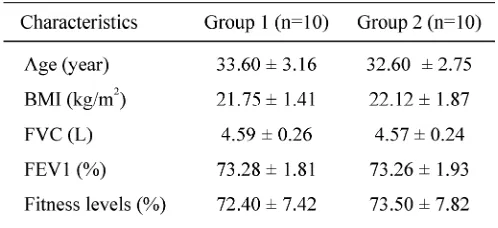
All subjects in two groups intervention have similar characteristic, such as the mean of age, BMI, FVC FEV1 and the fitness level. The variation of differences between both groups was not significant (p> 0.05) (TABLE 1). The means of age were 33.6 and 32.6 years in Group 1 and 2, respectively. The mean of BMI of Group 1 was 21.75 and Group 2 was 22.12. The means of FVC in both groups were closely similar, which were 4.59 and 4.57 liters in Group 1 and 2, respectively. The mean of FEV1 in both groups was about 73% and the fitness level in group 1 and 2 were 72.4 and 73.5, respectively.
TABLE 1. Characteristics of subjects (mean ± SD) before intervention
FEV 1 value after intervention
FEV1 values of both group were measured during pre-, middle- and post-physical intervention. The FEV1 values after swimming
TABLE 2. Cortisol hormone level at pre-, middle- and post- physical in-tervention in both groups
Note:*= 3 days before intervention,**= 18 times after intervention,***= 36 times
after intervention;a, b, c= significant difference
Comparison of FEV1 and cotisol hormone level between Group 1 and Group 2
The increase of FEV1 values and cortison hormone levels after post intervention compare
to before intervention in Group 1 were signi-ficantly higher compared to Group 2 (p< 0.05) as presented in TABLE 3.
TABLE 3. Comparison of FEV1 values and cortisol hormone level between Group 1 after swimming and Group 2 after asthmatic exercises
DISCUSSION
Variation in clinical assessment of FEV1 using spirometer is influenced by several aspects including the tools, procedures and biological variation of subjects. Biological variation includes intraindividual and inter-individual factors. Intrainter-individual variation consists of body and head position, and the muscle power. Interindividual factors which affect lung functions are gender, body size, age, race, health conditions and environmental factors such as geographic factors, environ-mental and occupational exposure in air pollution and socioeconomic status.7
The improvement of FEV1 values at pre-, middle- and post-physical activities in either swimm-ing or asthmatic exercise indicates the presence of stimuli (exercise or stress) on the sympathetic nervous system, which will cause
The release of epinephrine and norepinephrine results in the dilatation of respiratory tract.3 Swimming and asthmatic exercise are aerobic exercises that can alter the muscle fibers, which lead to the change of some fibers called “fast glycolytic/FG fiber” into “fast oxidative-glycolytic/FOG fiber”. The change will cause the increase of diameter and the number of mitochondria, blood supply and muscle strength in the respiratory system.
respiratory endurance of people who carry out long-distance running is higher compared to those who do asthmatic exercise, and the cardio respiratory endurance of people who do asthmatic exercise is higher than the ones who do not do any exercise.
In this study, the cortisol hormone level increased after 18thintervention and tended to be higher at 36thintervention. The increase of variation of cortisol hormone level depends on the intensity and duration of exercise, nutritional status, fitness levels and circadian rhythms. The increase of cortisol hormone level after exercise is also associated with lipolysis, cytogenesis, and proteolysis.5
The increase of cortisol hormone level is also influenced by hypothalamus. Hypothalamus secretes CRH, which will stimulate the anterior pituitary to release ACTH and lead to the release of cortisol hormone.9Cortisol hormone can increase the responsiveness of â-adrenergic receptor on airway smooth muscle. When a postganglionic neuron of the sympathetic division is activated, it releases norepinephrine as a neurotransmitter. At the same time, the adrenal medulla is stimulated to secrete epinephrine into the blood. Both norepinephrine and epinephrine regulate the target cells by binding to adrenergic receptors in the plasma membran. Acetylcholine (ACh) is released by all preganglionic neurons stimulates the postganglionic neurons by means of nicotinic ACh receptors. Postganglionic sympathetic axons provide adrenergic regulation of their target organs by binding the neuroepinephrine â2 adrenergic receptors causing the dilation of bronchioles of lungs as well reducing airway hiperresponsivity.11This is possible because it can decrease the number of circulating eosinophils, the production and secretion of cytokines in the respiratory tract.4In this study, the increase of cortisol hormone level was
accompanied by the increase of FEV1. Subjects with asthma carrying out swimming and asthmatic exercise improved their cortisol hormone level compared to subjects with asthma who did not do swimming and asthmatic exercise 8. This study strengthens Yunus’s statement that exercise can improve the cardiorespiratory function.
In this study, the swimming intensity is 70% - 75% between 20-30 minutes. The exercise intensity and duration used in this study is different with those recommended by McArdle.5 However, the intensity and duration in this study are able to stimulate the body’s response. According to McArdle et al.5, low-intensity exercise (60%) with a period of 45 minutes can also provide benefits. Therefore, when performing low-intensity exercise, a long duration is recommended.
The result of this study showed that the cortisol hormone level was higher in the group which carried out swimming than in those who did ashmatic exercise because the pressure in the water can cause lipolysis, cytogenesis, and proteolysis, which will lead to cortisol hormone secretion.10 The average calculation of metabolic at rest (MET) or oxygen uptake in liters per minute showed that the group who did swimming needed 1656.48 liters per minute, while the group who did gymnastics needed 1309 liters per minute. Based on these results, it can be concluded the group who carried out swimming needs more oxygen, so the energy released is also greater than the asthmatic exercise group.
CONCLUSION
Regular swimming and asthmatic exercise for asthmatic patients can increase FEV1 value and cortisol hormone level of the patients. However, the regular swimming can increase FEV1 and cortisol hormone level higher than the asthmatic exercise. The increase of FEV1 value and cortisol hormone level depends on the frequency, intensity, type and length of time of the physical exercise. Therefore hopefully, doing swimming and ashmatic exercise can reduce the frequency of drugs consumption in asthmatic patients. In addition, based on the results of this study, asthmatic exercise with longer duration can replace swimming. However, more study on the different intensity and duration of swimming and asthmatic exercise and the analysis of the frequency of asthma attack after swimming and asthmatic exercise needs to be done.
ACKNOWLEDGEMENTS
Authors would like to thank dr. Deny Agustiningsih., M. Kes., AIFM and dr. Ahcmad Djunaedi., AIFM for their supervision in doing this study.
REFERENCES
1. Sodeman. Patofisiologi. Edisi 7. Jakarta: Hipokrates, 1995.
2. Patu I. Tatalaksana asma jangka panjang pada anak. 2010. [Accesed at 2010 May 10]. Available from: cpddokter.com - Continuing Profesional Development Dokter Indonesia.
3. Tortora GJ, Derricson BH. Principles of anatomy and physiology. 1st
ed. New York: John Wiley and Sons Inc., 2009.
4. Barrett KE., Boitano S., Bahman S.M., Brook H.L. Ganong’s review of medical physiology. 28thed. New York: Lange Mc Graw Hill, 2010.
5. McArdle W.D, Katch F.I, Katch V.L. Essentials of exercise physiology. 7th ed. Pennsylvania: A Waverly Company, 1994.
6. Yunus, F. Latihan dan pernapasan. Jurnal Respirasi Indonesia 1997; 17:68- 9.
7. Yunus, F. Faal Paru dan latihan. Jurnal Respirasi Indonesia 2007; 17:100-5.
8. Handayani RN. Data not published. 2011. 9. McArdle WD, Katch FI, Katch VL. Exercise
physiology energy, nutrition & human performance. 6th
ed. New York: Lippicott William& Wilkins, 2004.
10. Robergs RA, Roberts SO. Exercise physiology: exercise, performance and clinical application. 1997. [Accesed at 2011 Jan 11]. Available from: http://www.unm.edu/~lkravitz/ Article%20folder/ cortisol.html.