II\TVESTII\TG
IN
FOOD
QIALTTY
Fl r{
lo
rl
I Ol
r\
OI
r*
r.I
z
ao
r^
SAFETY
&
I{I"JTRITION
Editor:
Lilis Nuraida Purwiyatno Hariyadi Ratih Dewanti-Hariyadi Harsi D. Kusumaningrum Desty Gita Pratiwi Nelis lmmaningsih
"rfrfiFH/T
*{tr,i};'r}-i{*
tnvesting tn Food Quotity, Safety and Nutrition
lmproving
Food SecuritYResearch Policy on Food Diversification in
lndonesia...'."""""""""313
Amin SaebandrioLocal Economy Empowerment and Food security: Lesson Learned ...'...315 Dohrul Syah
optimizing Food security through Bioavailability
lndices
...331 lndoh Epriliatilmprovement of Sago Competitiveness for Food Security in Maluku '...343
Wardis Girsang ond Eddy Ch.Papilaya
Development
of
lnstant corn as Raw Material for Traditionalcorn-Based Foods: an Effort to support the Food Diversification Program...361 Meta Mohendrodotta, Abu Bakar Tawoli, Amran Lago
Research and Development in Processing Technologies of corn
Noodle to Support NaiionalFood Security
Program
"""""""371
Feri Kusnondor
lndustrialization of Modified Cassava Flour (MOCAL/MOCAF) thro ugh cl uster I nd ustria I concept: from opportunity ldentification
to Market
Development...
""379
Achmod Subagio, Wiwik SitiWindroti, and Yuli Witono
Study On Noodle Making From Corn and Sago
F1ours"""""""""""""""'387
MoriyotiBilangDevelopment of Non-oilseed Legumes as a source of Protein to
Strengthen Food Security in
MarginalAreas
"""'397.
Achmad Subagio, Wiwik SitiWindrati, Yuli Witono ond A' Nofi'
consumption and Preference Survey on Maize Based Food Product in sub-Urban Area and Production area of Maize: case study in
Bogor and
Bojonegoro...'...'.
""""""405
HarsiD.Kusumaningrum ond Aldillo S. Utami
lmproving
Nutrition
public-private Partnership lnitiatives to lmprove community
Nutritional
Status
..'.""':""""'
"""""'415
HordinsYah
control of Blood Glucose Level by Green Tea and or Mullberry Leaf
Tea on Diabetic
Rats..."...
...'...'i"'
"""""""417
Evy Damayonthi, Rusman Efendi, Lilik Kustiyoh, and Nostitf Kusumorini
lndustrializat
(MOCAL/MOCAF)
from
Opportr
Achmad Subagic Faculty
of
Agricu Jl. Kalimaone of the best potential cro
especially starch as
the
majcmodified cassava flour, called
wheat flour. However, the problems
in
such areasof
tproduction continuity. Those r
community. Accordingly, the
industrial concept,
in
wherefollowing
a
central
millit' industrialization could generathe communi!y's income. Thi: of local government, food ir
presentation outlines the una
industrialization from oppo n r
lntroduction
Food
security
is
iindividual
to
accessnutrii
able
to
run
their
optin^:lndonesia (No. 7, 1996) ab
:ouseholds and families in
lnvesting ln Food Quolity, Safety and Nutrition
a
lndustrialization of
Modified
Cassava
Flour
... 313
'r're3 . ...315
331
a uku...343
Co
rn-)gram...361
r''l
.
,.',..,..'371,rat c n
379
387
tc
. ...397.
LL.IJ-L
n
,..,...,475
, ^^t rr -trd I
417
< - nrtnt
(MOCAL/MOCAF)
through
Cluster
tndustrial
Concept:
from
Opportunity
ldentification
to Market
Development
Achmad Subagio,
Wiwik
SitiWindrati,
andyuliWitono
Facultyof
Agricultural Technology, University of JemberJl. Kalimantan I Jembe
r
6SL2L|NDONES|AAbstract
One of the best potential crops for food diversification is cassava with carbohydrate, especially starch as
the
major component. We have successfully developed originalmodified cassava flour, called MOCAL or MOCAF which is applicable for substitution of wheat flour. However,
the
industrializationof
MOCAVMOCAF involves tacklingproblems
in
such areasof
technology, productivity, marketing price stability, and production continuity. Those matters are influenced by the socioeconomic condition ofcommunity. Accordingly, the MOCAL/MOCAF industry has been developed in a cluster
industrial concept,
in
where some small factoriesof
cassava chip are established followinga
central
milling factory.
Throughthis
method,
MoCAL/MOCAFindustrialization could generate economic activity based on local potential to increase
the communit/s income. This, indeed, can be achieved by encouraging the integration of local government, food industry business, farmers, and researchers it's self. This
presentation outlines the underlying methodological framework of this MOCALIMOCAF
industrialization from opportunity identifi cation to market development.
lntroduction
Food
security
is
internationallydefined
as
the
possibility
of
eachindividual
to
access nutrition, healthy, and safe food, which enables everyoneable
to
run
their
optimal
activitiesand life.
The
Regulationof
Republiclndonesia (No. 7, 1996) about food security defined it as a condition where all
I mi p iovi ng Food Secu ri ty
lndonesia
is
rich
in
natural resources. Oneof the
most, .promisi4g agr.iduituralproduct!
in'lndonesia is,cassava. Accordingto
the statiiiic,
the pioduction of cassava is the highest among the other seqondary crops (Table 1).On
2OO2,the'national
cassava.p,roduction reached 16.9million
tons,
andincreased significantly more thCn 2O riiillion tons at 2008. However,
the
use ofcassava as foods is
very
limited, since,,;
most lndonesians consider cassava as:,..
food for thbs.e of low- sociil-econOmit statui.
the
consumers swifch to consumerice i nstea.{ of - qassava. wh en the i r i ncome i ncreases.. Tt-t gpfgler, develop me nt of
cassava
into
products which could reducethe
"cassavafeel" is
necessary. Through applicationrof
fermentation techhology, cassava,is
processed intoMOCAL/MOCAF, which may have many advantages in food application. Mocal
is
likea
new hopeto
strengthen national food securityin
lndonesia throughfood
diversification.
.r
-l;:.;,,
Tabtel. Production of Secondary Food Crops in lndonesia (BPS; 2008)
2ffi2 9,654,'105 673,05,6 718,071 288,089 1,7V1,642
2003 10,886.442 671,600 7S5,526 335,n4 1,9s1,478
2CIO4 11,?25,243 723,483 837;495 21A,4',12 1,901,802
2005 12,523;894 808,353 836,295 320,963 1,8S,969
2006 12,495,742 783,554 851,1 33 311,623 1i868,994
N7
13,287,527 592,534 789,089 322,487 1,885,8522008t 14,8H,050 723,535 771,536 315,502 I,906,222
r Second forecast
.What
isMocaUMocaf?
MOCAL/MOCAF
is
flour
product dririved
fiom
cassaVa (Manihot esculento Crantz)which is
processedby
modifying cassavaplant
cells usingfermentation. Lactic acid bacteria (LAB) play
a
big rolein.this
fermentationprocess. These bacteria also produced enzymes that hydrolyze starch into sugar
and thus change
it
into rcauses characteristic cha
gelatinized
ability,
rehyt impacton
MOCAL/MO(cassava taste is covered ;
Based on Codex I
can be
classifiedas
a composition is not so dffispecific physicochem:=
MOCAL/MOCAF
is
lo','"e' because protein can causMOCAVMOCAF
is
bnirg:i.taste and aroma wtnidl.,
aroma. The MOCAUMCM
of starch granules Yreldftr
especially lactic acid, nfrri
The changing
C
SEM (Figure 1). At
1,m
starch granulesof
co,'meanwhile MOCAUhfiO( Bacteria grown durinrg ff
enrymes, which can d,s
granules
are
releaseo"magnification) were zoo surface were occurned lrr of the light, resultirE
r
ito
the
common casg'r:arougher, in where so,re
that
the
LAB
nnat
Erfermentation, amd L-e e
granule because scrne 1
processes affected
::
: en,ha^:i.E pasti.€ tefl'@J*reas
-e
r-'
s*e'lJ
:G,.
promising:
..,:lstic,
ther-,:.
Iablel).
_
- ::is,
and:,:- :ie
USe Ofl:'aaSSaVa aS ::
- io
consume:.,,elopment of
s
necessary.: -lcessed into
:?tion. Mocal
- - -. s ia th rough
..
(Manihot-:
:els
using'= -ilentation
',-
:to
sugarlnvesting ln Food euality, Safety and Nutrition
and thus change
it
into organic acids which most of them are lactic acid. This causes characteristic changed of the resulting flour, such as increased viscosity,gelatinized
ability,
rehydration capacity, and solubility. Therefore,it
has animpact
on
MoCAt/MocAF taste
which
becomesneutral;
thus the
originalcassava taste is covered as mueh asTAY,.
Based on Codex Standard, Codex Stan 176-1989 (Rev. 1 - 1995), MOCAL
can be
classifiedas an
edible
cassavaflour
product.
Eventhough
the composition is not so different to the original cassava flour, MocAL/MocAF has specific physicochemicaland
sensory
characteristics.protein
content of
MocAL/MocAF
is
lower than common eassava flour,which
is advantageous because protein can cause darken color when it is dried or heated. The color ofMocAL/MocAF
is
brighterthan
cassavaflour.
MoCAL/MoCAF has specifictaste and aroma which can cover
the
unfavorable cassavaflour
taste andaroma. The MocAL/MocAF taste and aroma changed occurs due
to
hydrolysisof starch granules yielding monosaccharide as material producing organic acids
especially lactic acid, which is then absorbed.
The changing
of
starch granule could be verywell
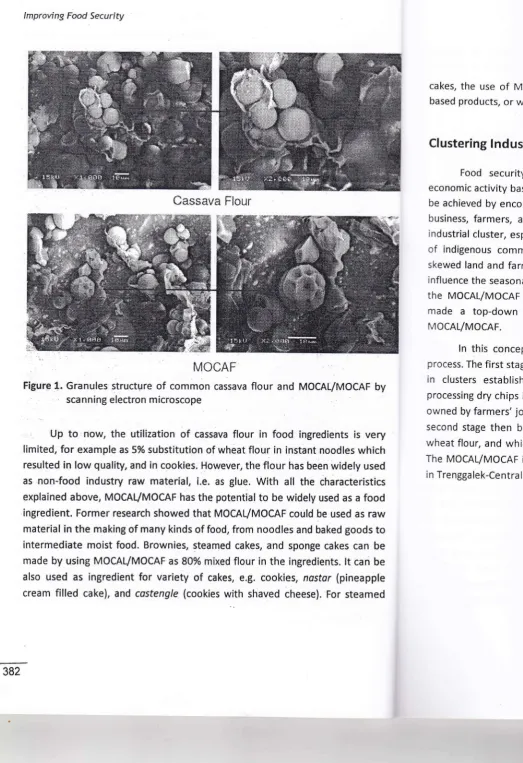
observed by usingsEM (Figure 1). At 1,000 times of magnification photograph
it
was seen that thestarch granules
of
common cassavaflour are
surrounded
by
cell
wall; meanwhile MocAL/MoCAF's starch granules are not surrounded by cell wall.Bacteria grown during fermentation may produce pectinolytic and cellulolytic
enzymes, which can destroy
the
cell wallsof
cassava, sothat
cassava starehgranules
are
released. Whenthe
bright
partsof
granule
(2,000 timesof
magnification) were zoomed,
it
was found that the damagesof
starch granulesurface were occurred intensively. The damage on the surface caused reflection of the light, resulting in appearance of bright parts. Furthermore, by comparing
to
the
common cassava flour,the
surfacesof
MOCAL/MOCAF granule were rougher, in where some holes presented distinctively. These results suggestedthat
the
tAB
may
produce amylasethat
hydrolyzedthe
starch
duringfermentation, and the easier part
to
be hydrolyzed is onthe
surface of starchgranule because some holes were produced in the surface
of
granule. Theseprocesses affected
to
the
functional propertiesof
MOCAT/MOCAF, such asenhancing pasting temperature, delaying gelatinization, increasing in viscosity,
decreasing
in
swell
capacity, and' improving stability, cooking quality, andlmproving Food Security
[image:6.595.58.582.36.800.2]MOCAF
]Figure 1. Granules structure
of
common cassavaflour
and MOCAL/MOCAF bysca nning electron microscope
Up
to
now,the
utilizationof
cassavaflour
in
food
ingredients is very limited, for example as 5% substitution of wheat flour in instant noodles which rezulted in low quality, and in cookies. However, the flour has been widely usedas non-food industry raw material, i.e. as glue.
With all
the
characteristics explained above, MOCAVMOCAF has the potentialto
be widely used as a food ingredient. Former research showed that MOCAL/MOCAF could be used as raw material in the making of many kinds of food, from noodles and baked goodsto
intermediate moist food. Brownies, steamed cakes, and sponge cakes can be
made by using MOCAL/MOCAF as 80% mixed flour in the ingredients. tt can be
also used as ingredient
for
varietyof
cakes, e.g. cookiest ndstor (pineapple creamfilled
cake), and castengle (cookieswith
shaved cheese). For steamedcakes, the use
of
MOCbased products, or whe
Clustering
lndustri
Food
security
e economic activity basedbe achieved by encoura
business, farmers, and
industrial cluster, espec
of
indigenous commoc skewed land and farm-sinfluence the seasonal a
the
MOCAL/MOCAF prrmade
a
top-down
prMOCAL/MOCAF.
ln this
concept,process. The first stage i
in
clusters establishedprocessing dry chips intr
owned by farmers' joint
second stage
then
beccwheat flour, and which The MOCAL/MOCAF ind in Trenggalek-Centra I Jar
lnvesting ln Food Quatity, Sofety and Nutrition
cakes,
the
useof
MocAL/MocAF can be applied inthe
makingof
riceflour-based products, or wheat flour added to tapioca.
clustering lndustriat concept
ln
MocaUMocaf
production
Food
security
empowermentshould also
be directed
to
generate economic activity based on local potential to increasa people,s income. This canbe achieved by encouraging the integration of local government, food industry business, farmers,
and
researchersto
encouragethe
establishmentof
food industrial cluster, especially in rural areas, which can increasethe
added valueof
indigenous commoditiesand improve
local people,s income. Moreover, skewed land and farm-size distribution, plus climatic fluctuations, also strongly influence the seasonal availability of cassava root, and thusthe
performanceof
the
MocAL/MocAF processing units.To
establishthis
integration,we
havemade
a
top-down
programto
develop
clusteringindustrial
conceptof
MOCAL/MOCAF.
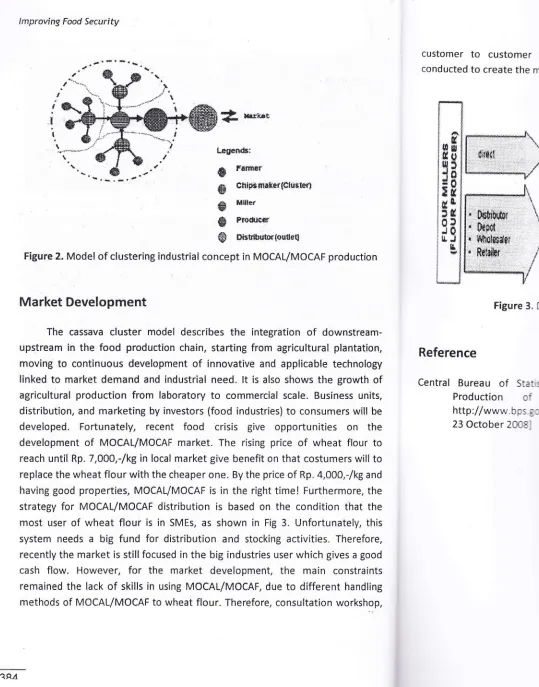
ln this
concept, MocAL/MocAF productionis
dividedinto
two-stageprocess. The first stage is the processing of cassava into dry chips, which is done
in
clusters establishedby
severalfarmers'
groups.The
second
stage isprocessing dry chips into MoCAL/MOCAF done in main factory, which could be
owned by farmers'
joint
group or privately owned. products resulting from thissecond stage
then
become ingredientsfor
the food industry, substituted forwheat flour, and which can then be processed further
to
other food products.The MOCAL/MOCAF industry adopting clustering concept has been estabtished in Trenggalek-Central Java, and the model is shown in Figure 2.
fMOCAF by
,Yrts is very
#les
whichridely used
lracteristics
d as a food
tsed as raw
#
goodsto
rkes can be
s.
lt
can be(pineappte
lmprovi ng Food Securi ty
F
."..,L:
Ii
*rot
Lagends::
&
ftntlsr@
ctrip.firik?f(clustef),a *llller
E
S
PrcaIC€re$
oiiutssts({qu{etlFigure 2. Model of clustering industrial concept in MOCAL/MOCAF production
Market Development
The cassava
cluster
model describesthe
integrationof
downstream-upstream inthe
food
production chain, starting from agricultural plantation, movingto
continuous developmentof
innovative and applicable technology linkedto
market demand and industrial need.tt
is also showsthe
growth ofagricultural production
from
laboratoryto
commercial scale. Business units,distribution, and marketing by investors (food industries)
to
consumers will bedeveloped. Fortunately,
recent
food
crisis give
opportunities
on
thedevelopment
of
MOCAL/MOCAF market.The
rising priceof
wheat flour
to reach until Rp.7,O0O,-/kg in local market give benefit on that costumers will toreplace the wheat flour with the cheaper one. By the price of Rp. 4,000,-/kg and
having good properties, MOCAL/MOCAF is in the right
time!
Furthermore, the strategyfor
MOCAL/MOCAF distributionis
based onthe
conditionthat
themost user
of
wheatflour
is in SMEs, as shownin
Fig3.
Unfortunately, this system needsa
big fund
for
distributionand
stocking activities. Therefore, recently the market is still focused in the big industries user which gives a goodcash
flow.
However,for
the
market
development,the
main
constraints remained the lackof
skills in using MOCAL/MOCAF, dueto
different handlingmethods of MOCAL/MOCAF to wheat flour. Therefore, consultation workshop,
customer
to
customer conducted to create the ne-"
I I
{
t
I
ffiffi.,,,,,.i,,1' ffilm$*r
$*tffi,;,,-Figure 3. t
Reference
Central
Bureau
of
Sta::Production
c'
http://www.bcs
;-23 October 2OCE'
fi' t8 sr
8U
tq3
JO
30
I(
g&
I(
0)
JOltJ
[image:8.595.56.596.31.718.2]customer
to
customer visits,conducted to create the market.
lnvesting ln Food euotity,
training
courses areSafety ond Nutrition
necessary
to
beand
rr:*Jt\
I
di{ffir
}
fry*4
l.
ru,**r
\
l'tu#
:\
l.
$llral*sd*r
I
l;
ftst*{ I
l;
IBI
til
i5f
tel
IEI
i0t
Iul
iJl
i(l
i* I
tEi
fl't
ihl
I5l
i0l
trt
t_r.
nflft,$IlE
{ffiilgxffi
i#
q
X*,*f*c.**iti,
f*r"*Xg-rC\t
$t{ff-+$s
*,***
f,t'i**fg**
*+Le.*t :production
lownstream-r! plantation, 3 technology
rc
growth of siness units, rrners will beies on
thercat
flour toumers will to
,0O0,-/kg and
'lermore, the
ion
that the unately, this s, Therefore,gives a good
r
constraints [image:9.595.0.586.15.750.2]ent
handling rn rvorkshop,Figure 3. Distribution of national flour industry
Reference
central
Bureau
of
Statistics tndonesia (Bps).2oog.
statistics
lndonesia:Production
of
secondary
Food
crops in
rndonesia,http://www. bps.go.id/se ctor / agri/ panga
n/table2.shtml,
[Accessed on23 October 20081
,
Inri:l$,lisr,**,
ftffi,,
r$f.
*isj$tl:*,k;*sr'