doi:10.1136/oem.2008.039883
published online 18 Nov 2008;
Occup. Environ. Med.
Tilja van den Berg, Leo Elders, Bart de Zwart and Alex Burdorf
the work ability index: A systematic review
http://oem.bmj.com/cgi/content/abstract/oem.2008.039883v1
Updated information and services can be found at:
These include: Rapid responses
http://oem.bmj.com/cgi/eletter-submit/oem.2008.039883v1
You can respond to this article at:
service Email alerting
top right corner of the article
Receive free email alerts when new articles cite this article - sign up in the box at the
Notes
Online First articles must include the digital object identifier (DOIs) and date of initial publication. establish publication priority; they are indexed by PubMed from initial publication. Citations to may be posted when available prior to final publication). Online First articles are citable and accepted for publication but have not yet appeared in the paper journal (edited, typeset versions
contains unedited articles in manuscript form that have been peer reviewed and
The effects of work-related and individual factors on the work
ability index: A systematic review
Tilja I.J. van den Berg1, Leo A.M. Elders1, Bart C.H. de Zwart2, Alex Burdorf1,3
1 Department of Public Health, Erasmus MC, Rotterdam, the Netherlands
2 AStri Research and Consultancy Group, Leiden, the Netherlands
3
Corresponding author
Erasmus MC
Department of Public Health
PO Box 2040
3000 CA Rotterdam
The Netherlands
tel: 0031-10-7038469
fax: 0031-10-7038474
e-mail: [email protected]
Keywords: work ability index, determinants, health promotion, systematic review
Word count: Abstract: 220
ABSTRACT
Objectives. This paper systematically reviews the scientific literature on the effects of individual and work related factors on the work ability index.
Methods. Studies on work ability published from 1985 to 2006 were identified through a structured search in PubMed, and Web of Science. Studies were included if the Work Ability Index (WAI) was used as measure of work ability (defined by the extent to which a worker’s capabilities is matched by the demands at work) and if quantitative information was presented on determinants of work ability. The methodological quality of studies was assessed.
Results. In total, 20 studies were included with 14 cross-sectional studies and 6 longitudinal studies. Factors associated with a poor work ability, as defined by WAI were lack of leisure-time vigorous physical activity, poor musculoskeletal capacity, older age, obesity, high mental work demands, lack of autonomy, poor physical work environment, and high physical work load. No differences were found in quality of the study for study design, type of determinant or significance of reported associations.
Main messages
1. In order to increase work participation and to prolong the working life among older workers the determinants of their work ability should be studied;
2. Important factors associated with a poor WAI were lack of leisure-time vigorous physical activity, poor musculoskeletal capacity, older age, obesity, high mental work demands, lack of autonomy, poor physical work environment, and high physical work load;
3. The potential impact of social and economic policies at company and national level on the work ability index remain largely unknown.
Policy implications
1. In programmes aimed at maintaining and promoting the participation of the labour force, interventions should be targetted at physical work load, poor physical work environment, and psychosocial demands as well as lifestyle factors, most notably leisure-time physical activity, and body mass;
INTRODUCTION
Most Western countries with an ageing population face the challenge of a need to increase work participation, especially at older age. Governmental policies are implemented to increase the age of full retirement in order to balance the ratio of employed over dependent persons.[1] Yet, in most countries the average age of permanent departure from paid labour is well below the statutory pension age [2], so there is a need to develop interventions that will facilitate workers to be engaged in paid employment until pension age.
Ageing of workers is accompanied with changes in physical and mental capacities. However, individual differences are large and lifestyle factors such as physical activity in leisure time may substantially influence the balance between work capacity and work demands.[3] Work demands that are not sufficiently attuned to physical and mental capacities of workers may increasingly cause health problems and subsequently displacement from the workforce.[2] The contribution of (work-related) health problems to unemployment and early retirement among older workers is substantial.[4]
In order to increase work participation and prolong the working life among older workers the concept of work ability has been developed in the early 1980s in Finland, and was later adopted in various other European and Asian countries. According to Ilmarinen [5], work ability is built on the balance between a person’s resources and work demands. The basis for work ability is health, and functional capacity, but work ability is also determined by professional
knowledge and competence (skills), values, attitudes, and motivation, and work itself.
Work ability has been measured in different ways. For example, by single questions asking respondents to range their current work ability on a 5 or 10-point scale.[6] Moreover, work ability has been defined as not being on long-term sick leave [7], or in total days on sick leave during the last 12 months.[8] Studies have shown that a poor work ability increased the risk on early retirement [9], long-term sickness absence, and work disability.[10]
The work ability index (WAI) [11] is by far the most used, and well-accepted instrument to measure work ability, as is demonstrated by its availability in 21 languages. Although several studies in different occupational settings have been conducted, there is a need for a systematic evaluation of the relative
METHODS
Identification of the studies
Relevant articles were identified by means of a computerized search of the bibliographical databases PubMed January 1985-December 2006, and Web of Science over the period January 1988-December 2006. The following search string was used: “work ability”. The search was restricted to studies published in the English language. The literature search identified 337 abstracts with 124 corresponding abstracts in both databases, resulting in 213 unique abstracts.
Selection
The initial selection of studies was performed by the first author (TB), and verified by the last author (AB). Studies were excluded if (a) the work ability index was not applied to describe work ability in an occupational population, and/or (b) no quantitative information on associations between individual and work-related factors and work ability was presented. The work ability index (WAI) is an assessment of the ability of a worker to perform his /her job, taking into accounts the specific psychosocial and physical work-related factors, mental and physical capabilities, and health. The index consists of a questionnaire on physical and mental demands of an individual in relation to his work, diagnosed diseases, limitations in work due to disease, sick leave, work ability prognosis, and psychological resources. These seven dimensions are rated and the summative index ranges from 7-49, which is classified into poor (7-27), moderate (28-36), good (37-43), and excellent (44-49) work ability.[11]
Based on title and abstract, 146 out of 213 abstracts (69%) was discarded due to lack of any quantitative description of associations between individual and work related determinants and the work ability index. Another 7 articles (3%) did not use the WAI for measurement of work ability. Another 4 abstracts were basically duplicates and 4 abstracts no full article. In total, 52 articles were retrieved for further review. Of these articles, 26 out of 52 (50%) were excluded due to lack of quantitative information on associations between determinants and work ability, and another 9 (17%) did not use the WAI. Thus, 17 (33%)
publications remained that met our selection criteria.[12-28] One publication was included after an additional search in the references of the articles included for review.[29]. Since two publications reported the results of both a cross-sectional study and a follow-up study, in total 20 studies were included in this
review.[16,22]
Data extraction
The data extraction on selected full articles comprised the study population, study design, research setting, outcome(s), determinants, confounders or effect
modifiers, and estimates of effects (with confidence intervals). Determinants of work ability, as defined by the WAI were categorized as individual
measurement itself, e.g. health complaints, and work satisfaction. Due to this dependency between determinant and WAI, these determinants were not
evaluated in this systematic review. Data extraction was performed by one author according to a standardized format (TB) and extracted data was reviewed by another author on consistency and completeness (AB). In case of doubt, data were discussed until agreement was reached (TB, AB).
The analysis focused on measures of association, expressed by for example an odds ratio (OR), or a regression coefficient. Whenever possible the measure of association was retrieved from the original article, together with the variables that were adjusted for in the statistical analysis. In case this information was not present, available raw data in a 2x2 table was used to calculate an odds ratio and confidence interval.
Classification of associations
In this review, 3 types of statistical associations are distinguished. The association is described as positive when a determinant is statistically significantly associated with an increased risk for a poor WAI or a reduced WAI. The association is describes as negative when a determinant is statistically significantly associated with a decreased risk for a poor WAI or a reduced WAI. In a null association no significant association was found between the determinant and WAI. In order to increase the comparability of the studies, the direction of the association presented in the original article was adjusted when needed to assure that an OR above 1 or a positive regression coefficient have a similar interpretation across all studies.
Quality assessment
The quality of the epidemiological studies (see table 1) was assessed by two reviewers (TB and AB) using a standardized form based on 7 items in a modified version of the guidelines for methodological quality assessment of the Dutch Cochrane Centre [30]:
- Study population; the characteristics of the population should be described in detail, at least age, gender, and occupation;
- Sample size and statistical power; the number of subjects should at least be 10 times the number of covariates;
- Response; the response at baseline should be at least 70%;
- Selection bias; substantial selection bias is not likely to be present; - Measurement error: Substantial misclassification in determinants is most
likely not present;
- The assessment of the determinants should be blinded to the WAI measurement;
- Confounding; the analysis should be adjusted for confounders.
Each criterion was rated when applicable, with a score of 1 being ‘sufficiently met’ , a score of 0 being ‘not sufficiently met’, and a question mark when
RESULTS
In total, determinants of work ability were reported in 14 cross-sectional studies, and 6 longitudinal studies. Individual characteristics were addressed in 18 studies and work-related characteristics in 9 studies. Occupations most studied in relation to work ability were (Finnish) municipal workers and care givers. In fact, all longitudinal studies regarding work-related characteristics were done among Finnish municipal workers.
The majority of the studies focused on a poor WAI as a dichotomous outcome, either defined by specific threshold level (mostly 37), lowest 25% or 15% percentiles (tables 2-5).
Individual characteristics
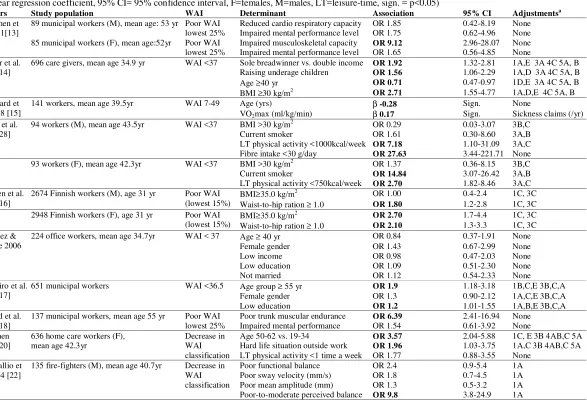
The demographic factor most studied was age (7 studies)(table 2 and 3). Four out of seven studies reported a decreased WAI with older age [15, 17, 20, 24], 2 studies demonstrated no association [26, 29] and one study found a higher risk for a poor WAI among younger workers. [14] Gender (n=2) [17, 29] was not associated with WAI, whereas a lower education was associated with a lower WAI in one study [17] and had no effect in another study.[29] Being a sole breadwinner, and degradation in economic position were associated with lower WAI [14, 27], whereas no relation was observed for low income.[29] Four studies reported on other individual characteristics. A lower WAI was associated with hard life situation outside work [20], raising underage children [14], and low self-confidence [23], and not significantly associated with marital status.[29]
One out of three studies found a positive association between a better cardiorespiratory fitness, expressed by maximum oxygen uptake, and a higher WAI.[15] All four studies on poor musculoskeletal capacity reported a significant association with a poor WAI with risk estimates varying from 6.4 to 9.1.[13,18, 19, 23] Poor functional balance in home care workers was associated with poor WAI [19], whereas this association was not observed in two studies among fire fighters.[22] Both studies on general cognitive mental performance showed no significant associations.[13, 18]
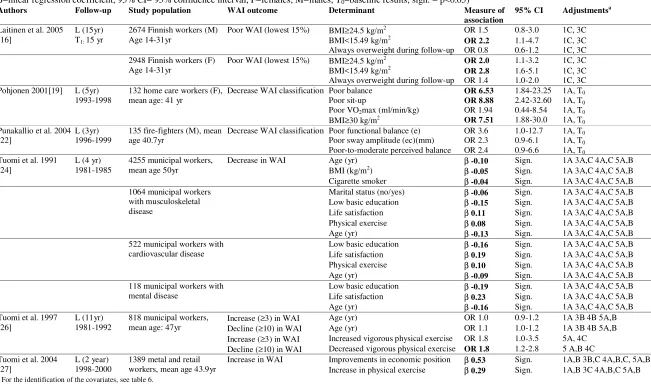
Overweight was positively associated with a poor WAI in four out of seven studies.[14, 19, 24, 25] Lack of leisure-time physical activity was
associated with a lower WAI in 4 out of 5 studies.[25-28] In one study smoking was associated with lower WAI [24], whereas in two studies no significant association was found.[25, 28] One study reported a positive effect of alcohol drinkers versus teetotalers on WAI.[25] In one study a diet with low fiber intake was reported with an odds ratio of 27.6 for a poor WAI.[28]
Work-related factors
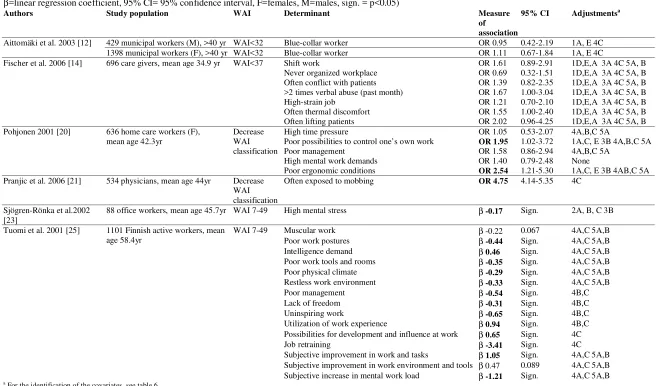
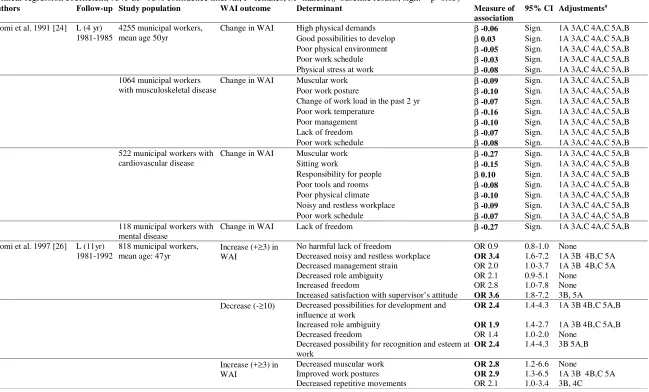
givers [14] no significant associations were reported. Three out of four studies reported a positive association with a poor WAI for lack of autonomy [20, 25, 27], whereas one study failed to corroborate this association.[26] High physical
demands, such as increased muscular work, poor work postures, and poor
ergonomic conditions were positively associated with a lower WAI in four out of seven studies.[20, 24, 26, 27] Regarding the physical work environment, 2 out of 4 studies reported a lower WAI with thermal discomfort and poor physical climate [24, 25], whereas another two studies did not find any association.[14, 26]
Quality rating
DISCUSSION
This review showed factors associated with a decreased work ability were lack of leisure-time vigorous physical activity, poor musculoskeletal capacity, older age, obesity, and high physical and psychosocial work demands. No conclusions can be drawn regarding the relative importance of the determinants, because of the large heterogeneity in study characteristics (study populations, sample size, definition of determinants).
Limitations
This systematic review has some limitations. The literature search may not be comprehensive enough, because publications in languages other than English were not included, and the search was limited to two computer-based
bibliographic databases. The search in Web of Science resulted in an additional 51 articles relative to Pubmed, but all of these were finally excluded. However, it cannot be ruled out that relevant publications would have been identified when using additional databases.
In the selection of relevant literature 16 abstracts (8%) were excluded, since work ability was used as a generic term without a clear method of measurement. These studies merely focused on generic work ability without measuring. In the full review of selected articles, 9 articles (18%) were excluded since work ability was not quantified (n=1) or measured differently from the WAI (n=8), for example using one question on current work ability with differing scales (n=4) or based on the number of sick leave days (n=2). This latter finding suggests that the WAI is indeed the most often used instrument to quantify the work ability in occupational populations.
An important limitation is that the majority of studies were of cross-sectional design and, as a consequence, causality cannot be determined. A clear example is the study reporting on a negative association between job retraining and a poor WAI.[31] It may be argued that job training is not a causal factor for poor WAI, but that workers with a poor WAI were likely to have received job retraining in order to increase their work ability.
Another limitation lies in the nature of the synthesis of results. A meta-analysis was not possible, because of the large heterogeneity in definition and measurement of determinants. For example, musculoskeletal capacity was characterized from a poor trunk muscular endurance to good spine forward flexion. Although the review was limited to studies using the same measurement method for work ability, comparability was hampered by differences in outcome definition (WAI as linear variable vs. dichotomized for poor work ability with different cut-offs). Besides, studies with different study designs (cross-sectional versus longitudinal) were included.
The selected studies were dominated by Finnish studies (70%), with also heavy emphasis on research among municipal workers. Therefore, some caution is needed in the generalisibility of the study results to other occupational
Interpretation of null associations
This review not only described individual and work related determinants associated with a poor WAI, but also evaluated negative and null associations (table 6). The number of null associations was independent of type of determinant and study design. A null association may be the result of (i) a small sample size and lack of statistical power, (ii) lack of exposure variability, (iii) presence of another risk factor or confounder, and (iv) non-differential measurement error. The first reason for an inconclusive result, a small sample size, may explain the non-significant associations for cardio respiratory capacity [13, 19], overweight [28], and poor functional balance [22] in study populations with less than 100 subjects. Similarly, a definition of a BMI equal or higher than 35 will probably not give a sufficient number of cases for a meaningful analysis.[16] Lack of exposure variability could be another explanation for null associations. For example, when the population was restricted to workers older than 40 years or workers within the same occupation, the population will be more homogenous and, hence, will have limited contrast in age and work related determinants and, thus, their influence on WAI will be difficult to determine.[24] The presence of another risk factor or confounder seems a likely explanation for the null associations in studies not controlled for confounders.[13, 29] Finally, a null association could also be due to substantial non-differential misclassification in the determinants. Misclassification is especially expected in self-reported measures with limited answer categories, for example leisure-time physical activity in three levels of frequency per week.[20] The quality assessment indeed showed most studies lost points because substantial misclassification in
determinants was likely to occur. The total quality score however showed no differences for type of determinant or significance of reported associations.
Individual determinants
For individual determinants the range in magnitude of associations was larger in cross-sectional studies than in longitudinal studies. A cross-sectional study design is more sensitive to bias, which may explain the larger differences in measure of association. For some determinants the available number of studies was too small to draw meaningful conclusions, gender (2 studies), education (2 studies), mental performance (2 studies). For other determinants the number of significant associations equaled the number of null associations, for example overweight (4 positive associations against 3 null associations).
Work related determinants
Despite the large differences in definition of the determinants and the validity of the measurement techniques applied, the studies consistently showed that important determinants for WAI were high mental work demands, poor autonomy, and high physical work demands. A recent study also demonstrated significant associations between these work related determinants and work ability.[32]
All work related determinants were measured by means of self-report. This assessment technique may lead to spurious results, when subjects with a poor WAI overestimate their physical and mental work load in the workplace relative to those with an excellent WAI. It is unclear if an objective measurement of the work demands would show similar results.
Some determinants, which feature prominently in the model of Ilmarinen [5] were not included in the observed studies. Health, functional capacity, and work were (over)represented in research, in respect to professional competence, and values, attitudes and motivation for work. Health, functional capacity and work related risk factors have a well-studied history in the field of work and health. The influence of competence and values, attitudes, and motivation on health-related performance at work clearly lags behind. This in agreement with the invitation of MacDonald et al. [33] to incorporate work organization into occupational health research. Besides, through increased medical standards and improvements in the work environment, it is expected that aspects of human resources management will become more important for improving work ability. This requires the development of valid measurement instruments, which until now are largely absent.
Implication for interventions
This study has presented important information to consider in programs aimed at maintaining or improving work productivity and work participation. The
interventions should focus on the identified determinants associated with a lower work ability. Several work-related determinants have also been identified as important risk factors for the occurrence of sickness absence [34] and for prolonged duration of sickness absence [35] and, hence, it is expected that interventions to promote maintaining or regaining a good work ability will also prevent partly (temporary) work disability. At individual level, it seems beneficial to target interventions at increasing leisure-time vigorous physical activity, increasing musculoskeletal capacity, and decreasing body mass index (i.e. obesity). Work related interventions should focus on an increase in autonomy at work, and decreases in physical and psychosocial demands. Professional
competence and attitudes and values towards work may also be essential points of interventions in workers with a decreased work ability, but their potential impact could not be demonstrated in this review.
leisure time and improved physical condition have shown positive effects, but were too small for a statistically significant change at the short term. [36-39]
Other intervention studies on work related determinants have shown promising results. Among employees in the construction industry with a high disability risk, an assessment and individual program for half a year focusing on optimizing functioning at work showed a slight, but insignificant, improvement in WAI.[40] Among farmers experiencing low back or shoulder pain
occupationally-oriented rehabilitation courses including training of ergonomically correct work techniques lasting 3 weeks, showed that changes in lifting techniques were minor after 1 year follow-up, but the WAI improved significantly for both men and women.[41] Among blue-collar workers with a high disability risk, an occupational health intervention program showed an increase inWAI, after six months follow-up, yet this positive effect was not present after two years.[42] Among truck drivers stress management [39] and among farmers training of work techniques [43] were both not significant in changing WAI. Thus, interventions on work related determinants have been conducted, but so far have failed to convincingly demonstrate significant improvements in WAI.
Concluding remarks
Goedhard 1998 [15] Cross-sectional 2 0 1 ? ? 1 ? 0
Kaleta 2006 [28] Cross-sectional 3 0 1 0 1 ? 1 1
Laitinen 2005 [16] Cross-sectional 5 1 1 0 1 1 ? 1
Laitinen 2005 [16] Prospective cohort 5 1 1 0 1 0 1 1
Martinez 2006 [29] Cross-sectional 5 1 1 1 1 0 1 0
Monteiro 2006 [17] Cross-sectional 6 1 1 1 1 ? 1 1
Nygard 1991 [18] Cross-sectional 4 1 1 ? 1 1 0 0
Pohjonen 2001 [19] Prospective cohort 5 1 1 ? ? 1 1 1
Pohjonen 2001 [20] Cross-sectional 6 1 1 1 1 0 1 1
Pranjic 2006 [21] Cross-sectional 5 1 1 1 1 0 1 0
Punakallio 2004 [22] Cross-sectional 6 1 1 1 1 1 ? 1
Punakallio 2004 [22] Prospective cohort 7 1 1 1 1 1 1 1
Sjögren-Rönkä 2002 [23] Cross-sectional 6 1 1 1 1 1 0 1
Tuomi 1991 [24] Prospective cohort 5 1 1 ? 1 0 1 1
Tuomi 1997 [26] Prospective cohort 6 1 1 1 1 0 1 1
Tuomi 2001 [25] Cross-sectional 5 1 1 1 0 0 1 1
Tuomi 2004 [27] Prospective cohort 5 1 1 0 1 0 1 1
1 = being ‘sufficiently met’ , 0 = being ‘not sufficiently met’, ‘?’ = information was lacking
on 10 December 2008
2006 [14] Raising underage children OR 1.56 1.06-2.29 1A,D 3A 4C 5A, B
LT physical activity <1000kcal/week OR 7.18 1.10-31.09 3A,C
Fibre intake <30 g/day OR 27.63 3.44-221.71 None
93 workers (F), mean age 42.3yr WAI <37 BMI >30 kg/m2 OR 1.37 0.36-8.15 3B,C
Current smoker OR 14.84 3.07-26.42 3A,B
LT physical activity <750kcal/week OR 2.70 1.82-8.46 3A,C
Laitinen et al. 2005 [16]
2674 Finnish workers (M), age 31 yr Poor WAI
(lowest 15%)
BMI≥35.0 kg/m2 OR 1.00 0.4-2.4 1C, 3C
Waist-to-hip ration ≥ 1.0 OR 1.80 1.2-2.8 1C, 3C
2948 Finnish workers (F), age 31 yr Poor WAI
(lowest 15%)
137 municipal workers, mean age 55 yr Poor WAI
lowest 25%
Poor trunk muscular endurance OR 6.39 2.41-16.94 None
Impaired mental performance OR 1.54 0.61-3.92 None
Pohjonen 2001 [20]
636 home care workers (F), mean age 42.3yr
Decrease in WAI classification
Age 50-62 vs. 19-34 OR 3.57 2.04-5.88 1C, E 3B 4AB,C 5A
Hard life situation outside work OR 1.96 1.03-3.75 1A,C 3B 4AB,C 5A
LT physical activity <1 time a week OR 1.77 0.88-3.55 None
Punakallio et al. 2004 [22]
135 fire-fighters (M), mean age 40.7yr Decrease in
For the identification of the covariates, see table 6.
on 10 December 2008
oem.bmj.com
Age 14-31yr BMI<15.49 kg/m OR 2.8 1.6-5.1 1C, 3C
Always overweight during follow-up OR 1.4 1.0-2.0 1C, 3C
Pohjonen 2001[19] L (5yr)
1993-1998
132 home care workers (F), mean age: 41 yr
Decrease WAI classification Poor balance OR 6.53 1.84-23.25 1A, T0
Poor sit-up OR 8.88 2.42-32.60 1A, T0
Poor VO2max (ml/min/kg) OR 1.94 0.44-8.54 1A, T0
BMI≥30 kg/m2 OR 7.51 1.88-30.0 1A, T
0 Punakallio et al. 2004
[22]
L (3yr) 1996-1999
135 fire-fighters (M), mean age 40.7yr
Decrease WAI classification Poor functional balance (e) OR 3.6 1.0-12.7 1A, T0
Poor sway amplitude (ec)(mm) OR 2.3 0.9-6.1 1A, T0
Poor-to-moderate perceived balance OR 2.4 0.9-6.6 1A, T0
Tuomi et al. 1991
1389 metal and retail workers, mean age 43.9yr
Increase in WAI Improvements in economic position β 0.53 Sign. 1A,B 3B,C 4A,B,C, 5A,B
Increase in physical exercise β 0.29 Sign. 1A,B 3C 4A,B,C 5A,B
a
For the identification of the covariates, see table 6.
on 10 December 2008
oem.bmj.com
Never organized workplace OR 0.69 0.32-1.51 1D,E,A 3A 4C 5A, B
Pohjonen 2001 [20] 636 home care workers (F),
mean age 42.3yr
Decrease WAI classification
High time pressure OR 1.05 0.53-2.07 4A,B,C 5A
Poor possibilities to control one’s own work OR 1.95 1.02-3.72 1A,C, E 3B 4A,B,C 5A
Poor management OR 1.58 0.86-2.94 4A,B,C 5A
High mental work demands OR 1.40 0.79-2.48 None
Poor ergonomic conditions OR 2.54 1.21-5.30 1A,C, E 3B 4AB,C 5A
Pranjic et al. 2006 [21] 534 physicians, mean age 44yr Decrease
WAI classification
Often exposed to mobbing OR 4.75 4.14-5.35 4C
Sjögren-Rönka et al.2002 [23]
88 office workers, mean age 45.7yr WAI 7-49 High mental stress β -0.17 Sign. 2A, B, C 3B
Tuomi et al. 2001 [25] 1101 Finnish active workers, mean
age 58.4yr
Utilization of work experience β 0.94 Sign. 4B,C
Possibilities for development and influence at work β 0.65 Sign. 4C
Job retraining β -3.41 Sign. 4C
Subjective improvement in work and tasks β 1.05 Sign. 4A,C 5A,B
Subjective improvement in work environment and tools β 0.47 0.089 4A,C 5A,B
Subjective increase in mental work load β -1.21 Sign. 4A,C 5A,B
a
For the identification of the covariates, see table 6.
on 10 December 2008
oem.bmj.com
Physical stress at work β -0.08 Sign. 1A 3A,C 4A,C 5A,B
522 municipal workers with cardiovascular disease
118 municipal workers with mental disease
Decreased noisy and restless workplace OR 3.4 1.6-7.2 1A 3B 4B,C 5A
Decreased management strain OR 2.0 1.0-3.7 1A 3B 4B,C 5A
Decreased role ambiguity OR 2.1 0.9-5.1 None
Increased freedom OR 2.8 1.0-7.8 None
Increased satisfaction with supervisor’s attitude OR 3.6 1.8-7.2 3B, 5A
Decrease (-≥10) Decreased possibilities for development and
influence at work
OR 2.4 1.4-4.3 1A 3B 4B,C 5A,B
Increased role ambiguity OR 1.9 1.4-2.7 1A 3B 4B,C 5A,B
Decreased freedom OR 1.4 1.0-2.0 None
Decreased possibility for recognition and esteem at work
OR 2.4 1.4-4.3 3B 5A,B
Increase (+≥3) in WAI
Decreased muscular work OR 2.8 1.2-6.6 None
Improved work postures OR 2.9 1.3-6.5 1A 3B 4B,C 5A
Decreased repetitive movements OR 2.1 1.0-3.4 3B, 4C
on 10 December 2008
oem.bmj.com
[27] 1998-2000 metal industry and retail, mean age 43.9yr
Increase in promotion of employee well-being β 0.53 Sign. 1A,B 3B,C 4A,B,C 5A,B
Decrease in uncertainty at the workplace β 0.70 Sign. 1A,B 3B,C 4A,B,C 5A,B
Decrease in mental demands at work β 0.89 Sign. 1A,B 3B,C 4A,B,C 5A,B
Decrease in physical demands at work β 1.35 Sign. 1A,B 3B,C 4A,B,C 5A,B
a
For the identification of the covariates, see table 6
on 10 December 2008
oem.bmj.com
Factor Positive association Null associations Negative associations A. Poor cardio respiratory
condition
0 1 2 1.86 – 1.94 0 0 0
B. Poor musculoskeletal capacity
4. Work related psychosocial and organizational factors A. High mental work
demands
1 4.75 4 2 1.40 – 1.21 0 0 0
B. Poor autonomy 1 1.95 2 1 1.40 0 0 0
C. Other 1 3.60 3 2 0.69 – 1.58 0 0 1
5. Work related physical factors
A. High physical demands 2 1.80 – 2.54 2 2 0.95 – 2.02 1 0 0
1. Ilmarinen JE. Aging workers. Occup Environ Med 2001;58(8):546-52. 2. Stattin M. Retirement on grounds of ill health. Occup Environ Med
2005;62(2):135-40.
3. Tuomi K, Ilmarinen J, Seitsamo J, et al. Summary of the Finnish research project (1981-1992) to promote the health and work ability of aging workers. Scand J Work Environ Health 1997;23 Suppl 1:66-71.
4. Schuring M, Burdorf L, Kunst A, et al. The effects of ill health on entering and maintaining paid employment: evidence in European countries. J Epidemiol Community Health 2007;61(7):597-604.
5. Ilmarinen J. Towards a longer worklife. Helsinki: FIOH Bookstore, 2005. 6. Bobko NA. Work ability, age and its perception, and other related concerns of
Ukraine health care workers. Exp Aging Res 2002;28(1):59-71.
7. Lindberg P, Vingard E, Josephson M, et al. Retaining the ability to work - associated factors at work. Eur J Public Health 2006;16(5):470-475.
8. Lindberg P, Josephson M, Alfredsson L, et al. Promoting excellent work ability and preventing poor work ability: the same determinants? Results from the Swedish HAKuL study. Occup Environ Med 2006;63(2):113-120.
9. Salonen P, Arola H, Nygard CH, et al. Factors associated with premature
departure from working life among ageing food industry employees. Occup Med (Lond) 2003;53(1):65-8.
10.Burdorf A, Frings-Dresen MHW, van Duivenbooden C, et al. Development of a decision model to identify workers at risk of long-term disability in the
construction industry. Scand J Work Environ Health 2005;31:31-36.
11.Tuomi K, Ilmarinen, J., Jahkola, A., et al. Work ability Index. 2nd revised edn, Occupational Health Care 19. Finnish Institute of Occupational Health, Helsinki,1998.
12.Aittomaki A, Lahelma E, Roos E. Work conditions and socioeconomic inequalities in work ability. Scand J Work Environ Health 2003;29(2):159-65. 13.Eskelinen L, Kohvakka A, Merisalo T, et al. Relationship between the
self-assessment and clinical self-assessment of health status and work ability. Scand J Work Environ Health 1991;17 Suppl 1:40-7.
14.Fischer FM, Borges FN, Rotenberg L, et al. Work ability of health care shift workers: What matters? Chronobiol Int 2006;23(6):1165-79.
15.Goedhard WJ, Rijpstra TS, Puttiger PH. Age, absenteeism and physical fitness in relation to work ability. Stud Health Technol Inform 1998;48:254-7.
16.Laitinen J, Nayha S, Kujala V. Body mass index and weight change from adolescence into adulthood, waist-to-hip ratio and perceived work ability among young adults. Int J Obes (Lond) 2005;29(6):697-702.
17.Monteiro MS, Ilmarinen J, Corraa Filho HR. Work ability of workers in different age groups in a public health institution in Brazil. Int J Occup Saf Ergon
2006;12(4):417-27.
18.Nygard CH, Eskelinen L, Suvanto S, et al. Associations between functional capacity and work ability among elderly municipal employees. Scand J Work Environ Health 1991;17 Suppl 1:122-7.
19.Pohjonen T. Age-related physical fitness and the predictive values of fitness tests for work ability in home care work. J Occup Environ Med 2001;43(8):723-30. 20.Pohjonen T. Perceived work ability of home care workers in relation to individual
index among physicians in Bosnia and Herzegovina: survey study. Croat Med J 2006;47(5):750-8.
22.Punakallio A, Lusa S, Luukkonen R. Functional, postural and perceived balance for predicting the work ability of firefighters. Int Arch Occup Environ Health 2004;77(7):482-90.
23.Sjogren-Ronka T, Ojanen MT, Leskinen EK, et al. Physical and psychosocial prerequisites of functioning in relation to work ability and general subjective well-being among office workers. Scand J Work Environ Health 2002;28(3):184-90. 24.Tuomi K, Eskelinen L, Toikkanen J, et al. Work load and individual factors
affecting work ability among aging municipal employees. Scand J Work Environ Health 1991;17 Suppl 1:128-34.
25.Tuomi K, Huuhtanen P, Nykyri E, et al. Promotion of work ability, the quality of work and retirement. Occup Med (Lond) 2001;51(5):318-24.
26.Tuomi K, Ilmarinen J, Martikainen R, et al. Aging, work, life-style and work ability among Finnish municipal workers in 1981-1992. Scand J Work Environ Health 1997;23 Suppl 1:58-65.
27.Tuomi K, Vanhala S, Nykyri E, et al. Organizational practices, work demands and the well-being of employees: a follow-up study in the metal industry and retail trade. Occup Med (Lond) 2004;54(2):115-21.
28.Kaleta D, Makowiec-Dabrowska T, Jegier A. Lifestyle index and work ability. Int J Occup Med Environ Health 2006;19(3):170-7.
29.Martinez MC, Latorre Mdo R. [Health and work ability among office workers] Saude e capacidade para o trabalho em trabalhadores de area administrativa. Rev Saude Publica 2006;40(5):851-8.
30.Dutch Cochrane Centre. Guideline for methodological quality assessment of observational studies [in Dutch]. www.cochrane.nl/downloads, accessed Septembre 1th 2007.
31.Tuomi K, Huuhtanen P, Nykyri E, et al. Promotion of work ability, the quality of work and retirement. Occupational Medicine-Oxford 2001;51(5):318-324. 32.Alavinia SM, van Duivenbooden C, Burdorf A. Influence of work-related factors
and individual characteristics on work ability among Dutch construction workers. Scand J Work Environ Health 2007;33(5):351-7.
33.Macdonald LA, Harenstam A, Warren ND, et al. Incorporating work organization into occupational health research: an invitation for dialogue. Occup Environ Med 2008;65(1):1-3.
34.Alexanderson K. Sickness absence: a review of performed studies with focused on levels of exposure and theories utilized. Scand J Soc Med 1998;26(4):241-9. 35.Dekkers-Sánchez PM, Hoving JL, Sluiter JK, et al. Factors associated with
long-term sick leave in sicklisted employees: a systematic review. Occup Environ Med 2008;65(2):153-7.
36.Smolander J, Blair SN, Kohl HW, 3rd. Work ability, physical activity, and
cardiorespiratory fitness: 2-year results from Project Active. J Occup Environ Med 2000;42(9):906-10.
training on work interest, work ability and health in elderly public urban transport drivers. Int J Ind Erg 2000;25:503-511.
40.de Boer, AG, Burdorf A, van Duivenbooden C, et al. The effect of individual counselling and education on work ability and disability pension: a prospective intervention study in the construction industry. Occup Environ Med 2007 Apr 4 [epub ahead of print].
41.Nevala-Puranen N. Effects of occupationally-oriented rehabilitation on farmers' work techniques, musculoskeletal symptoms, and work ability. J Occup Rehab 1996;6(3):191-200.
42.de Boer AG, van Beek JC, Durinck J, et al. An occupational health intervention programme for workers at risk for early retirement; a randomised controlled trial. Occup Environ Med 2004;61(11):924-9.
BMJ Publishing Group Ltd and its Licensees to permit this article to be published in Occupational and
Environmental Medicine editions and any other BMJPGL products to exploit all subsidiary rights, as set