II
PROCEEDING
INTERNATIONAL SEMINAR ON ELECTRICAL, INFORMATICS, AND ITS EDUCATION
COMMITTEE OF PROCEEDING SEIE 2013
Head Advisor
:
Rector of State University of Malang
Prof. Dr. Suparno, M.Pd.
Advisor
:
Dean Of Engineering Faculty
Dr. Waras Kamdi, M.Pd.
Responsible Person
:
Head of Electrical Egineering Department
Drs. Slamet Wibawanto, M.T.
Head of Conference
:
Dr. Hakkun Elmunsyah, S.T., M.T.
Secretary
:
Heru Wahyu Herwato, S.T., M.T.
Reviewer
:
Prof. Dr. Thomas Kohler (Dresden University of
Technology, Germany)
Prof. Andrew Nafalski (UNISA, Australia)
Prof. Kohei Arai (Japan)
Dr. Muladi, S.T., M.T. (Indonesia)
Prof. Dr. Abdul Hanan Abdullah (Malaysia)
Azizul Azhar bin Md Yusoff (Malaysia)
Dr. Bahaaeldin Mohamed (Deutch)
Steering Committee
:
Yuni Rahmawati, S.T., M.T.
I Made Wirawan, S.T., S.S.T.
Dyah Lestari, S.T., M.Eng.
Ahmad Fahmi, S.T. M.T.
Hary Suswanto, S.T., M.T
Sujito, S.T., M.T.
III
PREFACE
International Seminar on Electrical, Informatics and Its Education 2013 (SEIE
2013) is a media for the dissemination of information and publication of researches
from universities, researchers, teachers, and practitioners. SEIE will accommodate
the dissemination of information and research on Electrical, Information Technology
and Education of both.
SEIE 2013 is an international seminar organized by the Electrical Engineering
Department, Faculty of Engineering, State University of Malang. This seminar is the
third of SEIE first seminar which was held in 2009 and held every two years on a
regular basis.
Article published, packed with international categories classified in two
groups. The first group contains papers on the topic of electro and its application in
education. The second group contains papers on the topic of informatics and its
application in education.
The authors came from the local Indonesian and overseas including Japan,
Libya, Taiwan and Vietnam. Any posts or articles that have been entered in a review
by a competent reviewer.
The committees want to deliver big gratitude for your participation, and
congratulation for author that the papers accepted and published SEIE 2013’s
procreeding. Criticis and suggestions are expected for the improvement this seminar.
We hope this proceeding can be used as one of reference technology development
in electrical and informatics engineering and its education.
Malang, October 5
th, 2013
Chairman,
IV
PREFACE FROM HEAD OF ELECTRICAL ENGINEERING
DEPARTMENT ENGINEERING FACULTY
STATE UNIVERSITY OF MALANG
International Seminar on Electrical, Informatics, and Its Education (SEIE) 2013
held after the Engineering Faculty 48
thAnniversary which simultaneously of State
University of Malang 59
thAnniversary. SEIE 2013 is held every other year by
Electrical Engineering Department, Faculty of Engineering, State University of
Malang. In 2009, it was called National Seminar Electrical, Informatics, and Its
Education (SNEIE) 2009. For SEIE 2013 has already included an International area
and has published to some neighborhood countries as Japan, Libya, Taiwan,
Vietnam, etc.
The seminar packed with international categories classified in two groups. The
first group contains papers on the topic of electro and its application in education.
The second group contains papers on the topic of informatics and its application in
education.
Hoping this seminar would be a place of researchers and practitioners to
publicize and then disseminate the results of these researches that have taken place
due to the progression of sciences and education throughout Electrical Engineering
and Informatics Engineering.
Malang, October 5
th2013
Head of Electrical Engineering Department
CONTENTS
STEERING COMMITTE
II
PREFACE
III
PREFACE FROM HEAD OF ELECTRICAL ENGINEERING DEPARTMENT
IV
CONTENTS
V
Electrical And Its Education
1.
Aripriharta
PSPICE-based Experiments in Teaching Power Electronics
A-1
2.
Yunus Tjandi, Dyah
D. A.
Diagnosing Induction Motor Fault By Using Intelligent Software
A-
4
3.
M Khairudin,
Zamtinah, TH
Trimaryadi
Real Time System Identification of a Nonlinear Two
–
Link
Flexible Robot Manipulator
A-8
4.
M. Rodhi Faiz
Design of Grid-Tie Inverter with Anti Islanding System
A-12
5.
Syafriyudin, A.A.P.
Susastriawan,
Mursid Sabdulah
Development of Clinical Decision Support System Prototype for
Diagnosis and Management Dengue Hemorrhagic Fever
A-16
6.
Sujito
Simulation on Robot Control to Move Drink Bottle Using
Programmable Logic Controller
A-
19
7.
M. Donny
Koerniawan, Weijun
Gao
The Relation of Outdoor Environment and effectively Energy use
in Building
Study Case: Honjo Nishi Danchi Kitakyushu, Japan
A-24
8.
Aulia el hakim
Goalkeeper Robot Soccer Optimazation
Using Takagi-Sugeno FIS Method
A-29
9.
Didik Nurhadi
Implementation of Collaborative Learning Model With Industries
To Improve Students Competency Quality Of The Vocational
Education In Isolated Area
A-34
10. Sapto Haryoko,
Lu’mu, Hendra Jaya
Integrating Virtual Laboratory From Conventional Lab Into
Vocational High School To Facilitate Practicum Activity
A-45
11. Puger H. P.
The Application of Spoken Test In The Learning Evaluation
A-52
12. Riana T.Mangesa,
Dyah Darma
Andayani
Implementation of Technology as A Media With Character
Education Integration On Teaching Skill In Vocational High
School
A-57
13. Ahmad Mursyidun
Nidhom
The Relation Readiness of Learning, The Long of Learning, The
Suitable of Place and The Participation of Workstation With The
Result of Apprenticeship Competency Skills of TKJ Students at
SMK Batu City
A-60
14. Tri Atmadji Sutikno
Building Cooperation Between Vocational High School and
Industry for Suitability of Graduates Competence
A-66
15. Setiadi Cahyono
Putro
The Role of Leadership In Education Policy to Improve Quality of
Vocational Education Indonesia In The Future
A-70
16. Hary Suswanto
Developing a Model of a Competency and Students Computer
Network International Certification Test for Vocational High
Schools
A-77
17. Imam Sutrisno,
Mohammad Abu
Jami’in, Jinglu Hu
An Improved Fuzzy Switching Adaptive Controller for Nonlinear
Systems Based on Quasi-ARX Neural Network
A-85
18. Y o t o
Industrial Society Participation On Vocationalhigh School Quality
Improvement With "Cooperative Education Class" Model
A-94
Nguyen Trong The,
Ngo Quoc Tao
20. Ahmad Fahmi,
Fitriana S. , Wijono
Timer & Dimmer as an Electrical Energy Saver for Public Street
Lighting
A-106
21. Yuni Rahmawati,
Suprayitno
Correlation Of New Student Path Selection To Student
Achievement
A-110
22. Fx Budi Rahardjo
Ki Hajar Devantoro And Inonesia Competence Teacher
A-114
Informatics And Its Education
1.
Ali Mohamed A. How to Avoid Dangling Node in Pagerank Computation
B-1
2.
Andy Rahman,
Siti R. , Dwi S.
Optimization Comment And Function Detection On Open Source
Programming Language Using Regex
B-4
3.
Anik Nur H. ,
Kohei Arai
Predicting Quality of Answer in Collaborative Q/A Community
B-9
4.
Arif Muntasa
Line Detection Model and Adaptive Threshold Based Image
Segmentation For Handwriting Word Recognition
B-14
5.
Efrita Arfah
Zuliari
One Day Ahead Load Forecasting Using Recurrent Neural Network
B-19
6.
Hermawan,
Hamdi Mubarak,
Firdaus Solihin
Infrastucture As A Sevice In Cloud Computing For Education
Community Use Proxmox
B-23
7.
M. Irfan, Lailis
Syafa’ah,
Machmud E.
Design And Implementation Of Vpn-Mpls (Virtual Private Network
–
Multi Protocol Label Switching) Topology Model On Ip (Internet
Protocol)
B-29
8.
Muhammad
Rusli, I Wayan
Ardhana, I
Nyoman Sudana
The Effect of the Type Visualizing
—
on the Presentation Strategy of
the Computer-Based Multimedia Learning
—
and the Learning Style
toward the Student’s Ability in Applying Concept and
Procedure of
Object-Oriented Modelling
B-35
9.
M. Zainal Arifin,
Antonius Duty S
eMarketing Strategy in Property Business
B-41
10. Setiawardhana,
Sigit Wasista,
Maria M.
Object Detection Using
Viola Jones
And
Template Matching
Based
On Stereo Camera
B-44
11. Sigit Wasista,
Setiawardhana,
Afrischa Oktavia
Human Facial Expression Detection System Using Pca And Svm
B-49
12. Siti Sendari,
Kotaro Hirasawa
Improving Performance of Genetic Network Programming
Using Multi-Stage Reinforcement Learning
B-53
13. Suharyanto,
Rizka
Humardewayanti
A, Luthfan
Lazuardi
Development of Clinical Decision Support System Prototype for
Diagnosis and Management Dengue Hemorrhagic Fever
B-58
14. Trong-The
Nguyen,
Chin-Shiuh Shieh,
Mong-Fong
Horng
Prolonging the Network Lifetime in WSN using Fuzzy Clustering
Topology
B-62
15. Ely Setyo Astuti,
Dwi Puspitasari,
Designing and Building An Application Configuration of Open
DHCP Server and Proxy based on Client Server
Ariadi Retno Tri
H R
16. Triyanna
Widiyaningtyas
Development of Web-Based Module on Database Subject
B-77
17. Antonius Duty
Susilo, M.
Zainal Arifin
Social Media’s Effect on Student Learning
B-80
18. Bernardus S. W.,
Sunaryo S. ,
Khairudin
Supporting and Inhibiting Factors for The Application of Blended
Learning for Professional Vocational Teacher Education in Indonesia
B-84
19. Mila Mumpuni
Blended Learning-Based Trainings for Expenditure Treasurers
B-89
20. Nainunis Aulia
Izza, Syifaul F.
―DIGISTORY‖ History Books For Indonesia Future
B-94
21. Hakkun
Elmunsyah
A Study of Information and Communication Technology (ICT)
Vocational High Schools (VHS) are Synergistic Against the National
Education Policy
B-97
22. Iwan Sonjaya,
Rizkhita A.
Implementation of Edugame to Support Developing Multiple
Intelligence of Early Chilhood
B-101
23. Azhar Ahmad,
Waras, Slamet
Wibawanto
Development of a Blended Learning Model for Apprenticeship
Vocational Students of Class XI in Web Programming Subjects
B-106
24. Abdalhakim
A Network Security for E-Commerce
B-111
25. Asghaiyer M. ,
Bani Waleed
Internet Safety for Children in Libya
B-115
26. Mohamed Saad
A Sawa, Asrraje
Developing Knowledge Base System Based on PHP
B-118
27. Faizatul Amalia
The Impact Of Constructivist Approach And Learning Motivation
Towards Problem Solving Competency And Mastery Concept Of
Basic Programming Competency In Smk 6 Malang
SEMINAR ON ELECTRICAL, INFORMATICS, AND ITS EDUCATION 2013
A-45
Integrating Virtual Laboratory From Conventional Lab Into
Vocational High School To Facilitate Practicum Activity
Sapto Haryoko
Faculty of Engineering Education Makassar State University
Makassar, Sulawesi Selatan [email protected]
Lu‟mu
Faculty of Engineering Education Makassar State University
Makassar, Sulawesi Selatan [email protected]
Hendra Jaya
Faculty of Engineering Education Makassar State University
Makassar, Sulawesi Selatan
Mustamin
Faculty of Engineering Education Makassar State University
Makassar, Sulawesi Selatan
Abstract
The success of workers in the electronic field is not only determined by the mastery of hard skills but also of soft skills. The soft skills can reach by using an Information Technology (IT) through multimedia. A New technology introduced based on virtual laboratory for training activity. Virtual laboratory usually combined visual and audio mode, and threrefore need the active participation of the students to enhance the understanding of the learning materials. The software for building virtual laboratory is written by using Macromedia Flash MX, 3-D Max, where animation was
used to raise the users’ interest. The development of
virtual laboratory was involved in development of
instructional designing model (ID model). The
development of the virtual laboratory will used the theory of constructive, cognitive and contextual for Student in Vocational Education by the cognitive domain in Bloom Taxonomy to strengthen cognitive skill.
Keywords: Virtual Laboratory, vocational high school, Practicum Activity
I.
INTRODUCTION
During the 1960‟s and 1970‟s, teaching and learning tools were nothing but a piece of chalk and a blackboard, eraser, teachers and students who met each other face to face inside the classroom during class. In the 1980‟s, videotape programs were used as teaching aids. In the 1990‟s, one-way teaching by computer arrived. And finally today‟s advanced computer and information network technology has introduced radical innovative breakthroughs in our teaching and learning methods as well as in the learning environment. Students can listen to their
teacher or trainers in distant classrooms through PC‟s
and get a simultaneous view of their teachers and texts as well. They can ask questions and record the "class" for repeated viewing. Training organizations can conduct professional training directly via the computer network. These learning environments are not so different from a teacher-guided class with discussions and tests as well [1].
One of the concrete future strategic objectives of education and training systems in vocational high school is the improvement of the quality and the effectiveness of education and training systems in the workplace. This includes improving education and
training for teachers and trainers, developing skills for the students, ensuring access to ICT for everyone, increasing recruitment to scientific and technical studies, and making the best use of resources. The second strategic objective is facilitating the access of all to education and training systems. This objective includes open learning environment, making learning more attractive, and supporting active citizenship, equal opportunities and social cohesion.
Virtual Training Environment – An Ideal Training Place
The Virtual Training Environment models the new training environment, which is a place that students can customize their study in their own pace. Providing up-to-date training material and personal study guide, it is an ideal study environment for the
„life-long‟ learners. The main goal of the Virtual Training Environment is to deliver the „own-paced‟ material to the right person at any time. In the Virtual Training Environment, students can fully engage in the training process through an interactive, dynamic environment. The on-line material for each student is scheduled personally depending on his/her studying pace. Consequently, students will not waste their time learning irrelevant or already-known material, while other students may fail to understand the material. In addition, the Virtual Training Environment supports group-paced learning. The collaborative facility allows students to accomplish group projects and discussions.
The Virtual Training Environment not only transmits information to the students, but also provides forums for exchange. When group members participate and share their knowledge, their knowledge base increases and members continue to benefit [2]. This kind of real-time communication is not restricted to only peer interaction (student/student). It can also encourage active participation of students and the instructor in a shared task for understanding and applying the concepts and techniques that characterize a subject area [3].
Teaching Road Safety using computer applications
SEMINAR ON ELECTRICAL, INFORMATICS, AND ITS EDUCATION 2013
A-46
all of them focus on knowledge acquisition. Very few include some form of road simulation, even so, student's active participation is limited. In general, these applications present traffic situations with the use of static or animated graphics and ask student to make judgments about what to do next, if there is something wrong, what should have been done and so on. Even if this can be considered as a form of training in detecting dangerous situations, it does not train any of the crucial pedestrian skills.
Two research projects came to our attention that used computers for training specific skills [4]. The first one investigated the problem of distraction in children's attention and how audiovisual search strategies can be applied to help in partially solving this problem. The second research project examined how the pedestrian skills of safe place finding, roadside search,gap timing and perception of others' intentions can be improved [5]. Training in each of the above skills was a separate module of the application, with four training sessions in each one. All modules shared the same small town setting and a common cast of characters to emphasise the relationship between the skills. The activities in each training session were about making decisions on if, when or how the character that represented the child in the application should cross the street. When a decision was made, the character crossed the street and the computer demonstrated the consequences of that decision.
II.
METHODS
Virtual Laboratories to Support teaching, Learning, and practicum Activities The virtual environments, named virtual laboratories, vary from static Web pages with didatic videos and texts, to dynamic pages with sophisticated environments, collaborative authoring [6], videos on demand, virtual meetings, and many other features. These virtual laboratories may also allow remote access to measurement instruments, video cameras.
Virtual laboratory need an interesting grafik design to keep the student stay consistent to use the electronic learning, the diversity of models and structures for virtual laboratories is large and varies according to the nature of the project under investigation, the goals, and the technologies involved. The motivations for the implementation of virtual laboratories include, but are not restricted to [7]: a) The limitation on the resources and space in the real-world laboratories. This type of limitation may cause delay in the learning activities of the students, who may face the situation in which they have to compete or wait for the availability of a given
resource, in addition to the fact that one‟s experiment
may be interrupted before it is concluded, due to the need of sharing resources; b) The possibility of sharing usually expensive equipment; c) The stimulus for the collaboration of research or work in groups independentlyof their physical distance; d) The
existence of a learning environment outside the school, allowing the students to participate or develop their own projects together with other students in their spare time; e) The possibility of developing different parts of an experiment at different locations; f) The remote supervision and intervention in potentially dangerous experiments, thus helping to prevent accidents; g) The remote access and control of precision equipment; h) Facilitate the learning of a subject by allowing the distance experimentation with Engineering process, chemical reactions, biological mechanisms, physical simulations, or other subjects; h) Allow for the creation of virtual communities about a central subject, and thus result in the convergence of people with similar interests to the same virtual environment; i) Bring together resources and information related to a specific subject matter; j) Provide guidelines for the use, teaching, and learning of the subject, together with means for its assessment.
III.
RESULT
Virtual Laboratories to Support teaching, Learning, and practicum Activities The virtual environments, named virtual laboratories, vary from static Web pages with didatic videos and texts, to dynamic pages with sophisticated environments, collaborative authoring [6], videos on demand, virtual meetings, and many other features. These virtual laboratories may also allow remote access to measurement instruments, video cameras.
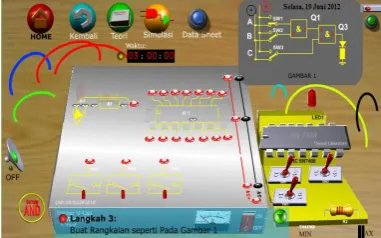
Virtual laboratory need an interesting graphics design to keep the student stay consistent to use the electronic learning, the figure 1 bellow shown a design of virtual laboratory in Digital Electronic.
Fig. 1 virtual laboratory in Digital Electronic Media virtual laboratory using the model adopted by Robinson [8]. Products made using the main software macromedia flash, swift 3D, 3Ds Max and produce media Virtual Laboratory. Digital Electronics Lab-simulation presented by the number of lab materials were 13 trials (AND, OR, NOT, NAND, NOR, EX-OR and EX-NOR) to the experimental (Decoder and Encoder).
Discussion
SEMINAR ON ELECTRICAL, INFORMATICS, AND ITS EDUCATION 2013
A-47
environment and approach to human computer interactive. Activity Virtual Laboratory in this study using laboratory equipment such as measuring devices and components are visualized in 3-D design an interactive, computer-operated and can simulate the activity in laboratory
Digital Electronics through modifying the circuit logic (modify), the circuit (construct), enter a value component (inject), install the circuit (Installation), measuring.components
(measure), and subsequent is the evaluation (evaluation) of the series that have been made. Display Simulation Laboratory is designed as if the user is at the actual lab. A complete virtual lab activity diagram in laboratory simulations are presented in Figure 2.
Figure 2. Lab Activity Diagram Virtual Laboratory
Integration of Virtual Laboratory Methodology
Virtual laboratory component is formed of several parts that support, it is necessary for the methodology of designing a virtual laboratory. Design approach / methodology enables the development of a virtual laboratory for all subjects without limitation or training courses. This involves the integration of architecture and organization held a virtual lab include: work-room, user interface, virtual simulation modeling, interactive, authoring tools, visual representation, and virtual workspace.
a. Entrance The Room
Laboratory and practical activities are an important component for engineering students especially students of SMK. Learning practices in vocational one of the principle is how to prove a theory. According to Banerji [10] which gives the main points that are very kompit engineering students in terms of knowledge transfer in the field no more is to find information. Besides engineering students' knowledge is dynamic. Students tend to do the construction and reconstruction of the meaning of something because they were familiar with the conceptual, analysis, and manipulation.
Currently the process to acquire the knowledge, skills, and abilities can be done outside
the classroom and the laboratory bench. Just as in the real lab to enter the lab room there are several steps that must be done are: 1) to enter the building, 2) to the laboratory space, and 3) open the door to the lab.
According to Dobrzanki [11] argues that some features in the workspace virtual appliances along with instructions for using it. This means that in building a virtual laboratory facilities should be given workspace / laboratory space. For it was made in the development of a display that shows as if the student enters a laboratory space as shown in Figure 3 and the students opened the door to the lab is shown in Figure 4.
Figure 3 Entrance page one of the room (i)
Figure 4. One page Enterance the room (ii)
In Figure 4, to open the door of the room used 2 methods namely through the door handles and via
password. Password used in this virtual lab is "vlab", keywords can be replaced by user desires / users.
User interface
The user interface is derived from the English language meaning of the user interface that serves as a mediator between users and computers. In the virtual laboratory user interface is very important because the presence of the user interface can easily happen interactivity and communication between users. User interface (User Interface) can receive information from the user (users) and provide information to the user (users) to help direct the flow of tracing the problem to find a solution.
In the virtual laboratory that developed interactive and include aspects of process control by considering the design of the aspects of ergonomics and psychology. Workscreen page provides ways: 1) input, allowing the user to manipulate the system, 2) output, allowing the system to show the effects of manipulation of the user (Figure 1).
In Figure 1 is shown a display of work
SEMINAR ON ELECTRICAL, INFORMATICS, AND ITS EDUCATION 2013
A-48
images located on the right side of the page. In doing the installation of the component user to first take the appropriate cables and components, if it does not match then the components will be returned to its original place. Furthermore, after all cables and components are properly installed last step is to press the red power switch is located on the trainer. If the circuit is strung correctly, then the switch will turn "ON" as dipelihatkan in Figure 5 and if it does not mean they are wrong or the installation of components that need to be forgotten for re-review.
Figure 5. One form of user interface in a virtual laboratory
Figure 6 shows that the trainer was able to run the lights marked a trainer and appointment voltmeter with 5 Volt designation value (Figure 6).
Figure 6. Input and output indicators of the user interface
Virtual Simulation Modelling
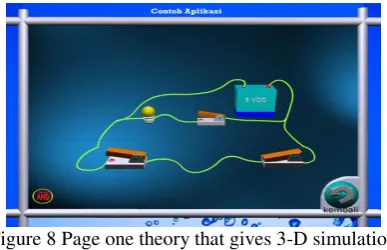
Representation in the virtual laboratory is designed in the form of 3-dimensional. All data is displayed in the form of 3-dimensional like the look of the actual (Figure 7). 3D view should have the ability to interpret broadly the Virtual world and be able to reflect the characteristics of the real world. One application of real-world application is shown in Figure 8.
Figure 7 Page one theory that gives 3-D simulation model for virtual
Figure 8 Page one theory that gives 3-D simulation applications in virtual
Interactive Tools
In the virtual laboratory that developed designed a page that incorporates a variety of applications and Audio Visual Media thereto, and interactively controlled by a control application to provide user convenience in process or the information needed in a row or randomly through an interactive navigation system logic. In this interactive virtual laboratory tools can be found on pages simulations as shown Figure 9.
Figure 9 Simulated one page
Interactive Tools developed using a hyphen that connects the legs of components. Connecting lines on this page serves as a connecting cable.
SEMINAR ON ELECTRICAL, INFORMATICS, AND ITS EDUCATION 2013
A-49
Figure 10. Interactive Tools through Oscilloscope
Other pages are developed based on the principles of Interactive Tools is workscreen page when completing the truth table. Truth table is filled by lab results. To make corrections to the truth table can use the "correction". After pressing the "correction" will be shown assessment scores. If the truth table stuffing one, then the program will execute and display the results in the form of a cross corrections and check mark on the right side of truth table as shown in Figure 11.
Figure 11. Workscreen one page with a table view of truth
Visual Representation
Basically visual representations are intimately associated with visual communication. Visual communication is the study and develop a visual language (semantic, syntactic, and pragmatic) for information and communication purposes. Process and a visual message from the messenger of information products, services or ideas to target (public), are communicative, persuasive through if sign (semiotics), though the way (rhetorika), though the taste (aesthetics) are creative and innovative (new, original, smooth and supple).
Virtual laboratory that developed many refer to elements of visualization are: 1) support the teaching materials and practical design, so readily accepted by the students. At any given frame will display with the message disampaiakan in depth; 2) every form shown adjusted to the things that are favored by the target associated with visual (icons, pictures and other visual elements); 3) Messaging (verbal) that of the conventional lab converted to Visual message, taking into account the visual message signs are understandable, easy, easy and comfortable viewing / reading; 4) with emphasis on the relevant image for each item of discussion theory.
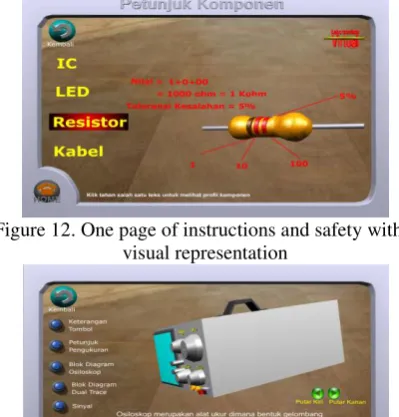
Visualization of virtual laboratory form in Figure 12 and Figure 13 are presented through the design of graphic design elements (objects, colors, fonts and layout) are made so that students feel at home and not feel bored, uncomplicated clarity of the message that is received and remembered easily, using a visual language harmonious, intact and matching that teaching materials is perceived as a whole (comprehensive).
Figure 12. One page of instructions and safety with a visual representation
Figure 13. One page of instructions and safety with a visual representation
Virtual Workspace
Practicum in "Hands-on" developed by education experts and science that provides the opportunity for students to undertake an investigation into a series. Process for student practicum will give you the skills of observation, prediction, deductive reasoning, conceptual modeling, theory building, and testing hypotheses in solving a challenging series.
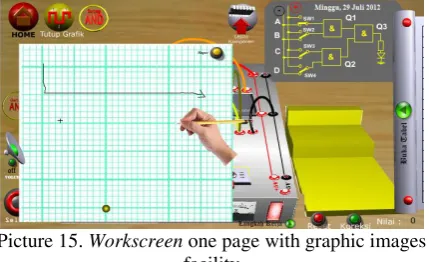
Using virtual manipulation as shown in Figure 14, students can take control, modify, and perform experiments with electrical systems to safely and accurately visualize an abstract concept and concrete.
SEMINAR ON ELECTRICAL, INFORMATICS, AND ITS EDUCATION 2013
A-50
In Figure 14 the students can see the demonstration and instruction given through the "Help" on how to use the tools of the workscreen this page. On this page students can also perform an interactive graphical representation as shown in Figure 15.
Picture 15. Workscreen one page with graphic images facility
Authoring Tools
A lot of software that can be used to design multimedia. For an interactive virtual laboratory is used Macromedia Flash (version Mx, and Prof. 8). For graphics processing using Adobe Photoshop CS3, sound processing using Cool Edit Pro and wave pad, processing animation using Swismax, Macromedia Flash and 3-D graphics processing using 3Ds-Max and processing of 3-D animation using Swift 3D Ver. 2.
Practicality Virtual Laboratory Use In Teaching
Further lectures with Virtual Laboratory research has practically qualified through assessment indicators as presented in Table 1, the obtained average overall score of 4.9 in the category of aspect is very good. Indicators are expressed practicality four assessment indicators are translated as follows: First, students can carry out and complete the practicum objectively according grooves and procedures in Virtual Laboratory obtained mean score 4.8 or are in a very good category. It is very practical when compared to conventional laboratory practicum on the equipment in practice by 4-5 students so that settlement is not running lab objectively because only one working and the other is just watching, as well as conventional laboratory only intelligent students who are could do with a good practice. Second, the teacher can immediately make an assessment and scoring of the student lab results stored in the data base Virtual Laboratory program earned an average score of 5 or excellent category. By contrast, in a conventional laboratory teachers should observe carefully the students one by one passage of the lab work done by students. Third, Virtual Laboratory stored in the computer can be directly accessed by the students to do lab work obtained the mean score of 5 with the category very well. All that is required in Virtual Laboratory has been provided, including equipment and materials, gauges, and data sheet book average score of 4.8 obtained with the category very well.
Table 1
Practicality assessment in teaching through Virtual Laboratory
COMPONENTS Mean
Score
Category
Practicality Indicator
1. Students can carry out and complete the practicum objectively according grooves and procedures in Virtual Laboratory
4.8 Very Good
2. Teachers can immediately make an assessment and scoringof the student lab results stored in the data base program Virtual Laboratory
5 Very Good
3. Virtual Laboratory stored in the computer can be directly accessed by the students to perform lab
5 Very Good
4. All that is required in Virtual Laboratory has been provided, including equipment and materials, gauges, and data sheet book
4.8 Very Good
Overall Mean Score 4.9 Very
Good
IV.
CONCLUSION
SEMINAR ON ELECTRICAL, INFORMATICS, AND ITS EDUCATION 2013
A-51
ACKNOWLEDGMENT
Thanks to Prof. Djemari Mardapi, Ph.D (UNY) and Prof. Adhi Susanto, Ph.D. (UGM).
REFERENCES
[1] M. Sahin, S. Yaldiz, F. Unsacar, B. Yaldiz, N. Bilalis, E. Maravelakis, A. Antoniadis. Virtual Training Centre for Computer Numerical Control. Int. J. of Computers, Communications & Control, ISSN 1841-9836, E-ISSN 1841-9844 Vol. III (2008), No. 2, pp. 196-203.
[2] Karen E. Goeller, “Web-based collaborative
learning: a perspective on the future”, Computer
Networks and ISDN Systems 30 (1998) 634-635. [3] Lynnette R. Porter, “Creating the virtual
classroom: distance learning with the Internet, New York: J. Wiley & Sons, c1997.
[4] Emmanuel Fokides. Virtual Reality in Education: A Theoretical Approach for Road Safety Training to Students. Aegean University. European Journal of Open, Distance and E-Learning
[5] Tolmie A., Thomson J., Foot H., McLaren B., Whelan K. (1998), 'Problems of Attention and Visual Search in the Context of Child Pedestrian Behaviour', Department of Transport, Road Safety Report No. 10.
[6] Emigh & Herring. “collaborative authoring
tools”. 2005
[7] Leandro. “virtual laboratories”. Mc. Graw Hills 2006.
[8] Robinson, stewart. (2004). Simulation: The Practice of Model Development and Use. Southern Gate Chichester: John Wiley & Sons Ltd.
[9] Trans. Roy. SOC. London, vol. A247, pp. 529-551, April 1955.
[10] Banerji, A., & Bhandari, R. (1996). Virtual laboratory in engineering training and education. Proceedings of the workshop on simulation-based training. PRICAI96, Cairns, Australia, 23-30. [11] Dobrzanki, L.A. (2007). Building methodology