58 AMJ March, 2015
Frequency of Chronic Venous Disease among Nurses
Cendy Martanegara1, RA Retno Ekowati 2 , Teguh Marfen Djajakusumah3
1Faculty of Medicine, Universitas Padjadjaran, 2Department of Biomolecular, Faculty of Medicine,
Universitas Padjadjaran, 3Department of Surgery, Faculty of Medicine, Universitas Padjadjaran / Dr. Hasan Sadikin General Hospital Bandung
Abstract
Background: Chronic vein diseases are quite common and its prevalence is also quite high in community.
One of the risk factors is occupation with prolonged standing. Quality of life and work efficacy may become
risk factors. This disease has not received any special consideration and response.
Methods: This is a cross-sectional study performed on nurses working in Dr. Hasan Sadikin General Hospital
Bandung (n=98; women=76, men=22). The study was conducted in November 2012 through collecting data on prevalence, risk factors, and clinical symptoms by using questionnaire. Chronic venous disease was observed by direct inspection in lower extremities. Diagnosis was concluded according to the Clinical
Etiology Anatomy Pathophysiological criteria.
Results: There was a high frequency, i.e. 86.7% (n=71), of chronic venous disease among nurses, with the age group of 20–29 years old (34.1%) as the age group that was mostly affected. Among female nurses,
almost all of them experienced the disease (93.4%; n=71). Clinical symptoms felt by most nurses were
heavy feeling on legs (82.3%) and cramps (55.3%).
Conclusion: The frequency of chronic venous disease among nurses is high, 86.7% and almost all of the
female nurses suffer from the disease. The high frequency in females could be caused by risk factors such as parity and hormonal contraception. Those who are mostly affected by the disease are within range of age
20–29 years old of age. Heavy legs and cramps are the most frequent clinical symptoms felt.
Keywords: Chronic vein disease, frequency, nurses
Correspondence: Cendy Martanegara, Faculty of Medicine, Universitas Padjadjaran, Jalan Raya Bandung-Sumedang Km.21, Jatinangor, Sumedang, Indonesia, Phone: +628985066418 Email: [email protected]
Introduction
There are several risk factors for chronic
venous disease (CVD) which can be endogenous or exogenous. Endogenous risk factors are age, sex, multiple pregnancies, hormonal contraception, obesity, and exogenous risk factor are prolonged standing,
high temperature and humidity.1 Prevalence
in the community is also high, between 40–
76%.1 Some studies revealed that the clinical symptoms, such as heavy legs, cramps, feeling
burnt or hot, and itch can affect psychological,
financial, and work efficiency.2,3
A study in Austria revealed a high prevalence of chronic venous disease among hospital employees and found a positive correlation
between presence of chronic venous disease
and mean periods of standing each day. The samples in this study were medical doctors and nurses, medical technician assistants,
secretaries, scientific staff, cleaners and utility
workers, with the highest prevalence was among medical doctors and nurses. 4
There are no published data about frequency
of chronic venous disease in Indonesia, also in Dr. Hasan Sadikin General Hospital Bandung which is the national hospital that may indicate a high workload among the hospital employees. The samples included in this study were only nurses. The aim of this study was to determine the frequency of chronic venous disease among nurses in Dr. Hasan Sadikin General Hospital Bandung.
Methods
The study population were randomly selected from nurses working in Dr. Hasan
Sadikin Hospital Bandung from six different
All participants agreed to sign the informed
consent after receiving explanation about the study and procedure, and then filled the
questionnaire regarding risk factors such as age, length of work in years, parity, hormonal
contraceptive, and Body Mass Index (BMI). Next, the participant was examined for their lower extremities and stand–up for minimum 30 seconds. All examinations were performed by one examiner who classified the findings
according to the Clinical Etiology Anatomy
Pathophysiological (CEAP) classification (Table 1). Participants were also asked for
clinical symptoms, such as heavy feeling
on legs, burning or hot sensations, edema,
pruritus, and cramp. The data were presented
as frequency analysis distribution and was
statistically analyzed using computer.
Results
Confirmation of the presence of CVD was performed by visual inspection of the lower extremities, as well as obtaining information regarding signs and symptoms of CVD (Table
2). From the entire clinical symptoms, heavy legs and cramps were the most symptoms
felt by the nurses with CVD. There were
Table 1 Clinical part of CEAP classification5
C0 No visible or palpable sign of CVD C1 Telangiectasis or reticular veins C2 Varicose vein
C3 Edema
C4a Skin changes; pigmentation or eczema
C4b Lipodermatosis or atrophie blanchie
C5 Skin changes with healed ulceration C6 Active ulceration
70 (82.4%) nurses who felt heavy legs and 47 (55.3%) felt cramps. Only 8 (9.4%) felt
burning and pruritus, and 2 (2.4%) had edema.
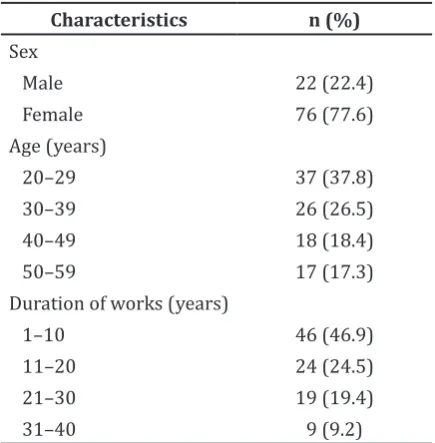
The characteristics were of 98 nurses, consisting of 76 (77.6%) female and 22 (22.4%) male. The range of age was 22 to 56 years, with the mean age 34 years (SD 10.95). As regards duration of work, the range was
between 1 to 36 years with mean of duration 11 years (SD 10.4) (Table 3)
The CVD was present in themajority (86.7%; n=85) of nurses in this hospital (Figure 1),
among both sexes indeed themajority suffered
ofthe disease: 71 (93.4%) werefemale nurses and 14 (63.6%) were male nurses.
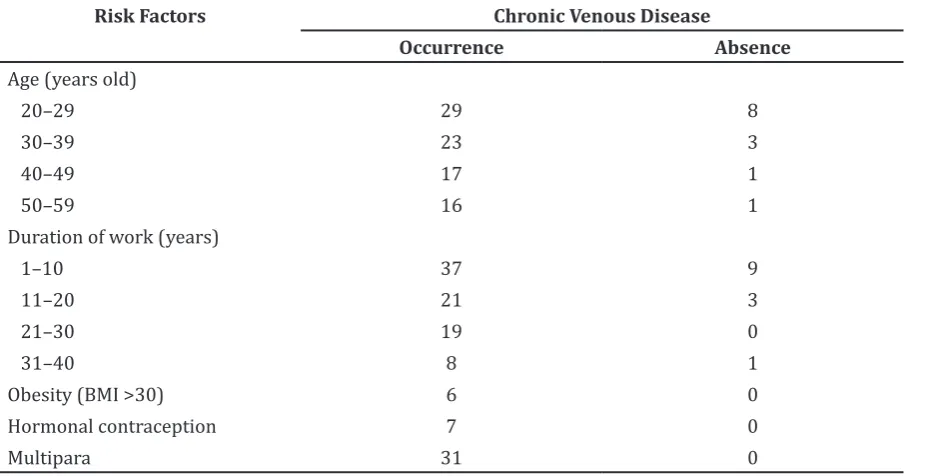
Table 4 evaluated several risk factors.
The data showed more than one third of the nurses with CVD were in the range of age 20–29 years and only a minority were of older age. As regards the duration of work, the majority of them has worked less than 10 years (43.5%). Among female nurses with this disease only a minority (8.2%; n=7) used hormonal contraception. When evaluation of
thenumber of parity was obtained, among the
female nurses who suffered CVD there were nulliparous and primiparous (52.6%; n=40) and less multiparous in female (43.7%; n=31).
Regarding Body Mass Index (BMI), only the
minority (7.1%; n=6) of all nurses with CVD
was classified into obese.
Table 3 Study Sample Characteristics
60 AMJ March, 2015
Discussions
This study aimed to determine the frequency of CVD among nurses. The presence
of CVD was confirmed by visual inspection as
well as evaluation of signs and symptoms of CVD among the patients. Most of the nurses with CVD felt heavy legs (82.3%, n=70) and
cramps (55.2%, n=40). These findings were
slightly different compared to the study of Ziegler et al.4, where heavy legs and edema are the most occuring common symptoms.
There was a high frequency of CVD among nurses working in this hospital, of which the
majority experienced this disease. This high frequency might also be influenced by the
work environmental risk, such as a higher temperature and humidity. There was also
possibility that higher orthostatic burdens
were present due to the workload, since Dr. Hasan Sadikin General Hospital Bandung is the reference hospital in the province.4,6
From the total of 85 nurses with CVD, the
majority was found in women. This finding is
similar with the result from a study of Tuchsen et al.7 and Carpantier et al.8 where CVD occurs predominantly in women. Since the majority of nurses are women, therefore there was an
imbalance proportion of population in this
study. When the data was calculated separately
between sexes, the frequency of occurrence
was found in more than half of population of
both sexes.
When evaluation of risk factors among
female nurses was obtained, parity did not become risk factors among these women. This
is contradictive with a previous study which stated that this factor was associated with this disease.1 Within this study, there were less multiparous women. Moreover, there was other contradictive risk factors found
compared to a study conducted by
Beebe-Dimmer et al.1. Older age and higher BMI did
not become risk factors among these women.
More nurses suffered from this disease at a younger age, and a majority had normal BMI.
Therefore the most possible risk factor may come from the orthostatic burdens as stated above.4,6
Some research found that hormonal
contraception could be the risk factors.1 This
study had a contradictive result, where only a minority of nurses suffering from this disease used hormonal contraception. The result agrees with Kostas et al.,9 who found that from 71 women nurses with CVD 34 (47.8%) used contraception; among them a minority used hormonal contraception.
In conclusion, this high frequency of CVD
should become a concern of the nurses. They
should pay more attention to work-related
health risk. Risk of CVD could be lowered with
more active life style; such as more sports and
little simple movements of lower extremities
after long standing. Also for nurses who already had CVD they should seek for treatment (e.g.:
Table 4 Risk Factors of CVD
Risk Factors Chronic Venous Disease
Occurrence Absence
Obesity (BMI >30) 6 0
Hormonal contraception 7 0
schlerotherapy injection) or use compression stockings.
References
1. Beebe-Dimmer JL, Pfeifer JR, Engle JS, Schottenfeld D. The epidemiology of
chronic venous insufficiency and varicose
veins. Ann Epidemiol. 2005;15(3):175–84. 2. Rabe E, Pannier F. Societal costs of chronic venous disease in CEAP C4, C5, C6 disease.
Phlebology. 2010;25 (Suppl 1):64–7.
3. Sritharan K, Lane TRA, Davies AH. The
burden of depression in patients with
symptomatic varicose veins. Eur J Vasc Endovasc Surg. 2012;43(4):480–4. 4. Ziegler S, Eckhardt G, Stöger R, Machula J,
Rüdiger HW. High prevalence of chronic venous disease in hospital employees. Wien Klin Wochenschr. 2003:115(15–16): 575–9. 5. Pappas PJ, Lal BK, Padberg FT, Zickler
RW, Duran WN. Handbook of venous
disorders: Edward Arnold Ltd.; 2009.
[downloaded in 6 April 2012] Available
at: http://www.hoddereducation.com. 6. Kroeger K, Ose C, Rudofsky G, Roesener
J, Hirche H. Risk factors for varicose veins. Int Angiol. 2004;23(1):29–34. 7. Tuchsen F, Krause N, Hannerz H, Burr
H, Kristensen TS. Standing at work and varicose veins. Scand J Work Environ Health. 2000;26(5):414–20. 8. Carpentier PH, Maricq HR, Biro C,
Poncot-Makinen CO, Franco A. Prevalence, risk factors, and clinical patterns of chronic venous disorders of lower
limbs: a population-based study in
France. J Vasc Surg. 2004;40(4):650–9 9. Kostas TI, Ioannou CV, Drygiannakis I,
Georgakarakos E, Kounos C, Tsetis D, et al. Chronic venous disease progression
and modification of predisposing
factors. J Vasc Surg .2010;51(4):900–7.
62 AMJ March, 2015
10. Jawien A. The influence of environmental