The Sundanese Comic Ririwa Nu Mawa
Pati-An Intertext of Sundanese-Islam Cosmology
Kankan Kasmana1, Setiawan Sabana2, Iwan Gunawan3, Hafiz Aziz Ahmad4
1,2,4 Doctoral Study Program of Visual Arts and Design, Bandung Institute of Technology, Indonesia 3
Department of Urban Arts and Cultural Industries-Jakarta Institute of Art, Indonesia
Ririwa nu Mawa Pati, the Sundanese strip comic with horror genre, published by “Mangle”, a Sundanese cultural magazine in West Java, 1922. The comic consist of material about belief in the supernatural being
in the Sundanese society at that time. This research attempts to find expressions of Sundanese human death journey conception derived from oral literature of selected informants in the comics as an intertext in an effort to understand and interpret the comics in depth. This is a qualitative research, intertextual analysis is used to find representations of cultural texts embodied in selected comic elements. The results of the analysis reveal the existence of oral literature absorption (hypogram) in the form of core and development in the comic as
transition work, present explicitly through storyline, comic element in the form of dialogue in word balloons,
description panel, and visual scene of the characters. Comics become a representation of the view of the comic
artist about the world around the visible (or tangible) and invisible (or intangible).
Keywords: Comic, Intertextual, Sundanese Comic, Supernatural Being
Komik Sunda Ririwa Nu Mawa Pati-Sebuah Interteks Kosmologi Sunda-Islam
Ririwa nu Mawa Pati, komik strip Sunda bergenre horor diterbitkan oleh majalah sastra dan budaya Sunda Mangle di Jawa Barat tahun 1992. Komik ini sarat materi mengenai kepercayaan akan mahluk halus di mas-yarakat Sunda saat itu. Penelitian berupaya menemukan ungkapan konsep fase perjalanan kematian manusia Sunda yang berasal dari sastra lisan informan terpilih yang ada dalam komik sebagai sebuah interteks sebagai upaya agar dapat memahami dan memaknai komik secara mendalam. Penelitian bersifat kualitatif, analisis intertekstual digunakan untuk menemukan representasi teks budaya yang mewujud dalam unsur komik terpi-lih. Hasil analisis mengungkapkan adanya serapan satra lisan (hypogram) baik berupa inti maupun pengem-bangan dalam komik ini sebagai karya transisi, hadir secara tersurat melalui alur cerita, unsur teraga komik berupa dialog balon kata, panel keterangan, serta visual adegan para tokohnya. Komik menjadi representasi kosmologi Sunda dan pandangan komikus mengenai dunia sekitarnya baik yang kasat mata maupun yang tak terlihat. Kosmologi Sunda tidak hanya dipandang sebagai pemisahan dunia, namun difahami pula sebagai fase perjalanan kehidupan dan kematian manusia Sunda.
Kata kunci: Komik, Komik Sunda, Intertekstual, Mahluk Halus.
INTRODUCTION
Sundanese people (a tribe/people of western Java) today mostly live with modernity in various aspects. But it is still embedded in their minds of belief in supranatural beings that derived from the view of tradition and customs. The supernatural beings in Sundanese society are an immateri-al-spiritual phenomenon, not just a narrative, so the inter-pretation of its, being overt and diverse. Influencing on the quantity of popular media such as television, radio, includ-ing comics that raise this theme as its content.
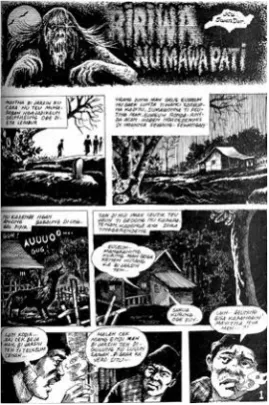
One of them is the Ririwa Nu Mawa Pati (the spirits whose carrier of death), a stripe comic with the horror genre (fig -ure 1), published in 1992 by Mangle, a magazine of liter-ature and Sundanese culture, which still survives to this day. The comics published in 42 times issue has a theme about the social life of the Sundanese people. The content was very thick with the cultural nuances of countryside Sundanese society. It tells the story about a woman named Bi Jarsih (Bi is a appelation to aunt in Sundanese) who turns into ririwa ie the soul of a man who died because his death is undesirable (Mustapa 2010: 157). Bi Jarsih died of unwanted death, suspected and believed to be drowned by jurig (ghost) Lulun Samak, the ghost of water believed by some Sundanese people, who live in a small lake. When his body was buried, and the age of his tomb was still new, a group of people stole the shroud that worn by Bi Jar-sih’s. In the story it is believed that the shroud of the newly deceased, who died on Thursday night can be used as an ajimat (amulets), in order to make the business/trade be -come success. This matter makes the soul Bi Jarsih rise again to find his shroud. In his quest Bi Jarsih asks to all the thieves to return his shroud, but no one returns him so that the soul haunts the thieves, and then kills the thieves one by one. After all the thieves died, the village is back in peace, the people are determined to improve themselves with many worship, drawing closer to God so as not to happen again similar events.
Being an interesting discourse when examined there is the assumption that the story in the comic in general has a closeness to the reality of the beliefs of today’s Sundanese society.
Through the storyline, and the variety of comic elements, depicted the journey of a human being in Sundanese soci-ety in his death, especially the undesirable death, includ-ing the Sundanese cosmology concept. This is related to the expression of Mulyana (senior comic artist in Mangle magazine) in an interview that what the comic artists de-picts in this magazine are mostly the result of research, observation, and even the result of experience and spiritual journey that is being undertaken. For all the comic artist, the comic contents are representations of the experiences, the the attitude of love for literature and Sundanese culture (wasana), who are grateful to live as Sundanese. The ex
-Figure 1. Comic Ririwa nu Mawa Pati by Iwan Darmawan, March 1992 (Mangle, 1992)
istence of comics along with the background of its emer-gence is interesting to examine because comic is a form of narration in the modern world, according to Danesi (2010: 78), comics reflect the world and help influence it, various meanings are conveyed through lines, symbols and words. Comics is a media of making texts on how comic artists express their views about the world that are seen, heard, spoken of and even hidden. Comics is perceived by schol-ars as one of the final forms of human desire to share their experiences through images and writings (Bonneff, 1976: 9-10), in these case, comics represent the reality life of a society in which a comic artist lives. In another view, com-ics as a work of art, cannot be regarded as trivial, comcom-ics can contain life experience and life of comic artist. In a work of art Sabana reveals the existence of visuality, visu -al qu-ality that involves a person’s journey in life, which is deeply represented in art work, including comic. (Kasma -na, 2018: 11-12)
The initial assumption of the comics is an uptake, a cultural text that exists in today’s Sundanese society. Through this research will be found the relation/link between the texts in tradition and the comic as a medium of transformation.
METHODS
-ing to Luxemburg in Nurgiantoro (1994: 50) is defined as writing and reading in an ‘intertext’ of a tradition, culture, social and literary, contained in texts. Ratna (2010: 211) explains that ‘intertext’ comes from the word ‘inter’ and ‘text’, which is defined as the relationship or braid be -tween one text with other texts.
Basically, this theory was originally born in the field of literature, but the lines, colors, fields in the artwork of painting, the composition of the tone in sound, as well as the style in the art of building is also a form of text, then the theory exploited in the field of art included in cultural studies (Ratna, 2010: 212). Ratna (2010: 212) adds that the relationship between the two texts is not a form of plagia -rism, but as a creative process in which it is constructed the new content, significance and meaning.
This study essentially seeks a relationship between two texts, since essentially artwork or literature is essentially nothing autonomous in the sense that works of art can not be empty without reference to other worlds (Ratna, 2010: 215). In the sense that the author of the text is someone who has knowledge derived from other texts, this knowl -edge becomes the basis for the creation of his work with the adjustment he composed again, given the nuances and even given additional.
According to the structuralists (Culler in Ratna there are important concepts that must be explained so that un -derstanding of intertextuality can be achieved with the maximum of them: a) Naturalization or the principle of making what was originally foreign became ordinary. b) Motivation or the principle of adjustment that the text is not arbitrator/incoherent. c) Vraisemblation or principle of integration between one another, this principle is con-sidered most important. Culler in Ratna on the same page explains there are five levels of vraisemblation namely: a)
Direct text is taken from the real world, i.e. documentary, non fiction literatur, based on reality, b) general cultural text (real world text itself framework is a subject to certain cultural patterns), c) the text as a genre convention, as a lit -eral artificial text resulting in an appointment between the author and the reader, i.e. goodness against evil, the truth always win, and d) the text quoted implicitly or explicitly and e) specifically the text as the basis of the creative pro -cess. (2010: 213)
In the process of analysis there are several terms related to this theory, hypogram, is the text that is considered to be the basis of the creation of the text, which is then written. Hypogram is an element of the story (either in the form of ideas, sentences, phrases, events, etc.) contained in a predecessor literary text which later became the model, reference, or background of later-born texts (literary texts influenced). (Hutomo, 1993: 14).
Hypogram according to Rifaterre (1978: 5) can be an ex -pansion (extension or development of hypogram), conver -sion (distortion hypogram), modification, (manipulation of words and sentences or manipulation of characters and plot stories) and also ekserp, the essence of hypogram. Two types of hypogram according to (Riffatere 1978: 5), the first hypogram is a potential hypogram that is the po -tential sign system on a text so that the meaning of the text can be understood on the work itself, without reference to pre-existing text. The second is the actual hypogram of the actual hypogram is the real text, which can be words, phrases, sentences, proverbs, or whole texts, which form the basis of the creation of new texts so that the signifi -cance of texts must be found with reference to other texts or pre-existing texts. The text in the general sense is not just written texts or oral texts, but also customs, cultures, religions and even the universe/the world (Pradopo 2003: 168). In this study the hypogram is the belief of supernat-ural beings in Sundanese people, especially those associat-ed with ririwa type and also about the presence of this type of creature. Another term is a work of transformation that is the term for a work created on the basis of a hypogram. In this study the comic is the work of transformation.
The research stages are as follows:
Oral literary texts were obtained through in-depth inter -views with selected informants, from Bandung and Cian-jur, i.e. panarosan (someone who asked to question about the occult problem). In West Java panarosan is often iden-tified as dukun (a shaman), but the term is often considered negative and is associated with Islamic polytheistic prac-tices. The dukun is depend on genie, meanwhile panaro-san depend to Allah (God).
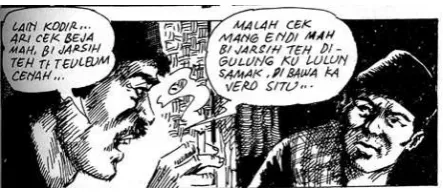
Interview results mapped into a framework of belief in su-pernatural beings, specific to matters relating to ririwa and spirit/human spirit after death. Once categorized, the oral literary (hypogram) is sorted and then compared with the Figure 2. Conversation about Bi Jarsih’s death
(Mangle, 1992)
Figure 3. The scene of Kodir & Emen digging Bi Jarsih’s tomb
comic (as a work of transformation) using intertextual, to find the similarity of words, syntagm, form models, ideas, or concepts manifested through various aspects of the se-lected comics.Each sese-lected frame is analyzed element of story, word balloon, description panel and visual scene. The expected findings are the comparison of the concept about the phase of human death as well as the Sundanese cosmology between comics and oral literature to obtain a more complete meaning and understanding.
SUNDANESE COSMOLOGY
Some Sundanese people todays forced or volunteered into a modern society, prioritizing logic and distanced from the mythical. However, it is apparent that it still embeds iden-tity as a Sundanese by performing various rituals and tradi-tions with the reason of respecting their parents, taking the good side of the culture and even as a conservation effort. Sundanese cultural expert Mamat Sasmita calls it a hybrid (Piliang, 2010: 43), a mixture in ways, attitudes, habits and behaviors that characterize Sundanese people, including in view of the world.
From the beginning the Sundanese had a view of the world, in the ancient Sundanese lontar manuscripts on kropak (box) 420 and 422, explained about Old Sundanese cosmology (the blends of Sundanese-Hindu and Buddhist teaching) mentioned that the universe is divided into 3 worlds, namely sakala, niskala and jatiniskala. Sakala is the real world, inhabited by physical creatures and has spirits, i.e. human, plants and other objects that can be seen, moving and silent. Niskala, the realm of gods, in-habited by non-physical creatures i.e. gods and goddesses, apsara-apsari, neutral spirits. And jantiniskala is the real world of magic, which is inhabited by the Essence of the Almighty (Maha Tunggal) is called Sanghyang Manon. (Darsa and Ekadjati, 2006: 24).
The arrival of Islam’s teachings in West Java, presents a new concept about the world. Islam through the quran presents teachings about the phases of human life. In Islam according to Darsa and Ekadjati, 2006: 25), the universe consists of 5 realms, namely the realm of ruh (spirits), the realm of the rahim (fetus/womb), the realm of dunia (the world), the realm of kubur/barzakh, and the afterlife. The presence of this teaching does not necessarily eliminate the previous cosmology, there is a gray area, between the Sun-danese cosmology and Islam. Islam is synchronized with previous teachings. Proving by the presence of Sundanese customs and traditions in which used/recited verses of the Quran as part of all rituals, included in viewing the world. According to Sumardjo (2011: 267), Sundanese-Islamic era cosmology, still includes previous cosmologies. And so does wtih Islamic cosmology that not abolish cosmol-ogy beforehand, but also not merge in a new concept. He added that all the old cosmological concepts of primordial Sundanese and Hinduism are maintained only in separate
order.
DISCUSSION
In this analysis the oral literature is documented in the form of a sound recording and then written in text form. This oral literature comes from three panarosan.
1. The concept of humans becomes ririwa according to oral literature:
“ririwa teh asalna tina kecap riwan, hartina kaimpikeun, nyaeta lelembutan anu di alam dituna can sampurna, bi-asana manehna maot can waktuna lantaran cara anu teu munasabah, diantarana maehan maneh, nya bunuh diri tea, ti teuleum, di racun, aya nu maehan atawa katabrak. Di alam lelembut manehna can boga tempat cicing, lin-glung matak kudu diduakeun. Tah kukituna, manehna ma-sih keneh boga urusan di dunya, jadi manehna ngariri-waan.”
Translation:
“the word of ririwa is originally coming from the word riwan which means “always dreamed’, He is a lelembu-tan (the kind of human spirits/spirits) who stay in super -natural world which has unperfect life condition, usually died prematurely due to unusual deaths, including suicide, drowning, poisoned, some are killed or hit. In the super-natural world he has no place to dwell, dazed, therefore there must be people who pray for him. Well therefore, he still has affairs in the world, that’s why he became ririwa (haunting). “
The concept of ririwa in the comics: Here’s the dialog:
“Lain Kodir ari cek beja mah Bi Jarsih teh ti teuleum cen-ah...”“Malah cek Mang Endi mah Bi Jarsih teh digulung ku lulun samak, di bawa ka jero
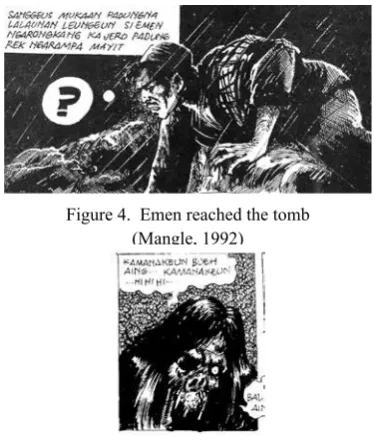
Figure 4. Emen reached the tomb
(Mangle, 1992)
Figure 5. Ririwa Bi Jarsih asking for his shroud
Translation:
“Not that Kodir, according to the news Bi Jarsih is drown-ing ...” “In fact accorddrown-ing to Mang Endi, Bi Jarsih was rolled by lulun samak brought to the lake.”
The concept of the presence of ririwa in the comic is ex -plained through the storyline, while the cause of Bi Jarsih death, told in the comic through the dialog of the antago-nist supporting characters Kodir and Emen who said that Bi Jarsih died from being drowned by jurig (ghost) named lulun samak
Another reason Bi Jarsih become ririwa was because after her death there are thieves disturbed her body corps, his shroud was stolen thats why she is not to get peace in the alam kubur. Therefore Bi Jarsih’s figure is visualized na -ked, his soul rose to look for what she should have.
“Aya eta teh muhit/muja make lawon mayit, boh ajang panglaris atawa jang kabeungharan. Lawon anu bisa dipake nyaeta lawon jelema anu maotna poe selasa, ata-wa juma’ah. Lawon mayitna di kuburan kudu dicokot ku leungeun, aya oge anu nyarita kudu make biwir. Jelas ari ngagalinamah teu menang make pacul, da kudu make leungeun bae. Tah mun geus hasil unggal malam juma’ah eta lawon disundut saeutik-saeutik ku cempor, lilin ayeu-na mah. Tah pan aya haseupayeu-na, haseupayeu-na kaangseu ku si lelembutan, terus datang neang eta lawon kujalan ngam-beu bau hasep lawon anu diduruk tea. Di dinya si jelema jeung si lelembut jual beli ku jalan jangji moal ngaduruk deui asal si lelembut bisa nyadiakeun kabeungharan. Tah tapi aya oge lawon anu di tulisan mantra atawa jampe, biasana etamah dipake jang panglaris, atawa jimat la-mun rek maling. Tapi eta oge biasana aya ritualna heula, dipuasaan, di wiridan. Nu kieu mah biasana ku dukun anu hideung, ilmu hitam tea.”
Translation:
“There is a ritual of worshiping demons using the shroud of corpses, whether for business or wealth. The shroud that can be worn is the one from people who died on Tues-day or FriTues-day. The shroud in the grave must be taken by hand and some say it must be taken by mouth. To dig it obviously should not use a hoe and should only use the hands only. if successful then the shroud can be burned bit by bit using a lantern or a candle every night Friday. The lelembut will come because the smell of smoke from the burning shroud. This is the time when the perpetrator and the spirits make a transaction by promising not to burn the shroud, with the requisition to the spirits for providing wealth. But there are also shrouds written with jampi or mantra, usually used for penglaris or talisman, or you can used it for stealing something. The shroud is usually given a ritual in advance, given a spell (jampi), and also given fasting by the perpetrator. This is usually done by a black shaman, black magic.”
The comics describe how Kodir and Emen effort to take
the shroud of Bi Jarsih by hand, to serve as an ajimat even though it was stolen by others.
On the dialog panel is written:
“sanggeus mukaan padungna lalaunan leungeun si Emen ngarongkang ka jero padung rek ngarampa mayit” Translation:
“After opening the tomb of grave with gently Emen’s hand dug into the tomb to touch the corpse.” (Figure 4)
In the word balloon is written:
“Kamanakeun boeh aing...kamanakeun...hihihi...”, “balikeun boeh aing...”
Translastion:
Where is my shroud ... where is it...hihihi (smiling)..”. “give me back my shroud...”(Figure 5)
The Figure of Ririwa
“Beungeut ririwa saenyana mah kumaha amalanna sawaktu didunya. Jadi wallahualam eta mah. Ancurnya meureun kena siksa kubur atau memang geus rusak ku jalan geus di rebung ku sato dina jero taneuh, nya cacing, bilatung. Getih baloboran jeung rusak. Mung saenyana-mah biasana mun nu geus maot terus hirup bisa wae eta-mah jin atawa setan. Sabab kitu teh lantaran maotna can sampurna terus kudu disampurnakeun. Matakna nu maot mah kudu diadanan, komo mun maotna teu munasabah. Salian ti eta kudu dibacakeun sahadat bumi tea supaya ruh jeung jasadna bisa di tarima. Mun teu kitu eta jasadna disurupan ku setan atawa jin.”
Translation:
“The figure of ririwa is depend on how his deeds work in the world. So the problem is only God knows (walla-hualam). His body was destroyed probably because of grave torture or indeed damaged by animals in the soil, either worms or maggots. So blood was pouring and bro-ken. But in fact, if the dead continue to live again could have been due to the act of jinn or demons. It is because the death is not perfect and must be perfected. Hence the deceased person should be given an adzan (muslim prayer calling), especially if died in an unusual way. In addition must be read the syahadat of the earth (syahadat bumi), so that the spirit and the body can be accepted. If it is not like that then the body will be infiltrated by a demon or a jinn. “
There is a caption panel containing text with comic-writ
ing letters (Figure 6), in capital letter format, italics con -taining the words:
“na sungutna calangap ngelay getih beureum, panonna nu gorowong jiga neuteup maranehannana”.
Translation:
“in his gaping mouth it is pouring red blood, his eyes is perforated-empty deep enough, and its looks like staring at them.”
The background is dark, the story mentioned that the scene was in the cemetery at night, accompanied by spatter rain.
Ririwa’s work
“Gawena ririwa biasana hayang nyaritakeun kaayaan dirina, hayang nyampeikeun pesen naon-naon anu acan kacumponan sawaktu manehna masih jumeneng hirup. Aya oge carita cenah ririwa teh ngawuran taneuh kubu-ran, nakolan parabot dapur dina pago, ku lantaran ngin-getan jadi riwan tea.”
Translation:
“What was ririwa usually doing is just want to tell some-one about his situation, to convey a message about the things that has not been fulfilled while still living in the world. There is also the story that ririwa is likes to scat-ter the gravesite soil, or beat the kitchen equipment on the shelf, with the excuse to remind people the term is called riwan.”
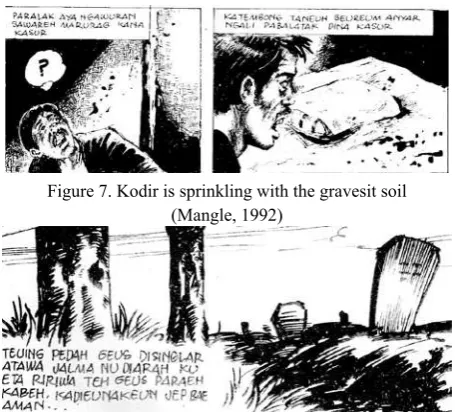
In the comic scenes depicted the existence of a sprinkling gravesite soil on Kodir’s body (Figure 7). In the descrip -tion panel it is explained:
“paralak aya ngawuran sawareh marurag kana kasur” “Katembong teneuh beureum anyar ngali pabalatak dina kasur.”
Translation:
Figure 7. Kodir is sprinkling with the gravesit soil (Mangle, 1992)
“Paralak (introduction word) there is a sprinkling soil, some fall into the mattress.”
“It is looks like the newly dug red soil is scattered over the mattress.”
Life Cycle of Ririwa
“Lelemesan atawa lelembutan jalma nu geus maot saben -erna arwahna tilu poe masih keneh aya dina lawang panto, biasana lolongseran diluhur kusen panto imahna. Ka opat puluh poenakeun manehna aya di tepas imah. Tah lamun geus opat puluh poe anjeunna mangkat ka alam maneh-na, ari ririwa mah biasana teu riwan mun geus di sampur-nakeun, salah sahjii carana kusahadat bumi, tah jampena teh: Bismilahirrohmanirrohim. Alohuma ibu bumi sang badan kawasa kumerep maring datuloh yaman hidayatu-loh dat sukma jadi sampurna, sampurna ku gusti Alhidayatu-loh ibu bumi neda eureun sakeudeung, bumi mulya badan mulang inya mulang ka jati sampurna berhimpi di bawa jisim ber-hampa di bawa jasam ibuna sarahsah wiah saderek sarah-sah bumi bumi cicing bumi mulang pelepes. Lailaha ilal -loh muhamadarosulul-loh.”
Translation:
“Lelemesan or lelembutan is the soul of the deceased. His soul for three days was still at the door gate, usual-ly swinging on the door top frame of the house. Forty days the ghost is in the hall of the house. Well after forty days he will go to his realm, ririwa will not haunting if it has been perfected, one of the way is read the syaha-dat of the earth (syahasyaha-dat bumi), The jampi (mantra) is: Bismilahirrohmanirrohim. Alohuma ibu bumi sang badan kawasa kumerep maring datuloh yaman hidayatuloh dat sukma jadi sampurna, sampurna ku gusti Alloh ibu bumi neda eureun sakeudeung, bumi mulya badan mulang inya mulang ka jati sampurna berhimpi di bawa jisim berham-pa di bawa jasam ibuna sarahsah wiah saderek sarahsah bumi bumi cicing bumi mulang pelepes. Lailaha ilalloh muhamadarosululloh.”
In the frame it is visualized a lonely grave and tends to be quieter (Figure 8). In the description panel there is the text: “Teuing pedah geus disinglar atawa jalma nu diarah ku eta ririwa teh geus paeh kabeh, kadieunakeun jep bae aman”
Translation:
“either because it’s been done by a singlar (mantra) or the people targeted by ririwa it’s all dead, and finally now the situation becomes safe.”
INTERTEXTUALITY IN THE COMIC
In oral literature (hypogram) mentioned the case about the beginning of the presence of ririwa, that is because hu-mans who died in an abnormal way. One of the causes is due to drowning. In the comic (as the work of transforma -tion) it is mentioned so, and it arises and becomes ririwa
Figure 8. The description panel indicates that ririwa has
because it has an unfinished world affairs (taking care of the material that belongs to, it is the shroud) The comic as a work of transition expresses the same concept. Intertext present in the comic, expressed through comic in the form of a word balloon, an explanatory panel and also a visual character scene. The element absorbed from the hypogram is the idea of a cultural text, in the form of ekserp, has the same core of the story.
The other matter is about the figure of ririwa. In oral liter-ature there is no specific mention of how the true form of ririwa is. In the comic character ririwa Bi Jarsih depicted that his face has been broken, but not explained about the details of the cause, it means a lot of possibilities. This shows the presence of cultural texts in comics as works of transformation. Intertext in the comic is an idea but a text is developed, meaning there is an expansion of ideas in comics.
The existence of ririwa is of course related to the work it does. In the comic it is said that ririwa is haunting (termed riwan) the perpetrators of the shroud theft, the same con-cept is expressed in oral literature, including the habit riri-wa is scattering the gravesite soil around the house, which are portrayed in the comic through visuals in selected frame scenes, as well as the information panel. In this case the comic becomes absorbed (ekserp) and takes only the core of the hypogram.
In the storyline, especially in the conclusion after the for-tieth day of Bi Jarsih’s ruin, it was rhetorically delivered because his world affairs (killing the thieves) were con -sidered finished and or because it was already done by a singlar (the mantra to keep away from things undesirable including the spirits). In oral literature it is mentioned that ririwa is still loitering for 40 days, and it will disappear if it has been perfected. One way to perfect it is with the earth’s syahadat (syahadat bumi; a mantra in Sundanese mixed with Islamic teachings) is a prayer to perfect the de -ceased but with an unwanted process in order for his soul to be accepted, in the next realm. This mantras is including to the type of jampi (spell), not a singlar. That means there is an oral literary uptake in the comic especially about the time of the human spirit roaming, but implied with implicit way, the annotation panel only gives the core explanation only (ekserp).
In the context of cosmology through the analysis it can be found that the concept of the journey of the death of the Sundanese people believed by the community that is represented in the comic. It can be understood that after a human being dies then the next stage is to be the spirits/ soul or lelembutan who will go to the alam kubur, (bar-zakh/kubur realm in Islam), where all human souls reside to wait for the next realm which is hereafter. As for those who died in a died in an unusual way their souls have not yet gained a place in the grave, so they are haunting and
looking for a place to dwell. In the knowledge of tradition-al society’s the death needs to be perfected. As expressed in oral literature in the way is should be given an adzan (muslim prayer calling) and in recited jampi (mantra) sya-hadat bumi (syasya-hadat of the earth). Because for the Sun -danese life must be perfect, if not perfect then there must be someone who perfected.
CONCLUSIONS
The comic became intertexts. The syncretism of Sun -danese and Islamic teachings is present in comics as a form of Cosmology of Muslim Sundanese. Islamic teachings do not necessarily eliminate the Sundanese doctrine, both of them overlap, and still believed some people to this day.
Comics is a work of transforming the comic artists knowl-edge about the world that he understands, in this case the knowledge and cultural aspects can be used as ideas and background story in comics. In the philosophical level of the comic shows the motives and worldview of the Sun-danese should be. That is how to be a perfect human (ma-sagi), i.e. humans who have enough preparation to life in the world and the hereafter, this perfection is built with various efforts, both from self and also from the people around.
Another view of life is the rawayan jati, it is the process of the journey of the humans soul and the whole universe (physical-psychic, spiritual-spirits) that keeps rolling since the beginning of human existence until the end from the realm of the spirits to death (huwal awalu wal akhiru) to the ijunajati nistemen, the eternal life of the eternal. (Sury -alaga, 2009: 9). So must has a better live live depend on God, by walking in the straight path so as not to regret later.
Through the comic story reminds people of death and all responsibility for life given by God, so that while still liv-ing in the human world can optimize themselves to always do good and right to the next life becomes a peace place to rest.
ACKNOWLEDGEMENT
This research program is funded by Ministry of Research Technology and Higher Education. Republic of Indonesia.
REFERENCES
Bonneff, Marcel. (1976), Komik Indonesia, Jakarta, Ke-pustakaan Populer Gramedia.
Danesi, Marcel. (2010), Pesan, Tanda, dan Makna: Buku teks dasar mengenai semiotika. Yogyakarta: Jalasutra.
Kosmologi Sunda, Bandung, Kiblat Buku Utama.
Hutomo, Suripan S., (1993), Merambah Matahari: Sastra dalam Perbandingan, Surabaya, Gaya Masa.
Kasmana, Kankan. (2018): The visuality of main char-acters and Sundanese horror visual grammer in comics Ririwa nu Mawa Pati, Opat Madhab Setan dan Kawin ka Kunti, Doctoral Dissertation, Institut Teknologi Bandung.
Kriyantono, Rachmat. (2012), Public Relations & Crisis
Management: Critical public relations, etnografi kritis,
dan kualitatif. Jakarta: Prenada Media.
Mustapa, Haji .Hasan. (2010), Adat Istiadat Sunda, Band-ung, Alumni.
Nurgiantoro, Burhan. (2010), Teori Pengkajian Fiksi, Yo-gyakarta, Gadjah Mada University Press.
Piliang, Yasraf A., (2004), Posrealitas: Realitas
kebu-dayaan dalam era postmetafisika. Yogyakarta, Jalasutra.
Pradopo, Rachmat D., (2003), Beberapa Teori Sastra, Metode Kritik, dan Penerapannya. Yogyakarta, Pustaka Pelajar.
Ratna, Nyoman K., (2010), Sastra & Cultural Studies: rep -resentasi fiksi & fakta, Yogyakarta, Pustaka Pelajar.
Riffaterre, Michael. (1978), Semiotic of Poetry, London, Metheun & Co. Ltd.
Sumardjo, Jakob. (2011), Sunda Pola Rasionalitas Bu-daya, Bandung, Kelir.