World Economic Forum
in collaboration with :
Marsh & McLennan Companies
Swiss Reinsurance Company
Wharton Center for Risk Management,
University of Pennsylvania
Zurich Financial Services
Global Risks
2011
Sixth Edition
An initiative of the Risk Response Network
The information in this report, or on which this report is based, has been obtained from sources that the authors believe to be reliable and accurate. However, it has not been independently verified and no representation or warranty, express or implied, is made as to the accuracy or completeness of any information obtained from third parties. In addition, the statements in this report may provide current expectations of future events based on certain assumptions and include any statement that does not directly relate to a historical fact or a current fact. These statements involve known and unknown risks, uncertainties and other factors which are not exhaustive. The companies contributing to this report operate in a continually changing environment and new risks emerge continually. Readers are cautioned not to place undue reliance on these statements. The companies contributing to this report undertake no obligation to publicly revise or update any statements, whether as a result of new information, future events or otherwise and they shall in no event be liable for any loss or damage arising in connection with the use of the information in this report.
World Economic Forum 91-93 route de la Capite CH-1223 Cologny/Geneva Switzerland
Tel.: +41 (0)22 869 1212 Fax: +41 (0)22 786 2744 E-mail: [email protected] www.weforum.org
© 2011 World Economic Forum All rights reserved.
No part of this publication may be reproduced or transmitted in any form or by any means, including photocopying and recording, or by any information storage and retrieval system.
ISBN: 92-95044-47-9
978-92-95044-47-0
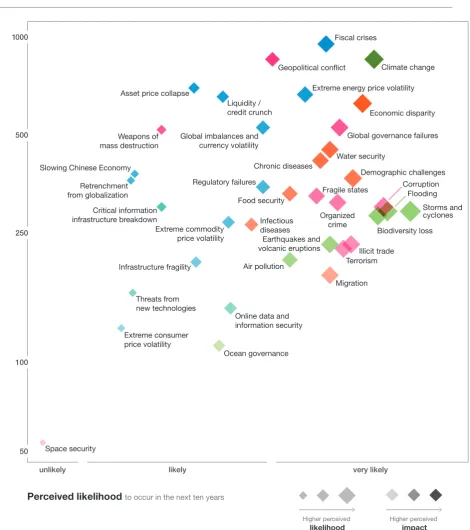
Figure 1 | Global Risks Landscape 2011:
Perception data from the World Economic Forum’s Global Risks Survey
Economic Risks Asset price collapse
Extreme commodity price volatility Extreme consumer price volatility Extreme energy price volatility Fiscal crises
Global imbalances and currency volatility Infrastructure fragility
Liquidity/credit crunch Regulatory failures
Retrenchment from globalization Slowing Chinese economy (<6%)
Environmental Risks
Air pollution Biodiversity loss Climate change
Earthquakes and volcanic eruptions Flooding
Ocean governance Storms and cyclones
Societal Risks Chronic diseases Demographic challenges Economic disparity Food security Infectious diseases Migration Water security
Geopolitical Risks
Corruption Fragile states Geopolitical conflict Global governance failures Illicit trade
Organized crime Space security Terrorism
Weapons of mass destruction
Technological Risks
Critical information infrastructure breakdown
Global Risks 2011 | 3
Contents
Preface 4
Executive summary
6
Cross-cutting global risks
Economic disparity and global governance failures
10
Risks in focus 1
The macroeconomic imbalances nexus
14
Risks in focus 2
The illegal economy nexus
22
Risks in focus 3
The water-food-energy nexus
28
Risks to watch
36
Conclusion 41
Appendix 1
Definitions and methodology
42
Appendix 2
Survey data overview 2011
44
Appendix 3
Common global risk response strategies
48
Appendix 4
Guide to online global risks 2011 resources
50
References and further reading
51
Acknowledgements 52
Preface
Since 2006 the World Economic Forum’s Global Risks report has provided a unique and timely analysis of the risks that are shaping the global environment. Underscored by an unprecedented pace of change, stakeholders from across business, government and civil society face a new imperative in understanding and managing emerging risks.
Global Risks 2011, Sixth Edition provides a high-level overview of 37 selected global risks as seen by members of the World Economic Forum’s Global Agenda Councils and supported by a survey of 580 leaders and decision-makers around the world. The report also benefits from the expertise and thought leadership of the World Economic Forum’s Global Risk Partners: Marsh & McLennan Companies, Swiss Reinsurance Company, Wharton Center for Risk Management, University of Pennsylvania, and Zurich Financial Services.
This report aims to enhance understanding of how a comprehensive set of global risks are evolving, how their interaction impacts a variety of stakeholders, and what trade-offs are involved in managing them.
Global Risks 2011, Sixth Edition is a useful tool for policy-makers, CEOs, senior executives and thought leaders around the world. It aims to equip institutions to understand and respond to global risks and to embrace change as a source of innovation. Most importantly, I hope that focusing on the critical connections between key global risks, stakeholders and decision-makers will inspire all to engage collectively in efforts to improve the global system’s overall resilience.
At the World Economic Forum Annual Meeting 2011 in Davos-Klosters, the Forum will go beyond its current global risk work in launching the Risk Response Network (RRN). The RRN will build on the understanding embodied in Global Risks 2011, Sixth Edition to provide a platform for our Partners and constituents to collaborate in multistakeholder efforts to shape a more secure, innovative and resilient future. I hope you find the report both informative and provocative.
Klaus Schwab
Global Risks 2011 | 5
The World Economic Forum’s Risk Response Network
Global Risks 2011, Sixth Edition is a flagship product of the World Economic Forum’s new Risk Response Network (RRN).
The RRN is a unique platform for global decision-makers to better understand, manage and respond to complex and interdependent risks. It will bring a rigorous approach to understanding the complexity of risks that face corporate, government and civil society leaders, and will provide tools enabling them to better mitigate risks and capture associated opportunities. It will combine:
• The most compelling insights, drawn from the World Economic Forum’s communities and contributors, including active expert groups such as our Network of Global Agenda Councils and a formal network of the world’s top universities and private sector content providers;
• The most relevant global decision-makers, brought together through a community of Risk Officers from top corporations, governments and international organizations;
• The most suitable tools and services, including analytic tools and risk management processes to enable decision-makers to better understand key risks in depth and in context, to respond to them proactively and mobilize quickly and efficiently in times of crisis
This report lays the foundations for the RRN by highlighting three ways for leaders to improve their response to complex and interdependent risks:
• Proactively address the causes, rather than the symptoms, of global risk, identifying effective points of intervention in underlying structures and systems – in particular with respect to global governance failures and economic disparities;
• Devise coordinated response strategies to address the existence of difficult trade-offs and the threat of unintended consequences caused in part by increased interconnectedness.
• Take a longer-term approach to assessment and response, particularly when seeking to manage global risks that emerge over decades rather than months or years.
The RRN will build on these insights over the coming months by launching a series of initiatives and workstreams focused on a variety of global risks highlighted in this Report. We hope that you will find
The world is in no position to face major,
new shocks. The financial crisis has
reduced global economic resilience,
while increasing geopolitical tension and
heightened social concerns suggest
that both governments and societies
are less able than ever to cope with
global challenges. Yet, as this report
shows, we face ever-greater concerns
regarding global risks, the prospect of
rapid contagion through increasingly
connected systems and the threat of
disastrous impacts.
In this context,
Global Risks 2011, Sixth
Edition
reveals insights stemming from
an unparalleled effort on the part of the
World Economic Forum to analyse the
global risk landscape in the coming
decade.
1Two cross-cutting global risks
Two risks are especially significant given their high degrees of impact and interconnectedness. Economic disparity2 and global governance3 failures both
influence the evolution of many other global risks and inhibit our capacity to respond effectively to them. In this way, the global risk context in 2011 is defined by a 21st century paradox: as the world grows together, it is also growing apart.
Globalization has generated sustained economic growth for a generation. It has shrunk and reshaped the world, making it far more interconnected and interdependent. But the benefits of globalization seem unevenly spread – a minority is seen to have harvested a disproportionate amount of the fruits. Although growth of the new champions is rebalancing economic power between countries, there is evidence that economic disparity within countries is growing. Issues of economic disparity and equity at both the national and the international levels are becoming increasingly important. Politically, there are signs of resurgent nationalism and populism as well as social fragmentation. There is also a growing divergence of opinion between countries on how to promote sustainable, inclusive growth.
To meet these challenges, improved global governance is essential. But this is another 21st century paradox: the conditions that make improved global governance so crucial – divergent interests, conflicting incentives and differing norms and values – are also the ones that make its realization so difficult, complex and messy. As a result, we see failures such as the Doha Development Round of the World Trade Organization (WTO) and the lack of international agreement at the Copenhagen Conference on climate change. The G20 is seen as the most hopeful development in global governance but its efficiency in this regard has not been proven.
Executive summary
1For more information see Appendix 2.
Global Risks 2011 | 7
Three important risks in focus
Beyond these two cross-cutting global risks, three important clusters of risks have emerged in this year’s analysis:
The “macroeconomic imbalances” nexus: A cluster of economic risks including macroeconomic imbalances and currency volatility, fiscal crises and asset price collapse arise from the tension between the increasing wealth and influence of emerging economies and high levels of debt in advanced economies. Savings and trade imbalances within and between countries are increasingly unsustainable while unfunded liabilities create extreme long-term pressure on fiscal positions. One way out of these imbalances would be coordinated global action but this is challenging given the conflicting interests of different states.
The “illegal economy” nexus: This nexus examines a cluster of risks including state fragility, illicit trade, organized crime and corruption. A networked world, governance failures and economic disparity create opportunities for such illegal activities to flourish. In 2009, the value of illicit trade around the globe was estimated at US $1.3 trillion and growing. These risks, while creating huge costs for legitimate economic activities, also weaken states, threatening development opportunities, undermining the rule of law and keeping countries trapped in cycles of poverty and instability. International cooperation – both on the supply side and on the demand side – is urgently needed.
The “water-food-energy” nexus: A rapidly rising global population and growing prosperity are putting unsustainable pressures on resources. Demand for water, food and energy is expected to rise by 30-50% in the next two decades, while economic disparities incentivize short-term responses in production and consumption that undermine long-term sustainability. Shortages could cause social and political instability, geopolitical conflict and irreparable environmental damage. Any strategy that focuses on one part of the water-food-energy nexus without considering its interconnections risks serious unintended consequences.
Five risks to watch
Five risks have been designated as “risks to watch”, as survey respondents assessed them with high levels of variance and low levels of confidence while experts4 consider they may have severe, unexpected
or underappreciated consequences:
• Cyber-security issues ranging from the growing prevalence of cyber theft to the little-understood possibility of all-out cyber warfare
• Demographic challenges adding to fiscal pressures in advanced economies and creating severe risks to social stability in emerging economies
• Resource security issues causing extreme volatility and sustained increases over the long run in energy and commodity prices, if supply is no longer able to keep up with demand
• Retrenchment from globalization through populist responses to economic disparities, if emerging economies do not take up a leadership role
• Weapons of mass destruction, especially the possibility of renewed nuclear proliferation between states
Effective risk response is not only about proactively reducing the downsides associated with global risks; it is also about seizing the opportunities for innovation and growth that may arise. Throughout this report, a series of risk response strategies are explored that can help stakeholders achieve both goals.
4Unless otherwise noted, in this report “experts” refers to the Global Agenda Council members and other contributors who are acknowledged at the end of this report. They provided input through various means, including participating in the Global Risks Survey, taking part in workshops, reviewing the report and providing individual advice and counsel.
Cross-cutting global risks
Economic disparity and global
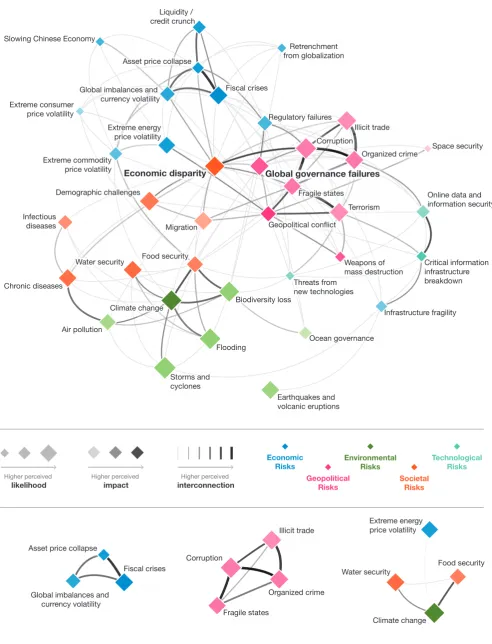
Economic disparity and global governance failures emerged from the Forum’s Global Risks Survey 2010 as the two most highly connected risks and were perceived as both very likely and of high impact (see Figure 1, Global Risks Landscape, and Figure 2, Risks Interconnection Map, at the beginning of the report). They influence the context in which global risks evolve and occur in two critical ways: first, they can exacerbate both the likelihood and impact of other risks; second, they can inhibit effective risk response.
Economic disparity
and social fragmentation
Definition: Wealth and income disparities, both within countries
and between countries, threaten social and political stability as well as economic development.
The Global Risks Survey identified economic disparity
as one of the most important risks in the coming decade. The Forum’s Global Agenda Council survey also supports this finding, having ranked economic disparity as the second most important trend in terms of impact on the business community and as the most underestimated trend in terms of its impact.
Economic disparity is tightly interconnected with corruption, demographic challenges, fragile states, global imbalances and asset-price collapse. Respondents perceived economic disparity as influencing chronic diseases, infectious diseases, illicit trade, migration, food (in)security, terrorism and weapons of mass destruction. They saw economic disparity as influenced by climate-change related risks and global governance failures. The data indicate that economic disparity and geopolitical conflict reinforce one another.
Economic disparity plays out between and within countries. Ease of communication has made inequalities between countries more visible. Despite robust growth in some emerging economies, many countries remain trapped in a cycle of poverty with tremendous implications ranging from lack of access to basic social infrastructure such as good education, healthcare and sanitation to political fragility of the state.
Stakeholders also expressed concerns over evidence of rising economic disparity within countries, in advanced and emerging economies alike. Economic analysis by the OECD and others suggests that real income growth of the top income quintiles of the populations in Finland, Sweden, the United Kingdom, Germany, Italy, and the USA was twice as large as that of the bottom quintiles between the mid-1980s to mid-2000s.5 Income inequality as measured by the
Gini Index over the past decade has also increased rapidly in emerging economies such as India, China, or Indonesia. While such studies are subject to methodological criticisms and there is disagreement over the findings, the risk of rising economic disparity, even in terms of perception alone, is concerning. Many factors may have contributed to this trend within countries, including the erosion of employment culture, the decline of organized labour, and failures of education systems to keep pace with the increasing demands of the workplace.
Economic disparities are also seen as contributing to a broader process of global social fragmentation. Globalization has led to different groups within countries having divergent economic interests, undermining a sense of broader national solidarity. At the same time, transnational associations are becoming more important in individual and group identity, enabled by the internationalization of media and communication. Traditional forms of association have been eroded. Trust in institutions seems to have dropped.
In part, it may be that vertically-integrated national societies are being replaced by more fluid, transnational societies. This naturally offers a range of opportunities for cross-cultural communication and community-forming unhindered by geography. However, it also creates tensions within countries that lead to global risks, and undermines governments’ political capacity to respond to local manifestations of those risks.
Cross-cutting global risks:
Economic disparity and global governance failures
Global Risks 2011 | 11
Global governance failures
Definition: Weak or inadequate global institutions, agreements
or networks, combined with competing national and political interests, impede attempts to cooperate on addressing global risks.
While risks are increasingly globalized and interconnected, global governance capacities are highly fragmented. Global governance failures
create and exacerbate systemic global risks, Survey results showed strong interconnections between global governance failures and regulatory failures, corruption and economic disparity, with retrenchment from globalization and global governance failures being seen as mutually reinforcing.
Global governance failures cited by experts include: UN climate change negotiations; the uncompleted Doha Development Round of trade negotiations; lack of progress on some of the Millennium Development Goals; the stalling of United Nations’ Security Council reform; and challenges to frameworks designed to prevent the proliferation of the capability of nuclear weapons. There is a growing sense of paralysis in responding to global challenges. The Washington Consensus is no longer accepted as the baseline model for economic development, but neither has it been replaced by an alternative set of unified values. The United States’ National Intelligence Council and the European Union’s Institute for Security Studies recently concluded that current governance frameworks will be unable to keep pace with looming global challenges unless extensive reforms are implemented. Increasingly, emerging economies feel that unfairly they have insufficient influence in international institutions as they are currently designed. Yet there is uncertainty over the ability and willingness of rising powers to shoulder a greater share of global responsibilities, as well as reluctance on the part of established powers to recognize the limits of their own power.
It is uncertain whether global governance will muddle along with an increasingly ill-fitting institutional framework, whether we will find the capacity and will to embrace more agile structures enabled by global networks and new forms of collaboration, or whether the idea of coordinated global governance will be discarded entirely.
Effective global governance is also held back by ineffective decision-making structures at the national level. Arguably, technological and social shifts have weakened the ability of leaders to implement internationally agreed commitments which are unpalatable in the short-term, as the cost of mobilizing interest groups has fallen. The difficulties in achieving an international climate change agreement, as well as resistance to internationally coordinated macroeconomic policy measures, are cases in point. A counterbalance would be a well-informed and well-mobilized global public opinion sharing norms and values of global citizenship, but this is not yet fully developed.
Recognizing the importance of global governance failures, the World Economic
Forum in 2009 launched the Global Redesign
Initiative. Its purpose has been to stimulate a strategic thought process among all
stakeholders about ways in which international institutions and arrangements should and could be adapted to contemporary challenges.
A series of specific proposals on how some of the gaps and failures in international cooperation might begin to be addressed was presented for initial discussion with senior representatives of about 50 governments and 20 international organizations at a special summit in Doha, Qatar, on 30-31 May 2010. The proposals are also available at:
http://www.weforum.org/globalredesign
Cross-cutting global risks:
Risks in focus 1
Risk description
and impacts
This cluster of three economic risks – global imbalances and currency volatility, fiscal crises
and asset price collapse – is characterized by both internal imbalances (within countries) and external imbalances (between countries).
Internal imbalances are produced by many factors, including government policies and private sector behavior and are influenced by the stage of economic development. Fiscal imbalances in advanced
economies have widened because of government profligacy. They were exacerbated by the impact of the financial crisis. First, many governments were forced to set aside large packages to bailout failing banks and stabilize the financial system. Second, and more importantly, many governments provided large fiscal stimuli to mitigate the recessionary impact of the crisis. The combination of bailout and stimulus packages resulted in burgeoning deficits and expanding debt-to-GDP ratios, particularly in advanced economies. Achieving fiscal consolidation while avoiding hampering the fragile recovery is a short-term challenge. However in the long-term, a key fiscal challenge will be
financing the unfunded liabilities of current and future generations (see discussion below and Risk to Watch
Demographic Challenges).
Related to this point, external imbalances between countries are also of concern. At the heart of global imbalances is a mismatch between saving and investment. Deficit countries do not save enough relative to their investments, and surplus countries do not invest enough given their high savings. In principle, external imbalances are not bad. Capital will tend to flow to the most profitable use; in a globalized system, that includes cross-border capital flows. As long as the recipients of such flows put them to productive use (i.e. as long as the resulting investments generate revenue that is high enough to serve and amortize the debt incurred) no major problem arises.6 External
imbalances become a problem if they contribute to an unsustainable accumulation of debt or, for countries that actively control their exchange rates, if they lead to an unsustainable accumulation of foreign reserves.
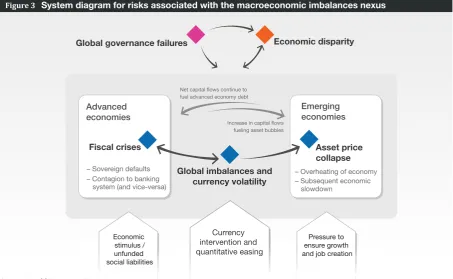
These imbalances lead to two primary risks. First, they lead to slow growth, increasing accumulation of debt and fiscal pressures create risks of sovereign defaults in certain advanced economies which could also affect banking systems worldwide (and vice-versa). Second, such weakness creates the risk of excessive capital flows to emerging markets, increasing the bubble risk and potentially leading to asset price collapse. While global imbalances will continue to imply a net flow of capital from surplus to deficit countries, these risks arise when increases in gross flows of capital from advanced to emerging economies are not matched by the commensurate ability of economies to absorb such flows productively.
Figure 3 shows how these risks are linked graphically, and Table 1 provides a non-exhaustive list of the direct and indirect impacts of these risks to stakeholders. These risks link strongly to other global risks. For example, fiscal pressures in advanced economies will accelerate the ongoing power shift towards Asia, increasing the risk of geopolitical tensions. All three risks could also exacerbate global governance failures as countries resort to zero-sum calculations and short-term, populist solutions.
6Some prominent economists, including US Federal Reserve Chairman Ben Bernanke, have argued that global imbalances contributed
materially to the recent global financial crisis by lowering the cost of debt and encouraging investors to search for higher yields in riskier
assets such as the US housing market.
Risks in focus 1:
Global Risks 2011 | 15
Figure 1
Table 1
System diagram for risks associated with the macroeconomic imbalances nexus
Impact of risks related to macroeconomic imbalances (non-exhaustive)
Impacts Direct Impacts Indirect Impacts
Impact on governments
• Advanced economies: Tough budget
decisions in balancing stimulus and austerity; debt defaults, rescheduling or rescue
• Emerging economies: Increased need to
explore currency adjustment
• Lack of political will to address other
global challenges such as climate change
Impact on society / populations
• Advanced economies: Low growth in
face of severe austerity; inability to meet entitlement commitments
• Emerging economies: Social adjustments
through shift towards domestic demand rather than exports (need for redistribution and social security schemes to boost consumption and lower savings)
• Welfare increases in China in the
longer term as a result of greater reliance on domestic consumption once rebalancing takes place
Impact on business • Protectionist (trade and financial) pressures
• Threat of collapse of banking system along
with government finance; uncertainty
• Realignment of business models as
global adjustments and retrenchment from globalization shift demand patterns
Figure 3
Table 1
Risks in focus 1:
The macroeconomic imbalances nexus
1996 1997 1998 1999 2000 2001 2002 2003 2004 2005 2006 2007 2008 2009 3.0
2.0
1.0
0
-1.0
-2.0
-3.0
Discrepancy Oil exporters China and East Asia Germany + Japan ROW
Other deficit nations US
% of W
orld GDP
Major trends and
uncertainties
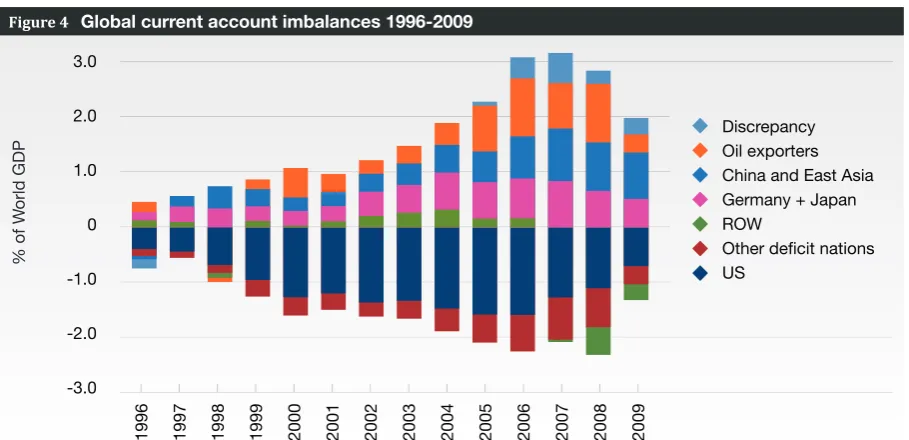
As Figure 4 shows, global imbalances increased significantly between 1996 and 2009. While the financial crisis acted to reduce these somewhat from recent highs, the IMF and others expect them to increase again in the future. Running sustained and large current account deficits requires capital inflows on the part of deficit countries. This implies an increase in public debt when accompanied by fiscal deficits. Figure 5 shows the long-run trends for government debt for G7 economies, including recent increases.
Figure 4
Figure 5
Global current account imbalances 1996-2009
Average government debt ratios in G7 Economies,1950-2010 (PPP-weighted)
Source: Long-Term Trends in Public Finances in the G-7 Economies, IMF Staff Position Note SPN/10/13, 1 September 2010 Source: IMF World Economic Forum Outlook, April 2010
1950 1955 1960 1965 1970 1975 1980 1985 1990 1995 2000 2005 2010
Gross Debt Net Debt
120
100
80
60
40
20
0
% of GDP
Risks in focus 1:
Global Risks 2011 | 17
Figure 6 Net present value of the impact on fiscal imbalance deficits of the financial crisis
and ageing-related spending for selected countries. There is a high degree of risk and uncertainty regarding
how much debt can be borne by the public sector, particularly in advanced economies, before the debt burden seriously impacts economic growth through increasing borrowing costs, politically unacceptable amortization payments, and the subsequent need for fiscal austerity. Based on a sample of 44 countries over a period of 200 years Kenneth Rogoff and Carmen Reinhart have found that there are distinct debt-to-GDP thresholds where debt growth becomes non-linear. Specifically, for public debt held by advanced and emerging economies they found this threshold to be approximately 90%.7 After this threshold, the
burden of debt reduces median GDP growth by roughly one percentage point and average GDP growth by considerably more. Depending on which measures of debt are used, US public debt is either fast approaching or even just past this threshold, while many European countries are well beyond it. Further, if current spending and income trends continue, IMF analysis indicates that net government debt for G7 economies could rapidly increase to unprecedented levels.
However, some economists argue that the standard debt-to-GDP ratios reported widely by official agencies fail to measure a country’s true long-term fiscal prospects. A more accurate measure of fiscal outlook is to factor in future liabilities not counted as current debt by calculating the net present value (NPV) of all future obligations relative to the NPV of all future income streams. Figure 6 summarizes such an IMF calculation for selected countries, with the average of the sample representing an NPV of 444% of GDP. While there are large uncertainties in these calculations, such analysis suggests that the impact of uncounted future liabilities is very large, and that the impact of age-related liabilities will dwarf short-term issues such as the cost of fiscal stimulus.
7Reinhart, Carmen M. and Kenneth S. Rogoff (2010), “Growth in a Time of Debt”, NBER Working Paper No. 15639, January 2010
Source: Fiscal Implications of the Global Economic and Financial Crisis, IMF Staff Position Note, SPN/09/13, 9 June 2009
JAP ITA TUR MEX FRA GER GBR
A
ver
gage AUS USA ESP KOR CAN
Aging Crisis
800
700
600
500
400
300
200
100
0
% of GDP
Risks in focus 1:
Given the magnitude of uncovered future liabilities, the IMF and Bank of International Settlements analysis implies that without significant adjustments in the medium-term, almost all advanced economies face serious threats to fiscal solvency in the long-run.8
This suggests that countries will have to embark on major fiscal consolidation exercises, increasing taxes or reducing spending, in order to cover the gap between expected future liabilities and expected future income. Experts argued that there is a distinct risk that politicians will not be able to muster the necessary will to prevent severe financial market turbulences and, ultimately, protect their countries against default. In light of the pressures of such fiscal and macroeconomic imbalances, discussions with experts highlighted three non-exclusive and negative scenarios whereby this cluster of risks produces severe challenges to the global financial and economic systems and beyond.
In the first scenario, a combination of recessionary pressures and lack of market confidence in the short-term and unfunded social obligations in the long-short-term could drive both fiscal and banking crises in selected advanced economies. In some countries, crises in public finances will mean a fall in value of government bonds, taking with them the value of assets invested by financial institutions. For countries with a higher proportion of private lending, as the threat of sovereign default rises, capital will flee banks that are seen to ultimately be reliant on public rescues. In either event, the direct impacts of fiscal crises are likely to be compounded by credit and banking crises with adverse systemic implications for the global financial system.
In the second scenario, emerging markets experience an asset price collapse. Loose monetary policy and slow growth in advanced economies, together with high growth in emerging markets, is already attracting increasing gross capital flows to emerging economies and decoupling their stock markets from those of advanced economies. This could result in asset bubbles as rising equity markets leak into real estate prices. Although some emerging markets are trying to restrain these capital inflows, it would be difficult for all emerging markets simultaneously to resist the upward pressure on their currencies. Such asset bubbles, driven as they are by excess liquidity rather than increases in underlying value, could result in severe crashes, damaging both emerging markets and the world economy as a whole.
The final scenario, although regarded by many as unlikely, is a repeat of the “stagflation” of the 1970s in advanced economies. This scenario sees loose monetary policy proving unable to stimulate economic activity, while supply-side restrictions for commodities and energy arise because of geopolitical conflict in the Middle East, or merely an outpacing of global supply by robust growth in the emerging world, leading to a loss of confidence in the ability of central banks in advanced economies and emerging countries to control inflation.
8See also IMF Country Report No. 10/248, 12 July 2010, Gokhale J, (2009) “Measuring the Unfunded Obligations of European Countries”,
National Centre for Policy Analysis and Kotlikoff, L (2010), “A Hidden Fiscal Crisis?”, Finance and Development, September 2010
Risks in focus 1:
Global Risks 2011 | 19
Levers and
trade-offs
Recognizing trade-offs in managing
global imbalances
Lack of agreement on how to reduce global imbalances makes it difficult to create joint responsibility at the international level. Diverging interests in the short-term are driven by both political and economic factors. While advanced economies see continuing imbalances as economically unsustainable, emerging economies running trade surpluses fear that adjustments involving currency appreciation would hurt employment in export sectors and potentially threaten social stability.
Political leaders in advanced economies are under increasing pressure to seek short-term solutions – but uncoordinated actions, such as simultaneous currency depreciation by multiple countries, could create new risks. For all countries to attempt to devalue their currencies at the same time would only have negative impacts.
There are three primary levers through which the risks described above could be addressed.
Strengthening global coordination
Although unlikely, experts consider that the G20 and IMF could play a key role in developing a stronger policy framework to discourage the build-up of unsustainable imbalances. Renewed leadership on promoting international exchange rate coordination is particularly important to avoid currency wars.
However, even more powerful would be cooperation on meaningful growth policies that change the incentives for the use of income in both deficit and surplus countries. Both price and income adjustments are required to reduce imbalances, and successful adjustment must include debtor and creditor (or deficit and surplus) countries.
Strengthening financial systems
Weak financial systems are a likely source of risk in both advanced and emerging economies; strengthening regulation and institutions in general is a key point of intervention. Many proposals have been made in this regard, including the Basel III provisions, and implementation is now seen as of most importance. Possibilities for strengthening the global financial system through regulation include:
• Better surveillance of the financial sector, including all systemically relevant players
• Tighter capital and liquidity ratios for all banking institutions (including non-banks), with higher ratios for systemically relevant institutions
• Risk retention for securitization (so-called “skin in the game”)
• Improved transparency and counterparty risk management in “over-the-counter” derivative markets
As outlined in the Forum’s Financial Development Report 2010, strengthening financial systems in emerging economies by developing capital markets and improving access to retail financial services could increase both domestic confidence and investment opportunities, both of which could stimulate
consumption and help to offset global imbalances as well as reduce the risk of asset bubbles.
Facilitating domestic transitions
towards balanced economies
While deficit countries will necessarily be required to take on far-reaching price and cost adjustments to enhance the competitiveness of their exports, surplus countries need to address weaknesses in private domestic consumption. This would not only increase the welfare of surplus societies, but also facilitate the necessary adjustments in deficit countries by raising their exports.
Most importantly, advanced economies urgently need to recognize the rising challenge of fiscal stress caused by unfunded liabilities linked to ageing societies. To shift dependence from government-provided social insurance to private savings for pensions and healthcare services, states will require a combination of careful reform, financial innovation, and private sector solutions to gradually but significantly reduce the burden on public finances and offset the risk of future fiscal crises.
Risks in focus 1:
Risk description
and impacts
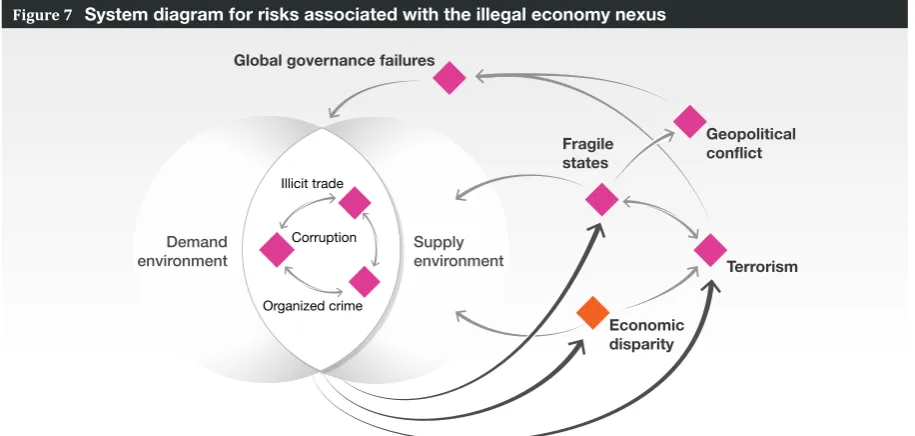
Illicit trade, organized crime and corruption are chronic risks that are perceived as highly likely to occur and of medium impact. As a highly interconnected nexus representing the illegal economy, however, experts see these risks as of central importance to the global risk landscape. As Figure 7 illustrates, both survey data and experts suggest that this nexus heavily influences three other important global risks – fragile states, terrorism and geopolitical conflict– which, in turn, have a significant and negative impact on global stability.
There is a feedback loop between this nexus and economic disparity. Economic disparity provides an enabling environment for illicit trade, corruption and organized crime to grow in advanced and emerging economies. In turn, the proceeds reinforce the power of the privileged, while undermining economic development by raising the costs of doing legitimate business, thereby increasing inequalities both within and between countries.
Similarly, while global governance failures have created a growing space for illegal activities, these activities have, in turn, tended to undermine efficient global governance.
Although this nexus of risks is often seen as more pervasive in emerging economies, a significant proportion of the demand for illicit goods is generated in advanced economies. Illegal networks also use the international banking and real estate systems to facilitate their financial management, laundering money and hiding profits from tax authorities.
The impacts of this nexus of risks can also spread far beyond emerging economies. For example, illicit trade of intellectual property-protected goods reduces incentives for innovation and investment. Trade in counterfeit medicines risks human health globally. Security risks arising from fragile states – terrorism and geopolitical conflict – may have broad consequences. And as Table 2 below shows, corruption in both emerging and advanced economies is a low-intensity transaction cost that stifles growth, distorts markets and undermines the rule of law.
Risks in focus 2:
The illegal economy nexus
Table 1
Impact of risks related to the illegal economy nexus (non-exhaustive)
Impacts Direct Impacts Indirect Impacts
Impact on governments
• Weakened institutions/undermining and
corruption of the rule of law
• Erosion of civil service function/capture of
state institutions by corruption
• Lack of continuity in policies affecting
business
• Small tax base/loss of revenue
• Exodus of capital
• Threats to political stability
• Decreased regional investments
• Shift of power to disruptive groups
Impact on society / populations
• Erosion of trust in public institutions
• Potential for draconian responses that limit
economic opportunity (stricter migration policies)
• Brain drain / skill depletion from emigration
• Reduction in tourism
• Destruction of biosphere through
unregulated activities
• Criminalization/marginalization of
segments of the population
Impact on business • Increased transaction costs
• Lost legitimate sales
• Deterred/appropriated investments
• Exposure to threats, bribes and reduced
security of personnel
• Higher costs of capital
• Pressure to participate in corrupt
practices through perceived competitive disadvantage Table 2
Global Risks 2011 | 23
Risks in focus 2:
The illegal economy nexus
Figure 1 System diagram for risks associated with the illegal economy nexus Figure 7
Source: World Economic Forum
Major trends and
uncertainties
The negative effects of corruption, illicit trade, organized crime and fragility are easy to characterize but extremely difficult to quantify. The opaqueness of this nexus of risks has resulted in too little attention and too few resources devoted to mitigating it, and the significance of this nexus of risks has increased considerably in recent years – in part because of global governance failures, as informal networks engage in legal and regulatory arbitrage.
Illicit trade is now thought to represent between 7 and 10% of the global economy – in some countries, illicit trade is the major source of income. Table 3 below is one example of attempts to judge the market size of illicit trade of different goods based on public sources. It must be stressed that these numbers are extremely rough estimates and are the subject of significant debate; the Forum’s Global Agenda Council on Illicit Trade is currently developing a methodology to track effectively the global impact of these activities. It should be noted that even when flows of illicit goods and criminal activity are small relative to global markets, they can have an outsized effect on fragile states as the real value of such activity can dwarf national salaries and government budgets.
The potential for this nexus of risks to cause contagion has arguably been demonstrated recently in Kyrgyzstan. Members of the Forum’s Global Agenda Councils argue that the undermining of state leadership and economic growth by corrupt officials and organized crime contributed significantly to social tensions which erupted in violent conflict in June 2010, causing widespread destruction, hundreds of civilian deaths and the displacement of 400,000 ethnic Uzbeks.
Figure 1 Rough estimated market size of illicit
goods based on public sources (in USD billion)
Table 3
Counterfeit pharmaceutical drugs: 200 Prostitution: 190
Marijuana: 140
Counterfeit electronics: 100 Cocaine: 80
Opium and heroin: 60 Web video piracy: 60 Software piracy: 50 Cigarette smuggling: 50 Human trafficking: 30
Environmental crimes and natural resources trade: 20 Logging: 5
Art and cultural artefacts: 5 Small arms: 1
Levers and
trade-offs
Recognizing trade-offs in responding
to the illegal econnomy nexus
Why has so little progress been made in mitigating this nexus of risks? One reason is that structures which enable illicit activities also benefit many people who would not consider themselves as engaging in criminal behaviour; for example, secrecy jurisdictions allow individuals and corporations to avoid tax. Increasing transparency and reducing illicit trade would undoubtedly involve increased costs and lower profits for many businesses. Similarly, there are large costs in shifting populations who currently rely on producing goods for illicit markets (such as poppy-farmers in Afghanistan) to other, legal activities.
However, if global leaders appreciate the importance of this issue as a collective challenge, a number of measures could be employed.
Improve global coordination with
stronger multilateral frameworks
Stronger links between international civil society and legal institutions in advanced economies would assist activists and law enforcement in emerging economies in tracking and halting flows of illicit capital out of fragile states. This was exemplified in the recent ruling by France’s Supreme Court allowing a judicial inquiry into complaints of alleged corruption and the removal of government assets filed against three African heads of state.
Reducing variation in regulation and enforcement capacity would inhibit the capacity of illicit activities to shift to the least-vigilant jurisdictions. National laws containing extraterritorial provisions to hold companies liable for corruption, such as the US Foreign Corrupt Practices Act and the United Kingdom Anti-Bribery Bill, offer a potential illustration example of how regulations could be extended and harmonized across jurisdictions.
Increase the transparency of
international financial and trade flows
The global financial system allows the profits of illicit trade, organized crime and corruption to be transferred and hidden. This protects participants, deprives governments of tax revenue and shifts tax burdens from capital onto wages and consumption. Ensuring transparency of financial flows would reduce opportunities for money to be laundered or transferred out of emerging economies, as well as enabling more effective law enforcement.
The Task Force on Financial Integrity & Economic Development recommends five steps to achieving greater transparency to ensure that financial flows can be tracked, verified and taxed:
• Requiring beneficial ownership to be a matter of public record, to reveal the true owners of capital
• Requiring multinational companies to undertake country-by-country reporting of all sales, profits and taxes
• Requiring all trade pricing to be conducted under the OECD arms-length principle and with pricing declarations and online data available to customs authorities, to curtail trade mispricing that avoids taxes and duties
• Implementing global automatic tax information exchange for all non-resident individuals, corporations and trusts
• Harmonizing anti-money laundering laws globally to standardize the predicate offences for money laundering, reduce legal arbitrage and ensure enforcement can proceed across different jurisdictions
Transparency in physical movement of goods similarly needs to be increased, to track the movement of products that may constitute illicit trade or be associated with organized crime and corruption. More responsible monitoring of supply chains could have a large impact.
Risks in focus 2:
The illegal economy nexus
Global Risks 2011 | 25
Increased demand side intervention
Experts argue that a greater understanding of the human and economic impact of engaging in illicit trade would reduce demand for illicit goods in advanced economies. This implies a focus on education, ethics training and the construction of new norms.
Similarly, rather than viewing it as an end in itself to reduce illicit trade, organized crime and corruption, this goal could be reframed as a means to support economic growth and human security. Such a reframing could shift priorities and behaviour while driving greater cooperation among institutions. For certain elements of illicit trade, there may be a case for reducing the profits on offer to organized crime by bringing trade within the framework of the law, as proposed recently in California with the legalization of marijuana.
For the corporate sector, reframing corruption from an issue of compliance to an issue of risk could increase vigilance in monitoring legal or reputational exposure. This requires a more precise assessment of the costs of this nexus to businesses and government tax bases.9 The Forum is convening private sector actors
through its Partnering Against Corruption Initiative to clarify the business impacts of corruption and develop collective solutions with government and civil society.
Reducing economic disparity
Economic disparity is an enabling environment for this nexus, as it provides the incentive for individuals to supply and consume the outputs of illicit trade, organized crime and corruption.
Reducing economic disparities is a major challenge; it must be faced at a structural level. An empirically reliable long-term strategy is to invest in universal education, equipping populations with the knowledge and skills to contribute fully to economic activity. Similarly, investments that attempt to correct for structural unemployment should be investigated.
9See for example Transparency International, the International Chamber of Commerce, the UN Global Compact and the World
Economic Forum (2008) Clean Business is Good Business: The Case against Corruption http://www3.weforum.org/docs/WEF_PACI_ BusinessCaseAgainstCorruption_2008.pdf
Risks in focus 2:
Risks in focus 3
Risk description
and impacts
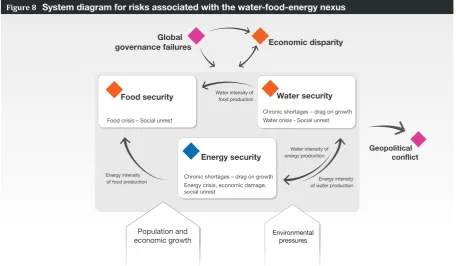
Water security, food security and energy security are chronic impediments to economic growth and social stability. Figure 8 shows their interrelatedness: food production requires water and energy; water extraction and distribution requires energy; and energy production requires water. Food prices are also highly sensitive to the cost of energy inputs through fertilizers, irrigation, transport and processing.
Economic growth and population growth are common drivers for all three risks, especially as improving living conditions in emerging economies results in more resource-intensive consumption patterns. Environmental pressures also drive resource insecurity – from climate shifts to extreme weather events that alter rainfall and affect crop production.
Governance failures in terms of managing shared resources – such as trans-boundary water and energy sources and food trade agreements – create tensions that can lead to conflict, as seen recently in Yemen. Economic disparity also often exacerbates this nexus of risks as governments and consumers seek short-term, unsustainable solutions to economic hardship such as growing high-value, water-intensive export crops in water-deprived regions.
It is at the local level that most opportunities can be found for improving resource efficiency and managing trade-offs between energy, water and food production. However, at the global and regional levels there are few initiatives to raise awareness, share leading practices and motivate consumers in an integrated approach. Table 4 shows a non-exhaustive list of some of the direct and indirect impacts stemming from this nexus.
Risks in focus 3:
The water-food-energy nexus
Table 1
Impacts of risks related to the water-food-energy nexus (non-exhaustive)
Impacts Direct Impacts Indirect Impacts
Impact on governments
• Stagnation in economic development
• Political unrest
• Cost of emergency food relief
• Significantly reduced agricultural yields
• Threats to energy security
• Increased social costs linked to
employment and income loss as agriculture is negatively effected
• National security risks/conflict over
natural resources
Impact on society / populations
• Increased levels of hunger and poverty
• Increased environmental degradation
• Severe food and water shortages
• Social unrest
• Food price spikes
• Migration pressures
• Irreparably damaged water sources
• Loss of livelihoods
Impact on business • Export constraints
• Increased resource prices
• Commodity price volatility as shortages
ripple through global markets
• Energy and water restrictions
• Lost investment opportunities
Table 4
Global Risks 2011 | 29
Risks in focus 3:
The water-food-energy nexus
Figure 1 System diagram for risks associated with the water-food-energy nexus Figure 8
Source: World Economic Forum
Major trends and
uncertainties
Agriculture is the dominant water user, consuming more than 70% of total global water demand. Industrially produced meat is especially water-intensive, requiring up to 20,000 litres of water to produce a kilogram, compared to approximately 1,200 litres to produce a kilogram of grain. Both population growth and increasing meat consumption in emerging economies will therefore have a tremendous impact on resource needs.
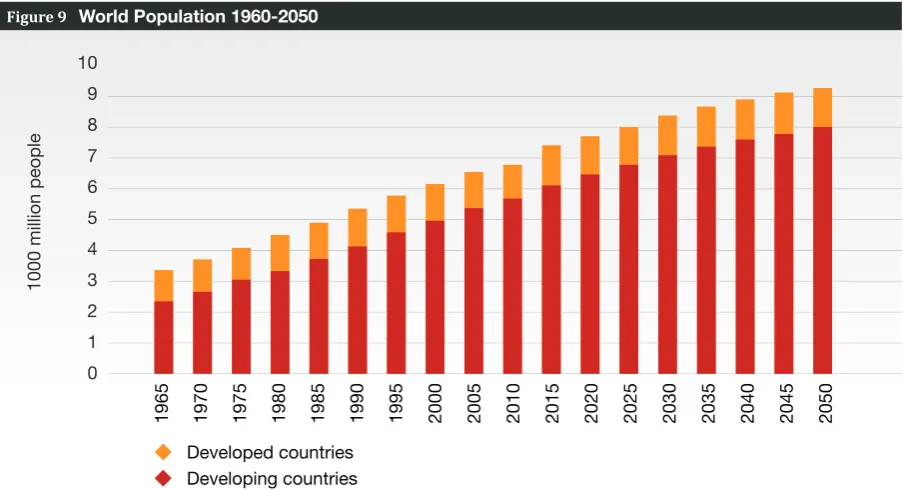
As Figure 9 shows, over the next 10 years, the world population is expected to rise from the current 6.83 billion to approximately 7.7 billion, with most of the growth in emerging economies. The United Nations Food and Agriculture Organization (FAO) projects a 50% increase in demand for food by 2030, and the International Food Policy Research Instituted (IFRI) expects a 30% increase in demand for water, with other estimates rising to over 40%. The International
Energy Agency (IEA) forecasts that the world economy will demand at least 40% more energy by 2030; producing this energy will draw heavily on freshwater resources. For such increased demand for water, food and energy to be realized, significant and perhaps radical changes in water use will be required as well as new sources for food and energy production exploited. For food production, supply-related challenges may limit the ability of farmers to meet growth in demand. Already, major grain-producing areas – in China, India and the United States, for example – depend on unsustainable mining of groundwater. In some regions, such as North Africa and Australia, climate-related changes of precipitation have already critically reduced the levels of freshwater supply. In northeast China, one of the country’s main grain-producing regions, climate change could increase drought losses by over 50% by 2030.10
10The Economics of Climate Adaptation (ECA) Working Group (2009) Shaping Climate Resilient Development: A Framework for
Decision-Making
Figure 1 World Population 1960-2050 Figure 9
Source: World Economic Forum Water Initiative, edited by D. Waughray (2010). Water Security: The Water-Food-Energy-Climate Nexus, based on United Nations Population Division, UN-DESA, UN Revision 2008
Developed countries Developing countries
10
9
8
7
6
5
4
3
2
1
0
1000 million people
1965 1970 1975 1980 1985 1990 1995 2000 2005 2010 2015 2020 2025 2030 2035 2040 2045 2050
Risks in focus 3:
Global Risks 2011 | 31
Risks in focus 3:
The water-food-energy nexus
Levers and
trade-offs
Recognizing trade-offs in the
water-food-energy nexus
Tough trade-offs will increasingly be needed between energy, food and water in terms of resource allocation and planning. The key challenge is to incorporate the complex interconnections of this nexus of risks into response strategies that are integrated and take into account the many relevant stakeholders. The Forum is working on such an approach with its innovative initiative WRG Phase 2, run in partnership with the Water Resources Group (See page 33: The Forum’s Water Initiative: Focusing on the Water-Food-Energy Nexus).
Unintended consequences abound. For example, because of policy incentives designed to reduce vehicle emissions, by 2030 the IEA predicts that at least 5% of global road transport will be powered by biofuel – over 3.2 million barrels per day. However, producing those fuels could consume between 20-100% of the total quantity of water now used worldwide for agriculture. This is clearly an unsustainable trade-off. Another example is shale gas extraction, which promises access to new reserves of fossil fuels, but is highly water-intensive and may pose a risk to water quality.
Few governments are developing energy policy with a goal of not only enabling economic growth and reducing carbon emissions, but also ensuring water efficiency; the nature of this nexus, however, means pursuing multiple goals will become a necessity. Trade-offs between the three resources, as well as trade-offs between users in the form of resource rationing, will become an increasingly important issue, as will managing these trade-offs through a combination of market mechanisms and regulation.
However, beware of false dichotomies. It is not necessary to trade biodiversity for economic growth, for example. Such trade-offs exist primarily when policy-makers and resource-users act in a short-term, reactive and hurried fashion. To avoid these unnecessary trade-offs and tackle the necessary ones, the Forum has identified a number of response strategies for further exploration.
Integrated and multistakeholder
resource planning
Regionally-focused infrastructure
development
Multistakeholder coordination on regional infrastructure investment could significantly enhance resilience with regard to food, water and energy security. For example, by investing in regional electricity grids, Gulf Cooperation Council countries increased the reliability of their power supply. Experience shows that countries with adequate levels of infrastructure, coupled with institutions which ensure that the scarcity value of water is reflected, can be extraordinarily adaptive.11
Market-led resource pricing
Resource pricing has a large role to play in managing demand for food, water and energy. Prices are kept artificially low by government subsidies or other regulation in many countries, thereby increasing demand. However, even if they were allowed to rise through market mechanisms, prices would not account for many of the negative externalities created by water, food and energy consumption. Both the cost of local impacts (such as the long-run social and environmental costs of resource exploitation) and global impacts (such as contribution to climate change through carbon emissions) should ideally be included in resource pricing. Without accurate pricing to reflect the full cost of resource use, it is likely that unsustainable decisions regarding resource use will continue.
However raising the price of water has significant and negative social impacts in many regions. To account for these, market mechanisms must be managed progressively so as not to endanger social stability by disadvantaging poor consumers; the human cost of higher resource prices should be recognized by stakeholders and solved with careful planning. Further, increased resource prices will inevitably impact economic growth, as higher prices are passed on to consumers. Experts suggest that despite such challenges, efforts to create properly-costed systems are critical to the future sustainability of global prosperity, as the cost of severe shortages because of irreparable damage to water and food sources would far exceed the costs incurred through proactive resource management. In regions such as the Middle East and North Africa, market prices may also attract private investment in infrastructure that can better preserve the scarce resources currently being depleted.
Community-level empowerment
and implementation
Experts argued that policies which aim to manage food, energy or water resources are in many cases well-designed; many of the barriers to sustainable resource use relate to implementation. As an example, lack of sanitary facilities impacts water security through the contamination of local water sources. However it may not be enough simply to build sanitation facilities without also addressing social norms on open defecation; to ensure that such facilities are used requires implementing cultural shifts as well infrastructure investment.
Overcoming such barriers means engaging, empowering and incentivizing local actors at the community level to ensure that those actually using core resources are also the guardians of their sustainable consumption.
Technological and financial
innovation for managing the nexus
Further research and investment in transformative technologies and risk management tools that address the nexus as a whole are needed. Ensuring that such tools are locally appropriate and broadly adopted is key to their success. Many efficiency improvements require new operational management models and access to information. Innovations such as synthetic protein manufacturing, drip irrigation, and hybridization of crops to make them salt resistant could potentially maintain food security while simultaneously achieving water and energy efficiency, but require investment for both development and implementation.
Innovative financial risk management initiatives also look promising, such as the development of “safety net” payments for Vietnamese rice farmers if yields fall below expected levels due to pests, diseases or weather events such as droughts, floods and typhoons. In the past, damages to agriculture due to weather or pests have resulted in losses of up to 5% of Vietnamese GDP; thanks to multi-stakeholder collaboration between agricultural banks, insurers and the national government, this scheme addresses multiple risks to help ensure food security on a national level, protecting the livelihoods of farmers and thus increasing the overall resilience of food production in the country. However, most of these instruments remain focused on a particular target such as yield or weather risk, and as such do not address regional risk management across sectors, or the ultimate risk of food supply. The interconnected nature of the challenge suggests that further work in integrating technical and financial solutions is needed.
11In southeast Australia, for example, a 70% reduction in water availability has had big effects on the composition of agriculture, but little impact on the overall economic value of agriculture.
Risks in focus 3:
Global Risks 2011 | 33
Risks in focus 3:
The water-food-energy nexus
The Forum’s Water Initiative:
Focusing on the Water-Food-Energy Nexus
The World Economic Forum has partnered with the Water Resources Group (“WRG”) on an innovative initiative under the guidance of the Global Agenda Council on Water Security. This initiative, known as WRG Phase 2, will engage governments who wish to work progressively on a water sector reform strategy; and then provide a supporting public-private approach. The initiative will follow the ACT process – undertaking Analysis to help Convene and build Coalitions to develop Transformational policies, programmes, projects and partnerships – aimed to create “proof points” that such a coordinated platform approach can work. There are two main steps to this process:
• Step 1: Initial diagnostic. The initiative will create a comprehensive fact base on the national water supply and demand balance to 2030 and the economic implications of the options available to address any gaps;
• Step 2: Country-level work. When invited by the government, the initiative will offer multidisciplinary support through a public-private advisory platform. This will help the government shape and test concepts and governance processes that seek to close identified future water volume gaps; to improve water resource management in a river basin, country or region; and to build this inform national into regional water adaptation planning.
The outcome of the WRG Phase 2 will be a validated and unique public-private model and a financed
global platform that can support governments who wish to catalyze change in their water sectors.
An example of this initiative in action is the Forum’s ongoing work in Jordan, supported by the Jordanian
Ministry of Planning and International Cooperation, and the Ministry of Water and Irrigation. Step one is underway, involving deep analysis and building cost-curves to understand the gaps between water supply and demand, and developing prioritized recommendations and sector strategies. Step two will build on
recent work with the Jordan Business Alliance on Water, a collaboration catalysed at the 2009 World
Economic Forum on the Middle East and involving the Jordanian government, Jordan Chamber of Industry, American Chamber of Commerce, USAID and GTZ.
A special focus of the initiative is to build awareness and better understanding of the
water-food-energy-climate nexus. This nexus represents the most important global dimension of the water crisis in terms of
managing economic growth and other impacts connected to water scarcity. The Global Agenda Council
on Water Security is a key supporter of the initiative, and will help the Forum develop deeper and more focused analysis of issues related to the water-food-energy nexus and the associated risks to growth.
The WRG Phase 2 initiative aims to contribute a range of expert briefing documents into the Forum’s Risk Response Network as well as to relevant Government officials and other stakeholders facing the challenges of the water-food-energy nexus.
Some risks in the global risk landscape saw low levels of confidence or strongly varying expert views as to likelihood and impact. For these very reasons, such risks may surprise or overwhelm us, and they have been designated as “risks to watch”.
Cyber security
Awareness is growing that the real world is vulnerable to security threats from the virtual world, but the complexity of “cyber security” issues is still not well understood and its risks could be underestimated. Cyber security encompasses online data and information security and critical information infrastructure breakdown, and ranges from petty online theft by disenfranchised youths to government-led provocations with potentially catastrophic consequences.
Four distinct global risk-related activities stand out:
• Cyber theft has become a growing industry with a long tail, particularly in countries where economic disparity has recently been combined with access to global communication technologies. Actors in this field range from entrepreneurial individuals to shell corporations built with the hope of economic gains offset by acceptable risks. Interestingly, some assessments indicate that cyber thieves experience a substantially lower feeling of guilt than is apparent in other criminal activities.
• Cyber espionage, whether by the private or public sector, has brought the age-old practice of intelligence-gathering into a new era. Particularly insidious, as has repeatedly been shown in the past two decades, is the use of such techniques not only by countries generally understood as enemies but also by friendly allies.
• Cyber war is little understood by the general public and has stirred controversy among civilian and military leaders. While an open war in cyber space is possible, experts indicate that the interplay between cyber war and physical war poses a more likely risk for society, with aggression online not only serving but also potentially provoking conventional attacks.
• Cyber terrorism is perhaps even less understood and is fuelling concerns over the openness of the Internet, security and privacy. Many have inferred a high risk of cyber terrorist attacks from terrorist organizations’ extensive use of the Internet in recent years for doctrinal, recruitment, and operational communication purposes as well as some occurrences of cyber theft. However, these practices do not in themselves indicate any capacity for large-scale cyber terrorist attacks, and it should be noted that terrorist use of the Internet equally allows law enforcement agencies to gather valuable intelligence.
In addition to these intentional or malevolent risks, a range of risks relate to design flaws in “smart” systems connected to the Internet. Data gathered for one benign purpose may be spread to other networks with unintended consequences, potentially leading to new machine-to-machine threats.
Further contributing to confusion about cyber
security’s landscape is the constant innovation in each of the above fields and potential new connections among them. Nevertheless, understanding the range of negative consequences is central to managing effective risk response. The pervasiveness of the Internet and importance of related technologies to everyday life and business means that should a major disruption occur, it is likely to have high impact globally.