* Corresponding author. Phone 334293, Fax. 062-331-330225. Email address : [email protected]
ELECTROPOLYMERISATION AND CHARACTERISATION OF DOPED-POLYPYRROLE
AS HUMIDITY SENSOR
Siswoyo
a,*, Trio F. Nugroho
a, Zulfikar
aand Agus Subekti
b aDepartment of Chemistry,Faculty of Mathematics and Sciences, University of Jember Jl. Kalimantan 37 Kampus Tegalboto, Jember Indonesia 68121
b
Department of Physics,Faculty of Mathematics and Sciences,
University of Jember, Jl. Kalimantan 37 Kampus Tegalboto, Jember Indonesia 68121
Received 9 March 2006; Accepted 1 June 2006
ABSTRACT
A new type of sensing materials for humidity measurement has been developed based on conducting polymer polypyrrole synthesised from pyrrole by adding some dopant compounds, bromide and chloride, it is prepared by potentiodynamic-electropolymerisation technique. Variation of dopant types and concentration has been carried out in order to investigate the effect of this variation to the change of polymeric conductivity when interacting with water vapour. Polypyrrole-Cl (Ppy-Cl) and polypyrrole-Br (Ppy-Br) exhibit a good principal characteristic as sensor candidate namely responding proportionally to humidly variation ranging 30% - 90% relative humidity. Characterisation test for the sensor candidates has been carried out for evaluating their linearity respond toward humidity, their stability in certain period and their reproducibility in some tests. The results show that Ppy-Cl and Ppy-Br showing good linearity respond with R value in a range of 0.95 – 0.99. Their reproducibility and sensitivity were relatively good, however their respond stability were only last in few days. The stability probably is related to the stability of resulted polymeric structure that very affected by synthesis process and dopant used. It is necessary to extend the use of other dopant materials and changing the synthesis process in order to improve sensor stability. In other hand it is also necessary to characterise other performance characteristic of the sensor namely response time, and interference effect of some volatile chemicals and other gases.
Keywords:polypyrrole, potentiodynamic, electropolymerisation, humidity sensor and conducting polymer. INTRODUCTION
Water vapour is a major component in ordinary air. It readily absorbs radiation and therefore its presence has a strong influence on the ability of infrared energy to penetrate the air. The water content in surrounding air in vapour form is an important factor for the well-being of humans, animals and others life organisms. The level of comfort is determined by a combination of two factors: relative humidity and ambient temperature. Humidity is an important factor for operating certain equipment, for instance, high impedance electronic circuits, electrostatic sensitive components, high voltage device, etc. [1].
Humidity is a very common component in our environment. Measurement and control of humidity are important not only for human comfort but also for a broad spectrum of industries and technologies. Humidity is one of the most difficult environmental variables to measure accurately and reliably. Visscher and Kornet said that during the last decade both supply of and demand for humidity sensors have shown a large increase, the rise has been due to an increase in volume in traditional areas as well as to the emergence of numerous new applications [2].
The trend towards using automated control systems has recently gained importance in
environmental control because of the falling cost of interface circuits and microprocessors, and their improved reliability and broadening applications [3]. Among the different types of humidity sensors, the best type of the sensors were based on the electrical properties such as resistance and capacitance and those are best suited to modern automatic control systems [4].
Particularly in the recent years the use of humidity control system has greatly increased in the quality control of production processes and products in a wide range of industries, such as the production of electronic devices, precision instruments, textiles and foodstuff, and also in many domestic applications, such as intelligent control of the living environment in building, where humidity sensors are used to maintain a comfortable humidity level and cooling [5].
performance characteristics.
Recently there has been developed a relatively new kind material that can be used for gas and odour sensing, namely conducting polymers. Rabe, et.al., reported that polypyrrole film showed reversible changes of their electrical conductivity when exposed to vapours of electron donating or accepting compounds [6]. They investigated effect of several compounds i.e. sulphur dioxide, methyl amine, ammonia and water, to change the conductivity of polypyrrole. As a gas sensor the response of polypyrrole to methanol vapour was rapid and reversible [7]. It was also reported that some of conducting polymers have characteristics that can be further exploited as humidity sensor [8,9].
Mostly, synthesise of this class polymer was targeted as sensors candidates for some particular gases [10-12] or as sensor array in electronic nose system [13,14]. Optimisation of the sensor response to water vapour was only done by compensating the sensor signal electronically [15]. This paper deals with electro-polymerisation of a particular conducting polymer i.e. polypyrrole that employing some type of dopant materials and characterisation of the response of polypyrrole-based sensor to humidity variation.
EXPERIMENTAL SECTION
Materials and reagents
Monomer pyrrole (Merck) was used without purification to produce polypyrrole by adding some dopant materials: potassium bromide (Sigma) and potassium chloride (Sigma). All chemicals were dissolved in purified water which was produced by purifying distilled water in Mili-Q®Milipore®water purifier system.
Electropolymerisation technique of polymer
Electropolymerisation of polypyrrole was conducted using potentiodynamic cyclic voltammetry technique performed on a computer-controlled potensiostat Amel 433A®. Electrochemical cell that consists of cooper working electrode (WE), stainless steel counter electrode (CE) and Ag/AgCl reference electrode (RE), was built on a 25 ml Pyrex beaker glass filled with the monomer solution and the appropriate dopant at varied concentration. Approximate effective surface of WE and CE were 0,5 mm2and 1,5 mm2respectively.
Characterisation of polypyrrole-based sensor
Response’s characterisations of polypyrrole-based sensor to humidity variation were conducted by placing the sensor in a humidity-controlled closed container and measuring resistance change of the sensor every varied
resistance sensor response during characterisation was performed using computer-connected digital multimeter (BM 202 Brymen®) that enable storing bulk resistance data into the computer storage for further data processing.
Controlling a certain value of humidity in the test chamber was achieved by applying two main steps: firstly the opened test chamber was flushed with a dry air for about 15-30 minutes ensuring homogeneity of the test chamber and then it was closed protecting from surrounding environment; secondly a certain volume of water was then injected into the closed test chamber, a small electric fan placed inside the chamber was used for speeding up conversion of the drop water into water vapour and ensuring homogeneity of the humidity in the chamber. A standard hygrometer was installed in the chamber for reading the humidity used for reference. The test sensor in the chamber was connected to the multimeter outside the chamber for reading its resistance continuously. Increasing the humidity was then carried out by injecting more water into the test chamber.
RESULT AND DISCUSSION
Electropolymerisation conducting polypyrrole
Synthesis of the polymer based on variation of 2 type dopants, 3 level of dopant concentrations (0,1 M; 0,05 M; and 0,025 M) and 6 replicates of each variation has resulted 36 sample polymers film. The thin film produced was on the gap of the cooper electrode as well as the both surfaces of the electrode. Surface area of the film deposited was around 0,5 mm2 and the colour of the polymer was black-brown.
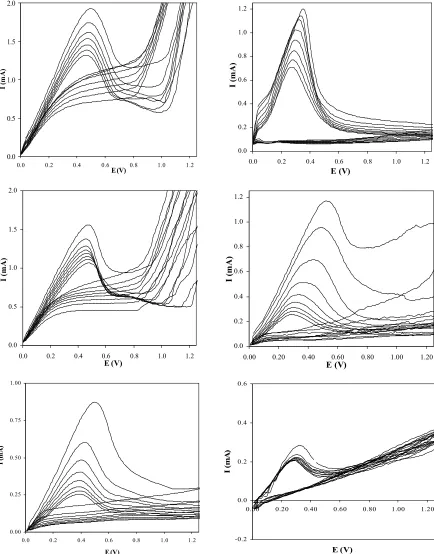
Voltammogram, curve of current generated vs applied potential that indicating the electro-synthesis processes for each the synthesis variation is shown in Fig 1. Only the first 10 cyclics are shown in each figure, generally the synthesis was completed after running the sixth 10 cycles for fully covering the gap of the electrode. Fig 1 shows mechanism of polymerisation of pyrrole in the presence of dopant KBr and KCl at concentration of 0,1 M; 0,05 M; and 0,025 at Cu-electrode. Addition of different dopant has shown a slight difference in potential oxidation of pyrrole on the electrode. The potential oxidation of pyrrole was found on the range of 0.45 V-0.55 V in the presence of KBr dopant, whilst in the presence of KCl the potential was on the range of 0.25 V-0.4 V
0.0 0.5 1.0 1.5 2.0
0.0 0.2 0.4 0.6 0.8 1.0 1.2
E (V)
I
(m
A
)
0.0 0.2 0.4 0.6 0.8 1.0 1.2
0.0 0.2 0.4 0.6 0.8 1.0 1.2
E (V)
I
(m
A
)
0.0 0.5 1.0 1.5 2.0
0.0 0.2 0.4 0.6 0.8 1.0 1.2
E (V)
I
(m
A
)
0.0 0.2 0.4 0.6 0.8 1.0 1.2
0.00 0.20 0.40 0.60 0.80 1.00 1.20
E (V)
I
(m
A
)
0.00 0.25 0.50 0.75 1.00
0.0 0.2 0.4 0.6 0.8 1.0 1.2
E (V)
I
(m
A
)
-0.2 0.0 0.2 0.4 0.6
0.00 0.20 0.40 0.60 0.80 1.00 1.20
E (V)
I
(m
A
)
Fig 1.Cyclic voltammogram of synthesis process of polypyrrole-dopant (PPy/X) at potential range of 0-1400 mV and scan-rate of 100 mV/s. Left hand side: X=Br; right hand side: X=Cl. Dopant concentration from top to bottom are 0.1M, 0.05M, and 0.025M
decreasing the activity of the electrode surface. It is due to this reaction is irreversible hence the deposited polypyrrole on electrode is getting thicker. It is noted that
0
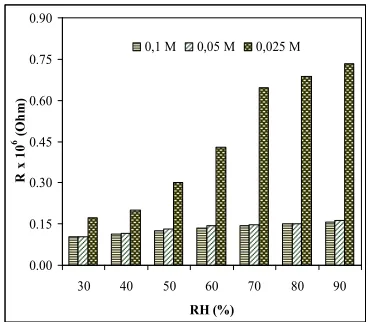
Fig 2. Resistance change of Ppy at various concentration of dopant Br- (0.1M, 0.05 M and 0.025 M) and relative humidity (30% – 90%)
From the voltammogram it is clear that generally concentration of dopant affected the oxidation current, more concentrated dopant has resulted higher oxidation current of the polymerisation process. This fact is good agreement with the established voltammetric concept, an increase in the amount of electroactive species might increase the oxidation/reduction current. It is indicated that the dopant has functioned as supporting electrolyte, facilitating current flow in the solution, as well as electroactive species that involved in electrochemical reaction, affecting the properties (chemically or physically) of the product reaction (will be shown later on). Similar result has also been observed that higher concentration of the dopant (electrolyte) causing the polymerisation reaction faster [16].
Characterisation of the sensors
As shown in Fig 2 and Fig 3, resistance of the doped-polypyrrole in the present study decreases as dopant concentration increases. A decrease in
poly-y = 8670x + 714851
Fig 4.Resistance change of Ppy-Br 0.1 M as function of relative humidity variation.
Fig 3. Resistance change of Ppy at various concentration of dopant Cl- (0.1 M, 0.05 M and 0.025 M) and relative humidity (30% – 90%)
pyrrole resistance (increasing polypyrrole conductivity) was caused by an increase in the amount of anion (Cl -and Br-) doped in polymer chains. Interaction between positive charge of the polymer and negative charge dopant anion will be more facilitated, hence resistance of the polypyrrole decrease. this result has also been reported on the previous study (paper) [16].
Further investigation of polymer-humidity interaction has indicated that the resistance of the doped-polypyrrole increase proportionally as the humidity increase. There are some opinions relating to the fact that the polypyrrole resistance increase when exposed to the increasing humidity (water vapour). In the present study doped (Cl- and Br-) polypyrrole can be considered as material n-type semiconductor (electron-rich polymer). Meanwhile, it was suggested that the interaction between the polymers with water vapour will cause conductivity of the polymer decrease. It is due to a reduction of charge mobility, as water molecule can reduce the charge mobility due to chain stretching of the polymer when water molecule filling
y = 77694x + 59520
y = 86107x + 6E+06
Fig 3. Resistance change of Ppy-Br 0.025M as function of relative humidity variation
y = 950.13x + 79881
Fig 4.Resistance change of Ppy-Cl 0.05M as function of relative humidity variation
the hole of polymer [17]. Considering to the molecular structure of water, it is well known that O atom in O-H bonding is very electronegative and bond-electron is concentrated on O side, hence H atom will pull the surrounding electron close to it. When water molecules interact with the polymer, the H atom of the water molecule will pull the electron-rich polymer (anion-doped polymer, Ppy-Br and PpY-Cl), hence the electron on the backbone polymer become less and then will affecting a decrease in the polymer conductivity or increasing its resistance.
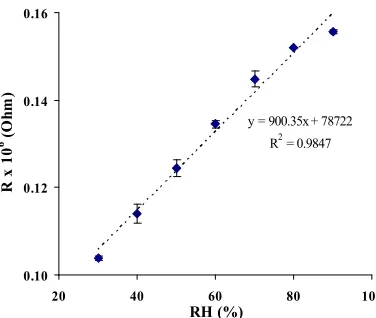
Reproducibility response of the doped-polypyrrole in form of resistance change was good as indicated by standard deviation based on six measurements (not shown). The response of both Cl doped-polypyrrole and Br doped-polypyrrole to humidity variation has a good linearity as shown by correlation coefficient ranging 0.95-0.99. The dopant concentration has also give a significant effect to the sensitivity of the sensor. The sensitivity of Ppy-Cl with various concentration of Cl-(0,1
y = 900.35x + 78722
Fig 5.Resistance change of Ppy-Cl 0.1M as function of relative humidity variation.
Fig 6.Resistance change of Ppy-Cl 0.025M as function of relative humidity variation.
M, 0.05 and 0.025 M) were found to be 900, 950 and 10713 Ohm/decade respectively. Meanwhile, the sensitivity of Ppy-Br were 8670, 77694 and 86107 Ohm/decade for the concentration of Br- 0.1, 0.05 and to Fig 6). In contrast to the good linearity response of sensors, stability of the sensors response was found slightly poor, a degradation of the response was found after several days. This is probably related to the dopants type and the synthesis process as well. Currently an ongoing work has being done to investigate the use of other dopants and also effect of the potential scan-rate to the stability of polypyrrole-based humidity sensors.
CONCLUSION
Ppy-the humidity sensor candidates. The results show that Ppy-Cl and Ppy-Br showing good linearity respond to the relative humidity variation ranging 30% - 90% with R value in a range of 0,95 – 0,99. Their reproducibility and sensitivity were relatively good. The poor stability of the sensor probably is related to the stability of resulted polymeric structure that very affected by synthesis process and dopant used.
It is suggested to extend the use of other dopant materials and changing the synthesis process, especially the potential scan-rate of polymerisation, in order to improve sensor stability. In other hand it is also necessary to characterise other performance characteristic of the sensor namely response time and interference effect of some volatile chemicals and other gases.
ACKNOWLEDGEMENT
Authors thank Directorate General Higher Education, Ministry of National Education for funding this work through Research Competitive Grant XIII.
REFFERENCES
1. Brundrett GW, 1990, Criteria Moisture Control, Butterworth, London, 193-209,
2. Visscher GJW, and Kornet JG, 1994, Meas.Sci.Technol., 5, 1294-1302,
3. Yagi, H, 1993, Humidity sensors using ceramic materials, in Butler,M., Ricco,A., and Yamazoe, N. (Eds), Proc. Symp. Chemical Sensors II, Vol. 93-7, The Electrochemical Soc., Pennington, NJ, 498-509.
Actuators, 10, 379-398.
5. Traversa E, 1995,Sensors & Actuators B, 23, 135-156.
6. Rabe JG, Bischoff G, and Schmidt WF, 1989, Jpn. J. App. Physics, 28, 3, 518-523.
7. Bartlett PN, and Ling-Chung SK, 1989, Sensors & Actuators, 19, 141-150.
8. Siswoyo, 1996, Construction of A System for Humidity Measurement Based on Conducting Polymers, M.Sc Dissertation, Department of Instrumentation & Analytical Science UMIST, Manchester.
9. Persaud, KC and Siswoyo, 2000, Electrically Conducting Polymer for Sensing Volatile Chemicals, in Selected Topics in Advanced Solid State and Fibre Optic Sensors, Eds. SM Vaezi-Nejad, Institution of Electrical Engineers, London. 10. Miasik JJ, Hooper A and Tofield BC, 1986,
J.Chem.Soc. Faraday Trans, 1, 82, 1117-1126. 11. Bartlett PN, Archer PBM, and Ling-Chung SK,
1989,Sensors and Actuators, 19, 125-140.
12. Slater JM, Watt EJ, Freeman NJ, May IP, and Weir DJ, 1992, Analyst, 117, 1265-1270.
13. Gardner JW, and Bartlett PN, 1994, Sensors and Actuators B, 18-19, 211-220.
14. Hatfield JV, Neaves P, Hicks PJ, Persaud KC, and Travers P, 1994, Sensors & Actuators B, 18-19, 221-228.
15. Siswoyo, 2005,Journal Ilmu Dasar, 2005, 6 (1) 16-23.
16. Berselline C, Garofano L, Giannetto M, Lusardi F, and Mori G, 2001,J. Forensic Sci.. 46, 872. 17. Teh K and Lin L, 2003, A Micro-Gap Sensor