FOOD HABITS OF THE YELLOW RASBORA, Rasbora lateristriata, (FAMILY: CYPRINIDAE) BROODFISH DURING MOVING TO SPAWNING GROUND
Djumanto and F. Setyawan
*) Laboratory of fi sheries resource management, Department of Fisheries, UGM *)Corresponding author; E-mail: [email protected]
Abstract
The purpose of this research was to clarify the food habits of yellow rasbora (Rasbora Iateristiata) when moving into spawning site during spawning season. Specimens of yellow rasbora were collected between July and August, 2007 from spawning site surveys during spawning season in their natural environment which run yearly from April to August. There were 628 individual fi sh collected from spawning ground, and 30 of them were selected to analyze the gut content. Samples were preserved in alcohol solvent until identifi ed their gut content in laboratory.
The results showed that yellow rasbora broodfi sh fed plankton continuously both in the day and night while moving into the spawning site. Percent Index of Relative Importance values indicated the most important prey items of yellow rasbora were phytoplankton (68.43%), and then zooplankton (29.79%), leaf cut (0.02%), little caterpillar (0.01%), insect larva (0.15%), and unidentifi ed items (1.60%), respectively. Chrysophyta and protozoa was found the most dominant of phytoplankton and zooplankton in the gut content, respectively. Based to the ratio between gut length and total length, and the feeding mode, R. lareritriata is categorized to an omnivorous feeder.
Key words: Water properties, phytoplankton, Lakes Sentani
Introduction
Members of the genus Rasbora are widely distributed along the east and southeast area of the As ian continent (Kottelat, et al. 1993), as well as in Africa (Nelson 2006), and in Sumatra, Borneo, Jav a, Bali and Lombok. In Java island, this species was occured in several streams inhabitat in shallow area with relatively fast fl owing water and plenty of gravel in riverbottom. Rasbora lateristriata (Cyprinidae) is riverine fish found in mountainous streams of Yogyak arta regency. It used to be an important protein source for communities residents in the old days. However, since the last decade, environmental degradation, heavy fi shing, illegal use of poison, and fragmentation of rivers by construction of some dams along the habitat of this fi sh have driven it to the edge of extinction. Eventhough it hasn’t offi cially been listed as an endangered species yet in Indonesia, however a sharp decline in numbers was occured since building the dams in same rivers, especially a dam found in the middle Ngrancah river (Triyatmo, et al. 1997; Setyobudi, 2000). Despite decreasing in individual numbers which lead to being an endangered species,
R. lateristriata was little studied. A study program of R. lateristriata was initiated with the aim to understand the habitat conditions and use, reproduction (Djumanto et al. 2008), and feeding behavior of the fi sh.
Feeding studies can prov ide res earchers with important insights towards understanding potential fishery impacts on freshwater. Information about feeding of spawner freshwater fi shes in Yogyakarta regency, both in rivers and reservoirs, is rare. Yellow rasbora is one of the riverine fi sh, yet life history information is extremely limited for this species and its diet especially during spawning seasons are unknown.
The fish family cyprinidae has great ec onomic importance in Central Java (Djumanto 2000). In Yogyakarta special regency, investigations on the biology of rasbora of this genus was rare (Triyatmo,
et al. 1997; Setyobudi, 2000). The spawning behavior of R. lateristriata in the natural environment has been studied (Djumanto, et al. 2008), however there are still left some questions about the biology of R. lateristriata. This species has recently become important to the riparian communities of the Sermo Reservoir area of Kulon Progo regency principally because of its affordability, tasteful fl esh and relative abundance in comparison with other genus in the river.
Tropic ecology is a key in evaluating the ecological role of a population or species in the community of any ecosystem. There is a general understanding that yellow rasbora occupy low trophic levels, the adults feeding mainly on phytoplankton and zooplankton
(Piet and Guruge, 1997). There have been some studies on the feeding habits of various rasbora species . Howev er, thes e studies were us ually superfi cial descriptions of yellow rasbora diets from the data of one season and or small samples which were unable to examine the variations spawning seasons and fi sh size c lasses. Also, little is known about the feeding habit of signal yellow
rasbora in central Java. A better understanding of the diets and rations of yellow rasbora is very important value to culture and useful in the assessment the potential ecological impact on the native communities. Theref ore, the re have been ca lls for de tailed quantitative studies of the feeding habits of yellow rasbora.
The present study has examined the feeding ecology of the yellow rasbora in the river of Ngrancah, the major inlet river into Sermo reservoir. Emphasis was placed on assessing spawning season related feeding habits, as well as the feeding intensities daily ration and periodicities. We describe the composition of the diet of the yellow rasbora in terms of number, mass, and frequency of occurrence of the prey items.
Materials and methods Description of study site
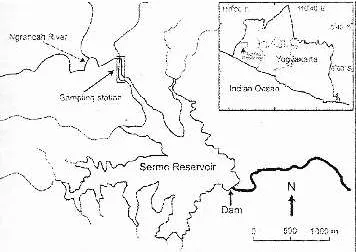
On the western side of Yogyakarta regency, Ngrancah River and its upstream tributaries form the major water
system where yellow rasbora occurs. The Ngrancah River (7048’34”S and 110006’38’’E; Fig. 1) is the main
river that water run through Sermo Reservoir. The stream is about 29 km long, but descends from a more than 1000 m high mountain area to the sea. It runs through hilly of Turgo goes into Sermo Reservoir in hilly of Hargowilis subdistrik, and then fl ows out from the dam to the Ngrancah River below the dam. The river then joint with some rivers and forming serang river with rivermouth in Indian ocean.
The station was selected based on occurring fi sh spawning site, the variety of habitats, and their acc essibility. Samplings and observations were performed weekly from June to August 2007.
The study site was characterized by clean freshwater with fast fl owing and gravel type riverbed. It was located between reservoir and sediment check dam erosion controlled nearly 500 m above the reservoir. Two climatic seasons, namely wet and dry season, was prevail in this area. Water elevated around 2.0 m during the rainy season and 0.5 m in the dry season.
Spawning site
To promote the brood fi sh to spawn, the spawning site was provided and constructed in the riversides around 500 m above the reservoir. The place for spawning site was selected that have clean water fl ows smoothly, shallow, available enough of sand and gravel, and no garbage around them. Spawning site was constructed
from the sand, pebble and small stone which was arranged in oval shape around 2x3 m in size located at the depthless than 30 cm. The spawning site has one entrance gate where the fi sh trap was operated to catch the brood fi sh in the spawning site.
Fish sample
Fish were cathed using casenet in the evening from riverbed, and sampled using fi shtrap made of bamboo in the spawning site after mating were completely fi nished. We caught female fi sh 148, and male fi sh 141 from riverbed, and female fi sh 109, and male fi sh 230 from spawning site during the period from June to August 2007. Information recorded for each specimen included measurements for total length (TL) to the nearest 0.1 mm, body weight and gonad weight (W) to the nearest 0.01 g.
To describe the type of feeding and diet in the gut, we grouped the sample fi sh based on size and sex, and then selected sum 30 individuals based on representation of the groups. The selected fi sh were analyzed by total length classes. Yellow rasbora 5.4-6.9 mm TL were grouped into small size classes, 7.0-8.9 mm TL were group into medium size classes, and then 9.0-11.2 mm TL were group into large size classes in order to enable the detection of minor changes in food habits apparent in these intervals of ontogeny.
The selected samples were measured for their gut length and total body length to the nearest 0.1 mm. The value of relative gut length (RGL) was calculated by ratio of gut length and total length. If the RGL is less then unity, the fi sh is a carnovorous while more the value RGL the fi sh tend to be herbivorous, and then an intermediate value indicates the omnivorous nature of the fi sh. To identify the food items, the gut contents of selected samples were identifi ed and counted under a stereosc opic microscope and a compound microscope. The gut contents was poured into small glass volume. Then, one milliliter of gut content was taken out and put into a sadwich rafter glass for examination under a light microscope (x400). We used both the numeric and occurrence methods (Biswas 1993) to calculate the numeric (NF%) and occurrence (OF%) frequencies of each food item by total length class. We analyzed similarity in diets through species. Relative abundance was ranked based on occurring the specimens in the samples.
Food habits measurements
Stomach contents of each yellow rasbora were so rted and placed int o the following funct ional cat egories: phytoplankton, zooplank ton, insect,
debris, and other. Plankton was defi ned as small, non-elusive, prey that occurred suspended in the water column. Phytoplankton was plant category of plankton, whereas zooplankton was animal category of plankton. insects were defi ned as members of the class Insect. The volumetric contribution of gut content was expressed as a percentage of whole stomach contents. Gut content volume (GF%) was estimated using water-displacement in graduated cylinders. Mouth gape measurement was done by open the mouth to its maximum capabilities. Gape height was measured as the distance between the tip of the premaxilia and the tip of the dentary bones to the nearest 0.01 mm. All measurements were made with a caliper on preservation specimens.
Results
The amounts of food in the gut of yellow rasbora broodstock during traveling to the spawning ground varied from 37.577.1%, and the amount of food consumed tended to increase with the size of fi sh. The numeric contribution of plankton to the diets of these fi sh (6.8-10. cm SL) was different between groups. This increase in group mean feed intake was associated with a marked increase in the mouth gape. The length body sizes increases lead to mouth gape were wider, therefore the size of food consume was increase. The amounts of food consumed by bigger size of broodfi sh, however, tended to reduce.
Fish tended to consume most of their food during the afternoon feeding and stay in the spawning ground, and towards the end of the spawning activities, the gut content was over 55% of the volume (Table 1). Most of feeding fi sh were registered as having fed inclusively during the night, bigger proportions were recorded as having fed during both day and night, and few fi sh were recorded as having consumed food exclusively during the hours of darkness. T he remaining fi sh had eaten some food during the day and during the hours of darkness, although consumption tended to be greatest during the daytime.
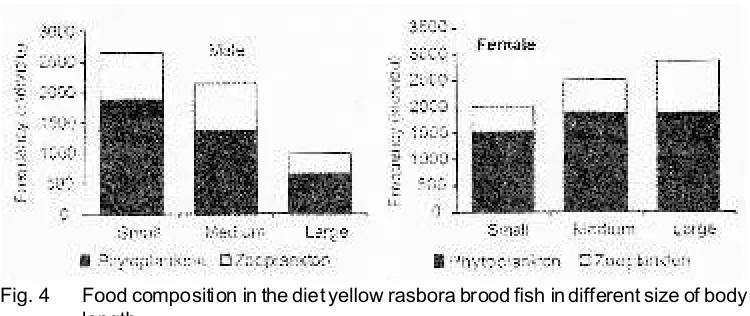
Plankton accounted for the most dominant of the diet in both male and female of yellow rasbora broodfi sh. Female was more than 32% of the diet consisting of zooplankton, on the other hand male was less than 25% of the diet comprised of zooplankton (Fig. 3). In contrast, female was more than 74% of the diet consist of phytoplankton, whereas male was more than 67% of the diet comprise of phytoplankton.
Food composition of the diet showed variation among size group of body length (Fig 4.). T he main food items that caused the variation, z ooplankton and phytoplankton, showed similar variations in their proportion in the diet. The proportion of zooplankton in the gut of male yellow rasbora was higher than female, however the numbers of food items consume were decrease in male fi sh, and in contrast was increase in female fi sh. The proportion of zooplankton in bigger
size of female fi sh was decrease, on the other hand was increase in male fish. Gut content analysis showed the yellow rasbora was an opportunistic omnivore, feeding on various plankton associated prey organisms. Small size (≤7.0 cm SL), medium (7.0-9.0 cm SL) and large (≥ 9.0 cm SL) had distinct feeding patterns. Overall, phytoplanktons were both the most frequently eaten prey and contributed the greatest volume in all size classes sampled.
Both male and female of yellow rasbora brood fi sh fed mainly phytoplankton with 58.2% consisting of genus belong to divisi chrysophyta, and then followed by divisi chlorophyta about 17.7%, and class euglenophyta about 15.8% in all the guts sampled (Fig. 5). Cyanophyta despite being present in the diet was less important comprising about 6.0%. Other food such as, leaf cut and debris, consisted of 2.3% in the diet.
Fig. 2 The relationship between total length to the feed size and mouth gape of yellow rasbora broodfi sh
Zooplankton was consisted of some type of food. Phylum protozoa were the most commonly eaten of zooplankton and numerically contributed most (76.6%) to the diet and followed by class rotifera (13.1%) then cladocera (9.7%). Others zooplankton prey such as insect, contributed little numerically 0.5%. T here was evidence of occasional feeding within the surface water on the meroplankton such as mosquito larva and caterpillar.
Yellow ras bo ra was the om nivorou s spe cie s that ex hibited significant variation in feeding of phytoplankton and zooplankton (Appendix 1). However, phytoplankton was consumed much number than zooplankton. Phytoplankton was containing divisio of chrysophyta, chlorophyta, euglenophyta, cyanophyta, and other, while zooplankton was composed of phylum protozoa, class rotifer and cladora, and other. There were 18 genus in divisio chrysophyta, followed by 24 genus in divisio chiorophyta, and then 9 genus in euglenophyta, and 7 genus in cyanophyta.
Divislo chrysophyta was consist of 24 genus, and the most dominant was Synendra sp.and Nitzschia sp. with number frequency and occurrence frequency was 26.4%,13.4% and 100%, 100%, respectively. Other genus in chrysophyta composed only small proportion with number occurrence less than 9.0%. Although genus
Surirulla and Tabellaria in the divisio chrysophyta were consist only small proportion in the diet, however the occurrence frequency that genus was 100% showing each fi sh consumed for their diet.
In the divisio chlorophyta was found the genus
Chloroc ocu m the mos t dominant with nu mber frequency 23.3% and occurrence frequency 76.7%, followed by Oocystis with number frequency 12.0% and occurrence frequency 50.0%, and then followed by genus Coelastra with number frequency 10.9% and occ urrence frequenc y 60.0%. Although the
number frequency of genus Staurastrum was 10.2%, but occurrence frequency found the most at amount 90%.
Divisio euglenophyta was the third dominant of phytoplankton in the diet, and genus Euglena was found the most dominant with number frequency 73.4% and occurrence frequency 93.3%, and other genus composed only small proportion with number frequency less than 8.2%. In the class cyanophyta, genus Merismopedia was found the most dominant with number freq uency 76.2% and occ urren ce frequency 96.7%, and followed by Anabaena with number frequency 16.8% and occurrence frequency 63.3%. Other genus in cyanophyta consist only small proportion with number frequency less than 3.2%. Other food found in the diet was unidentifi ed food and leaf cut, which found in small size of fi sh.
Zooplankton was found in the diet and consists of some classes, and a class protozoa was the most dominant followed by rotifera and cladocera. Genus
Difflugia belong to class protozoa was found the most dominant with number frequency 35.9% and occurrence frequency 100%, followed by Verticella
and Nebela with number frequency 16.5%, 9.2%, and occurrence frequency 93.3%, 83.3%, respectively. Stentor, despite being present in the diet, was less important both in number frequency (5.7%) and in occurrence frequency (76.7%). Rugipes sp. was most often eaten with number frequency 5.8% and occurrence frequency 53.3% to the diet (Appendix 1).
Centropyxis and Lesquereusia were also frequently eaten (4.5% and 4.3%), yet were roughly important numerically (63.3% and 86.7%, respectively) and few Ophrydium, Campanella and Leucophrydium
were consumed. Other protozoan prey suc h as
Tintinnopsis, despite being common in the diet, contributed little numerically (0.5%).
Although the omnivore small pelagic fi sh had diet changes in their gut contents, only the proportions of phytoplankton and zooplankton in the gut of yellow rasbora varied signifi cantly.
No macrophytes were found in the guts of fi shes collected both in the spawning ground and spawning site. In the spawning ground the proportion of phytoplankton was higher while the proportion of zooplankton was lower than during the day. The diet of the brood fi sh of yellow rasbora was the high proportion of phytoplankton at dusk and zooplankton at dawn after spawning takes place, this fi sh showed signifi cant diel changes in feeding behavior during spawning season.
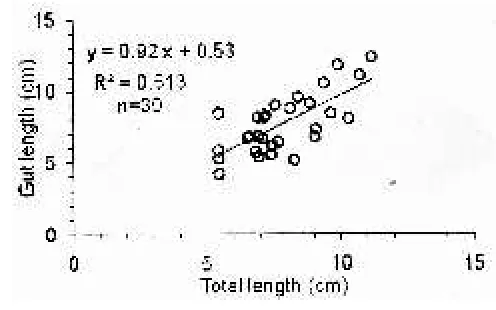
The relationship between gut length and total length of yellow rasbora showed the proportion of gut length to the total length less than one (Fig. 6) with equation Y=0.92x+0.533. Increasing total length will be followed by gut length in equal proportion. Based on the proportion of gut length to total length, the fi sh was categorized as omnivore and feeding mainly phytoplankton and zooplankton. The fi sh feed
actively both during the day and night, and there were diel variation on composition of food, however the proportion of phytoplankton was higher than others. The fi sh was actively feed in the upper layer of water body and shoreline of the reservoir. Yellow rasbora was mainly diurnal feeder and feeding activity evenly distributed over the 24-hour period. The typical diurnal feeders was active from dawn until dusk. For most of the diurnal feeders their activity was based on their gut fullness and inversely related to proportion of digested matter.
Discussion
Food composition of adult yellow rasbora showed plankton was the main item of the diet. Fish mostly fed on phytoplankton and zooplankton both during the day and night. Phytoplankton as energy source of yellow rasbora numerically has higher proportion on the diet than zooplankton. Besides that, plankton is principally primary producers in food chain at waters, Fig.5 The type of food found in the diet of yellow rasbora brood
fi sh
so the herbivore and omnivore fi sh use plankton as energy source (Mann, 2000). Yellow rasbora was the ones of the primary consumer in the base of pyramidal ecology. Also, yellow rasbora was as prey for predator fi sh, such as snake head and red devil, formed a food chain in the ecosystem of reservoir. The presence and absence of yellow rasbora will affect to other fi shes due to contribution of energy fl ow into the ecosystem. Therefore, yellow rasbora has played an important role for fi sh community forming in Sermo reservoir which the main water source input is Ngrancah river.
Ngrancah river, like on many other rivers in Yogyakarta, is characterized by a steep topography, which results in a short run, fast and varying seasonal water fl ow. The strong water fl ow that is governed by heavy rainy erodes the bedrock on its way to the narrow fl oodplain (10-30 km wide) and creates a series of deep pools connected by riffl es and runs in the mountain area. This habitat provides the fi sh not only with high levels of dissolved oxygen, but also calm feeding, resting and breeding grounds (Kido,1997). Nevertheless, the fi sh still have to tolerate a wide range of dramatic environmental changes caused by heavy rains, such as fl oods and muddy water.
Yellow rasbora move to the upper reaches of its range during, early dry season and to stay at lower pool during the cool temperature occurred in the early dry season. By the end of the rainy season would increase of water transparency which could create benefi ts fi sh by supplying a clean and freshly water lead to produce a great variety of spawning ground and abundant food such as plankton (Han et al., 2002). In the case of Yellow rasbora, the end of rainy season could be equally important for dispersal of their progeny, providing the heavily crowded larva of with a migration path to the upperparts of the stream and an opportunity there to exploit new resources. The presence or absence of a species relates to the microhabitat of the area was affected by local habitat for feeding ground, spawning ground and nursery ground, and escaping from predator (Han et al., 2002). The substrate components in a habitat might be a more determining factor than others. In this study, yellow rasbora brood stock moved to the upper stream to fi nd out the spawning site and foraged prey during the day and night. These places provided brood stock not only for spawning, but also for forage the prey, and provide shelter for the progeny (Huskey and Turingan, 2001). The brood stock needed to denser of plankton, the presence of small pebble, shallow
water column, and clean freshly water to lay out the eggs during spawning season.
Spawning at the end of the rainy season would have advantages. It would reduce the risk for the offspring to grow in rough conditions. The larva would not be swept away by fast water fl ow, and they would have time to grow during dry season to become the size that can withstand the fl oods in the following rainy season. In addition the plankton at the spawning grounds grew well throughout the year and would provide plenty of food for the larva even in the dry season. A similar timing of spawning was also occurred for other local fi sh species and reported for other cyprinids in southern India (Harikumar et al., 1994).
The gravel in riverbed along upstream was provides a habitat of low velocity fl ow to prevent drifting of fertilized egg and yolk sac larva downstream since their swimming ability is weak. In addition, predation risk for yolk sac larva occupying shallow areas may be lower because larger fi sh tend to avoid these areas (Harvey 1997). Adult yellow rasbora fed on the zooplankton and phytoplankton that grew on rocks in all seasons. The uptake of insect larvae was probably unintentional, on the other hand, fed on phytoplankton, zooplankton, insect larvae and adult insects. The general feeding habit of yellow rasbora could be considered an omnivorous since the gut contain was composed of phytoplankton and zooplankton, and the proportion of the gut length and total length was almost unity. Yellow rasbora distributed at higher altitudes, more than 800 m, and sometimes higher than 2000 m (Kottelat et al., 1993). It could tolerate a water temperature lower than 20° C. The low water temperature in tributaries at high altitudes might increase dissolve oxygen, but limit growth of phytoplankton. Therefore, yellow rasbora became adapted to a general diet when invading the upper stream with limited food, while became an omnivorous in utilizing the abundant phytoplankton and zooplankton in the upstream.
fl ats, and the more abundant plankton growth, would be important for the success of reproduction.
Conclussion
Yellow rasbora was omnivorous feeder, diet composed of phytoplankton and zooplankton, proportion of gut length to total length was unity. Phytoplankton in the diet was dominantly by chrysophyta, and then chlorophyta and euglenophyta, while zooplankton was dominantly by protozoa and rotifera. The fi sh fed continuously during the day and night. Increasing of total length will follow by mouth gape and food size, however bigger fi sh tended to selective to the kind of food.
Recommendation
It is suggested to conserve the spawning habitat of the yellow rasbora located in the inlet of reservoir along Ngrancah river.
Acknowledgments
I would like to express my gratitude to anonymous reviewer for helpful criticism and detailed suggestions that greatly improved this manuscript. I thank A.A. Sentosa, N. R. Budi and N.C. Nirwati for helping during sampling in the fi eld and sample analysis in the laboratory.
References
Biswas, S.P. 1993. Manual of methods in fi sh biology. S.S Publishers, LTD. 157 p.
Djumanto, 2000. Growth parameters estimation of Nile Tilapia (Oreochromis niloticus) in Rawapening Lake Central Java. Journal of Fisheries Sciences. II (2): 63–70.
Djumanto, E. Setyobudi, A. Sentosa, R. Budi & N. Nirwati, 2008. Reproductive biology of the yellow
rasbora (Rasbora lateristriata) inhabitat of the Ngrancah River, Kulon Progo regency. J ournal of Fisheries Sciences. X (2): 261–275
Han C.C., K.S.Tew, S. Chen, L.Y. Su & L.S Fang, 2000. Enviromental b iology of an e ndemic cyprind, Varicorhinus alticorpus, in a subtropical mountain stream of Taiwan. E nvironmental Biology of Fishes. 59: 153 – 161
Harikumar, S., K.G. Padmanabhan, P.A. John & K. Kortmulder. 1994. Dry- season spawning in a cyprinid fi sh of southern India. Env. Biol. Fish. 39:129-136.
Harvey, B.C. 1997. Interactions among stream fi shes - predatorinduced habitat shifts and larval survival. Oecologia 87: 29-36.
Huskey, S.H. & R.G. Turingan. 2001. Variation in prey-resource utilization and oral jaw gape between two populations of largemouth bass, Micropterus salmoides. Environmental Biology of Fishes. 61: 185-194.
Kido, M.H., 1997. Food relations between coexisting native Hawaiian stream fi shes. Environmental Biology of Fishes. 49:481-494.
Kottelat, M., A. J. Whitt en, S.N. Kartikas ari & S. Wirjoatmo djo. 1 993. Fre shwat er Fish es of Western Indonesia and Sulawesi.
Mann K.H., 2000. Ecology of coastal waters: with implications for management. 2nd. Black well
Science, Inc. 406 p.
Nelson, J.S. 2006. Fishes of the world, Fourth edition. John Wiley & Sons, Inc. 601 p.
Piet, G.J. & W. A.H.P. Guruge. 1997. Diel variation in feeding and vert ical distribution of ten co- occurring fi sh species: consequences for resource p ar titi on in g . E n vir o nm en ta l B io lo gy o f Fishe. 50:293-307. Se tyo bud i, E. 200 0. S tru ctu re and p ot ential
reproduction of Nile Tilapia (Oreochromis sp.) population in Sermo Reservoir. Master thesis. GMU, Yogyakarta.
Appendix 1
Ini ketiknya belum selesai
Phytoplankton No NF% OF%
I Chrysophyta
1 Campylodiscus sp. 458 8.5 93.3
2 Cylclotella sp 27 0.5 26.7
3 Cymatopleura sp. 48 0.9 16.7
4 Cymbella sp. 27 0.5 30.0
5 Diatom sp. 277 5.2 83.3
6 Epithemia sp 371 6.9 96.7
7 Fragillaria sp. 14 0.3 6.7
8 Frustulia sp. 26 0.5 16.7
9 Mallomonas sp. 1 0.0 3.3
10 Melosira sp. 481 9.0 96.7
11 Navicula sp. 128 2.4 70.0
12 Nitzchia sp. 717 13.4 100
13 Pinnularia sp. 11 0.2 6.7
14 Stauroneis sp. 30 0.6 43.3
15 Surirella sp. 328 6.1 100
16 Synedra sp. 1416 26.4 100
17 Tabellaria sp. 910 17.0 100
18 Tribonema sp. 93 1.7 50.0
Total 5363 100
II Chlorophyta
1 Asterococcus sp. 7 0.4 6.7
2 Basicladia sp. 1 0.1 3.3
3 Chlorella sp. 23 1.4 13.3
4 Chlorococum sp. 379 23.3 76.7
5 Closteridium sp. 18 1.1 26.7
6 Closteriopsis sp. 54 3.3 46.7
7 Coelastra sp. 178 10.9 60.0
8 Crucigenia sp. 74 4.5 63.3
9 Microspora sp. 71 4.4 56.7
10 Oocystis sp. 195 12.0 50.0
11 Pediastrum sp. 13 0.8 26.7
12 Planktosphaeria sp. 63 3.9 46.7
13 Protococcus sp. 80 4.9 46.7
14 Scenedesmus sp. 1 0.1 3.3
15 Schizogonium sp. 14 0.9 3.3
16 Sphaerrocystis sp. 11 0.7 6.7
17 Spirogyra sp. 35 2.1 23.3
18 Staurastrum sp. 169 10.4 90.0
19 Cosmarium sp. 80 4.9 66.7
20 Desmidium sp. 99 6.1 30.0
21 Hyalotheca sp. 22 1.3 3.3
22 Micrasterias sp. 38 2.3 33.3
Zooplankton No NF% OF%
I Protozoa
1 Arcella sp. 261 8.6 83.3
2 Campanella sp. 89 2.9 60.0
3 Centropyxis sp. 135 4.5 63.3
23 Onychonema sp. 4 0.2 6.7
24 Pleurotaenium sp. 1 0.1 3.3
Total 1630 100
III Euglenophyta
1 Chlamydomonas sp. 5 0.3 6.7
2 Dinobryon sp. 68 4.7 20.0
3 Euglena sp. 1065 73.4 93.3
4 Gonyaulax sp. 119 8.2 46.7
5 Monomastrix sp. 11 0.8 10.0
6 Peridinium sp. 102 7.0 50.0
7 Phacus sp. 23 1.6 26.7
8 Trachelomonas sp. 3 0.2 6.7
9 Volvox sp. 55 3.8 13.3
Total 1451 100
IV Cyanophyta
1 Anabaena 93 16.8 63.3
2 Chroococcus sp. 2 0.4 10.0
3 Coelospaerium sp. 1 0.2 3.3
4 Merismopedia sp. 422 76.2 96.7
5 Nostoc sp. 18 3.2 10.0
6 Polycystic sp. 14 2.5 16.7
7 Symploca sp. 4 0.7 6.7
Total 554 100
V Others
1 Unidentifi ed 210 98.6 36.7
2 Leaf cut 3 1.4 3.3
Total 213 100
IV
1 20 95.2 6.7
2 1 4.8 3.3