A
CCELERATING
E
NTERPRISE
A
GILITY
J
IM
H
IGHSMITH
Many of the designations used by manufacturers and sellers to distinguish their products are claimed as trademarks. Where those designations appear in this book, and the publisher was aware of a trade-mark claim, the designations have been printed with initial capital letters or in all capitals.
The author and publisher have taken care in the preparation of this book, but make no expressed or implied warranty of any kind and assume no responsibility for errors or omissions. No liability is assumed for incidental or consequential damages in connection with or arising out of the use of the information or programs contained herein.
The publisher offers excellent discounts on this book when ordered in quantity for bulk purchases or special sales, which may include electronic versions and/or custom covers and content particular to your business, training goals, marketing focus, and branding interests. For more information, please contact:
U.S. Corporate and Government Sales (800) 382-3419
For sales outside the United States, please contact:
International Sales
Visit us on the Web: informit.com/aw
Copyright © 2014 Pearson Education, Inc.
All rights reserved. This publication is protected by copyright, and permission must be obtained from the publisher prior to any prohibited reproduction, storage in a retrieval system, or transmission in any form or by any means, electronic, mechanical, photocopying, recording, or likewise. To obtain permission to use material from this work, please submit a written request to Pearson Education, Inc., Permissions Department, One Lake Street, Upper Saddle River, New Jersey 07458, or you may fax your request to (201) 236-3290.
ISBN-13: 978-0-13-359844-5 ISBN-10: 0-13-359844-6
Foreword by Gary Gruver vi Foreword by Christopher Murphy vii
Foreword by John Crosby x
Preface xii
About the Author xiv
Chapter 1 Enterprise Agility 1
CEOs and CIOs Focus on Agility 2
Why Agility? 4
Business Agility Needed in Turbulent Times 4
Responsiveness and Efficiency 5
How Agile Do We Need to Be? 6
Manage the Flow of Opportunities 8
Opportunity Types 8
Phases 9
Organizing for Innovation 12
Criteria 13
Organizational Structures 13
The Strategic Impact of Continuous Delivery 15 Levels of Agility: Strategic, Portfolio, Operational 17
The Challenge of Adaptive Leadership 18
Chapter 2 Adaptive Leadership Today 20
Creating a Culture of Adaptation and Learning 20
What Do Leaders Want from Agile? 22
The Law of Raspberry Jam: Reflecting on Agile Progress 24 Unorthodox, Unconventional, and the Next Decade of Agile 24
Innovators, Imitators, and Idiots 25
Iterative Delivery, Waterfall Governance 27
IT’s Changing Value Proposition 29
More Than Software: Integrating Economics, Product, and Social
CONTENTS iv
Velocity Is Killing Agility 32
You Can’t Plan Away Uncertainty 35
The Ambidextrous Organization 37
Chapter 3 Deliver a Continuous Flow of Value 39
Speed-to-Value 40 Beyond Scope, Schedule, and Cost: The Agile Triangle 41
Constraints Drive Innovation 43
Determining Business Value 44
Beyond Project Plans 47
Feature Folly 50
Features or Quality? Selling Software Excellence to Business Partners 52
All Projects Are Not the Same 54
Scope Issues in an Agile Project 55
Speed 57
Reducing Cycle Time 57
Cycles, Cycles, Cycles 58
Shortening the Tail 60
Quality Management 62
The Financial Implications of Technical Debt 64
Do Less 66
The “To Do Less” List 68
Build Less, Start Sooner 69
Chapter 4 Create an Adaptive, Innovative Culture 70
Adapting 71
Purpose Alignment Model 73
Satir Change Model 74
Short Horizon Model 75
OODA Loop Model 75
Pivots and Adaptations 76
Don’t Plan, Speculate 76
Embracing Change 78
Exploring 82
Engaging and Inspiring 83
Facilitating 84
Oscillation versus Iteration 85
Micromanaging Angst 86
Can-Do Thinking Makes Risk Management Impossible 87
Making Self-Organization Work 89
Leadership and Decision Making 92 The Usefulness of “Over” in Decision Making 93
Riding Paradox 94
Embracing Paradox 96
Balancing Adaptability and Predictability 98
Complexity and Leadership 100
Chapter 5 Final Words 102
vi
Foreword by
G
ARY
G
RUVER
Jim Highsmith, one of the key founders of the agile movement, has done us a great favor by packaging up some of his key blog posts over the last decade into an easily digestible electronic book. While a lot of the agile movement over time has focused on the details of Scrum, Jim reminds us all that agile, at its core, is about much more. It is about embracing uncertainty and developing an organization that responds quickly. It is about creating processes and approaches that are designed to teach and adjust.
The agile movement is about being able to quickly respond to the ever-evolving busi-ness environment and being able to deliver ongoing value. Jim reminds us of those facts through several different perspectives in his different blog posts. He highlights the magnitude of uncertainty facing current business leaders and provides frame-works for addressing these challenges. He shows the importance of delivering value early and often with technical approaches like continuous delivery. He also points out that the biggest challenges are not technical, but rather relate to leadership and the organization change-management process.
One of my favorite sections of this book is on organizational agility, which I found representative of what we found during my time at at HP. We started with a focus of improving the productivity of our firmware development. What we found was that the changes we implemented in the firmware development process had a much bigger impact across larger parts of the organization. It changed the value proposition we were able to provide our customers and how we managed the delivery of all the com-ponents required to deliver LaserJet printers.
Throughout these blogs, Jim challenges us all as leaders of change to remember that the agile movement is about so much more than Scrum, and we should all take a broader perspective. Please join me as we look back on his perspectives and think about how we can get better at leading our organizations through uncertainty.
— Gary Gruver
C
HRISTOPHER
M
URPHY
I had been a follower of Jim Highsmith’s writings in the blogosphere for several years when I first had the opportunity to meet Jim in person during the Agile Australia conference held in Melbourne in the second half of 2010.
During Jim’s keynote address on adaptive leadership at that conference, I recall feel-ing particularly inspired and challenged—in the most positive sense—by his obser-vations on leadership in dynamic and turbulent environments. For while much of Jim’s thinking had derived from his experience with agile software development, I realize d as I listened to the presentation that the impact was far more wide-reaching— to every level of organizational leadership.
Indeed, Jim’s observations got me thinking. Change is accelerating. Why is that the case, and what is the role that technology, and technologists, are playing in that change? What does it take to not merely survive, but to actually thrive in an environment where change is the norm, rather than the exception? As Jim vividly demonstrates in this book, this turbulence creates enormous opportunity for those who are willing to embrace it rather than fight it. But this opportunity doesn’t come automatically; on the contrary, it often requires fundamental change in leadership assumptions, models, and structures that are counterintuitive to traditional hierar-chical structures and management disciplines developed during, and inherited from, the last 300 years.
FOREWORDBY CHRISTOPHER MURPHY viii
For it is indeed another revolution that we are in, not only with regard to the physi-cal hardware technologies, but perhaps more importantly for the knowledge workers who unleash their potential. The rapid increases in computing power are widely rec-ognized and understood, and are easily demonstrated by the power of the computers that we now hold in the palms of our hands. It is less widely recognized, however, that software development—the primary method by which the advances in hardware technology are released to industry and society—has progressed in similar seismic leaps and bounds. Modern software professionals are armed with sophisticated lan-guages, frameworks, environments, and ecosystems with which to wield their craft. That increasing sophistication is leading to an increasingly powerful ability to craft impactful software for users, in increasingly short cycle times.
Moreover, software is no longer focused on automating manual tasks—the systems of record on which so much IT effort has been expended over the last twenty years— but on software that very often is the business, meaning the systems that individuals, businesses, and governments use to reach and engage their users and constituents. Nimble, disruptive, and technologically driven interlopers are challenging existing business models, and entire industries, through technologically driven disinterme-diation. Whether traditional media, travel, real estate, publishing, retail, financial services, photography, health care, or education, the chance is that some industry is being disrupted, and that, in some way, changes in technology are contributing to that change. To understand and respond to those changes, adaptive leadership will be required.
Adaptive leadership, at its heart, is an articulation of the adaptations necessary for modern organizations to flourish in this new, technological era, and to embrace the change that it enables. As any business leader knows and will attest, and as Jim ably reinforces in this book, at the heart of any successful organization or movement is its ability to understand and articulate its own unique, ambitious mission. Jim takes this a step further: not only must that organization or movement be able to clearly articu-late its mission, but it must also clearly understand the difference between respon-siveness and efficiency to achieve that mission and, where responrespon-siveness is required, implement practices around delivering a continuous stream of value by discovering and managing the flow of market and technology opportunities. It must also cre-ate the adaptive, innovative culture necessary to accomplish this. Frequently, this endeavor will involve revisiting and, as necessary, adapting or removing the vestiges of 19th/20th-century management structures such as traditional planning cycles, “command and control” management styles, hierarchy and silos, and traditional portfolio management, among others. It may sound obvious, but to be a truly adap-tive organization, the leaders of the organization need to practice and demonstrate
At the organization at which I am chief strategy officer, ThoughtWorks, a global soft-ware consultancy and products business, we work for clients who are at the heart of Jim’s book: organizations with ambitious missions where technology is a major enabler of competitive advantage. Many of our clients are, not surprisingly, dealing with the implications of ever-increasing turbulence and speed of change. In some instances, they are the ones creating that turbulence; they are the archetypal “ruptors” using technology to introduce a new business model or, perhaps, to dis-intermediate a more traditional model. In other cases, they are the more established industry leaders who are being “disrupted” and are looking to respond.
Jim’s work on adaptive leadership has been of significant assistance, both to Thought-Works’ clients and to our own business. Articulating the difference between funda-mental strategies of efficiency versus responsiveness and continuous value delivery has changed our conversations with business executives, which in turn has empow-ered those executives to transform their organizations. Adaptive leadership has provided the language, terminology, and ideas that have helped us forge stronger partnerships with our clients, helping them to bring exciting new products and ser-vices to market in a fraction of the time they would previously have required. It has also provided guidance and ideas that have helped our own internal management development efforts, culminating in the articulation of our new market position-ing brposition-ingposition-ing together our offerposition-ings and proposition into a consistent, empowerposition-ing theme.
Adaptive leadership, and its underling agile principles, is no longer a set of practices for the IT department; it is a powerful business differentiator. Jim’s thinking on adap-tive leadership should be compulsory reading for any business leader wanting to step up to, understand, guide, and support adaptive thinking across his or her organiza-tion in the current technological era.
— Christopher Murphy
x
Foreword by
J
OHN
C
ROSBY
As I see the pace of change continuing to increase, it’s become apparent to me that organizations need to find new ways to adapt, survive, and prosper. Increasingly in our digital world, a structural competitive advantage is becoming harder and harder to maintain. Organizations that are able to embrace, experiment, and learn quickly within their environment and then take that acquired knowledge to market quickly will now succeed in the long term. As Jim highlights in this book, “discovering and executing on new opportunities is the critical capability.” However, achieving this goal is not easy and requires a holistic approach within the organization. Over the last decade, I’ve seen the agile software delivery movement make great strides in improv-ing the quality and reliability of software delivery—increasimprov-ingly so with the advent of continuous delivery. Yet I have often seen the power of the agile approach lost when this process interacts with traditional approaches to business planning and execu-tion. These nonagile approaches still place too much emphasis on trying to manage and inspect the inputs and deliverables as opposed to enabling great outcomes. The challenge is no longer “Can we build it?” but rather “Should we build it?”
Adaptive leadership provides a framework for individuals and organizations to address this challenge. Key to this is ensuring that at the core of the organization is the abil-ity to instigate, encourage, and inspire disruptive thinking. At lastminute.com, we’ve found a culture of team empowerment critical to creating this ability. Give a team clear objectives in terms of business outcomes, be clear about constraints, and then allow the team the freedom to achieve the outcomes in the best way they identify. This may sound risky to many, and without the right approach it undoubtedly is! However, our experience suggests that this courageous leadership need not be based on blind faith. Continuous delivery has provided us with the solid bedrock of delivery quality and reliability. Paired with continuous design and the key build–measure–learn tenets of the Lean Start-up movement, it ensures we are building products that customers will both want and love.
the entire organization can quickly understand and rapidly act upon this situation. For without this ongoing focus on reducing cycle time and increasing learning, you can be certain you’ll be left behind by faster, nimbler, more adaptive organizations.
— John Crosby
vice president of product and technology, lastminute.com
xii
P
REFACE
Over the past couple of years, I’ve been thinking, writing, and speaking about issues of adaptive/agile leadership and organizational transformations. Working with com-panies, working with the Agile Leadership Network Executive council, and speaking at conferences and internally with company leaders have encouraged me to focus my energy on management and leadership issues around responding to the opportunities created by today’s technological and marketplace change.
The agile movement has greatly impacted software development over the last decade since the Agile Manifesto was signed. The two underlying themes of the agile move-ment have been reasonably successful (there’s always progress to be made)—namely, building better software and increasing satisfaction (and fun) at work. In a growing number of companies, agile/Lean values and practices have been infused throughout the organization, although there remain too few of these pioneers.
As the agile movement moves past its ten-year anniversary, we need to reflect on our successes, identify areas ripe for improvements, and create a vision for the future. I’ve labeled the last item “agile imagineering” (paraphrasing from Disney). Just imagine what we could accomplish if more companies focused on values and quality; if they focused on achieving their ambitious missions; if they focused on increasing respon-siveness to customers; if they focused on self-organizing at every level; if they focused on collaboration, transparency, courage, and technical excellence; if they focused on disruptive thinking and inspiring their people; and if they used the success generated from this transformation to promote social and economic justice in the world.
My personal ambitious mission is to inspire executives and managers to build adap-tive organizations and provide them with the framework and tools to do it. Just as the original Agile Manifesto vision hasn’t been fully realized in the past decade, I doubt my mission will be realized in the next ten years. However, one of the primary prac-tices of agility is envisioning and evolving rather than planning and doing—it’s about having a BHAG (Big Hairy Audacious Goal, per Jim Collins [2001] in Good to Great) and adapting over time to move toward that goal, rather than having a prescriptive plan and executing tasks.
paper and subsequently expanded upon in my blog posts. One of the problems with a blog is that older entries get lost, so I wanted to pull them out into a more readily accessible format. I’ve rewritten material to bring a little cohesion to the disparate blogs, while other material remains as originally written.
xiv
A
BOUT
THE
A
UTHOR
Jim Highsmith is an executive consultant at ThoughtWorks, Inc. He has more than thirty years’ experience as an IT manager, product manager, project manager, consul-tant, and software developer.
Jim is the author of Agile Project Management: Creating Innovative Products, Second Edition (Addison-Wesley, 2010); Adaptive Software Development: A Collaborative Approach to Managing Complex Systems (Dorset House, 2000; winner of the pres-tigious Jolt Award), and Agile Software Development Ecosystems (Addison-Wesley, 2002). Jim is the recipient of the 2005 international Stevens Award for outstanding contributions to systems development.
E
NTERPRISE
A
GILITY
The agile movement has made enormous strides in the last decade, greatly improving software delivery and creating more satisfactory work environments in many organiza-tions. The next horizon is extending agility from basic software delivery to continuous delivery and into the business itself, utilizing the advances in delivering software fea-tures early and often into a transformation of businesses to deliver complete solutions early and often. The drivers for this trend, as we will see, come from a growing focus of chief executive officers (CEOs) on trying to survive and thrive in a world of grow-ing complexity, uncertainty, and fast-movgrow-ing competition. Achievgrow-ing enterprise agility, however, requires a different style of management—an adaptive leadership style. This book describes this style by considering it in three parts: (1) by describing the need for enterprise agility to engage in ambitious organizational missions; (2) by identifying what leaders need to be doing (actions) to deliver a continuous stream of value, espe-cially as it relates to today’s greatest source of change—technology; and (3) by identify-ing a mindset that encourages leaders to think disruptively about opportunities and respond quickly to those by creating adaptive, innovative organizations.
The core of this book is also built around two key concepts:
Technology is the number one concern of CEOs worldwide.
Discovering and executing on new opportunities is the critical organizational capability.
The first of these ideas reflects the results of a 2012 study of CEO concerns published by IBM (IBM, 2012). IBM’s survey has been updated every two years since 2004, but in 2012, for the first time, technology was considered the top concern of CEOs world-wide. With mobility, social media, data analytics and big data, and cloud computing entering the lexicon of business, executives are concerned about how they can com-pete in this new technology-driven world. As one CEO said in the study, “The biggest risk we have is technological. If we fail to anticipate a huge technology step, we might go out of business.”
CHAPTER 1 ENTERPRISE AGILITY 2
time company executives realize they are on the downward slope, it’s often too late. Companies need to react in ever-shorter time frames; they need to take advantage of new opportunities as they arise. They need faster response and faster feedback on critical opportunities. In Sull’s view, managing the flow of opportunities is even more important than innovation because it introduces a factor that many ignore when thinking about innovation—timing. Some opportunities that come along require risk taking and commitment more than innovation. This isn’t to say that innovation is unimportant, but simply that applying innovation to the right opportunity at the right time is a fuller determinant of success than innovation alone.
Finally, pursuing new opportunities and bringing cutting-edge technology to your company won’t be easy. For this endeavor to succeed, it needs to be driven by a big idea, a BHAG—A Big Hairy Audacious Goal (Collins, 2001). Only such an audacious mission draws people in and energizes them and provides enough driving force to overcome the trials and tribulations of disrupting your business into the future.
Managing the flow of opportunities is critical to success, and today many of those opportunities will be driven by technological innovation. Keeping abreast of new technologies, figuring out how to create disruptive uses of those technologies, and building the capability to deliver products that incorporate those technologies will be critical to success in the next decade. Keep these concepts in mind as this book’s topics unfold.
CEO
S ANDCIO
SF
OCUS ONA
GILITYLeaders are recognizing that our new connected era is fundamentally changing how people engage. This shift is one reason why, for the first time since this CEO Study series began in 2004, technology now tops the list of external forces impact-ing organizations. Above any other external factor—even the economy—CEOs expect technology to drive the most change in their organizations over the next three to five years. (Leading Through Connections: Insights from the Global Chief Executive Officer Study (2012). Reprint Courtesy of International Business Machines Corporation, © 2012 International Business Machines Corporation.)
“Our interviews revealed that CEOs are now confronted with a ‘complexity gap’ that poses a bigger challenge than any factor we’ve measured in eight years of CEO research.” As this quote from the 2012 study indicates, technology is now at the head of that complexity gap. In 2004, 2006, 2008, and 2010, market factors topped the list of CEO concerns, while the 2012 study illustrates the rising criticality of technology to company futures. Technology is the number one disrupter, while at the same time it is the number one way to thrive from that disruption. Eight in ten CEOs expect their environment to grow significantly more complex, and fewer than half believe they know how to deal with it successfully (IBM, 2010).
The CEOs cited three key factors to success in this turbulent environment:
Embody creative leadership
Build operating dexterity
Reinvent customer relationships
Creative leadership includes embracing ambiguity, taking risks that disrupt the status quo, instituting new management styles, and making decisions more quickly. Build-ing operatBuild-ing dexterity requires simplifyBuild-ing whenever possible, managBuild-ing systemic complexity (standardization in some cases), and promoting a fast and flexible mind-set. Reinventing customer relationships involves honoring customers, using two-way communications (increasing the use of business social networking), and profiting from the information explosion (taking advantage of new data analytics).
CHAPTER 1 ENTERPRISE AGILITY 4
W
HYA
GILITY?
To effectively respond to these new dynamics (the digital world), companies must begin thinking about ways to broaden their ecosystems and revenue streams while becoming more responsive and agile. (McKinsey & Company, “Competing in a Digital World: Four Lessons from the Software Industry” [Sikes, 2013])
One of the “lessons” articulated in this article in the McKinsey quarterly is the need to create an agile organization, because this step is required for the other three les-sons to succeed. At the core of an agile, or adaptive, organization is the ability to instigate, encourage, and inspire disruptive thinking. Surely adaptive leadership is about learning, adapting, collaboration, and more—but disruptive thinking lies at the core of these behaviors. Disruptive thinkers see the same information others do, but they interpret it differently. Disruptive thinkers aren’t satisfied with the status quo, or even with incremental improvements; they are looking for big wins. Disrup-tive thinkers challenge your mental models about the world, and they challenge their own as well. Much has been written about disruptive change—in technology, in busi-ness models, in product development speed, in politics and economics—but finding, keeping, and encouraging disruptive thinkers in your organization will be hard— very hard. The demise of company after company, some at one time at the cutting edge of their industries, attest to the difficulty.
B
USINESSA
GILITYN
EEDED INT
URBULENTT
IMESAgility is a business imperative, not just a technological one. Agile software develop-ment has enjoyed great success over the past 10 years and agile project managedevelop-ment has made inroads into the project management community, but there is still a long way to go. Many companies relegate agile methods to the position of “just another in a long line of software engineering techniques,” while in others the transition to agile methods stalls after a few projects, even though those projects are successful. Too few agile transitions make an impact outside of software delivery groups.
What is missing? The agile movement has the potential to be strategic to businesses, particularly those whose overall strategy focuses on responsiveness over efficiency. We are selling ourselves short! We have the potential to energize new business mod-els, engage middle and upper management in becoming agile, and change the way product and project managers connect agile concepts and practices with upper management.
turbulence in business environments are complication and complexity. Something that is complicated has many parts and is hard to understand. Something that is complex is unpredictable (or at least less predictable). A Boeing 767 is complicated (many parts) but not complex. However, the process of designing a 767 would be both complex and complicated, as many uncertainties would arise during this design pro-cess. Complexity can be further defined by volatility (speed, magnitude) and ambi-guity (the haziness of reality), as well as by uncertainty (lack of predictability). But turbulence has an upside—creating opportunities for those who can weather the dynamism and complexity.
R
ESPONSIVENESS ANDE
FFICIENCYThe previously cited IBM CEO study focused on the strategic issues of complexity and complication. Whether the name assigned to the approach used to tackle these problems is agility, adaptability, dexterity, or responsiveness, the capability is criti-cal to success. For the purposes here I’ll use the term “responsiveness” and criti-call the opposite strategy “efficiency.” While companies may strive to achieve both, one of these factors must be the driver, the objective, and the other a constraint. Constraints help guide companies, but they are different from objectives and the two shouldn’t be confused. Responsiveness is a business strategy. Agility and adaptability achieve that strategy.
As an example, consider Google and Wal-Mart—both very successful companies, but each coming from a different perspective. Google focuses on responsiveness, creat-ing new products at a prodigious rate. Does Google’s management have an interest in efficiency? Of course, but its goal of responsiveness and efficiency is a constraint. Wal-Mart is the opposite. Obviously, Google’s strength and competitive edge comes from its responsiveness: it is able to create new service offerings quickly, to deploy new features early and often, and to take advantage of new opportunities quickly. Constraints keep costs within reason, but they are not objectives. In contrast, Wal-Mart’s strategy focuses on efficiency and driving costs down in every way possible. Does Wal-Mart need responsiveness in some of its operations? Of course, but it doesn’t confuse which is the objective and which is the constraint.
CHAPTER 1 ENTERPRISE AGILITY 6
shortcuts (not hooking up to all corporate systems, for example), they improvised— but they got the store up and running fast and allowed the company to confirm a decision to build additional stores.
Agility Generates 30% Higher Profits
An overwhelming majority of executives (88%) cite organizational agility as key to global success. Other studies support this idea as well: research conducted at MIT suggests that agile firms grow revenue 37% faster and generate 30% higher profits than non-agile [firms]. Yet most companies admit they are not flexible enough to compete successfully. Internal barriers stall agile change efforts. The main obstacles to improved business responsiveness are slow decision-making, conflicting depart-mental goals and priorities, risk-averse cultures and silo-based information. Technol-ogy can play an important supporting role in enabling organizations to become more agile companies. (Economist Intelligence Unit, Special Report on Agility, March 2009)
For a number of organizations, the driving force for their agile/Lean transformations will be the ambitious mission of improving their responsiveness to the flow of oppor-tunities that arrive every day on their doorstep.
H
OWA
GILED
OW
EN
EED TOB
E?
Organizational agility is the ability to respond to opportunities in the marketplace, or as Donald Sull defines it, “the capacity to identify and capture opportunities more quickly than rivals do.” The follow-up question should be, “How agile or responsive do we need to be?” This last question is one that organizations rarely ask themselves, or at least they don’t ask it in enough depth. What follows are six different ways in which this depth of needed analysis can be accomplished.
The first area for analysis is organizational units. For starters, some organizations are conglomerates of multiple companies. Companies then may be organized along busi-ness units that may be product type oriented, plus a separate shared services busibusi-ness unit. Other layers of organization may be functional areas (marketing, sales, manu-facturing, and product development). The “How responsive do we need to be?” ques-tion needs to be asked at every level. One product may be more mature or market dominant than another. Marketing may need to be more nimble than finance. Prod-uct A may be competing in a more volatile market than ProdProd-uct B.
enhancement that creates a clear differentiation from the competition and that keeps the company ahead of its competition for some short-to-medium time frame. This type of change creates differentiation within a market, but doesn’t significantly change a market. Disruptive change requires innovating to create an entirely new market or business model. Disruptive changes can drastically impact companies or even industries (for more detail on these types of change, see the section “Change Isn’t Change” in Chapter 4).
Based on the type of changes anticipated, the capabilities required to respond are dif-ferent as identified by Donald Sull in The Upside of Turbulence:
Strategic: spotting and seizing game-changing opportunities
Portfolio: shifting resources—including cash, talent, and managerial atten-tion—quickly and effectively out of less promising business areas and into more attractive ones
Operational: exploiting opportunities within a specific business model
A third area for analysis is deciding how to manage the flow of opportunities. Oppor-tunities go through four stages—identification (scanning for possibilities), start-up (expanding the opportunity into a minimum viable product with validated custom-ers and business model), scaling (ramping up to volume), and maturing (managing the maturing and decline). For example, Lean Start-up concepts and practices might be very useful for a new product or a new business opportunity. Regularly scanning the technology space (see, for example, the ThoughtWorks technology radar) could alert an organization to an opportunity for experimentation.
A fourth area for analysis, and one related to the type of change anticipated, is what changes in response—the product, product features, customers, technology, or busi-ness model. A disruptive change might create a strategic response that introduces a new product. A differentiating change might require an organization to reallocate money and talent from one product line to another. A competitor’s incremental prod-uct change might require a quick response to match its new features. Part of this anal-ysis should include looking at cycle/lead times for technology or product results—how often new products/features need to be deployed and how much lead time is required for new products/features (development time from backlog release to deployment).
CHAPTER 1 ENTERPRISE AGILITY 8
A final area for analysis might be the “continuous flow” requirements for organiza-tional units or products. Both lead time and deployment frequency should be identi-fied. Lead time (time for a feature to move from backlog release to deployment) and deployment frequency (monthly, weekly, daily, multiple times per day) requirements help an organization determine which capabilities it needs in this area.
Few organizations appear to do the depth of analysis and strategizing about which “level” of agility makes sense for them. They talk about improving delivery speed, increasing responsiveness to customers, reducing costs, or improving quality—but they don’t take the next step and describe the benefits in a compelling manner. They don’t analyze and prioritize desired benefits—they want them all, not understanding that there are differences in how one would implement agile methods to reduce costs versus to increase responsiveness.
M
ANAGETHEF
LOW OFO
PPORTUNITIESThe critical reason companies need to manage opportunity flow, rather than com-pany life cycles, is the speed of change. Comcom-pany life cycles are a combination of many opportunity life cycles, but by the time problems with the aggregate are rec-ognized, it may be too late. The problem today is that opportunities bombard us, and sorting out which ones to pursue and which ones to pass on is a never-ending struggle. Success comes from having an ambitious, well-articulated mission; a flare for correct timing; a resolute commitment to an often risky path forward; a collab-orative, innovative team; and, of course, a bit of luck.
The life-cycle flow described in this section incorporates phases (and processes within those), but my use of the word “flow” shouldn’t be visualized as indicating a product funnel. It’s not a meandering flow through an ever-narrowing boundary, but more like a raging torrent that could sweep you away at any moment. Opportunities could spring up quickly and leave just as fast. This section (and the next on organiza-tion) will attempt to answer three key questions:
Which types of opportunities might we encounter?
What are the phases that opportunities move through over time?
Which alternative organizational structures might we use?
Opportunity Types
creates something substantially different—a process, product, or service—that gen-erates new value.” Many definitions of innovation mention “different” (or “new”) and “value” but don’t use adjectives. Is a different (or even a new) paint color on a product innovative? To me, some adjective such as “substantially” is needed to qual-ify “different.” Similarly, the result—economic or social value—should have a new component to it and not just be a little more of the same.
The three types of changes or opportunity types are incremental, differentiating, and disruptive, as described in the previous section on how agile we need to be.
Phases
The phases in the flow of opportunities are shown in Figure 1.1. This figure is based on one in Don Sull’s work with a couple of additions. The five phases are identified here:
Discovery: Find good opportunities (my addition)
Start-up: Confirm a viable customer base, business model, and product
Scale: Commit major resources to fulfill the mission Mature: Avoid sense of lock-in
Decline: Limit new investment
The second difference from Sull’s diagram is the addition of an opportunity type to each of the entries (bubbles). In the early Discovery and Start-up phases, it is particu-larly important to determine whether the opportunity is differentiating or potentially
Discovery Start-up Scale
Life-Cycle Phases Age of
Opportunity
Mature Decline Dis
Inc Diff
CHAPTER 1 ENTERPRISE AGILITY 10
disruptive (I say “potentially,” because identifying disruptive opportunities early is exceedingly difficult). (Note: The sizes of the bubbles in the diagram indicate the magnitude of the investment required.)
Discovery
While Don Sull’s opportunity phases begin with Start-up, I think there is a step prior to that—Discovery. Opportunities abound today. They come in many forms—tech-nology, business model, social action, management practices, new products, and more. The Discovery phase focuses on finding “good” opportunities out of the myriad of possibilities. Not every discovery deserves a Start-up experiment.
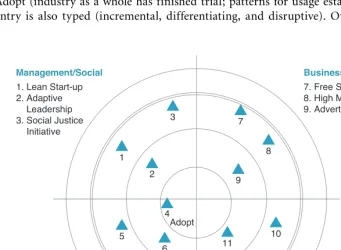
One visual approach to displaying the spectrum of possibilities is the opportunity radar shown in Figure 1.2. Organizations should customize the quadrants in the radar starting with management practices and social action, technology, products and services, and business models. Each entry in the radar would be characterized as Hold (proceed with caution), Assess (worth exploring with the goal of finding out how it will affect you), Trial (worth pursuing; start with a low-risk project), or Adopt (industry as a whole has finished trial; patterns for usage established). Each entry is also typed (incremental, differentiating, and disruptive). Over time, both
10
12
7. Free Site 8. High Margin 9. Advertising Business Models
10. Retail Mobile App 11. Sales Analytics 12. Social Media
Product/Service Hold Assess Trial Adopt 4. Mobile 5. Agile Analytics 6. Private Cloud
Technology 1. Lean Start-up 2. Adaptive Leadership 3. Social Justice Initiative Management/Social 11 9 8 7 3 1 2 5 6 4
characterizations and types might change. While we talk about the flow of oppor-tunities, the progression should not be viewed as a traditional pipeline, narrowing choices at each phase. Opportunities are more volatile than that—for example, mov-ing from Assess to Trial status, and then back as uncertainty changes.
The opportunity radar operates in conjunction with the phase diagram—at least in the Discovery, Start-up, and Scale phases. (Note: Based on ThoughtWorks’ Technol-ogy Radar.)
Start-up
The objective of the Start-up phase is to reduce risk and uncertainty around the cus-tomer, the business model, and the product. New companies may pursue a single start-up opportunity, while established companies may have a portfolio of them. Just as continuous development and continuous delivery have become part of agile and Lean methods, so continuous discovery—the front-end piece of defining prod-ucts, markets, and business models—has evolved over the recent past. Much of this front-end work has emerged from the Lean Start-up movement, characterized in Eric Ries’s 2011 book, The Lean Startup: How Today’s Entrepreneurs Use Continuous Inno-vation to Create Radically Successful Businesses. Whereas agile/Lean product develop-ment focuses on building products quickly and effectively, Lean Start-up focuses on making sure there are markets, customers, and sustainable business models for those products.
Lean Start-up and agile delivery make a powerful combination to convert opportuni-ties into new products and businesses in a fast-paced, evolutionary manner.
Scale
Scale is where opportunities go from little businesses to big businesses. If Discovery and Start-up are about finding and validating opportunities, Scale is about fulfilling potential. Also, while the first two phases require entrepreneurial spirit, the latter requires executive courage. The core issue is summed up by Geoffrey Moore (2011): “You have to escape the gravitational field of last year’s operating plan.”
CHAPTER 1 ENTERPRISE AGILITY 12
In addition to shifting resources, successful scaling may require significant organiza-tional changes as described in the next section.
Mature and Decline
3M has long had a corporate vision that 30% of the company’s revenues will come from products that are less than 3 years old. Top-level visions like this make it eas-ier (but not easy) to manage the maturity and decline of products or markets. They require senior executives to be realistic about “category” power. As Moore (2011) says, “Category power, in short, is the number one predictor of future economic per-formance.” Print media versus digital media is a category shift that has provided both opportunity and peril for many companies. Some companies have successfully made the transition by shifting internal resources from print to digital, while others have made an external shift through bankruptcy. Kodak, for example, tried to make the shift from film to digital, but never achieved the right balance between scaling up its digital photography efforts while managing the decline of print film.
Effective management of the Mature and Decline phases is critical to free up resources to fund the start-up and scaling phases. It is a delicate balancing act because the rev-enue and profit stream from mature products has proven very difficult to give up. In addition, especially with disruptive opportunities, the cost structure of new prod-ucts may be drastically lower than with the mature product. Asking mature organiza-tions to drastically reduce their cost structures can be a daunting prospect. (For more on the issue of disruptive opportunities, see the classic in the field, The Innovator’s Dilemma, by Clayton Christensen [1997]).
O
RGANIZING FORI
NNOVATIONOne of the questions I get most frequently goes something like this: “Should we cre-ate a separcre-ate agile group, team, department, or product team, or should we plan our agile transformation within our current organization?” This question arises not only for agile transformations, but also for opportunity management and innovation in general. Many people approach this question as a problem to be solved once and for all; in truth, the question is a classic paradox that has a resolution, not a solution. Resolutions are temporary, not permanent, and change from time to time as the situ-ation changes.
Criteria
The three types of changes—incremental, differentiating, and disruptive—were described in a previous section, as were the five opportunity phases—Discovery, Start-up, Scale, Mature, and Decline.
The size of the change or opportunity also impacts structure. A small agile project, for example, could be launched with minimum organizational impact, whereas a 500-person project would require more analysis and probably greater disruption.
Finally, culture influences how any change is approached. Some companies have carried off a large agile transformation across the entire organization at one time, whereas others would have found (and some have found) this approach to be disastrous.
Organizational Structures
The first organizational structure for change is to use the existing structure, keeping things as they are—that is, in situ. This option might work well for an incremental change, but it is less attractive for a disruptive one, as disruptive changes are usually large (in potential at least) and call for cultural changes.
The second structure has been used extensively—a skunk works that is a stand-alone organization. This type of structure has been used as organizations have moved to the Web, with digital presence development groups splitting off from central IT orga-nizations. In the early stages, these groups are often product-centric. New products, particularly innovative ones, often suffer when they remain within an existing orga-nization, so new groups are set up. The problem with skunk works is that they are often separate from the main organization and have less political influence because they report to a relatively low level in the main organizations. The most famous skunk works, which came up with innovation after innovation in the 1980s, but whose innovations were not translated into commercial success, was Xerox Parc.
The differences between a skunk works and an ambidextrous1 structure are basically reporting level and the presence of all business functions. Skunk works are usually product related, but they are not complete businesses with their own marketing, sales, manufacturing, and other support functions. When the separate group has all those functions, it usually reports to a high executive level. One very successful such organization was the original IBM PC group. This organization was completely self-contained (e.g., sales, manufacturing, product development) and was physically
CHAPTER 1 ENTERPRISE AGILITY 14
separated from IBM headquarters in New York. The parent organization had a very different culture and a different approach to development (partnering with Microsoft was one such deviation) from the ambidextrous PC group (the IBM PC group was located in Florida).
The downside of ambidextrous organizations is that the changes they make don’t get promulgated to the rest of the company. Many financial and retail companies have set up separate digital presence groups that have innovative, fast-moving cultures— but these changes don’t permeate the rest of the company, or do so only very slowly. Although some types of changes don’t need to affect the wider organization, for oth-ers broader distribution would be advantageous.
Finally, the newest twist on organization structure comes from John Kotter’s (2012)
Harvard Business Review article, titled “Accelerate! How the Most Innovative Com-panies Capitalize on Today’s Rapid-Fire Strategic Challenges—and Still Make Their Numbers.” Kotter, who has written several well-known books on change manage-ment, says:
Perhaps the greatest challenge business leaders face today is how to stay competi-tive amid constant turbulence and disruption. The existing structures and processes that together form an organization’s operating system need an additional element to address the challenges produced by mounting complexity and rapid change. The solution is a second operating system, devoted to the design and implementation of strategy, which uses an agile, networklike structure and a very different set of processes. I’m proposing two systems that operate in concert.
Kotter’s dual operating system begins with the existing organization—one that han-dles current business operations well. He then superimposes a network structure on top of the existing structure. Kotter’s network system has some additional hallmarks:
It is called a “Guiding Coalition” to differentiate it from the traditional hier-archical structure.
Individuals “Volunteer” to be part of this structure. The structure operates as a “Self-organizing” team.
The structure contains “Many change agents” who are part of the manage-ment structure rather than a separate team.
T
HES
TRATEGICI
MPACT OFC
ONTINUOUSD
ELIVERYContinuous delivery is one of the exciting new trends in software development. According to Humble and Farley (2011), the purpose of the practices and princi-ples of continuous delivery is to encourage “greater collaboration between everyone involved in software delivery in order to release valuable software faster and more reliably.” Continuous delivery is an extension of the agile practices that deliver value to customers early and often. As shown in Figure 1.3, it combines continuous design and delivery: a front end of customer experience and technical design in an iterative process, continuous integration (characterized by comprehensive automated testing), and continuous delivery (the ability to deploy new releases to production frequently). This enterprise value creation model extends over the entire application development life cycle—from inception to deployment, with high levels of automation throughout.
Jez Humble says that there are three strands to continuous delivery: one strand con-cerned with automation of build, test, deployment, database migrations, and infra-structure; a second strand concerned with practices, such as continuous integration, good configuration management, and testing; and a third strand concerned with people, having everyone involved work together throughout the software delivery life cycle. While these appear to be technical issues, continuous delivery involves critical organizational collaboration (development and operations, for example) and busi-ness process changes.
Enterprise Value Creation
Continuous Design & Delivery
Continuous Deployment
Continuous Integration
Iterative Development
Strategic Impact
Adaptability/Agility
Agile 101
Sustainable
CHAPTER 1 ENTERPRISE AGILITY 16
Flickr releases new changes to its website multiple times per day. How would the capability to release new features—monthly, weekly, daily, hourly—impact your business? If your business is SaaS (software as a service), the impact could be stra-tegic, but every business can benefit from fast and flexible releases in some way. The real questions revolve around business process changes and management’s ability to find innovative ways to take advantage of continuous delivery.
Gaining business value from continuous design and delivery is associated with two other issues: strategic impact and agility. First, as a company progresses farther to the right on the horizontal axis of Figure 1.3, additional investment and organizational collaboration are required. Therefore, from a business value perspective, companies need to assess the strategic impact of the progression. While continuous delivery can reduce cost and risk (through more automation), the most significant benefits arise from frequent release of new software functionality. The key question then becomes, “How can we benefit from releasing new functionality monthly, weekly, or even daily?” Furthermore, “How will our organization and business processes need to change?”
In large organizations, IT applications support a variety of business areas. For some applications, the benefits of continuous delivery may be enhanced revenues; for oth-ers, the benefits may take the form of cost and risk reduction. In thinking about implementing continuous delivery across an application portfolio, companies should begin with those areas that have the biggest strategic impact, those applications with revenue-enhancing prospects.
The second issue in realizing the benefits of continuous delivery is the organization’s agility or adaptive maturity. Many organizations seem to be stuck at Agile 101, the rule-based approach to the agile world (do this, don’t do that). This is a necessary first step toward becoming agile, but it’s only a first step. To take advantage of the fast-paced responsiveness of a continuous delivery environment, the entire organiza-tion—from delivery teams to executive management—needs to embrace the process changes required to respond rapidly, collaborate effectively between development and operations, and adopt an adaptive, exploratory mindset.
L
EVELS OFA
GILITY: S
TRATEGIC, P
ORTFOLIO, O
PERATIONALOne reason why organizations have difficulty implementing agile and Lean methods is that they fail to tie the reasons for this implementation to their business strategy.
Agility is the ability to both create and respond to change in order to profit in a turbulent business environment. (Highsmith, 2009)
The degree of agility required by the business then indicates which level of agile transformation may be viable.
Figure 1.4 shows three levels of agility that organizations may strive to achieve— operational, portfolio, and strategic. Organizations need to be very clear about which level they aspire to and whether that level corresponds both to their business strategy and to the benefits they want to achieve.
The operational level focuses on improving the delivery of software projects. Regard-less of the long-term goals, every effective agile transition begins at this level. Soft-ware delivery projects are enhanced, but no wider organizational change takes place. If there isn’t a driving business need for responsiveness, then operational agility may be all that is reasonably achievable. There will, therefore, always be tension between delivery staffs who are agile and project, product, and line managers who operate as they did before the introduction of agile practices.
Chief Agility Officer
Operational Portfolio
Strategic
CHAPTER 1 ENTERPRISE AGILITY 18
The strategic level focuses on achieving responsiveness throughout the organization: within IT, in other functional areas, and spreading up into management and leader-ship positions. A number of software companies and a few other firms have achieved this strategic level of agility.
At the portfolio level, agile practices have moved up somewhat in the IT or software development organizations, but have not been fully embraced at the top and haven’t spread outside IT. Projects that have certain characteristics are slated for agile develop-ment, but traditional development projects persist within the company. The portfolio level actually holds tremendous opportunity—to focus on high-value projects, to radi-cally reduce the scope of projects, to reduce work-in-process bottlenecks, and to reduce the amount of time spent doing project analysis and estimates. Agile portfolio manage-ment is the bridge between enterprise agility and successful execution of agile projects.
While organizations can move from operational to strategic agility over time, there isn’t a right level—only a level that matches an organization’s responsiveness strategy and business goals.
T
HEC
HALLENGEOFA
DAPTIVEL
EADERSHIPLeaders often forget or don’t understand the difficulty a company’s staff has in tran-sitioning to an agile delivery model. Programmers have to change how they do testing (a technical change) and how they interact more collaboratively with others (a social change). Product managers have to change their interactions with delivery teams— increasing their availability, managing backlogs, and engaging with the delivery team. These are often challenging changes.
Adaptive leadership is the work of energizing, empowering, and enabling teams to rapidly and reliably deliver business value by engaging customers and continuously learning and adapting to a volatile environment. What many agilists, or their exec-utives and managers, haven’t realized is that the changes that leaders face are just as wrenching. Leaders face the same two challenges as delivery teams: doing differ-ent things and behaving differdiffer-ently. The latter differ-entails changing their mdiffer-ental mod-els about how best to improve performance. For example, here are just a few of the things adaptive leaders need to do:
Create an agile performance management system Align agile transformation efforts to business strategy
Determine operational, portfolio, and strategic agility aims
Facilitate a decentralized, empowered, collaborative workplace
This list could be greatly expanded upon, as could one that listed adaptive mindset characteristics. However, this book concentrates on the critical aspects of being agile and doing agile that managers and executives need to focus on first—that is, the most critical aspects of being adaptive leaders. These issues are outlined in Figure 1.5. Note that this model is a starting place, a core on which to expand. Just as asking program-mers to collaborate for the first time may be difficult for them, so tackling the tasks in this model may be difficult for leaders. “Doing less,” for example, isn’t usually in managers’ lexicon— they want to do more and more. In reality, figuring out the pri-mary focus and eliminating marginal and low-value work can bring substantial ben-efits. If these things were easy, they probably would not be worth doing. Growing adaptive organizations requires managers and executives who can lead, who can take risks, who can seize opportunities, and who ultimately are courageous.
Enterprise Agility Vision Adapting Exploring Engaging Riding Paradox Speed-to-value
Quality Do Less Capability
Doing Agile Being Agile
20
Chapter 2
A
DAPTIVE
L
EADERSHIP
T
ODAY
This chapter addresses leadership issues that range from what leaders want from agile today, to the future of the agile/Lean movement, to integrating economics, product, and social responsibility.
C
REATING AC
ULTUREOFA
DAPTATION ANDL
EARNINGWhen outcomes are uncertain, answers hard to devise, That’s the time to form a team, tap dreams, and improvise. . . . Putting lipstick on a bulldog won’t transform enough, Makeup can’t hide everything; change takes deeper stuff. (Kanter, 1983)
In e-volve!, Rosabeth Moss Kanter sends two clear messages: there is a new digital culture of the future that we have to understand, and a little makeup here and there won’t be enough to meet the challenge. Her words are still true—three decades later. A little less documentation, sprinkling an “extreme” practice here and there, revamp-ing a couple of procedures, or pseudo-empowerrevamp-ing teams won’t be enough to build the organizational ecology required to deliver value as markets change again and again.
The new digital frontier “is a frontier of technologies, ideas, and values,” says Tom Petzinger, author of The New Pioneers (1999):
The new pioneers celebrate individuality over conformity among their employees and customers alike. They deploy technology to distribute rather than consolidate authority and creativity. They compete through resilience instead of resistance, through adaptation instead of control.
Indeed when you look deeply enough into a growing organization or spend enough time with thriving entrepreneurs, business begins to look very much like pure biological evolution, propelled into real time on the fuel of human intelligence.
Since the mid-1980s, scientists have explored the concepts of complex adaptive sys-tems (CAS) in increasing depth. Similarly, since the mid-1990s, a growing group of managers began applying CAS concepts to make sense of how organizations operate in an increasingly complex world (for the latest rendition of applying CAS to manage-ment, see Management 3.0 by Jurgen Appelo [2011]). Many, but not all, of the leaders in the agile movement have based their ideas about management on the sense-mak-ing ideas of complex adaptive systems. When Kent Beck talks about “organic design” or “generative rules,” his conceptual foundation is an understanding of complexity, as are Ken Schwaber’s ideas when he designs daily Scrum meetings.
Five key ideas about complex systems are helpful in understanding organizations in new ways. These ideas reinforce ideas that managers have found to work in actual practice.
Complex systems, be they biological or human, are composed of indepen-dent, decentralized agents.
These independent agents, in the absence of centralized control, will self-organize.
Self-organization will create complex behavior and emergent results that are not evident from studying the agents themselves.
Rich information flows in an ecosystem balanced at the edge of chaos define the most effective pattern for generating emergent results.
Simple, generative rules guide the creation of complex behaviors.
The Agile Manifesto principle that individuals and interactions are more important than process and tools is a reflection of these complexity principles. Individuals are independent, and it is the interaction between those individuals that creates innova-tive (emergent) results. If these agents are guided by a simple set of rules (the Agile Manifesto, for example) rather than volumes of processes and procedures, they have a much better chance of responding to the complexity of the world around them. Why? In a turbulent, oft-changing environment, a set of comprehensive procedures will never be comprehensive enough to address every situation, and the more com-prehensive they become, the more difficult they are to apply. Simple rules guide inno-vative, intelligent responses; comprehensive rules guide rote, routine responses.
CHAPTER 2 ADAPTIVE LEADERSHIP TODAY 22
organizations require more of the former (adaptive practices) and less of the latter (efficiency practices), as shown in Figure 2.1.
Rich information flows in an ecosystem balanced at the edge of chaos define the most effective pattern for generating emergent results. Emergent results, creativity, and innovation require a rich stew of information, of conversations and interactions. The “edge of chaos” defines a narrow band in which there is enough order to stave off randomness, yet enough disorder to generate new ideas. This balance point might be referred to as the zone of creative adaptability. Dee Hock (1999), in Birth of the Cha-ordic Age, refers to “chaordic” management, meaning balancing between chaos and order. Creating an adaptive organization involves balancing on this precipice—a very uncomfortable position for those raised within a management culture whose world-view is one of Newtonian certainty.
W
HATD
OL
EADERSW
ANT FROMA
GILE?
I’ve just returned from a busy 4-week trip to first Germany and Australia, and then Chicago. In shaking off the jet-lag cobwebs, I took some time to reflect on this trip and others over the last 6 to 8 months (the United Kingdom, Brazil, and the Agile Executive Summit). On these trips I’ve talked with many executives and managers who are attempting to transform their organizations in one way or another. Issues that keep coming up appear to be somewhat universal across the world. Leaders and managers share the following characteristics:
They are eager to understand their role beyond software delivery.
They want to explore how to expand agile concepts outside IT.
Anticipate
Adapt
– Rate of Change – Higher Lower
Anticipate
Adapt
– Rate of Change – Higher Lower
They are figuring out ways to be more responsive to business and technology opportunities.
They are eager to connect with other leaders and managers.
First, the agile community has been focused, and rightfully so, on delivery issues—the principles and practices that have improved software delivery in many organizations. From small projects in the early years, agile teams have expanded their repertoire to include large projects, distributed projects, projects in regulated industries, business intelligence projects, and much more. However, less emphasis has been given to what managers and leaders need to do to further the goal of delivering a continuous stream of value from their development organizations. The agile and Lean communities are beginning to address these issues in a more substantive way, but there is a long way to go and many managers would like more ideas and direction.
Second, leaders and managers are increasingly asking how to influence their orga-nizations in an agile/Lean manner beyond the boundaries of IT. These forward- thinking individuals recognize that to take full advantage of agile IT, the enterprise outside of IT needs to be more fully engaged in responding rapidly to environmental opportunities. Furthermore, this movement toward enterprise agility is being driven not just from internal IT, but also from management trends such as those described in Radical Management (Denning, 2010), Beyond Budgeting (Boqsnes, 2008), and
Lean Startup (Ries, 2011).
Third, leaders and managers are looking for integrated ways to improve their respon-siveness to business and technology opportunities. This actually involves the integra-tion of enhanced delivery practices and wider use of agile practices in enterprises to dramatically reduce cycle times using practices like those found in continuous deliv-ery. Cycle time reductions that enable better business responsiveness come in two flavors—feature delivery cycle time and release frequency. The former is the time it takes for a feature to traverse the delivery pipeline from initiation to release, and the latter is the frequency of actual release (e.g., daily, weekly). IT executives are search-ing for ways to increase responsiveness in areas such as mobility, cloud computsearch-ing, and Big Data, while maintaining efficiency in their core applications operations.
CHAPTER 2 ADAPTIVE LEADERSHIP TODAY 24
I don’t claim that these four topics are the total of those considered important by managers and leaders. I don’t even claim that they are the most important four. How-ever, they do arise from my experience in a number of different types of venues, in many locations, with a variety of leaders and managers over the last 6 to 8 months.
T
HEL
AW OFR
ASPBERRYJ
AM: R
EFLECTING ONA
GILEP
ROGRESSIn his classic The Secrets of Consulting (1986), Jerry Weinberg offers us his Law of Raspberry Jam: “The wider you spread it, the thinner it gets.” I’ve thought about this point recently as I’ve read blogs and articles from agilists who are bemoaning the state of the agile movement. They are concerned that the movement has gone awry, that people are practicing prescriptive agile, that they are not living up to the vision of the founders.
So what did they expect?
As any movement expands from its narrow early base of practitioners, others take it in unforeseen directions—some good, some not so good. That’s just the way move-ments go. We can wax nostalgic about the “good old days,” we can reflect on the progress made and try to redirect the movement, or we can innovate and move for-ward. As we reflect on 10 years of agility, I’d prefer to focus on the positive—how we’ve learned to deliver value to customers faster, how we’ve brought quality to the forefront in ways that haven’t happened before, and how we’ve improved the quality of workplaces around the globe.
Yes, it’s thinner than we would like. Of course, thinner isn’t all bad, and there are plenty of individual companies and organizations that are thick. Jam (at least good jam) is lumpy—it’s thicker in some places than others. Let’s push forward on things like DevOps, continuous integration, Lean/Kanban, agile product management, and enterprise agility. Let’s stand on the jam lumps and create more of them.
U
NORTHODOX, U
NCONVENTIONAL,
AND THEN
EXTD
ECADEOF
A
GILEapproach. In bringing medical services to the desperately poor, he changed health care delivery on three continents.
In Different: Escaping the Competitive Herd (2011), Harvard Business School profes-sor Youngme Moon writes about “succeeding in a world where conformity reigns but exceptions rule.” Product differentiation, meaning sustainable differentia-tion, she says, “is rarely a function of well-roundedness; it is typically a function of lopsidedness.”
Recently, well-known blogger Seth Godin wrote about unreasonableness examples: “It’s unreasonable to start a new company without the reassurance venture money can bring. It’s unreasonable to devote years of your life to making a product that most people will never appreciate.” But, he notes in his final comment, you have to com-pete against companies that are unreasonable.
Walk through your neighborhood grocery and look at hand soap—hundreds of vari-ations, little differentiation. Innovation requires stepping out of comfort zones and being different from others. I know one IT organization that has figured out how to capitalize more than 90% of its software development expense by looking beyond tradition. I know another IT organization that has eschewed the common offshoring wisdom, keeping development onshore and outperforming its competitors.
Ten years ago, in February 2001, a group of 17 unconventional, unorthodox, and sometimes really strange individuals got together, wrote the Agile Manifesto, and launched the agile movement. In the last 10 years, agile delivery has often moved from the unconventional to the conventional, from the maverick to the conformist. So what now?
The roots of agility lie in complex adaptive systems and the notion of operating at the edge of chaos, that knife-edged balancing point between chaos and stifling structure. As we move into the second decade (wow!) of the agile movement, we can’t forget that agility isn’t about structure, practices, and conventions. Instead, agility is ultimately about living on the edge, pushing the envelope, standing out in a crowd, and being lopsided in a world of conformity.
I
NNOVATORS, I
MITATORS,
ANDI
DIOTSCHAPTER 2 ADAPTIVE LEADERSHIP TODAY 26
the idiots, whose