A Study On Factors of Attitude Towards Using Electronic Human
Resource Management : A Case of PT. Pusri
Palembang, Indonesia
Charisma Ayu Pramuditha
Alumni of Universiti Utara Malaysia (UUM) [email protected]
Abstract :The management of PUSRI has built a strong foundation and continuously directed the company to ensure the good implementation of strategies. The great achievements of PT. PUSRI have resulted from strategies and innovation based upon the various management areas and subsidiaries holding company. HRD as a central human resource office which has responsibility to create the good human resource for the company to give the customers such a good services and good reputation for PUSRI itself. Consequently the companies require hard working, high commitment and competent staff members. Therefore the purpose of the study is to examine empirically the relationship between attitudes (perceived usefulness, user satisfaction, intention to use, user support and social influence) on electronic human resource management at HRD PT. PUSRI. The respondents of the study are 80 employees. The Pearson correlation suggested attitudes (perceived usefulness, user satisfaction, intention to use, user support and social influence) have significant correlation with electronic human resource management. Multiple regression analysis indicated perceived usefulness and intention to use the predictors in explaining the respondents’ electronic human resource management. The findings were discussed and recommendations for future research were also addressed.
Keywords: human resource management, electronic human resource management, attitude
Abstrak : Manajemen PT. PUSRI telah membangun pondasi yang kuat dan terus menerus diarahkan untuk memastikan implementasi strategi yang baik. Prestasi terbaik dicapai berdasarkan strategi dan inovasi terbaik bidang manajemen berbagai anak perusahaan. HRD sebagai kantor pusat sumber daya manusia yang memiliki tanggung jawab untuk menciptakan sumber daya manusia yang baik untuk memberikan pelayanan dan reputasi yang baik untuk PT. PUSRI. Perusahaan memerlukan kerja keras, komitmen tinggi, dan anggota staff yang kompeten. Tujuan penelitian ini adalah untuk menguji secara empiris hubungan antara sikap (kegunaan yang dirasakan, kepuasan pengguna, niat untuk menggunakan, dukungan pengguna dan pengaruh sosial) pada manajemen sumber daya manusia elektronik HRD PT. PUSRI. Responden berjumlah 80 karyawan. Korelasi Pearson menyarankan sikap (kegunaan yang dirasakan, kepuasan pengguna, niat untuk menggunakan, dukungan pengguna dan pengaruh sosial) memiliki korelasi yang signifikan dengan manajemen sumber daya manusia elektronik. Analisis regresi ganda menunjukkan kegunaan yang dirasakan dan niat untuk menggunakan, sebagai prediktor dalam menjelaskan manajemen sumber daya manusia elektronik responden. Penelitian ini dibahas dan direkomendasi untuk penelitian masa depan.
Kata kunci: manajemen sumber daya manusia, manajemen sumber daya manusia elektronik, sikap.
1. INTRODUCTION
Now days, technology and science is growing rapidly. The technology will be more changing rather than science. On this chapter will be explores the problem statement, objectives of
There is no doubt that attitude towards are linked to the electronic HRM in PT PUSRI Palembang, Indonesia. Researcher provide an extensive review of the literature in terms of research findings from studies that have been trying to measure and understand factors of attitude towards using electronic HRM (e-HRM). Management is the process of designing and maintaining an environment in which individuals, working together in groups, efficiently accomplish selected aims (Koontz and Weihrich, 1990). The use of technology in HR (e-HRM) is well established for the purposes of improving HR operational processes and allowing distributed access to employees and managers.
e-HRM is the (planning, implementation and) application of information technology for both networking and supporting at least two individual or collective actors in their shared performing of HR activities. Using e-HRM technology is a way of implementing HR strategies, policies, and practices. The e-HRM technology supports the HR function to comply with the HR needs of the organization through web-technology-based channels (Ruel et al., 2004).
The e-HRM technology provides a portal that enables managers, employees, and HR professionals to view, extract, or alter information, which is necessary for managing the HR of the organization. In addition, with the use of E-HRM, fewer HR professionals are needed, because e-HRM eliminates the “HR middleman” (Lengnick-Hall & Moritz, 2003). e-HRM is reserved for relational and transformational outcomes, to include a fully integrated, organization-wide electronic network of HR related data, information, services, databases, tools, applications and transactions.
HR department is really needed the electronic human resource management. e-HRM can make the work more easier, the worker can get effectiveness from the e-HRM. From this study will be conduct about the factors influencing attitude towards using electronic human resource management. The scope of study is basically limited to HRD employees of PT.
PUSRI Palembang, also another department that use the e-kiosk. Hence the researcher will study on role of attitude towards electronic human resource management. Therefore, measures such as perceived usefulness, user satisfaction, intention to use, user support, social influence will be evaluated in a specific context of use among employees in HRD also another department that use the e-kiosk.
The respondents are at various levels such as human resources management staff, human resource executive, human resources manager, also another department that use the e-kiosk. Refer to this e-kiosk, this e-kiosk is already 10 years used in PT. PUSRI Palembang. So this research important to improvement the system based on the latest requirement of ICT. This research is to determine the relationship between perceived usefulness towards electronic human resource management, to determine the relationship between user satisfaction towards electronic human resource management, to determine the relationship between intention to use towards electronic human resource management, to determine the relationship between user support towards electronic human resource management, to determine the relationship between social influence towards electronic human resource management, to determine the most influence attitude towards electronic human resource management.
2. LITERATURE REVIEW 2.1. Human Resource Management
& Walton, 1984; Fombrum, Tichy & Devanna, 1984; Guest, 1989) were largely conceptual and not based on substantial empirical evidence for their validity. The 1990s saw a substantial amount of empirical research carried out to find evidence on the link between HRM practices and performance. In recent years much of the research in the 1990s did in fact found statistical evidence for an association between HRM practices and performance (e.g. Arthur, 1994; Huselid, 1995; Ichniowski, Shaw & Prennushi, 1997). Armstrong (1995) defined HRM as “a strategic and coherent approach to the management of organization’s most valued assets, the employees who individually and collectively contribute to the achievement of the objectives of the business.” Beer et al.
Storey (1995) considered HRM as a distinctive approach to employment management, which seek to obtain competitive advantage through the deployment of a highly committed and skilled workforce, using an array of techniques. While others have defined HRM as being concerned with the need to achieve congruency among the various HRM policies and practices so that they become mutually supportive, rather than conflicting (Milliman, Von Glinow & Nathan, 1991, Schuler & Jackson, 1987). Human resource management is the organizational function that deals with recruiting, managing, developing and motivating people, including providing functional and specialized support and systems for employee engagement and managing systems to foster regulatory compliance with employment and human rights standards (Stranberg, 2009). Human Resource Management is the management discipline that specializes in the management of people in organizations (Martin, 2010).
2.2. e-HRM
e-HRM is the (planning, implementation and) application of information technology for both networking and supporting at least two individual or collective actors in their shared performing of HR activities. e-HRM is in essence the devolution of HR functions to management and employees. They access these functions typically via intranet or other web-technology channels. Intranet has fourth
generation. First generation intranets use static web pages and provide no functionality to the user. Second generation intranets also use static web pages but provide some simple functionality, such as the ability to download documents. Third generation intranets rely on dynamic web pages where the content of pages is pulled from a database and displayed to users within template. User can also send the information to the database. Fourth generation intranets recognize who is accessing a page and modify the content appropriately as well as providing full third generation functionality. (James Markham, 2003). In this e-hrm, more used on the fourth generation intranets. The empowerment of managers and employees to perform certain chosen HR functions relieves the HR department of these tasks, allowing HR staff to focus less on the operational and more on the strategic elements of HR, and allowing organizations to lower HR department staffing levels as the administrative burden is lightened. It is anticipated that, as e-HRM develops and becomes more entrenched in business culture, these changes will become more apparent, but they have yet to be manifested to a significant degree. A 2007 CIPD survey states that "The initial research indicates that much commented on development such as shared services, outsourcing and e-HR have had relatively little impact on costs or staff numbers" (Wikipedia, 2011).
Laumer et al. (2010) studied e-HRM in an e-Business environment among 144 HR managers from German top 1,000 firms. Their survey results revealed that HR manager’s most pressing challenges are staff retention and internal and external employer branding. They concluded the importance for an e-HRM that needs to be both effective adequately fill vacancies and efficient make best use of scarce resource. Voermans and van Veldhoven (2007) conducted a study on attitude towards e-HRM. They utilized an online questionnaire, in which 99 managers and 257 employees within Philips (Electronics) Netherlands participated.
preference) and employee champion (low preference), were related to a positive attitude towards e-HRM systems. For managers, user support was also found to be a predictor of a positive attitude towards e-HRM. Some definitions see e-HRM as conducting HR transactions using the Internet or intranet (Lednick-Hall and Moritz 2003). Electronic human resource management is an umbrella term covering all possible integration mechanisms and contents between HRM and Information Technologies aiming at creating value within and across organizations for targeted employees and management (Ruel, H.J.M, 2009). e-HRM (Electronic Human Resource Management) is advance business solution which provides a complete on-line support in the management of all processes, activities, data and information required to manage human resources in a modern company (Srivastava, Shashank Kumar, 2010).
The implementation of e-HRM is an opportunity to delegate the data entry to the employee. e-HRM facilitates the usages of HR marketplace and offers more self-service to the employees. e-HRM is a way of implementing HR strategies, policies, and practices in organizations through a conscious and directed support of and/or with the full use of web technology based channels. Employees have access to everything they need to change and manage their personal files, plan their development, process financial documents and apply for new jobs.
The topic of e-HRM is certainly not becoming obsolete, and its full potential is still anticipated, and therefore, academic involvement in the topic needs to grow. Information is only useful if it is used. Otherwise it is just an expensive way to producing data. Now days, HRIS and e-HRM are becoming more sophisticated, not just “electronic filing cabinets’, but also tools that enhance decision making. More recent this system is able to make use of up to date technology including intranet and Internet. (John Leopold, 2002). Today’s HR portal technology, combination of text, data, and video that’s new vehicle by which critical information about people is now captured, edited, stored, retrieved, and shared with others who need the information (Walker, Alfred J, 2001).
Wright and Dyer (2000) distinguish three areas of HRM where organizations can choose to ‘offer’ HR services face to face or through an electronic means: transactional HRM, traditional HRM, and transformational HRM. Lepak and Snell (1998) make a similar distinction, namely operational HRM, relational HRM and transformational HRM. The first area, operational HRM, concerns the basic HR activities in the administrative area. One could think of salary administration (payroll) and personnel data administration. The second area, relational HRM, concerns more advanced HRM activities. The emphasis here is not on administering, but on HR tools that support basic business processes such as recruiting and the selection of new personnel, training, performance management and appraisal, and rewards. Transformational HRM, the third area concerns HRM activities with a strategic character. Here we are talking about activities regarding organizational change processes, strategic re-orientation, strategic competence management, and strategic knowledge management.
There are three types of e-HRM. These are described respectively as Operational, Relational and Transformational. Operational e-HRM is concerned with administrative functions payroll and employee personal data for example. Relational e-HRM is concerned with supporting business processes by means of training, recruitment, performance management and so forth. Transformational e-HRM is concerned with strategic HR activities such as knowledge management, strategic re-orientation. An organization may choose to pursue e-HRM policies from any number of these tiers to achieve their HR goals.
will be offered through web based HR (e-enabled). This question, for the operational type of HRM, provides the choice between asking employees to keep their own personal data up to date through an HR website or to have an administrative force in place to do this. For relational HRM there is the choice between supporting recruitment and selection through a web based application or using a paper based approach (through advertisements, paper based application forms and letters etc.). Finally, in terms of transformational HRM, it is possible to create a change-ready workforce through an integrated set of web based tools that enable the workforce to develop in line with the company’s strategic choices or to have paper based materials.
Organizations around the world are no longer surprised by e-HRM and are ready to invest in it further. We see new steps in the practice of e-HRM caused by (or due to) recent organizational developments. For example, e-HRM applications are no longer ‘stand alone’ tools but mostly a part of more complicated ERP systems, where e-HR modules are integrated with financial or other modules. Next, there is a new discourse in organizational life engineered by e-HRM: self-service portals, HR user friendliness, streamlined processes, HRIS vendors, etc. Additionally, e-HRM projects are now run by cross-functional teams while five years ago such projects were in the hands of MIS professionals, who selected software methodology and designed business processes around the configuration of the hardware. These examples show that the introduction of e-HRM into organizational life increasingly calls for an integration of diverse expertise, interdisciplinary comprehension, and modernization of the HR profession.
The actual business case for the adoption of e-HRM technology has been argued on number of fronts. For example, e-HRM can increase efficiencies by reducing HR transaction costs and headcount. E-HRM can also substitute physical capability by leveraging digital assets, i.e. HR information can be used flexibly on an infinite number of occasions at little or no marginal cost. In addition, the effective use of integrated e-HRM
systems can transform the HR business model by freeing up the HR function to provide strategic value to the business that it previously could not do. (Heikkilä, Jukka-Pekka, 2010).
“With e-HRM, managers can access relevant information and data, conduct analyses, make decisions, and communicate with others and they can do this without consulting an HR professional unless they choose to do so. For example, a manager who wants to make a merit pay decision may access files containing text, audio, and video describing how best to make the decision. Then, the manager can access the data file containing information on his/her employees. With a click of the mouse, the decision is recorded and other departments (such as finance) are notified. Hours of processing are reduced to minutes, and much paperwork is avoided by the use of this technology (Lengnick-Hall & Moritz, 2003, p.366).”
“With e-HRM employees control their own personal information. They can update records when their situations change and make many decisions on their own, consulting HR professionals only when they deem it necessary. For example, an employee who wishes to increase investments in a retirement plan can do so from work or home using the Internet. 20 Marco Maatman 0000272 Employees may also, for example, participate in a training program at home after working hours (Lengnick-Hall & Moritz, 2003, p. 366).” Self-service for managers (MSS) and employees (ESS) are the key concepts of these technologies (Lengnick-Hall & Moritz, 2003).
(Lengnick-Hall & Moritz, 2003, p. 366).” Benefits from e-HRM may help reduce costs and improve productivity, also improve communication, reduce paperwork, and above all increase productivity, also the some ways create an organization without boundaries (Mario Arias, 2005). The use of e-HRM technology, as it is a way to implement HR strategies, policies and practices, is expected to have an impact on how the HR function operates. Moreover, it is aimed to improve the HR system.
2.3. e-Kiosk
There are three types of e-HRM. These are described respectively as Operational, Relational and Transformational. Operational e-HRM is concerned with administrative functions payroll and employee personal data for example. Relational e-HRM is concerned with supporting business processes by means of training, recruitment, performance management and so forth. Transformational e-HRM is concerned with strategic HR activities such as knowledge management, strategic re-orientation. In this research more focus on the Operational e-HRM that’s more concerned with administrative functions payroll and employee personal data. The application electronic human resource management in PT. Pusri Sriwijaya has the recruitment, e-leave, e-kiosk, etc. In this paper, will be more focus on the operational e-HRM, e-kiosk as employee personal data. The e-kiosk as one of the application electronic human resource management that will be influences the attitude of the staff. e-kiosk is use for employees can see the entire output of each employee through the information system on employment through the login name. e-kiosk is a system that provides all the activities of employees from the beginning he entered until he retired. e-kiosk can access only in the working areas.
Because they still use intranet to access it. e-kiosk can use by the number id of the employee, only each employee can access it and the staff that working to maintenance of the e-kiosk system. From the e-kiosk employee can know about the company information and his information in that company, such as when he start working, how long he doing the MC or leave the work, etc. e-kiosk is
really need for the human resources department, that can make easy to identify the employee information from e-kiosk. By using e-kiosk database becomes organized, also simplify the task of analyzing large amounts of data, facilitate employees to entry the data and to view data, it is integrated. In this research to got the data analysis use the kiosk as one of application from the e-HRM type. e-kiosk will be related to the attitudes, the attitude will be more focus on perceive usefulness, user satisfaction, intention to use, user support, social influence as the independent variables.
2.4.
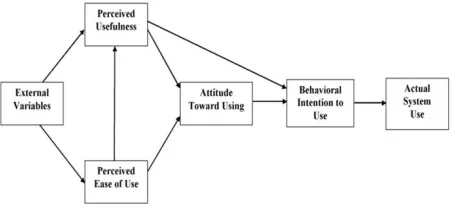
Technology Acceptance Model (TAM) Technology Acceptance Model (TAM) is one of the most influential models used in explaining the acceptance of information technology (IT) (Lee et al., 2003). According to TAM (Davis, 1989), perceived usefulness (PU) and perceived ease of use (PEU) of IT are two major determinants of IT usage. PU defined as the extent to which a person believes that using the system will enhance his or her job performance and PEU defined as the extent to which a person believes that using the system will be free of effort. TAM posits that computer usage is determined by a behavioral intention to use a system, where the intention to use the system is jointly determined by a person’s attitude toward using the system and it’s perceived usefulness (see Figure 1).Source : TAM (Davis et al, 1989)
predicting and explaining user behaviors across a wide variety of domains. According to the theory of reasoned action (TRA), a person's performance of a specified behavior is determined by his or her behavioral intention to perform the behavior, and behavioral intention is jointly determined by the person's attitude and subjective norms concerning the behavior in question (Ajzen & Fishbein, 1980, Fishbein & Ajzen, 1975). Following the logic of the TRA, the TAM explores the factors that affect behavioral intention to use information or computer systems and suggests a causal linkage between two key variables perceived usefulness and perceived ease of use and users attitude, behavioral intention, and actual system adoption and use (Davis, 1986).
Perceived usefulness is defined as "the prospective user's subjective probability that using a specific application system will increase his or her job performance within an organizational context," while perceived ease of use refers to "the degree to which the prospective user expects the target system to be free of effort" (Davis et al., 1989, p. 985). As Figure 1 illustrates, the TAM is a path model that identifies the impact of external factors such as system design characteristics, user characteristics, task characteristics, nature of the development or implementation process, political influences, organizational structure, and so on (Ajzen & Fishbein, 1980). The TAM suggests that information system usage is determined by behavioral intention, which is viewed as being jointly determined by the user's attitude toward using the system and the perceived usefulness of the system (Davis et al., 1989). Since Davis (1986) introduction of the model, many studies have been conducted using it in a variety of information technology usage settings, testing its appropriateness and modifying it in different contexts. Past research on the TAM has largely focused on personal computer usage or relatively simple software applications such as email, word processing programs, spreadsheet software, and the Windows operating system (e.g., Chau, 1996, Davis, 1993, Davis et al., 1989, Doll, Hendrickson, & Deng, 1998, Mathieson, 1991).
Recently, in line with the development of the Internet and Internet-based technologies, applications of the TAM have been made in the
areas of organizational contexts (e.g., Hu, Chau, Sheng, & Tam, 1999, Igbaria, Zinatelli, Cragg, & Cavaye, 1997, Venkatsh & Davis, 1996), e-commerce (e.g., Jiang, Hsu, & Klein, 2000), telemedicine (e.g., Chau & Hu, 2002, Karahanna, Straub, & Chervany, 1999), and digital library systems (e.g., Davies, 1997, Hong, Thong, Wong, & Tam, 2002, Thong, Hong, & Tam, 2002). Finally, such attitude towards using technology determines the behavioral intention to use that technology (Maslin, 2007). From the description about TAM, considered distinct factors influencing the user’s attitude towards using the technology, though perceived ease of use is also hypothesized to influence perceived usefulness and attitude towards using the technology. In this research more focus on the attitude towards using the one of technology for human resource management. The technology is use the electronic human resource management.
3. METHODOLOGY
3.1. Research Site and Subjects
The participation is from the human resource department in PT. Pusri Sriwijaya Palembang. The participation will be around 120 staff in human resource department. The subjects of the questionnaire is about the relationship between the attitudes and the electronic human resource management.
3.2. Design of Study
Research design provides an indication of the means to be used to attain the research objective s (Bak, 2004) where the combination of methods and procedures to be followed in conducting research to eventually come to the findings or testing of a hypothesis.
variables selected for investigation are reflected in the hypotheses. According to Sekaran (2003), quantitative data are standard, simple analysis, systematic and easy to analysis in a short time. As a quantitative study, conclusions are based on the questionnaires distributed to respondents. This quantitative study used statistical data as a medium to obtain the needed information. This study aims to determine the relations between the independent variables and the dependent variable. As people understand that quantitative method is an approach by numeric data is collected (Singh, 2007) such as mean and median to describe variables (Bieger and Gerlach, 1996) also correlation coefficients to show a relationship among variables.
Quantitative method is categorized with become a scientific where the researcher usually using the survey of mathematics and statistics to explore and find out the phenomenon. Here the focus is to explain cause and affect relationships (why things happen) and to be able to test if the hypothesis is applicable in reality (Andersen, p.31, Lund, 1998). The measurement, scales, test and questionnaires are very controlled and the conclusion often results in a generalization of the population. According to Leary (2004), the major advantages of questionnaires are that they can be administered to groups of people simultaneously, and they are less costly and less time-consuming than other measuring instruments. The researcher is seen as an outsider and keeps a distance and an objectives view of the research (Ghauri, p.110). The research already made decision which strategy of research shall be used. There are two kind of research strategy such as induction and deduction (Ghauri & Gronhaug, 2005). Researcher use deduction strategy which means study start from theory, concept, observation, and until findings. This kind of strategy used because researcher was tried to test the theory in the practice and adopt the quantitative study. The findings and the conclusion of the study will solely depend on the full utilization of the statistical data collected.
3.3. Research Framework
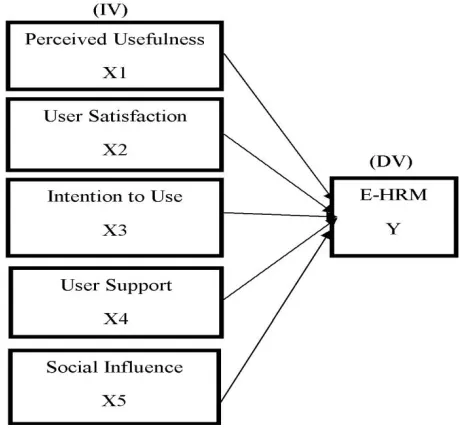
Research framework is a conceptual model of how one theory of the relationships among the
several factors that have been identified as important to the problem (Sekaran, 1992). She was mentioned in his book that an independent variable is one that influences the dependent variable in either a positive or negative way (see Figure 2).
Source : Theoretical Framework
Figure 2 : Theoretical Framework
H1: There is relationship between perceived usefulness and electronic human resource management.
H2: There is relationship between user satisfaction and development and electronic human resource management.
H3: There is relationship between intention to use and electronic human resource management. H4: There is relationship between user support and
electronic human resource management. H5: There is relationship between social influence
and electronic human resource management. H6: There is a relationship between overall
determinant factors (perceived usefulness, user satisfaction, intention to use, user support, social influence) and electronic human resource management.
3.3.1. Hypotheses
Ho1: There is no significant relationship between perceived usefulness and electronic human resource management.
Ha1: There is significant relationship between perceived usefulness and electronic human resource management.
Ho2: There is no significant relationship between user satisfaction and development and electronic human resource management. Ha2: There is significant relationship between user
satisfaction and development and electronic human resource management.
Ho3: There is no significant relationship between intention to use and electronic human resource management.
Ha3: There is significant relationship between intention to use and electronic human resource management.
Ho4: There is no significant relationship between user support and electronic human resource management.
Ha4: There is significant relationship between user support and electronic human resource management.
Ho5: There is no significant relationship between social influence and electronic human resource management.
Ha5: There is significant relationship between social influence and electronic human resource management.
Ho6: There is no significant a relationship between overall determinant factors (perceived usefulness, user satisfaction, intention to use, user support, social influence) and electronic human resource management.
Ha6: There is significant a relationship between overall determinant factors (perceived usefulness, user satisfaction, intention to use, user support, social influence) and electronic human resource management.
3.4. Item and Measurement
These researches have one of Dependent Variable, and five for the Independent Variable. Dependent Variable is the effect or the result or outcome of another variable. Dependent variable are the key factor that has been looked into to explain or predict if they are affected by some other
factors. Independent Variable is one that identifies forces or conditions that act on something else, Independent Variable is defined as the presumed cause of some changes in the dependent variable (Robbins, 1998).
Dependent Variable is Electronic Human Resource Management, and the Independent Variable is Perceived Usefulness, User Satisfaction, Intention to Use, User Support, and Social Influence. Total of the question from the items is 35 questions. A set of question was developing which comprises of seven (7) parts. Section A (Personal Information) have 4 questions, Section B (Electronic Human resource management) have 5 questions, Section C (Perceived Usefulness) have 5 questions, Section D (User Satisfaction) have 6 questions, Section E (Intention to Use) have 5 questions, Section F (User Support) have 5 questions, and Section G (Social Influence) have 5 questions.
According to Sekaran (2003), questionnaire is will introduce the research topic and motivate the respondents to offer their frank answers. The Likert scale design is used to examine how strongly subjects agree and disagree with statements on five point scale (Cavana et al, 2001).
a) 1 = Strongly disagree b) 2 = Disagree
c) 3 = Neither agree nor disagree d) 4 = Agree
e) 5 = Strongly agree
3.5. Sampling Design and Procedure
Gay et al. (2006:109) population means the group of interest such individuals, objects, or items (Singh, 2007) as a sample to be taken by researcher where the results of the study will be generalize. The population is the employees that use the e-kiosk system. Total population of this study around 120 employees ranged from junior staffs to manager in human resources department. In PT. PUSRI total of employee based on April 2012, around 2848 employee. The questionnaire was distributed randomly to the staff in human resource department. Total of the questionnaires is 120 pieces. To check the credibility questionnaire process of test and re-test, this will applied by 7 person based on voluntary respondents. The voluntary 3 from UUM, 4 from PT. PUSRI Palembang. After that the question will be improve which to answer the content and measuring the item highly consistent. The questionnaire distribute and collection process around 1 month (30days).
3.6. Data Analysis Technique
There are several statistical techniques that can be carried out to draw accurate conclusion about electronic human resource management. In this study, the data analyzed using descriptive statistics and inferential statistics. Descriptive statistics such as frequency and percentage used to measure the percentage of returned questionnaire and also used to describe the respondents’ profile. For inferential statistic, researcher used The Pearson Correlation to measure the relationship among variables and Multiple Regression to measure the influence of independent variables toward dependent variable. The data for entire study was inputted into the Statistical Package for Social Science (SPSS) 17.0 program for Windows to interpret results.
3.6.1.Validity and Reliability
There are three quality of research such as internal validity, external validity and reliability. Internal validity is how the findings of the research match reality and as the researcher measure the things that are aimed to measure. Moreover, the reality in quantitative research is
an ongoing processes, it always changes due to the fact that what is being studied is how people understand the job.
External validity is primarily about refusing the findings in other situations, if it is possible to generalize the results of the study. To develop the result from a quantitative study in external way different strategies can be used. Starting with rich, thick description, where one should provide much material so the readers can decide if their situation matches the research. Typicality or modal category is to make a detailed description of the studied phenomenon so that it can be compared with other categories. Finally, multisite designs where the researcher uses as much information and data collection as possible so the reader can use the result in other situations.
Reliability, where the research findings with same studied phenomenon, should reach the same conclusion, independent of the researcher. When it comes to quantitative studies, the reliability is hard to define though human behavior is investigated. It can be hard to segregate and it could be explained by researchers seek to describe and explain the world as those in the world experience it (Merriam, p.205). Additionally, the Cronbanch Alpha coefficients were computed to determine the reliability the instrument to ensure the items are available. Table 3.3 shows the guideline suggested by Hair et al. (2007) to interpret. The reliability analysis was conducted to test the internal consistency of the measuring instruments.
3.6.2. Inferential Statistic
3.6.2.1. The Pearson Correlation
The Pearson correlation used to measure the significance of linear bivariate between independent and dependent variables thereby achieving the objective of this study. The significant of the variable will known through this analysis whereby if p is 0.05 (0.05>p) / 0.01 (0.01>p) there is significant correlation variables. According to Hair, Money, Samouel and Page (2007), a correlation coefficient meaning that the level of the variation is together between two variables. The strength of the association is reviewed based on the scale suggested by Hair et al (2007) in order to quantitatively describe the relationship between independent variables and dependent variable.
3.6.2.2. Multiple Regressions
Multiple regressions will be used to determine the relationship between independent and dependent variables, the direction relationship, the degree of the relationship, and strength of the relationship (Sekaran, 2000). Multiple regressions meaning that the simple statistical technique to predict the variance in the dependent variable by regress the independent variables against it (Sekaran, 2010).
4. RESULTS AND DISCUSSION 4.1. Data Screening
Data screening is the process of inspecting data for errors and correcting it prior to doing data analysis. The screening may involve checking raw data, identifying outliers and dealing with missing data. While data analysis often focuses on summarization, model fitting, and numbers, data screening emphasizes exposure, preparation for modeling, checking the adequacy of assumptions, and graphical display.
During the data screening process, we meet missing data for variety of reason. The target respondent may refuse to answer personal questions that include to their income, sexual
orientation or some questions that they not understand. Some reasons maybe respondents may not be competent to respond because of a lack of knowledge regarding a particular topic. The missing value analysis has been made to check the values during the data transferred. Based on the result obtained by using the SPSS, the percentage of missing values for all the items in questionnaire is 0.000%, which means that there are no missing values during the data transfer.
4.2. Data Analysis
The objective of this study is to examine the influence of electronic human resource management toward attitudes at HRD South Sumatera. For examine the objectives of this study, there six research questions, which will be answered in this section as noted below:
a. Do perceived usefulness have relationship towards electronic human resource management?
b. Do user satisfaction have relationship towards electronic human resource management?
c. Do intention to use have relationship towards electronic human resource management?
d. Do user support have relationship towards electronic human resource management?
e. Do social influence have relationship towards electronic human resource management?
f. Which the most influence attitude towards electronic human resource management?
4.3. Demographic Profile of Respondents
The distribution frequencies analysis is used for the personal information of respondents. Total employees of HRD answered the questionnaires distributed. The demographic factors considered in this study are described below:
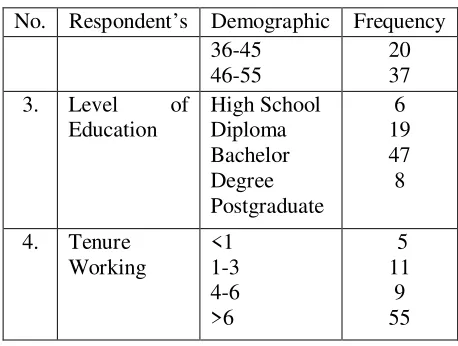
Table 1: Profile of the Respondents No. Respondent’s Demographic Frequency
1. Gender Male Female
48 32
2. Age 25
26-35
Table 1 : Continued
No. Respondent’s Demographic Frequency 36-45
Source: Data that has been processed, 2012
Total of the respondents is 80 employees from human resource department. They answer all the questionnaire. Based on the research the majority gender answer this questionnaire is male the frequency is 48/80. In human resource department have many male rather than female employee. The range of age from the questionnaire, the majority is 46-55 years old the frequency is 37/80. For the level education the majority is bachelor degree, the employee in human resource department the basic is from bachelor degree the frequency is 47/80. The majority for long working in the company is more than 6 years. The frequency is 55/80, that’s mean the staff in human resource department is have more skill in human resource side.
4.4. Analysis of Result 4.4.1.Reliability of Measures
The first test carried out on the data was the reliability test on the multi-item instrumentals used in this research. The Cronbach’s Alpha value was used to test the reliability of the items measuring each variable: electronic human resource management, perceived usefulness, user satisfaction, intention to use, user support, social influence. It is a reliability measure coefficient that reflects how well items in a set are positively correlated to one another.
The result obtained as shown in table 2 indicates that the Cronbach’s Alpha value for the measuring items of independent variables and dependent variables.
Table 2: Summary of Reliability Analysis
No. Variables Number
Source: Data that has been processed, 2012
All the Cronbach’s Alpha values is greater that more than 0.80 and indicates inter-item consistency. The lowest is user support at 0.81 and the highest is intention to use at 0.87. Based on the rules of thumb for Cronbach’s Alpha coefficient size for 0.80<0.90 the internal consistency reliability is very good (Sekaran, 2003).
negatively. Correlations were shown in Tables 3 to 7 respectively.
Research question no. 1. Does perceived usefulness have relationship towards electronic human resource management?
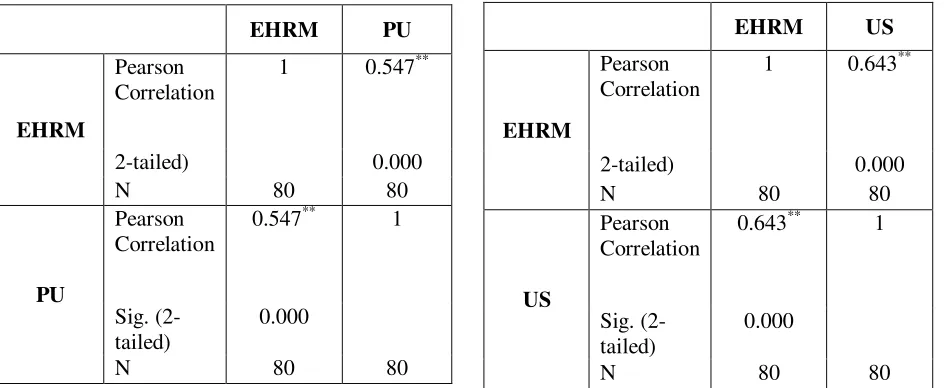
Table 3: Correlations of Perceived Usefulness and Electronic Human Resource Management
EHRM PU
EHRM
Pearson Correlation
1 0.547**
2-tailed) 0.000
N 80 80
PU
Pearson Correlation
0.547** 1
Sig. (2-tailed)
0.000
N 80 80
**Correlation is significant at the 0.01 level (2-tailed).
Source: Data that has been processed 2012
Table 3 shows the correlation value was (r=0.55, p < 0.01). To determine the correlation coefficient, the coefficient and its associated significant value (p) are examined. The value of the correlation shows the strength of association between the two variables, which is moderate. This result provides an answer for research question number one, Does perceived usefulness have relationship towards electronic human resource management?. Besides that, also support hypothesis number one can be concluding that there is a significant correlation between perceived usefulness and electronic human resource management. Moreover, finding there will be a positive relationship between perceived usefulness’ and attitude toward using the system (Malhotra, Yogesh, 1999). Another responding said Perceived usefulness will be
positively related to attitude towards E-HRM (Yusoff, et all, 2010).
Research question no. 2. Does user satisfaction have relationship towards electronic human resource management?
Table 4: Correlations of User Satisfaction and Electronic Human Resource Management
EHRM US
EHRM
Pearson Correlation
1 0.643**
2-tailed) 0.000
N 80 80
US
Pearson Correlation
0.643** 1
Sig. (2-tailed)
0.000
N 80 80
**Correlation is significant at the 0.01 level (2-tailed).
Source: Data that has been processed 2012
Research question no. 3. Does intention to use have relationship towards electronic human resource management?
Table 5: Correlations of Intention to Use and Electronic Human Resource Management
EHRM IU
EHRM
Pearson Correlation
1 0.721**
2-tailed) 0.000
N 80 80
IU
Pearson Correlation
0.721** 1
Sig. (2-tailed)
0.000
N 80 80
**Correlation is significant at the 0.01 level (2-tailed).
Source: Data that has been processed 2012
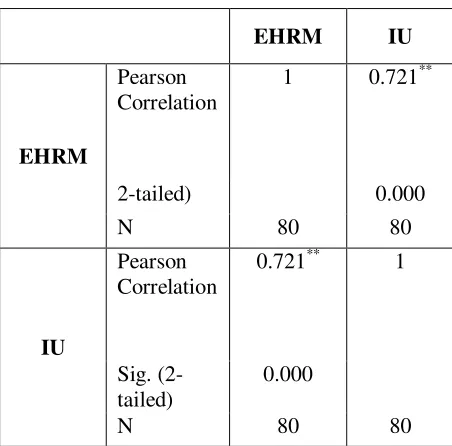
Based on table 5, Pearson Correlations were again performed to test the correlation of variables. Shows that the intention to use and electronic human resource management variables are significantly correlated (r=0.72, p < 0.01). To determine the correlation coefficient, the coefficient and its associated significant value (p) are examined. The output confirms the showing of the scatter plot, that there is a significant positive relationship between intention to use and electronic human resource management. There are many past studied discuss about intention to use is related to the system, there is relationship between intention of end-user to make use of the new technology (Amoako-Gyampah & Salam, 2004).
Research question no. 4. Does user support have relationship towards electronic human resource management?
Table 6: Correlations of User Support and Electronic Human Resource Management
EHRM USP
EHRM
Pearson Correlation
1 0.671**
2-tailed) 0.000
N 80 80
USP
Pearson Correlation
0.671** 1
Sig. (2-tailed)
0.000
N 80 80
**Correlation is significant at the 0.01 level (2-tailed).
Source: Data that has been processed 2012
Based on table 6, Pearson Correlations were again performed to test the correlation of variables. Shows that the user support and electronic human resource management variables are significantly correlated (r=0.67, p < 0.01). To determine the correlation coefficient, the coefficient and its associated significant value (p) are examined. The output confirms the showing of the scatter plot, that there is a significant positive relationship between user support and electronic human resource management. There are many past studies discuss about the user support related to the electronic human resource management, in the past studies discuss about significant positive relationship between IT experiences (experienced ease of use, usability, output quality, user support) and attitudes towards electronic human resource management (Voermans and van Veldhoven, 2007).
Table 7: Correlations of Social Influence and Electronic Human Resource Management
EHRM SI
EHRM
Pearson Correlation
1 0.566**
2-tailed) 0.000
N 80 80
SI
Pearson Correlation
0.566** 1
Sig. (2-tailed)
0.000
N 80 80
**Correlation is significant at the 0.01 level (2-tailed).
Source: Data that has been processed 2012
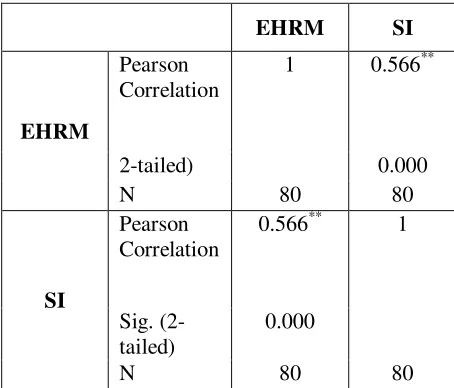
Based on table 7, Pearson Correlations were again performed to test the correlation of variables. Shows that the social influence and electronic human resource management variables are significantly correlated (r=0.57, p < 0.01). To determine the correlation coefficient, the coefficient and its associated significant value (p) are examined. The output confirms the showing of the scatter plot, that there is a significant positive relationship between social influence and electronic human resource management. There are many past studies discuss about the relationship between social influence and the system, the degree to which an individual perceives that important others believe he or she should use the new system (Venkatesh et al, 2003). The social influences have relationship to electronic human resource management (Yusoff, et all, 2011).
4.4.3 Regression Results
In this sub section, researcher provides the results of multiple regressions between independent variables (perceived usefulness, user satisfaction, intention to use, user support and social influence)
and dependent variable (electronic human resource management). By multiple regressions, researcher able to find the answers of research questions. The result is shown in Table below:
Research question no. 6. Which the most influence attitudes (perceived usefulness, user satisfaction, intention to use, user support, social influence) towards electronic human resource management?
Table 8: Model Summary (b)
Model R R Square
Adjusted R Square
Std. Error of
the Estimate
1 0.771a 0.595 0.568 0.41812
a. Predictors: (Constant), SI, PU, IU, US, USP b. Dependent Variable: EHRM
Source: Data that has been processed 2012
From table 8 if the R-value has more than 0.5 it will be considered as a critical value. From the table above the value of R is 0771, it can be concluded that there is a relationship between the independent variable with dependent variable. The R-Square value was found to be 0.595 indicating that 59.5% of the variance in electronic human resource management as been significantly explained independent variables (perceived usefulness, user satisfaction, intention to use, user support and social influence).
Table 9 : ANOVA(b)
Model Sum of
Squares Df
Mean
Square F Sig.
1 Regression 19.013 5 3.803 21.751 0.000a
Residual 12.937 74 0.175
Total 31.950 79
a. Predictors: (Constant), SI, PU, IU, US, USP b. Dependent Variable: EHRM
The ANOVA result which shown in table above indicates that the model fit is
statistically significant with a p-Value/ Sig. = 0.00 (< 0.01).
Table 10 : Coefficients (a)
Model Unstandar
dized Coefficients
Standardized
Coefficients t Sig.
B Std.
Error Beta
1 Cons. 0.107 0.373 0.288 0.774
PU 0.225 0.110 0.213 2.041 0.045
US 0.168 0.145 0.145 1.160 0.250
IU 0.541 0.136 0.504 3.983 0.000
USP 034 0.180 0.028 0.188 0.852
SI 0.005 0.125 0.004 0.037 0.970
* Dependent Variable: EHRM
Source: data that has been processed, 2012
Through regression analysis, Beta value is used to identify which of the five independents variables is more important in explaining the variance in electronic human resource management. For the beta value all the variables is have the positive results for the variables. It was found that from five dimensions of independent variables, three dimension (user satisfaction = .145; p 0.01, user support = .028; p 0.01, social influence = .004; p 0.01) have no significant influence toward electronic human resource management. This probably happened because employees satisfy enough regarding communication, for instance direction that comes from manager is communicated well, manager using multiple channel in order to get better understanding regarding convey the message or information. Other two dimensions (perceived usefulness = .213; p 0.01 and intention to use = .504; p 0.01) which means both of dimensions are significantly influence toward electronic human resource management. However, the multiple R (0.71) suggests there is a positive correlation of the independent variables with the dependent variables. The R square is 0.595. F statistic is 21.75 at the significant level of .000 (a). Finally, multiple regressions indicates that the attitudes variables including perceived usefulness, user satisfaction, intention to use, user support and
social influence, have contribution 59.5% as a factors that influence electronic human resource management, and 40.5% influences by of other factors that not conducted in this study.
4.5 Summary of Hypothesis Testing
Based on the analysis, it can be concluded that there is a relationship of attitudes (perceived usefulness, user satisfaction, intention to use, user support and social influence) towards electronic human resource management in PUSRI Regional Human Resource Department Office Palembang, South Sumatera. The result of hypotheses testing are summarizes in Table below.
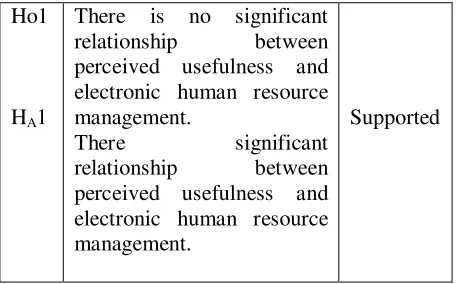
Table 11 : Summary Hypothesis Ho1
HA1
There is no significant relationship between perceived usefulness and electronic human resource management.
There significant relationship between perceived usefulness and electronic human resource management.
Table 11 : Continued Ho2
HA2
There is no significant relationship between user
satisfaction and
development and electronic
human resource
management.
There is significant relationship of significant relationship between user
satisfaction and electronic human resource management.
There is significant relationship between intention to use and electronic human resource management.
Supported
Ho4
HA4
There is no significant relationship between user support and electronic
human resource
management.
There is significant relationship between user support and electronic
human resource
management.
Supported
Ho5
HA5
There is no significant relationship between social influence and electronic
human resource
management.
There is significant relationship between social influence and electronic
human resource (perceived usefulness, user
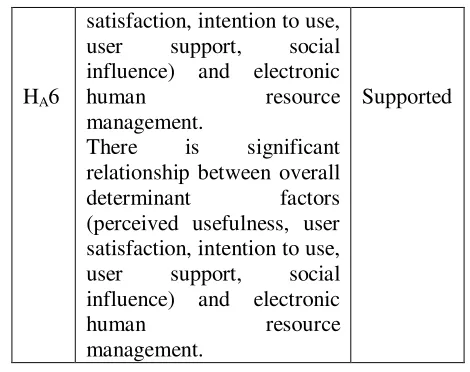
HA6
satisfaction, intention to use, user support, social influence) and electronic
human resource
management.
There is significant relationship between overall determinant factors (perceived usefulness, user satisfaction, intention to use, user support, social influence) and electronic
human resource
management.
Supported
Source: data that has been processed 2012
5. CONCLUSION AND RECOMMENDATION 5.1. Overview findings and Discussion
This study attempts to find out the effects of attitudes (perceived usefulness, user satisfaction, intention to use, user support and social influence) on electronic human resource management of HRD PT. PUSRI at South Sumatera. In this study attitudes is limited and referring to perceived usefulness, user satisfaction, intention to use, user support and social influence.
The data collected were analyzed by using SPSS Version 17.0. HRD South Sumatera was selected as scope of study on this study. Researcher had distributed 120 questionnaires, and only 80 questionnaires returned back which provided clear answers. Means all of 80 questionnaires are suitable to use.
1-3 years, 9 for 4-6 years, and 55 for more than 6 years. Categorizes in demography variables of respondents were represented in the study were restricted to medium-contact and high-contact person. In conclusion the survey achieved a good distribution in terms of gender, age, educational level, and time of work.
The analyses outcome indicated all attitudes which employee as independent variable has relationship on electronic human resource management. The result shows that the levels of attitudes (perceived usefulness, user satisfaction, intention to use, user support and social influence) through electronic human resource management are high. Besides that, it also proved by looking the correlation results whereby among variables; perceived usefulness, user satisfaction, intention to use, user support and social influence have a strong and significant relation toward electronic human resource management. Results which came from multiple regressions also consider as a provident. Two variables are significant, perceived usefulness and intention to use the value is not more 0.05 and less or equal to 0.01 it will reject null hypothesis (H0) and accept alternative hypothesis (HA) with confidence level 95%. It shows that there significant relation between attitudes (perceived usefulness, user satisfaction, intention to use, user support and social influence) and electronic human resource management in HRD PT. PUSRI.
5.1.1. Summary of Research Objective
The discussions were based on the objectives of the study, which presented, as listed below:
a. To determine the relationship between perceived usefulness towards electronic human resource management
b. To determine the relationship between user satisfaction towards electronic human resource management
c. To determine the relationship between intention to use towards electronic human resource management
d. To determine the relationship between user support towards electronic human resource management
e. To determine the relationship between social influence towards electronic human resource management To determine the most influence attitude towards electronic human resource management
By using Pearson Correlation test, all objectives are significant. Hellriegel, et al. (2004:286). It was found on chapter 4 that perceived usefulness positive significant (r=0.55, p < 0.01). User satisfaction positive significant (r=0.64, p < 0.01). Intention to use positive significant (r=0.72, p < 0.01). User support positive significant (r=0.67, p < 0.01). Social influence positive significant (r=0.57, p < 0.01).
Based on the Multiple Regressions test, that perceived usefulness and intention to use is the highest influence to the electronic human resource management. It was found on chapter 4 that perceived usefulness = .213; p 0.01 and intention to use = .504; p 0.01. This finding is consistent with the studies by Gupta and Govindarajan (2000), Chiaburu and Takleab (2005) and Ismail et al. (2007).
Followed by user satisfaction = .145; p 0.01, user support = .028; p 0.01, social influence = .004; p 0.01. User satisfaction is have the relationship to electronic human resource management, user satisfaction is really important for analyze the satisfied the user with the system. User support is one of important relationship for the electronic human resource management, from the user support the system can be more improve. Social influence is relate to electronic human resource management, the user will be use the system based on the environment. So the social influence is relate to the user.
5.2. Implication of Study
will increase the satisfaction and performance while working that use the system. Employees are become more confident, loyal, and commitment to the organization because they feel comfort and think that they are such an important resource that company has, also the employee can more understand the system to use.
Lastly, this research expected to give attention for the course that University offer to student, whereby it must provide the subjects regarding attitudes towards to electronic human resource management in order to help students get more knowledge and applying all the appropriate theories to the real world. Hence, students who are need more references regarding; attitudes, perceived usefulness, user satisfaction, intention to use, user support, social influence and electronic human resource management are allowing refer to this study. This research also gives the knowledge about the human resource management, attitudes and electronic human resource management related to attitude in the working environment.
5.3. Limitation and Further Study
The study has some limitations. These limitations include, the present study is restricted to a small sample of firms in one industry and may therefore provide limit of findings. The respondents’ provided information on the influence of attitudes and perceived measure of electronic human resource management. The possibility of respondents’ bias in reporting may have happened (Paul & Anantharaman, 2003). However, researcher has been conducted pilot of study in order to avoid bias. This study had collected the data purely through the survey questionnaire, survey has been known to have many problems such as lack of responses from respondents. Another limitation is from the system that use in the company, e-kiosk only can access in the working area. E-kiosk only can use intranet in the company. So this one of the limitation for system. Future research also next apply to another application for electronic human resource management, such as leave, pay, e-procurement. Future research also better to apply culture being the variable to additional IV, culture
is one of successful factors in e-hrm implementation associated in works or organization (Lauren, 2010).
Future researchers should make sure that they have people (networking) to assist in distributing and getting the questionnaires back. In this way, the response rate can be improved. In addition, future researchers who are interested in this type of study should also use interviews to complement the survey. Sample only consists of employees from one small organization with same nationality, which is Indonesia.
National cultural values may influence the way personal thinking, interpret, and re-act the attitudes approach at the particular organization. Hence, the data of this study were gathered through translated questions. The questions have been translated from English to Bahasa Indonesia as mean to help respondents to understand the questions. So that, possibility dissimilarity connotation compared to the original questions may occurred. Furthermore, time also became one of limitations because only given several months in order to finish this study. Need little more time to gather information in order to get better result and support theory as well.
5.4. Recommendation
For the system, e-kiosk should be extend to extranet or online so can use outside from the working area, because the branch for PT. PUSRI in another country. So, can directly use everywhere, and ever time the user need to use it. For the research, need little more time to gather information in order to get better result and support theory as well.
5.5. Conclusion
tested in this study possibly may have an impact to the attitudes of the respondents. Researches only account 59.5% of the variance attitudes towards electronic human resource management. Future researches perhaps can do some analysis on the other factors and help explain the 40.5% of other attitudes. The number of variables might be increased in future researches.
Finally, this research can have the benefit to the company, to know how to improve the employee performance by use the system. These researches also have the benefit to the researcher to understand how to do the research and analyze the data from the research.
REFERENCES
[1] Agarwal, R. & Prasad, J. 1997, ‘The role of innovation characteristics and perceived voluntariness in the acceptance of information technologies’, Decision Sciences, vol. 28, no. 3, pp. 557-582.
[2] Al-Maskari, Azzah & Sanderson, Mark 2010, ‘A Review of Factors Influencing User Satisfaction in Information Retrieval’, University of Sheffield Collection, UK.
[3] Amoako-Gyampah, K. & Salam, A. F. 2004, ‘An extension of the technology acceptance model in an ERP implementation environment’, Information & Management, vol. 41, no. 6, pp. 731-745.
[4] Bergman, Elaine M. Lasda & Holden, Irina I. 2010,’User Satisfaction with Electronic Reference : A Systematic Review’, Reference Services Review, vol.38, no.3, pp.493-509.
[5] Cowen, Jeffrey B. 2009, ‘The Influence of Perceived Usefulness, Perceived Ease of Use, and Subjective Norm on the Use of Computed Radiography Systems: A Pilot Study’, Radiologic Sciences and Therapy Division.
[6] Daud, Normala 2006, ‘Human Resource Management Practices and Firm Performance
: The Moderating Roles of Strategies and Environmental Uncertainties’, Thesis submitted in fulfillment of the requirements for the Degree of Doctor of Philosophy.
[7] Davis, F. D. 1989, ‘Perceived usefulness, perceived ease of use, and user acceptance of information technologies’, MIS Quarterly, vol. 13, no. 3, pp.319-340.
[8] Eberlein, Mario 2008, ‘Culture As A Critical Success Factor For Successful Global Project Management In Multi-National IT Service Projects’, Journal of Information Technology Management, vol. XIX, no. 3, pp. 27-42.
[9] Fishbein, M. & Ajzen, I. 1975, Belief, Attitude, Intention and Behavior: An Introduction to Theory of Research. Addison-Wesley, Reading, MA.
[10]Glyde, Laurel A & Klobas, Jane E. 2001,’Social Influence and Internet Use’, Library Management. vol.22,no.1/2,pp.61-67.
[11]Harvard Business Essentials 2005. Power, Influence, and Persuasion. Boston : Harvard Business School Press.
[12]Hooi, L.W. 2006, ‘Implementing e-HRM: The readiness of small and medium sized manufacturing companies in Malaysia’, Asia Pacific Business Review, vol. 12, no. 4, pp. 465-485.
[13]Lee, Y., Kozar, K. A. & Larsen, K. R. T. 2003, ‘The technology acceptance model: Past, present, and future’, Communications of the AIS, vol. 12, pp. 752-780.
[14]Leopold, John 2002, Human Resources in Organisations. England : Pearson.
[15]Li, X. 2004, ‘Informational cascades in IT adoption’. Communications of the ACM, vol. 47, no. 4, pp. 93-97.
[17]Martin, John 2010, Human Resources Management. London : Sage.
[18]Oliva, Mario Arias & Coronas, Teresa Torres 2005, e-Human Resources Management :Managing Knowledge People. London : Idea.
[19]Perrin, Towers & Walker, Alferd J. 2001, Web-Based Human Resources. New York :McGraw-Hill.
[20]Ramayah, T., Nornina, D., Noorliza, K. & Normalini, M. K. 2006, ‘Perceived characteristics of innovation (PCI): The case of the human resource information system (HRIS)’, Advance Global Business Research, vol. 3, no. 1, pp. 159 – 165.
[21]Roberts, Caroline & Jowell, Roger 2008, Attitude Measurement Volume 1. London : Sage.
[22]Rouibah, Kamel & Hamdy, Hosny I. 2008,’Effect of Management Support, Training, and User Involvement on System Usage and Satisfaction in Kuwait’, Industrial Management & Data Systems, vol. 109, no. 3, pp. 338-356.
[23]Ruël, H. J. M. 2001, 'The non-technical side of office technology; Managing the clarity of the spirit and the appropriation of office technology’, Twente University Press, The Netherlands.
[24]Seddon, P. B. 1997, ‘A specification and extension of the DeLone and McLean model of IS success’, Information System Research, vol. 8, pp. 240-253.
[25]Sekaran, U. 2000, Research methods for business (3rd ed.). New York: John Wiley & Son, Inc.
[26]Srivastava, Shashank Kumar 2010, ‘Shaping Organization with e-HRM’, Journal of
Innovation, Management and Technology, vol. 1, no. 1, pp.47-50.
[27]Strandberg, Coro 2009, ‘The Role of Human Resource Management in Corporate Social Responsibility’, CSR and HR Management Issue Brief and Roadmap.
[28]Strohmeier, Stefan 2006, ‘Research in e-HRM : Review and Implications’, Human Resource Management Review, vol. 17, pp.19–37.
[29]Vaughan, Paula J. 2001, ‘System Implementation Success Factors; It’s not just the
Technology’, University of Colorado, Boulder.
[30]Venkatesh, V. & Davis, F. D. 2000, ‘A theoretical extension of the technology acceptance model: Four longitudinal field studies’, Management Science, vol.46, no. 2, pp. 18-204.
[31]Venkatesh, V., Morris, M. G., Davis, G. B. & Davis, F. D. 2003, ‘User acceptance of information technology: Toward a unified view’, MIS Quarterly, vol. 27, no. 3, pp. 425-478.
[32]Voermans, M. & van Veldhoven, M. 2007, ‘Attitude towards E-HRM: An empirical study at Philips’, Personnel Review, vol. 36, no. 6, pp. 887-902.
[33]Yusliza M. Y., Ramayah, T. & Haslindar, I. 2010, ‘E-HRM: A proposed model based on Technology Acceptance Model’, African Journal of Business Management, vol. 4, no. 13, pp. 3039-3045.
[34]Zhou, Tao 2011, ’Understanding Online Community User Participation : A Social Influence Perspective’, Internet Research, vol.21, no.1, pp.67-81.