Design of Eco-Friendly Shallow Draft Fishing Vessel
Sunardi1*, Anthon Efani2*, Oktiyas Muzakky L3*
1 Fisheries Technology, Faculty of Fisheries and Marine Faculty, University of Brawijaya 2 Socio-Economic of Marine Fisheries, Faculty of Fisheries & Marine Faculty, University of Brawijaya
3Marine Science, Faculty of Fisheries and Marine Faculty, University of Brawijaya
Email: [email protected]
ABSTRACT
One of the main problems of inland waterways fisheries is the transportation of fish from ponds to fish market during low tide trough inland waterways with 0.6m water depth. The boat is experiences grounding due to water depth of the river is not sufficient for the fishing boat to carry fish at it is maximum 2 tons capacity or experience dead freight. This condition forces fisherman to wait until the high tide from the sea, this delay causes the quality of the fish is decreasing. Besides the problem dead freight problem the existing vessel is causes environmental problem such as erosion of the river bank due to wake wash. The other important issue is the increases of fuel price and it is scarcity. This paper presents the results of comparison of existing monohull fishing boat and two other alternative catamaran designs. The catamaran design alternatives are is ordinary catamaran and flat side catamaran. Both of the catamaran fishing boat design lower compared to ordinary catamaran and 44% lower compared to monohull. It means that the consumption of flat side catamaran is lowest compared to two other type of hull design. The flat side catamaran also produces lowest wake wash compared to o two other design. The low wake wash means more friendly to environment.
Keywords: Monohull, Flat Side Catamaran, Resistance, Wake Wash, Environment
INTRODUCTION
One of the common problems of brackish fish pond is the difficulties in transporting the harvest results due to low tide especially in summer. The river is shallow and the existing vessel is unable to carry the fish in required load. And there are two other issues regarding the erosion of the river bank due to wave generated by the vessel and also the fuel price which increases constantly.
The average fish which must be carried by the vessel in the brackish fish pond is 2 – 2.5 tons as the existing vessel maximum payload. But during the low tide it is unable to carry on its maximum load due to the water depth is less than 0.5m while the draft of the monohull existing vessel is more than 0.5m, this situation called as dead freight and the vessel may occur grounding as shown by Figure 1.
Besides, the problem of dead freight during low tide, the wave which produced by the hull causes erosion to the river bank. The wake wash problem will create sedimentation in the river bed and eventually worsen the silting process. This can be concluded that the existing vessel is not eco-friendly design.
From the economic perspective, the existing vessel considered less favourable due to the fuel price is to keep climbing. Its inability operates during low tide and the high resistance lead to inefficiency in operational cost.
Based on background mentioned in the previous paragraph, a solution is needed to solve dead freight, environmental issue and fuel efficiency.
THEORETICAL FRAMEWORK
Ship Resistance
Ship resistance is the sum of force acting on the ship which against the direction of the ship. Total resistance consist of friction resistance, viscous pressure resistance and wave resistance (Moland, 2011).
Total Resistance = Frictional resistance+ Viscous Pressure resistance + Wave resistance
The resultants of resistance components is the total resistance force acting on the vessel. Vessel is a submerged body, a submerged body travels through a fluid. This movement creates pressure variations around the hull. The pressure variation which depends to hull shape will creates fluid level near free surface, this phenomena creates wave which travel same speed as the hull speed (Molland, 2004). There are two wave patterns, transverse and divergent wave as shown by Figure 2.
Figure 2. Ship wave Pattern (Carlton, 2007).
In order to reduce resistance, wave erosion and increase efficiency, a design improvement is required.
Wave produced by catamaran
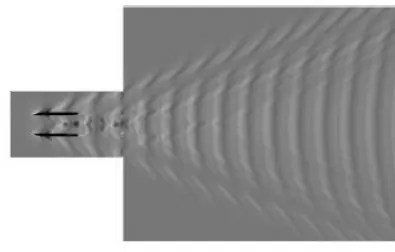
As explained in previous section, the wave formed by the hull is one of the components of resistance. The other aspect of wave pattern is the effect of wave created by the hull to the river bank. The higher and wider the wave created by the hull, the erosion rate is higher. One of solution which has been proposed is low wake wash or eco-friendly catamaran. The eco-friendly catamaran previously has been studied by Omar et.al and it was found that flat side catamaran generates wave which more eco-friendly compared to monohull and conventional catamaran (Omar et.al, 2012). The wave generated by ordinary catamaran is shown by Figure 3and flat side catamaran is shown by Figure 4.
Figure 4. Wave Generated by Flat side catamaran.
Based on comparison of both figure above, it can be concluded that the flat side catamaran produced less wave which causes river bank erosion.
Vessel Displacement
Displacement of a vessel is the total water volume or weight displaced due to submerged body of the vessel. In order to make a vessel a float, a displacement of a vessel must equal or exceeding the total weight of the vessel.
Displacement = L x B x T x Cb
Where,
L : Length Of the vessel B : Breadth of the vessel T : Draft of the vessel Cb : Block Coefficient.
Displacement = LWT + DWT + Margin
The total weight of a vessel consist of several components, those are:
1. Light weight of the vessel (LWT), is the weight of the structure, engine, outfitting and other machinery.
2. Dead Weight Tonnage (DWT), is the weight of cargo, consumables, and passenger.
3. Margin is the spare volume or weight in order to make the vessel stay afloat.
METHODS
As mentioned in previous section, a design improvement of existing vessel is
required. There are several requirements of improved design in order to make it comparable with existing vessel. The new design must:
1. Reduce vessel draft but still able to carry the same or more displacement
compared to existing vessel.
2. Reduce total resistance which lead to efficiency improvement.
3. Reduce wave produced by its hull.
The existing vessel is able to carry 2.5 tons fish at its maximum draft (0.6m). The existing vessel is shown by Figure 5.
Figure 5. Existing vessel.
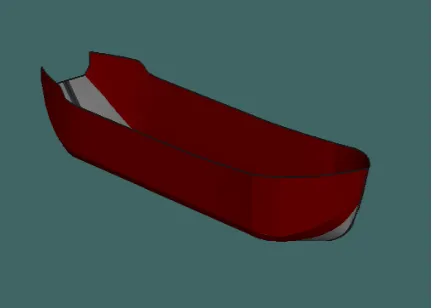
There are three alternatives of solutions, the first option is to develop shallow draft monohull. The second solution is to develop standard catamaran and the third alternative is to develop flat side catamaran. The shallow draft monohull design as shown by Figure 6.
The shallow draft vessel has characteristic as a bulky vessel and its wide body as the results of effort to maintain 2.5 tons payload with smaller draft. The draft of the monohull is 0.4m.
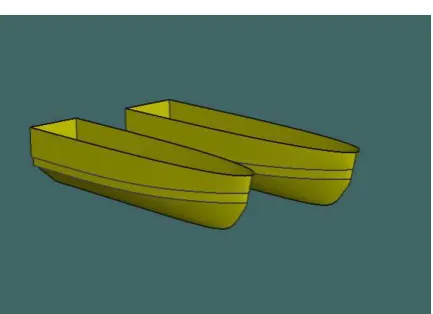
The standard catamaran characteristic is slimmer compared to first option. The draft of the standard catamaran is 0.4m.
Figure 7. Standard Catamaran
The flat side catamaran is the third alternative which has flat side hull in the outward side as shown by Figure 8.
Figure 8. Flat Side Catamaran
In order to conduct a comparison for the three type of the hull, the displacement of each vessel must be considered equal.
RESULTS
Based on the calculation, the existing vessel displacement is 3.19 tons. Based on the existing vessel displacement the other vessel design must be set to equal to 3.19 tons.
Principal dimension comparison.
The improved design principal dimensions are shown by Table.
Table 1. Principal dimension comparison.
It can be concluded from the principal dimension of the vessels that the displacement of each vessel are equal. The draft of the new vessel is 0.4m, which is lower than the existing vessel 0.6m.
As mentioned in the requirement that the new design must be able to reduce resistance. The resistance of the three hull type must be compared.
Resistance comparison.
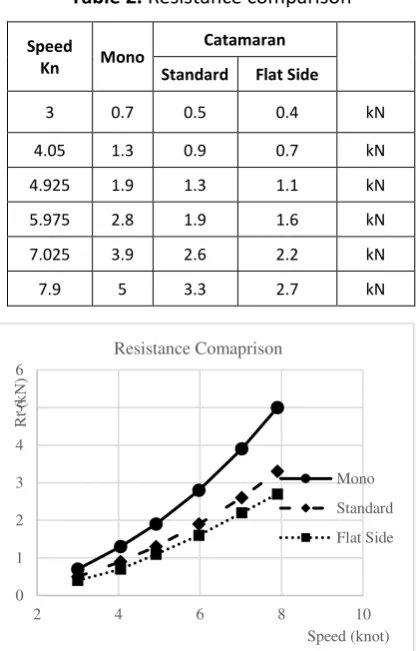
The resistance of each vessel was calculated and the results are presented as shown by Table 2. From the Table 1 and Figure 9 it can be concluded that the flat side catamaran provide the smallest resistance compared to two other vessel among 6 speed configuration. At speed of 7 knot, the force required by flat side catamaran is 2.2 kN while the Standard catamaran is 2.6 kN and the monohhull is 3.9 kN. It means the flat side catamaran 43.58% more efficient compared to monohull vessel and 18.18% more efficient compared to standard catamaran. The efficiency leads to less power required to propel the vessel at same speed (7 knot). The less power means less fuel consumption and more profitable in operating cost.
Exist Mono hull
Catamaran
Standard Flat
Side
Displacement 3.19 3.197 3.198 3.198 ton
Draft 0.6 0.4 0.4 0.4 m
Breadth 1.9 1.823 3.339 3.25 m
LWL 4.6 6.036 7.926 9 m
Table 2. Resistance comparison
Speed
Kn Mono
Catamaran
Standard Flat Side
3 0.7 0.5 0.4 kN
Figure 9. Resistance Comparison
The three alternatives must be evaluated from the environment perspective. The new design must be able to reduce river bank erosion caused by the wave.
Wave generated by vessel.
In this section the wave generated by the vessel is evaluated. The monohull wave profile creates a lot of transverse wave which cause river bank erosion as shown by Figure 10.
Figure 10. Wave Profile of Monohul.
While the standard catamaran produces less transverse wave compared to monohull as shown by Figure 11.
Figure 11. Wave Profile of Standard Catamaran.
From the visual inspection shown by Figure 12 and based on the study conducted by Omar et.al. The Flat side catamaran produced less transverse wave and lowest pressure compared to monohull and standard catamaran. The pressure is indicated by the red area in the wave field around the hull.
Figure 12. Wave Profile of Flat Side Catamaran.
CONCLUSION
From several findings discussed in the results section, it can be concluded that: 1. The draft of the proposed designs
(shallow draft, standard catamaran, flat side) is 0.4m. It means that the proposed designs able to carry in its maximum load during low tide where the existing vessel is unable.
that the flat side is the most efficient design among the others.
3. From the wave profile evaluation, it can be concluded that the flat side catamaran produced the most eco-friendly wave which indicated by the low pressure wave around the hull compared to monohull and standard catamaran. 4. The general conclusion is that the flat
side catamaran is the best solution for the problem of dead freight, fuel efficiency and eco-friendly design which are required for the brackish water pond and river.
REFERENCES
Molland, et.al, (2011), Ship Resistance and Propulsion: Practical Estimation of Ship Propulsive Power, Cambridge University Press, pp. 14.
Omar et.al, (2012), Parametric Study of Low Wake Wash Inland waterways catamaran, Scientia Iranica 19 (3), 463-471.
Yaakob, O., Abdul Mukti, M., Nasirudin, A. and Abdul Wahab, M (2007). ‘‘Hull form configuration study of low wake wash catamaran leisure boat’’, Proceedings 2nd