UPDATE ON THE FINANC
ING OF THE FUND’S
CONCESSIONAL ASSISTANCE AND DEBT RELIEF TO
LOW-INCOME MEMBER COUNTRIES
EXECUTIVE SUMMARY
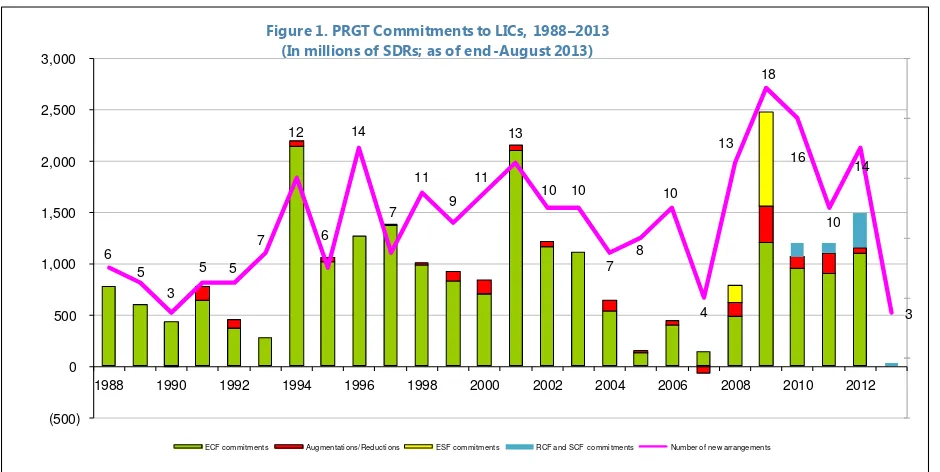
New commitments under PRGT-supported programs fell below SDR 0.1 billion in the first eight months of 2013 while disbursements on existing agreements
amounted to about SDR 0.5 billion. New commitments are projected to fall to about
SDR 0.3 billion in 2013 as a whole, but lower demand is expected to be temporary. Commitments are projected to rebound to about SDR 1.3 billion in 2014 similar to the level of commitments observed in 2011 and 2012.
Effectiveness of the second partial distribution of reserves linked to windfall gold sales profits would be a key step towards securing a self-sustaining PRGT with an
average annual capacity estimated at SDR 1.3 billion from 2014. The Trust’s
self-sustainability would rest on a three-pillar strategy: (i) a base annual average lending capacity of SDR 1¼ billion; (ii) contingent measures which can be activated when average financing needs exceed the base envelope by a substantial margin for an extended period; and (iii) the expectation that all modifications to LIC facilities would be designed in a manner that is consistent with maintaining self-sustainability. This framework is robust to a range of demand scenarios.
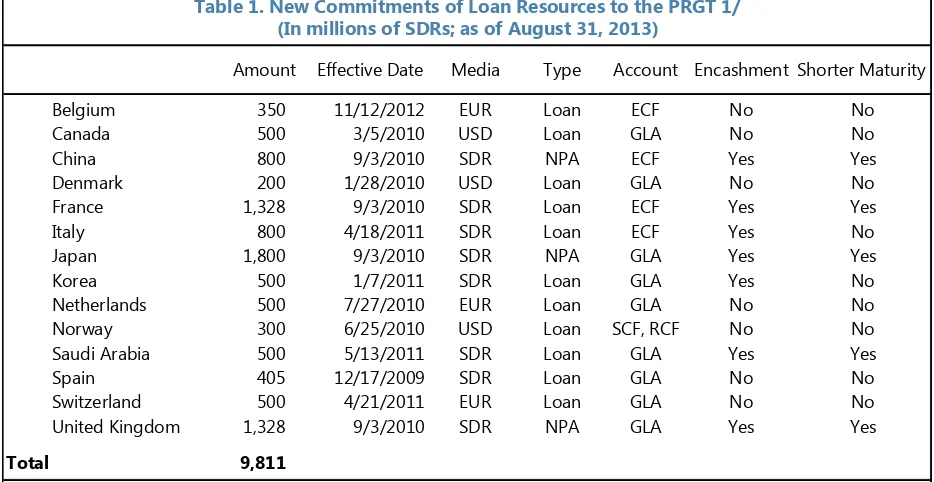
Further pledges are needed to make the second distribution of reserves linked to
windfall gold sales profits effective. Following the Executive Board’s decision in
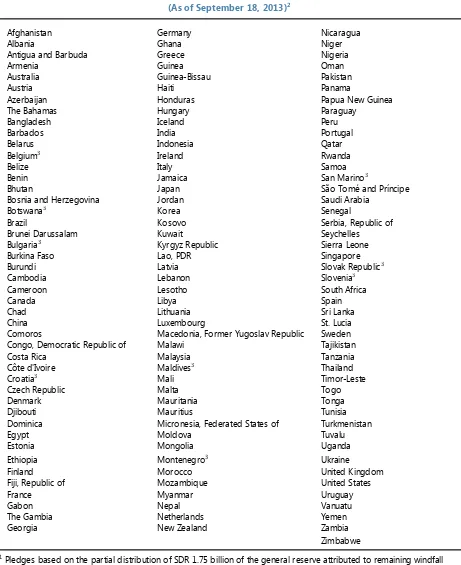
September 2012 on the distribution of amounts linked to the remaining windfall gold sales profits of SDR 1.75 billion, 136 members have so far pledged about 83.70 percent of the distribution or SDR 1.46 billion. This compares with the minimum threshold of
90 percent required to make the second distribution effective. Under the first partial distribution of SDR 0.7 billion that became effective in October 2012, a total of 141 members have so far pledged 91.27 percent of the distribution and 118 of these members have transferred a total of SDR 537 million to the PRGT.
There have been no additional bilateral loan and subsidy pledges to the PRGT since
the April 2013 update beyond pledges related to distribution of reserves. Since 2009
the PRGT has secured SDR 9.8 billion in loan resources and SDR 214 million in new bilateral subsidy resources. Loan resources are adequate against the current demand projections through 2015 but current loan agreements only allow for disbursements through end-December 2018.
Resources available in the HIPC and MDRI accounts are projected to be sufficient to finance debt relief for the remaining eligible countries, with the important
exceptions of the protracted arrears cases. Substantial additional resources will be
Approved By
Andrew TweediePrepared by the Finance Department (In consultation with the Legal and Strategy, Policy, and Review Departments)
CONTENTS
GLOSSARY _______________________________________________________________________________________ 5
INTRODUCTION _________________________________________________________________________________ 6
CONCESSIONAL FINANCING AND PRGT _______________________________________________________ 6
SOURCES OF FINANCING FOR THE PRGT ______________________________________________________ 8
A. Loan Resources ________________________________________________________________________________ 9
B. Subsidy Resources ____________________________________________________________________________ 11
C. Reserve Account ______________________________________________________________________________ 16
DEMAND FOR PRGT CONCESSIONAL LENDING ______________________________________________ 16
SUBSIDIZATION OF EMERGENCY ASSISTANCE _______________________________________________ 20
FINANCING OF DEBT RELIEF ___________________________________________________________________ 20
A. Remaining HIPCs _____________________________________________________________________________ 20
B. Pending Contributions to Liberia’s Debt Relief ________________________________________________ 21 C. Protracted Arrears Cases ______________________________________________________________________ 22
BOXES
1. PRGT Concessional Financing Framework ______________________________________________________ 7 2. Strategy to Make the PRGT Sustainable _______________________________________________________ 14
FIGURE
1. PRGT Commitments to LICs, 1988–2013 ______________________________________________________ 17
2. Disbursements to PRGT-Eligible Countries, 1988–2013 _______________________________________ 18
TABLES
1. New Commitments of Loan Resources to the PRGT ___________________________________________ 10 2. ESF Subsidy Contributions ____________________________________________________________________ 11
3. PRG-HIPC Trust—Pending Contributions _____________________________________________________ 12
8. Self-Sustainable PRGT Capacity Under Elevated Demand Scenarios ___________________________ 19 9. Financing of Debt Relief to the Remaining HIPCs _____________________________________________ 21 10. Pending Disbursements to Finance Debt Relief to Liberia as of end-June 2013 ______________ 21
APPENDIX TABLES
1. Summary of Bilateral Commitments to the PRGF-ESF and PRG-HIPC Trusts___________________ 23
2. PRGT—Borrowing Agreements________________________________________________________________ 26
3. PRGT—Subsidy Agreements __________________________________________________________________ 27
4. PRGT Reserve Account Coverage _____________________________________________________________ 28 5. Subsidy Contributions for Emergency Assistance _____________________________________________ 29 6. Implementation of the HIPC Initiative _________________________________________________________ 30 7. Debt Relief Following Implementation of the MDRI ___________________________________________ 31 8. Distribution of the General Reserve Associated to Gold Windfall Profits of SDR 700 Million __ 32
Glossary
ECF Extended Credit Facility EFF Extended Fund Facility
ENDA Emergency Natural Disaster Assistance EPCA Emergency Post-Conflict Assistance ESAF Enhanced Structural Adjustment Facility ESF Exogenous Shocks Facility
GLA General Loan Account GRA General Resources Account GSA General Subsidy Account
HIPC Heavily Indebted Poor Countries IMF International Monetary Fund LICs Low-Income Countries
MDRI Multilateral Debt Relief Initiative NPA Note Purchase Agreement
PCDR Post-Catastrophe Disaster Relief Trust PRGF Poverty Reduction and Growth Facility
PRG-HIPC Trust for Special Poverty Reduction and Growth Operations for the Heavily Indebted Poor Countries and Interim ECF Subsidy Operations
PRGT Poverty Reduction and Growth Trust RCF Rapid Credit Facility
SCA-1 First Special Contingent Account SCF Standby Credit Facility
INTRODUCTION
1. This paper reviews recent developments in financing of the Fund’s concessional
lending and debt relief. It reports the latest available data including the pledges made thus far in
response to the Managing Director’s fund-raising requests of August 2009 and February and November 2012 aimed at establishing a self-sustained PRGT. The PRGT’s potential self-sustained capacity is discussed in the context of longer-term projections of the demand for concessional lending.1
2. The paper is organized as follows. Section II provides an overview of the Fund’s
concessional lending instruments and the associated financing framework as well as the
developments since the April 2013 Update. Section III reviews the sources of financing for PRGT operations and discusses developments in the PRGT framework. Section IV reviews the use of PRGT resources and assesses the Trust’s estimated self-sustained capacity in light of the demand
projections. Section V provides updates on the subsidization of emergency assistance, while Section VI presents the developments on the financing of debt relief under the HIPC, MDRI, and PCDR Trusts. The paper concludes with a proposed decision completing the financing reviews of the PRG-HIPC and MDRI Trusts.2
CONCESSIONAL FINANCING AND PRGT
3. Fund facilities for concessional financing of LICs have been reviewed regularly to take
account of the changing needs of these countries. Lending facilities were reformed in 2009, and
additional amendments were adopted in April 2013 as part of the LIC facilities review. Since 2010, lending by the PRGT has been conducted under three facilities depending on the nature of the
country’s need and capacity: the Extended Credit Facility (ECF), the Standby Credit Facility (SCF), and the Rapid Credit Facility (RCF).
4. The concessional financing framework under the PRGT consists of three main types of
accounts: Reserve Account, Loan Account(s), and Subsidy Account(s). Resources in these
accounts ensure both the Trust’slending capacity and its financial strength (Box 1).
1A “self
-sustained” PRGT would rely solely on resources in the Trust to generate the required resources to subsidize commitments, while loan resources would continue to be provided by members. Amendments to the PRGT Instrument would be necessary to authorize the use of Reserve Account resources for subsidy purposes (see Box 1).
2
The decisions adopting both the PRG-HIPC Trust and MDRI Trust Instruments require that the Executive Board conducts semi-annual reviews of the financing of these Trusts (Decision No. 11436-(97/10),
February 4, 1997, as amended; and Decision No. 13588-(05/99) MDRI, adopted November 23, 2005, and
Box 1. PRGT Concessional Financing Framework
The operations of the PRGT are conducted through the Reserve Account (RA), four Loan Accounts, and four Subsidy Accounts. The balances accumulated in these accounts ensure the PRGT’s ability to provide concessional assistance, its lending capacity, and financial strength.
Loan Accounts contain resources borrowed at market interest rates from official creditors and on-lent on a pass-through basis to eligible low-income-countries (LICs). There are loan accounts dedicated to finance each PRGT facility: Rapid Credit Facility (RCF), Stand-by Credit Facility (SCF), and Extended Credit Facility (ECF) loan account in addition to the General Loan Account (GLA) that may finance any of the facilities. Subsidy Accounts (SAs) contain bilateral contributions from members and from the Fund’s own resources. The PRGT extends loans to eligible members at below-market-interest-rates but it acquires its loan
resources and pays back to its lenders a market-interest rate. The difference between these borrowing and lending rates is covered from resources held by the SAs. There are subsidy accounts dedicated to subsidize interest payments for each PRGT facility: RCF, SCF, and ECF in addition to the General Subsidy Account (GSA) that may subsidize any of the facilities. The dedicated subsidy accounts were established to allow the PRGT creditors and donors to earmark their contributions for use by specific facilities.
Reserve Account (RA) contains resources that would be called upon to meet the PRGT’s obligations vis-à-vis its creditors in the event of delayed payments by the PRGT borrowers. The account may also be used to meet the Fund’s cost of administering PRGT operations. The RA was primarily financed from the profits on gold sales by the IMF in 1970s. Under the self-sustaining PRGT, the income earned on the balances in the account will be used to subsidize PRGT lending. The necessary amendments to the PRGT Instrument to authorize the use of RA resources for subsidy purposes will be proposed for consideration in due course.
5. The LIC financing package, approved in July 2009 as part of the LIC reforms, has been
critical in supporting higher PRGT lending during the crisis.3During 2008–12, average annual
lending commitments were about SDR 1.4 billion, peaking in 2009 at SDR 2.5 billion with 18 new arrangements. Average commitments during this period were significantly higher than the average PRGT commitments of SDR 0.9 billion during 1988–2007.
3
Additional background information and details of the financing package were provided in Financing the Fund’s
Concessional Lending to Low-Income Countries—Further Considerations .
Reserve
1/ Transfers may be made from the General Subsidy Account for subsidizing ENDA/EPCA credit on an "as needed" basis. Concessional Financing Framework
6. In September 2012 the Executive Board approved a distribution of the Fund’s general reserves (SDR 1.75 billion) attributed to the remaining windfall gold sales profits as part of a
strategy to make the PRGT self-sustaining in the longer term.4 This strategy rests on three
pillars: (i) a base annual average lending capacity of SDR 1¼ billion; (ii) contingent measures which can be activated when average financing needs exceed the base envelope by a substantial margin for an extended period; and (iii) the expectation that all modifications to LIC facilities would be designed in a manner that is consistent with maintaining self-sustainability. This distribution will be effected only after members have provided satisfactory assurances that new amounts equivalent to at least 90 percent of the amount to be distributed will be transferred or otherwise provided to the PRGT (see Box 2).
7. In December 2012, taking account of the ongoing global economic crisis, the Executive
Board approved a two-year extension of the temporary interest waiver on PRGT loans
through end-2014.5 In view of the modest additional cost to the PRGT, the extension of
the temporary waiver was considered to be consistent with the three-pillar strategy to establish a self-sustaining PRGT, but it remains important for the integrity of the agreed financing framework that the interest rate mechanism be allowed to function as was originally envisaged, once conditions return to normal.6
8. The second stage of the review of facilities for low-income countries and the 2013
review of PRGT eligibility was discussed by the Executive Board in April 2013.7The adopted
modifications are expected to keep demand consistent with the available resources over the longer term, under a wide range of scenarios.
SOURCES OF FINANCING FOR THE PRGT
9. The 2009 LIC financing package, approved in July 2009 as part of the LIC reforms,
aimed to provide enhanced financial support to LICs which had been severely affected by the
global economic crisis. The financing package, which sought to increase the Fund’s concessional
lending capacity to SDR 11.3 billion for 2009–14, required the mobilization of new loan resources of SDR 10.8 billion (including a liquidity buffer of SDR 1.8 billion to enable a voluntary encashment regime) and new subsidy resources of SDR 1.5 billion (end-2008 NPV terms).8 Most of the additional
4
See Proposal to Distribute Remaining Windfall Gold Sales Profits and Strategy to Make the Poverty Reduction and Growth Trust Sustainable (9/17/12) and IMF Executive Board Approves the Distribution of Remaining Windfall Gold Sales Profits.
5
See PRGT Interest rate Mechanism – Extension of Temporary Interest Rate Waiver (12/14/12). 6
Absent the waiver, the applicable interest rate for 2013 and 2014 would have been zero percent for all ECF and RCF loans, and 0.25 percent for SCF loans.
7
See Review of Facilities for Low-Income Countries (3/15/13) and Eligibility to Use the Fund’s Facilities for Concessional Financing(3/15/13).
8
Under the encashment regime, the PRGT provides participating lenders/note purchasers with the right to request early repayment of outstanding claims in case of balance of payments need. Participating lenders/note purchasers agree that drawings under their borrowing arrangements with the PRGT could be made to fund early repayment of other participating lenders that face a balance of payments need. The Fund repays the
subsidies were to be financed from the Fund’s internal resources—including transfers from the PRGT Reserve Account, delaying until FY 2013 the resumption of reimbursement of the GRA for PRGT administrative costs, and use of resources linked to gold sales as a means to facilitate new subsidy resources. Bilateral subsidy contributions of SDR 200–400 million (end-2008 NPV terms) were also important to complete the financing package. The Managing Director approached a wide spectrum of the membership in 2009 to mobilize the required loan and subsidy resources, and staff continues to follow up on these requests.
10. The 2009–14 financing package is now largely complete. As of end-August 2013,
pledges for new subsidy resources exceeded the lower end of the targeted range of
SDR 0.2-0.4 billion. Commitments of SDR 1 billion are still required to meet the target for loan resources, although existing capacity is sufficient for projected needs through 2014 given that demand for new commitments from 2009–13 has been over SDR 3 billion below the level projected at the time of the 2009 reforms. Going forward, the current focus of fundraising has been on
establishing a self-sustained PRGT over the longer term after 2014. In this context, it is important for the PRGT to continue to receive new loan resources from the membership to support the Trust’s lending capacity beyond 2014.
A. Loan Resources
11. As of end-August 2013 new loan resources of SDR 9.8 billion have been provided by
fourteen members (Table 1). No new loan pledges or contributions have been made since the
April 2013 Update. Two-thirds of the secured resources (SDR 6.2 billion) have been made available to the General Loan Account (GLA), about 31 percent to the ECF Loan Account (SDR 2.9 billion), and the remainder (SDR 0.3 billion) to the SCF and RCF Loan Accounts.
12. Lenders to the PRGT have made use of all of the elements under the new framework
for mobilizing bilateral loan resources agreed in 2010.9 Loan resources have been provided
through both traditional Loan Agreements and Note Purchase Agreements (NPAs), and seven members have included in their borrowing agreements participation in the encashment regime of the PRGT.10 Five of the borrowing agreements also have shorter initial maturities than in the case of traditional loan agreements.11 Eight of the new borrowing agreements provide loans to the PRGT in SDRs; all these contributors also have in place voluntary SDR trading arrangements.12 requesting lender by drawing down resources committed to the PRGT by other participating lenders, by means of a liquidity buffer of 20 percent of outstanding loans from participating contributors.
9
See Decision No. 14593-(10/41), adopted April 21, 2010 10
Participants of the encashment regime are: China, France, Italy, Japan, Korea, Saudi Arabia, and the United Kingdom.
11
In all these cases, the Fund, at its sole discretion, can extend the maturities for additional periods up to the maturity dates for the corresponding loan disbursements under the facility of the PRGT.
12
Since the start of the sales of SDRs under these arrangements in June 2011 through
end-August 2013, drawings amounting to SDR 1,603 million have been made under the new SDR borrowing agreements, and sales of SDRs related to these drawings amounted to
SDR 1,078 million. The difference reflects the borrowing members’ acquisition of SDRs to replenish their SDR holdings. These sales were conducted through the voluntary SDR trading arrangements.
13. Uncommitted PRGT loan resources amounted to SDR 6.8 billion at end-June 2013. The
bulk of these resources were in the GLA, amounting to SDR 6.1 billion. Resources available in the Special Loan Account (SLA) for the ECF amounted to SDR 0.8 billion, while resources in the SLA for the SCF and RCF have been fully committed and about SDR 0.1 million will have to be drawn from the GLA.13,14
13
The PRGT Instrument provides that resources of the SLAs will be drawn first for disbursements under the respective facilities, and resources in the GLA will be used for a facility only when resources in the relevant SLA are exhausted. In addition, staff will manage disbursements under borrowing agreements of contributors participating in the encashment regime in a manner that preserves a sufficient liquidity buffer for the encashment regime to be operational.
14
The SLA for the RCF was fully depleted in April 2012; balances in the SLA for SCF stood at SDR 66 million at end-June 2013, significantly below existing SCF commitments.
Effective Date Media Type Account Encashment Shorter Maturity
Belgium 350 11/12/2012 EUR Loan ECF No No
Canada 500 3/5/2010 USD Loan GLA No No
China 800 9/3/2010 SDR NPA ECF Yes Yes
Denmark 200 1/28/2010 USD Loan GLA No No
France 1,328 9/3/2010 SDR Loan ECF Yes Yes
Italy 800 4/18/2011 SDR Loan ECF Yes No
Japan 1,800 9/3/2010 SDR NPA GLA Yes Yes
Korea 500 1/7/2011 SDR Loan GLA Yes No
Netherlands 500 7/27/2010 EUR Loan GLA No No
Norway 300 6/25/2010 USD Loan SCF, RCF No No
Saudi Arabia 500 5/13/2011 SDR Loan GLA Yes Yes
Spain 405 12/17/2009 SDR Loan GLA No No
Switzerland 500 4/21/2011 EUR Loan GLA No No
United Kingdom 1,328 9/3/2010 SDR NPA GLA Yes Yes
Total 9,811
Table 1. New Commitments of Loan Resources to the PRGT 1/ (In millions of SDRs; as of August 31, 2013)
Amount
14. Loan resources are expected to be sufficient to meet projected PRGT commitments through 2015 providing for the disbursement of new loans through end-December 2018.
However, for new commitments with scheduled disbursements extending past end-2018, existing agreements will need to be updated.15 PRGT lenders will be approached during the next year with a view to amending current agreements to allow new disbursements beyond 2018, as well as
potentially increasing lending capacity under these agreements and seeking new agreements with additional lenders, including reaching out to non-traditional lenders.
B. Subsidy Resources
15. Total balances in the PRGT Subsidy Accounts at end-June 2013 amounted to
SDR 1.9 billion. Additionally, SDR 0.2 billion is assumed to be available from PRG-HIPC Trust.16
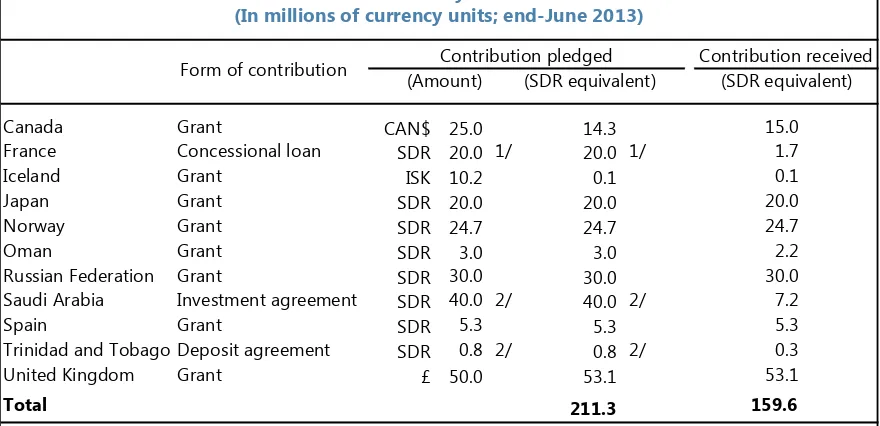
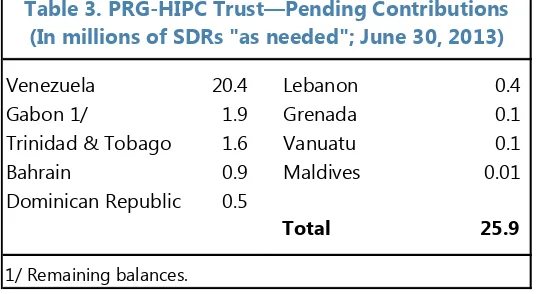
Subsidy resources from earlier fund-raising efforts amount to SDR 1.3 billion. This amount includes all contributions pledged during the 2005 ESF fund-raising exercise, including those that are still expected to be received (Table 2). However, it excludes SDR 25.9 million pledged during earlier fundraising that donors have not yet provided (Table 3).
15The PRGT Instrument states “The drawdown period under borrowing agreements to the Loan Accounts of the Trust entered into or amended after September 19, 2001, shall normally extend through
December 31, 2018. The drawdown period may be extended by mutual agreement between the Trustee and the creditor. The Managing Director is authorized to conclude such agreements on behalf of the Trustee.” Instrument to Establish the Poverty Reduction and Growth Trust, paragraph 3, Commitments, in: Selected Decisions and Selected Documents of the IMF, December 31, 2011, Washington DC, p. 210.
16
The PRG-HIPC Trust was established in 1997 with a dual purpose: (i) to provide assistance to LICs by making grants and/or loans for purposes of reducing their external debt burden to sustainable levels, and (b) to subsidize the interest rate on interim ECF operations to PRGT-eligible members. As of end-June 2013, the PRG-HIPC Trust balance was SDR 0.24 billion.
(SDR equivalent)
Canada Grant CAN$ 25.0 14.3 15.0
France Concessional loan SDR 20.0 1/ 20.0 1/ 1.7
Iceland Grant ISK 10.2 0.1 0.1
Japan Grant SDR 20.0 20.0 20.0
Norway Grant SDR 24.7 24.7 24.7
Oman Grant SDR 3.0 3.0 2.2
Russian Federation Grant SDR 30.0 30.0 30.0 Saudi Arabia Investment agreement SDR 40.0 2/ 40.0 2/ 7.2
Spain Grant SDR 5.3 5.3 5.3
Trinidad and Tobago Deposit agreement SDR 0.8 2/ 0.8 2/ 0.3
United Kingdom Grant £ 50.0 53.1 53.1
Total 211.3 159.6
1/ To be generated from the concessional loan as an implicit subsidy.
2/ Reflecting net investment income (in end-2005 NPV terms) to be generated from deposit/investment agreements.
Table 2. ESF Subsidy Contributions (In millions of currency units; end-June 2013)
Contribution received (Amount)
Contribution pledged
16. Pledges of bilateral subsidy resources under the 2009 LIC financing package for the
PRGT stand slightly above the lower end of the target range of SDR 0.2–0.4 billion (end-2008
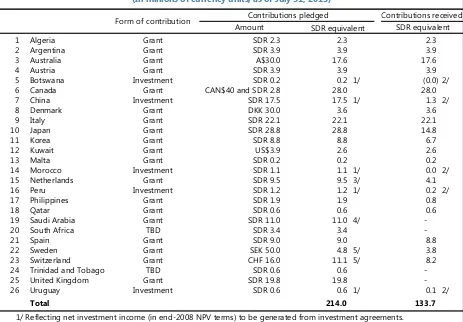
NPV terms). As of end-July 2013, a total of twenty-six members have committed SDR 214 million in
additional subsidies. Staff continues to seek additional bilateral subsidy resources which will help make the self-sustained PRGT more robust over a wide range of demand scenarios. Of the amounts pledged, SDR 133.7 million has so far been received (Table 4).
17. An important element of the 2009 LIC financing package linked to use of windfall gold
sales profits has been achieved, augmenting the PRGT’s total subsidy resources. Thepartial distribution of SDR 0.7 billion of the Fund’s general reserves attributed to the windfall gold sales profits became effective in October 2012. To date, a total of 141 members have pledged
91.27 percent of the distribution. As of September 18, 2013, 118 members have made contributions or transferred their share of the distribution to the PRGT’s subsidy accounts, totaling
SDR 537 million. This amounts to 84.07 percent of the pledges and 76.73 percent of the
SDR 0.7 billion distribution. Additional contributions linked to this distribution are still expected from members (Appendix Table 8).
18. A key goal remains to make the PRGT sustainable over the medium and longer term.
A central element of this strategy was the Executive Board decision of September 2012 to distribute amounts in the general reserve attributable to the remaining windfall gold sales profits of
SDR 1.75 billion with to the aim of ensuring the longer-term sustainability of the PRGT (see Box 2). Once the ongoing resource mobilization exercises are completed successfully, the PRGT will have sufficient capacity to accommodate annual lending of about SDR 1 ¼ billion on average on an ongoing basis. This capacity would be based on the resources and pledges received under the 2009 financing package as well as the new pledges for PRGT subsidy resources of at least
SDR 1.575 billion (90 percent of the distribution) resulting from the distribution of resources linked to the remaining windfall gold sales profits.
Venezuela 20.4 Lebanon 0.4 Gabon 1/ 1.9 Grenada 0.1 Trinidad & Tobago 1.6 Vanuatu 0.1
Bahrain 0.9 Maldives 0.01
Dominican Republic 0.5
Total 25.9
1/ Remaining balances.
19. Further pledges are needed to make the second distribution of reserves linked to the
remaining windfall gold sales profits effective. As of September 18, 2013, 136 countries
representing 83.70 percent of the distribution have pledged to transfer or otherwise contribute their share of the distribution to PRGT subsidies (Table 5). Once the necessary pledges have been
received, and the distribution effected, these resources would increase the self-sustained capacity of the PRGT from about SDR 0.93 billion to about SDR 1.30 billion annually from 2014 onwards.
Members that have not yet pledged their contribution are urged to do so expeditiously. 1 Algeria Grant SDR 2.3 2.3 2.3 2 Argentina Grant SDR 3.9 3.9 3.9 3 Australia Grant A$30.0 17.6 17.6 4 Austria Grant SDR 3.9 3.9 3.9 5 Botswana Investment SDR 0.2 0.2 1/ (0.0)2/ 6 Canada Grant CAN$40 and SDR 2.8 28.0 28.0 7 China Investment SDR 17.5 17.5 1/ 1.3 2/ 8 Denmark Grant DKK 30.0 3.6 3.6
9 Italy Grant SDR 22.1 22.1 22.1
10 Japan Grant SDR 28.8 28.8 14.8 11 Korea Grant SDR 8.8 8.8 6.7 12 Kuwait Grant US$3.9 2.6 2.6 13 Malta Grant SDR 0.2 0.2 0.2 14 Morocco Investment SDR 1.1 1.1 1/ 0.0 2/ 15 Netherlands Grant SDR 9.5 9.5 3/ 4.1 16 Peru Investment SDR 1.2 1.2 1/ 0.2 2/ 17 Philippines Grant SDR 1.9 1.9 0.8 18 Qatar Grant SDR 0.6 0.6 0.6 19 Saudi Arabia Grant SDR 11.0 11.0 4/ -20 South Africa TBD SDR 3.4 3.4 -21 Spain Grant SDR 9.0 9.0 8.8 22 Sweden Grant SEK 50.0 4.8 5/ 3.8 23 Switzerland Grant CHF 16.0 11.1 5/ 8.2 24 Trinidad and Tobago TBD SDR 0.6 0.6 -25 United Kingdom Grant SDR 19.8 19.8 -26 Uruguay Investment SDR 0.6 0.6 1/ 0.1 2/
Total 214.0 133.7
Amount SDR equivalent SDR equivalent
5/ Calculated using the exchange rates as of July 31, 2013.
4/ A pledge of SDR 16,709,643 is to be received following expiry of existing investment agreement with the PRGT on 12/31/2021; estimated as SDR 11 million in end 2008 NPV terms at the time when the pledge was made.
3/ Initial pledge of SDR 9.5 million has been changed to SDR 10.33 million to be paid in 8 tranches by January 2018. 1/ Reflecting net investment income (in end-2008 NPV terms) to be generated from investment agreements. 2/ Reflecting end-June 2013 net income earned on the investment (in end-2008 NPV terms).
Contributions pledged Contributions received Form of contribution
Box 2. Strategy to Make the PRGT Sustainable
The three-pillar strategy to ensure the PRGT has the resources to meet projected demand for IMF concessional lending over longer term, set out in Proposal to Distribute Remaining Windfall Gold Sales Profits and Strategy to Make the Poverty Reduction and Growth Trust Sustainable
(September 17, 2012), is as follows:
A base envelope of about SDR 1¼ billion in annual lending capacity, which is expected to
cover concessional lending needs over normal periods. While financing commitments can vary substantially from year-to-year, the self-sustaining PRGT can build up capacity in years with low levels of new lending commitments and draw down capacity in years with higher demand. This implies that the base envelope could cover periods where demand in individual years could be much higher as long as fluctuations average out over a number of years.
Contingent measures that can be put in place when average financing needs exceed the
base envelope by a substantial margin for an extended period. If the Board considers that the self-sustaining capacity would decline substantially below SDR 1¼ billion, it could decide to activate a range of contingent measures including (i) reaching additional understandings on bilateral fund-raising efforts to be supported by a broad range of the membership; (ii) the suspension for a limited period of the reimbursement of the GRA for PRGT administrative expenses; and (iii) modifications of access, blending, and interest rate and eligibility policies to reduce the need for subsidy resources.
A principle of self-sustainability under which future modifications to LIC facilities would be expected to ensure that the demand for IMF concessional lending can be met with the resources available under the first and second pillars under a plausible range of scenarios. It was noted, in particular, that the review of PRGT eligibility and the second stage of the review of facilities—completed in April 2013—should ensure that all modifications, taken together, would, over the longer term, keep demand consistent with available resources.
Afghanistan Germany Nicaragua
1 Pledges based on the partial distribution of SDR 1.75 billion of the general reserve attributed to remaining windfall
profits from the recent gold sales. Pledges may be subject to domestic processes to enable members to make PRGT subsidy contributions.
Table 5. PRGT Subsidy Pledges Based on the Partial Distribution of the General Reserve Associated to Remaining Gold Windfall Profits1
2 Responses were initially requested by January 31, 2013; follow-up letters were sent on June 25, 2013, requesting
C. Reserve Account
20. The PRGT Reserve Account continues to provide adequate security to PRGT lenders
and note purchasers. The Account was originally financed by reflows of Trust Fund and Structural
Adjustment Facility repayments, as well as investment returns on balances held in the Account. The PRGT can tap these resources temporarily to meet its obligations in the event of a delayed payment by a borrower to any loan account of the Trust. The balance in the Reserve Account amounted to SDR 3.9 billion at end-June 2013, representing a substantial multiple of the projected PRGT
repayments falling due over the next twelve months and about 67 percent of total PRGT obligations (Appendix Table 4). It is expected that the Reserve Account will continue to provide a loan coverage ratio of about 40 percent in the medium term, in line with the historical average.
DEMAND FOR PRGT CONCESSIONAL LENDING
21. From January 2010 through end-2012, total commitments under the ECF, including
augmentations, amounted to SDR 3.31 billion, while commitments under the SCF and RCF
amounted to SDR 0.36 billion and SDR 0.23 million, respectively.17 Average commitments
during 1988–2012 were about SDR 1.0 billion annually. With the onset of the global crisis, the amount and number of new PRGT commitments reached their highest level in 2009 with 18 new arrangements totaling SDR 2.5 billion.
22. Demand for PRGT resources has been unusually low in the first eight months of 2013
but this decline is expected to be temporary and demand is expected to rebound in 2014.
Commitments under new PRGT arrangements were less than SDR 0.1 billion in the first eight months of 2013 (Table 6), as the completion of program negotiations has been delayed on a number of potentially large arrangements. As a result total new PRGT commitments in 2013 are unlikely to exceed SDR 0.3 billion, well below the SDR 1.5 billion committed in 2012 or SDR 1.2 billion
committed in 2011 (Figure 1). However, PRGT demand, including under large arrangements initially expected in 2013, is projected to rebound in 2014 to about SDR 1.3 billion, compared with average annual commitments of SDR 1.4 billion during 2008–12.18 This level of commitments would be
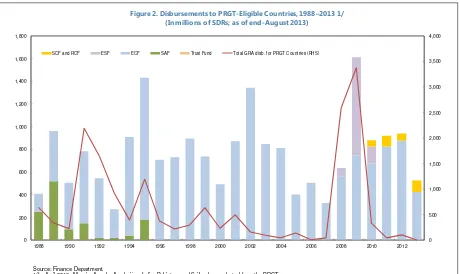
consistent with the PRGT’s average annual self-sustained capacity when the second distribution of reserves attributable to windfall gold sales profits has been effected. Disbursements in the first eight months of 2013 amounted to about SDR 0.5 billion (Figure 2) broadly in line with the levels
observed during 2010-12.
17
In view of the closure of the Exogenous Shocks Facility (ESF) Subsidy Account in May 2010 after resources in that account were depleted, resources in the ECF Subsidy Account are available to meet the subsidy
requirements of outstanding ESF loans. See IMF Reforms Financial Facilities for Low-Income Countries (the Framework became effective on January 7, 2010); and A New Architecture of Facilities for Low-Income Countries (6/26/09).
18
6 5
3 5 5
7 12
6 14
7 11
9 11
13
10 10
7 8
10
4
18
13
16
10 14
3
(500) 0 500 1,000 1,500 2,000 2,500 3,000
1988 1990 1992 1994 1996 1998 2000 2002 2004 2006 2008 2010 2012
Figure 1. PRGT Commitments to LICs, 1988–2013 (In millions of SDRs; as of end-August 2013)
ECF commitments Augmentations/Reductions ESF commitments RCF and SCF commitments Number of new arrangements
Country Board
Approval
RCF disbursements 27.8
Mali 02/05/13 12.0
Samoa 5/24/2013 5.8
Mali 6/18/2013 10.0
Total 27.8
Table 6. New PRGT Commitments to LICs in 2013
(In millions of SDRs; as of end-August 2013)
23. Updated staff projections indicate that longer-term demand for the Fund’s
concessional lending could be about SDR 1.1–1.7 billion annually up to 2036 (Table 7). This is
unchanged from the last Update and consistent with expectations following adoption of a moderate expansion of blending rules, graduation of two members, and entry of new PRGT-eligible members as approved in March 2013 in respectively Review of Facilities for Low-Income Countries and
Eligibility to Use the Fund’s Facilities for Concessional Financing . In the context of the recently approved framework for concessional lending on a self-sustained basis, this level of demand
compares to the PRGT’s basic annual capacity to support concessional lending of about SDR 1¼ billion.
0 500 1,000 1,500 2,000 2,500 3,000 3,500 4,000
0 200 400 600 800 1,000 1,200 1,400 1,600 1,800
1988 1990 1992 1994 1996 1998 2000 2002 2004 2006 2008 2010 2012
SCF and RCF ESF ECF SAF Trust Fund Total GRA disb. for PRGT Countries (RHS)
Source: Finance Department.
1/ In April 2010, Albania, Angola, Azerbaijan, India, Pakistan, and Sri Lanka graduated from the PRGT.
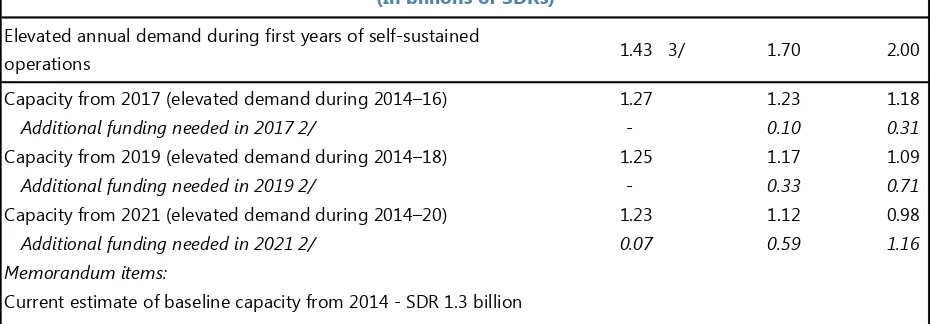
24. The framework for self-sustained lending under the PRGT is robust under a number of
demand scenarios. Lower commitments in 2013 have only a modest impact on the self-sustained
capacity from 2014. The framework can accommodate demand at a higher level than the estimated self-sustained long-term capacity for a period of time as indicated below (Table 8). However, estimates of self-sustained capacity would be significantly affected if demand were to remain elevated for extended periods, or exceeded the estimated self-sustained lending capacity by significant margins. Under these circumstances, new subsidy resources or other contingent
measures considered consistent with the three-pillar strategy would have to be sought to bring the Trust back to a self-sustained lending capacity of SDR 1¼ billion.
2014–24 2014–36
2/ All the demand projections take into account that Armenia and Georgia graduate from PRGT eligibility.
3/ Based on 50 percent reduction in access norms and limits (in percent of quota) when the quota increase under the Fourteenth General Review of Quotas goes into effect in 2013, followed by increases in access in nominal SDR terms of 24.2 percent at three-year intervals, starting in 2016. The update to the baseline also reflects other methodological refinements, such as (i) applying the vulnerability criterion to the graduation and blending assumptions; and (ii) aligning the graduation assumptions with the two-year PRGT-eligibility review cycle.
4/ Includes entry into PRGT-eligibility of Marshall Islands, Micronesia, and Tuvalu.
5/ For PRGT-eligible countries that are presumed to blend, half of access to Fund resources is from the PRGT.
Table. 7 Projected Demand for PRGT Resources (In billions of SDRs)
1/ The low-case scenario assumes that about 30 percent of PRGT-eligible countries would resort to Fund financing in any given year, while the high-case scenario assumes that some 50 percent of LICs request some form of Fund financial support in any given year.
Capacity from 2017 (elevated demand during 2014–16) 1.27 1.23 1.18
Current estimate of baseline capacity from 2014 - SDR 1.3 billion
3/ SDR 1.43 billion reflects average commitments during 2008–12.
3/
1/ Tested for elevated demand during first years of PRGT self-sustainable operations (3,5,7 years) with resulting annual capacity following thereafter.
2/ Amount of additional subsidies needed after the time of elevated demand (for 3,5,7 years) to return to SDR 1.25 billion annual capacity.
Table 8. Self-Sustainable PRGT Capacity Under Elevated Demand Scenarios 1/ (In billions of SDRs)
Elevated annual demand during first years of self-sustained
SUBSIDIZATION OF EMERGENCY ASSISTANCE
25. The EPCA/ENDA Administered Subsidy Account is in the process of being terminated.
The EPCA/ENDA Administered Subsidy Account was maintained on an interim basis for the
subsidization of EPCA/ENDA credits outstanding on January 7, 2010. Since there are no longer any outstanding EPCA or ENDA credits to PRGT-eligible countries, the account will shortly be
terminated. Contributors are being encouraged to transfer their share in the remaining balance to the Rapid Credit Facility (RCF) Subsidy Account, or any of the other PRGT subsidy accounts. At end-August 2013 the remaining resources in the account amounted to SDR 10.6 million (Appendix Table 5).
FINANCING OF DEBT RELIEF
26. As of end-June 2013, the Fund had provided a total of SDR 5.2 billion of debt relief to
eligible countries. This includes HIPC debt relief of SDR 2.6 billion to 36 countries, MDRI debt relief
of SDR 2.3 billion to 30 countries, “beyond-HIPC” debt relief to Liberia, and PCDR debt relief to Haiti (Appendix Tables 6 and 7). There remains one decision point country (Chad), which at
end-June 2013 had received HIPC interim assistance of about SDR 9 million from the Fund. No debt relief has been provided through the PCDR Trust since the last update, and the balance in the PCDR Trust was SDR 0.1 billion at end-June 2013.
A. Remaining HIPCs
27. The Fund’s cost of debt relief for the remaining HIPCs (excluding the protracted
arrears cases) is estimated at SDR 0.01 billion (end-June 2013 NPV terms, Table 9).19 This
estimate excludes the arrears cases and is based on assumptions regarding the timing of HIPC completion point and the future path of interest rates, all of which are subject to uncertainty. Moreover, the estimate does not take into account potential needs for topping-up assistance.
28. Available resources in the PRG-HIPC and MDRI Trusts are estimated to be sufficient to
cover debt relief for the remaining eligible countries (excluding the protracted arrears cases).
Since the HIPC sub-account of the PRG-HIPC Trust is depleted, resources of about SDR 0.01 billion from the PRG-HIPC sub-account are expected to be used to cover the projected HIPC needs. The PRG-HIPC sub-account resources amount to SDR 0.2 billion at end-June 2013. The two MDRI Trusts now have resources totaling about SDR 0.05 billion (Table 9).
19
B.
Pending Contributions to Liberia’s Debt Relief
29. Following Liberia’s reaching the HIPC completion point, there remain a number of
countries that have yet to finalize their pledged contributions to the Fund’s debt relief for
Liberia. Since the last update, no further contributions have been received from the remaining
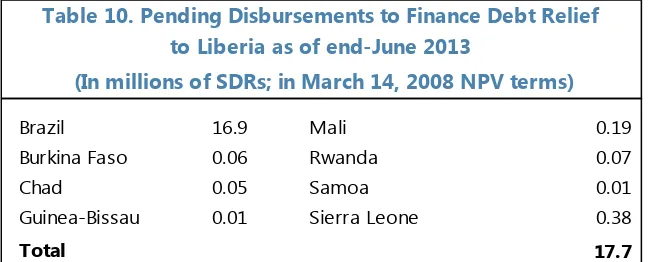
countries who had pledged to contribute. Pledged contributions totaling SDR 17.7 million
(March 2008 NPV terms) from eight members are yet to be received (Table 10). It remains important that these contributions be disbursed as soon as possible to replenish the PRG-HIPC Trust.
Resources available in 0.24 HIPC sub-account 1/
-PRG-HIPC sub-account 1/ 0.19 MDRI-I Trust 0.01 MDRI-II Trust 0.04
Financing needed from 0.01 HIPC and PRG-HIPC sub-accounts 1/ 0.01 MDRI-I Trust MDRI-II Trust
-Remaining balance 0.24 HIPC sub-account
-PRG-HIPC sub-account 0.18 MDRI-I Trust 0.01 MDRI-II Trust 0.04
Memorandum items:
Resources in the PCDR Trust 0.10
1/ Since the HIPC sub-account is depleted, resources of SDR 0.01 billion are expected to be drawn from the PRG-HIPC sub-account to meet the estimated cost of the remaining HIPCs.
Table 9. Financing of Debt Relief to the Remaining HIPCs (In billions of SDRs; end-June 2013 NPV terms)
Brazil 16.9 Mali 0.19 Burkina Faso 0.06 Rwanda 0.07 Chad 0.05 Samoa 0.01 Guinea-Bissau 0.01 Sierra Leone 0.38
Total 17.7
Table 10. Pending Disbursements to Finance Debt Relief to Liberia as of end-June 2013
30. The SCA-1/Deferred Charges Administered Account holds a balance from one member
(Brazil). The Executive Board approved a decision to delay the termination date of the account to
March 13, 2014, to allow completion of the procedures that would enable the disbursement of the
pledged contribution for financing Liberia’s debt relief.20
It is expected that this amount would by that time be transferred to the PRG-HIPC Trust, which financed the shortfall in members’
contributions relative to their commitments for the financing of Liberia’s debt relief.
C. Protracted Arrears Cases
31. Providing debt relief to Somalia and Sudan would require substantial additional
resources. At end-August 2013, the total amount of overdue financial obligations of these two
countries to the IMF amounted to SDR 1.2 billion.21 As the cost to the Fund for providing debt relief to these countries was not included in the original costing estimates for the HIPC Initiative,
additional financing would need to be secured when these members are ready to clear their arrears and embark on the HIPC Initiative and possible “beyond-HIPC” debt relief. 22,23,24 The approach
developed for Liberia’s debt relief, including the financing modalities, could provide a useful framework for Somalia and Sudan at the appropriate time. Zimbabwe is currently neither
PRGT-eligible nor included in the list of “ring-fenced” countries that could benefit from the HIPC Initiative.
20
This account, which became effective on March 14, 2008, was an interim vehicle to temporarily hold the refunds of the distribution of a portion of the SCA-1 balances and the deferred charges adjustment in the context of the Fund’s debt relief for Liberia, pending instructions from members as to the disposition of the resources.
21
Following the secession of South Sudan from Sudan on July 9, 2011, all the overdue obligations to the Fund remain a liability of Sudan, which is the continuing state.
22
In the context of the MDRI in 2005, the G-8 committed that donors would provide the resources required for full debt relief at the completion point for the three protracted arrears cases (Liberia, Somalia, and Sudan). 23
Neither Somalia, nor Sudan, is eligible for debt relief under the MDRI, as there would be no MDRI-eligible debt following the clearance of their arrears. It is possible, however, that they could be considered for “beyond HIPC” debt relief, as was done in the case of Liberia.
24
TOTAL 2,185.9 1,120.0 3,305.9 26,191.2 1,562.3 25.9
Other developing countries 104.2 44.8 148.9 1,155.6 224.7 2.7 Appendix Table 1 (continued). Summary of Bilateral Commitments to the PRGF-ESF and PRG-HIPC Trusts
Countries in transition 11.8 -- 11.8 -- 42.9
--Croatia -- -- -- -- 0.4
--Czech Republic 11.8 -- 11.8 -- 4.1
--Estonia -- -- -- -- 0.5
--Hungary -- -- -- -- 6.0
--Latvia -- -- -- -- 1.0
--Poland -- -- -- -- 12.0
--Russian Federation -- -- -- -- 14.6
--Slovak Republic -- -- -- -- 4.0
--Slovenia -- -- -- -- 0.4
--Memorandum Item:
OPEC Fund for International -- -- -- 37.0 --
Development
* Less than SDR 5,000.
2/ Estimated values of total contributions include forthcoming contributions that are not yet received. The term "as needed" refers to the nominal sum of concessional assistance taking into account the profile of subsidy needs associated with PRGF lending and the provision of HIPC assistance, respectively.
Appendix Table 1 (concluded). Summary of Bilateral Commitments to the PRGF-ESF and PRG-HIPC Trusts
1/ These are contributions originally pledged for the PRGF-ESF Trust which are now available for the PRGT. Excludes the G-8 commitment of SDR 100 million in end-2005 NPV terms, new ESF subsidy contributions, and any subsidy contribution made in the context of the LIC reform of 2009.
4/ Including a borrowing agreement in support of the establishment of the ESF.
PRGF-ESF Trust 1/ PRG-HIPC Trust
Subsidy contributions "as needed" 2/ Subsidies and HIPC grant contributions
"as needed" 2/
3/ Including new borrowing agreement in support of 2009 reform of LIC facilities.
(In millions of SDRs; as of end-June, 2013)
For subsidization
For MDRI debt relief
Of which: Pending "as needed" 2/ Loan
Amount In percent of 2/ Committed to the General Loan Account of the PRGT. 3/ Committed to the ECF Loan Account of the PRGT.
4/ Before April 17, 1998, known as Caisse Française de Développement.
5/ The loan commitment, which became effective on August 20, 2009, was made in the context of establishment of the ESF. 6/ In late 1999, the Bank of Italy replaced the Ufficio Italiano dei Cambi as lender to the PRGF Trust.
7/ On October 1, 1999, the Export-Import Bank of Japan merged with the Overseas Economic Cooperation Fund and became the Japan Bank for International Cooperation. 8/ Committed to the SCF Loan Account and RCF Loan Account of the PRGT in equal proportion.
9/ The loan commitment is for the SDR equivalent of US$50 million.
10/ The original loan commitment of the Bank of Spain was SDR 220 million; however, only SDR 216.4 million was drawn and disbursed by the expiration date for drawings. 11/ The full loan commitment of SDR 200 million was drawn in January 1989; this amount was fully disbursed to borrowers by March 1994.
12/ On August 26, 1998, the SFD indicated that it did not intend to make further loans in association with the PRGF. Appendix Table 2. PRGT—Borrowing Agreements
Interest
People's Bank of China Aug. 23, 2011 General Subsidy Account
Banco Central de Reserva del Peru 7/ Jan. 29, 2010 General Subsidy Account
Government of Spain 9/ Feb. 8, 1995 General Subsidy Account Banco Central del Uruguay Mar. 11, 2010 General Subsidy
Account
1/ Subsidy contributions to the PRG Trust result from the difference between the investment income on contributions and the below market rate of interest paid to contributors.
2/ As a result of renaming of the PRG Trust and its subsidy accounts in January 2010, the name of subsidy account shown represents the current name of the account for deposits/investments that have not yet expired, and the old name of the account for deposits/investments that have been repaid.
3/ Equivalent of US$10 million (at the exchange rate of June 29, 1994).
4/ The Fund made early repayments to Botswana, Malaysia, and Singapore on March 1, 2004.
5/ Interest rate paid was equivalent to the return on investment by the Fund on this deposit (net of any costs), less 2.0 percent per annum. If the interest rate obtained was less than 2.0 per annum, the deposit bore zero interest. The investment was extended in 2004 for another 10 years to benefit HIPC Trust. 6/ All the deposits were repaid together at the end of sixteen years after the date of the first deposit.
7/ Interest rate paid is 0.1 percent per annum until a subsidy contribution of SDR 1.2 million (end-2008 NPV) is reached. No interest will be paid if net investment earnings are lower than 0.1 percent per annum.
8/ Including (i) a new investment of SDR 38.2 million; and (ii) a rollover of two investments of SDR 49.8 million and SDR 27.9 million and of the deposit of SDR 16.7 million from the PRG-HIPC Trust upon their maturities in 2011, 2011–14, and 2018, respectively.
9/ The investment coincides with the repayment of each of the first nine (out of ten) semiannual instalments of a drawing of the PRGT loan of SDR 67 million from the Government of Spain (the Instituto de Crédito Oficial). The agreement expired in November 2012.
10/ Equivalent of US$5 million (at the exchange rate of May 11, 1994).
1988 169 103 164.1
1989 272 510 53.3
1990 395 795 49.7
1991 513 1,320 38.9
1992 630 1,786 35.3
1993 793 2,005 39.6
1994 1,009 2,786 36.2
1995 1,336 3,919 34.1
1996 1,716 4,446 38.6
1997 2,093 4,892 42.8
1998 2,345 5,421 43.3
1999 2,548 5,820 43.8
2000 2,714 5,773 47.0
2001 2,917 5,971 48.9
2002 3,079 6,636 46.4
2003 3,115 6,703 46.5
2004 3,174 6,632 47.9
2005 3,285 6,185 53.1
2006 3,392 3,656 1/ 92.8
2007 3,557 3,673 96.8
2008 3,818 3,895 98.0
2009 3,926 4,965 79.1
2010 3,967 5,068 78.3
2011 3,981 5,092 78.2
2012 3,962 5,581 71.0
Jun-13 3,909 5,873 66.5
Memorandum item:
PRGT repayments: July 2013–June 2014 371
Appendix Table 4. PRGT Reserve Account Coverage (In millions of SDRs; end-period)
(A) (B) (A)/(B)
Reserve coverage ratio (In percent)
1/ The decline in total PRGT credit outstanding by about 40 percent from 2005 reflects early repayments arising from the delivery of HIPC and MDRI debt relief.
Outstanding PRGT credit Reserve Account
Luxembourg 4/ Feb. 2005/Nov. 2008 Euro 1.75 1.6 1.6 0.3 Netherlands 5/ Mar. 2002/Mar. 2005 US$ 4.0 2.9 2.9 1.2
Norway Feb. 2005 NKr 10.0 1.1 1.1 0.5
Sweden Feb. 2005 US$ 10.0 6.6 6.6 2.9
United Kingdom Feb. 2005 £ 1.0 1.2 1.2 0.5
Sub Total 15.1 15.1 6.1
Total 40.9 40.9 10.6
5/ Contribution of March 2002 was previously earmarked for EPCA.
1/ The SDR equivalent is the actual SDR amount received using the exchange rate on the value date. 2/ Contribution generated from investment income on a deposit agreement for SDR 7 million from 2006–10. 3/ To subsidize the rate of charge on purchases by Sri Lanka and Maldives under ENDA following the 2004 Tsunami. 4/ Contribution of February 2005 was previously earmarked for ENDA.
Completion point countries (35) 2,406 2,578
1/ Includes the commitment made in NPV terms plus interest earned on that commitment. 2/ At the time of its decision point, Afghanistan did not have any outstanding eligible debt. 3/ Includes commitment under the original HIPC Initiative.
Pre-decision point countries (1)
Protracted arrears cases (2)
HIPC countries (28) 3/ 2,863 670 2,192 1,104 1,088
Memorandum item (1) Total Financed by LLA Remaining debt Financed by LLA 31 Liberia 5/ Jun-10 543 427 116 116
-Total 6/ 3,532 1,097 2,434 1,347 1,088
2/ Balances available at the time of MDRI debt relief.
4/ Non-HIPCs but qualified for MDRI debt relief with a per capita income below the US$380 threshold.
6/ Including Liberia's beyond HIPC debt-relief.
5/ Liberia received "MDRI-like" (beyond-HIPC) debt relief at end-June 2010, which was financed from the Liberia Administered Account. Its eligible credit outstanding corresponds to the amount of arrears clearance to the IMF in March 2008.
Appendix Table 7. Debt Relief Following Implementation of the MDRI (In millions of SDRs; end-June 2013)
1/ Amount outstanding at the completion point (net of repayments between January 1, 2005 to the completion point date).
(A) (B)
3/ Afghanistan, Comoros, Haiti, and Togo did not have MDRI-eligible credit and did not receive MDRI debt relief. Côte d'Ivoire and Guinea had fully repaid MDRI-eligible debt by completion point date.
27 Congo, Democratic Republic of the 1.57 0.22 1.57 10/23/2012
28 Costa Rica 0.48 0.07 - Pending
74 Macedonia, Former Yugoslav Republic of 0.20 0.03 0.20 10/23/2012
75 Malawi4 0.18 0.03 0.18 10/23/2012
1 Quota as of October 12, 2012. The precise amount distributed to members was based on the quota shares in effect on the day the distribution was effected. Payments also
include interest earned in Interim Administered Account on originally pledged amount, where applicable.
3 Member's actual contribution differs from initial pledge on account of foreign exchange rates on value date of payment.
2 Assurances for new subsidy contributions of at least SDR 630 million were required before the distribution was effected. The distribution became effective on October 12, 2012
and was implemented on October 23, 2012.
4 Botswana, Bulgaria, Burundi, Malawi, Maldives, and Slovak Republic pledged 90 percent of their share of the proposed distribution; Belgium pledged 75 percent; Croatia, Lesotho,
Montenegro, and Slovenia pledged 50 percent.