A THESIS
Presented as Partial Fulfilment of the Requirements for the Attainment of A Sarjana
Sastra Degree in English Language and Literature
By
Fatmawati Sukmarini 08211141009
ENGLISH LANGUAGE AND LITERATURE STUDY PROGRAM FACULTY OF LANGUAGES AND ARTS
v
“The more I read, the more I acquire, the more certain I am that I
know nothing.”
-Voltaire-
“The only true wisdom is in knowing you know nothing.”
vi My beloved parents, Ibu and Bapak,
viii
APPROVAL SHEET ... ii
RATIFICATION SHEET ... iii
SURAT PERNYATAAN ... iv
MOTTOS ... v
DEDICATIONS ... vi
ACKNOWLEDGEMENTS ... vii
TABLE OF CONTENTS ... viii
LIST OF FIGURES ... xi
LIST OF TABLES ... xii
LIST OF ABBREVIATIONS ... xiii
ABSTRACT ... xiv
CHAPTER II THEORETICAL REVIEW ... 8
A. Theoretical Description ... 8
1. Translation ... 8
a. Definitions of Translation ... 9
b. Types of Translation ... 10
c. Translation Process ... 13
d. Theory of Meaning in Translation ... 14
e. Equivalence in Translation ... 16
2. Additions, Subtractions, and Alterations ... 18
ix
4. About The Rundown ... 37
B. Previous Research ... 38
1. Additions, Omissions, and Alterations in English-Indonesian Translation of Ernest Hemingway’s The Old Man and The Sea by Dian Vita Ellyati by Harsianti (2010) ... 39
2. A Translation Analysis of Exclamatory Sentences based on the Technique of Adjustment in the Novel of Harry Potter and the Deathly Hallows into Harry Potter and Relikui Kematian by Agustriani (2011) ... 40
C. Conceptual Framework and Analytical Construct ... 41
1. Conceptual Framework ... 41
2. Analytical Construct ... 51
CHAPTER III RESEARCH METHOD ... 52
A. Type of the Research ... 52
B. Data and Source of Data ... 53
C. Techniques of Data Collection ... 53
D. Method of Data Analysis ... 56
E. Data Trustworthiness ... 57
CHAPTER IV FINDINGS AND DISCUSSION ... 58
A. Findings ... 58
1. Description of Additions, Subtractions, and Alterations Found in Indonesian Subtitles of The Rundown ... 58
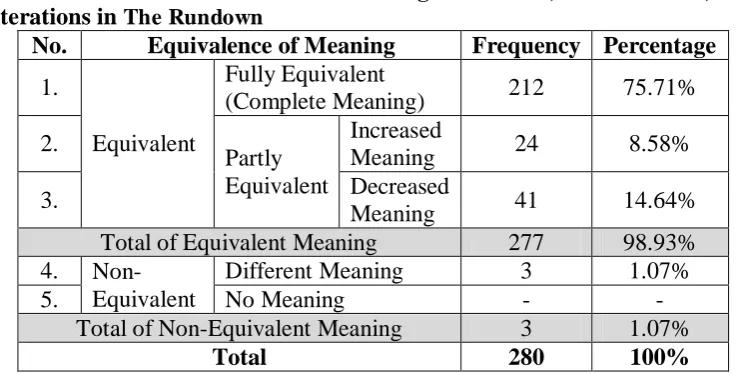
2. Description of Degree of Meaning Equivalence of the Translation of English Utterances which are Translated Using Additions, Subtractions, and Alterations in The Rundown ... 60
B. Discussion ... 65
x
CHAPTER V CONCLUSIONS AND SUGGESTIONS ... 107
A. Conclusions ... 107
B. Suggestions ... 108
REFERENCES ... 110
APPENDICES ... 114
xi
xii
Using Additions, Subtractions, and Alterations in The Rundown ... 55 Table 2. The Occurrence of Additions, Subtractions, and Alterations Found
in the Indonesian Subtitles of The Rundown…………... 59 Table 3. The Degree of Meaning Equivalence of the Translation of English
Utterances which are Translated Using Additions, Subtractions, and Alterations in The Rundown……….…………... 61 Table 4. The Relation of Additions, Subtractions, and Alterations Found in
xiii
D2 : Disc 2
SL : Source Language Text (English subtitles of The Rundown) TL : Target Language Text (Indonesian subtitles of The Rundown) FEE : Filling out elliptical expression
OS : Obligatory specification
AGR : Addition required by grammatical restructuring AIE : Amplification from implicit to explicit status R : Repetition
SR : Specification of reference Co : Conjunctions
V : Vocatives
Ca : Categories WC : Word classes
O : Order
SSW : Semantic problems involving single words
SEE : Semantic problems involving exocentric expressions Eq : Equivalent
Non Eq : Non Equivalent
FEq : Fully Equivalent (Complete Meaning) PEq : Partly Equivalent
IM : Increased Meaning DM : Decreased Meaning DifM : Different Meaning
xiv ABSTRACT
This research aims to analyze the kinds of additions, subtractions, and alterations found in the Indonesian subtitles of The Rundown. Moreover, this research also analyzes the degree of meaning equivalence of the translation of English utterances which are translated using additions, subtractions, and alterations in The Rundown.
This research was a descriptive qualitative research. Therefore, the discussion was presented in the descriptive way. However, number and percentage were used to support the analysis of the data and to strengthen the findings. The data were movie subtitles and were collected in the form of dialogues. The data sources were the English utterances and Indonesian subtitles of The Rundown the movie. There were some procedures in analyzing the data: identifying the additions, subtractions, and alterations in the Indonesian subtitles, analyzing and classifying, reporting the findings, and drawing the conclusion. To ensure the trustworthiness of the research, the data findings were triangulated by two graduates of English language and literature majoring translation.
The findings of this research show that there are 12 kinds of additions, subtractions, and alterations found. There are 3 kinds of additions: filling out elliptical expression, obligatory specifications, and amplification from implicit to explicit status. Meanwhile, there are 4 kinds of subtractions: repetition, specification of reference, conjunctions, and vocatives. In addition, there are 5 kinds of alterations: categories, word classes, order, semantic problems involving single words, and semantic problems involving exocentric expressions. There is no occurrence of additions required by grammatical restructuring. Most of the English utterances are translated using alterations; the occurrence is 151 out of 280 (53.93%). It shows that alterations is the translation strategy which most often used by the translator. Furthermore, the second rank goes to subtractions which occurs 108 times (38.57%). Finally, additions places in the third rank which occurs 21 times (7.50%). In terms of meaning equivalence, the translation of English utterances which are translated using additions, subtractions, and alterations in the movie The Rundown has a higher degree of equivalent meaning (98.93%) compared to non-equivalent one (1.07%). It can be concluded that the translator is successful in translating the English utterances.
1 CHAPTER I INTRODUCTION
A. Background of the Research
People all around the world need to communicate to each other to share their feelings, thoughts, and ideas. To achieve this purpose, they need language. Language is the system of communication used by people of a particular country or profession. Culture diversity and the development of science and knowledge lead people to communicate in different languages.
There are thousands of languages in the world which belong to different countries. In order to make communication among people using those languages possible, a process of translation is needed. Translation is an activity of transferring meaning or message of a text from source language (SL) to target language (TL). This activity may involve one or more languages. There are no two languages which have same language system in this world. Furthermore, not every word in one language has a pair of words in another language which has exactly the same meaning. Therefore, translating a text needs the mastery of one or both languages involved.
media such as movies is essentially needed to transfer information and knowledge through both spoken languages and motion pictures on screen.
Movie has an important role in human life. It enlarges and enhances people understanding. From movie, people obtain knowledge about norm and the truth of life which make them wiser in thinking or considering something before making a decision. Movie gives people pleasure, satisfaction, and lesson at the same time. Indonesian people have big enthusiasm toward foreign movies. The most common language used in foreign movies is English. However, the problem comes when the audience who are not familiar with English face difficulty to understand the meaning of the English language used in the movie. It is hard for the majority of Indonesian people whose mother language is not English to understand the meaning of the English language used in the movie. To solve this problem, subtitles are required.
Translating subtitles is not an easy job. It is very complicated because there are several aspects that must be considered by a translator, such as background or the cultural aspects of each character in the movie. Moreover, subtitles are limited by space and time. There is only a limited room for a limited number of characters across the bottom of the film. Subtitles only have very limited times to be displayed, that is two to six seconds to enable the audience to read it. It means that the translator must translate the subtitles from the source language (SL) to target language (TL) in a very short form without changing the meaning or message of the story.
A translator must consider the context of the text. If the translator translate the text in different context, the reader will interpret it in different ways too. It means that the translator must give extra attention to the background and culture of the source text. A translator should consider the context, background, and culture where the text comes from to produce the best result of the translation.
on the translation process of additions, subtractions, and alterations as translation strategies which occurs in a movie entitled The Rundown. The choice of using translation strategies such as additions, subtractions, and alterations is very important because it determines the meaning equivalence of the translation.
B. Research Focus
There are thousands of languages in the world. Each language has its own rules and systems. This difference always causes problems in translation. To produce a good translation product, a translator must consider background and context of the text. Different context may cause different interpretation for the readers. The mastery of one or both languages involved in the process is also important to get the best result of translation.
There are so many foreign movies which have been translated into Indonesian. It means that majority of Indonesian people are fond of foreign movies. Besides giving knowledge and pleasure, foreign movies in English language can be a good tool for Indonesian people specially for students to study English language. Moreover, students who are interested with translation can learn about translation through translated movie. However, there are several problems which may occur in the translation. The problems such as meaning, style, and form cannot be avoided.
must make sure that the text will fit in the screen space and that readers can read it. The text must be synchronised with both picture and sound. Furthermore, translator must recognize any cultural cues and connotations that are particularly difficult to translate, as the amount of text fitted in the screen is limited.
Since every language has different rules and systems, translator must choose the most appropriate strategy to translate the text. Nida (2003: 226) states three kinds of techniques of adjustments: addition, subtraction, and alteration. In the process, translator is not allowed to add, change, or omit the meaning or message of the text. However, translator is allowed to add, change, or omit the word with purpose to get an accurate and natural translation.
This research focuses on the translation process of additions, subtractions, and alterations as translation strategies which occur in a movie entitled The Rundown. The degree of meaning equivalence of the translation of English utterances which are translated using addition, subtraction, and alteration in The Rundown is also analyzed.
C. Formulation of the Problems
The problems are formulated as follows.
1. What kinds of additions, subtractions, and alterations are found in the Indonesian subtitles of The Rundown?
2. How is the degree of meaning equivalence of the translation of English utterances which are translated using additions, subtractions, and alterations in The Rundown?
D. Research Objectives
Based on formulation of the problem above, this research is aimed at: 1. describing the kinds of additions, subtractions, and alterations found in the
Indonesian subtitles of The Rundown,
E. Research Significance
This study is expected to give theoretical and practical advantages. Those advantages are as follows.
1. Theoretical Significance
a. The result of this research can be used as a reference for those who have the same interest in the same field.
b. The result of this research can be used as an input for those who are concerned with language learning and acquisition especially translation. 2. Practical Significance
a. Practically, the result of this research could provide feedback information for the readers especially the students of the English Department who have the interest in translation.
8
This chapter presents the theoretical review and it is divided into three sections: theoretical description, previous research, and conceptual framework and analytical construct.
A.Theoretical Description
This section presents the theoretical description and is divided into four parts. The first part provides definitions of translation, types of translation, translation process, theory of meaning in translation, equivalence in translation, and translation strategies. The second part provides definitions and examples of additions, subtractions, and alterations. The next part provides the explanation of subtitles. The last part provides information about a movie entitled The Rundown as the object of this research.
1. Translation
a. Definitions of Translation
There are many definitions about translation. Larson (1984:3) gives a simple definition. Larson states that translation is a transfer of meaning and a change of form. In the process of transferring, it is the meaning which must be held constant, and the form may change according to the language convention of the target language. While, Dubois in Bell (1991: 5) defines that translation is the expression in another language (or target language) of what has been expressed in another source language, preserving semantic and stylistic equivalences.
While according to Wills in Nadar (2009: 231), based on text, translation is a transfer process which aims at the transformation of a written SL text (SL) into an optimally equivalent TL text (TL), and which requires the syntactic, the semantic and the pragmatic understanding and analytical processing of the SL text. Meanwhile, Catford (1965: 20) states that translation is the replacement of textual material in one language by equivalent textual material in another.
b. Types of Translation
Jakobson in On Linguistic Aspects of Translation (in Bassnett, 2002: 23) distinguishes three types of translation: intralingual translation, interlingual translation, and intersemiotic translation. Intralingual translation, or rewording is an interpretation of verbal signs by means of other signs in the same language. Interlingual translation or translationproper is an interpretation of verbal signs by means of some other language. Intersemiotic translation or transmutation is an interpretation of verbal signs by means of signs of nonverbal sign systems.
In Textbook of Translation, Newmark (1988: 45) points out eight types of translation.
1) Word-for- word translation
This type of translation can be used if the target text has the same language structure with the source text. Newmark (1988: 45) states “the main use of word-for-word translation is either to understand the mechanics of the source language or to construe a difficult text as a pre-translation process”. In addition, this is usually called as interlinear translation. Catford (1965: 21) puts word-for-word translation in the kind of translation which is based on ranks. 2) Literal translation
3) Faithful Translation
This translation needs to be faithful to the source text or the original text. Newmark (1988: 46), states “a faithful translation attempts to reproduce the precise contextual meaning of the original within the constraints of the TL grammatical structures; it „transfers’ cultural words and preserves the degree of grammatical and lexical „abnormality’ (deviation from SL norms) in the
translation. It attempts to be completely faithful to the intentions and the text-realization of the SL writer.” Faithful translation is always closer to the original
and it tends to emphasize on the source language. This is applied in order to present the source language culture.
4) Semantic translation
This type of translation has a similarity with the faithful translation. It is about the bounded of the source language culture. According to Newmark (1988: 46), “the distinction between 'faithful' and 'semantic' translation is that the first is uncompromising and dogmatic, while the second is more flexible, admits the creative exception to 100% fidelity and allows for the translator's intuitive empathy with the original”.
5) Adaptation
6) Free translation
In free translation, the translator is free to translate or transfer or reproducing the translation as far as the translator does not change the meaning or the message. Thus, the translator has to be able to understand the meaning of the source text correctly. Catford (1965: 21) puts free translation in the kind of translation which is based on ranks. Because of the correctness of meaning, this type of translation tends to be at the higher level of equivalence about the content but not the form of the text.
7) Idiomatic translation
Newmark (1988: 46) states that “idiomatic translation reproduces the
'message' of the original but tends to distort nuances of meaning by preferring colloquialisms and idioms where these do not exist in the original”. Idiom is
the expression of the combination of two or more words in which the meaning cannot be drawn from each single word. Idiom is special expression which is related with the culture of a language. Translating idiom is not easy, thus the translator needs to understand about the meaning of idiom in both of the SL text and TL text.
8) Communicative translation
c. Translation Process
The process of translation is an act of recreating meaning from the source language into the target language. Nida and Taber (1982: 33) state three stages in translation process:
1) Analysis, in which the surface structure (i.e. the meaning as given in source language) is analyzed in terms (a) the grammatical relationship and (b) the meaning of the words and combination of words.
2) Transfer, in which the analyzed material is transferred in the mind of translator from source language to receptor language.
3) Restructuring, in which the transferred material is restructured in order to make the final message fully acceptable in the receptor language.
The translation process can be illustrated as follow:
SOURCE LANGUAGE RECEPTOR LANGUAGE
ANALYSIS RESTRUCTURING
TRANSFER
Figure 1. Translation process by Nida and Taber
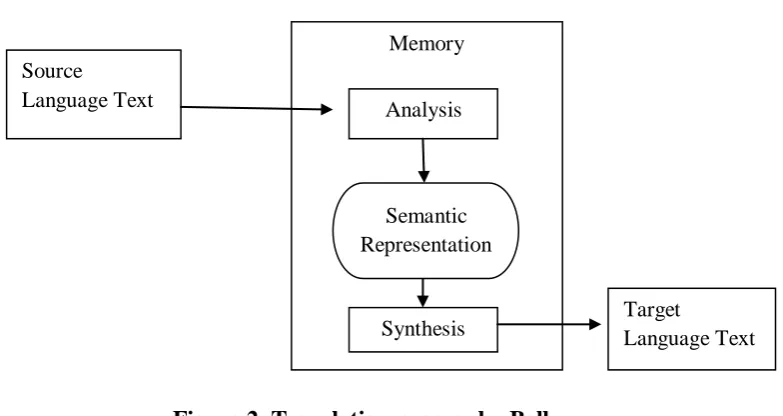
Figure 2. Translation process by Bell
Dealing with the steps that must be done in the translation process, in order to make a good translation, the translator must understand more in each process of translation not only in the final product. Thus, translation is not an easy process unless it is done carefully and correctly. Furthermore, it will produce a good translation with the best meaning accuracy.
d. Theory of Meaning in Translation
The overriding principle is that translation is meaning-based rather than form-based. Once the translator has identified the meaning of the source text, his goal is to express that same meaning in the receptor language with forms which may be very different from those of the source text (Larson, 1984: ix).
Meaning is important thing in translation process. When a translator makes a translation, it means that the translator transfers meaning of source text. What is necessary to consider is that the meaning must be maintained constantly or, in other words, when the change of form occurs, the meaning must be maintained.
Memory Source
Language Text Analysis
Synthesis Target Language Text Semantic
Halliday and Hasan (1985: 44) write that text has three kinds of meaning, namely ideational meaning, interpersonal meaning, and textual meaning. The ideational meaning is the meaning in as the representation of experience. It is the meaning in the sense of content, i.e., meaning that people have in mind when they talk about what word or sentence means. Ideational meaning is divided into logical and experiential meaning. Logical meaning relates to the relationship between ideas. It refers to relationship between one process and another or one participant and another that share the same position in the text. The experiential meaning relates to the content or ideas. It refers to the processes, the participants in these processes, and the circumstances associated with them. Interpersonal meaning is related to the interpersonal aspect of communication, such as speaker – addressee relationship, their social status, age, as well as setting and purpose of
communication. Textual meaning is the putting of referential information into a coherent whole. It is relevance to the context, both the preceding text and context of situation. It is the construct of a message of text.
to what words and utterances refer to. It is propositional meaning which can be judged as true or false while expressive meaning cannot. For example, “Quiet, please!” versus “Shut your mouth!”. The difference in the sentences does not lie
in the propositional meaning but in their expressiveness. Presupposed meaning arises from co-occurrence restrictions (selectional and collocational restrictions) on what other words or expressions are expected to be seen before or after a particular lexical unit. Selectional restrictions, connected to the propositional meaning of a word. For example, next to the adjective “furious” we expect a
human subject, and next to the verb “to feed” we expect an animal subject. Collocational restrictions do not depend on the propositional meaning of a word but are linked to its usage in the various languages. For example, in English, teeth are “brushed”, but in German and Italian they are “polished”, in Polish they are “washed”, and in Russian they are “cleaned”. Evoked meaning arises from dialect
and register variation. Dialect is a variety of a language which is used in a specific community / group of people. Register is a variety of a language that a language user considers as appropriate to a specific situation. For example, American people use “lift” while British people use “elevator”.
e. Equivalence in Translation
Meaning is closely related to the concept of equivalence or non-equivalence. Baker (1992: 5) divides equivalence into five types:
the first element to be taken into consideration by the translator. In fact, when the translator starts analyzing the source text, he or she looks at the words as single units in order to find a direct „equivalent’ term in the target language.
2) Equivalence can appear above word level when translating from one language into another. It explores the meaning of the combination of words and phrases. 3) Grammatical equivalence refers to the diversity of grammatical categories
across language. Grammatical rules may vary across languages and this may pose many problems in terms of finding a direct correspondence in the target language. The different grammatical structures in the source language and target language may cause remarkable changes in the way the information or message is carried across. The changes may induce the translator either to add or to subtract information in the target text because of the lack of particular grammatical devices in the target language itself.
4) Textual equivalence refers to the equivalence between a source language text and a target language text in terms of information and cohesion. Texture is a very important feature in translation since it provides useful guidelines for the comprehension and analysis of the source text which can help the translator in his or her attempt to produce a cohesive and coherent text for the audience in a specific context.
translator is to recreate the author’s intention in another culture in such a way
that enables the target language reader to understand it clearly.
Meanwhile, Bell (1991: 6) explains equivalence in a clear way of degree equivalence: text in different languages can be equivalent in different degrees (fully or partially equivalent), in respect of different levels of presentation (equivalent in respect of context, of semantics, of grammar, of lexis, etc.) and at different ranks (word-for-word, phrase-for-phrase, sentence-for-sentence).
2. Additions, Subtractions, and Alterations
A language always has differences from another language. This differences always creates problems in translation. Besides of the different system of language, cultural differences also become big problems in translation. Culture is information of the situational condition and the way people live in certain area. Culture cannot be translated because every area has its own specific situational condition that is different from the others. Therefore, to make a good translation, some adjustments in the contexts of cultural and situational meaning are needed.
Due to semantic, socio-cultural, and grammatical differences between source language and the target language, loss and addition of information in translation cannot be avoided. Bassnett-McGuire (1991: 30) states that once the principle that sameness cannot exist between the two languages is accepted, it is possible to approach the question of loss and gain in the translation process. Bell (1991: 6) writes that there is no absolute synonymy between words in the same language, and there is a lack of synonymy between languages. Something is always „lost’ (or, might one suggest, „gained’) in the process of translation. Sometimes the translator does not translate some parts of the original text. This is because the lack of equivalent word in the target text. The omission of some parts of the original text causes the target text to lose messages contained in the source text.
According to Nida and Taber (1982: 112) there are many efforts to make a translation by maintaining the semantic and structural form of the source language, but it seems impossible. The translation will be unintelligible and awkward, and it will be very hard for the readers to understand. Therefore structural adjustments are needed in translation.
designed to justify a modification of the source language message, but to facilitate its reproduction in a different form, and in its fullest and most accurate sense. Similar to Nida’s statement, Nababan (2008) defines three strategies as the
possibilities to solve problems of equivalence: addition of information, deletion of information, and structural adjustment.
Moreover, Nida (2003: 226) writes the purposes of these strategies as follows: (1) permit adjustment of the form of the message to the requirements of the structure of the receptor language; (2) produce semantically equivalent structures; (3) provide equivalent stylistic appropriateness; and (4) carry an equivalent communication load.
a. Additions
There are several experts’ statements related to additions as translation
strategy. Baker (1992: 86) says:
Differences in the gra mmatical structures of the source and target languages often result in some changes in the information content of the message during the process of translation. This change may take the form of adding to the target text information which is not expressed in the source text. This can happen when the target language has a grammatical category which the source language lacks.
Baker explains that the change may take the form of adding to the target text information which is not expressed in the source language, if the target language has the grammatical category which the source language lacks.
are: filling out elliptical expressions; obligatory specification; additions required by grammatical restructuring; and amplification from implicit to explicit status.
Furthermore, Nida (2003: 230-231), emphasizes that although the above techniques involves “additions”, it is important to recognize that there has been no actual adding to the semantic content of the message, for these additions consist essentially in making explicit what is implicit in the source language text. Simply changing some element in the message from implicit to explicit status does not add meaning to the content; it simply change the manner in which the information is communicated. There are four kinds of additions:
1) Filling out elliptical expression
An elliptical construction is one in which a word or phrase implied by context is omitted from a sentence, because it is a repetition of a preceding word or phrase. In addition, according to Webster’s New World College Dictionary (1996: 441), elliptical (ellipsis) is the omission of a word or words necessary for complete grammatical construction but understood in the context.
For examples:
a) SL: “He is greater than I”
TL: “He is greater than I am great”.
Nida (2003: 227) The clause in target language is filled by elliptical construction ‘am great’ to emphasize that the subject ‘I’ is also great but not as great as ‘He’.
b)SL: Deborah leads a very easy life and always has breakfast in bed.
TL: Hidup Deborah sangat santai dan ia selalu makan pagi di tempa t tidur.
Widyamarta (1989: 109) In the source language (English), there is no need to add the pronoun ‘she’ in the sentence. The reader will understand that the actor is Deborah. However, the target language is the opposite. It is necessary to add the word ‘ia’ in order to emphasize that the person who ‘always has breakfast in bed’ is Deborah.
2) Obligatory specifications
For example:
A third person reference, such as “Paul ... to the church at ...” would imply that some Paul other than the writer is being spoken of, since, if the writer is the same individual as is mentioned in the salutation, it is necessary to add I, e.g. “I, Paul, am writing to the church at ...”.
Nida (2003: 228) 3) Additions required by grammatical restructuring
Almost any type of restructuring a source language expression can result in some lexical additions. The most common instances which require amplification are shift of voice and alteration of word classes (Nida, 2003: 228).
a) Shift of voice
Nida (2003: 228) writes that when a passive expression is changed to an active one, it is obviously necessary to insert the agent. In addition, Nababan (2008) says that in some cases, addition due to shift of voice is required to avoid misinterpretation. This kind of addition occurs when an active voice is changed into a passive voice and vice versa.
For example:
SL (in Mark 16:16) : “he will be condemned.” TL (in Zacapoastla Aztec) : “God will condemned him.”
b)Alteration of word classes
Probably the most frequent additions must be made when there is a shift in word classes (Nida, 2003: 228). Moreover, Nababan (2008) writes that in some cases, addition due to alteration of word classes is required to achieve grammaticality.
For example:
SL (in English) : “False prophets.”
TL (in Luvale, spoken in Angola): “Those who pretend the work of a prophet.”
Nida (2003: 228) 4) Amplification from implicit to explicit status
Nida (2003: 228) states that important semantic elements carried implicitly in the source language may require explicit identification in the source language.
Some of the situations that apply amplification from implicit to explicit status are the addition following verb, the changes of noun to phrase, identification of an object or an event, specification of an object by using a classifier, and an explanation of the term.
For examples:
a) SL (in Luke 11:31) : Queen of the south.
Thus, the word ‘Queen’ is expanded into a phrase identifying an object and an event, and the word ‘south’ is expanded, by means of a classifier to specify the type of object referred to. All this information, implicit in the source language phrase, must be made explicit in many target languages.
b)SL : This rule is to round to the nearest even number.
TL : Menurut aturan pembulatan ini, suatu angka yang berada pada batas dua kategori dibulatkan ke angka genap terdekat.
Nababan (2008) If translated into Indonesia, an addition of information of ‘suatu angka yang berada pada dua batas kategori’ (a number lying between two categories) and alteration of word class (the active verb ‘membulatkan’ into the passive verb ‘dibulatkan’) are required to achieve grammaticality and produce an explicit meaning for Indonesian readers.
b. Subtractions
Newmark (1981: 149) uses the word „deletion/omission’. Sometimes „deletion/omission’ is allowed in translation when the word/s in the source text
function only as supporting information. In addition, Baker (1992: 86) says:
Baker explains that in the process of translating, the change of information content of message can be done in the form of omitting information in the source language, if the target language lacks a grammatical category. Moreover, Baker (1992: 40) writes that it does no harm to omit translating a word or expression in some contexts. If the meaning conveyed by a particular item or expression is not vital enough to the development of the text to justify distracting the reader with lengthy explanations, translators can and often do simply omit translating the word or expression.
Nida (2003: 231) says though in translating subtractions are neither so numerous nor varied as additions, they are, nevertheless, highly important in the process of adjustment. Here is the explanation of four kinds of subtractions. 1) Repetition
Nida (2003: 231) writes that in many languages, one of the many repeated lexical items must be subtracted or in some cases replaced by a term that intensifies the expression in question.
For examples:
a) The sentence, “I will kill him with my weapon, I will slay him with my sword.” The translation of this sentences in many languages merely, “I will certainly kill him with my sword”. To avoid the repetition of information,
several words in the sentence must be eliminated. This kind of subtraction is done to make an effective sentence in target language.
b) The category of plural in English is both morphologically conditioned (e.g. child/children, mouse/mice), and phonologically conditioned (e.g. book/books, box/boxes, pen/pens). A plural noun is also preceded by a determiner showing plurality (some books, three pens). If it is expressed in Indonesian, redundancy will occur. Indonesian plural category is lexically formed by repetition of the noun „buku-buku’ (book-book) or by adding a noun quantifier such as „beberapa’ (some) or „tiga’ (three). Once a given noun is in the plural form, the quantifier has to be deleted. On the other hand, once there is a quantifier denoting plurality, the noun in question should be in the singular form or the repetition of the noun should be avoided.
Example: three books = tiga buku-buku should be tiga buku Some men = beberapa pria-pria should be beberapa pria
Nababan (2008) 2) Specification of reference
Nida (2003: 231) writes that a transfer from source to receptor language requires the addition of elements which serve to make the reference to participants more exact and explicit. However, the reverse situation also occurs, for reference is not expressed in the same way in all languages.
Widyamarta (1989: 48) writes:
“Kata ganti dalam bahasa Barat tidak selalu perlu diterjemahkan dengan kata ganti dalam bahasa Indonesia. Jumlah dan medan makna kata ganti dalam bahasa Indonesia tidak sebanyak dan seluas kata ganti dalam bahasa Barat.”
Widyamarta explains that pronouns in Western language (English) not always need to be translated into pronouns in Indonesian. The numbers and the kinds of meaning of pronouns in Indonesian are not as much as pronouns in Western language (English).
In some languages, for example, the repetition of a proper name in two closely related sentences may be misleading. To avoid the repetition of proper name, a translator can subtract some of them.
For examples:
a) SL: There is a big mango tree in my garden. It bears plenty of fruits each year.
TL: Di kebun saya ada sebuah pohon mangga yang besar. Tiap tahun berbuah banyak.
Widyamarta (1989: 49) ‘It’ (the pronoun of mango tree) cannot be translated with ‘itu’ or ‘ini’ without reducing the clarity of the language. ‘It’ should be translated by
b) SL: It was my youngest brother who studied at Nusantara University.
TL: Saudaraku laki-laki yang termudalah yang belajar di Universitas Nusantara.
Widyamarta (1989: 53) The translator did not translate‘It’ on purpose. If ‘it’ was translated into ‘itu’ or ‘hal itu’, then the reader will be confused when he/ she read the sentence.
3) Conjunctions
Two principal types of conjunctions are: (a) those associated with hypotactic constructions; and (b) those which link coordinates, elements often combined without conjunctions, either in appositional relationships (Nida, 2003: 232). Referring to point (a), it can be explained that hypotactic conjunction is the conjunction relating two or more clauses, but each clause has a different position, one as a dependent clause and the other as an independent clause. Referring to point (b), the conjunction denoting the coordinate of the lexical element, which is usually related but without a certain conjunction. This kind of subtraction can be seen in the examples below.
a) SL: “John and Bill and Jim.” TL: “John, Bill, Jim.”
Nida (2003: 232) b) SL: White Cross Baby Powder is soft and smoothing. It absorbs moisture
TL: White Cross Baby Powder lembut dan halus, menyerap kelembaban, menjaga kesega ran dan kenyamanan bagi bayi anda. Mengandung Chlorhexidine 0.038% antiseptik yang banyak digunakan di rumah sakit dan klinik-klinik.
Nababan (2003: 34-35) In both of the examples, the translator subtracts the conjunction ‘and’ in the target language because the name of ‘antiseptic’ here is „Chlorhexidine 0.038%’. Thus, there is no need to add conjunction ‘and’
(dan) in target language. 4) Vocatives
Vocative is a word or phrase used to address a reader or listener directly, usually in the form of a personal name, title, or term of endearment. The examples of vocatives are ‘darling’, ‘my dear’, ‘sir’, ‘my little chickadee’, etc. Nida (2003: 232) writes that all languages have ways of calling people, but in some languages there is no means by which one may directly address another in a polite form. In certain situation, vocatives can be shifted into nearby claused or omitted, if the total impact does not distort the meaning.
For example:
SL: Lily asked her husband, Benny, “Darling, where are you going?” TL: Lily bertanya pada suaminya, Benny, “pergi kemana?”
above, the vocative darling is eliminated. This subtraction is allowed because the total impact does not change the meaning.
c. Alterations
Alteration is also called „shift’ or „transposition’. Newmark (1988: 85)
states that a „shift’ (Catford’s term) or „transposition’ (Vinay and Darbelnet) is a translation procedure involving a change in the grammar from SL to TL. In brief, alteration refers to a change in the grammar from SL to TL. While according to Nida, there are so many types of alterations which may be employed in the process of translating, among them the most common and important are: categories; word classes; order; semantic problems involving single words; and semantic problems involving exocentric expressions.
1) Categories
Alterations of categories include not only shifts of forms within categories, but also the employment of expressions which have no corresponding function in the source language. Other events that are included in this type are: the changes of singular expression to plural expression and vice versa, the changes from active to passive and vice versa, and the changes in the position of the adjective (Nida, 2003: 234).
For examples:
a) SL: A pair of glasses. TL: Sebuah kacamata.
The plural form ‘glasses’ in SL changed into singular form ‘kacamata’ in TL.
b) SL: John hit Peter.
TL: Si Peter dipukul oleh si John.
Simatupang (2000: 36) The sentence changed from active to passive. The subject is changed from ‘John’ into ‘Si Peter’. The object of the sentence in SL (Peter) is put as the subject of the sentence in TL.
c) SL: Black ink. TL : Tinta hitam.
Muawanah (2012) There is a change in the position of adjective in the example above. The translator puts the adjective ‘hitam’ behind the noun ‘tinta’ in TL. Although, the adjective ‘black’ (hitam) is located in front of the noun ‘ink’ (tinta) in the SL.
2) Word classes
Alteration of word classes includes the shifts from noun to verb, preposition to verb, etc. Simatupang (2000:91) writes that alteration of word classes could happen in the translation process.
For examples:
a) SL: We had a very long talk. TL: Kami berbicara lama sekali.
The translator translate the word ‘talk’ into ‘berbicara’. ‘Talk’ in the example above is a noun, while ‘berbicara’ is a verb.
b) SL: He’s in danger.
TL: Dia dalam keadaan berbahaya.
Simatupang (2000: 91) The translator translate the word ‘danger’ into ‘berbahaya’. ‘Danger’ in the SL is a noun, while ‘berbahaya’ is a adjective.
3) Order
Nida (2003: 235) says that there are certain situations in which the shifts of order may not seem so vital, but in which they are nevertheless important, if the translation is to be natural. The shifts are used to emphasize important elements in a sentence, and provide a pleasing rhythm, so they can make clear of a complicated expression.
For examples:
a) SL: The housewife expends more muscle power in an average day than her husband would use while working at his desk in the office.
TL: Rata-rata sehari lebih banyak tenaga otot yang dikeluarkan oleh isteri
di rumah daripada yang digunakan oleh suaminya ketika bekerja di depan mejanya di kantor.
sehari’ is located in the front of ‘isteri’. This shift is used to make the
translation more natural.
b) SL: If the industrial and medical revolutions made increased freedom for women a possibility, what made it a reality was the women’s rights movement.
TL: Jika karena revolusi-revolusi industri dan kedokteran menjadi mungkinlah bagi wanita untuk semakin bebas, maka karena hak-hak
wanitalah kemungkinan itu menjadi kenyataan.
Widyamarta (1989: 111) There is a change of order in the example above. ‘Hak-hak
wanitalah’ (the women’s right) is located in the front of ‘kenyataan’
(reality) in the TL.
4) Semantic problems involving single words
For examples: a) SL: leg or foot
TL: kaki
Simatupang (2000: 92) b) SL: arm or hand
TL: tangan
Simatupang (2000: 92) In both of examples above, TL is generic term of SL. On the other words, TL is the higher rank of SL.
5) Semantic problems involving exocentric expressions
This type of alteration is applied to translate expressions or idioms. When there is no readily corresponding idiom in the receptor language, a slight adjustment in the source language expression may make it acceptable in the receptor language (Nida, 2003: 237-238).
meaning of it cannot be drawn by its individual components. It is used as one semantic meaning.
A translator often makes a radical change in translating idioms or expressions because the difference of social-culture background between the source language and target language.
For examples:
a) SL: Kill two birds with one stone. TL: Menyelam sambil minum air.
Simanjuntak (1988: 129) b) SL: Get angry with.
TL: Naik darah.
Simanjuntak (1988: 80) There is a similarity between the two examples above that is both of the idiomatic expressions in SL is translated into idiomatic expressions in TL. The meaning of idiomatic translation in SL is completely transferred in TL.
3. On Subtitles
Luyken (in Anderman and Cintas, 2009: 21) defines subtitles as:
It can be interpreted that subtitles are words shown at the bottom of a film or television picture to explain what is being said by the characters in the film. Subtitles are needed when a movie is released in the country which does not use English as an official language. By reading the subtitles of the movie, the audience will understand what is being said in the film, as the subtitles is the translation of the movie dialogues.
Georgakopoulou (in Anderman and Cintas, 2009: 21) writes that interlingual subtitling is a type of language transfer in which the translation, that is the subtitles, does not replace the original Source Text (ST), but rather, both are present in synchrony in the subtitled version. Subtitles are said to be most successful when they are not noticed by the viewer. For this to be achieved, they need to comply with certain levels of readibility and be as concise as necessary in order not to distract the viewer’s attention from the programme.
Subtitles are limited by space and time. There is only a limited room for a limited number of characters across the bottom of the film. Moreover, subtitles only have very limited times to be displayed, that is two to six seconds to enable the audience to read it.
4. About The Rundown
for an ancient golden artefact named Gato. Fortunately, Travis managed to find the Gato. In El Dorado town, there was a man who ran the town and had monopoly on mining supplies, named Hatcher. He employed townspeople with small salary and treated them like slave. His bad treatment toward townspeople gave a birth to a group of rebellion. This group was lead by Mariana. Mariana, who knew the worth of Gato, planned to steal and sell it in order to release the townspeople from Hatcher. Unfortunately, Hatcher also wanted to possess the Gato. In order to grabe the Gato, Hatcher kidnapped Mariana and tried to kill Beck and Travis. However, Hatcher failed and died. Then, Beck and Travis gave the Gato to the townspeople. After that, Beck and Travis got back to Travis’ home in Los Angeles. When they arrived at Travis’ house, Beck realized that Travis’
father treated his son badly. Thus, Beck freed Travis from his father and escaped with him. In the end of the story, Beck and Travis became friends.
In addition, The Rundown is a successful film which has gained many awards. The Rundown was nominated for Best Fight by MTV Movie Award in 2004, won Taurus Award for Best High Work and Best Overall Stunt by World Stunt Award in 2004, and nominated for Best Fight and Best Specialty Stunt by World Stunt Awardin 2004.
B.Previous Research
Hemingway’s The Old Man and The Sea by Dian Vita Ellyati by Harsianti (2010).
The second previous research is A Translation Analysis of Exclamatory Sentences based on the Technique of Adjustment in the novel of Harry Potter and the Deathly Hallows into Harry Potter dan Relikui Kematian by Agustriani (2011). However, these previous researches are different from this research in terms of topic discussed.
1. Additions, Omissions, and Alterations in English-Indonesian Translation of
Ernest Hemingway’s The Old Man and The Sea by Dian Vita Ellyati by
Harsianti (2010)
2. A Translation Analysis of Exclamatory Sentences based on the Technique of Adjustment in the novel of Harry Potter and the Deathly Hallows into Harry
Potter dan Relikui Kematian by Agustriani (2011)
The research aims to find out the technique of adjustments, the purposes of applying technique of adjustments and accuracy and acceptability of the translation of exclamatory sentences in Harry Potter and the Deathly Hallows. The findings show that the most dominant technique of adjustment used by the translator is in terms of alteration which amounts to 51.2%. Technique of adjustment in terms of substraction taken the second place with 21.5%. The third major technique of adjustment used is in terms of addition with 19.8%, followed by the technique of adjustment used is in terms of substraction and alteration with 5.8% of 121 data and the last is in terms of addition and alteration which amounts 1.7% from the whole data.
C.Conceptual Framework and Analytical Construct 1. Conceptual Framework
Translating subtitles is not an easy job. It is very complicated because there are several aspects that must be considered by a translator, such as background or the cultural aspects of each character in the movie. Moreover, subtitles are limited by space and time. It means that the translator must translate the subtitles from the source language (SL) to target language (TL) in a very short form without changing the meaning or message of the story.
A good translator must be able to translate a text from source language (SL) to target language (TL) and deliver the meaning or message of the text at the same time. In the process, a translator is not allowed to add, change, or omit the meaning or message of the text. However, translator is allowed to add, change, or omit the word with a purpose to get a natural translation.
This research focuses on the translation process of additions, subtractions, and alterations as translation strategies which occur in a movie entitled The Rundown. The degree of meaning equivalence of the translation of English utterances which are translated using additions, subtractions, and alterations in The Rundown is also analyzed.
additions, subtractions, and alteration is made. For the additions there are filling out elliptical expression, obligatory specifications, additions required by grammatical restructuring, and amplification from implicit to explicit status. For the subtractions there are repetition, specification of reference, conjunctions, and vocatives. While for the alterations there are categories, word classes, order, semantic problems involving single words, and semantic problems involving exocentric expressions. Here, the examples and brief explanations of additions, subtractions, and alterations:
a. Additions
Additions is the addition of additional information which is not found in the source language by the translator in order to enrich the information of the text in target language. Several examples of additions are presented below. 1) Filling out elliptical expression
SL: Eventually, their widened horizons and their increased economic power brought wives into a new relationships with their husbands.
TL: Pada suatu saat, karena cakra wala istri-istri meluas dan kekuatan mereka di bidang ekonomi bertambah, maka terciptalah tata hubungan baru antara mereka dan suami mereka.
‘mereka’ in order to give additional information that people who have ‘new relationships with their husbands’ were ‘mereka’ (wives).
2) Obligatory specifications
The word ‘men’ in Tannen is tolerated for men if translated into ‘para pria’ in Indonesian. It does not actually refer to men in general but to American men in particular, who became the focus of Tannen’s study on
male-female interactions (Deborah Tannen is University Professor and Professor of Linguistics at Georgetown University). It can be argued that translators should add the word ‘Amerika’ to the Indonesian version to avoid ambiguity or to avoid a misleading interpretation of the outcomes of the study by Indonesian readers.
Nababan (2008)
3) Additions required by grammatical restructuring SL: “I cut my finger.”
TL:“Jariku tersayat oleh pisau.”
4) Amplification from implicit to explicit status
SL: White Cross Baby Powder is soft and smoothing. It absorbs moisture and keeps baby cool and comfortable. It contains Chlorhexidine, and antiseptic widely used in hospitals and clinics.
TL: White Cross Baby Powder lembut dan halus, menyerap kelembaban, menjaga kesegaran dan kenyamanan bagi bayi anda. Mengandung Chlorhexidine 0.038% antiseptik yang banyak digunakan di rumah sakit dan klinik-klinik.
Nababan (2003: 34-35) The translator added ‘anda’ and ‘0.038%’ in the target language although those words are not found in the source language. Translator provides additional information so that the translation easily understood by the readers.
b. Subtractions
1) Repetition
SL: Your father didn’t change his mind in the past, he doesn’t change it now, and he won’t change it in the future.
TL : Ayahmu tidak berubah pandangan – dahulu, sekarang, maupun pada wa ktu yang akan datang.
Widyamarta (1989: 56) The translator subtracts ‘he doesn’t change it’ and ‘he won’t change it’ in the TL because there is no past tense or future tense in the
target language.
2) Specification of reference
SL: It is her oldest son she loves most.
TL: Anak laki-lakinya yang sulunglah yang paling dikasihinya.
Widyamarta (1989: 53) The translator subtract the word ‘It’. If ‘it’ translated into ‘itu’ or ‘hal itu’, then the reader will be confused when he/ she read the sentence.
3) Conjunctions
SL: He is 30 years old, six feet tall, and has black hair and blue eyes.
TL: Umurnya 30 tahun, tingginya enam kaki, rambutnya hitam, dan matanya biru.
4) Vocatives
SL: Take the ring, buddy. TL: Ambillah cincinnya.
The translator subtract vocative ‘buddy’. This subtraction is allowed because the total impact does not change the meaning.
c. Alterations
Alteration refers to a change in the grammar from SL to TL. The examples of alterations are presented below.
1) Categories
SL: A beautiful garden.
TL: Sebuah taman yang indah.
Suryawinata and Hariyanto (2003: 41) There is a change in the position of adjective in the example above. The translator put the adjective ‘yang indah’ behind the noun ‘taman’ in TL. Although, the adjective ‘beautiful’ (yang indah) is located in front of the noun ‘garden’ (taman) in the SL.
2) Word classes
SL: They had a quarrel. TL: Mereka bertengkar.
3) Order
SL: There is a big mango tree in my garden. It bears plenty of fruits each year.
TL: Di kebun saya ada sebuah pohon mangga yang besar. Tiap tahun pohon itu mengeluarkan banyak buah.
Widyamarta (1989: 49) There is a shift of order in the example above. The translator reverse the location of ‘It bears plenty of fruits’ (pohon itu mengeluarka n banyak buah) with ‘each year’ (tiap tahun) in the target language. Thus, in the target language, ‘tiap tahun’ is located in the front of ‘pohon itu mengeluarkan banyak buah’. This shift is used to make the translation more natural.
4) Semantic problems involving single words SL: Brother
TL: Adik laki-laki
Simatupang (2000: 92) In the example above, TL is the lower rank of SL. ‘Brother’ could be translated into ‘kakak laki-laki’ or ‘adik laki-laki’.
5) Semantic problems involving exocentric expressions SL: Cry over spilt milk
TL: Nasi sudah menjadi bubur
These two idiomatic expressions have precisely the same meaning. Both expressions in SL and TL have the same meaning that is ‘it is not useful feeling sorry about something which has already happened’.
Meanwhile, related to the equivalence, this research uses Bell’s theory (1991: 6), which states that texts in different languages can be equivalent in different degrees (fully or partly equivalent), in respect of realization and ranks. Based on this theory, a classification into equivalent and non-equivalent meanings which are then classified into fully and partly equivalent, and non-equivalent meanings is made. For the fully equivalent meaning there is a complete meaning, while for the partly equivalent meaning there are increased and decreased meaning. For non-equivalent meaning, there are different meaning and no meaning. The classification is described below:
a. Equivalent
Equivalent meaning is divided into fully equivalent (complete meaning) and partly equivalent.
1) Fully Equivalent (complete meaning)
Complete meaning occurs when the meanings in the source language text are completely transferred in the target language text. For example, the words „red bag’ is translated into „tas merah’. The
2) Partly Equivalent
Partly equivalent is divided into increased meaning and decreased meaning.
a) Increased meaning
Increased meaning occurs when there is an addition of information realized by new meaning which is not found in the source language text. For example, the word „warm’ is transferred into „hangat dan terang’.
Here, the translator adds the word ‘terang’ in the translation. b) Decreased meaning
Decreased meaning occurs when a part of the meaning in the source language text is omitted in the target language text. For example, the meaning of the original noun phrase „bedroom mat’ is transferred into ‘tempat tidur’. Here, the meaning of the original noun phrase „bedroom mat’ is transferred incompletely in the translation.
b. Non-Equivalent
Non-equivalent is divided into different meaning and no meaning. 1) Different Meaning
‘menyuapi’ is differently transferred into ‘sarapan bersama’ in the
Indonesian realization. 2) No Meaning
No meaning occurs when the translator subtracts the words or expression in the source language text so that the target language text looses all information contained in the source language text. For example, the meaning of the clause „young and free’ is transferred into „bebas’ so the meaning of the word „young’ is lost or totally not transferred into
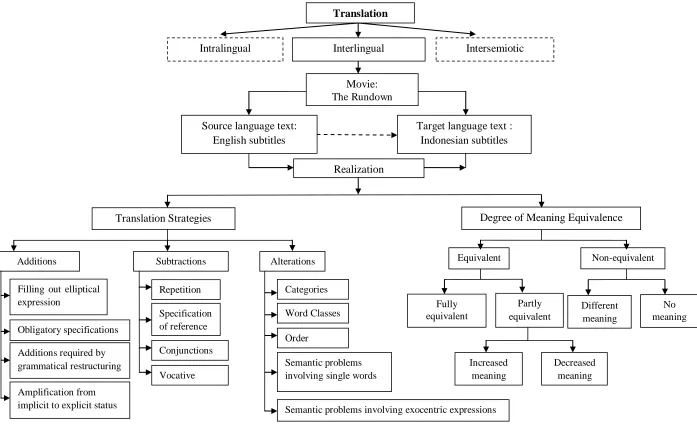
51 Figure 3. Analytical Construct
Intersemiotic Intralingual Interlingual
Target language text : Indonesian subtitles Movie:
The Rundown
Realization
Translation Strategies Degree of Meaning Equivalence
Equivalent Non-equivalent Source language text:
English subtitles
Filling out elliptical expression
Amplification from implicit to explicit status Obligatory specifications
Semantic problems involving exocentric expressions Semantic problems
involving single words Order
52
This chapter presents research method and is divided into five parts: type of the research, data and source of data, techniques of data collection, method of data analysis, and data trustworthiness.
A.Type of the Research
This research used the descriptive qualitative method. Vanderstoep and Johnston (2009: 7) state that qualitative research produces narrative or textual descriptions of the phenomena under study. Thus, this research was emphasized to describe the use of translation strategies in the translation subtitles, especially the use of additions, subtractions, and alterations and to know the degree of meaning equivalence. However, this research also employed a little bit number (quantitative analysis) to support the analysis of the data.
Furthermore, Denzin and Lincoln (in Lewis and Ritchie, 2003: 2-3) state: “Qualitative research is a situated activity that locates the observer in the world. It consists of a set of interpretive, material practices that makes the world visible. These practices ... turn the world into a series of representations including fieldnotes, interviews, conversations, photographs, recordings and memos to the self. At this level, qualitative research involves an interpretive, naturalistic approach to the world. This means that qualitative researchers study things in their natural settings, attempting to make sense of, or to interpret, phenomena in terms of the meanings people bring to them.”
predictive. The goal is to understand, in depth, the viewpoint of a research participant. In conducting this study, the researcher collected, rewrote, classified, analyzed the data and made some conclusions.
B.Data and Source of Data
The data of this research were in the forms of utterances uttered by the characters in The Rundown which were translated using additions, subtractions, and alterations. The context of the data were dialogues. Meanwhile, the sources of data used in this research were the English utterances and Indonesian subtitles of The Rundown the movie.
C.Techniques of Data Collection
This research employed visual analysis, note taking, and observational techniques. In addition, several stages were conducted to collect the data. Those stages were as follows:
1. The English utterances of The Rundown was taken as the primary data.
2. The English utterances and Indonesian subtitle text of The Rundown were written in a note. The Indonesian subtitle text was taken from the DVD and became the secondary data.
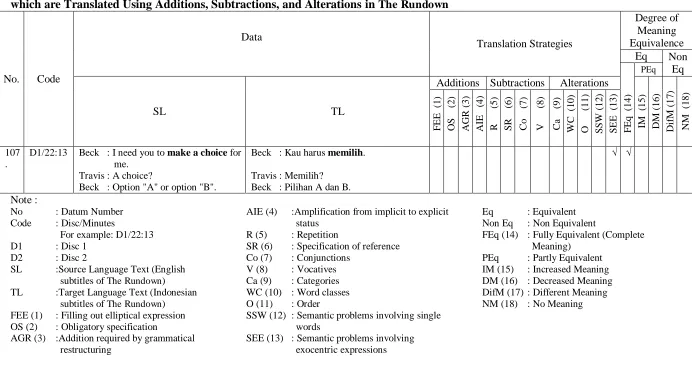
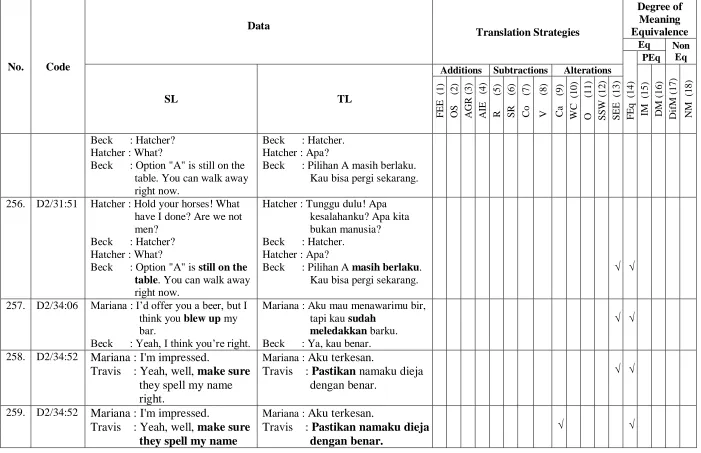
3. The data sheets were made to categorize the data based on the classification and code.
55
Additions Subtractions Alterations
IM Code : Disc/Minutes
For example: D1/22:13 D1 : Disc 1
D2 : Disc 2
SL :Source Language Text (English subtitles of The Rundown) TL :Target Language Text (Indonesian
subtitles of The Rundown) FEE (1) : Filling out elliptical expression OS (2) : Obligatory specification
AGR (3) :Addition required by grammatical restructuring
AIE (4) :Amplification from implicit to explicit status
R (5) : Repetition
SR (6) : Specification of reference Co (7) : Conjunctions
V (8) : Vocatives Ca (9) : Categories WC (10) : Word classes O (11) : Order
SSW (12) : Semantic problems involving single words
SEE (13) : Semantic problems involving exocentric expressions
Eq : Equivalent Non Eq : Non Equivalent
FEq (14) : Fully Equivalent (Complete Meaning)
C. Method of Data Analysis
According to Vanderstoep and Johnston (2009:191), the data analysis of the qualitative research occurs after the first data are collected, and the initial analysis should determine the focus and strategies used in subsequent data collection. Thus, the data analysis was conducted as the process of systematically searching and arranging the collected data. In addition, Vanderstoep and Johnston (2009:199) mention that there are five research methods in analyzing the data, namely: ethnography, phenomenology, case study, textual analysis, and applied research.
This research employed textual analysis. Pierce in Vanderstoep and Johnston (2009: 210) says that textual analysis involves the identification and interpretation of a set of verbal or non-verbal signs. Everything that people encounter, from clothing to books to food to architecture, is a sign. A sign, compels people to think about something other than itself. Generally, the steps of data analysis in this research were as follows:
1. The English utterances were compared to the Indonesian subtitles based on the data gathered.