Full Terms & Conditions of access and use can be found at
http://www.tandfonline.com/action/journalInformation?journalCode=cbie20
Download by: [Universitas Maritim Raja Ali Haji] Date: 18 January 2016, At: 00:25
Bulletin of Indonesian Economic Studies
ISSN: 0007-4918 (Print) 1472-7234 (Online) Journal homepage: http://www.tandfonline.com/loi/cbie20
Monopolising Islam: The Indonesian Ulama
Council and state regulation of the ‘Islamic
economy’
Tim Lindsey
To cite this article: Tim Lindsey (2012) Monopolising Islam: The Indonesian Ulama Council and state regulation of the ‘Islamic economy’, Bulletin of Indonesian Economic Studies, 48:2, 253-274, DOI: 10.1080/00074918.2012.694157
To link to this article: http://dx.doi.org/10.1080/00074918.2012.694157
Published online: 27 Jul 2012.
Submit your article to this journal
Article views: 454
View related articles
ISSN 0007-4918 print/ISSN 1472-7234 online/12/020253-22 © 2012 Indonesia Project ANU http://dx.doi.org/10.1080/00074918.2012.694157
MONOPOLISING ISLAM?
THE INDONESIAN ULAMA COUNCIL AND
STATE REGULATION OF THE ‘ISLAMIC ECONOMY’
Tim Lindsey*
The Ulama Council of Indonesia (MUI) is an advisory body with a nationwide network of branches that produces fatwa ‘to guide the Islamic community and the government’. Nominally an independent NGO, MUI has always had a com-plex and mutually dependent relationship with the state, which established it and funds it. This paper describes regulatory changes since Soeharto’s fall in 1998 that have expanded MUI’s formal role in the state system for the administration of Islamic legal traditions and, in particular, the ‘syariah economy’. These changes
have heightened MUI’s inluence and the legal authority of its fatwa, granting it new institutional roles (and, in some cases, monopolies) in relation to halal
cer-tiication, Islamic inance and the haj pilgrimage. MUI has now begun to accrue quasi-legislative powers resembling those enjoyed by state ulama councils and state Muftis elsewhere in Southeast Asia, but not previously available to any mod-ern Indonesian fatwa-producing body.
Keywords: civil society, regulatory regime, regulatory compliance, inancial sector
The Ulama Council of Indonesia (Majelis Ulama Indonesia, MUI) is made up of Muslim scholars and intellectuals from a range of Indonesian Muslim organisa-tions. It is an advisory body that produces fatwa1 and other forms of opinion on
issues relating to Islam ‘to guide the Islamic community and the government’ (MUI 2010). Most studies of MUI focus on its production of fatwa and how they
inluence Muslim thought in Indonesia. Many are concerned with MUI’s increas -ingly conservative views on moral and social issues and its hostility towards so-called ‘deviant’ or unorthodox minority religious groups (aliran sesat).2 The chief
focus of this paper is on how regulatory changes since the 1998 fall of Soeharto’s New Order government have expanded MUI’s formal role in the state system for
* Tim Lindsey directs the Asian Law Centre and the Centre for Islamic Law and Soci-ety at the University of Melbourne. Research for this paper was funded by an Australian
Research Council Federation Fellowship, with valuable research assistance provided by Melissa Crouch, Nic Parsons, Jemma Parsons and Helen Pausacker. Earlier versions of
some parts appear in Lindsey (forthcoming and 2012).
1 A fatwa (Arabic fatwā) is an answer given by Muslim scholars in response to a question raised. Traditionally, it is not binding.
2 See Van Dijk (2008); Hooker (2008); Gillespie (2007); Olle (2006); Ichwan (2005); and
Hosen (2004), among others.
254 Tim Lindsey
administering Islamic legal traditions, particularly the ‘syariah economy’ (ekonomi syariah),3 thus greatly expanding its inluence and authority.
The paper begins with brief accounts of that state system, of the changing nature of MUI’s relationship with the state since the New Order, and of the way in which MUI structures itself, including the institutes it has established as vehicles for intervention in the state-sanctioned ‘syariah economy’. Laws passed in the last decade have granted new institutional roles to MUI in relation to halal4 certiica -tion, Islamic inance and the haj5 pilgrimage. This new regulatory framework is
described to show how MUI has begun to accrue quasi-legislative powers that resemble those enjoyed by state ulama6 councils and Mufti7 elsewhere in
South-east Asia, but that have not previously been available to any modern Indonesian
fatwa-producing body.8
THE BUREAUCRATIC ADMINISTRATION OF ISLAM
Indonesia has often been described as a ‘bureaucratic state’, and this form of gov-ernment, known as the beambtenstaat, was one of the legacies of Dutch rule.9All
modern states have bureaucracies, but the idea of the Indonesian state as bureau-cracy refers to the overpowering executive that prevailed for much of the period since independence in 1945. The boundaries between the executive and the judi-cial and legislative branches have been weak for most of Indonesia’s modern his-tory, and the country has often been governed through a web of executive orders,
with control centralised in Jakarta.This was certainly true under Soeharto, and it continued until amendment of the Constitution between 1999 and 2002 intro-duced democratisation and the separation of powers.10 The power of the central
bureaucracy was further diluted by the regional autonomy process introduced after the end of the New Order. This delivered a huge transfer of power to local governments elected at every level, from village to province, and led to the crea-tion of a largely autonomous layer of local bureaucracy to serve them.
3 Syariah (Arabic sharīca
) Islamic law, understood as norms and rules derived from the Qur’ān and ḥadīth.
4 Halal (Ar. ḥalāl): permissible according to Islamic law.
5 Haj (Ar. ḥajj): Islamic pilgrimage to Mecca to perform speciic rites.
6 Ulama (Ar. culamā’, plural of cālim): Muslim religious scholars. The term ‘ulama’ is often
used for the singular in Indonesia.
7 Mufti (Ar. muftī): Muslim jurist capable of giving an authoritative legal opinion or fatwa. 8 Indonesian laws are, of course, rarely fully and consistently enforced. The important question of how far new regulations giving MUI authority in relation to the ‘syariah econo-my’ are actually implemented in practice is, unfortunately, beyond the scope of this paper.
This is an issue that will require further research in the ield.
9 See Benda (1966: 589–605); McVey (1982); and Day (2002: ch. 2). As Schulte Nordholt (2003: 553) puts it, ‘McVey (1982) took Benda’s idea of the beambtenstaat as a point of depar-ture when she compared the late colonial state with the New Order. Although the colonial state was basically run by civil servants and the New Order by the military, the similarities were compelling because both regimes were ultimately based on force, political demobili-zation, and a technocratic approach towards the modernization of society’.
10 See Indrayana (2008) for a detailed account of the amendment process and its outcomes.
Despite these dramatic changes, the national bureaucracy has kept its former
authority for the administration of religion, because article 10(3) of Law 32/2004
on Regional Government allowed the central government to retain jurisdiction over, among other things, ‘religious affairs’ (urusan agama).11The lead agency at
the national level for the administration of religious affairs is still the Ministry of
Religion (Kementerian Agama), which was established early in 1946, within the irst year of the revolution.12 The ministry’s reach now extends to most aspects
of Islamic legal traditions recognised and regulated by the state. Although it lost authority over Indonesia’s Islamic courts – the Pengadilan Agama (Religious Courts) – to the Supreme Court after 2004,13 the ministry still administers Islamic education, in uneasy partnership with the Ministry of National Education
(Lind-sey forthcoming: ch. 5). It likewise determines the procedures by which the provi -sions of the Compilation of Islamic Laws (Kompilasi Hukum Islam, Presidential Instruction 1/1991), Law 1/1974 on Marriage and other regulations relevant to family law for Muslims are implemented. The ministry also organises the haj and
umroh14 pilgrimages, and administers zakat15 and wakaf.16 In addition, it manages
the forms and procedures for the areas of Islamic legal tradition that it
adminis-ters through its main ofices in Jakarta and hundreds of local representative ofices across the country. For most Muslims, these local ofices are their main point of
direct contact with the state’s system for the administration of the limited forms of syariah it recognises.
The ministry is, however, not the only non-judicial institution on which the
Indonesian state relies in this ield. In fact, it is often not the most important one
when it comes to the formation of policy on issues of Islamic legal tradition. The other leading institution is, of course, MUI. Although MUI is nominally inde-pendent, it is, in reality, a quango,17 endorsed and funded by the state, that under
11 ‘Religious affairs’ is deined in the Elucidation (explanatory memorandum) to the Law
as ‘for example, ixing religious holidays on a national scale, giving recognition to the exist -ence of a religion, determining policy in the implementation of religious life, and so on, and certain other aspects of government affairs on a national scale’. As Parsons and Mietzner
(2009) demonstrate, the exact meaning of this deinition, and its implications for regional
regulations drawing on Islamic norms, are open to question. It is generally accepted,
how-ever, that article 10(3) preserves the existing authority of the central bureaucracy over re -ligious matters.
12 Government Regulation 1/SD/1946. Long known as the Department of Religion (De
-partemen Agama, DepAg), it recently oficially became a ministry again: see Regulation of
the Minister of Religion 1/2010.
13 This occurred pursuant to the so-called ‘one roof’ (satu atap) reforms, described in
Lind-sey (forthcoming: ch. 8); see also Butt and LindLind-sey (2011); and Sumner and LindLind-sey (2011).
These removed the Supreme Court and the courts it supervises from the overlapping
au-thority of the Ministry of Justice and other ministries, establishing the judiciary as an inde -pendent branch of government under its own ‘roof’.
14 Umroh (Ar. cumra): minor pilgrimage to Mecca.
15 Zakat (Ar. zakāt): charitable contribution required to be made in accordance with Mus -lim law.
16 Wakaf (Ar. Waqf): Islamic charitable foundation, trust or endowment; pious donation. 17 Quango: quasi-autonomous non-government organisation.
256 Tim Lindsey
the New Order often worked in step with the Ministry of Religion. This relation-ship is no longer so straightforward. As the then Minister of Religion complained in 2001, MUI now sometimes‘want[s] to go its own way [and] never consult[s] with the Ministry of Religion’.18 Despite this, the institutional inluence of MUI in
the state system for the administration of Islamic legal traditions has, if anything, increased since the end of Soeharto’s rule in 1998. In other words, MUI’s assertion
of independence from government has not diminished its inluence on govern -ment. Indeed, MUI’s position in the state regulatory system for the administration of Islam, and its links to the ministry, have been strengthened by new regulation introduced over the last decade and described later in this paper.
The key to MUI’s inluence are the fatwa it produces. Before the early 20th century, Indonesian Muslims often sought fatwa from ulama in the Middle East
(Hosen 2004: 9). Since then, fatwa production has become institutionalised within
Indonesian civil society, although Middle Eastern inluences are growing again as
internet fatwa sites proliferate. In Indonesia, fatwa have typically been given col-lectively by councils independent of the state and appointed by Islamic
organisa-tions (Hooker 2008; Gillespie 2007: 206). The most signiicant of these councils are
MUI, Persis,19 Nahdlatul Ulama (NU)20 and Muhammadiyah.21 The latter two are
often said to be the largest Muslim organisations in the world, but over the last 10 years MUI has been able to become ‘the most authoritative Muslim institution in
Indonesia in the ield of fatwa production’ (Hasyim 2011: 8).
In Islamic tradition, fatwa are not binding and until recently Indonesia did not give legal force to the fatwa of any group or individual, although both Brunei and Malaysia have done so for some time. Likewise, the government of
Indo-nesia has never created a state-endorsed Ofice of the Mufti, as Brunei, Malaysia
and Singapore have done. Although the New Order’s endorsement of a generally compliant MUI that often supported state policy seemed sometimes to approach state control of fatwa making (Ichwan 2005; Hosen 2004), this was never formally institutionalised. As a result, there are today no state regulations broadly appli-cable to fatwa per se. They are not a formal source of law in their own right and have hardly been recognised within the Indonesian legal system at all.22 Even the
Religious Courts rarely rely on fatwa in making decisions.23
MUI has nonetheless been effective in using fatwa to inluence state policy on
Islamic legal traditions in a way that favours its own increasingly conservative orthodox positions on social and doctrinal issues. This has led to an important shift in recent years, as new regulation has made certain fatwa issued by MUI
18 Prof. Dr Said Agil Husin Al Munawar, cited in Van Dijk (2008: 52).
19 Persis (Persatuan Islam or Islamic Union), a conservative modernist Muslim
organisa-tion established in West Java in 1923.
20 Nahdlatul Ulama (‘Awakening of the Ulama’), Indonesia’s largest traditionalist Mus-lim organisation.
21 Founded in 1912, Muhammadiyah is Indonesia’s largest modernist Muslim organisa -tion.
22 Fatwa are mentioned in the Compilation of Islamic Laws, but only as a source of legal thought consulted by its drafters, and not as positive law in their own right.
23 See Lindsey (forthcoming: chs 8 and 10) and Wahid (2010: 13–14); but compare
Nurlaelawati (2010).
in relation to banking and halal certiication enforceable as binding law, as this
paper will show. This, combined with the new role in the administration of the haj
granted to MUI by recent laws, has given it new powers, more reminiscent of the
powers of the oficial Muftis of Brunei and Malaysia (with whom MUI has active links; Hasyim 2011: 5) than of those of traditional Indonesian fatwa-issuing organi-sations.Although MUI still has far to go to achieve the broad formal authority enjoyed by the Malay Muftis, the limited authority it has recently won in these
areas is a signiicant development in its own right, albeit one that has received
little attention.
Before turning to the detail of the new legislation, I will briely describe the
circumstances in which MUI was established, since this offers insight into the dynamics of its changing, and sometimes ambiguous, relationship with the state.
ORIGINS OF MUI
MUI’s current prominence owes much to the fact that it was set up as a vehicle
for the New Order regime’s management of Islamic policy. As Van Dijk (2008: 46) argues, it is ‘doubtful that the establishment of an (in principle) authoritative
institution such as the MUI could have been possible without government con-sent and direction’.
In May 1975, President Soeharto formally agreed, during a meeting with the Council for Indonesian Mosques (Dewan Masjid Indonesia), to the establishment of a national fatwa institute. The Ministry for Home Affairs quickly instructed local governments to establish their own regional ulama councils to create a nationwide structure over which the institute could preside. By the end of May, all provinces
and some districts had done so (Hosen 2004). By Decision 28 of 1 July 1975, the Minister of Religion set up a preparatory committee, and the First National Coun
-cil of Indonesian Ulama met soon afterwards, on 26 July.
On the morning of the irst day of the Council, Soeharto himself gave an address
outlining the future functions of MUI.24 Unsurprisingly, these were linked to
the New Order’s secularising rhetoric on national development, with Soeharto clearly seeking to use the ulama to bolster his political position. According to him, MUI’s most important function was not religious at all. Rather, it was to ‘translate’ to the community his regime’s local and national development policies. MUI’s second function was to provide ‘input’ to the government, when requested, in the form of ‘information about religious life in Indonesia’. Third, MUI was to mediate between the government and the ulama. Finally, MUI was to be a forum to ‘discuss
governance and the role of ulama in Indonesia’ (MUI 1976: 32).MUI’s
contempo-rary role as a leading interpreter of Islamic doctrine – including for the beneit of
the state – was thus less important to Soeharto than the twin role he granted it as a mouthpiece for the state and a ‘buffer’ between the state and the ulama.
Soeharto also set boundaries for the new organisation that were designed to keep it dependent on the government. MUI was, for example, not to become a
24 ‘Amanat Presiden Republik Indonesia pada Pembukaan Musyawarah Nasional ke-I
Majelis Ulama Indonesia, tanggal 21 Juli 1975 di Istana Negara [Speech of the President of the Republic of Indonesia at the Opening of the First National Conference of the Ulama Council of Indonesia, 21 July 1975 in the State Palace]’, in MUI (1976).
258 Tim Lindsey
political party, nor was it have mass-based membership like NU and Muham-madiyah. Soeharto clearly did not want MUI to have the capacity for potentially threatening grassroots political activity. It was likewise not to develop its own Islamic schools, mosques or hospitals. This, he said, was already taken care of by
existing Muslim mass organisations (MUI 1976: 31–2). Instead, the New Order’s oficial ulama organisation was to draw its authority from the government and not from the Muslim community(ummat).
On the penultimate day of the conference, the charter establishing MUI was
signed by the 53 ulama in attendance. President Soeharto did not sign,25 nor did
he or any of his ministers ever issue a decision or instruction establishing MUI. Accordingly, despite the president’s involvement in MUI’s foundation, it has never been a statutory body or a government agency. It was nonetheless clear from the outset that MUI could look to the government for funding support.
Guidelines circulated after the conference in 1975 speciically provided that MUI’s budget would be obtained from three primary sources: ’non-binding community
funds and donations; … government assistance; [and] … other valid and halal
businesses’. Today, the state is still the main source of MUI’s income, as shown below, and this distinguishes it from all other Muslim organisations in Indonesia.
Another president more recently reiterated the state’s commitment to MUI, although on somewhat different terms from those chosen by Soeharto in 1975.
Opening its seventh national conference on 26 July 2005, President Susilo Bam
-bang Yudhoyono called for MUI to help form state policy on Islam (ICG 2008: 8–9).
He stated his hope that MUI would give advice to the government so that it could stamp out not just crime but also illicit activities (kemunkaran) and social ills ( kemak-siatan) such as drugs, gambling, pornography and ‘pornoaction’ (pornoaksi).26 He added that ‘not all problems in our community, particularly those concerning religion [and] Islamic issues, can be resolved by a legal approach’. The govern-ment, therefore, ‘had opened the doors of [its] heart, [its] thoughts to at any time receiving viewpoints, recommendations and fatwa from MUI and from the ulama’. ‘We want to place MUI in a central role in matters regarding the Islamic faith’, he continued, making it clear that he saw MUI as the government’s leading adviser
on Islamic issues (Yudhoyono 2005; ICG 2008: 8). Two years later, at the national MUI meeting of November 2007, Yudhoyono reiterated his support:
… MUI issues fatwa. The President cannot issue a fatwa. But after a fatwa is issued, the tools of the state can do their duty. Hopefully our cooperation will deepen in
the future … We must all take strict measures against deviant beliefs (ICG 2008: 9).
25 Soeharto’s name does, however, appear as ‘Patron’ or ‘Protector’ (pelindung) of MUI on
the list of board members formulated for the conference (MUI 1976: Lampiran II).
26 ‘Pornoaksi’ is a contested term for public acts of sexuality that derives from the debate surrounding the highly contentious bill eventually enacted as Law 44/2008 on
Porno-graphy. Article 1(2) of an early draft of the bill deined it as ‘acts that deliberately exploit sexual objects, which are carried out in public and which lower the dignity and value of
human beings’. Although the term was deleted from the inal Law, the idea survives in
article 1, which prohibits, among other things, ‘movements of the body, or other forms, through a variety of communication media and/or performances in public that contain obscenity or sexual exploitation that violates the moral norms of society’.
These statements show that Yudhoyono, like Soeharto, was keen for MUI to
maintain its semi-oficial, quasi-state, ‘central’ role as a religious ‘watchdog’, as one of its chairs, Hasan Basri, once described it (Hosen 2004: 155). Soeharto, how -ever, saw MUI as a means by which the state could impose its policies on ulama
and Muslim leaders. Yudhoyono, by contrast, saw MUI as means by which ulama could inluence and guide the state. He therefore actively encouraged MUI to
issue fatwa that he would consider as policy or even as a type of de facto law on Islamic issues that could guide the ‘tools of state’.
This approach is relected in a range of regulatory changes introduced after
1998 that institutionalise the role of MUI fatwa as a form of quasi-legislation for the ‘syariah economy’, allowing MUI to make policy decisions in this area on
behalf of the state. This is done through MUI’s Fatwa Commission and the series
of lembaga (institutes) MUI has established. To understand how these function it is
useful irst to describe briely the overall structure of MUI.
STRUCTURE OF MUI
MUI is headed by a board of directors (pimpinan harian; literally ‘day-to-day lead-ership’), now led by general chair K.H.27 M.A. Sahal Mahfudh. The board’s 29
members come from a range of Islamic organisations. Mahfudh, for example, is Rois Aam or ‘spiritual leader’ of NU. His deputy at MUI, Professor H.M. Din Syamsuddin, has been general chair of Muhammadiyah since 2005. The MUI
board is assisted by an equally high-powered advisory board of 68 members, chaired by Professor K.H. Tholchah Hasan, a senior NU igure and former Min -ister of Religion.28 Although collectively very socially conservative in many of its
decisions, MUI’s leadership is diverse. It is linked to wider social and political
elites and can be very inluential. Despite this, MUI does not operate as a rep -resentative umbrella for Islamic organisations, nor is it yet the national Mufti of Indonesia. Instead, it produces fatwa in parallel with other Muslim organisations and often in competition with them, notwithstanding its unique endorsement by the state.29 The Islamic organisations represented among MUI’s central leader-ship are thus not managed or controlled by MUI, although it certainly can inlu -ence them, and often seeks to do so.
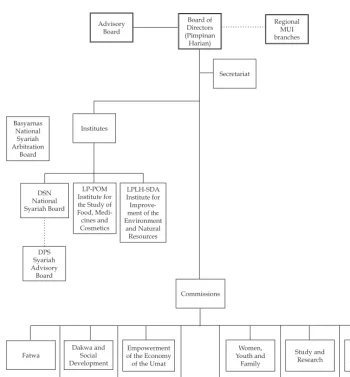
The board of directors oversees the activities of MUI’s various commissions,
which have grown steadily in number, from ive under the New Order (Mufrodi
27 K.H: Kyai Haji. ‘Kyai’ is a Javanese honoriic commonly given to ulama. ‘Haji’ is an
honoriic indicating a person who has completed the haj pilgrimage to Mecca.
28 The advisory board’s membership also includes the current general chair of NU, Said Aqil Siradj, and the current Minister of Religion, Suryadharma Ali, as well as other
prominent Muslim igures, such as Professor Azyumardi Azra, former rector of the Syarif
Hidayatullah State Islamic University and a leading progressive public intellectual; and Salahuddin Wahid, former deputy chair of the National Human Rights Commission. Brother of former NU leader and president of Indonesia, Abdurrahman Wahid, Salahuddin was the vice-presidential running mate of former military commander Wiranto in the 2004 elections. 29 See, for example, differences of opinion on the interpretation of the prohibition of riba, described below.
260 Tim Lindsey
1994: 275) to a current total of 12, as shown in igure 1.30 Of these, the most impor-tant is the Fatwa Commission, chaired by Professor H. Hasanuddin.MUI’s Islamic
Brotherhood (Ukhuwah Islamiyah) Forum, chaired by H. Adnan Harahap, is also
important because it engages with a wide range of Islamic organisations, among them so-called ‘hard-line’ (garis keras) conservative Islamist groups such as the Indonesian Mujahidin Council (Majelis Mujahidin Indonesia, MMI), Hizbut Tah-rir Indonesia (HTI, literally ‘Party of Liberation’, a pan-Islamic organisation) and
the Islamic Defenders Front (Front Pembela Indonesia, FPI) (Ichwan 2005: 49; Gillespie 2007: 213). Through the Islamic Brotherhood Forum, these groups have
30 Details of the membership of MUI’s commisions can be found under ‘Tentang MUI
(About MUI)’ at <http://www.mui.or.id/index.php> (viewed 28 January 2011). FIGURE 1 The Structure of MUI at the National Level
Fatwa Dakwa and Social
often taken part in the issuing by MUI of tausiyah, a form of non-fatwa opinion.31 There is also a Law and Legislation Commission, but this is concerned with MUI’s responses to government legal policy and legislative initiatives rather than with
fatwa.
The board of directors coordinates relations with MUI’s more than 150 regional branches, at provincial and district level and, since 2010, at village level too (MUI
2010: 12). It is important to understand that MUI’s central organisation in Jakarta
does not have clear hierarchical authority over its regional branches. The nature of their relationship is, in fact, sometimes obscure.The central MUI describes its relationship with its branches as ‘consultative’ and based on ‘coordination, com-munication and information’ (MUI 2010). Fatwa produced by central and local branches are therefore regarded by MUI as of equal status, such that one cannot over-ride the other, even if they contradict each other.32 Indeed, MUI’s stated aim is for ‘every MUI fatwa whether at central or local level [to become] positive law’, an aim partly achieved in the legislation described below (at least so far as the
central branch is concerned) (MUI 2010: 73) and in the increasing inluence of fatwa in local politics (so far as its regional branches are concerned) (Hosen 2004; Gillespie 2007).
MUI thus functions more like a national network of autonomous ulama
associa-tions than a single, coordinated organisation. For this reason, its national confer -ences (musyawarah) and the leadership meetings that bring the branches together with the central leadership are very important in developing and coordinating MUI policies. Regional MUI branches often follow the lead of the central MUI, but can also act independently, sometimes even leading the centre.33
MUI’S INSTITUTES
In addition to its commissions, MUI has established a series of institutes at the central level. These have specialised functions and have played important roles in
expanding the inluence on the ‘syariah economy’ enjoyed by the central board of
directors of MUI and its national Fatwa Committee. The best known of these insti -tutes is the National Syariah Board (Dewan Syariah Nasional, DSN or DSN MUI). This oversees the Syariah Supervisory Boards (Dewan Pengawas Syariah, DPS)
that are now required in all Islamic inancial institutions, including banks and takaful34 (Islamic insurance) companies.35 The DSN is chaired by K.H. Ma’aruf
Amin, a member of the inluential national Presidential Advisory Council (Dewan
Pertimbangan Presiden, Wantimpres). It receives funding from the government
31 Tausiyah (Ar. tawsīya) are not fatwa, but general opinions or recommendations that are
often political in nature. They are usually produced not by MUI’s Fatwa Commission but
by other branches of MUI (Ichwan 2005: 45).
32 On this, see article 8, Decision of the MUI Leadership Council on Guidance on Deter
-mining MUI Fatwa, No. U-596/MUI/X/1997; and Hosen (2004: 166–7, 174).
33 See Hosen (2004: 166–7, 174). For a case study of the inluence of local branches on the central MUI, see Lindsey (forthcoming: chs 4 and 12).
34 Takaful (Ar. takāful): Islamic insurance.
35 See Law 21/2008 on Syariah Banking and Law 10/1998 amending Law 7/1992 on Banking, and related regulations.
262 Tim Lindsey
through the Ministry of Finance and the central bank (Bank Indonesia, BI), as well as payments from the various DPS established in Islamic inancial institutions,
which are funded ultimately by those institutions. The DSN is ‘responsible’ to MUI for these funds; that is, MUI has access to the DSN income stream.36
This is important because, like oficial Muftis elsewhere in Southeast Asia, but unlike other inluential Muslim organisations in Indonesia, MUI still lacks mass
membership, as Soeharto had intended would be the case. MUI therefore must continue to look to the government for income. This is earned through its
insti-tutes, in particular, DSN MUI and the Institute for the Study of Food, Medicines
and Cosmetics (Lembaga Pengkajian Pangan, Obat-obatan dan Kosmetika, LP-POM MUI),37 by virtue of the state monopolies granted them on Islamic inan -cial doctrinal compliance and halal certiication, respectively. In addition, the state
provides MUI with an annual budget through the Ministry of Religion. In 2008
this amounted to Rp 2 billion (A$241,742) and in 2009 and 2010 to Rp 3 billion (A$362,613).38 MUI does not publish or publicly discuss its accounts39 but its
state-sanctioned income from the DSN and halal certiication is widely believed to
be much greater than the direct funding it receives from the Ministry of Religion.
These institutionalised links to government conirm that, although formally independent, MUI is, in fact, inancially dependent on the state, just as the state
depends on MUI to provide doctrinal and political support for the bureaucratic system that administers the Islamic legal traditions – in particular as regards the ‘Islamic economy’. The tensions created by the sometimes competing demands of MUI’s nominal independence, pressures from Muslim community organisations and a ‘complicated’ but deep funding and policy connection to the state are not
trivial (Hosen 2004: 154). MUI nevertheless often functions as if it were a de facto
(if often unruly) arm of the bureaucracy – a sort of national Mufti, in fact. That, at any rate, is how the general public in Indonesia usually seems to see it.
MUI has established two other institutions that deserve mention. The National Syariah Arbitration Board (Badan Abritrase Syariah Nasional, Basyarnas) was
originally established by MUI in October 1993, by notarial deed, as the Indonesian
Islamic Arbitral Tribunal (Badan Arbitrase Muamalat Indonesia, Bamui). A foun-dation (yayasan) offering a dispute resolution service for Islamic inance, includ -ing bank-ing and insurance, it also accepts disputes from non-Muslim parties.40
The creation of Bamui was a response to growing interest in Islamic banking; it
was speciically intended to support the activities of Bank Muamalat Indonesia,
36 This is made clear on the ‘DSN MUI‘ page of MUI’s website at <http://www.mui. or.id/index.php> (viewed 5 June 2012).
37 LP-POM’s chair is Amin Aziz; see <http://www.halalmui.org/> (viewed 15 Novem -ber 2011). A brief history is available under the ‘sejarah (history)’ tab at this site (viewed 15 November 2011).
38 For the 2008 budget, see <http://itjen.kemenag.go.id/sirandang/peraturan/de
-tail/3422.html>; for the 2009 budget see <http://itjen.kemenag.go.id/sirandang/peratu
-ran/detail/3538.html>; for the 2010 budget see <http://itjen.kemenag.go.id/sirandang/ peraturan/detail/3731.html> (all viewed 8 June 2012).
39 MUI also declined to respond to direct inquiries about its income and inances. 40 The history of Bamui and Basyarnas is outlined at <http://www.mui.or.id/index. php?option=com_content&view=article&id=57&Itemid=83> (viewed 9 January 2011).
the country’s irst fully-ledged Islamic bank, which opened in 1991. By a decision of the Board of Directors (Kep-09/MUI/XII/2003), Bamui became Basyarnas in 2003, and is now an autonomous branch of MUI. Chaired by H. Yudo Paripurno,
Bamui/Basyarnas has usually acted with independence and is seen as a credible dispute resolution body.
Despite this, Bamui/Basyarnas has not been extensively used. From 1997 to
2010, for example, it decided only 17 cases.41 MUI’s DSN has issued fatwa to the effect that Islamic inance disputes should be resolved by Basyarnas,42 although
how this now sits with the new ‘syariah economy’ jurisdiction conferred on the
Religious Courts in 200643 remains unclear. The judges of the Religious Courts
deal almost exclusively with family law, and other areas of law occupy only a tiny part of their caseload.44 They have therefore been slow to explore the technically complex and challenging area of Islamic inance. Some guidance is offered to the
Religious Courts by the new Kompilasi Hukum Ekonomi Syariah (Compilation of
Syariah Economic Law, KHES). Containing 796 articles, this is a detailed ‘bench -book’, a selection of iqh (Arabic, Islamic jurisprudence) on Islamic inance that draws heavily on DSN MUI fatwa (Hukumonline 2009). Unfortunately, no judicial decisions on the issues covered by the KHES were available to the author at the time of writing.
In late 2010, MUI also established the Institute for Improvement of the Envi-ronment and Natural Resources (Lembaga Pemuliaan Lingkungan Hidup dan Sumber Daya Alam, LPLH-SDA).45 LPLH-SDA’s stated aim is to improve public
understanding of the teachings of Islam on the importance of caring for the envi-ronment and proper management of natural resources. However, it has yet to attract much public attention.46
I now turn to the new regulations governing MUI’s involvement in Islamic
inance, halal certiication and the haj.
41 ‘Basyarnas sosialisasi penyelesaian sengketa muamalah’ [Basyarnas socialises the resolution of muamalah disputes], Republika, 27 September 2010, available at <http://www.
republika.co.id/berita/bisnis-syariah/berita/10/09/27/136724-basyarnas-sosialisasi-penyelesaian-sengketa-muamalah> (viewed 28 January 2011). In that period, a total of 19 cases were submitted. Two were listed as pending in 2010.
42 See <http://www.mui.or.id/index.php?option=com_content&view=article&id=57&It emid=83> (viewed 9 January 2011).
43 See Law 7/1989 on Religious Courts, art. 49 (as amended by Law 3/2006 on Amend -ment of Law 7/1989 on Religious Courts).
44 In 2010, for example, divorce cases formed more than 98% of irst-instance decisions in the Religious Courts across the whole of Indonesia. For details of caseload and case
statistics over recent years, see Sumner (2010); Sumner and Lindsey (2011); and Lindsey
(forthcoming: ch. 8).
45 Decision of the Board of Directors of MUI No. Kep-485/MUI/IX/2010. LPLH-SDA’s chair is Hayu Susilo Prabowo.
46 See <http://www.mui.or.id/index.php?option=com_content&view=section&layout= blog&id=9&Itemid=91> (viewed 10 January 2011).
264 Tim Lindsey
MUI AND ISLAMIC FINANCE
Islamic banking is based on the clear prohibition in the Qur’ān(Al-Baqara, 2: 278;
and Al-cImrān, 3: 130) against taking or receiving riba (Arabic ribā). What ‘riba’
means has been widely debated by scholars since the 1970s, but supporters of Islamic banking worldwide are now settled in their interpretation of it to mean
any form of interest payment. On January 2004, MUI issued a fatwa (No. 1 of that year) restating the prohibition of riba in the Qur’ān, and deining the term broadly to mean any ‘additional charges levied on the postponement of agreed payments’. Muhammadiyah issued a similar fatwa in April 2010.47 Although the
overwhelm-ing majority of Indonesian Muslims continue to use conventional bankoverwhelm-ing
ser-vices, the tiny Islamic banking sector – now around 3% of overall banking activity in Indonesia – is growing at double-digit rates, hitting 60% in 2006, for example (Hamzah 2010: 101).48 As I have written elsewhere (Lindsey forthcoming: ch. 6;
Lindsey 2012) on the wider system for regulation of Islamic banks in Indonesia, I
will here only briely summarise MUI’s role in that system.
During the last decade of the New Order, BI accepted the need to recognise and
regulate the activities of inancial institutions purporting to operate under Islamic
principles. It began developing the policies and systems that now form the basis
of the current regulatory regime (BI 2004: 4). The irst formal step taken by the
government was the enactment of Law 7/1992 on Banking. Although this statute
was, at best, vague about Islamic inance, one of its implementing regulations, Government Regulation 72/1992 on Banks Applying Proit Share-Based Princi
-ples, required that banks ‘applying a proit share-based principle’ (that is, those that offered Islamic banking transactions where proit-sharing is used in place of
forbidden riba) must have a DPS (art. 5).
This requirement has since been adopted in subsequent Islamic banking and
inance regulation in Indonesia, including, for example, Government Regulation 30/1999, which repealed the 1992 regulation but maintained the DPS system.
These regulations provide that the DPS is to be independent of the bank’s man-agement. It is to be the internally authoritative body for determining whether the
bank’s inancial products, services and activities ‘comply with syariah law’, to use the broad phrase repeated in these laws.
Law 10/1998 amending Law 7/1992 on Banking conirmed oficial recognition of Islamic banking in Indonesia. It was the irst statute unequivocally to grant explicit state recognition to Islamic inancial institutions. It placed them on an equal foot
-ing with non-Islamic banks, and opened Islamic inance to the whole bank-ing sec
-tor, although it did not contain many provisions of substance on Islamic inance. A speciic-purpose statute did not exist until July 2008, when the national legislature
(the Dewan Perwakilan Rakyat, DPR) passed Law 21/2008 on Syariah Banking. Again, this did not radically alter the existing regulatory framework for Islamic
47 NU, however, regards the matter as khilāfīya (Ar.), that is, subject to different opinions or
unresolved (‘MUI dan Muhammadiyah fatwakan bunga bank haram, NU Khilaiyah [MUI
and Muhammadiyah fatwa make bank interest forbidden]’, Voice of Al-Islam, 5 April 2010,
available at <http://www.voa-islam.com/news/indonesia/2010/04/05/4722/mui-dan-muhammadiyah-fatwakan-bunga-bank-haram-nu-khilaiyah> (viewed 9 January 2011). 48 On Islamic banking in Indonesia generally, see Karim (2005); Juoro (2008); Hamzah
(2010); and Venardos (2012).
banking, but it provided important political support and consolidated existing
laws to ‘tidy up’ inconsistencies (Hamzah 2010: 104).
Despite this, the substantive law applicable to Islamic banking remains a jig-saw of instruments, many issued by BI and most relying, directly or indirectly, on MUI rulings. In 2008, for example, BI released a Code of Islamic Banking
Prod-ucts that aims to create consistency in the market by deining the commonly used forms of Islamic inancial transactions.49 It identiies the MUI fatwa, BI
regula-tion and accounting standard relevant to each transacregula-tion type, as well as the kind of Islamic banking institution authorised to offer each product.The Finan -cial Accounting Standards Board (Dewan Standar Akuntansi Keuangan, DSAK) of the Indonesian Accountants Association (Ikatan Akuntan Indonesia), working
with BI and Islamic inancial institutions, has also prepared various Statements of Financial Accounting Standards (PSAKs) for Islamic banking.50Again, all were
approved by MUI’s DSN before issue.
Like Islamic banks, Islamic insurance enterprises in Indonesia are distinguished from their conventional counterparts by the requirement that they have a DPS, in
this case imposed by various decisions of the Minister of Finance rather than by BI (see, for example, No. 424/KMK.06/2003). As in the case of Islamic banks, the
DPS in insurance companies is an independent body, separate from the insurance company’s management, and it determines whether or not insurance products, services and activities comply with the usual ‘syariah-compliance’ requirements
imposed by various regulations issued by the Ministry of Finance and relevant
accounting bodies.
The DPS is therefore the key to ‘Islamicity’ in the day-to-day functioning of all businesses operating in Indonesia’s ‘syariah economy’. In both Islamic banks and insurance companies, membership of the DPS is limited to ‘people with substan-tial knowledge of syariah laws’. Each DPS is required to consult the DSN MUI for guidance on issues of doctrine, which the latter usually gives in the form of fatwa
or other rulings. This system gives the DSN MUI great authority over all religious
aspects of Islamic inance in Indonesia and it has been active in exercising that
authority.The DSN MUI issued more than 50 fatwa between 1993 and 2003 offer
-ing ‘guidance’ relat-ing to ‘Islamic economy and inance’ – encompass-ing both
Islamic banking and Islamic insurance – as well as many other types of rulings
and statements (DSN 2003: 135, cited in Suma 2006: 41). It has, for example, sum -marised the role of the DPS as being to undertake periodic supervision of the business in which it is nested; to submit proposals for the development of the business to both the business and the DSN; to report on the products and
opera-tion of the business to the DSN at least twice in every inancial year; and to refer
questions that require resolution to the DSN.51 Probably the most important DSN
fatwa for the insurance industry is No. 21/DSN-MUI/X/2001, which requires that
49 The full Code is available at <www.bi.go.id/NR/rdonlyres/1DFA882B-16DB-44C9-8461-5CA3D8C637A5/16893/CODIFICATIONOFISLAMICBANKINGPRODUCTS.pdf>
(viewed 8 November 2010).
50 For a list of Indonesian accounting standards and interpretations, see <http://www. iasplus.com/en/jurisdictions/asia/country10> (viewed 8 June 2012).
51 See DSN MUI fatwa No. 21/DSN-MUI/X/2001 and No. 01/DSN-MUI/2000, under the
‘Fatwa DSN MUI’ tab at <http://www.mui.or.id/index.php>.
266 Tim Lindsey
all implementation of Islamic principles within the business must be done ‘in con-sultation with, and under the supervision of,’ the DPS.
There is some controversy about the fees payable to DPS members. Because
the DPS is an additional entity not required in conventional inancial institu -tions, it is often argued that it contributes to increasing premium costs for Islamic
inance businesses, although DPS supporters, of course, reject this argument (Suma 2006: 43). Instead, they follow MUI’s (unsurprising) position, arguing that
while these fees are a cost that is unique to Islamic businesses, compliance with
Islamic norms in fact increases proitability. Accordingly, they claim that DPS fees do not render Islamic inance uncompetitive.There are also concerns about the impartiality and integrity of DPS members, given that they are funded by the banks and insurance companies they oversee, and therefore presumably have
some interest in approving their inancial products and activities. These issues
are, however, unlikely to lead to the abolition of the DPS system, which now
seems as entrenched in the inance sector as in the government system for the
administration of syariah. The DPS system will probably continue for some time yet, providing employment for ulama and graduates of the new ‘syariah economic law’ courses springing up in the Islamic tertiary education system across the
country (Lindsey forthcoming: ch. 7).
MUI AND HALAL CERTIFICATION
MUI exercises an effective monopoly over Indonesia’s halal certiication scheme
similar to that which it enjoys in relation to doctrinal compliance in Islamic bank-ing and insurance. Halal certiication is essentially a labelling system by which
Muslims can be assured that products comply with Islamic rules about ritual cleanliness, and do not breach any other doctrinal prohibitions. Halal certiica -tion is relevant to a wide range of products, but is especially important for food and, in particular, meat, by reason of ritual requirements relating to slaughter and butchery. As with its role in banking and insurance, the formal basis for MUI’s
halal monopoly is found not in a single statute but rather in a series of intercon-nected regulations, in this case all relating to LP-POM, MUI’s food, medicines and cosmetics institute.
Law 18/2001 on Animal Health and Husbandry sets basic requirements for
halal certiication of meat in Indonesia.52 It requires that ‘animal products
pro-duced in and/or imported to Indonesia for distribution must be accompanied by ... a halal certiicate’ (art. 58(4)), that is, an ‘explanatory document issued by a halal certifying body in Indonesia’ (Elucidation to art. 58). The Law also provides that ‘animal products exported from Indonesia must be accompanied by ... a halal certiicate if required by the importing country’ (art. 58(5)). Minister of Agricul -ture Regulation 20/Permentan/OT.140/4/2009 likewise obliges all businesses in foreign countries producing carcasses, meat or offal for import to Indonesia (other than those producing pig products) to have an internal system and permanent
52 See articles 17, 22, 34(2), 61(2), 78(6) and 82. This Law replaced Law 6/1967 on Animal
Health and Husbandry.
staff to ensure their products are halal (art. 15(1)(d).53These oficers are to be ‘con
-trolled and supervised by a Halal Certiication Institute recognised by and coop
-erating with [LP-POM MUI] and the Fatwa Commission of the Central Branch of
MUI’ (art. 15(1)(e)). Every import of carcasses, meat or offal is to be accompanied
by a certiicate that records the name and address of the registered halal certii -cation body in the exporting country ‘accredited by MUI’ (art. 15(2)(a)).MUI is
mentioned again in articles 41 and 45. The latter provides that:
[i]n order to increase community involvement and the protection of consumers from carcasses, meat and/or offal that does not meet the requirements of hygiene and sanitation or the peace and well-being of the community, [supervision] may involve the participation of MUI ... and other relevant community organisations and associations.
MUI also has a comprehensive formal role in relation to halal food labelling and advertising in general.Article 30(2)(e) of Law 7/1996 on Food states that ‘every person who produces or imports packaged food into Indonesia for commercial purposes must attach a label on and/or in the package’ that states whether the product is halal. According to article 11(1) of Government Regulation 69/1999 on Food Advertising and Labelling, the food must irst be checked by an accred -ited inspection agency (art. 11(1)).This inspection is to be conducted according to guidelines issued by the Minister of Religion, who is to take into account
‘recom-mendations of the religious organisation with competence in the ield’ (art. 11(2)). The Elucidation to Regulation 69/1999 explains that this is a reference to MUI.
In Decision 518/2001, the Minister of Religion issued guidelines and
proce-dures for the inspection and identiication of halal food. These oblige all com-mercial packaged-food producers and importers who claim their food is halal to submit their produce to the inspection agency (art. 2(1)).The Decision also sets
out criteria for certiication as an inspection agency (art. 2); procedures for apply
-ing for a certiicate (art. 3); internal systems that applicants must put in place
(art. 4); requirements for a product to be halal (art. 7); procedures for inspection (art. 7); requirements for halal labels (art. 10); and more.Once issued by an
inspec-tion agency (art. 8(1)), a certiicate is valid for two years and is renewable (art.
8(2)). The inspection agency may conduct random inspections (art. 9(1)) and may
revoke the certiicate (art. 8(3)).Holders of certiicates must inform the inspection
agency of changes to their products or processes (art. 9(2)). Article 1 grants this inspection power to MUI, appointing it ‘as the inspection agency for food that is said to be halal, that is packaged for trade in Indonesia’. Article 3(1)(b) also pro -vides that, where the food contains animal products, the producer/importer must
include with the application a certiicate from MUI (or a foreign halal certiication
body recognised by MUI) stating that the animal was killed in a halal manner. This is in line with Minister of Agriculture Regulation 20/Permentan/OT.140/4/2009,
53 Minister of Agriculture Regulation 20/Permentan/OT.140/4/2009 on the Importation
and Supervision of the Distribution of Carcasses, Meat and/or Offal from Overseas. This
replaced earlier regulations made under Law 6/1967, but its provisions in relation to halal certiication are essentially the same.
268 Tim Lindsey
and means that producers and importers may need two MUI Halal Certiicates in
certain circumstances.
It appears that LP-POM is, in fact, the only institution in Indonesia appointed as an inspection agency for halal food, although its standing is not entirely clear.
Both article 11(1) of Government Regulation 69/1999 and article 2(4) of the guide -lines in Decision 518/2001 provide that any inspection agency for halal food must be accredited by the National Accreditation Committee (Komite Akreditasi Nasional, KAN), part of the National Standardisation Body (Badan Standardisasi Nasional, BSN).Interestingly, KAN’s website suggests LP-POM MUI is, in fact, not registered with KAN. Presumably, its appointment by the Minister of Reli-gion in his Decision 519/2001 exempts MUI from this requirement. In any case, the guidelines in Minister of Religion Decisions 518/2001 and 519/2001 give LP-POM regulatory powers as well.Article 13 of the guidelines delegates ‘technical
matters’ relating to the inspection and certiication of halal food to the ‘inspection agency’, that is, MUI.Article 3 of Minister of Religion Decision 519/2001 allows inspection activities to be further regulated by the Minister of Religion and MUI, ‘both separately and together’, and refers to the decision of the board of directors of MUI establishing LP-POM for these purposes (No. 018/MUI/I/1989).A list of regulations and guidelines issued by LP-POM pursuant to these powers can be found on its website,54 and a large number of MUI’s fatwa concerning the halal
qualities of different foods, pharmaceuticals and cosmetics, and permissible ways of slaughtering animals, are now also available online.55
To this extent, MUI fatwa in Indonesia are no longer always just religious rec-ommendations issued from civil society that lack binding force, as in the past. In the case of the halal certiication industry, as for Islamic banking, some MUI fatwa
now have legal status as enforceable regulatory instruments of state.
The regulations also conirm that halal certiication is a source of income for
MUI.Article 11(1) of Minister of Religion Decision 518/2001 states that the costs of inspection and labelling are to be borne by the applicant, that is, the producer or importer.Article 11(2) adds that the ‘government has an obligation to provide support in the way of policy, personnel and budget, both from the State Budget and from other lawful sources’.Similarly, article 4 of Decision 519/2001 provides that ‘the costs of implementing the [inspection] activities shall be borne by the producers or importers who make the application, the State Budget and other
lawful sources’. MUI is thus entitled to charge a fee to businesses seeking certiica -tion and to receive funds from the government and ‘other sources’ to support the activities of LP-POM.
One problem created by these overlapping and dispersed regulations is uncer-tainty as to whether halal certiication is mandatory. Article 30(1) of Law 7/1996 requires producers to obtain certiication only if they claim their food is halal
(emphasis added). The Elucidation to article 10(1) of Government Regulation
69/1999 likewise states that the inclusion of a halal certiicate on the food label is
required only ‘if the producer or importer of food into Indonesia for commercial
54 See ‘Peraturan POMMUI’ (POM MUI Regulations) at <http://www.halalmui.org/in
-dex.php> (viewed 9 December 2010).
55 MUI fatwa on halal issues can be found under ‘Fatwa MUI’ at <http://www.halalmui. org/index.php> (viewed 9 December 2010).
purposes claims the food in question is halal for Muslims’ (emphasis added).56 Law 18/2009 provides, however, that all ‘animal products produced in and/or imported to Indonesia must be accompanied by ... a halal certiicate’ (emphasis
added). Halal certiication is also mandatory under Minister of Agriculture Regu -lation 20/Permentan/OT.140/4/2009 (with an exception for pig products).
This contradiction has caused confusion among food producers and importers in Indonesia. A bill to rationalise the regulation of halal certiication was there -fore planned for enactment in September 2009, but was delayed by objections from the business sector and food organisations to halal certiication becoming unequivocally compulsory. Unsurprisingly, MUI wishes certiication to be man
-datory and MUI to continue as the sole certiication and inspection agency, a role it has enjoyed since LP-POM began issuing certiicates in 1994. Against this, it is claimed that compulsory certiication will be restrictive for small and
medium-sized businesses, and will increase food prices for consumers.57 Some wish the
government, rather than MUI, to take responsibility for halal certiication. Others
would be happy for any organisation to conduct inspections and issue halal
cer-tiicates, so long as it is accredited by KAN. The Religious Court has also made an
ambit claim, arguing that, constitutionally, it is the only institution with authority
to make a inal and binding determination on whether something is halal. At the time of writing, the halal certiication bill was still under consideration
by the DPR. MUI continued to enjoy its effective monopoly on halal certiication
in Indonesia and the important income stream resulting from it.
MUI AND THE HAJ
The haj, or pilgrimage to Mecca, is a ritual in which all able-bodied Muslims should participate at least once in their lives (Qur’ān, Al-ḥājj, 22). In a nation of 240 million, where more than 80% are Muslims, this personal obligation becomes
a matter of national importance. Massive bureaucratic, inancial, legal and logistic
challenges are created by hundreds of thousands of Indonesians wishing to travel to Saudi Arabia and back every year during the Muslim month of Dhū al-ḥijja (and outside that month for umroh, the lesser pilgrimage). They are naturally matters of concern to the state, and affect the government’s standing in the eyes of Muslims. It is thus not surprising that the government has recently granted MUI a small but important role in the administration of the haj by the Ministry of Religion.
The Saudi Arabian authorities operate a quota system for pilgrims from each
country, set in 2008 at over 200,000 for Indonesia (Hooker 2008: 209). The adminis
-tration of this quota in Indonesia involves ixing provincial and district-level quo -tas; managing the waiting list; issuing special passports; providing appropriate
56 The Elucidation to article 11 conirms this: ‘The writing of the word halal is essentially voluntary. However, every person who produces and/or imports food into Indonesia for commercial purposes and claims that it is a halal product must … write the word halal on the label.’
57 See, for example, comments by the Food and Beverage Industry Information Centre
(Pusat Infomasi Produk Industri Makanan dan Minuman, PIPIMM) after a hearing with
Committee VIII of the DPR on 23 September 2008, published 23 October 2008 at <http:// www.pipimm.org/cetak.php?id=37> (viewed 7 August 2010).
270 Tim Lindsey
accommodation, transport, baggage-handling, security, health care and insur-ance; and advising pilgrims on the proper performance of rituals.58 Despite the
national importance of Indonesian involvement in the haj and the logistical com-plexity it involves, its handling by the Directorate General for Haj and Umroh in the ministry has long been criticised (often with good reason) for neglect, incom-petence and even outright corruption.
Under Soeharto, administration of the haj – previously managed privately – was placed under the authority of a directorate general in the ministry, and the area was governed largely by a series of ad hoc presidential decisions. Major reforms were introduced only after Soeharto’s fall, by Law 17/1999 on Haj
Implemen-tation and Minister of Religion Regulation 371/2002. These instruments created
the comprehensive system for the management of the haj, described in detail by
Hooker (2008: ch. 5). The reforms did not, however, resolve the problems of mis -management and fraud long associated with the administration of the haj. In Feb
-ruary 2006, for example, the former Minister of Religion, Said Agil Al-Munawwar,
and a former director general responsible for the haj, Tauik Kamil, were con
-victed of embezzling over Rp 652 billion ($82,748,300) of haj funds.59 The resulting
scandal led to calls for further reform of the system for administration of the haj in
Indonesia, and resulted in the passing of Law 13/2008 on Haj Administration.60 The new Law conirmed the Minister of Religion as sole organiser and chief coordinator of the government’s ‘national duty’ to assist pilgrims (arts 1(19), 6
and 8), but also introduced two new bodies that dilute the ministry’s once
sweep-ing authority in this area. The irst of these is the Indonesian Haj Supervisory Commission (Komisi Pengawas Haj Indonesia, KPHI). Under article 13, the KPHI
is independent of the ministry and is responsible directly to the president. It is also separately funded from the state budget (art. 18) and reports annually to the president and the DPR (art. 7). The principal job of the KPHI is to monitor the ministry’s administration of the haj (arts 1(7), 7(7) and 12). It also works with external bodies to provide policy advice to the government on how to improve
haj services. Of the KPHI’s nine members, three are appointed by the ministry and six must be members of MUI or Muslim social organisations, or leaders of Mus-lim society. It would be very surprising if MUI members were not among those
chosen. More speciic qualiications are set out in article 17. The nine members
serve three-year terms (art. 14) and choose their own chair (art. 15). The president
may dismiss a member after hearing the opinion of the DPR (art. 16). Clearly, the
expectation here is that giving MUI a formal role in this new ‘integrity watchdog’ will improve the quality of haj services.
The second new body is the Umma Perpetual Fund Management Agency
(Badan Pengelola Dana Abadi Umat, BP DAU).61 The BP DAU is responsible
for overseeing and managing the Umma Perpetual Fund or DAU (arts 1(17) and
48–50), part of which is used for the organisation of the haj. The agency reports
58 See Hooker (2008: ch. 5) for a detailed account of haj administration in Indonesia prior
to Law 13/2008.
59 ‘Said Agil jailed in Haj scandal’, Jakarta Post, 8 February 2006. 60 See also Regulation in Lieu of Law 2/2009, amending Law 13/2008. 61 ‘Umma’ and ‘umat’ are variants of ‘ummat’ (religious community).
to the president and the DPR (art. 62) and comprises a chair, a supervisory board
and an implementation board (art. 47). The supervisory board has the same mem-bership structure as the KPHI, that is, three members appointed by the ministry and six who are members of MUI or Muslim social organisations, or are leaders of Muslim society (art. 52). These members, who are always likely to include MUI
representatives, choose their own chair and deputy chair (art. 54(6)). The imple
-mentation board has seven members – all government oficials appointed by the minister – who choose a chair from among their number (art. 53). Members of
both boards serve for three years (art. 54) and can be dismissed by presidential decision (art. 55).
Under the current system, a would-be pilgrim is required to register with the
Haj Administration Committee (art. 11) in the local ofice of the Ministry of Reli -gion (art. 5(a)) and pay a fee known as the BPIH (Biaya Penyelenggaraan Ibadah Haj, haj administration payment) (arts 1(8) and 5(b)). He or she is then placed on
a waiting list (art. 26), based on the regional quotas set by the minister (art. 28).
In return, the government accepts responsibility for providing ‘accommodation, transportation, health care, security’ and other necessary services when the
pil-grim’s turn eventually arrives (arts 6 and 31–37), and it may not seek additional payments (art. 29). The BPIH is ixed by the president on the basis of a recommen -dation from the Minister of Religion and must be approved by the DPR (art. 21). The intending pilgrim pays the BPIH into accounts held by the Minister of Reli-gion in Islamic banks or nominated conventional banks with Islamic ‘windows’ (art. 22 and Elucidation). The ministry must report annually on the status of haj
funds, within three months after the haj season inishes (art. 25).
The DAU is made up of the balance of these funds as well as funds from ‘other sources’, such as hibah62 (arts 1(17), 25 and 58). The DAU funds are to be invested in ‘syariah-compliant’ ways for the ‘beneit of the Muslim community’ (arts 47 and 57) and to fund the operational costs of the BP DAU (art. 60). At present, the BPIH is set at Rp 25 million (A$3,500), a high cost by Indonesian standards. Total
funds held are estimated at Rp 1.2 trillion (Osman 2011), a level that gives added importance to MUI being awarded more or less certain representation on both the KPHI and the BP DAU.
The new system has not, however, solved the problems of poor governance so long associated with the state administration of the haj in Indonesia, as in so
many other Muslim countries. In January 2011, for example, the ministry admit -ted that it had ‘dipped into’ haj funds (Osman 2011). Abdul Ghafur Djawahir, secretary of the ministry’s Haj Directorate, said the ministry used interest earned
from pilgrims’ deposits to pay for its oficials’ trips to Mecca because ‘we believe
the people who can afford to go on the hajj are those who are inancially secure,
even though we realise that many people have to save for years to go on the pil-grimage’ (Osman 2011). The way these funds were used by the ministry has also been questioned by the Anti-Corruption Commission (Komisi Pemberantasan Korupsi, KPK), and there is debate as to whether earning ṣukūk (Arabic, Islamic bonds) ‘interest’ on pilgrims’ funds is permissible at all or a breach of articles 47
and 57 of Law 13/2008, to say nothing of the Islamic prohibition on riba. Amend-ments to the Law to clarify how pilgrims’ funds are to be managed were under
62 Hibah (Ar. hiba): donations.
272 Tim Lindsey
consideration by the DPR at the time of writing,63 but it is likely that MUI will retain its new place in the haj system.
CONCLUSION
MUI owes its current prominence to the fact that the New Order set it up as a tool to manage Muslim opinion. In the post-Soeharto period, however, it has increas-ingly been recognised as the opposite – a means by which Muslim leaders can
inluence state policy.From being seen as an often-compliant agent of the New
Order’s statist and developmentalist policy on Islam, MUI now presents itself instead as a champion of a conservative and often populist orthodoxy that some-times challenges government policy.
Despite this, MUI has managed to retain and exploit the state endorsement
irst granted it in 1975. In fact, it has expanded its oficial roles in the state admin
-istration of Islamic legal traditions, now fulilling key regulatory functions in the Islamic banking, inance and halal certiication industries, as well as winning inluential participation in overseeing the state’s administration of the haj. In this
way, it has, as Hasyim (2011: 23) puts it, elevated ‘its inluence from the theologi -cal and social level to the legal one’, and made a place for itself at the heart of the
bureaucratic Muslim ‘establishment’ of Indonesia, funded by, and inluencing, the government. More signiicantly still, certain fatwa of MUI now have
regula-tory status as a form of quasi-legislation, relecting MUI’s public position as the
most authoritative source of fatwa in Indonesia from the government’s perspec-tive. This is a relatively new development for Indonesia, where fatwa have usually been characterised by their diversity and non-binding nature, and by the fact that they are a product of civil society rather than of the state.
A little over half a decade ago, Saeed wrote that the pluralism of Islam in
Indo-nesia and ‘the absence of a uniied religious outlook’ makes it ‘dificult for a par
-ticular local orthodoxy to be imposed’, even by MUI (Saeed 2005: 11). These words
remain true in 2012 but it is also the case that MUI has expanded its reach in the post-Soeharto period, particularly as regards the administration of the ‘syariah economy’. In this way, MUI has moved closer to the model of the oficial Muftis
of the Malay world, state fatwa-givers who are certainly able to impose ‘particular local orthodoxies’. It remains to be seen how much further MUI can go towards
becoming an oficial national Mufti capable of imposing broader legal Islamisa -tion, in the way its counterparts have done in Brunei and Malaysia.
63 In 2010, the constitutional validity of Law 13/2008 was also challenged in the Constitu
-tional Court (see Mahkamah Konstitusi, No. 51/PUU-VIII/2010). Farhat Abbas and Windu
Wijaya, who claimed to have been ‘waiting in the queue for years’ to go on the haj, argued that the ministry’s monopoly on the haj, and, in particular, the BPIH and the quota system, violate the freedom of religion guaranteed in article 29(2) of the Constitution. The Court, however, pointed out that quotas and conditions for the haj are imposed by Saudi Arabia’s government, not Indonesia’s, and that, in fact, Saudi Arabia requires the Indonesian state to manage the process. If the Law is revoked, it asked, ‘then who will be charged with the
administration of the Hajj?’ (Hukumonline 2010). When the applicants realised that if their application was successful it might prevent Indonesian Muslims from taking part in the haj entirely, they withdrew it.