Evaluation of Islamic Management of Beef Cattle Development
Program of Lembaga Mandiri Mengakar Masyarakat; Case
Study in Pesantren Al Mawaddah Warrahmah Kolaka-
Sulawesi Tenggara
M
UHAMMADA
SKARIZ
AKARIAHSTAI Al Mawaddah Warrahmah Kolaka, Sulawesi Tenggara [email protected]
Abstract: The purpose of the research were to analyze the level of achievement of islamic management on beef cattle development program of Lembaga Mandiri Mengakar Masyarakat (LM3) in Pondok Pesantren Al Mawaddah Warrahmah Kolaka-Sulawesi Tenggara Case. The research was conducted January 2012-January 2016. Independent agencies are Rooted in the Community in Pondok Pesantren Al Mawaddah Warrahmah as respondent were selected. The data were statistically analyzed by descriptive analysis to analyze the achievement of the program. The result showed that the achievement level of amount of beef was high in periode 2012, 2013, 2014, and 2015 (75, 78.5, 75, and 88.88 % respectively), number of farmer was low (100, 100, 100, and 57.4% respectively) from its target, profit sharing was high (Rp.10.425.000, Rp.16.700.000, Rp.17.500.000, dan Rp.21.025.000).). That can be concluded that program of independent agencies are rooted in the community (LM3) in Pondok Pesantren Al Mawaddah Warrahmah case is effective.
Keywords: Evaluation, Management, Beef Cattle, pesantren.
Introduction
center (agent of development), and changes (agent of change), as well as social control (the agent of social control).
Lembaga Mandiri Mengakar Masyarakat (LM3) program is made one of them to boarding schools, because the schools are independent institutions and rooted in society need to play an active role in assisting the development of agriculture, especially in the field of food crops, horticulture and agro-processing. Boarding school is an independent institution in the middle of the community are given the motivation to active in the development of agriculture by means of given programs and activities in the form of capital assistance to try. LM3 program is one form of agricultural development that includes boarding school in order to improve the livelihoods of farmers in terms of students and guardians of students. Boarding school been in the program because it could motivate the public around the cottage, because the religious leaders in the religious educational institution is very close to the people so as to help the successful continuity LM3 program.
Basyuni (2008) states that pesantren as LM3 expected to be a dynamic factor in establishing, and developing, independence movement and the growth of the economy. The availability of land, and market share in the boarding school, it is possible for economic development. Pesantren as LM3 is expected to grow the business by using modern management principles and which is based on collective leadership. In the development of pesantren independence through agricultural activities should be understood in terms of follow-up boarding school, as an educational institution that is independent of the community, by the community, and to society. For that programs developed duly developing the potential for economic self-sufficiency through life skills empowerment of religious leaders and students. Islamic boarding school with different expectations and predicate is put to him, actually led to the three main functions that always carried, namely: first as the central cadre of thinkers religion (center of excellence). Second, as an institution that prints human resources (human resources). Third, as an institution that has the power to empower the community (agent of development). Pondok pesantren also understood as parts involved in the process of social change (social change) amid changes (Faozan, 2006).
existence LM3 can really benefit the beneficiary and the surrounding community. A necessary condition for the success of the LM3 is intensive coaching from mentoring, especially at the beginning of the program implemented. LM3 companion must also actively guide the beneficiary community groups. Given the strategic role LM3 especially in schools and community empowerment around, need to do more in-depth analysis of the institutional aspects, sustainability, and empowerment. In general, the program LM3 considered to be very helpful in developing the business managed by the institution rooted in the community such as boarding schools (Pusat Sosial Ekonomi dan kebijakan Pertanian, 2009). Continuation agribusiness development program at a time in order to anticipate the impact of global financial crisis on the poor community and other vulnerable groups in rural areas, from 2006 to 2009. The agriculture ministry has allocated the budget of more than Rp. 700 billion for the empowerment and development of agribusiness through 4354 LM3 scattered throughout Indonesia (Lembaga Pengembangan Perbankan Indonesia, 2012).
Hadi (2015), said that the boarding school could be developed into a center for information and education on agribusiness development, and as a financial institution in order to serve the surrounding community. There are three elements in developing institutions and public root (LM3) in boarding schools, namely:
1. Development/strengthening of institutions. In order to prepare for boarding to assume this role, especially with regard to local economic development, institutional guide earnest and reinforcement will be needed. Both of these will exist in it pesantren itself, and also inside the institutions relevant village.
2. Human Resource Development. Human resource development is organized in two levels; human resource development in the boarding school itself, and among members of the community chosen for it is interested in the development of agribusiness. Besides, the development of human resources of the boarding school, which in based on focuses on teachers, human resource development also makes the community who settled around the site boarding school as a target, either formally or be queried "on the job training".
be used as a laboratory experiance for boarding school and as a learning center for the community around them. For activities within the community, seems to lead to the development-oriented groups and is expected to generate a plasma for the development of agribusiness community groups in the future, under the guidance of the boarding school.
The condition LM3 relatively scattered and nature spots as well as with activities that vary widely it is necessary to design a comprehensive development design LM3 from upstream to downstream. Thus it would be guaranteed continuity of operations and their future development so that the existence LM3 program can benefit both the beneficiary and around (Pusat Sosial Ekonomi dan kebijakan Pertanian, 2009). Therefore it is necessary to conduct research evaluation of beef cattle development program at an independent institution that is rooted in the community (LM3), especially in Pondok Pesantren Al Mawaddah Kolaka, Southeast Sulawesi.
Material and Method
The experiment was conducted at Pondok Pesantren Al Mawaddah Warrahmah as the Independent Institute Rooted in the community (LM3). Selection of pesantren Al Mawaddah Warrahmah for boarding these LM3 ongoing and continuous since 2009 until now. The research was conducted from 2011 to 2015. Pondok Pesantren Al Mawaddah Warrahmah which serve as the respondent is the recipient for Lembaga Mandiri Mengakar Masyarkat/the Independent Institute Rooted in the community (LM3) to obtain data and information, then conducted intensive support since the aid is given.
DR. KH. M. Zakariah, MA, agribusiness development center moved to Mowewe sub-regency, East Kolaka Regency.
Measurements for the results to society and LM3 using descriptive method, whereas for determining the success rate and the number of livestock breeders LM3 partners using the formula percentage success rate. The success rate is level categories to serve as the basis in determining the successful achievement of beef cattle development program. Determining the success rate is based on a specified target is a 100% success rate for each criterion. Category be used is a) Lower, on the achievement of the target of 0-33%, b). Medium, on the achievement of the target of 34-66%, and c) High, on the achievement of the target of 67-100%. Data secondary (supporting) from LM3 Pondok Pesantren Al Mawaddah Warrahmah higher than reported by Sonbait (2011), that beef cattle development program gaduhan (Islamic management) through a group of community-rooted self-Organization in Monokwari, West Papua has an average income earned/sharing profit is Rp. 5, 212, 500 per year.
Table 1. Level of profit sharing to the community and LM3. Year Balance Cattle purchases Sold out Profit Sharing
LM3
2012 Rp.51,225,000 Rp.40,800,000 Rp.61,650,000 Rp.10,425,000 4 Rp.10,425,000 2013 Rp.65,725,000 Rp.47,500,000 Rp.80,900,000 Rp.16,700,000 5 Rp.16,700,000 2014 Rp.75,700,000 Rp.58,200,000 Rp.93,200,000 Rp.17,500,000 6 Rp.17,500,000 2015 Rp.98,894,500 Rp.76,700,000 Rp.118,750,000 Rp.21,025,000 4 Rp.21,025,000
ownership of the required asset, the farmer contributes certain % of total price and the rest would be paid by LM3. LM3 afterwards rents its share out to the farmer, both parties share the risks on pro rata basis.
Musyarakah (Al Sharikat Al Zira’iyyah) is good path for community development. Farmer think that getting benefit/profit without determination from LM3. Iqbal et al (2014), said that commercial puposes partnership project can take two forms i. e. agriculture and trading. Agriculture partnership (Al Sharikat Al Zira’iyyah) are three further division of this category: Muzara’ah (Share cropping), it’s a kind of agricultural partnership in which the land is contributed by a party while th other party cultivates it and does all the work and then the yield is divided between the two;
Musaqah (share watering) this is another kind of agricultural partnership in
which the land and trees are provided by one partner and the other does all the work and takes care of the trees and then the fruit is shared between two;
Mugharasah (share planting) this is a kind of agriculture partnership, in this
kind of partnership, the land and plants are provide by one party dose the planting work and gets a share in the crops.
Increasing the number of livestock and livestock selling price in the market has made for the results of LM3 and partners to be quite high. Ilham (2009), stated that the demand for beef continues to increase so that the gaps of production and consumption continues to grow, as a result the price of beef in the domestic market continued to rise to rise. It is added Center Trade Policy in the State (2013) that the determinants of the price of beef from the supply side is the price of beef local, the price of imported beef, the number of cattle production local, reproductive technologies, the number of cattle population, the level of real wages, interest rates , the capital, and the real price of cattle.
Sharing profit was done with transparency to farmer who partner LM3, it was done based on Islamic shariah. Transparency on profit sharing influenced many farmer interested to join beef cattle development program of LM3. System sharing profit 50:50 was done LM3 Al Mawaddah Warrahmah is good and make comfort zone for farmer and LM3. Khasanah
et al., (2013), said that Profit sharing (PS) has equality (reflected on the
becomes good social capital for farmers society. Iko (2008), showed that system profit sharing 50:50 was thought as good method for owner and worker. Farz Foundation (2011), showed that expected profit sharing in pakistan on completion of the first partnership cycle is 50:50 (farmer : investor and farz share). Bouzar (2012), said that profit sharing in Islamic microfinance, the lending institution is no longer a sole financier but becomes a co-owner of the business with a strong interest in its success.
Success rate of achieving the development of beef cattle in the program LM3
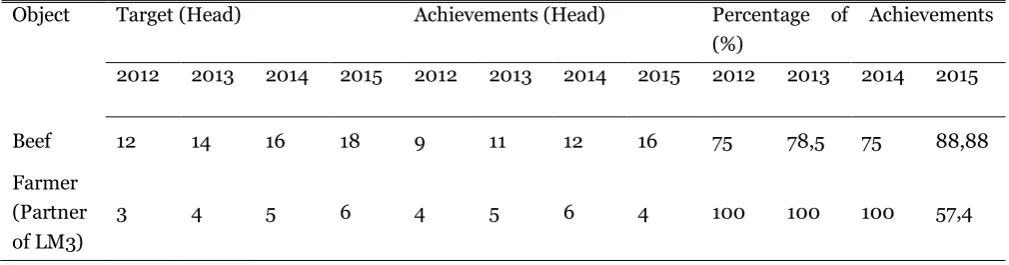
The level of success in achieving the development of beef cattle on LM3 program, as the comparison is presented in Table 2. The number of cattle LM3 boarding school in parentheses last 4 years since 2012 until now has increased. Percentage of achievements is fluctuating, percentage was get from achievements divided target. On 2015, LM3 have number beef cattle highest than previous years. The achievement of targets in this study is higher than that reported by the LM3 program Kamil (2015), said that LM3 Babussalam during a three-year timeframe of 10 cattle (consisting of bulls and cows ) just gave birth to 12 calf.
The number farmer as partner of LM3 increased from 2012 until 2014 year (percentage achievement is high level) , and decreased on 2015 year (percentage achievement is medium level), because any change or reconstructed technical management. Social and Environmental Assesment Team PT. Intersys Kelola Maju (2006), Lembaga Mandiri yang Mengakar di Masyarakat (LM3) will be promoted through collaboration with farmer organizations, these LM3 have been welcomed by the communities near these institutions because they strengthen the economy and society of of the communities.
Table 2. Level of success in achieving the development of beef cattle on LM3 program
Object Target (Head) Achievements (Head) Percentage of Achievements (%)
2012 2013 2014 2015 2012 2013 2014 2015 2012 2013 2014 2015
Beef 12 14 16 18 9 11 12 16 75 78,5 75 88,88
Farmer (Partner of LM3)
Institutional LM3 islamic boarding school in its function to also drive the economy, society, certainly not free from the constraints and technical and non technical barriers. This is due to several issues and problem resolutions, among others:
1. Technical factors
Technical factors as something quite important and influential in the success of the program LM3. Technical factors referred to is selecting prospective partners LM3. Potential partners must go through the selection phase LM3. LM3 selected potential partners to be honest, enterprising, and a clean track record. In the selection process, candidates LM3 partners who do not qualify will not enter into LM3 partners. In practice, the selection is still there are potential beneficiaries who do not meet the requirements, so that in 2015 the number of partners LM3 lowered, it is to improve the effectiveness and efficiency of development LM3, so the results of LM3 partner selection in 2015 based on objectivity and selectivity. Kutsiyati et al., (2009) stated that the selection of farmers should not promote the alumni/students, but give priority to experience, ownership cowshed, a good reputation in the community and live around schools. b. Institutional factors
Institutions have been set up by the foundation under the Development Business Unit, but not professional in the development of LM3, it is motivated by the background of personnel Development Business Unit which oversees LM3 almost all the educational background of teachers, but addition time LM3 boarding school, Development Business Unit to clean themselves. Hadi (2014), stated that some of the institutional problems such as no technical construction management of productive economic activities, to the need for technical guidance counseling involving government. Zakariah (2016), suggested that sustainable program is done by workship between Universities (Academic), Coorporate Social Responsbility (Stakeholder), and Government (Excutive).
2. Educational factors
Higher education will facilitate the transfer of technology, the transformation of the pattern of traditional/conservative into modern/ advanced. Zakariah (2016), said that main problem of economic and agrotourism development based on integrated farming system is low level education and skill management. Sonbait et al., (2011), states that farmers who have higher levels of education would be faster in accepting and understanding new information able to pass convert innovative livestock management.
Level of education will adopt technology (up to date), and then will searching new innovation because he know that science have fast way. Founder of Pondok Pesantren Al Mawaddah Warrahmah DR. KH. M. Zakariah always to suggest LM3 and Farmer to improve level education, for LM3, every director, instructor, and staff minimum have level education on magister. Beside that, for farmer, suggested to fund his child to study next level. Kiai (called for Chief/President of Pondok Pesantren) always think that Education is everything, and its key to get success for this community development via LM3. Suratiyah (2006), said that farmer with high level of education will faster than farmer low level education to do adopt innovation was given.
3. Factors field extension.
Agricultural extension, livestock, or other fields to spearhead the implementation, because the communication methods more acceptable LM3 partners in the field. Isbandi (2004), stated that counseling and guidance to the livestock farmers do to change the way the raising of the traditional pattern into a commercial cattle business by implementing ways good zoo tehnique.
4. Social factors.
Animal farming still optional under constraint crop. This is because the partners have LM3 main job as a farmer, so that the cultivation of cattle into a side job. This makes it possible, taking care of livestock LM3 partners only 2 times a day, ie morning (prior to the rice field) and afternoon (after return from the fields), and intensity is getting smaller when entering the planting and harvesting. Bahtera and Arshad (2015), showed that among the socio-economic variables, only monthly income and farming size had the significant relationship on perception of farmer towards empowerment program.
Gender is another factor, male farmer who are often get Main position. Next planning, LM3 will do contract in team work with female farmer. Role female farmer will increase profit sharing via time efficiency, because when male farmer (her husband) went to farm/harvest, female farmer focused to animal husbandry. Raney et al. (2011), showed that the contribution of women to agriculture and food production is significant but it is impossible to verify empirically the share produced by women.
5. Factors governance management
Applied management LM3 partners are still not optimal. The issue of the availability of food and water becomes a major constraint. Feed Technology are necessary to be a provision in improving enclosure management LM3 partners. It is seen, in the dry season in the feed stock for cattle is not enough, while the rainy season is quite abundant availability.
6. Seasonal factor
Seasonal factor affect to animal farming LM3 divided two group, the first to availability of forage, the second to comfort zone of beef cattle. Lembaga Mandiri Mengakar Masyarakat effort to handle and control maximum seasonal factor. Discussing with expert agent or/and general agriculture extension agents (PPL), and doing Research about seasonal factor.
The availability of forage is mainly influenced by seasonal factors. Thus, the utilization of plantation waste has been becoming a popular tool to overcome the lack of forage during the dry season. Mowewe sub-regency where animal farming located have potential alternative feed from waste product harvesting such as cocoa pod husk. Zakariah (2015), suggested to use cocoa pod husk (waste product from cocoa harvesting) fermentation with inoculated Lactobacillus plantarum and
Saccaharomycess cerevisiae mixture have better quality as feed ruminant
(beef, cow, goat etc. ) on dry season.
Dry season is longer than rainy season can impact to heat stress to beef cattle. High temperature can lead high evaporative water loss through skin surface, respiratory tract, thus cattle need water intake to reduce thermal load of cattle. Heat stress can induce alteration digestive system, which reduction gut motility and rate of passage of digesta, but it can increase digestibility dry matter, crude protein, and mean retention time. Effect increasing temperature because seasonal factor can influence average daily gain (Weight), and then will relate to price. St-Pierre et al.,
(2003), showed that Impact of green house gases is damage to environment, one result of that has been felt with increasing temperature of the earth surface that could eventually lead to extreme climate change. Climate change is expected to have an impact on animal production throughout the world. Across the United states, heat stress results in estimation total annual economic losses to livestock industries that are between $1.69 and $2.36 billion. Of these losses, $897 to $1500 million occur in the dairy industry, $370 million in the beef industry, $299 to $316 million in the swine industry, and $128 to $165 million in the poultry industry
beef cattle. Brown-Brandl et al., (2005) showed that shade was found impact physiological responses in all weather categories.
Conclusion
Based on the results of research and discussion it can be concluded that beef cattle development program rooted public institutions (LM3) Pondok Pesantren Al Mawaddah Kolaka is effective. This is evident from some of the problems that occur and can be minimized by 2015, start to increase profit sharing, tighten the selection of partners LM3, professionalize agency development business unit in charge LM3 boarding school Al Mawaddah Warrahmah, improve the knowledge of farmers as partners LM3, establish communication with field extension and surrounding communities place beef LM3 unit development, governance and management development.
Beef cattle program of Lembaga Mandiri Masyarakat Mengakar Masyarakat should be continued. Beside that, we suggested to collect beef cattle to on communal group, to easily planning, monitoring, controlling, handling and evaluating. Then, LM3 should be opened to do research experiment on animal feeding technology, socio-economic, etc. Finally, We do hope build animal farming LM3 with experiment.
Acknowledgements
The author wish to thank DR. KH. M. Zakariah, MA, he leaded me about Research Evaluation Islamic Management. The author greatful to Khaeruddin, S. Pd. I, M. Si and Nur Amin S.Pd. I, M. Si, he guided me as long as this research in animal farming of LM3 Pondok Pesantren Al Mawaddah Warrahmah.
References
Arias, R. A and Marder, T.L. “Enviromental factors affecting daily water intake on cattle finished in feedlots,” J. Anim. Sci. Vol. 89. (2011): 245 - 251
Basyuni, M. “Sambutan Menteri Agama RI pada Silaturrahmi Nasional Lembaga Mandiri yang Mengakar Masyarakat”, Surabaya, 1 November 2008.
Bouzar, K. “Islamic microfinance: unlocking new potential to flight rural poverty”, International Fund for Agriculture Development (2012) 1 - 4.
Brown-Brandl, T M, R. A. Eigenberg, ”Dynamic response indicators of heat stress in shaded and non shaded feedlot cattle, part 1: analyses of indicators Biosystem engineering,” J. A Nienaber,G. L. Hahn. Vol 90 (4) (2005): 451 – 462.
Faozan, A. “Pondok pesantren dan pemberdayaan ekonomi: P3M STAIN Purwokerto”, Jurnal Ibda. Vol 4 (10) (2006): 88-102.
Farz Foundation. “Livestock through Islamic Microfinance a Halal”, Investment Project (2011): 1- 24.
Raney, T, G. Anrique, A. Croppenstedt, S. Gerosa, S. Lowder, I. Matuscke, and J. Skoet. “The role of women in agriculture”, Food and
Agriculture Organization (2011): 1- 46.
Hadi, S. “Peran kelembagaan lokal terhadap aktivitas ekonomi masyarakat pesisir di Kabupaten Jember”, Jurnal UNARS.(2014): 1-15.
Hadi, A. P. 2015. Pemanfaatan kelembagaan pondok pesantren bagi penyuluhan pertanian dan pengembangan agribisnis. Diakses pada tanggal 20 februari 2016 via http://suniscome.50webs.com/data/download/014%20Ponpes%20Ag ribisnis.pdf.
Iko, H, “Pelaksanaan perjanjian bagi hasil tanah pertanian di Kecamatan bulakamba, Kabupaten Brebes, Jawa Tengah” (Tesis., Program Pascasarjana Fakultas Hukum Universitas Diponegoro Semarang, 2008).
Ilham, N. “Kebijakan pengendalian harga daging sapi nasional”, Analisis
Kebijakan Pertanian Vol 7 (3) (2009): 211-221.
Iqbal, A, S. Akhtar, R. N. Lodhi. “Islamic financial product development in the Pakistan: shariah analysis”, European Journal of Accounting
Isbandi. “Pengaruh dinamika kelompok terhadap penerapan zooteknik oleh kelompok petani-peternak sapi potong”, Jurnal Pengembangan
Penyuluhan Pertanian Bidang Ilmu-Ilmu Peternakan Vol. 13 (2014):
120-123.
Kamil, I. “Strategi penigkatan kesejahtraan ekonomi pesantren melalui wirausaha: studi pada pesantren babussala Skripsi Fakultas Syariah dan Ekonomi Islam.” IAIN., Antasari Banjarmasin, 2015.
Khasanah, U., U. Salim, I. Triyuwono, and G. Irianto. “The practice of profit and loss sharing system for rice farmers in East Java Indonesia”, IOSR
Journal of Business and Management Vol 9(3) (2013): 1-7.
Kutsiyah, F., M. Mustadjab, R. Anindita, dan A. E. Yustika. “Analisis kinerja program bantuan pinjaman langsung masyarakat melalui lembaga pesantren di Madura”, Jurnal Agro Ekonomi Vol 27 (2) (2012): 109-134.
Lembaga Pengembangan Perbankan Indonesia. “Laporan Pemetaan Lembaga Keuangan Mikro dan Kajian Situasi Terkini Usaha Mikro”,
International Labour Organization, 2012.
Pusat Sosial Ekonomi dan kebijakan Pertanian. “Memberdayakan Masyarakat Pedesaan Melalui Program LM3”, Warta Penelitian dan
Pengembangan Pertanian Vol 31 (5) (2009): 16 – 18.
Pusat Sosial Ekonomi dan Kebijakan Pertanian. “Analisis Kebijakan Pertanian”, Vol. 7 (4) (2008): 36-42.
Pusat Kebijakan Perdangangan dalam Negeri. “Analisis faktor-faktor yang mempengaruhi harga eceran daging sapi dalam negeri”, Kementrian
Perdagangan. (2011): 1-48.
Said, P., M. A. Khan, K. A. Bakhshi, M. Ahmed, A. Ahmed, I. Saba, “Guidelines on Islamic Financing for Agriculture. Agriculture Credit
Departement”, Islamic Banking Departemen State Bank of Pakistan,
(2008): 1-14.
Suratiyah, K, “Ilmu Usaha Tani”, Penebar Swadaya, Jakarta, (2006).
agricultural technology and information project”, PT. Intersys Kelola Maju, (2006): 1-35.
Sonbait, L. Y. “Evaluasi Program pengembangan Sapi Potong, Gaduhan melalui Kelompok, Lembaga Mandiri yang mengakar di Masyarakat Di Kabupaten Manokwari Papu Barat Fakultas Peternakan. Tesis Universitas Gadjah Mada Yogyakarta, 2011.
Sonbait, LY., K. A. Santosa, dan Panjono. “Evaluasi Program pengembangan Sapi Potong Gaduhan melalui Kelompok Lembaga Mandiri yang mengakar di Masyarakat Di Kabupaten Manokwari Papu Barat”,
Buletin Peternakan Vol. 35 (3) (2011): 208 – 217.
St-Pierra, N. R. B. Cobanov, and G. Schnitkey. “Economic losses from heat stress by US livestock industries”, J. Dairy Sci Vol. 86 (E. Suppl.) (2003): 52-77.
Waldron, S., D. Mayberry, Dahlanuddin, M. Mulik, S. Quigley, and D. Poppi, “Eastern Indonesian agribusiness development opportunities-analysis of beef value chains”, Australian Centre for
International Agriculture Research, (2013): 25
Zakariah, M. A, ”Optimalisasi pemberdayaan masyarakat desa melalui pengembangan ekonomi dan agrowisata berbasis integrated farming system di kecematan mowewe, kabupaten kolaka timur,
Sulawesi tenggara”, Jurnal Ilmiah Al Mawaddah. Vol II (1) (2016):
31-43.