Full Paper
International Conference on Food, Agriculture and Culinary Tourism 2015
Samarinda, 4-6 August 2015
Title:
Prebiotic potential of bamboo shoot powder produced from tabah bamboo
(Gigantochloa nigrociliata Buse-Kurz)
Authors:
Nyoman Semadi Antara*
Dylla Hanggaeni Dyah Puspaningrum Ida Bagus Wayan Gunam
Affiliation:
Laboratory of Bioindustry and Environment, Department of Agroindustrial Technology, Faculty of Agricultural Technology, Udayana University, Kampus Bukit Jimbaran – BALI, Indonesia.
Prebiotic potential of bamboo shoot powder produced from tabah
bamboo (Gigantochloa nigrociliata Buse-Kurz)
Nyoman Semadi Antara*, Dylla Hanggaeni Dyah Puspaningrum, Ida Bagus Wayan Gunam Laboratory of Bioindustry and Environment, Department of Agroindustrial Technology, Faculty of Agricultural Technology, Udayana University, Kampus Bukit Jimbaran – BALI,
Indonesia.
Abstract
Tabah bamboo (Gigantochloa nigrociliata BUSE-KURZ) that is one of the local varieties of bamboo
produces shoot which commonly consumed as a source of nutrition. The study was conducted to determine the potential of tabah bamboo shoots as a source of dietary prebiotic. In this experiment, the shoot was prepared as shoot powder which size of 60 mesh. Separately, three parts of the bamboo shoot were processed into powder, namely tip, middle, and bottom part. The shoots powder were determined their content of dietary fiber enzymatically, simple sugar and oligosaccharide using HPLC. The powder contained dietary fiber, simple sugar, and oligosaccharide raffinose. Total dietary fiber content was significantly different among parts of the shoot. The tip and middle part contained higher dietary fiber than a bottom part. The powder contained low amount of simple sugar glucose, fructose, and galactose, but higher amount of oligosaccharide raffinose. These carbohydrate content supported the prebiotic potential of bamboo shoot powder. By in vitro test, the bamboo shoot powder could stimulate the growth of lactic acid bacteria (LAB). All LAB tested (Lactobacillus acidophilus,
Lb. brevis, Lb. casei subsp. rhamnosus, and Bifidobacterium bifidum) could grow well in medium of
YP-r.
[Key words]: bamboo shoot, prebiotic, dietary fiber, oligosaccharide.
Introduction
Recently, many people have been informed that the function of food does not only meet the nutritional needs of the body, but the food is also expected to provide health benefits. A change in lifestyle is characterized by increasingly conscious people in maintaining health with functional foods. Functional foods are foods that benefit one or more target functions in the body as well as nutrients that can strengthen the body's defense mechanism and lowers the risk of a disease (Robertfroid, 2007). The groups of functional food component are vitamins, minerals, oligoshaccarides, unsaturated fatty acids, amino acids, dietary fiber, prebiotics, probiotics, choline, lecithin and inositol, carnitine and squalene, isoflavones, phytosterols, and polyphenols.
Currently the food products that contain dietary fiber have been developed into a functional food product. The benefits of dietary fiber that has been widely publicized is its role in regulating the elasticity of the gastrointestinal tract, affects the metabolism of glucose and lipids, facilitate defecation, stimulate the activity of bacterial metabolism, detoxification of the substances that are in the colon, and contribute to maintaining the stability of the ecosystem of the colon and integrity intestinal mucosa (Guillon et al., 2000). The soluble dietary fiber can also function as prebiotics. Prebiotics have a beneficial effect to the host by selectively stimulating the growth and/or activity of one or a limited number of bacteria in the colon, thus improving the health of its host (Manning and Gibson, 2004). The most commonly used as prebiotics are the carbohydrates, such as fruktooligosakarida, galaktooligosakarida, inulin, lactose, and oligosaccharides. In general, the prebiotic is soluble dietary fiber, has unique characteristics, and can not be digested (Roberfroid, 2002).
protein, carbohydrates, amino acids, minerals, fats, sugars, fiber, inorganic salts (Shi and Yang, 1992 in the Nirmala et al., 2007). Bamboo shoots contain high fiber include hemicellulose, cellulose, pectin and lignin. In the shoots contained 8% 92% soluble fiber and insoluble fiber (Azmi et al., 2012). The fiber content in fresh bamboo shoots different in every part. The top of the fiber content is smaller than at the bottom. The fiber content, top, middle, and bottom shoots are respectively 0.42%, 0.89%, and 1.25% (Kurosawa, 1969 in Salahuddin, 2004). Rahmadi (2011) states that the crude fiber content of powder shoots kind of sweet bamboo shoots (paring) amounted to 44.36% and on the kind of bitter bamboo shoots (haur) amounted to 47.98%, the results obtained through the treatment of spontaneous fermentation. In several studies provide data to support the role of dietary fiber or dietary fiber in triggering the growth of lactic acid bacteria (Lactobacillus) having metabolic properties such as bifidobakteri to produce short-chain fatty acids and repair the immune system.
One of the varieties of bamboo that can be utilized as source of shoots are tabah bamboo (Gigantochloa nigrociliata Kurz). Tabah bamboo shoots are commonly consumed and popular society (Son, 2009). Tabah bamboo shoots potentially be processed into various food and powder. Tabah bamboo shoots processing into powder is expected to facilitate the public in its application as a substitute material of various food products. Powder bamboo shoots can serve as a prebiotic and a source of dietary fiber, or may be expanded to other products. In addition it also has some advantages such as easy to store, durable and easy to distribute.
So far there has been no complete information on the utilization of tabah bamboo shoots powder as a prebiotic to stimulate the growth of bacteria of lactic acid bacteria and its use as a source of dietary fiber. So that the research had been carried out in relation to potential powder of tabah bamboo shoots as a prebiotic by testing in vitro and analysis of dietary fiber include dietary fiber soluble, insoluble, total dietary fiber enzymatically and fiber components that get comprehensive information about the potential powder bamboo shoots stoic as the source dietary fiber and prebiotic.
Material and Method
Bamboo Shoot Powder
Bamboo shoots were obtained and harvested from Pupuan District, Regency of Tabanan, Bali. The shoots were peeled and washed by using running water. The shoots were then divided into three parts (the tip, middle and botom) and each part were sliced thinly ± 0.1 cm. Slicing bamboo shoots were blanched by steaming for 10 minutes and then the shoots were dried by using cabinet dryer at 50°C for 12 hours. Slices of dried bamboo shoots subsequently milled into fine powder, then the powder obtained were sifted by using 60 mesh size of sieve powder and then the sieving powder were used for experiment.
Lactic Acid Bacteria Culture Preparation
Four culture of lactic acid bacteria were used in this experiment, namely Lactobacillus
acidopilus, L. casei subsp. rhamnosus, L.brevis, and Bifidobacterium bifidum. The bacteria
were from Food Nutrition Culture Collection (FNCC) Gadjah Mada University. The culture of lactic acid bacteria from the ampoule opened and refreshed in 5 ml MRSB and the culture were incubated for 24 h at 37 ° C. After 24 hours, the lactic acid bacteria refreshed by inoculating 50 µ l of overnight culture into the tube containing fresh MRSB, then incubated for 24 hours at 37 ° C. For Bifidobacterium bifidum incubation was carried out in anaerobic jar (anaerobgen).
The research was experimental research which was done in Laboratory of Bioindustry and Environment, Faculty of Agricultural Technology, Udayana University. The experiment was designed by simple randomized block design (CRD) with treatment of bamboo shoot parts. Three level of treatment (tip, middle, and bottom part of shoot) were experimented, which the experiments were separated into 6 blocks.
Analysis of Dietary Fiber
Determination of dietary fiber was done using modified method of multi-enzyme developed by Asp. et al. (1983). The fat content in dry samples extracted with petroleum benzene at room temperature for 15 minutes. The removal of fat from the sample was to maximize the degradation of starch. A sample of 1 g was suspended by adding 25 ml of 0.1 N sodium phosphate buffer at pH 6. Thereafter the suspension was added 0.1 ml termanyl and incubated at a temperature of 100ºC for 15 minutes, while occasionally stirring evenly. Furthermore, Erlenmeyer flask removed and cooled. The suspension was then added 20 ml of distilled water and the pH was adjusted to 1.5 by adding HCl 4 N. Subsequently the suspension was added 100 mg of pepsin and incubated with agitation at a temperature of 40 ° C for 60 minutes. After 60 minutes Erlenmeyer flask was removed and added 20 ml of distilled water and the pH was adjusted to 6.8 (with NaOH 4N). After a suitable pH, the suspension was added 100 mg pancreatic enzyme and incubated with agitated at a temperature of 40 ° C for 60 minutes. Furthermore, the solution is filtered using Whatman filter paper with a pore size 40 (weight unknown). Then washed twice each with 10 ml of distilled water. Once this process is obtained residue and filtrate.
The residue obtained from the sample preparation was washed twice each with 10 ml of 95% ethanol and twice each with 10 ml acetone. Mix a solution of the residue was dried at a temperature of 105oC until its weight was constant and weighed after cooling in a desiccator. Filter paper and residue were burned in the furnace at a temperature of 500oC for at least 5 hours, cooled in a desiccator and weighed after cooling. The blank was done in this step without sample. The insoluble dietary fiber was calculated by reducing the weight after drying with the weight after burning and blank after burning.
The filtrate obtained from the sample preparation was added to 100 ml of distilled water. The solution was poured into Erlenmeyer flask containing 400 ml of 95% ethanol warm (60 ° C) and precipitated for one hour. The precipitate was filtered with filter paper. Then the precipitate was washed twice each with 10 ml of 78% ethanol and twice each with 10 ml acetone. The precipitate was dried at a temperature of 105oC until its weight is constant. Filter paper and residue was burned in the furnace temperature of 500oC for at least 5 hours, cooled in a desiccators, and weighed after cooling. The blank was done in this step without sample. The soluble dietary fiber was calculated by reducing the weight after drying with the weight after burning and blank after burning. The sum of insoluble and soluble dietary fiber was a total of dietary fiber.
Analysis of Sugar and Oligosaccharides
The sugar and oligosaccharide content of bamboo shoot powders were analyzed by using high performance liquid chromatography (HPLC) according to AOAC (1998). One gram sample was added 50 ml of distilled water in a 250 ml Erlenmeyer flask. The sample was heated at 60oC for 30 minutes. The samples were then cooled at room temperature. After that the samples poured into the 50 ml volumetric flask, then added distilled water to 50 ml.
Samples were centrifuged at 5000 rpm for 15 minutes. Samples were filtered with 0.45 μm
with Flow Rate (FR) 0.6 ml/min and a column temperature of 85oC. Standard sugar used is raffinose, sucrose, glucose, galactose and fructose.
Prebiotic Test
Media preparation. Media of YP-r created by formulation (g/100 ml): protease peptone 1 g, 0.8 g Meat extract, Yeast extract 0.5 g, K2HPO4.3H2O (di-potassium hydrogen phosphate) 0.2 g, Tween 80 0.1 g, sodium acetate 0.5 g, ammonium citrate 0.2 g, magnesium sulphate (MgSO4.7H2O) 0.02 g manganese sulphate (MnSO4.4H2O) 0.005 g, and tabah bamboo shoots powder 2 g. The materials are mixed in Erlenmeyer and stirred using a magnetic stirrer until dissolved. Then the pH was set to 6.6 using NaOH and sterilized at a temperature of 121oC for 15 minutes.
Stimulation growth of lactic acid bacteria. Powder bamboo shoots ABC (upper, middle and lower) tested its effectiveness in stimulating the growth of lactic acid bacteria. The bacteria used were Lactobacillus acidopilus, L. casei subsp. rhamnosus, L. brevis, and Bifidobacterium bifidum. Media used as a growth medium was YP-GYP r which is a medium where glucose was replaced with starch component bamboo shoots ABC. Controls used were YP, ie GYP without the sugar component. 100 mL of bacterial culture was inoculated into the YP-r then divorteks tube and incubated for 24 h at 37 ° C. The growth of the bacteria were determined after incubation.
Data Analysis
Data collected from the experiment were analyzed by analysis of variance. If there is a significant effect of treatment, the analysis will continue to analysis the significance different among the treatment levels by using Duncan multiple different tests.
Result and Discussion
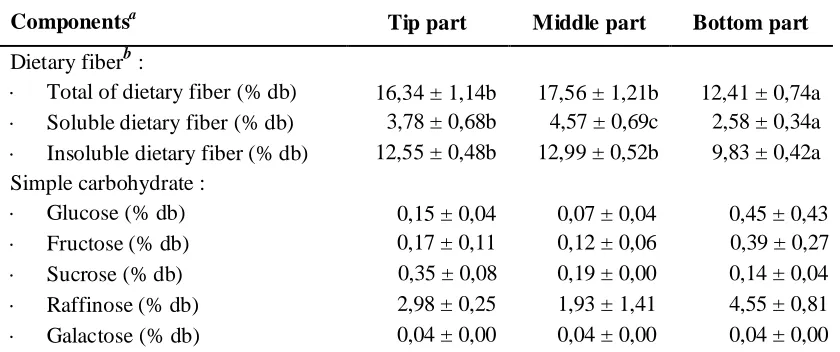
Powder of tabah bamboo shoots has a different dietary fiber content and simple carbohydrates in each part of bamboo shoots (Table 1). The difference of its part is due to bamboo shoots had histologically different in each part (tip, middle and bottom) (Winarno, 1992 ). At the tip of the bamboo shoots had a crispy texture and tender shoots, the bamboo shoots middle part had a crispy texture and dense, while the bottom had a gritty texture of crisp, hard and dense. Differences in texture were a line with differences in the characteristics of powder from each part of bamboo shoots.
Table 1. Characteristics of powder from the difference parts of tabah bamboo shoot
Componentsa Tip part Middle part Bottom part
Dietary fiberb :
Dietary Fiber
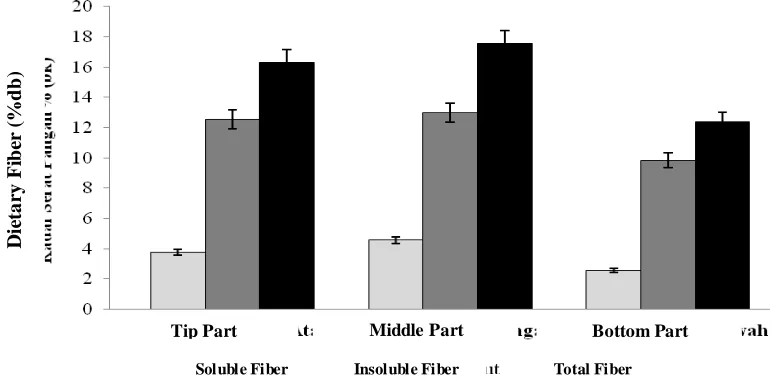
The dietary fiber content in tabah bamboo shoots processed into powder in the middle and the top did not differ significantly in the amount of 17.56% (bk) in the middle and 16.34% (bk) at the top (Figure 1). Dietary fiber consists of a total dietary fiber content of insoluble and soluble dietary fiber. The powder of tabah bamboo shoots from the tip part of shoots had a 12.55% (db) insoluble dietary fiber and 3.78% (db) soluble dietary fiber. The powder from the middle shoots had a 12.99% (db) insoluble dietary fiber and 4.57% (db) soluble dietary fiber. The powder of tabah bamboo shoots that processed from the bottom part of the shoots had total dietary fiber of 12.41% (db) which was the lowest among the parts. The powder had a 9.83% (db) insoluble dietary fiber and 2.58% (db) soluble dietary fiber.
Figure 1. Dietary fiber content of bamboo shoot powder processed from different parts of shoot: tip, middle, and bottom part.
The content of dietary fiber in the powder of tabah bamboo shoots ranged between 12.41% - 17.56% (db) is higher than the content of dietary fiber in the suweg powder amounted to 15.10% (db) and arrowroot powder 9.78% (db ) (Utami, 2008), modified powder of fermented banana 15.91% (db) (Putra, 2010). Muchtadi (2000) states that the total dietary fiber consisting of components soluble dietary fiber (SDF) and the component insoluble dietary fiber (IDF), the IDF is the largest group of dietary fiber in the diet, while the SDF only occupies the number one third. Fresh bamboo shoots are known to contain dietary fiber (hemicellulose, cellulose, and lignin), and consists of 8% soluble and 92% insoluble fiber component (Azmi, 2012).
Soluble dietary fiber is hypoglycemic and hypocholesterolemic and can function as a prebiotic for intestinal microflora. Whereas the insoluble dietary fiber that has laxative function can reduce the risk of gastrointestinal cancer formation. Based on the analysis of
tabah bamboo shoots powder contain dietary fiber which is good enough when it is used
as a source of dietary fiber and its application as a food ingredient.
Simple Carbohydrate
Simple carbohydrates are contained in the powder resilient bamboo shoots include monosaccharides (glucose, fructose and galactose) and oligosaccharides (sucrose and raffinose). The content of these components is different in each section of bamboo shoots
D
ie
ta
ry
F
ib
er
(%d
b
)
Tip Part Middle Part Bottom Part
(top, middle and bottom). Differences in the content of glucose, fructose, sucrose and galactose on each piece of bamboo shoots because of the differences between the nature of the physiological and histological sections on bamboo shoots.
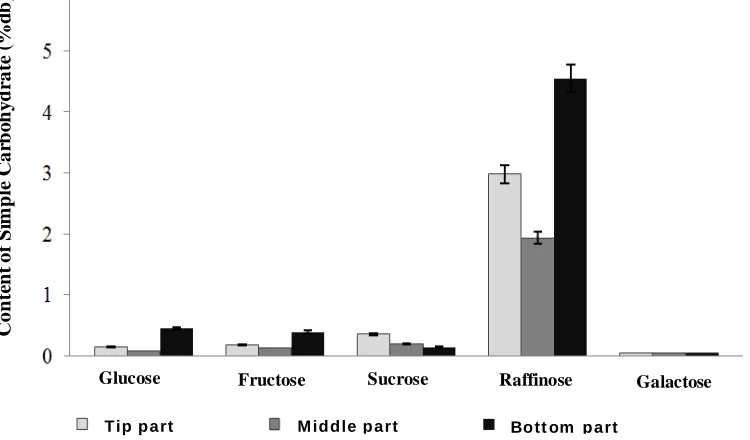
Bamboo shoots are steadfast bottom bamboo shoots produce powder with the sugar components of the highest at 0.45% (bk) glucose, 0.39% (bk) fructose and 4.55% (bk) rafinosa. The highest sucrose contained in powder processed bamboo shoots from the top of the bamboo shoots, which amounted to 0.35% (bk). The content of galactose to the third section of bamboo shoots stoic processed into powder is the same, namely 0.04% (bk) (Figure 2).
Figure 2. Simple carbohydrate content of tabah bamboo shoot powder processed from different parts of shoot: tip, middle, and bottom part.
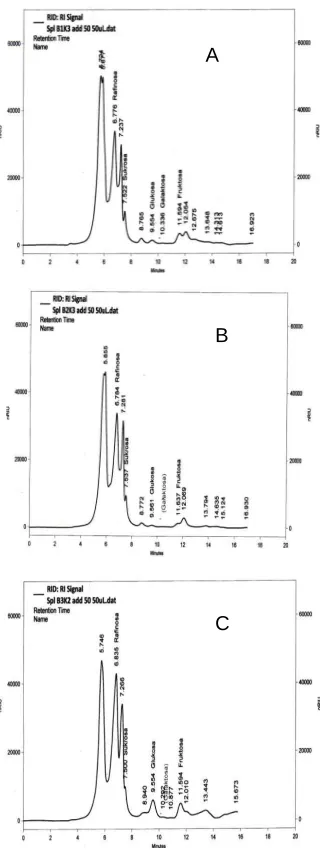
At the top of the bamboo shoots high sucrose content due to the upper part happened shoots high cell division and cell organelle able to absorb sucrose, so that sucrose accumulates at the top is much greater. These data supported the results of research Thammawong (2009) who found that the sucrose content of fresh bamboo shoots more at the top of shoots, while the content of glucose and fructose is more abundant in the bottom of the fresh bamboo shoots. Glucose content in powder resilient bamboo shoots is influenced by the content of cellulose in bamboo shoots. According Fengel and Gerd (1995), cellulose is the development of glucose units into a macromolecular compound which is insoluble in all solvents commonly used. Increased glucose content in the plants would lead to increased cellulose content. Chromatogram simple carbohydrate analysis of bamboo shoot powder processed from different parts of bamboo shoots can be seen in Figure 3.
Raffinose is a trisaccharide consisting of the monomer fructose, galactose and glucose. When viewed from the content of glucose, fructose and galactose in powder of tabah medium containing oligosaccharides (raffinose and staciose) and sugar from lotus seeds
C
Glucose Fructose Sucrose Raffinose Galactose
and bulbs can stimulate the growth of lactic acid bacteria. Oligosaccharides and the sugar can be fermented by Lactobacillus acidophilus and Bifidobacterium bifidum.
Prebiotic Test of Bamboo Shoot Powder
Type of Lactic Acid Bacteria (LAB) used in this test was L. acidophilus, L. brevis, L.
casei subsp. rhamnosus and B. bifidum. The test results showed that all four types of BAL
tested could utilize tabah bamboo shoots powder as a carbon source. Lactobacillus
acidophilus can grow well on the YP-r, bamboo shoots powder-supplemented media.
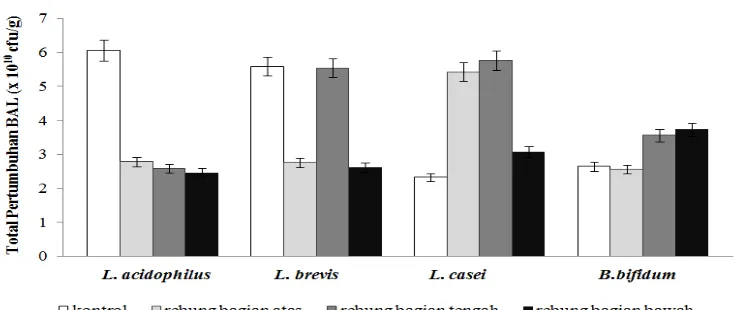
Powder processed bamboo shoots bamboo shoots from the top of the well to stimulate the growth of L. acidophilus. Lactobacillus brevis able to grow on each part of bamboo shoots powder and the highest growth of the bacteria on bamboo shoots powder-supplemented media, which amounted to 5.5 x 10¹⁰ CFU/g. The growth of L. brevis was not different from the control using GYP media. The others two bacteria, L. casei subsp.
rhamnosus and B. bifidum, also could grow well on media supplemented by bamboo
Figure 3. Chromatogram of simple carbohydrate analysis of bamboo shoot powder processed from different part of bamboo shoot. A: tip part;
B: middle part; and C: bottom part.
A
B
shoot powder.
Figure 4. The growth of lactic acid bacteria on YP-r media, tabah bamboo shoot flour-supplemented media. The flour was processed from different parts of bamboo shoot, tip
part, middle part, and bottom part. Control: the bacteria was grown on GYP medium.
Powder of tabah bamboo shoots are known containing dietary fiber amounted to 17.56% (bk), cellulose 37.55% (bk), hemicellulose 30.99% (bk), glucose 0.45% (bk), fructose 0.39%, galactose 0.04%, sucrose 0.35%, and raffinose 4.55%. These components could be fermented by Lactobacillus acidophilus, L. brevis, L. casei and B. bifidum.
Bifidobacterium bifidum, B. longum, Lactobacillus casei subsp. rhamnosus, L. casei
Shirota, Lactobacillus G1, Lactobacillus F1, Lactobacillus G3 may take advantage of the oligosaccharide extracts from potato powder arrowroot as a source of sugars for growth.
Tabah bamboo shoots powder contained oligosaccharides such as sucrose and raffinose.
This indicates that the powder of tabah bamboo shoots can be used as a prebiotic. Oligosaccharides are simple carbohydrates short chain with a unique chemical structure. These compounds can not be digested by the digestive enzymes, so it is not absorbed in the small intestine, which it will go into the large intestine. Oligosaccharides can act as a prebiotic because it can not be digested, but could stimulate the growth of lactic acid bacteria such as Lactobacilli and Bifidobacteria in the digestive tract (Weese 2002). Smiricky-Tjardes et al. (2003) stated that raffinose and/or stachiose more rapidly fermented to produce short chain fatty acids compared with Frukto-oligosaccharides (FOS).
Conclusion
Powder of tabah bamboo shoots have different characteristics for each part (top, middle and bottom) Total dietary fiber content of tabah bamboo shoots powder ranged between 12.41% - 17.56% (bk). Components of simple carbohydrates in the powder of tabah bamboo shoots consisting of glucose, fructose, galactose, sucrose, and raffinose. Trisaccharide of raffinose was the highest simple carbohydrate contained in tabah bamboo shoots powder. Soluble dietary fiber and oligosaccharides contained in bamboo shoot powder could stimulate the growth of lactic acid bacteria. The growth of lactic acid bacteria were well on YP-r media, tabah bamboo shoot powder-suplemented media. It is showed that the powder of tabah bamboo shoots has potential as a prebiotic.
AOAC (Association of Official Analytical Chemist). 1998. Official Method of Analysis of the Association of Official Analytical Chemist. Virginia: Arlington Inc.
Asp, N.G., Johannson C.G., Halmer H and Silsestrom M. 1983. Rapid enzymatic assay of insoluble and soluble dietery fibre. J. Agric. Food Chem. 31:467- 482.
Azmi A., Mustafa S., Hashim D., Manap Y.A. 2012. Prebiotic Activity of Polysaccharides Extracted from Gigantochloa Levis (Buluh beting) Shoots.
Molecules 17: 1635-1651.
Ballongue, J. 2004. Bifidobacteria and Probiotic Action. Di dalam: Salminen S., Wright A. dan Ouwehand A., (editors). Lactic Acid Bacteria Microbiological and Functional Aspects. Ed ke-3, Revised and Expanded.
New York: Marcel Dekker, Inc. hlmn 67-124.
BeMiller, J.N., Whistler, R.L. 1996. Carbohydrate. Dalam Fennema OR (Ed). Food Chemistry (3rd ed). New York: Marcell Dekker.
Brown, A. 2000. Understanding Food : Principles and Preparation.Wadsworth Thomson Learning. USA.
Cordenunsi, B.R., Shiga, T.M., Lajolo, F. 2008. Non-Starch Polysaccharide Composition of Two Cultivars of Banana (Musa acuminate L. : cvs Mysore and Nanicao). Carbohydrate Polymers. 71:26-31.
Dallas, G.H. 1999. Bifidobacterium. Di dalam: Robinson R.K., Batt C.A., Patel P.D. 2000. Encyclopedia of Food Microbiology. Vol 1. London: Academic Press. Datta, R. 1981. Acidogenic Fermentation of Lignocellulose-Acid Yield and Conversion
of Components. Biotechnology and Bioengineering. 23 (9): 2167-2170.
Dwiari, S.R. 2008. Pengujian potensi prebiotik ubi garut dan ubi jalar serta hasil olahannya (Cookies dan sweet potato flakes) [Tesis]. Sekolah Pascasarjana IPB. Bogor.
Fengel, D. dan W. Gerd. 1995. Kayu, Kimia, Ultrastruktur, Reaksi-Reaksi. Gadjah Mada University Press. Yogyakarta.
Fitrial, Y. 2009. Analisis Potensi Biji dan Umbi Teratai (Nymphaea pubescens Willd) untuk Pangan Fungsional Prebiotik dan Antibakteri Escherichia coli Enteroptogenik K1.1. Disertasi. Bogor. Program Studi Ilmu Pangan. IPB. Bogor. Kencana, P.K.D. 2009. Fisiologi Dan Teknologi Pascapanen Rebung Bambu Tabah
(Gigantochloa Nigrociliata Kurz) Fresh-Cut. Disertasi. Program Pascasarjana Fakultas Pertanian. Universitas Brawijaya.
Krisnayudha, K. 2007. Mempelajari Potensi Garut (Maranta arundiacea L.) dan Ganyong (Canna edulis, Kerr) untuk Mendukung Pertumbuhan Bakteri
Asam Laktat. Skripsi. Fakultas Teknologi Pertanian. Institut Pertanian Bogor.
Lu, Z., Fleming, H.P., Mc Feeters, F.R. 2001. Diferrential Glucose and Fructose Utilization During Cucumbar Juice Fermentation.
Manning, T.S. and Gibson, G.R. 2004. Prebiotics. Best Practice and Research Clinical Gastroenterology 18(2): 287-298.
Manning, T.S., Rastall R., and Gibson G. 2004. Prebiotics and Lactic Acid Bacteria. Di
dalam : Salminen S., Wright A. dan Ouwehand A. (editors). 2004. Lactic Acid Bacteria Microbiological and Functional Aspects. Ed ke-3, Revised and
Expanded. New York: Marcel Dekker, Inc. hlmn 407-418.
Nirmala, C., David E., and Sharma, M.L. 2007. Changes in nutrient components during aging of emerging juvenile bamboo shoots. Int J. Food Sci. Nut. 58:345–352. Putra, I N. K. 2009. Efektivitas Berbagai Cara Pemasakan Terhadap Penurunan
Kandungan Asam Sianida Berbagai Jenis Rebung Bambu. Agrotekno 15 (2): 40-42.
Shi, Q.T, and Yang, K,S. 1992. Study on Relationship Between Nutrients In Bamboo Shoots And Human Health. Proceedings of the International Symposium on Industrial Use of Bamboo. International Tropical Timber Organization and Chinese Academy, Beijing, China: Bamboo and its Use; p 338–46.
Smiricky-Tjardes, M.R., Flickinger, E.A., Grieshop, C.M., Bauer, L.L., Murphy M.R., Fahey, G.C. Jr. 2003a. In Vitro Fermentation Characteristics of Selected Oligosaccharides By Swine Fecal Microflora. J Animal Sci. 81:2505–14.
Suryadjaya, A. 2005. Potensi Ubi Jalar Putih dan Merah (Ipomoea batatas L) untuk pertumbuhan Bakteri Asam Laktat dan Menekan Pertumbuhan Patogen. Skripsi. Bogor. Fakultas Teknologi Pertanian. Institut Pertanian Bogor.
Thammawong, M., Daisuke. N., Poritosh. B., Nobutaka, N., Takeo. S. 2009. Characteristics of sugar Content in Different Sections an Harvest Manturity of Bamboo Shoot. Hort Science. 44(7): 1941-1946.
Tillman, A.D. 1989. Ilmu Makanan Ternak Dasar. Gadjah Mada University Press. Yogyakarta.
Utami, A.R. 2008. Kajian Indeks Glikemik Dan Kapasitas In Vitro Pengikatan Kolesterol Dari Umbi Suweg (Amorphophallus campanulatus Bl.) dan Umbi Garut (Maranta
arundinaceae L.). Skripsi. Bogor. Fakultas Teknologi Pertanuan. Institut
Pertanian Bogor.
Vanhoutte, T., et al. 2006. Molecular Monitoring of the Fecal Microbiota of Healthy Human Subjects during Administration of Lactulose and Saccharomyces boulardii. Applied and Environmental Microbiology. 72:5990-5997.
Van Soest, P.J. 1982. Nutritional Ecology of the Ruminant. O & B Books, Inc. Oregon, U. S.A. pp. 26−34; 61−67; 82−93 and 301−388.
Weese, J.S. 2002. Probiotics, Prebiotics, and Synbiotics. Elsevier Sci. 22(8).
Wells, A.L., Saulnier, D.M.A., Gibson, G.R. 2008. Gastrointestnal Microflora and Interactions with Gut Mucosa. Di dalam : Gibson, G.R., Roberfroid, M.B, editor. Handbook of Prebiotics. New York : CRC Press. Hlm 13-38.