ADVERSATIVE CONJUNCTIONS IN INDONESIAN EFL
TEACHERS’ ACADEMIC WRITING
A
Agguussttiinnuuss NNggaaddiimmaann99 C
Coonnnniiee TTaannoonnee1100
Abstract.
This study focuses on the English adversative conjunctions empl0yed by Indonesian scholars in their academic essays. The data sources for this study were twenty introduction part of the academic writing written by Indonesian EFL teachers published I TEFLIN journals in 2002 – 2011. The instrument of this study was the writer herself. The data were analyzed based on the categorization of adversative conjunction by Murcia and Freeman (1999). The study reveals that there were variety of adversative conjuncts used in the academic essays,: (1) proper, (2) contrastive, (3) correction, (4) dismissal but not all the adversative conjuncts were appropriately used which might not be realized by many writers. 85% of the writers misused the adversative conjuncts in their papers. The might be two possible causes of errors: (1) false-concept of hypothesis and (2) the interference of the L1.
Keywords: academic writing, adversative conjunctions, error
Introduction
Academic discourse are sometimes referred to as research or documented papers especially written with a purpose of either acquitting oneself with important sources of facts in a particular field or simply shedding light on an event, a person, or a current issue through published sources and sometimes unpublished ones. In this respect, researchers look at new evidence and ask new questions; they review these earlier findings and how their own research provides new understanding of the subject (Levin 1987:538).
In college or university, academic essays are written by lecturers for publication in scientific journals. A university student may write a term paper, a thesis or dissertation to be submitted for assessment by the advisor(s) as one of the requirements for joining the next term or obtaining a degree. In writing academic essays (scientific journals, term papers, theses or dissertations) one has to adopt particular formats that have been outlined by the board of editors (scientific journals) and the faculty board (theses or dissertation).
9
Agustinus Ngadiman adadaallaahh Dosen Bahasa Inggris di FKIP Universitas Katolik Widya Mandala Surabaya.
Most academic writing includes (1) title, (2) abstract, (3) introduction, (4) review of literature, (5) method, (6) analysis, and (7) conclusion. More specifically, a minimum requirement for an activity to be considered research is that it contains three components, such as a question, data, and analysis and interpretation (Nunan 1992:211). Thus, regardless of the writing format, an academic writing has at least to meet those three components
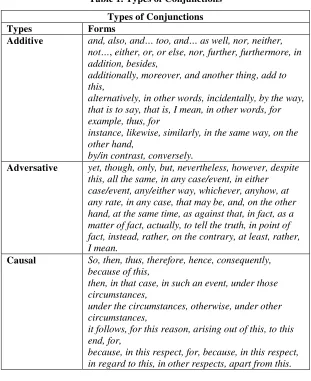
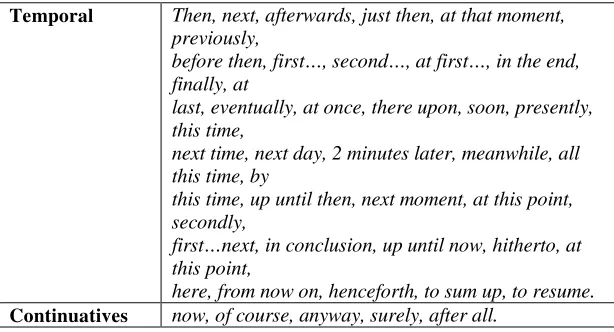
The requirement that makes an academic writing meaningful is its coherence. a text is coherence when the ideas of the text are related one to another. One of the devices that make threads of sentences in an academic writing coherence is called conjunction. Conjunctions can be categorized into five types (1) additive, (2) adversative, (3) causal, (4) temporal, and (5) continuatives, as presented in the following table.
Table 1. Types of Conjunctions
Types of Conjunctions Types Forms
Additive and, also, and… too, and… as well, nor, neither, not…, either, or, or else, nor, further, furthermore, in addition, besides,
additionally, moreover, and another thing, add to this,
alternatively, in other words, incidentally, by the way, that is to say, that is, I mean, in other words, for example, thus, for
instance, likewise, similarly, in the same way, on the other hand,
by/in contrast, conversely.
Adversative yet, though, only, but, nevertheless, however, despite this, all the same, in any case/event, in either case/event, any/either way, whichever, anyhow, at any rate, in any case, that may be, and, on the other hand, at the same time, as against that, in fact, as a matter of fact, actually, to tell the truth, in point of fact, instead, rather, on the contrary, at least, rather, I mean.
Causal So, then, thus, therefore, hence, consequently, because of this,
then, in that case, in such an event, under those circumstances,
under the circumstances, otherwise, under other circumstances,
it follows, for this reason, arising out of this, to this end, for,
Temporal Then, next, afterwards, just then, at that moment, previously,
before then, first…, second…, at first…, in the end, finally, at
last, eventually, at once, there upon, soon, presently, this time,
next time, next day, 2 minutes later, meanwhile, all this time, by
this time, up until then, next moment, at this point, secondly,
first…next, in conclusion, up until now, hitherto, at this point,
here, from now on, henceforth, to sum up, to resume. Continuatives now, of course, anyway, surely, after all.
Halliday and Hasan’s classification of conjunctions: an overview (re-adapted from Christiansen 2011).
This study aims to reveal the adversative conjuncts employed in
the academic writing by Indonesian EFL teachers. Since in the
introduction of an academic writing the writer usually contrast ideas of previous studies, to be specific the study focused on the adversative conjuncts in the introduction section of research articles published in research article Journals of English language teaching.
Adversative Conjuncts in English
Adversative conjunctions are the term proposed by Halliday and Hasan, and adopted by Murcia and Freeman. The basic meaning of adversative is contrary to expectation. The expectation may be derived from the content (Halliday, 1976). From the meaning, we can assume that the conjunctions are used to contrast. This concept is the root. However, some linguists have different term to define the concept. Quirk et al (1972) call contrastive conjunct that covers four classes: reformulatory, replacive, antithetic, and concessive. Other linguists from the field of discourse also name differently; Guy Cook (1989) calls contrastive conjunctions, Swales and Feak (2008) name linking words, Oshima and Hogue (2006) name opposite transitional signals, and Brown et al (1984) name contrastive coordinating words. Brown classifies adversative conjuncts into four groups: (1) proper, (2) contrastive, (3) corrective, and (4) dismissal. Each of which has different function as explained in the following table.
Table 2. Types and functions of adversative conjuncts
No Type Lexical Forms Functions
1 Proper but, yet, though,
and only
To oppose ideas
nevertheless,
despite this, in contrast
and uncertainty
2 Contrastive in fact, actually, on
the other hand, and
Introductions of research articles are important because they play a key role in showing the reference of the research about to be reported in the essay to previous work (Bunton: 2002:58). As such, they set up the reader’s expectation and can make it easier to navigate the long text to follow. In line with this statement, Davis (2005: 232) state that introduction for a journal manuscript will specially do these things: (1) almost immediately call attentions to and define or clarify the specific topic for the reader, (2) provide brief precise background necessary for understanding the topic and justifying why the writer is working with it, and (3) clearly define the main focus or objective relative to the subject. In an abstract these things would be done briefly with a sentence of rationale and definition that takes care of the first two things and then a specific statement of the objectives.
Similar to Davis, state that the function of the Introduction is to: (1) establish the context of the work being reported, which is accomplished by discussing the relevant primary research literature (with citations) and summarizing the writers’ current understanding of the problem you their investigating; (2) state the purpose the work in the form of the hypothesis, question, or problem you investigated; and, (3) briefly explain the rationale and approach and, whenever possible, the possible outcomes the study can reveal. In other words, the Introduction must answer the questions, "What was I studying? Why was it an important question? What did we know about it before I did this study? How will this study advance our knowledge?"
introductions of research articles are important because they play a key role in showing the reference of the research about to be reported in the essay to previous work (Bunton: 2002:58). As such, they set up the reader’s expectation and can make it easier to navigate the long text to follow.
Weissberg and Buker (1990: 20) suggest the introduction of an academic essay, especially a research-based one, be divided into five parts or stages.
Stage
1 General statement(s) about a field of research to provide reader with a setting for the problem to be reported.
2 More specific statements about the aspects of the problem already studied by other researchers.
3 Statements that indicate the need for more investigation
4 Very specific statements giving the purpose/ objectives of the writer’s study.
5 Optional statements that give a value of justification for carrying out the study.
As summarized in the table above in stage 1, the writer establishes a context, or frame of reference, to help readers understand how the research fits into a wider field of study. In stage 2, the writer reviews the findings of other researchers who have already published in the related field. This stage is often called review of related literature. Stage 3 indicates an area that is not treated in the previous studies, but that is important from the point of view of the writer’s own work. Stage 4 formally announces the purpose of the study. This stage serves to stage as consciously as possible the specific objective(s) of the research report. The statement of the purpose should be directly related to the research question upon which the writer based the study. Stage 5 indicates benefits or application of the work. This stage, the statement of value, is written in a way that suggests an attitude of tentativeness or modesty on the part of the author. When writing a report of his/her own study, Weissberg and Buker (1990: 82) suggest the writer should not sound too sure of the benefits, either practical or theoretical, of his/her work. It is conventional to sound more caution.
“Create Research Space (CARS)’ model for research article introduction
Move 1: Establishing a Territory Step 1: Claiming centrality;
Step 2: Making topic generalization(s) Step 3: Reviewing items of previous Move 2: Establishing a Niche
Step 1A: counter-claiming, or
This echoes Bathia (1993: 30), who suggests that generic or “cognitive structure” shows the moves the writer makes in text in order to achieve his/her communicative purpose in the genre. The communicative purpose of a research article introduction is defined by Bhatia (1993: 82) as marking ‘a link between what has gone before in the relevant field of research and the present work that is being reported’, making it ‘relevant by placing it appropriately in the context of previous research in a particular field of study’
According to Swale and Feak (2004:224) the introduction section of Research papers follow the patterns in table 2 in response to two kinds of competition: competition for research space and competition for readers. In this introduction pattern, the work of others and/or what is known about the world is primary, and the work of the writer is secondary.
Swale’s mode above is modified by Paltridge ans Starffield (2007: 83, as illustrated in the following table.
Move 1: establishing a research territory
a. by showing that the general research area is important, central, interesting, problematic, or relevant in some way (optional); b. by introducing and reviewing items of previous research in the area
(obligation)
Move 2: establishing a niche
a. by indicating a gap in the previous research; or by extending previous knowledge in some way (obligation)
Move 3: Occupying the niche
a. by outlining purpose or stating the nature of the present research b. by listing research questions or hypotheses
c. by announcing principal findings
According Paltridge and Starfield (86-89) in this model Move 1 – establishing a research territory – the writer typically begins to carve out his/her research space by indicating that the general area is in some way significant. This is often done through reviewing previous research in the field. In Addition, the writer may choose to provide background information on the particular topic being investigated and may define key terms which are essential for the study.
Move 2 – establishing a niche – points to a ‘gaps’ or niche in previous studies which the research will ‘fill’. For Swales and Feak (1994), the metaphor for the niche or research space is based on the idea of competition in ecology –academic writers seeking to publish must compete for ‘light and space’ as do plants and animal. This gap sometimes presented as a problem or need that has been identified as requiring further research. In Move 2 of the framework, the writer typically establishes a niche by indicating a gap in the previous research or possibly extending a current research approach into a new area.
In move 3 – occupying the niche – the writer, by outlining the purposes of his or her research, indicates to the reader how the proposed research will ‘fill’ the identified niche or gap.
In line with Swale and Feak’s model of rhetorical move, Paltrige and Starfield (2007: 82-83) state that the introduction section of a research article typically moves from a fairly general review of the research terrain to the particular issues under investigation through they key moves which capture the communicative purposes of the introduction.: (1) to establish a research territory, (2) to identify a niche or gap in the territory and ; (3) to then signal how the topic in question occupies that niche.
In analyzing The Generic Moves in PhD thesis Introduction, Bunton (2002: 37-75) found that nearly all introductions had sequences of text identifiable as three moves of Swale’s (1990) CARS model: Establishing Territory (T), Establishing a Niche (N), and Occupying the Niche (O). The only exception was one author whose introduction did not explicitly establish a niche in the previous research for his researcher to occupy. Further he identified that the moves were cyclical in nearly all introduction. Only in three did the T – N – O moves. The most frequently used cycle was not T – N O, but T – N. this typically occurred as authors were reviewing previous research and pointing out gaps or problems or raising questions as they reviewed the literature, but did not go on to announce their own research until later. On average, Bunton found, there were 2.5 T –N, cycles per introduction, 1.4 T –N – O cycles and 0.7 T – O cycles.
establish the territory (T). He also found that the majority of the introductions analyzed (42 of 45) ended with occupying the niche.
Research Method
The subjects of this study were the Indonesian EFL teachers who wrote academic writing published by academic journals. Indonesian EFL teachers are the representative of scholars who have experiences in writing academic discourse. Second, to have the portrait of the ability of using conjunctions, the subjects must have the advance level of English mastery. They are English teachers in the university level from ten different universities in Indonesia. From 20 papers published in the journals, eight of them were presented in the seminar of English language studies. Since the thesis is a case study research in which the purpose is to investigate a phenomenon in the real context, then the appropriate data source must be the real academic writing written by Indonesian EFL teachers.
The source of data in this study was the research papers of Indonesian EFL teachers published in several journals ranging from 2002 to 2011. There are six journals from there different publishers. The six journals involved four journals published by two universities in Surabaya and in Jogjakarta, and the other two journals were published. The data are classified based on the categorization proposed by the Murcia and Freeman categorization
The Findings
1. Types of Adversative Conjunctions Employed
There are 4 types of adversative conjuncts employed in the research articles und3r study: (1) proper, (2) contrastive, (3) correction, (4) dismissal. Another type of the adversative conjuncts can be categorized as miscellaneous, as they cannot be categorized into any of those four types proposed by the Murcia and Freeman categorization.
1. Proper: however, nevertheless, despite this, in contrast
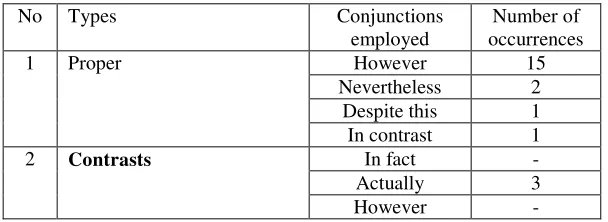
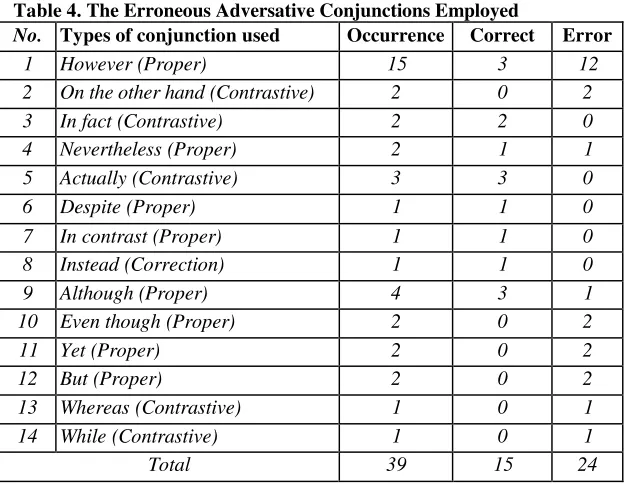
There are four conjunctions belong to “Proper‟ adversative category. The most frequent conjunction used was however which occurred 15 times of 39 conjunctions (the total occurrence of conjunction). Followed by nevertheless which occurred twice. The other two conjunctions despite and in contrast occurred once. Unfortunately, the high frequent of use of the conjunction however was not parallel with its suitable use, because from 15 times occurrence, 12 or 80% of them were used unsuitably. Nevertheless which occurred twice, was used suitably once or 50% of the use was suitable. The conjunctions
2. Contrastive.: in fact, actually, however, on the other hand, at the same time
The conjunction actually occurred three times and were 100 % suitably used. In fact occurred twice and were 100 % suitably used.
On the other hand occurred twice and 100 % unsuitably used. At the same time did not occur at all. At the same time did not occur at all because in many cases it did not show contrast as much as its contemporal relationship. Therefore, the absence can be understood because of its other common function. From the total conjunctions in the source of data, 18, 4 % or 7 conjunctions used are from this category.
3. Correction: instead, rather, on the contrary, at least
The conjunctions in this category were used minimally because of their specific functions. The conjunction instead only occurred once and used unsuitably. The other three conjunctions, on the other hand, did not occur at all. Therefore, the conjunction used from this category was only 2, 6% of the total conjunctions used. In fact, after analyzing the data, the writer found several contexts that should use the conjunctions in this category because of their context.
4. Dismissal: in any case, anyhow, at any rate
The conjunctions that show dismissal never occurred in the source of data or 0%. Once again, again after analyzing the use of conjunctions, the writer found the contexts that should have used the conjunctions from this category.
5. Miscellaneous: although, even though, yet, but, while, whereas
Besides the adversative conjunctions based on the categorization by Murcia and Freeman, the writer found some conjunctions operated that show contrast in the sources of data. The writer categorized them in one category, called „Miscellaneous‟. There are six conjunctions in this category; they are although, even though, yet, but, while, and
whereas.
(a) Although is used where there is an unexpected contrast between two propositions, for example: Reid failed to score himself although he helped Jones score two goals.
The unexpected contrast is between the Reid failed himself and helped other score two goals.
(b) Even though
Even though is a stronger form of although that used when the contrast is particularly strong to mean “despite the fact that‟, for example:
Even thoughTom doesn’t speak Spanish, I think he still should visit Madrid.
(c) Yet
The meaning of yet is simply “but at the same time‟. It refers to denial of expectation, which after the conjunction the condition turns out not to be true. the adversative conjunct “Yet” is used where denial of expectation is not especially strong and formal, for example:
Mark is lazy, yet well intentioned
The conjunction above can be changed with but at the same time
without changing the meaning at all. From the sentence, we also know that the context is not formal.
(d) But
The adversative conjunct But is often described as logically equivalent to “and‟ as can be seen in the examples bellow.
It is raining, but I am happy. It is raining and I am happy.
Both of the uses are true. The different is the meaning. The first sentence means a contrastive situation, and the second sentence means a parallel situation.
(e) Whereas and While
Whereas and while are used to express simple differences. Whereas is more formal than while. The formal form for while and whereas is whilst. Below are the examples:
I’ve got two sisters, while my best friend has got two brothers. Read and yellows are warm colors, whereas blues and greens are cool.
Only 84 people died on railways last year, whilst more than 5,000 died on the roads.
The miscellaneous conjuncts in the data were categorized based on their functions as follows: (1) Proper: Although, even though, yet, and but and (2) Contrastive: whereas and while:
To get clear picture of the adversative conjuncts employed in the research articles under study table 3 summarizes the types of the conjuncts used.
Table 3. Type of Adversative Conjuncts Employed
3 Correction Instead -
Rather -
on the contrary -
at leas - 4 Dismissal in any case, -
Anyhow -
, at any rate -
5 Miscellaneous although,. 1
even though 1
yet, 1
but, 1
, while 1
Whereas 1
2. The Erroneous Adversative Conjunctions Employed
There were 24 erroneous conjunctions employed in 20 sources of data. The 24 erroneous conjunctions were caused by intralingual factor, specifically false concept hypothesis. False-concept hypothesis is the result of the subjects’ difficulty in particular adversative conjunctions, thus errors occurred in their writing. This may be caused by the perception that conjunctions are synonym or interchangeable as long as they are in the same category. For example the conjunctions „in contrast‟, on the other hand‟, and „on the contrary‟ may be perceived the same, which are very different in function and in context. The understanding that conjunctions are specific is important in English language teaching and learning. The second possible cause is interference of Bahasa Indonesia with 21 times occurrence. The subjects were affected by their L1 can be seen quite clear in several data. In data 8,”whereas‟ is used in: “In Writing III the teacher responded to the students‟ diary entries, whereas in Writing IV their partners responded to their diaries entry.” This sentence can be formed in L1 first and then translated into English. In L1 or Bahasa Indonesia, this sentence is, “Pada Writing III guru merespon diari siswa, sedangkan pada Writing IV rekan-rekannya yang merespon.” “Whereas‟ is “sedangkan” (John M. Echols, 1995) in Bahasa Indonesia. L1 interference can be seen in data 14. “The „label‟ was written English with student’s active learning or CBSA approach, yet the learning activities were very much like the ones I found in my junior high school.” This sentence was probably outlined in Bahasa Indonesia as
Table 4. The Erroneous Adversative Conjunctions Employed
No. Types of conjunction used Occurrence Correct Error 1 However (Proper) 15 3 12 2 On the other hand (Contrastive) 2 0 2 3 In fact (Contrastive) 2 2 0 4 Nevertheless (Proper) 2 1 1 5 Actually (Contrastive) 3 3 0 6 Despite (Proper) 1 1 0 7 In contrast (Proper) 1 1 0 8 Instead (Correction) 1 1 0 9 Although (Proper) 4 3 1 10 Even though (Proper) 2 0 2 11 Yet (Proper) 2 0 2 12 But (Proper) 2 0 2 13 Whereas (Contrastive) 1 0 1 14 While (Contrastive) 1 0 1
Total 39 15 24
In short, as illustrated in the table above, the study reveals the following phenomena. First, there were 14 types of conjunctions used in 20 sources of data to show contrast, and 8 of them belong to the category of Murcia and Freeman. The other 6 conjunctions that do not belong to the categorization were securitized based on the functions and contexts and were categorized to the categorization. Second, there were 39 conjunctions used in 20 sources of data. From 39, the correct conjunction employed was 15 or 38 %, and the error made was 24 or 62%. The conjunction however is mostly used by the writer to show contrast. This conjunction occurs 15 times, but only 3 of them are appropriate.
Discussion
according to Chou (2002), is due to inadequate knowledge of the necessary linguistics devices.
The implication of this finding was that conjunctions are important and needed to be addressed in academic writing. Writers of academic writing and advanced writers therefore should be well informed with the e use of adversative conjuncts to create qualified academic discourse.
Conclusion and Suggestions
In order to accomplish the task to contribute to the society and the knowledge of a particular discipline, a teacher deals with academic writing in the form of research, articles, papers and many others. To get the academic writing published, a writer need to show the significance, this can be done in the introduction part. In introduction, the writer shows the gap that he wants to solve. In indicating the gap, he needs to make use of the adversative conjunctions correctly. This study was intended to give benefits for all scholars, especially for those who write academic papers or researches. The study was different from the previous and related studies conducted, because the data of this study were written by nonnative EFL teachers. This present study focused on adversative conjunction in the introduction part. In addition, the theories and the results of this study might give inputs for improvements of using the adversative conjunctions In this study, the 20 introductions written by Indonesian EFL teachers from 2002 to 2011 were analyzed based on the categorization of Murcia and Freeman (1999). It was found out that 85% of the subjects misused the adversative conjunctions.
Adversative conjunctions have different functions that might be not realized by many writers. This fact is based on the finding that 85% of the writers misused the adversative conjunctions in their papers. The errors happened because of two possible causes. The first one is false-concept hypotheses of the target language itself and the interference of L1 False-concept hypothesis. This assumption may be caused by the perception that conjunctions are synonym or interchangeable as long as they are in the same category. The understanding that conjunctions are specific is important in English language teaching and learning. The second possible cause is the interference of L1. The subjects might compose the sentences in L1 which then translated into L2, including the conjunctions. After finding out the possible causes of the errors, the writer evaluated the level of the errors, whether they belonged to global or local errors. The errors were in the level of local errors; in other words, the errors did not hindrance the understanding of the message.
the academic writing like in the body or in the conclusion. It is expected that by more studies on conjunctions, the understanding can be developed. Furthermore, the study in academic writing is needed to help scholars to write linguistically correct.
References
Alice Oshima, A. H. (2006). Writing Academic English. New York: Pearson Longman.
Ann Cole Brown, J. N. (1984). Grammar and Composition. United States of America: Houghton Mifflin Company.
Bathia (1995: 82)
Borkin, A. (1979). Antithetic Conjuncts in Written English. RELC Journal , 44 - 56.
Bunton (2002:58)
Carrio, M. L. (n.d.). Retrieved from www. espworld. info/Articles_13/Connector.htm.
Celce-Murcia, M.-F. D. (1999). The Grammar Book. United States of America: Heinle & Heinle Publishers.
Cook, G. (1989). Discourse. Oxford: Oxford University Press.
Coulthard, M. (1985) Second Edition. An Introduction to Discourse Analysis. London Longman.
Douglas Biber, S. J. (1999). Grammar of Spoken and Written English.
London: Longman.
Halliday, M. R. (1976). Cohesion in English. London: Longman.
Hashimoto, Irvin Y. (1982) Strategies for Academic Writing- A Guide for College, USA: The University of Michigan.
Laura Centonze. 2013. Conjunctions in ELF Academic Discourse: A Corpus-based Analysis. The Sixth International Conference of English as a Lingua Franca: New Perspectives on ELF, held at Roma Tre University, 4-7 September 2013.
LeCompte, M. D. et al. (1992) The Handbook of Qualitative Research in Education, California: Academic Press.
Levin (1987:538)
Murphy, R. (2004). English Grammar in Use. Singapore: Cambridge University Press.
Nunan, D. (1992) Research Method in Language Learning, USA: Cambridge University Press.
Paltridge, B. S. (2007). Thesis and Dissertation Writing in a Second Language. New York: Routledge.
.Quirk, R. S. (1972). A Grammar of Contemporary English. New York: Longman.
Roth, A. (1986) Fifth Edition. The Research Paper-Process, Form, and Content, California: Wadsworth.
Scott, D. and Usher, R. (1996) Understanding Educational Research, London: Routledge.
Swales, J. M. and Feak, C. B. (2004) Second Edition. Academic Writing for Graduate Students- Essential Tasks and Skills, USA: The University of Michigan.
Swales, J. M. (2008). Academic Writing for Graduate Students. United States of America: The University of Michigan Press.
- - - gunting dan kirimkan ke alamat Tata Usaha FKIP atau fax. (031) 3891267 - - -