Mei Vita Cahya Ningsih, Ns.
KROMOSOM
Kromosom manusia 46 buah t.d 22 autosom dan 1 ps. Sex kromosom
Satu bagian diturunkan dari ayah, satu bagian lain dari ibu Pasangan yg homolog membawa informasi genetik yang sesuai
Penurunan dilaksanakan melalui proses pembelahan
Sel tubuh/somatik mempunyai kromosom diploid
Sel gamet mempunyai kromosom haploid
Sebelum mengalami pembelahan DNA mengalami replikasi terlebih dahulu Replikasi terjadi selama interfase ( S phase)
MORFOLOGI KROMOSOM
Tiap kromosom t.d 2 kromatid yang berkumpul di sentromerSentromer berfungsi utk pegangan fiber dari spindel pd waktu pembelahan Sentromer membagi kromosom menjadi 2 bagian p (lengan pendek) dan q
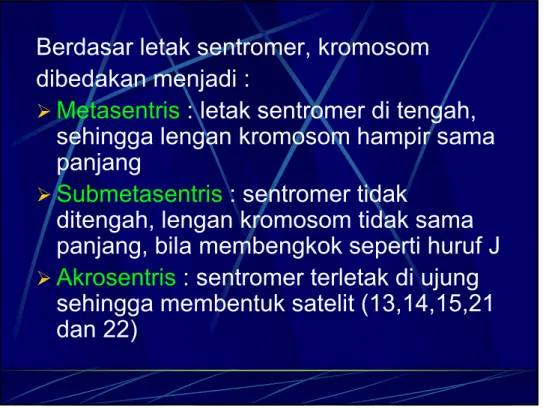
sehingga lengan kromosom hampir sama panjang
Submetasentris : sentromer tidak
ditengah, lengan kromosom tidak sama panjang, bila membengkok seperti huruf J
Akrosentris : sentromer terletak di ujung sehingga membentuk satelit (13,14,15,21 dan 22)
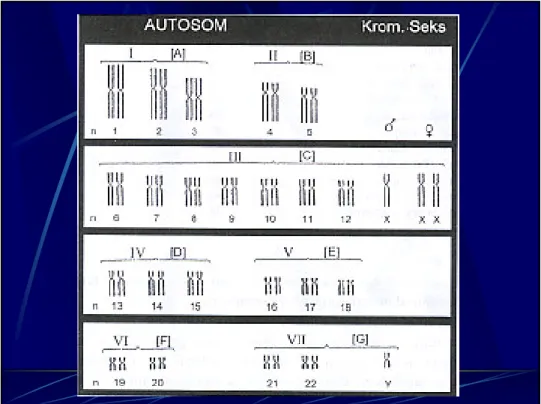
Didasarkan pada besar dan letak Sentromernya
A : terbesar, metasentrik (1,2,3)
B : submetasentrik besar, p ¼ lengan q (4,5)
C : submetasentrik, medium (6-12,X) D : akrosentrik, medium, satelit (13-15) E : metasentrik, medium (16) dan
submetasentrik kecil (17,18)
F : metasentrik kecil (19,20)
G : akrosentrik kecil, satelit (21,22) dan akrosentrik tak bersatelit (Y)
Klasifikasi juga berdasar pada gambaran kromosom waktu dilakukan pengecatan 1q24.3 = kromosom 1, lengan panjang,
DNA and Protein
(Structure and
Functions)
DNA carries the genetic information of a cell and consists of thousands of genes. Each gene serves as a recipe on how to build a protein molecule.
Proteins perform important tasks for the cell functions or serve as building blocks.
The flow of information from the genes determines the protein composition and thereby the functions of the cell.
DNA is the physical carrier of inheritance. It is like a giant book of information
containing all the instructions for building and maintaining a living organism.
Replication followed by cell division is the answer to one of life's most interesting questions: How can the union of a single sperm and an egg become a five-trillion-cell baby, all containing the same DNA?
The helix makes a complete turn every 3.4 nm and there are about 10.5 base pairs per turn.
The building blocks of DNA are the 5-carbon sugar deoxyribose linked together by phosphodiester bonds
forming two strands of sugar-phosphate backbones on the outside of the double helix
The human genome contains 3x10⁹ base
pairs of DNA divided into 23 chromosomes which if linked together would form a thread of 1 meter with a diameter of 2 nm.
This DNA codes for about 105 different proteins. In fact only about 2-4 % of the total coding capacity in the human DNA is used for coding of different genes, the rest of it
probably has other more structural and organizational functions.
Chromatin
The DNA double helix in the cell is packaged by special proteins called histones to form a protein/DNA complex called chromatin
The structural unit of chromatin is the
nucleosome.
It consists of a central protein complex, the histone octamer, and two turns of DNA, about 146 base pairs, which are wrapped around the histone octamer complex.
There are four different types of core histones which form the octamer
containing two copies each of H2A, H2B, H3 and H4.
There is a linker histone, H1, which contacts the exit/entry of the DNA strand on the nucleosome.
The nucleosome together with histone H1 is called a chromatosome.
Chromatosomes are held together by the continuous DNA strand, thus
forming linker DNA of 30-50 base pairs in length.
The Gene
A functional and inheritable element in the genome is referred to as a gene and usually codes for a protein.
In some cases genes also code for RNA molecules that are not translated to
promoter, usually consists of many
different DNA segments defined by their particular base pair sequences
Each individual segment, usually
involving about 6-12 base pairs of DNA, serves as a binding target for a DNA binding protein which functions as a transcription factor
Furthermore, the DNA binding capacity of various transcription factors is usually regulated via cellular signals through
extracellular hormones and receptor pathways or via cell interactions with the
environment.
In this way a particular stimulus in the surrounding of a cell will trigger the
Like DNA, the RNA molecule, is built up by nucleotides linked together in a chain. There are some differences though :
The RNA molecule is single stranded The four bases in the DNA nucleotides are adenine, guanine, thymidine and cytosine. In RNA thymidine is replaced by uracil.
The sugar in DNA is deoxyribose. In RNA it is ribose.
There are three major types of RNA: 1) mRNA,
messenger-RNA, which transfer the information about the aminoacid sequence from the DNA to the protein
synthesis. 2) rRNA,
ribosomal-RNA, which builds up the ribosome together with proteins. 3)tRNA, transfer-RNA, which transfer
aminoacids to the ribosome for protein synthesis.
After transcription has been initiated RNA polymerase II, together with the necessary transcription elongation factors, travels along the DNA template and polymerizes
ribonucleotides into an RNA copy of the gene The polymerase moves at a regular speed (approximately 30 nucleotides per second) and holds on to the DNA template efficiently, even if the gene is very long
RNA Processing
The primary transcription product of a gene is therefore called a precursor of mRNA, pre-mRNA.
Both ends of the pre-mRNA are modified. An additional nucleotide, a 7-methylguanosine is added to the 5'-end to form a cap-structure. This process is called capping (1). The 3'-end of the pre-mRNA is cleaved and polyadenylated (4). The pre-mRNA is cut at a specific site and 150-200 adenylate residues are added to the 3'-end to form a poly(A)-tail. The third major
Translation
Translation is the actual synthesis of a protein under the direction of mRNA
the ribosome, provides the basic machinery for the translation process. The major role of the ribosome is to catalyse coupling of amino acids into protein according to the sequence specified by the mRNA.
Initiation
formation of the initiation complex between mRNA, charged tRNA and the ribosome
translation begins at a specific codon, the initiation codon (AUG)
the growing polypeptide chain is attached to an amino acid in the P site
the next codon to be read is present beneath the A site
the tRNA bearing the next amino acid to be inserted enters the A site
a peptide bond is formed between the new amino acid and the growing chain, transfering the chain to the tRNA in the A site
the ribosome moves down one codon moving the peptide-tRNA to
translation of a particular protein ends when the ribosome encounters one of three termination codons
A. Cara kerja Polimerase DNA
Sebelum pembelahan salinan genom (Replikasi)
Dikatalis oleh Polimerase DNA
Enzym ini memerlukan DNA untai tunggal Untai Cetakan
(matrix strand)
Substrat Polimerase DNA :
dATP,dGTP, dCTP, dTTp
B. Replikasi pada E. coli
• Dimulai pada titik awal mula replikasi dan
dilanjutkan ke kedua arah garpu replikasi
• Setiap garpu memiliki 2 molekul Polimerase
DNA III+ enzym pembantu(topoisomerase DNA danhelikase) mengendurkan dan memisahkan ikatan DNA
DNA polymerase III Newly synthesized leading strand 3' 5' 5' Replication fork 3' 5'
Pertama terbentuk fragmen okazaki yang diperlukan u/ polimerase DNA dapat berfungsi
Ada beberapa tempat fragmen okazaki dan tidak saling
berhubungan
Enzym polimerase DNA I menyambung dan
menutupinya