L
Journal of Experimental Marine Biology and Ecology 242 (1999) 233–244
www.elsevier.nl / locate / jembe
Filtration in antarctic ascidians – striking a balance
* Jens Kowalke
Alfred Wegener Institute of Polar and Marine Research, Columbusstrasse, 27515 Bremerhaven, Germany Received 6 February 1999; received in revised form 15 June 1999; accepted 20 July 1999
Abstract
Retention efficiencies and pumping rates of the four Antarctic ascidian species Ascidia
challengeri, Cnemidocarpa verrucosa, Corella eumyota and Molgula pedunculata from Potter
Cove, King George Island, were measured. None of the species reached a 100% retention efficiency at any given particle size. Pumping rates of the four species range between 250 and 349 ml / h per gram of ash free dry mass (T518C), being lower than measured in temperate water species. This is connected to the sediment laden environment in which the animals are dwelling. A less efficient retention and low pumping rates decrease the risk of filtering structures being clogged. 1999 Elsevier Science B.V. All rights reserved.
Keywords: Antarctica; Ascidians; Pumping rates; Retention efficiency
1. Introduction
Suspension feeding animals play a significant role in bentho–pelagic coupling throughout the oceans (Hargrave, 1973; Flint and Kamykowski, 1987; Doering et al., 1986; Ahn, 1993). The uptake of phytoplankton and particulate organic matter from the water column followed by the biodeposition of faeces and pseudofaeces is known to be one of the major trophic pathways in marine ecosystems (Doering and Oviatt, 1986; Martin et al., 1991).
Antarctic soft bottoms also reveal a rich and diverse fauna of suspension feeders often dominated by sponges, ascidians, bivalves and bryozoans (Belyaev and Uschakov, 1957; Propp, 1970; Winston and Heimberg, 1988; Kirkwood and Burton, 1988; Galeron et al., 1992; Gerdes et al., 1992; Barnes, 1995; Barnes et al. 1996; Starmans, 1997; Sahade et al., 1998), which thus form a major part in Antarctic bentho–pelagic interactions.
*Corresponding author. Tel.:149-471-4831-313; fax:149-471-4831-149.
E-mail address: [email protected] (J. Kowalke)
Despite the importance of these taxa, their ecological role is still poorly investigated in Antarctic waters. Potter Cove, the site of investigation on King George Island, South Shetlands, is dominated by strong north-western winds and, during summer time, by
¨ enormous amounts of glacial meltwater which transports terrestrial sediments (Kloser et al., 1994a). Thus, the bottom of the inner cove consists mainly of fine sediments and
2
houses a variety of suspensivores of up to 25 ind / m which are mainly ascidians, the clam Laternula elliptica and the sponge Mycale acerata (Sahade et al., 1998; Kowalke, 1998).
To establish a basis for the calculation energy budgets of one of these important trophic groups, the dominant ascidians Ascidia challengeri, Cnemidocarpa verrucosa,
Corella eumyota and Molgula pedunculata, the most abundant solitary ascidian species
in Potter Cove, were chosen for further investigation.
The focus of this study was to (i) measure retention efficiencies and pumping rates of the four species and (ii) discuss the results in an ecological context.
2. Material and methods
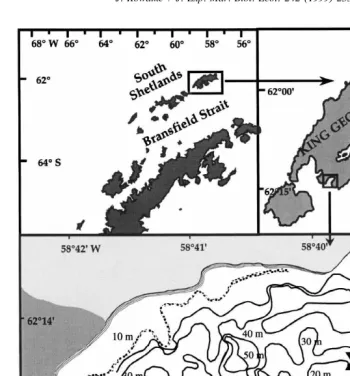
The investigation was conducted at the Dallmann Laboratory, Potter Cove, King George Island, Antarctica (Fig. 1). Potter Cove is an inlet of the larger Maxwell Bay
2
system and stretches over 2 km . Maximum water depth is 50 m and the bottom is mainly composed of fine sediments imported by glacial meltwater. Hard substrates, rocky shores, stones and pebbles border the mouth of the cove. The soft bottom communities display a wide variety of suspension and deposit feeding animals (Sahade et al., 1998; Kowalke and Abele, 1998). The hydrography of the cove is governed by strong, mostly westerly winds, which block the water circulation inside the cove and
¨
hamper the outflow of sediment laden water (Kloser et al., 1994a).
Between December 1995 and February 1996 divers collected the experimental animals which were immediately placed in an aerated flow-through aquaria of 8 to 25 l, according to animal size. The ascidians were individually kept for several days in order to acclimatise before starting the experiments. The water was drawn directly from the cove from 10 m depth.
J. Kowalke / J. Exp. Mar. Biol. Ecol. 242 (1999) 233 –244 235
Fig. 1. Geographic location of Potter Cove, the x indicates the sampling station; shaded area is free of ice and snow during summer.
The often used simple exponential model for the calculation of pumping rates requires a complete filtration of all particles after a given time for a correct evaluation of rates. Thus, the Williams’ formula, which allows for correction for unfiltered particles in each size group, was used (see Williams, 1982).
(2PR?t )
Ct5y0 1z0
where
y05 particle concentration of a given filterable size at time 0
z05 unfilterable fraction of a given particle size (constant) at time 0
PR5pumping rate
The pumping rate is expressed as a function of body mass using the allometric equation, which was fitted using a least-squares regression with ln-transformed values:
ln PR5a1b?M,
where M is the body mass and b the linear regression coefficient.
After the experiments the dry mass and ash free dry mass of each animal were determined by drying at 608C for 48 h and burning at 5008C for 5 h, respectively.
3. Results
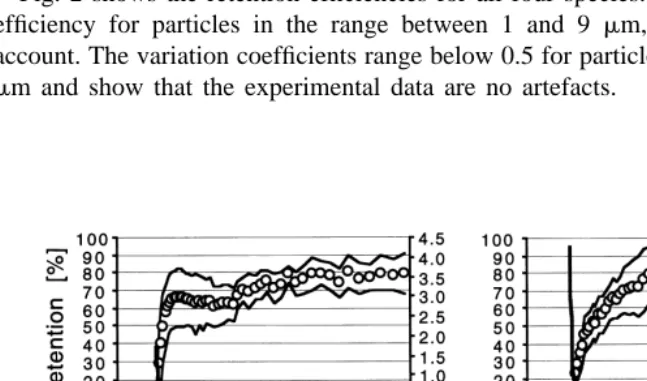
Fig. 2 shows the retention efficiencies for all four species. No species reached 100% efficiency for particles in the range between 1 and 9 mm, even taking the SD into account. The variation coefficients range below 0.5 for particle sizes bigger than 1.5 to 2 mm and show that the experimental data are no artefacts.
Fig. 2. Retention efficiencies (%) of the four ascidian species, A: Ascidia challengeri, B: Cnemidocarpa
verrucosa, C: Corella eumyota, D: Molgula pedunculata; points refer to means, solid lines to SD (left y-axis);
J. Kowalke / J. Exp. Mar. Biol. Ecol. 242 (1999) 233 –244 237
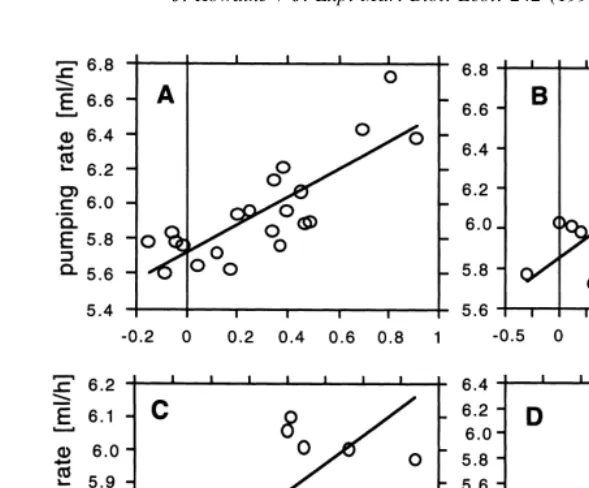
Fig. 3. Pump rates in relation to ash free dry mass, ln-transformed; A: Ascidia challengeri, Y50.804X15.717 (n521; r50.82; F538.31; P50.0001); B: Cnemidocarpa verrucosa, Y50.395X15.852 (n522; r50.87;
F563.21; P50.0001); C: Corella eumyota, Y50.435X15.524 (n58; r50.78; F59.33; P50.0224); D:
Molgula pedunculata, Y50.376X15.855 (n522; r50.78; F530.78; P50.0001).
A. challengeri, C. eumyota and M. pedunculata retain particles larger than 1.2mm, C.
verrucosa retains particles larger than 1.4 mm. Minimum particle size for maximum
retention differs greatly between the species; 2 mm in A. challengeri, 4 mm in C.
verrucosa, 5 mm in C. eumyota and even 6.5mm in M. pedunculata.
Pumping rates are shown in ml / h in a double-log plot (Fig. 3). They vary between 250 and 349 for an animal of 1 g ash free dry mass (Table 1). The erect forms of M.
Table 1
Regression equations, standard errors and pumping rates in ml / h for the four ascidian species; ash free dry mass (RE ; SE ; PR ) and dry mass (RE ; SE ; PR )1 1 1 2 2 2
Species RE1 SE1 PR1 RE2 SE2 PR2
A. challengeri 0.804?lnM15.717 0.173 304 0.793?lnM14.704 0.181 110
C. verrucosa 0.395?lnM15.852 0.295 348 0.346?lnM15.439 0.354 230
C. eumyota 0.435?lnM15.524 0.308 251 0.575?lnM14.684 0.228 108
pedunculata and C. verrucosa pump more water per unit time than the flattened forms of
A. challengeri and C. eumyota. Data for dry weight are given in Table 1.
4. Discussion
4.1. Methodology
The indirect method was used to determine retention efficiencies and pumping rates because low pumping rates rendered flow through methods unsuccessful. The indirect method bears the problem that the water sampled does not necessarily pass the animal but floats alongside and thus dilutes the filtered water. This problem can be minimised by taking the samples closest to the exhalant aperture, but cannot be completely overcome. Another reason is the continuous fission of autotrophic and heterotrophic cells, which, due to the long time of experimental exposure and permanent excretion of ammonia by the ascidians must be taken into account (Porter, 1976; Roman and Rublee, 1980). But as excretion rates are very low (between 0.02 and 0.04 mm / day; Kowalke, 1998), this probably does not stimulate planktonic cell growth.
4.2. Retention efficiencies
Retention efficiencies are lower compared to temperate water species, which cleared a natural suspension with a 100% efficiency (Stuart and Klumpp, 1984). Randløv and
˚
Riisgard (1979), using algal cells, reported a complete retention for particles bigger than ´ 2 to 3mm in diameter. An equally low efficiency of 70% calculated by Fiala-Medioni (1978) for Mediterranean species probably reflected an underestimation due to the
˚
methodology used (Randløv and Riisgard, 1979; Robbins, 1984) and not a natural behaviour.
The low efficiencies recorded here in Antarctic ascidians might partly be related to the experimental set up. Permanent aeration, holding particles in resuspension, was provided, which diluted the already filtered water. But after 24 h of filtration the concentration of particles remained stable (Kowalke, 1998) and the variation coefficient is below 0.5 for particles bigger than 2mm (Fig. 2), the low retention efficiencies do not seem to be experimental artefacts: the ascidians probably produce less efficient mucus nets. Robbins (1984) did not detect any regulation of the retention efficiency in the boreal species Ascidia mentula using inorganic particle concentrations of up to 300 mg / l. His animals were taken from the river Clyde area in Scotland, where normal particle concentrations in the water column range from 1–10 mg / l (Robbins, 1983), much less than the normal total particulate matter (TPM) content in Potter Cove. Thus, there might be a trend towards less efficient mucus nets in the Potter Cove species. But unless there are no data on these species from other sites, this cannot be confirmed.
J. Kowalke / J. Exp. Mar. Biol. Ecol. 242 (1999) 233 –244 239
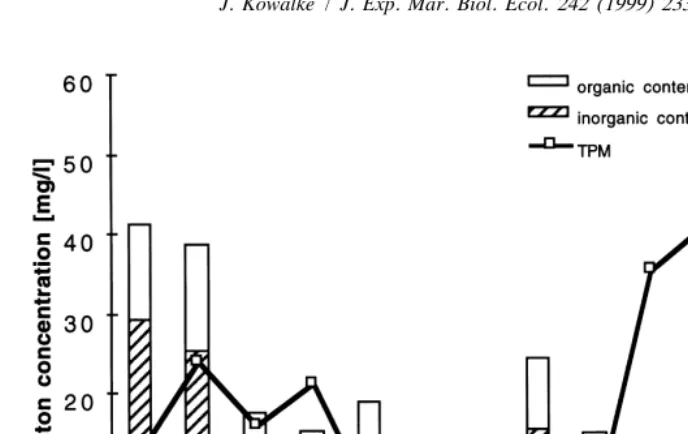
Fig. 4. Seston concentration, organic and inorganic content of the seston in 30 m depth (size class 0.8 to 30
mm diameter) for the period of February 1995 to January 1996 (from Kowalke, 1998, altered; TPM5total particulate matter).
personal communication), they separate nutritional niches by size selectivity and thus reduce competition.
This becomes important in the background of food availability. Particles larger than 8 mm, e.g. most diatom species, are comparatively rare during most of the year. A year round analyses of total particulate matter (TPM) between 8 and 30 mm in diameter
6
shows less than 10 particles / l with an inorganic fraction of always more than 50% (Fig. 4; see Kowalke, 1998), which corresponds to 0.3 to 0.5 mg / l chlorophyll a (Schloss, 1997). Particles of smaller sizes like protozoans and bacteria seem to play a significant role in the nutrition of these species. M. pedunculata and Corella eumoyta, by far the most abundant ascidians of Potter Cove in terms of biomass (Table 2; Kowalke, 1998), obviously benefit from their ability to exploit particles down to the bacterial range.
Table 2
2
abundance (ind / m ) and average biomass per individuum (dry mass) and biomass per square meter (dry
2
mass / m ) of Potter Cove (from Kowalke, 1998, altered)
2 2
Species ind / m dw (g) dw / m (g)
A. challengeri 2.3 1.6 3.7
C. verrucosa 1.0 5.7 5.7
C. eumyota 2.2 5.2 11.4
4.3. Pumping rates
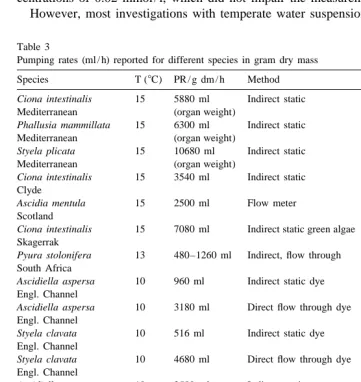
The pumping rates are clearly below those of temperate water animals (Table 3). Holmes (1973) reported a depression of water transportation of animals measured in static water conditions with factors between three and nine for the species Ascidiella
aspersa and Styela clavata, respectively, when compared to flow through methods
(Table 3). In general steady state methods diminish the pump rates by CO enrichment.2
A rough calculation of CO2 accumulation in the aquaria yielded maximum con-centrations of 0.02 mmol / l, which did not impair the measurements.
However, most investigations with temperate water suspension feeding species seem
Table 3
Pumping rates (ml / h) reported for different species in gram dry mass
Species T (8C) PR / g dm / h Method Source
´
Ciona intestinalis 15 5880 ml Indirect static Fiala-Medioni, 1978
Mediterranean (organ weight)
´
Phallusia mammillata 15 6300 ml Indirect static Fiala-Medioni, 1978
Mediterranean (organ weight)
´
Styela plicata 15 10680 ml Indirect static Fiala-Medioni, 1978
Mediterranean (organ weight)
Ciona intestinalis 15 3540 ml Indirect static Robins, 1983 Clyde
Ascidia mentula 15 2500 ml Flow meter Robins, 1984 Scotland
˚
Ciona intestinalis 15 7080 ml Indirect static green algae Petersen and Riisgard, 1992 Skagerrak
Pyura stolonifera 13 480–1260 ml Indirect, flow through Stuart and Klumpp, 1984 South Africa
Ascidiella aspersa 10 960 ml Indirect static dye Holmes, 1973 Engl. Channel
Ascidiella aspersa 10 3180 ml Direct flow through dye Holmes, 1973 Engl. Channel
Styela clavata 10 516 ml Indirect static dye Holmes, 1973 Engl. Channel
Styela clavata 10 4680 ml Direct flow through dye Holmes, 1973 Engl. Channel
˚
Ascidiella aspersa 10 2580 ml Indirect static Randløv and Riisgard, 1979 Kattegat
˚
Ascidiella aspersa 10 3240 ml Direct, flow through Randløv and Riisgard, 1979 Kattegat
˚
Ciona intestinalis 10 2760 ml Direct, flow through Randløv and Riisgard, 1979 Kattegat
Ascidia challengeri 1 110 ml Indirect static this work Potter Cove
Corella eumyota 1 230 ml Indirect static this work Potter Cove
Molgula pedunculata 1 108 ml Indirect static this work Potter Cove
J. Kowalke / J. Exp. Mar. Biol. Ecol. 242 (1999) 233 –244 241
to overestimate water transportation rates. Doering and Oviatt (1986), working with the
14
clam Mercenaria mercenaria in mesocosm tanks using labelled C carbon assumed an overestimation of pumping rates in investigations using unnatural suspensions like monoalgal cultures. This was confirmed by MacDonald and Thompson (1986), Grant and Cranford (1991) and Cranford and Gordon (1992) for pectinid clams and Prins et al. (1995) for Mytilus edulis. So far the only available publication using natural suspensions as food sources for ascidians states 480–1260 ml / h at 138C (Pyura stolonifera; Stuart and Klumpp, 1984), whereas rates of Ascidiella aspersa or Ciona intestinalis yielded
˚
2580 and 2760 ml / h, respectively, at 108C (Randløv and Riisgard, 1979).
Particle loads have an influence on pumping rates. Robbins (1984) found a rate decreased by 50% when Ascidia mentula was exposed to 100 mg / l inorganic seston.
˚
Petersen and Riisgard (1992) found similar results for Ciona intestinalis using green algae as the food source. As ascidians are not able to discriminate between particles of organic or inorganic origin (Robbins, 1984), the Potter Cove species presumably pump less water due to the sediment laden ambient water. Squirting, a rhythmical contraction of the body wall to get rid of surplus particles, was never observed in the Antarctic species. But as the animals were not continuously observed during the long lasting experiments, it cannot be excluded. These events would of course lower the mean pumping rates. Another factor, which is reducing the pumping rates, is the increased water viscosity at low water temperatures. But as Antarctic surface water at 08C is only 50 to 60% more viscous than water of 208C, the temperature difference alone cannot account for the observed rates.
4.4. Ecological implications
At first sight Potter Cove seems to be an unfavourable habitat for filter feeding benthos. Primary production is very low (Schloss, 1997) and the benthos has to cope with sinking inorganic sediments of glacial origin that dilutes an already scarce
¨
planktonic food supply (Kloser et al., 1994b; Varela, 1998). Benthic material, re-suspended by fierce wind, is of greater nutritional value (Schloss et al., in press) but still contains large amounts of inorganic particles (Kowalke, 1998). Ascidians in Potter Cove are thus forced to handle large quantities of particles of low average nutritional value, but have to prevent the blockage of the filtering apparatus due to an overload of particles. As ascidians are not able to select particles and directly reject unwanted ones, this can only be done by closing the inhalant openings as well as by squirting, both at the cost of energy (Hoyle, 1953; Werner and Werner, 1954). Robbins (1985) demon-strated for Ciona intestinalis a high mortality rate due to starving at sediment concentrations higher than 600 mg / l, a reasonable value in certain conditions for Potter Cove (Varela, 1998). The species of Potter Cove present a new strategy minimising the risk of clogging the filtering structures by lowering the retention performance.
The two flat forms with their inhalant openings close to the bottom, A. challengeri and C. eumyota, pump less water than the erect species M. pedunculata and C.
verrucosa (Table 1). The particulate matter is not distributed evenly above the sea
press). After resuspensive events like storms, POM is generally sinking slower than the inorganic fraction (Fabiano et al., 1997) thus raising the level of organic material in higher regions and diluting POM concentrations close to the ground. To get the same amount of energy, the flat species have to pump more water, process more useless inorganic particles and squirt more often than the other two.
These species reduce in comparison to the erect forms the pumping rates to avoid an overload of inorganic particles. However, the strategies, lowering both retention efficiencies and pumping rates, certainly decrease the energy intake.
5. Summary
These investigated Antarctic ascidians have to balance between their energetic demands and the threat of suffocating to optimise production but nevertheless seem to be physiologically well adapted to near shore waters with high turbidity and sediment load and thus dominate benthic communities in these areas (Gallardo et al., 1977; Jazdzewski et al., 1986; Ramos et al., 1987, Saiz-Salinas et al., 1997), whereas zones of low turbidity and high water clarity, in shallow as well as in deeper waters, are mainly populated by sponges (Dayton et al., 1974; Battershill, 1989; Barthel and Gutt, 1992; Starmans, 1997) or bryozoans (Barnes, 1995; Barnes et al., 1996; Starmans, 1997). Nevertheless, it remains unclear to which degree heavy particle loads hamper pro-duction. This remains to be investigated in the future.
Acknowledgements
I would like to thank the Alfred Wegener Institute for Polar and Marine Research and the staff of the Dallmann Laboratory for logistical support. As well Dr. T. Brey, J. Diikstra and two anonymous reviewers for useful comments on the manuscript. This work was partially financed from the Deutsche Forschungsgemeinschaft. This is AWI publication no. 1627.
References
Ahn, I., 1993. Enhanced particle flux through the biodeposition by the Antarctic suspension feeding bivalve
Laternula elliptica in Marion Cove King George Island. J. Exp. Mar. Biol. Ecol. 171, 75–90.
Barnes, D.K.A., 1995. Sublittoral epifaunal communities at Signy Island, Antarctica. 2. Below the ice-foot zone. Mar. Biol. 121 (3), 565–572.
Barnes, D.K.A., Rothery, P., Clarke, A., 1996. Colonisation and development in encrusting communities from the Antarctic intertidal and sublittoral. J. Exp. Mar. Biol. Ecol. 196 (1–2), 251–265.
Barthel, D., Gutt, J., 1992. Sponge associations in the Weddell Sea. Ant. Sci. 4, 137–150.
Battershill, C.N., 1989. Distribution and abundance of benthic marine species at Cape Armitage. Ross Island, Antarctica – initial results. New Zealand Ant. Rec. 9 (2), 35–52.
J. Kowalke / J. Exp. Mar. Biol. Ecol. 242 (1999) 233 –244 243 Cranford, P.J., Gordon, Jr. D.C., 1992. The influence of dilute clay suspensions on sea scallop (Placopecten
magellanicus) feeding activity and tissue growth. Neth. J. Sea Res. 30, 107–120.
Dayton, P.K., Robillard, G.A., Paine, R.T., Dayton, L.B., 1974. Biological accommodation in the benthic community at McMurdo Sound. Antarctica Ecol. Mono. 44, 105–128.
Doering, P.H., Oviatt, C.A., 1986. Application of filtration rate models to field populations of bivalves: an assessment using experimental mesocosms. Mar. Ecol. Prog. Ser. 31, 265–275.
Doering, P.H., Oviatt, C.A., Kelly, J.R., 1986. The effects of the filter-feeding clam Mercenaria mercenaria on carbon cycling in experimental marine mesocosms. J. Mar. Res. 44, 839–861.
Fabiano, M., Chiantore, M., Povero, P., Cattaneo-Vietti, R., Pusceddu, A., Misic, C., Albertelli, G., 1997. Short-term variations in particulate matter flux in Terra Nova Bay. Ross Sea Ant. Sci. 9 (2), 143–149.
´
Fiala-Medioni, A., 1978. Filter-feeding ethology of benthic invertebrates (Ascidians) IV. Pumping rate, filtration rate, filtration efficiency. Mar. Biol. 48, 243–249.
Flint, R.W., Kamykowski, D., 1987. Benthic nutrient regeneration in South Texas coastal waters. Estuar. Coast. Shelf. Sci. 18, 221–230.
Galeron, J., Herman, R.L., Arnaud, P.M., Arntz, W.E., Hain, S., Klages, M., 1992. Macrofaunal communities on the continental shelf and slope of the south-eastern Weddell Sea. Antarctica Pol. Biol. 3, 283–290.
˜ ´
Gallardo, V.A., Castillo, J., Retamal, M., Yanez, A., Moyano, H., Hermosilla, J., 1977. Quantitative Studies on the soft-bottom macrobenthic animal communities of shallow Antarctic bays. In: Llano, R. (Ed.), Adaptation within Antarctic ecosystems, Proc. 3. SCAR on Ant. Biol., pp. 361–387.
Gerdes, D., Klages, M., Arntz, W.E., Herman, R.L., Galeron, J., Hain, S., 1992. Quantitative investigations on macrobenthos communities of the south-eastern Weddell Sea based on multibox corer samples. Pol. Biol. 12, 291–301.
Grant, J., Cranford, P.J., 1991. Carbon and nitrogen scope for growth as a function of diet in the sea scallop
Placopecten magellanicus. J. Mar. Biol. Ass. UK 71, 437–450.
Hargrave, B.T., 1973. Coupling carbon flow through some pelagic and benthic communities. J. Fish. Res. Board Can. 30, 1317–1326.
¨ Holmes, N., 1973. Water transport in the ascidians Styela clavata (Herdman) and Ascidiella aspersa (Muller).
J. Exp. Mar. Biol. Ecol. 11, 1–13.
Hoyle, G., 1953. Spontaneous squirting of an ascidian, Phallusia mamillata (Cuvier). J. Mar. Biol. Ass. U.K. 31 (3), 541–562.
Jazdzewski, K., Jurasz, W., Kittel, W., Presler, E., Presler, P., Sicinski, J., 1986. Abundance and biomass estimates of the benthic fauna in Admirality Bay. King George Island, South Shetland Islands. Pol. Biol. 6, 5–16.
Kirkwood, J.M., Burton, H.R., 1988. Macrobenthic species assemblages in Ellis Fjord Vestfold Hills, Antarctica. Mar. Biol. 97, 445–457.
¨
Kloser, H., Ferreyra, G., Schloss, I., Mercuri, G., Laturnus, F., Curtosi, A., 1994a. Hydrography of Potter Cove, a small, fjord-like inlet on King George Island (South Shetlands). Estuar. Coast. Shelf. Sci. 38, 523–537.
¨
Kloser, H., Mercuri, G., Laturnus, F., Quartino, M.L., Wiencke, C., 1994b. On the competitive balance of macroalgae at Potter Cove (King George Island, South Shetlands). Pol. Biol. 14 (1), 11–16.
¨
Kowalke, J., 1998. Energieumsatze benthischer Filtrierer der Potter Cove (King George Island, Antarktis), Rep. Pol. Res. 286.
Kowalke, J., Abele, D., 1998. A first record of the soft bottom infauna community of Potter Cove. Rep. Pol. Res. 299, 106–112.
MacDonald, B.A., Thompson, R.J., 1986. Influence of temperature and food availability on the ecological energetics of the giant scallop Placopecten magellanicus. 3. Physiological Ecology, the gametogenetic cycle and scope for growth. Mar. Biol. 93, 37–48.
Martin, J.L., Sornin, J.M., Marchand, M., 1991. The significance of oyster biodeposition in concentrating organic matter and contaminants in the sediment. Aquacult. Environ. 14, 207.
˚
Petersen, J.K., Riisgard, H.U., 1992. Filtration capacity of the ascidian Ciona intestinalis and its grazing impact in a shallow fjord. Mar. Ecol. Prog. Ser. 88, 9–17.
Prins, T.C., Escavarage, V., Smaal, A.C., Peeters, J.C.H., 1995. Nutrient cycling and phytoplankton dynamics in relation to mussel grazing in a mesocosm experiment. Ophelia 41, 289–315.
Propp, M.V., 1970. In: Holgate, M.W. (Ed.), Antarctic Ecology, The study of bottom fauna at Haswell Islands by SCUBA diving, Vol. 1, Academic Press, London, pp. 244–257.
˜
Ramos, A., Sobrino, I., Gilde Sola, L., Pinero, C., 1987. Un examen general del macrobenthos de los ˜
archipelagos del arco de escocia, encontrados durante la campana ‘Antartida 8611’. In: Actas del segundo ˜
simposio espanol de estudios antarcticos, Consejo superior de investigaciones cientificas, Madrid, pp. 353–364.
˚
Randløv, A., Riisgard, H.U., 1979. Efficiency of particle retention and filtration rate in four species of ascidians. Mar. Ecol. Prog. Ser. 1, 55–59.
Robbins, I.J., 1983. The effects of body size, temperature and suspension density on the filtration and ingestion of inorganic particulate suspensions by ascidians. J. Exp. Mar. Biol. Ecol. 70, 65–78.
Robbins, I.J., 1984. The regulation of ingestion rate, at high suspended particulate concentrations, by some phleobranchiate ascidians. J. Exp. Mar. Biol. Ecol. 82, 1–10.
Robbins, I.J., 1985. Ascidian growth and survival at high inorganic particulate concentrations. Mar. Poll. Bull. 16 (9), 365–367.
Roman, M.R., Rublee, P.A., 1980. Containment effects in copepod grazing experiments. Limnol. Oceanogr. 25, 982–990.
´ ¨
Sahade, R., Tatian, M., Kowalke, J., Kuhne, S., Esnal, G., 1998. Benthic faunal associations on soft substrates at Potter Cove, King George Island, Antarctica. Pol. Biol. 19, 85–91.
´ ´
Saiz-Salinas, J.I., Ramos, A., Garcıa, F.J., Troncoso, J.S., San Martin, G., Sanz, C., Palacin, C., 1997. Quantitative analysis of macrobenthic soft bottom assemblages in South Shetland waters (Antarctica). Pol. Biol. 17 (4), 393–400.
´
Schloss, I.R., 1997. Escalas temporo-espaciales de variabilidad del fitoplancton costero antartico. Ph.D. Thesis, University of Buenos Aires.
Schloss, I., Ferreyra, G., Mercuri, G., Kowalke, J., 1999. Potential food availability for benthic filter feeders in an Antarctic coastal shallow environment: a sediment trap study. Sci. Mar.
¨ ¨
Starmans, A., 1997. Vergleichende Untersuchungen zur Okologie und Biodiversitat des Megaepibenthos der Arktis und Antarktis. Rep. Pol. Res. 250.
Stuart, V., Klumpp, D.W., 1984. Evidence for food-resource partitioning by kelp-bed filter feeders. Mar. Ecol. Prog. Ser. 16, 27–37.
Varela, L., 1998. Hydrology of Matias and Potter Creeks. Rep. Pol. Res. 299, 33–39. ¨
Werner, E., Werner, B., 1954. Uber den Mechanismus des Nahrungserwerbs der Tunicaten, speziell der Ascidien. Helgol. Wiss. Meeresunters. 5, 57–92.
Williams, L.G., 1982. Mathematical Analysis of the Effects of Particle Retention Efficiency on Determination of Filtration Rate. Mar. Biol. 66, 171–177.