ISSN 0024-9521
IJG Vol. 45, No.1, June 2013 (90 - 100) © 2013 Faculty of Geography UGM and The Indonesian Geographers Association
THE EFFECT OF SOCIO-ECONOMY TOWARDS CONSERVATION
AT CI TANDUY WATERSHED
Dede Sugandi [email protected]
Geography Education, University of Education Indonesia
ABSTRACT
The aims of the study are: 1) Analyzing positive effect of resident’s income towards resident’s participation on conserving Ci Tanduy watershed 2) Analyzing negative effect of resident’s
knowledge towards resident’s participation in conserving Ci Tanduy watershed, 3) Analyzing negative effect of land possession towards resident’s participation in conserving Ci Tanduy watershed 4) Analyzing effort to improve resident’s socio-economy which supports maintenance and protection effort of Ci Tanduy watershed. Study method which is used is survey with analysis with quantitative method. Analysis technique which is used is linear Regression. Area population is Ci Tanduy Watershed. Resident population is farmers and fishermen around the wwatershed. Analysis conclusion shows that 1) There is positive effect of income towards participation, 2) There is negative effect of knowledge towards participation, 3) There is negative effect of land possession toward participation, 4) Area physical condition, which affects erosion and participation, requires resident participation.
Key Words: Income, Knowledge, Land possession, Participation and Empowerment
ABSTRAK
Tujuan penelitian yaitu 1) Menganalisis pengaruh positif tingkat pendapatan penduduk terhadap Partisipasi penduduk dalam konservasi daerah aliran Ci Tanduy.2) Menganalisis pengaruh negatif pengetahuan penduduk terhadap partisipasi penduduk dalam konservasi daerah aliran Ci Tanduy.3) Menganalisis pengaruh negatif dari luas kepemilikan lahan penduduk terhadap partisipasi penduduk dalam konservasi daerah aliran Ci Tanduy. 4) Menganalisis upaya meningkatkan keadaan sosial ekonomi penduduk yang menunjang upaya pemeliharaan dan perlindungan daerah aliran Ci Tanduy. Metode penelitian yang digunakan adalah survey dengan analisis dengan metode kuantitatif. Teknik analisis digunakan Regresi linier. Populasi wilayah adalah Daerah aliran Ci Tanduy. Populasi penduduk adalah petani dan nelayan pada DAS Citanduy.Kesimpulannya bahwa 1) Terdapat pengaruh positif tingkat pendapatan terhadap partisipasi, 2) Terdapat pengaruh negatif pengetahuan terhadap partisipasi, 3) Terdapat pengaruh negatif luas kepemilikan lahan terhadap partisipasi, 4) Keadaan fisis daerah memengaruhi terjadinya erosi dan konservasi perlu partisipasi penduduk.
Kata Kunci : Pendapatan. Pengetahuan, Kepemilikan lahan, Partisipasi dan pemberdayaan.
THE EFFECT OF SOCIO - EKONOMI Dede Sugandi
because of land reclamation and deforestation.
Such opinion describes that silting up and stricture in Sagara Anakan waters are caused by big erosion from Ci Tanduy. Because of it, it is needed an effort in reducing erosion level through conservation. Conservation is an effort in protecting, conserving and using all things in the environment. Conservation is not meant that we are forbidden to manage the land, but is an effort in reducing erosion level which is begun at upstream and midstream of the watershed.
Such conservation effort needs to involve residents, because with residents’ participation, it can minimize erosion level. Participation is related with information about residents condition, residents involvement in development program in the preparation and planning, because without their involvement can cause failure [Conyers, 1991]. Thus, participation should be enhanced through economy empowerment, stakeholder empowerment, nature conservation and law enforcement in the frame of sustainable environmental management [Suryanto, E, 2004]. Participation, according to Sastropoetro (1988), is spontaneous involvement with awareness and also responsible towards group interest in achieving shared goals. Wazir W.A. et. al., [1999] stated that participation can be interpreted as one’s involvement consciously into certain situation. Based on such interpretation, someone can participate if he finds himself with or in the group, through various processes sharing with each other in the terms of shared value, tradition, feeling, and solidarity, obedience, and responsibility. Other opinion stated that Citizen Participation is citizen power [Sherry, R.A, 1969]. To reduce level of erosion and silting up, we need not only knowledge, but also residents’ participation in land management. Kartasasmita, [1997], stated that the failure on development cannot achieve the goals because of residents’ participation
with reason 1) Development for people’s interest, but not understood by people, 3) the implementation which is not in accordance with such understanding, 4) People do not participate.
Such opinion shows that development must be in the side of residents’ interest, so, residents’ participation can be relied on, and so, it is needed socialization. Development, which is continuing, is not only physical, but also related with income, so participation in conserving and protecting environment. In conserving Sagara Anakan as central of resident’s activity, residents have significant role, because it involves resident’s involvement. Conyers, [1991] stated that, first, residents’ participation is a tool in obtaining information about condition, needs; second, residents will trust to development program if they are involved in preparation and planning process; third, it is a right of democracy if residents are involved in the development. With comprehension and participation, conservation program can be implemented effectively.
Residents’ participation, in conducting conservation on the land which is managed, is related with socio-economy condition, namely: Income, knowledge and land possession.
Efforts in saving environment from erosion through conservation, is related with resident activity in working on field. In working on field, residents try to work on field in accordance with field condition, because it is related with physical and socio-economy nature. Field work is conducted to make a living, so residents try to save the damaged field. But, unconsciously what they do otherwise cause the erosion.
This study arises questions as follows: 1. Is there positive effect towards
resident’s income towards resident’s participation in conservation of Ci Tanduy watershed?
resident’s knowledge towards resident’s participation in conserving Ci Tanduy watershed? 3. Is there negative effect towards
resident’s land possession towards resident’s participation in conserving Ci Tanduy watershed? 4. How to improve resident’s
socio-economy condition which supports maintenance and protection effort through conservation of Ci Tanduy watershed?
This study based on problems that Ci Tanduy River undergoes erosion which gives impact towards silting up and stricture of Sagara Anakan waters. To reduce such silting up and stricture, it needs conservation at Ci Tanduy River, so, the aims of the study are:
1. Analyzing positive effect of residents’ income towards resident’s participation on conserving Ci Tanduy watershed? 2. Analyzing negative effect of
resident’s knowledge towards resident’s participation in conserving Ci Tanduy watershed? 3. Analyzing negative effect of land
possession towards resident’s participation in conserving Ci Tanduy watershed?
4. Analyzing effort to improve resident’s socio-economy which supports maintenance and protection effort of Ci Tanduy watershed?
This study is aimed to describe about conservation effort which requires resident’s involvement, because it is useful for
1. Developing theory and effort to improve resident’s socio-economic with little erosion.
2. For academic, this study has significant meaning as learning material to improve participation, because conservation of agricultural land is influenced by
agriculture.
3. This study gives contribution for social study, especially, Geography that continual development must be conducted with inter disciplinary approach and cross-sectoral.
THE METHODS
The study area is Ci Tanduy Watershed with geographical location between 108 01’ 15,66” E - 109 00’00”” E and 7 01’12,96” S - 7 46’44,4” S. Ci Tanduy has brooks, namely Ci Kawung and Ci Seel.
Area population in this study is Ci Tanduy Watershed and resident’s population is residents who work on the field with sample are taken from upstream, downstream and midstream. Amount of sample are 180 respondents.
Data is obtained from respondents by using Questionnaires and field check which is related with:
1. Free Variable, namely:
Level of income, Knowledge and Land possession
2. Bound Variable, namely: Participation
To obtain primary data from residents at Ci Tanduy watershed who work on field is by using survey method. Instruments which are developed based on variable, namely; income, knowledge, land possession, attitude, participation and conservation. Statistic Analysis use linear Regression Analysis. This analysis is assisted with SPSS version 16 software with Structural Equation is:
THE EFFECT OF SOCIO - EKONOMI Dede Sugandi
RESULT AND DISCUSSION
Study Location
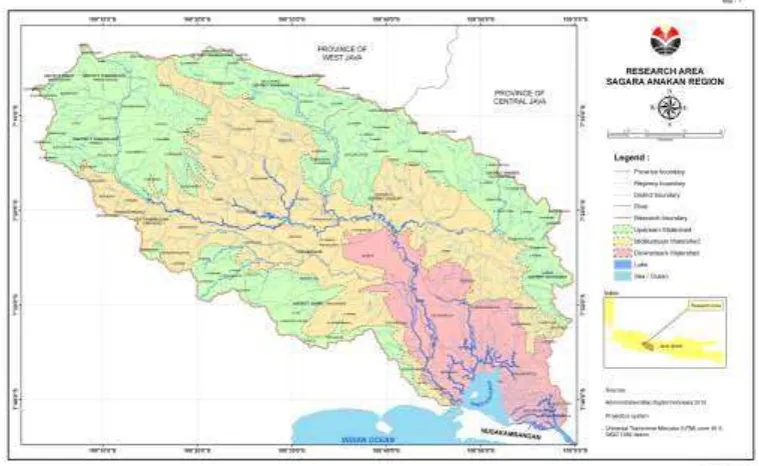
Ci Tanduy Watershed flow into Sagara Anakan Sea. Ci Tanduy is a river which has its upper reaches at Garut Regency. This Watershed gives significant contribution towards Sagara Anakan Sea, because of erosion on Watershed. The study location is shown at Map 1.
Weather
This area has tropical weather with Precipitation > 1.500 mm/year and average temperature > 18 C. Precipitation will flow to the surface that has potency to cause erosion, especially at rainy season, in which around month October until April. Geology and Morphology
Ci Tanduy Watershed has rocky riverbed, namely: a) QTv is rock which is originated from volcano eruption which is divided into QTvs, QTvk, QTvb, QTvd, QTvr, and QTvc which has resistance nature towards erosion. Qa and Qf is rock which is resulted from deposit process. Qv with rocks which are originated from young volcano eruption and Tmpk with material have resistance nature towards erosion, b) Tpt, Tmph, Tmkl, Tml, Tpc and Tmhg with limestone material with insertion. With limestone which is dissolved by water, and napal insertion, flake which is vulnerable towards erosion. The steepness of watershed is classified into 5 classes,
namely: a) Class 1, with steepness around 0 - 8%, soft materials from limestone until sand, b) Class 2, with steepness of slope around > 8 - 15%, c) Class 3, with steepness of slope around > 15 - 25, d) Class 4, with the steepness of slopes around > 25 - 40% and e) Class 5, with the steepness of slopes around >40%.
Soil
Ci Tanduy Watershed consists of various type of soils, namely: 1) Alluvial; is type of soil in the form of sediment, 2) Regosol; is a type of young soil which has high porosity, 3) Andosol; develop at area which is above 3.000 meter, 4) Gleysol; which is formed because of sediment process, 5) Organosol; which is formed by fossil material from plant and animal, 6) Grumusol; which develop with wavy morphology - hilly, 7) Latosol; which has undergone washing, 8) Mediteran; which develop form main material of limestone. Hydrograph
Ci Tanduy flow into Sagara Anakan Sea and has brooks namely, Ci Seel and Ci Kawung. This stream is dammed by Maganti Dam to irrigate rice field at Cilacap and Ciamis Regency. The upper stream with erosion material is brought and deposited at Ci Tanduy estuary, namely; Sagara Anakan Sea which undergoes silting up and stricture.
Figure 1. Study Location Land Usage
Land at wwatershed is used for various usages. These usages are classified into;
a) Forest; that function to balance environment ecosystem
b) Mangrove forest; which is spread at midstream and downstream area
c) Plantation; which is managed by residents in small area while plantation in the wide area is managed by government or private. d) None irrigated dry field; is
dry agriculture with seasonal plants which is worked on by residents. e) Settlements; are spread
around Watershed by flatting the soil.
f) Rice field; s is terrace fields, but with waterproof soil.
g) Bushes; are not worked on by residents.
Amount and Density of Residents
Watershed boundary is based on natureal boundary as separator of water flowing system which is come from precipitation in the form of ridge.
Study Result Description
THE EFFECT OF SOCIO - EKONOMI Dede Sugandi
Table 2. Development of Participation
Area Development
L % SM % I % C %
Upstream Watershed 36 60 17 28,33 3 5 4 6,67
Midstream Watershed 28 46,67 18 30 1 1,67 13 21,7
Downstream Watershed 14 23,33 10 16,67 25 41,7 11 18,8
Annotation: L : Livestock
SM : Seed and Manure I : Irrigation
C : Cooperative
From Sub structure statistic test result 2 is obtained R2 = 0.29 (rounding off), F = 23,977 sig value = 0,000 (significant). Simultaneous effect X123 towards Y around 8, 41% and around 91, 59% is influenced by other factors.
1) Hypothesis 1 test, X1 Effect towards Y. Test results is obtained that t value = 3,609 with sig value = 0,000 (significant). It means that the effect around (0, 2962) = 9% and around 91% is influenced by other factors.
2) Hypothesis 2 test, X2 Effect towards Y. Test result is obtained t value = -2,001 with sig value = 0,047 (significant). It means that around (-0, 1252) = 2% and around 98% is influenced by other factors. 3) Hypothesis 3 test, X3 Effect
towards Y. Test result is obtained t value = - 0,213 with sig value = 0,034 (significant). It means that the effect around (0, 1712) = 3% and around 97% is influenced by other factors.
4) To implement conservation by increasing income, knowledge and land possession. Conservation with method and form always be conducted, but land area which is worked on is limited and will cut down area which is not intended for agriculture.
Discussion
The study results show that conservation at Sagara Anakan Sea is influenced by variable, level of income (X1), knowledge (X2) and land possession (X3) which tend to affect towards participation (Y).
The Impact of Income towards Participation (X1 towards Y)
Hypothesis "There is a positive effect on the income level of the population participation in conservation" (X1 to Y). Statistical tests obtained probability value is greater than the value of sig (0.05> 0.000) with a Beta value of 0.296, the Hi Ho rejected and accepted with positive influences. Revenue has positive influence on the level of participation in the conservation of the relationship enough. The meaning of the positive influence suggests that the higher the level of income will be greater participation of the population. Since participation can be done in the form of money, goods / capital, labor, ideas / ideas and social.
The Impact of Land Possession towards Participation (X3 towards Y)
The research hypothesis states "There is a widespread negative impact of land ownership on participation of the population in conservation" (X3 to Y). The test results obtained over Esar an idea of the probability of sig (0.05> 0.034) with a Beta value of - .171, the Hi Ho rejected and accepted by the influence is negative. Describe the meaning of the negative influences reverse effect, where the higher
participation. To obtain higher income, they are trying to increase the area of the land, although the land is physically unconditional.
The results of the analysis illustrates that water conservation Sagara tillers influenced variable, income level (X1), knowledge (X2) and tenure (X3) tend to affect the participation of (Y).
Effect of Income Level for Participation (X1 to Y).
Hypothesis "There is a positive effect on the income level of the population participation in conservation" (X1 to Y). Statistical tests obtained probability value is greater than the value of sig (0.05> 0.000) with a Beta value of 0.296, the Hi Ho rejected and accepted with positive influences. Revenue has positive influence on the level of participation in the conservation of the medium relationship. The meaning of the positive influence suggests that the higher the level of income will be greater participation of the population. Since participation can be done in the form of money, goods / capital, labor, ideas and social.
Effect of Knowledge of Participation (X2 to Y).
The research hypothesis states "There is a negative effect on the participation of the people of knowledge in conservation." (X2 to Y). Statistical tests obtained probability value is greater than the value of sig (0.05> 0.047) with a Beta value of - 0.125, then Ho is rejected and accept Hi with negative influences. It describes the meaning of the negative influences reverse effect, where the higher the knowledge, the participation of the lower. Conservation is a need to conduct land management, without the conservation tilled land will fail. Knowledge in agriculture will only be done on the land without considering the land tilled land affecting working on.
Y).
The research hypothesis states "There is a widespread negative impact of land ownership on participation of the population in conservation" (X3 to Y). The test results obtained over Esar an idea of the probability of sig (0.05> 0.034) with a Beta value of - .171, the Hi Ho rejected and accepted by the influence is negative. Describe the meaning of the negative influences reverse effect, where the higher land under cultivation, the lower participation. To obtain higher income, they are trying to increase the area of the land, although the land is physically unconditional.
socio-THE EFFECT OF SOCIO - EKONOMI Dede Sugandi
economic situation of the population, because it is the cutting edge of conservation needs.
CONCLUSION
Ci Tanduy Watershed is a river which gives impact towards Sagara Anakan Sea. Effort to reduce erosion is made through
integrated conservation. Conservation
involves resident s participation, but
participation is influenced by socio-economy condition. It means that erosion which is occurred at watershed is affected by physical and social factors. This study suggests several conclusions.
1. Conservation program needs to concern to the socio economy
condition, because of the
fulfillment of residents necessity. Socio-economy life is related with
conservation which involves
residents, namely: The Impact of Income (X1), Knowledge (X2), and
Land possession (X3) towards
Participation (Y).
2. Ci Tanduy watershed has
precipitation around 1691 mm/year
- 3398 mm/year and average
temperature around 24, 1C - 31, 3C.
3. Conservation towards land with
physical condition which is
vulnerable towards erosion needs to be overcome.
4. Land physical condition which
affects conservation and treatment towards physical condition must be distinguished based on necessity.
RECOMMENDATION
Ci Tanduy is a river which gives impact towards erosion, while to reduce level of erosion, it is related with resident s economy. The development of socio-economy needs to give concerns towards land characteristic, thus, this study is proposed several recommendations.
1. Area which has base rock and soil
which is vulnerable towards
erosion, with slopes steepness which is wavy - very steep and
require regulation for
re-forestation, is mainly area which is belongs to government. It is based on the benefit obtained by residents is fewer that its negative impact. So, government intervention and also social figures is needed.
2. Vocation in agricultural sector has significant role in implementing conservation, because most of farmers conducted conservation method. Working hours of farmers are limited until 12 pm. The rest of the time can be used to do other
activities. Thus, to empower
residents, especially for developing side job, it is possible to be conducted by giving guidance, elucidation, and aids in developing livestock, seed and manure and also irrigation.
ACKNOWLEDGEMENT
This article is made possible through the guidance, encouragement from various parties, as the author expressed his
Bahari (2003), Segara Anakan Need Help.
[Online]. Available: www.
sinarharapan.co.id. [20 Mei 2011].
BPKSA (2007), Report of Population and
Population Control Activities in the Area Immigrants Segara Anakan, Cilacap.
Collier W.L at al (1996),New Approach to
Rural Development in Java. Obor Indonesia Press, Jakarta.
Conyers, D (1991), Social Planning in the
Third World. Yogyakarta: UGM Press.
Study on Agricultural Land in Sub
Watershed Ci Kendang Garut
Residence, Geografi FPIPS UPI.
Dietz, T (1998), Entitlements to Natural Resources Contours of Political
Environmental Geography,
International Book, Utrecht,
Cooperate Remdec, Insist Press dan Pustaka Pelajar Press, Yogyakarta.
Erftemeijer P, Balen, Bas Van and Djuharsa. E (1988), The Importance of Sagara Anakan For Nature
Conservation (with special
reference to its avifauna), PHPA-AWB/INTERWADER,Bogor Residence.
Indonesia Constitution No. 32, 2009.
Environment Management.
Ismawan, I (1999). Ecological Risks,
behind Economic Growth, Media
Presindo, Yogyyakarta.
Kartasasmita (1997), Factors Affecting the Development of Civil Society in
Political Participation. [Online].
available:
http://pustakaonline.wordpress.com /2008/03/ 22/ faktor- faktor-yang- mempengaruhi-partisipasi-politik- masyarakat-dalam-pembangunan-desa/18 [18 des 2010].
Meadows H, et.al (1980), The Limits of
Growth, Report to the Rome
Group, Gramedia Press, Jakarta.
Rahmawaty, S (2004), Forests: Function
And Role For Community, Faculty
of Agriculture, Forest Science Program University of North Sumatra, 2004 Digitized by USU digital library.
Sastropoetro (1988), Participation, Communication, Persuasion and
Discipline in National
Bandung.
Satyana A (2010), Sedimentation at
Segara Anakan, Cilacap. [Online]
Available : http://www.mail-
archive.com/[email protected]/msg21920. Html, [21 Jun 2011].
Sherry R, Arnstein R (1969), A Ladder of
Citizen Participation [Online].
Tersedia:http://lithgow- schmidt.dk/sherry-arnstein/ladder-of-citizen-participation.html, JAIP, Vol. 35, No. 4, July 1969, [21 Maret 2011].
Sinatala, A (1989), Soil and Water Conservation, IPB Press, Bogor.
Soemarwoto. O (2001), Environmental
Impact Assessment. Gadjah Mada
University Press, Yogyakarta.
Soeriaatmadja, R.E (1997), Environmental
Science, ITB Press Bandung.
Stipulation of Forestry Minister No. 677/Kpts-II/1998 about, The Forest management.
Sukardi. Y (2010), Problems of Sagara
Anakan. [Online]. Avalaible
:http://sidhat. blogspot. com/29 Juli 2011.
Suryanto, E.S (2004). Environmental Management Of Village Forest In The Middle Watershed Segment (Case Study: Development Of Forest Village At Babon Watershed in Semarang City), Thesis: Environmental Studies Program, Graduate School Universitas Diponegoro
Wazir W.A. et al., ed. (1999),
Strengthening management guide
NGOs. Jakarta: INDHRRA