• Tidak ada hasil yang ditemukan

A THESIS SRI ARNA NENGSI

N/A
N/A
Protected

Academic year: 2022

Membagikan "A THESIS SRI ARNA NENGSI"

Copied!
107
0
0

Teks penuh

(1)

THE PHONOLOGICAL INTERFERENCE IN PRONOUNCINGTHEENGLISH SOUND BY BUGINESE STUDENTS ON THE THIRD SEMESTER ENGLISH

EDUCATION DEPARTMENT AT MAKASSARMUHAMMADIYAH OF UNIVERSITY

(A Descriptive-Qualitative Research on Buginese Students)

A THESIS

Submitted to the Faculty of Teacher Training and Education Muhammadiyah University of Makassar in Partial Fulfillment for the Degree of Education in

English Department

SRI ARNA NENGSI 10535 6294 15

ENGLISH EDUCATION DEPARTMENT

FACULTY OF TEACHER TRAINING AND EDUCATION MAKASSAR MUHAMMADIYAH OF UNIVERSITY

2019

(2)

ii

(3)

ii

(4)

iv iii

(5)

iv

(6)

v

UNIVERSITAS MUHAMMADIYAH MAKASSAR FAKULTAS KEGURUAN DAN ILMU PENDIDIKAN Jalan Sultan Alauddin No. 259Makassar no. 259 Telp. (0411) 86672 Makassar 90221

SURAT PERNYATAAN

Saya yang bertanda tangan dibawah ini:

Nama : Sri Arna Nengsi

Nim : 105356294 15

Jurusan : Pendidikan Bahasa Inggris

Judul Skripsi : The Phonological Interference in Pronouncing the English Sound by Buginese Students on the Third Semester English Education Department at Makassar Muhammadiyah of University

Dengan ini menyatakan bahwa:

Skripsi yang saya ajukan di depan TIM Penguji adalah ASLI hasil karya saya sendiri, bukan hasil ciplakan dan tidak dibuatkan oleh siapapun.

Demikian pernyataan ini saya buat dengan sebenarnya dan saya bersedia menerima sanksi apabila pernyataan ini tidak benar.

Makassar, 30 November 2019 Yang membuat pernyataan

Sri Arna Nengsi

(7)

vi

UNIVERSITAS MUHAMMADIYAH MAKASSAR FAKULTAS KEGURUAN DAN ILMU PENDIDIKAN

Jalan Sultan Alauddin No. 259Makassar no. 259 Telp. (0411) 86672 Makassar 90221

SURAT PERJANJIAN Saya yang bertanda tangan di bawah ini:

Nama : Sri Arna Nengsi

Nim : 105356294 15

Jurusan : Pendidikan Bahasa Inggris

Judul Skripsi : The Phonological Interference in Pronouncing the English Sound by Buginese Students on the Third Semester English Education Department at Makassar Muhammadiyah of University

Dengan ini menyatakan perjanjian sebagai berikut:

1. Mulai dari penyusunan proposal sampai selesainya skripsi ini, saya akan menyusun sendiri skripsi saya (tidak dibuatkan oleh siapapun).

2. Dalam penyusunan skripsi saya akan selalu melakukan konsultasi dengan pembimbing, yang telah ditetapkan oleh pimpinan fakultas.

3. Saya tidak akan melakukan penjiplakan (Plagiat) dalam menyusun skripsi saya.

4. Apa bila saya melanggar perjanjian saya seperti butir 1, 2, dan 3, maka saya bersedia menerima sanksi sesuai aturan yang berlaku.

Demikian perjanjian ini saya buat dengan penuh kesadaran.

Makassar, 30 November 2019 Yang membuat perjanjian

Sri Arna Nengsi

(8)

vii

MOTTO AND DEDICATION

Always Bismillah every doAnything Beacause without Allah, we are Nothing.

Amalan yg paling dicintai Allah adalah yg terus-menerus (dilakukan) meskipun sedikit. Al Qasim berkata:“Dan Aisyah, bila ia mengerjakan suatu amalan, maka ia kan menekuninya.”

[HR. Muslim No.1305]

Do the slightest kindness, because you don't know which kindness will bring you to heaven

(Researcher)

I Dedicated this Thesis for:

Allah SWT, My Beloved Parents, Sister, My Family and My

Friends

(9)

viii ABSTRACT

Sri Arna Nengsi, 2019. ThePhonological Interference in Pronouncing the English Sound by Buginese Students on the Third Semester English Education Department at Makassar Muhammadiyah of University (A Descriptive- qualitative Research).Under the Thesis of English Education Department the Faculty of Teacher Training and Education, Makassar Muhammadiyah of University,supervised by RadiahHamid and Ratu Yulianti Natsir.

The objective of this research to find out the phonological interference occurs and factors that cause interferencein pronouncing English sounds on vowel and diphthong sounds by Buginese Students on the Third Semester at Makassar Muhammadiyah of University.

This research used Descriptive-qualitative Method and applied Purposive Sampling Techniques with Inclusion Criteria. Respondents consisted of 10 Buginese studentsThird Semester English Education Department at Makassar Muhammadiyah of University. The data were collected by using audio recorder and interview.

The results of this research showed the interference that occurs of Buginese Students of Third Semester is substitution. There were 52types interference made by Buginese students in pronouncing English sounds consisting of 23vowels and 29 diphthongs. The main factors contribute to language interference is interlingual factor such as are less knowledge about phonology of the students, less practice in pronouncing English word, the difficulty in recognizing phonetic symbols and limited vocabulary from the target language mastered by students.The researcher concluded thatthe students need to practice more in speak English with their daily life, so they can pronounce each word correctly based on good English pronunciation.

Keywords: Phonological Interference, Language, Buginese, Vowel, Diphthong.

(10)

ix ABSTRAK

Sri Arna Nengsi, 2019. ThePhonological Interference in Pronouncing the English Sound by Buginese Students on the Third Semester English Education Department at Makassar Muhammadiyah of University (A Descriptive- qualitative Research).Pada Skripsi Departemen Pendidikan Bahasa Inggris, Fakultas Keguruan dan Ilmu Pendidikan, Universitas Muhammadiyah Makassar, dibimbing oleh Radiah Hamid dan Ratu Yulianti Natsir.

Tujuan dari penelitian ini untuk mengetahui gangguan fonologis yang terjadi dan faktor-faktor yang menyebabkan gangguan dalam pengucapan bunyi bahasa Inggris pada bunyi vokal dan diftong oleh Mahasiswa Bugis pada Semester Ketiga di Universitas Muhammadiyah Makassar.

Penelitian ini menggunakan Metode Deskriptif-kualitatif dan menggunakan Teknik Purposive Sampling dengan Kriteria Inklusi.Responden terdiri dari 10 mahasiswa Bugis Jurusan Pendidikan Bahasa Inggris Semester Tiga di Universitas Muhammadiyah Makassar.Data dikumpulkan melalui rekaman audio dan menggunakan teknik wawancara.

Hasil penelitian ini menunjukkan gangguan yang terjadi pada Mahasiswa Bugis Semester Ketiga adalah substitusi.Ada 52 jenis gangguan yang dilakukan oleh siswa Bugis dalam mengucapkan bunyi bahasa Inggris yang terdiri dari 23 vokal dan 29 diftong.Faktor utama yang berkontribusi terhadap gangguan bahasa adalah Faktor Interlingual seperti kurangnya pengetahuan tentang fonologi siswa, kurang praktik dalam mengucapkan kata bahasa Inggris, kesulitan mengenali simbol fonetik dan terbatasnya kosa kata dari bahasa target yang dikuasai oleh siswa.Peneliti menyimpulkan bahwa siswa perlu berlatih lebih banyak dalam berbicara bahasa Inggris dengan kehidupan sehari-hari mereka, sehingga mereka dapat mengucapkan setiap kata dengan benar berdasarkan pengucapan bahasa Inggris yang baik.

Kata Kunci: Gangguan Fonologis, Bahasa, Bugis, Vokal, Diftong.

(11)

x

ACKNOWLEDGEMENTS

Alhamdulillahi Rabbil Alamin, all praises be to Allah SWT, the Lord of this universe. Researcher expresses her highest gratitude to Allah SWT for the love, blessing, mercy, help and health to the researcher in finishing this research.

Peace and blessing be upon our prophet Muhammad SAW, his family, companions, and his faith followers till the end of the world.

Alhamdulillah by the grace of Allah the highest, the researcher could finish her thesis after long hard effort of writing. Thus, she would like to express her greatest gratitude to her beloved parents MuhammadBintang and Darnawati who always pray, support, and motivate her of every part of her life especially in doing this research. During the writing of this thesis, the researcher received a lot of help from a number of people. She realized that this thesis could never be completed without their generous help, support, advice and prayers. It would be an honor for researcher to express herdeepest appreciation to:

1. Prof. Dr. H. Abd Rahman Rahim SE., MM. as the rector of Makassar Muhammadiyah University.

2. Erwin Akib M.Pd.,P.Hd as the Dean of FKIP also for his signature, support and motivation during her study at UNISMUH.

3. Ummi Khaerati Syam, S.Pd, M.Pd the head of English Department of FKIP also for her signature, support and motivation.

4. Researcher most profound and sincere thanks and appreciation is due to

her first supervisor Dra. Radiah Hamid, M.Pd. and to her second

supervisor Ratu Yulianti Natsir, S.Pd., M.Pd. Who patiently guided and

(12)

xi

assisted her to finish this thesis by giving suggestions, motivation, and correction since the proposal until this thesis finished.

5. All lecturers who have taught her and all staff of FKIP and especially staff of English Education Study Program.

6. The Students Third Semester English Education Department 2017 of FKIP UNISMUH Makassar.

7. Her big family who always gives inspiration and motivation to continue her study.

8. Special thanks go to her motivator Dian Hera Utami and her beloved friendsfor the critics, suggestion and especially the unforgettable days, they are: Herawati,Siti Aisyah, Siti Hajar Martina, Nurlinda, Tasmaniar Taiyeb, Emilia Sianti, Sam Pravita Sari, Khairunnisa, Rika Afraini, Khadijah, Wiranggi Wahidin, Mirdawaty and all member of Class C whose name cannot be mentioned one by one.

9. Thanks to all her friends in Magang III, ISEH, TKJ 1, and P2K 2019.

Finally, the researcher realizes that this thesis has some weakness and shortage. Thus, she would be grateful to accept any suggestions and corrections from anyone for better writing.

May the Almighty bless us now and forever, and this thesis can be useful, Aamiin ya Rabbal alamin.

Makassar, November 2019

Sri Arna Nengsi

(13)

xii

TABLE OF CONTENTS

Page

COVER ...i

LEMBAR PENGESAHAN ...ii

APPROVAL SHEET ...iii

COUNSELLING SHEET ...iv

SURAT PERNYATAAN ...v

SURAT PERJANJIAN ...vi

MOTTO AND DEDICATION ...vii

ABSTRACT ...viii

ACKNOWLEDGMENTS ...x

TABLE OF CONTENTS ...xii

LIST OF TABLES ...xiv

LIST OF FIGURES ...xv

LIST OF APPENDICES ...xvi

CHAPTER I INTRODUCTION A. Background ...1

B. Research Question ...4

C. Objective of the Research ...4

D. Significance of the Research ...4

E. Scope of the Research ...5

CHAPTER II REVIEW OF RELATED LITERATURE A. Previous Findings ...7

B. Some Pertinent Ideas ...10

1. The Concept of Contrastive Analysis ...10

2. The Concept of Interference...11

3. First Language ...14

4. Factors that Cause Language Interference ...15

5. Vowel and Diphthong Sounds...16

C. Conceptual Framework ...26

CHAPTER III RESEARCH METHOD A. Research Design ...27

B. Research Setting ...28

C. Instrument of the Research ...28

D. Procedure of Data Collection ...29

E. Technique of Data Analysis ...29

(14)

xiii

CHAPTER IV FINDINGS AND DISCUSSION

A. Findings ...31 1. The Phonological Interference Occurred in

2. Pronouncing English Sound by Buginese Students ...32 Factors that Causes the Interference Occurred in

Pronouncing English Sound by Buginese Students ...47 B. Discussion ...49

1. The Phonological Interference Occurred in

Pronouncing English Sound by Buginese Students ...49 2. Factors that Causes the Interference Occurred in

Pronouncing English Sound by Buginese Students ...51 CHAPTER V CONCLUSION AND SUGGESTION

A. Conclusion ...53 B. Suggestion ...54 BIBLIOGRAPHY

APPENDICES

CURICULUM VITAE

(15)

xiv

LIST OF TABLES

Number Pages

4.1 The phonological interference in pronouncing vowel sound by S1 32

4.2 The phonological interference in pronouncing diphthong sound by S1 33

4.3 The phonological interference in pronouncing vowel sound by S2 33

4.4 The phonological interference in pronouncing diphthong sound by S2 34

4.5 The phonological interference in pronouncing vowel sound by S3 35

4.6 The phonological interference in pronouncing diphthong sound by S3 36

4.7 The phonological interference in pronouncing vowel sound by S4 37

4.8 The phonological interference in pronouncing diphthong sound by S4 37

4.9 The phonological interference in pronouncing vowel sound by S5 38

4.10 The phonological interference in pronouncing diphthong sound by S5 39

4.11 The phonological interference in pronouncing vowel sound by S6 40

4.12 The phonological interference in pronouncing diphthong sound by S6 41

4.13 The phonological interference in pronouncing vowel sound by S7 41

4.14 The phonological interference in pronouncing diphthong sound by S7 42

4.15 The phonological interference in pronouncing vowel sound by S8 43

4.16 The phonological interference in pronouncing diphthong sound by S8 44

4.17 The phonological interference in pronouncing vowel sound by S9 44

4.18 The phonological interference in pronouncing diphthong sound by S9 45

4.19 The phonological interference in pronouncing vowel sound by S10 46

4.20 The phonological interference in pronouncing diphthong sound by S10 46

(16)

xv

LIST OF FIGURES

Number Page

2.1 English Vowel Chart 19

2.2 Diagram of the Total Number of Diphthong 21

2.3 Buginese Vowel Sound 24

2.4 Buginese Diphthong Sound 25

2.4 Conceptual Framework 25

(17)

xvi

LIST OF APPENDICES

APPENDIX A Instrument Text in Pronounce English Sound

APPENDIXB Key Answer of Instrument Text in Pronounce English Sound

APPENDIXC Total Correct and Incorrect Students in Pronouncing Vowel and Diphthong Sounds

APPENDIXD List Name of the Participants APPENDIXE Results of Students Pronunciation APPENDIX F Instrument of Interview

APPENDIX G Result of Student Interview

APPENDIX H Documentations

(18)

CHAPTER I INTRODUCTION

This chapter consists of background, research questions, objective of the research, significance ofthe research and scope of the research.

A. Background

Every country has their language to communicate. Language is a system of sound symbols that humans use in communicating with others. As we know, language consists of words or sets of words. One of the language is used from several thousand languages in many countries is English because it is international language. Selinker as cited in Utami (2017) states that when language learners or a speaker try to learn a second language, their habits in the first language will affect with the pronunciation of the target language.The resulting pronunciation differs from native speakers, but both will always try to convey the same meaning. The difference is the sound that results from second language learning that influence of mother tongue.

For some foreign language learners, pronunciation is the most

important thing to learn because error pronunciation will have consequences

(19)

2

that can change the meaning of a word delivered.Therefore, to avoid these errors it is necessary to know what kinds of interference occur that can affect the foreign language learners' first language in pronouncing English sounds.

English sounds divided into two parts namely consonant and vowel.

Vowel is the production of sound whose air flow does not encounter obstacles while consonant is a sound made by a cover or narrowing in the vocal tract so that the air flow is completely or limitedly blocked by audible friction (Sinulingga, 2016). In this study, researcher will only focus on vowel and diphthong sounds, because based on observations the researcher found that there were still many English students who did not pronounce the several English vowel and diphthong words correctly because of the interference from their first language especially Buginese. For example the word late /leɪt/ pronounced/let/and word stay/steɪ/ pronounced /stʌɪ/.Buginese is one of the many regional languages found in South Sulawesi that still holds a variety of linguistic problems that are challenging to study. One of them is about language errors due to the occurrence of Buginese interference against foreign languages (Saharuddin, 2016: 78).

Weinrich as cited in Syarifah (2017) states language interference is the situation when the person uses rule from their first languages involved to the second language as a result on the language contact on both languages.

Problems that are Indonesian learners often face in learning English are language factors that arise from the interference of their first language.

Interference happens whenthe speaker uses second language and ones which

(20)

3

is interfered into first language or mother tongue.English learners are often influenced by their first language or mother tongue. However, both languages can affect each other in the aspect of syntactic, morphology and phonology. Phonology is the field of linguistics that investigates the sounds of language according to their function (Kridalaksana, 1982). Phonology can interpret as part of the language order that study the sounds of language.

Phonological differences between English and Indonesian often cause difficulties. They may be able to speak with correct grammar and lexicon, but the intonation is still in Indonesian.

Based on observations from researchers in the classroom and in the surrounding environment, researchers got differences in English pronunciation by Buginese students from various regions in South Sulawesi, especially in English students at Makassar Muhammadiyah ofUniversity.

Then the researcher did research on English students in the third semester,

because based on the opinion of researcher, third semesters students are still

new or beginners are the best targets for conducting a study because they

still have strong influence from their first language, also they are learn about

phonology in third semester. Therefore, researcher conducted a study

entitled: The Phonological Interference in Pronouncing the English Sound

byBuginese Students on theThird Semester English Education Department

at Makassar Muhammadiyah of University.

(21)

4 B. Research Question

Based on the explanation above, the researcher focused on the interference of Buginese students and the research question were formulated as follows:

1. What the interference occurs in pronouncing English sounds by Buginese Students Third Semester at UNISMUH?

2. What factors affect the pronunciation interference in pronouncing English sounds by Buginese Students Third Semester at UNISMUH?

C. Objective of the Research

In accordance with the research question above, the objectives of the research were to find out:

1. The interference phonological occurs in pronouncing English sounds by Buginese Students Third Semester at UNISMUH.

2. The factors interference phonological in pronouncing English sounds byBuginese Students Third Semester at UNISMUH.

D. Significance of the Research

The researcher hopes this research is useful practically and theoretically for:

a) English Students

The research can provide information that can help students or

English learner in understanding the pronunciation of English sounds

correctly. Also for avoid and reduce the interference phonological of

Buginese students.

(22)

5 b) Lecturers or Educators

The researcher expect in this study can help to develop English learning process, especially in the field of phonological system of English. The problem of mastering English pronunciation can be solved by knowing about phonological language system.

c) Next Researchers

In this study, the researcher expected to be able provide information or contribute to other researchers, so that next researchers can use the results of this study as a reference and comparison with other similar studies of the first language phonological interference in the pronunciation of English sounds.

E. Scope of the Research

The scope of this research is limited to find substitution of

phonological interference that happened from Buginese to English and to

find the factor causes phonological interference of Buginese students from

various regions in Makassar Muhammadiyah of University. Buginese here

not determined in specific areas, because every Buginese student from

various regions has characteristics in pronouncing wordand a jaw of person

in pronouncing word is not always the same or different and the samples in

this research were Buginese students in South Sulawesi. In this study,

researcher only focus on vowel and diphthong sounds; vowel /ʊ/, vowel /æ/,

vowel /ɜ:/, vowel /ɔ:/, vowel /ʌ/, vowel /ɒ/,diphthong/eɪ/, diphthong/ɑʊ/,

diphthong /əʊ/,diphthong /eə/, diphthong/ʊə/, diphthong/ɪə/.The research

target is English Students in the Third Semester English Education

(23)

6

Department at Makassar Muhammadiyah of University during the

Academic Year 2019/2020.

(24)

7 CHAPTER II

REVIEW OF RELATED LITERATURE

This part deals with some pertinent ideas consisting of previous findings, some pertinent ideas, concept related to this study and conceptual framework.

A. Previous Findings

A number of researcher had conducted researches related to the interference of first language to second language or target language. There were some previous related study that supported this research. Some of them were presented as follows:

1. Utami (2017) in her thesis entitled The Phonological Interference of Students’ First Language in Pronouncing English Sound concluded that there are 46 kinds manner articulation that students made when they pronounced English sound consist of 32 vowels and 14 consonants. The factor was interlanguage transfer, some of the students have known about the rules but sometimes they forgot to applied it when produced the English sounds.

2. Pratama (2017) in his research entitled Error Analysis on Diphtong

Sound Pronounced by Fourtheenth Semester Student in English

Department UIN Sunan Kalijaga focused on the error analysis in the

(25)

8

diphthongs sound by forth semester English students in UIN Sunan Kalijaga. He concluded that there are 66 wrong words when student speak, because of the difficulty of students in pronouncing a second language. This condition is called Intralingual Error or they have difficulties in second language when pronouncing diphthong words.

The result of psychological factors is students’ intelligence does not effect of their pronunciation.

3. Syarifah (2017) in her thesis entitled Phonological Interference In The

Spoken English Performed By Japanese Speaker In Teaching Process

Of “Mind Your Language Video” found that there are four types of

phonological disorders that occur in Japanese speakers who speak

English in the Mind Your Language video. Those were, (1) the

existence of distinction phonetic systems so as to produce production

errors, this is also called phoneme differentiation; Japanese speaker

confused to distinguish of sounds /l/ and /r/; (2) there were distinction

only in primary language, this is also referred to as Over-differentiation

of phonemes; Japanese speaker adds a voice /o/ in several English

words; (3) the distinction of reinterpretation occur when different

phonetic systems and different interpretations of the emphasis on a few

secondary words by then producing on error pronunciation; (4) actual

phone substitution occurs when absence of corresponding distinctions

in primary languages consisting of several sound including /ɒ/, /ӕ/, /ʌ/,

/ɵ/, /əʊ/, /ð/, /ə/, /ᴐ:/, /ʊ/, /ɪ/ and /ɜ:/.

(26)

9

4. Tilman and Nurhayani (2015) in their research entitled Kesalahan Pengucapan Vokal Depan Bahasa Inggris oleh Mahasiswa Semester I Universitas Nasional Timor Lorosa’e aimed to describe the pronunciation errors of front vowels done by the first semester students of Timor Lorosa’e National University in Timor Leste. The results of this research show that the pronunciation of native speakers of students and Portuguese front vocals in English is different from the standard spoken by native English speakers. Problems that occur in this study are caused by sound and grammatical disorders that affect the pronunciation of students' English vocals. Based on the results of this study, they concluded that students still have problems in pronouncing English vowels because they are influenced by the Portuguese pronunciation system.

From the findings that have been explained above, the researcher interprets that most students’ error can be due to their L1 transfer. A researcher found that language students having interference in their phonology, morphology and syntax. Summarily, that L1 has the potential to have a big influence on language students who will have an impact on the English production.

The researcher proposed a difference between the studies mentioned.

Because the study above focuses on pronunciation disorders in consonant

sounds, mispronunciation on the vowel front in English, interference in their

phonology, morphology and syntax. And in this research,researcher focused

on phonological interference in several symbol on vowel and

(27)

10

diphthongsounds. Buginese is known as the largest tribe in South Sulawesi.

Particularly,the interference of students pronunciation from Buginese to English.

B. Some Pertinent Ideas

1. The Concept of Contrastive Analysis

In Indonesia, English is generally learned at school, sometimes giving difficulties to students because this language is a foreign language in this country.Linguists have developed a Contrastive Analysis Approach to assist students in learning a foreign language and allow students to compare two languages so they are easy to describe language similarities and differences. Contrastive analysis has beenregarded as main pillars in the domain of second or foreign language acquisition especially in Indonesia.

Contrastive Analysis of two languages in question: L1 and L2, pointing at the specific features of each language system (in its major areas: phonology, morphology, lexicology, syntax, text analysis) helps in the process of anticipation of possible difficulties with the L2 learners. A part of the difficulties can be attributed to the mother tongue (first language) interference (Kardaleska, 2006).Tarigan as cited in Listiani (2013) argues that Contrastive Analysis is an activity of comparing the structure of two languages - first language (B1) and second language (B2) - to find differences that exist in both languages.

Linguistic state of language that has been mastered by the learner,

influences the process of acquiring the language learned or trying to

(28)

11

master it. There is this theoretical assumption that there will be transfers in learning: in the case of the Service Level Agreement, this means the transfer of elements obtained (or eliminated) at L1 to the target L2.

Transfers are called positive (or facilitating) when the same structure is suitable in both languages, and transfers are called negative (or interfering) when the L1 structure is used inappropriately in L2 (Utami, 2017).

Based on the explanation above, researcher concluded the definition of Contrastive Analysis is a systematic learning from the language part to analyze the similarities and differences with the assumption of different elements between the first language and the target language (second language).

2. The Concept of Interference a) Language Interference

Language interference is one of the current problems in learning a foreign language, because the influence from the first language to the second language. Therefore, it was necessary to be known what the causes and it can be given handling in minimizing the problem.

Suwito (1983: 55) explained that interference may occur in

the in all the linguistic component, such as grammar, sentence, the

words and the meaning. Skiba (1997) stated that interference can

see as transferring elements from one language to another at

(29)

12

various levels including phonological, grammatical, lexical and orthographic. Dulay, et. al. as citedin Wahyuni (2016) defined interference as the automatic transfer, due to habit, of the surface structure of the first language onto the surface of the target language.Interference is negative transfer because the transfer is the influence resulting from similarities and differences between the target language and any other language that has been previously acquired (Muhyidin, 2016). Based on the explanation of some of the experts above,researcher concluded that the language interference is the presence of the influence of automatic transfer or foreign languages against native language either from the components of phonological, grammatical, lexical or orthography.

b) Phonological Interference

According to Weinrich as cited in Lubis (2014) the phonological interference occurs at the level of the sound. The type of this interference occurs when a person utters phonemes in a foreign language. He also divided interference into three types;

they are phonic interference (phonological interference), grammatical interference and lexical interference. He said that phonological interference is also called the interference of sound.

Berthold,et.al.as cited in Skiba (1997) defined the

phonological interference is the various items from the first

language that affect the second language.Phonological interference

can occur when there are different phonological rules active in both

(30)

13

languages. When speaking English, students will tend to use similar sounds in their language systems that they often use to replace those sounds (Syarifah, 2017).

As have been explained above, researcher concluded that second language learners tend to make mistakes when they produce the target language. One source of the errors is interference. That is the use of mother tongue patterns or rule in producing the target language. The mistakes that learners second language make not only in grammar and vocabulary but also in phonology. Based on this explanation, phonological interference can be defined as an error in producing the sound of the target language caused by transfers or influences from the first language.

c) Types of Interference

There are four main types of interference of contrastive phonology stated by Hickey (2006);

1) Substitution. At any stage in language acquisition, students can use existing elements that they do not have. For example the sound that has been obtained is used on the sound that has not been obtained; [w] for [r] in English as [rein] to [wein].

2) Over- and under- differentiation. Over-differentiation that

there are several sounds in the first language which

transferred to produce into the second language. For instance,

in the contact of Schwyzertutsch, in the interpretation of

/'lada/ pronounced as /'la ﮲da/ by Schwyzertutsch.

(31)

14

3) Under- phoneme differentiation occurs when two sounds from a secondary system whose counterparts are not differentiated in the primary system. There are two sounds in the second language counterparts but in the first language here is no difference that makes speakers confused. For example: Romansh speaker confusion about /y/ and /i/.

4) Over-indulgence and under-representation. This is scalar phenomena, the structure used in the second language is not wrong, but statistically not the same with the native speakers of this language. For example Ihave many books for I’m having many books. Over-indulgence is common for second language speakers to have a limited range of synonyms. The structure used by students repeatedly in foreign languages because they have no broad alternatives.

3. First Language

A person's first language is part of his identity. First language or

mother tongue (also known as arterial language or L1) is a language

that has been exposed to someone since birth (Wikipedia). In some

countries first language or mother tongue refers to a person's group or

ethnic language. Statistics Canada defines mother tongue as "the first

language learned at home in childhood and still understand by

individuals”. L1 has a role that can support the learning process in

foreign language classes.

(32)

15

First language used in South Sulawesi were fourethnic groups namely Buginese (70%), Makassarese (25%), Torajarese (2,5%) and Mandarese (2,5%).Buginese is included in the Austronesian language family, spoken in Indonesia in the South Sulawesi Region with a total of 4 million speakers. Buginese in South Sulawesi which is spread in parts of Maros Regency, some in Pangkep Regency, Soppeng Regency, Wajo Regency, Bone Regency,Barru Regency, Pare-pare City, Pinrang Regency, part of Enrekang Regency, some Majene Regency, Luwu Regency, Sidenrengrappang Regency, Sinjai Regency, Bulukumba Regency, and Bantaeng Regency (Sidauruk, 2017).

4. Factors that Cause Language Interference

Lott as cited in Utami (2017) defines interference is an errors in the used of second language students that can be traced back to first language or mother tongue. In other words, language learners use the structure of the first language into the target language. According to Lott as cited in Utami (2017) there are three factors that cause language interference as follows:

a. The interlingual factor. Transfer between languages is an important

resource for language learners. This concept comes from

contrastive analysis of behavioristic school of learning. This

emphasizes negative interference from mother tongue as the only

source of error. This type of error results from the negative transfer

of the first language rules for the target language system.

(33)

16

b. The over extension of analogy. In general, students incorrectly use vocabulary caused by the similarity of elements between the first language and the second language, e.g. the use of cognate words (the same form of words in two languages with different functions or meanings). Examples are the use of moon and months.

Indonesian students can make the mistake of using the month to say the moon in space.

c. Transfer of structure. There are two types of transfer according to Dulay et.al. (1982: 101), Positive and negative transfer. Negative transfers are errors that occur as a result of old habits of behavior that are different from those of new behavior. Conversely, positive transfer is the correct speech because of the same structure of the first language and second language, whereas interference occurs because of the negative transfer of the native language.

5. Vowel and Diphthong Sounds

English vocals divided into two main types, namely vowels and diphthongs. Vowels do not indicate changes in quality as in the words:

pit, set, cat, dog, put, and the first vowel on word suppose. Diphthongs are vowels that show a change in quality in one syllable (buy, say, cow, go, ice and boy).

A vowel is one of the two principal classes of speech sound, the

other being a consonant. Vowel divided into two types, namely short

vowel and long vowel. McCully as cited in Marifatika (2015)

(34)

17

definesShort vowel is a simple (non-complex) vocalic segment occurring within the nucleus of a syllable. Long vowels are vowels associated with two X-slots within the syllabic nucleus. Examples include /i:/ (/hi:d/, heed) and /ɔ:/ (/hɔ:l/, hall).

Diphthong sound is that consist of movement from one vowel to another. In the diphthong the first part is longer and stronger than the second part; for example, most of the diphthongs (as in the word 'Eye', 'I') consist of vowels, and only about the last quarter of the diphthong that glides on me becomes real. When the movement occurs, the loudness of the sound is reduces. As a result, the part is shorter and quieter. English students must always remember that the last part of English diphthong cannot be made too strong (Roach, 2009).

a. The Classification of Vowels Sound

Vowels classification based on Ba'dulu (2009) as follows:

1) Front vowels are vowels produced in the front part of the mouth. They are: /i:/, /ɪ/, /e/, /æ/.

2) Central vowels are vowels produced in the central part of the mouth. They are: /ɜ:/, /ə/, /ʌ/, /ɑ:/.

3) Back vowels are vowels produced in the back part of the mouth. They are: /ɒ/, /u:/, /ʊ/, /ɔ:/.

Based on the height of the tongue in the mouth:

1) High vowels are vowels produced with the tongue high in

the mouth. They are: /i:/, /ɪ/, /u:/, /ʊ/.

(35)

18

2) Mid vowels are vowels produced with the tongue is neither raised nor lowered. They are: /e/, /ɜ:/, /ə /, /ʌ/.

3) Low vowels are vowels produced with lowered tongue.

They are: /æ/, /ɑ:/, /ɔ:/, /ɒ/.

Based on whether the lips are round or unrounded:

1) Round vowels are vowels produced with the rounding of the lips. They are: /u:/, /ʊ/, /ɔ:/, /ɒ/.

2) Unround vowels are vowels produced without the rounding of the lips. /i:/, /ɪ/, /e/, /ɜ:/, /ə/, /ʌ/ /æ/, /ɑ:/.

Description vowel sounds:

1) /ɑ:/ = the back of the tongue is fully open and no contact between the side of the tongue and the upper molar. The tip of the upper tongue behind the lower teeth and lips in a neutral position.

2) /ʌ/ = the middle of the tongue is fully open, the jaw is far apart and the lips are open neutral and the tip of the tongue is behind the lower teeth.

3) /ɔ:/ = the lips are rounded but not full, the back of the tongue is raised between the half-open and half-close position, this is considered a relatively long vowel.

4) /ɒ/ = the back of the tongue is raised above, the position is

half open, no contact is made between the tongue and the

upper molars and the tip of the tongue is behind the lower

teeth

(36)

19

5) /i:/ = the front part of the tongue is raised, the lips are spread out, the tongue is firm with the rim making strong contact with the upper molar. Jaw is open from narrow to medium.

6) /ɪ/ = the part of tongue used to produce it is the front of the tongue connected to the palate, the position of entire tongue is relatively high in the mouth, make it a closed vowel and lips spread widely.

7) /u:/ = the lips are round or medium and the jaw is narrow, strong contact is made between the tongue and the upper molar; the tip of the tongue is behind the lower teeth. Lips tend to be round.

8) /ʊ/ = the part of the tongue is lifted up with a half closed position close to the center from back, the lips are rounded, the tip of the tongue is behind the lower teeth.

9) /e/ the front of the tongue is raised and the rim may make contact with the upper molar, the lips spread slightly wider and the tongue is tighter than /ɪ/.

10) /ɜ:/ = the center of the tongue is raised between the half-

open and half-close position, this phoneme is central and

pronounced with unrounded lips. The opening of the jaws

is narrow.

(37)

20

11) /æ/ = the position of the front of the tongue is half-open and raise, the lips open neutral, the side rim makes contact with the upper and back molar.

12) /ə/ = the tongue is raised between the half-open and half- closed position, the lips in a neutral position, the tip of the tongue is behind lower teeth. This is a relatively short vowel sound and is never spoken in a depressed position.

In the following, all the vowels mentioned above are put into vowel chart, it easy to describe and name them.

Figure 2.1 English Vowel Chart b. The Classification of Diphthong Sound

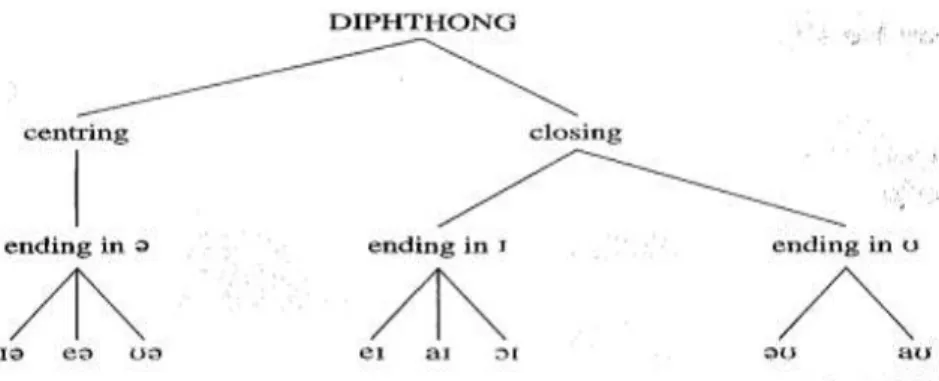
Based on Roach (2009) there are two classification of diphthong sound, centering and closing diphthongs:

a. Centering Diphthongs

The centring diphthongs glide towards the (schwa) vowel, as the symbols indicate.

1) /ɪə/= Example words: beard, weird, fierce. The

starting point is a little closer than /ɪ/ in bit, bin,

(38)

21

2) /eə/= Example words: aired, cairn, scarce. This diphthong begins with a vowel sound that is more open than the /e/ of get, men.

3) /ʊə/ = Example words: moored, tour, lure). For speakers who have this diphthong, this has a starting point similar to in put, pull. Many speakers pronounce /ɔː/ instead.

b. Closing Diphthongs

1) /eɪ/= Example words: paid, pain, face. The starting point is the same as the /e/ of get, men.

2) /aɪ/= Example words: tide, time, nice. This diphthong begins with an open vowel which is between front and back; it is quite similar to the of the words cut, bun,

3) /ɔɪ/= Example words: void, loin, voice. The first part of this diphthong is slightly more open than in ought,born.

4) /əʊ/ = Example words: load, home, most. The lips may be slightly rounded in anticipation of the glide towards, for which there is quite noticeable lip-rounding.

5) /aʊ/ = Example words: loud, gown, house. This diphthong begins with a vowel similar to /aɪ/.

Since this is an open vowel, a glide to would

(39)

22

necessitate a large movement and the tongue often does not reach the u position. There is only slight lip-rounding.The movement in /ʊ/

diphthong is not a large one, because the second part of the diphthong is weak.

The total number of diphthongs is eight. The easiest way to remember is in terms of three groups divided as in the following figure 2.2:

Figure 2.2: Diagram of the Total Number of Diphthong

c. Buginese Vowel and Diphthong Substitution

According to Utami (2017) she finds that there are the interference of vowel sound substitutions from Buginese students, they are:

1. /ɔ/ substitutes /ɒ/:the first case of vowel substitution is vowel /ɔ/ instead of /ɒ/ to utter the nonsense, honor, involved, of, and blonde.

2. / ə/ substitutes / ɪ /: the second case of vowel substitution

is vowel / ə / instead of / ɪ / to utter the privet, inflicted,

behind, inflicted and indigeneous.

(40)

23

3. /a/substitutes /ɔ/: the students pronounce word called /kaːləd/ instead of /kɔːld/, word although/aːlˈðəʊ/

instead of /ɔːlˈðəʊ/ and word formeris /ˈfaː.mər/

instead of /ˈfɔː.mər/.

4. /e/ substitutes /æ/: the students use of /e/ to replace /æ/

as happen on the words have, that, chapter, families, man and land.

5. /ə/ substitutes /ɑ/: the fifth vowel change is the substitution from vowel /ɑ/ to /ə/. It happen on the word large, students pronounce /ləːrdʒ/ instead of /lɑːrdʒ/.

6. /ʌ/ substitutes /e/: vowel /e/ was changing to the vowel /ʌ/. Student mispronounced in pronounced word difficulties.

7. /u/ substitutes /ʌ/: the students pronounce a word culture/ˈkul.turs/ instead of /ˈkʌl.tʃərs/.

8. /e:/substitutes /ɔ:/: the students pronounce a word small /smeːl/ instead of /smɔːl/.

9. /a/ substitutes /æ/: student mispronounced in

pronounced word character /ˈkar.ʌk.tər/ instead of

/kær.ɪk.tər/ and word families /ˈfam.əl.i:s/ instead of

/ˈfæm.əl.i:s/.

(41)

24

10. /i:/substitutes /ɜ:/: student mispronounced in pronounced word firm /fiːm/ instead of /fɜːm/ and word her /hiːr/ instead of /hɜːr/.

According to Muhyidin (2016: 211-213) vowel and diphthong substitution describes as the substitution of the vowel in a word to another vowel. From the data, he found 4 mistakes substitution of vowel to diphthong sound, they are:

1. /ɪ/ substitutes /ɑɪ/. The studentsuse /ɪ/ to replace /ɑɪ/

as happen on the word campsite, /kæmp. saɪt/ and /fraɪ.deɪ/.

2. /o/ substitution of /oʊ/. The fourth vowel change is the substitution from vowel /oʊ/ to /o/ the substation occurs on word middle position of the word home pronounced as /hom/ instead of /hoʊm/.

3. /ɪ/ substitutes /ɪə/. The seventh pronunciation error of the English vowel is the substitutesof diphthong /ɪə/ to replace the vowel /ɪ/.

4. /ʌ/ substitutes /eɪ/.The eight mispronunciation of

vowel anddiphthong substitution happen on the

word stay which should be pronounced as /steɪ/.

(42)

25

Figure 2.3 Buginese Vowel Sound (Sidauruk: 2017)

Sidauruk (2017: 9) in his research concluded that in Buginese there are two phonemes of diphthongs /ai/ and /ui/. The diphthong distribution is displayed in the diphthong chart below:

Figure 2.4 Buginese Diphthong Sound (Sidauruk: 2017)

(43)

26 C. Conceptual Framework

The conceptual framework of this research is given in the following diagram.

The Conceptual framework above explained the process that researchers did to obtain the result. Researcher identified phonological interference on English pronunciation of students from first language (Buginese) to second language (English). Researcher focused on identifying the interference pronunciation on the several symbols from vowel and diphthong sounds.

Phonological Interference English Pronunciation

Figure.2.5 Conceptual Framework of the Phonological Interference of Buginese Students' (L1) in Pronouncing English

Sounds (L2).

Buginese (L1) – English (L2)

Vowel Sounds Diphthong Sounds

(44)

27 CHAPTER III RESEARCH METHOD

This chapter deals with the description of research design, research setting, instrument of the research, procedures of data collection, and techniques of data analysis.

A. Research Design

The design of this research used Descriptive Qualitative

Method.Descriptive Qualitative Methodis the method of research that

reveals events or facts, phenomena, variables and circumstances that occurs

when the research takes place by presenting what actually happened. The

aims of used a Descriptive-Qualitative Method to find out what is the

interference and factors that causes interference Buginese students in

pronouncing English sounds. Therefore, data collected and explained using

words and not numbers.

(45)

28 B. Research Setting and Research Subject

The population of this research was the ThirdSemester Students of English Education Department atMakassar Muhammadiyah of University for Academic Year 2019/2020. The researcher collected 10 samples of Buginese students from various regions Third Semester English Education Department at Makassar Muhammadiyah of University.Researcher had several considerations in choosing a sample such as; the students must Buginese, their first language is Buginese, their parents must be from Buginese and their daily language is more dominant Buginese. This research used Purposive Sampling Techniques with Inclusion Criteria. Inclusion Criteria were sample criteria desired by researcher based on research objectives.

C. Instrument of the Research

In this research, the researcher used recording techniques and interview as instruments of collecting data.

1. Recording techniquesis a technique of collecting data by tapping conversationsor the use of persons’ language (Sudaryanto as cited in Jaya, 2018).

2. Interview is one technique in collecting data in a research by

debriefing between interviewers and respondent which has purpose

to get certain information. According to Sugiyono as cited in

Mutmainnah (2019) Interview is technique used to collect the data

when the researcher wants to do the study to find out the problems.

(46)

29

The researcher used text to read by students. Researcher provided a list of word and used recording audio to get the data. After the data was collected through audio recording, the researcher have written the recording to the orthographic transcription and compared it with the standard phonetic transcription taken from Oxford English Dictionary (OED) and obtained the interference. Also the researcher interviewed students concerningwith their problem to the English pronunciation to answer the second research question. Interview that used by researchers were unstructured interview, but researchers have provided guidelines for questions to ask students relating to the research title.

D. Procedures of Data Collection

The techniques of data collection used in this research wererecording techniques and interview. The researcher used audio recording to obtain data relating to the English pronunciation of students. After that, the researcher made a transcript of students’ error in pronouncing English sounds especially in vowel and diphthong sounds in the scope of the research. Also audio recording used to interview the students to get data about the factor that interference in pronouncing English sounds.

E. Techniques of Data Analysis

To analyze the data, researcher used thetechnique of Sudjana as cited

in Megawati (2018) as following steps:

(47)

30 1. Identify the Interference

The researcher listened the recording and identified the interference by looking for language substitution from Buginese to English from the students’ pronunciation in reading a list of word and compared the words pronouncing by students with standard phonetic transcription from Oxford English Dictionary and got the substitution of interference that occurs.

2. Describe the Interference

After identifying interference, the researcher explained the interference that occurs in students' pronunciation by classified into types or categories such as substitution in vowel and diphthong sound.

3. Explain the Factor that Cause Interference

The researcher explained the factors and causes of

interference from students in pronouncing English sound,

especially in vowel and diphthong sounds. Researcher interviewed

students and got the factors that made students difficult in

pronouncing English sound, by giving students 12 questions that

have been provided by researchers relating to the research title.

(48)

31

CHAPTER IV

FINDINGS AND DISCUSSION

This chapter deals with research findings and discussion. The findings cover the descriptive answers to the two research questions and discussion reveals the explanation of the research findings.

A. Findings

Findings were explained in this section based on data analysis collected by researchers through recording techniques. The findings refer to the research questions inprevious chapter, namely: 1) What are interference occurs in pronouncing English sounds by Buginese students? And 2) What is the factor affect the pronunciation interference in pronouncing English sounds by Buginese students?

The researcher made a transcript of students' pronunciation in English

vowels and diphthongs sound. The transcription of this study used the Oxford

English Dictionary (OED). Before making a student transcript in pronouncing

the words, the researcher gave the participant's code name as follows:

(49)

32 1. The first Student as S1

2. The second Student as S2 3. The third Student as S3 4. The fourth Student as S4 5. The fifth Student as S5 6. The sixth Student as S6 7. The seventh Student as S7 8. The eighth Student as S8 9. The ninth Student as S9 10. The tenth Student as S1

1. The Phonological Interference Occurred in Pronouncing English Sound by Buginese Students

The data is taken from the pronunciation of students when pronouncing the words. Researcher used theory of Contrastive Analysis to analyze mispronounced to the source of interference in pronouncing vowel and diphthong sound.

Based on the results of the recording of respondents totaling 10 students

who read the instrument text in the form of English vocabulary which

contained 12 English sound consisting of 6 vowels and 6 diphthongs, then the

total overall recorded data of respondent was 36 words.

(50)

33

Table 4.1 The Phonological Interference in Pronouncing Vowel Sound by S1

No Vowels Substitution Words

Correct Pronunciation

(OED)

Student Pronunciation

1. /ʊ/ ->/ɔ:/ Nose /nəʊz/ /nɔ:s/

2. /æ/ ->/ʌ/

Campus /kæmpəs/ /kʌmpiʊs/

/ə/ -> /ʊ/

3. /ʌ/ -> /ɔ:/ Double /’dʌbl/ /dɔ:bl/

Table 4.1 showed a list of words that students' mispronounced. The interference that occurs of S1 pronunciation in the vowel sound was the change of close-mid back rounded vowel to long rounded open-mid back vowel (/ʊ/became/ɔ:/) mid central vowel to close-mid back rounded vowel (/ə/ became /ʊ/) near-open front unrounded vowel to open-mid back unrounded vowel (/æ/ became/ʌ/)and open-mid back unrounded voweltolong rounded open-mid back vowel (/ʌ/ became /ɔ:/).

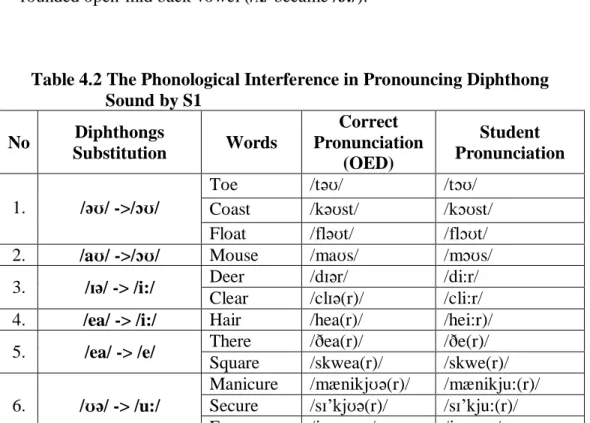
Table 4.2 The Phonological Interference in Pronouncing Diphthong Sound by S1

No Diphthongs

Substitution Words

Correct Pronunciation

(OED)

Student Pronunciation 1. /əʊ/ ->/ɔʊ/

Toe /təʊ/ /tɔʊ/

Coast /kəʊst/ /kɔʊst/

Float /fləʊt/ /flɔʊt/

2. /aʊ/ ->/ɔʊ/ Mouse /maʊs/ /mɔʊs/

3. /ɪə/ -> /i:/ Deer /dɪər/ /di:r/

Clear /clɪə(r)/ /cli:r/

4. /ea/ -> /i:/ Hair /hea(r)/ /hei:r)/

5. /ea/ -> /e/ There /ðea(r)/ /ðe(r)/

Square /skwea(r)/ /skwe(r)/

6. /ʊə/ -> /u:/

Manicure /mænikjʊə(r)/ /mænikju:(r)/

Secure /sɪ’kjʊə(r)/ /sɪ’kju:(r)/

Europe /jʊərəʊp/ /ju:rɔ:p/

(51)

34

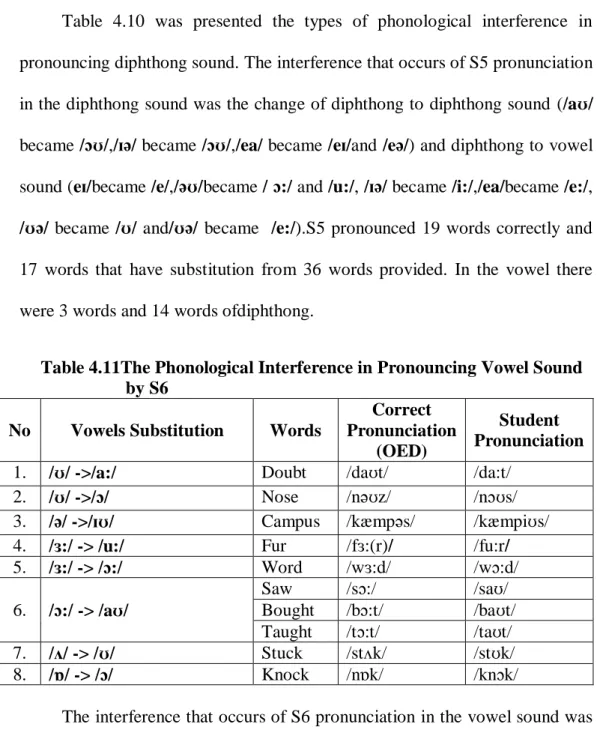
Table 4.2 described a list of words that students' mispronounced. The interference that occurs of student pronunciation in the diphthong sound was the change of diphthong to diphthong (/əʊ/to/ɔʊ/ and /aʊ/to/ɔʊ/) and diphthong to vowel (/ɪə/ became /i:/, /ea/ became /i:/, /ea/ became /e/, /ʊə/became /u:/and /ʊə/became /ɔ:/). From 36 words provided, S1 mentioned 21 words correctly and 15 words that have substitution. In the vowel there were 3 words and 12 words ofdiphthong.

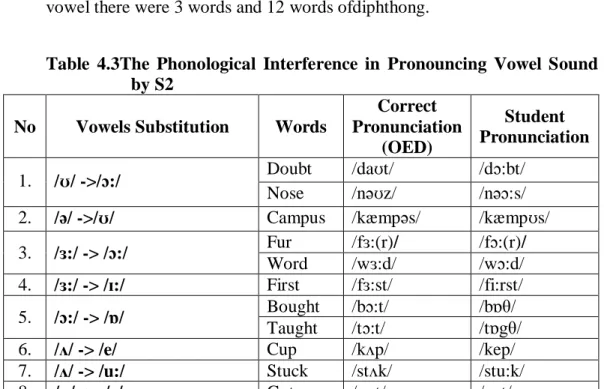
Table 4.3The Phonological Interference in Pronouncing Vowel Sound by S2

No Vowels Substitution Words

Correct Pronunciation

(OED)

Student Pronunciation

1. /ʊ/ ->/ɔ:/ Doubt /daʊt/ /dɔ:bt/

Nose /nəʊz/ /nəɔ:s/

2. /ə/ ->/ʊ/ Campus /kæmpəs/ /kæmpʊs/

3. /ɜ:/ -> /ɔ:/ Fur /fɜ:(r)/ /fɔ:(r)/

Word /wɜ:d/ /wɔ:d/

4. /ɜ:/ -> /ɪ:/ First /fɜ:st/ /fi:rst/

5. /ɔ:/ -> /ɒ/ Bought /bɔ:t/ /bɒθ/

Taught /tɔ:t/ /tɒgθ/

6. /ʌ/ -> /e/ Cup /kʌp/ /kep/

7. /ʌ/ -> /u:/ Stuck /stʌk/ /stu:k/

8. /ɒ/ -> /e/ Got /gɒt/ /get/

Table 4.3 was presented a list of words that students' mispronounced.

The interference that occurs of student pronunciation in the vowel sound was the change of close-mid back rounded vowel to long rounded open-mid back vowel (/ʊ/became/ɔ:/)mid central vowel to close-mid back rounded vowel (/ə/ became /ʊ/)long unrounded open-mid central vowelto long rounded open-mid back vowel and long unrounded high front vowel(/ɜ:/

became /ɔ:/ and /ɪ:/) long rounded open-mid back vowel to open back

rounded vowel (/ɔ:/became /ɒ/) open-mid back unrounded vowel to close-

(52)

35

mid front unrounded vowel and long rounded high back vowel (/ʌ/became /e/ and /u:/) and open back rounded vowel to close-mid front unrounded vowel (/ɒ/became /e/).

Table 4.4The Phonological Interference in Pronouncing Diphthong Sound by S2

No Diphthongs

Substitution Words

Correct Pronunciation

(OED)

Student Pronunciation 1. /eɪ/ -> /e:/ Brave /breɪv/ /bre:v/

2. /eɪ/ -> /ɔ:/ Sale /seɪl/ /sɔ:l/

3. /əʊ/ -> /ɔ:u/ Toe /təʊ/ /tɔ:u/

4. /əʊ/ -> /ɔ/ Coast /kəʊst/ /kɔast/

5. /əʊ/ -> /c:/ Float /fləʊt/ /flɔ:t/

6. /aʊ/ -> /oʊ/ Around /ə’raʊnd/ /ə’roʊnd/

7. /aʊ/ -> /ɔ:/ Mouse /maʊs/ /mɔ:s/

8. /ɪə/ -> /i:/ Deer /dɪər/ /di:r/

Clear /clɪə(r)/ /cli:r/

9. /ea/ -> /eɪ/ Hair /hea(r)/ /heɪr/

10. /ea/ -> /i:/ There /ðea(r)/ /ðri:(r)/

11. /ea/ ->/ʊa/ Square /skwea(r)/ /skʊa(r)/

12. /ʊə/ -> /ɪ/ Manicure /mænikjʊə(r)/ /mæni:kɪ(r)/

13. /ʊə/ -> /ʊ/ Europe /jʊərəʊp/ /eʊroʊp/

Secure /sɪ’kjʊə(r)/ /sekjʊ(r)/

Table 4.4 showed a list of words that students' mispronounced in diphthongs sound. The interference that occurs of student pronunciation in the diphthong sound was the change of diphthong to diphthong sound (/aʊ/

to /oʊ/, /ea/ to /eɪ/, /ea/ to/ʊa/) and diphthong to vowel sound (/əʊ/ become /ɔ:/,/əʊ/ become /ɔ/, /eɪ/became /e:/, /eɪ/became /ɔ:/, /əʊ/ became /ɔ:/,/aʊ/

became /ɔ:/, /ɪə/ became /i:/, /ea/ became /i:/, /ʊə/ became /ɪ/, /ʊə/ became

/ʊ/). From 36 words provided, S2 mentioned 9 words correctly and 27

words that have substitution. In the vowel there were 11 words and 16

words ofdiphthong.

(53)

36

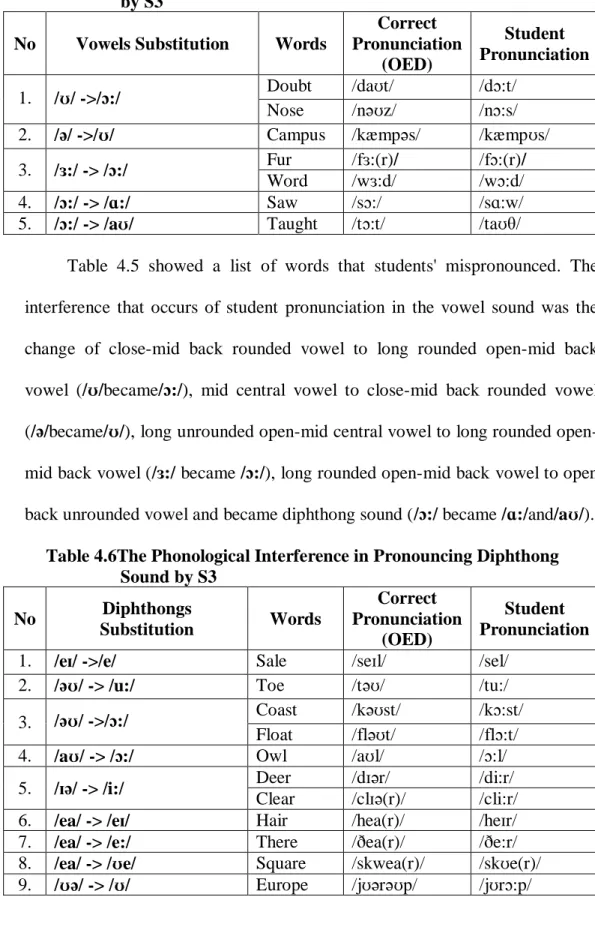
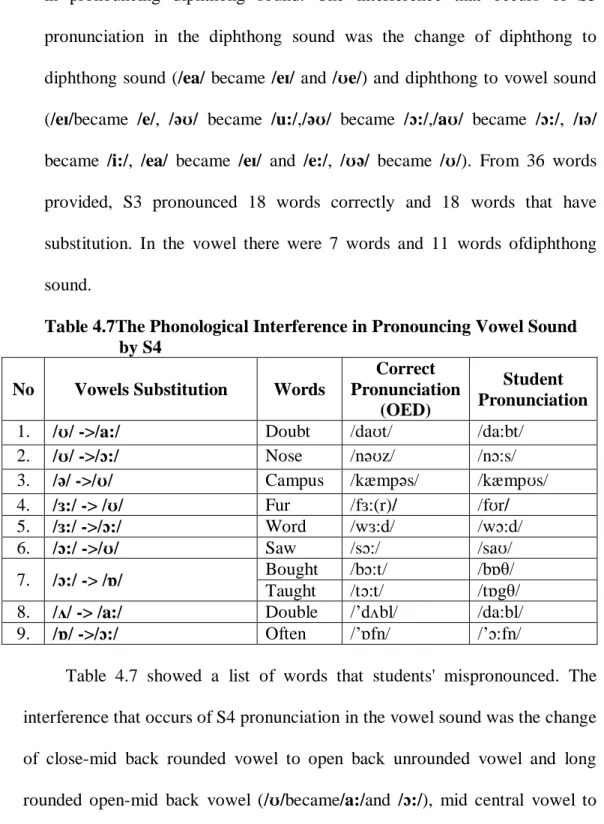
Table 4.5The Phonological Interference in Pronouncing Vowel Sound by S3

No Vowels Substitution Words

Correct Pronunciation

(OED)

Student Pronunciation

1. /ʊ/ ->/ɔ:/ Doubt /daʊt/ /dɔ:t/

Nose /nəʊz/ /nɔ:s/

2. /ə/ ->/ʊ/ Campus /kæmpəs/ /kæmpʊs/

3. /ɜ:/ -> /ɔ:/ Fur /fɜ:(r)/ /fɔ:(r)/

Word /wɜ:d/ /wɔ:d/

4. /ɔ:/ -> /ɑ:/ Saw /sɔ:/ /sɑ:w/

5. /ɔ:/ -> /aʊ/ Taught /tɔ:t/ /taʊθ/

Table 4.5 showed a list of words that students' mispronounced. The interference that occurs of student pronunciation in the vowel sound was the change of close-mid back rounded vowel to long rounded open-mid back vowel (/ʊ/became/ɔ:/), mid central vowel to close-mid back rounded vowel (/ə/became/ʊ/), long unrounded open-mid central vowel to long rounded open- mid back vowel (/ɜ:/ became /ɔ:/), long rounded open-mid back vowel to open back unrounded vowel and became diphthong sound (/ɔ:/ became /ɑ:/and/aʊ/).

Table 4.6The Phonological Interference in Pronouncing Diphthong Sound by S3

No Diphthongs

Substitution Words

Correct Pronunciation

(OED)

Student Pronunciation

1. /eɪ/ ->/e/ Sale /seɪl/ /sel/

2. /əʊ/ -> /u:/ Toe /təʊ/ /tu:/

3. /əʊ/ ->/ɔ:/ Coast /kəʊst/ /kɔ:st/

Float /fləʊt/ /flɔ:t/

4. /aʊ/ -> /ɔ:/ Owl /aʊl/ /ɔ:l/

5. /ɪə/ -> /i:/ Deer /dɪər/ /di:r/

Clear /clɪə(r)/ /cli:r/

6. /ea/ -> /eɪ/ Hair /hea(r)/ /heɪr/

7. /ea/ -> /e:/ There /ðea(r)/ /ðe:r/

8. /ea/ -> /ʊe/ Square /skwea(r)/ /skʊe(r)/

9. /ʊə/ -> /ʊ/ Europe /jʊərəʊp/ /jʊrɔ:p/

Gambar

Figure 2.1 English Vowel Chart  b.  The Classification of Diphthong Sound
Figure 2.2:  Diagram of the Total Number of Diphthong
Table 4.2 The Phonological Interference in Pronouncing Diphthong  Sound by S1  No  Diphthongs  Substitution  Words  Correct  Pronunciation  (OED)  Student  Pronunciation  1
Table 4.2 described a list of words that students' mispronounced.  The  interference that occurs of student pronunciation in the diphthong sound was  the  change  of  diphthong  to  diphthong  (/əʊ/to/ɔʊ/  and  /aʊ/to/ɔʊ/)  and  diphthong  to  vowel  (/ɪə/
+7

Referensi

Dokumen terkait

Selanjutnya, dari hasil penelitian ini juga diperoleh gambaran bahwa 29% (18 orang) siswa-siswi kelas XII jurusan kimia tekstil SMKN 7 Bandung memiliki orientasi

Kecepatan rencana sebaiknya diambil sama atau mendekati kecepatan maksimum yang diijinkan, karena debit rencana atau debit puncak tidak sering terjadi maka debit dan kecepatan

Puri merupakan tempat tinggal untuk kasta Ksatria yang memegang pemerintahan Umumnya menempati bagian kaja kangin di sudut pempatan agung di pusat desa.. Puri umumnya

Publikasi Statistik Daerah Kecamatan Astanaanyar Kota Bandung 2015 diterbitkan untuk melengkapi publikasi-publikasi statistik yang sudah terbit secara rutin setiap

Perbedaan metode ekstraksi maserasi, perkolasi, sokletasi dan refluks dapat menghasilkan kadar flavonoid total yang berbeda dari ekstrak metanol daun kersen (Muntingia

yan ang g ak akan an se seiim mba bang ng de deng ngan an ar arus us k kas as m mas asuk uk y yan ang g dihasilkan dari in!estasi" rus kas yang mengambil

Berdasarkan prosedur coding dan olah data distribusi frekuensi yang telah dilakukan sebagai rangkaian analisis isi, diketahui terdapat 5 jenis strategi komunikasi

Data dari BPJS Ketenagakerjaan pada tahun 2015 telah terjadi kecelakaan kerja sejumlah 50.089 kasus.(Pusat Data dan Informasi Kementerian Kesehatan RI,2015)