ADDRESSING
YOUTH ABSENTEEISM
IN EUROPEAN
Author Luis Bouza
EDITORIAL TEAM
Editor
John Lisney – Jennifer de Njs – Giuseppe Porcaro – Andrew Bradley – Aya Kasasa
Copy Editor Neil Lewis http://www.youngvoters.eu
© International Institute for Democracy and Electoral Assistance, 2014 © League of Young Voters in Europe Aisbl, 2014
© European Youth Forum Aisbl, 2014
Views expressed in this publication do not necessarily represent the view of International IDEA, the League of Young Voters in Europe, the European Youth Forum, or their respective executive boards, governing bodies, and/or member states.
This publication is independent of speciic national or political interests.
The electronic version of this publication is available under a Creative Commons Licence (CCl) – Creative Commons Attribute-NonCommercial-ShareAlike 3.0 Licence. You are free to copy, distribute and transmit the publication as well as to remix and adapt it provided it is only for non-commercial purposes,
that you appropriately attribute the publication, and that you distribute it under an identical licence. For more information on this CCl, see: http://creativecommons.org/licenses/by-nc-sa/3.0/.
EXECUTIVE SUMMARY
INTRODUCTION
I. THE SOCIAL PROFILE OF YOUNG ABSTAINERS
II. YOUNG PEOPLE, POLITICAL REPRESENTATION AND PARTY ACTIVISM
2.1 Background
2.2 Young candidates in 2009
2.3 How parties address the younger generation 2.4 Political parties and youth absenteeism 2.4.1 Background
2.4.2 Issues
2.4.3 Addressing the issues
III. THE CAUSES OF YOUTH ABSENTEEISM IN EUROPEAN ELECTIONS
3.1 Rational choice and minimalist conceptions of democracy 3.2 Youth absenteeism as an evaluation of the EU
3.3 Weakening socialisation, misrepresentation and apathy
3.4 Parties are out of touch with young people’s preferred forms of activism
IV. RECOMMENDATIONS
4.1 Empowering young people through participation and representation 4.2 Engaging with young people
4.3 Bringing young people into party and European politics
NOTES
REFERENCES
ANNEXES
3
5
9
11
11 13 14 15 15 17 18
21
21 22 24 26
29
29 30 31
33
35
39
ALDE
Alliance of Liberals and Democrats for Europe
EPP
European People's Party
EU
European UnionLYMEC
European Liberal YouthMEP
Member of European Parliament
PES
Party of European Socialists
PIREDEU
Providing an Infrastructure for Research on Electoral Democracy in the European Union
YEPP
Youth of the European People's Party
YES
This study takes a comprehensive approach to understanding the reasons why young people abstain from voting in large num-bers in elections to the European Parliament; it considers both the sociological proile of young abstainers and the ofers that political parties make.
The study contains three main indings: irst, absenteeism by young people is related to socio-economic factors; second, there is mutual distrust between political parties and young peo-ple; third, political parties have yet to take into account chang-es in young people’s forms of political activism and means of communication.
The European Union has addressed criticism of its democratic deicit by increasingly empowering the European Parliament. Yet, since 1979, voter turnout has declined in every election. The 2009 European Parliamentary election was marked by youth ab-senteeism of almost 65%.
‘Eurobarometer’ data from 2009 show that all the main socio-demographic factors afect the likelihood of voting. The typical young abstainer is: a woman under the age of 25; who sees herself as belonging to the lower tiers of society; has only
a secondary education; and is either not working or is in manual employment.
The data also show that because a majority of young voters abstain, political parties – quite rationally – do not target young people in their campaigns. In a sample of party manifestos in ive countries for the 2009 European Parliamentary election campaigns, half the parties failed to mention young people and, among those that did, most failed to ofer speciic policies when referring to youth issues.
The study considers four possible reasons as to why young people do not vote in European Parliamentary elections. Rational choice theorists argue that when individual votes are not seen to make a diference, citizens prefer to devote their time to other pursuits than to politics. However, data demonstrate that this does not hold for young voters in European elections, as young people rarely cite a preference for private afairs as a reason for absenteeism.
A second explanation is that absenteeism is a form of pro-test against the EU. However, data does not support this the-ory, as young people are the least likely to abstain through
dissatisfaction with the EU. An alternative explanation suggests that elections for the European Parliament are seen as second-order elections. However, the data show a strong correlation be-tween voting in national and European Parliamentary elections. Voters who abstain in national elections almost certainly abstain in European Parliamentary elections, too.
A third theory simply states that young people feel excluded from politics and that the issues they care about are not consid-ered. This is consistent with the lack of attention to youth issues in parties’ manifestos and the existence of few young candidates for oice. When young people perceive this, apathy towards poli-tics can develop. In addition, political institutions are failing to make the most of new media to engage young voters in the ways they prefer.
The fourth theory suggests that young people are not disen-gaged from politics, but rather their preferred forms of activism have not been recognised by parties and governments. Research shows that younger people’s political engagement has shifted away from electoral politics towards cause-orientated political action and networking. Parties need to engage better with these forms of political involvement as a way of channelling them into electoral turnout.
Precisely because young people are not disengaged from po-litical issues, they can be brought back to the ballot box. This study makes recommendations on changes that can be made which will assist the process of encouraging young people to be-come more involved in the political institutions and processes that exist today at both national and European levels.
RECOMMENDATIONS
• Member states should establish a quota on party MEP candidates: 25% should be aged under 35;
• Replace the existing methods of selecting candidates for election with open primaries;
• Include youth issues clearly in party manifestos without ‘ghettoising’;
• Target key groups of young people: students, the socially excluded and irst time voters;
• Broadcast a high proile youth-focused debate among top candidates of the European elections, such as between the European political parties’ candidates for the position of President of the European Commission;
• Use social media to engage and network with the audience;
• Integrate the history and role of the EU into national educational systems;
• Simplify the process of voting;
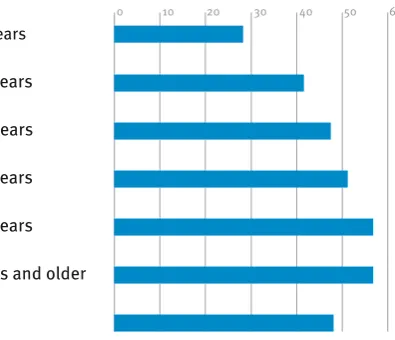
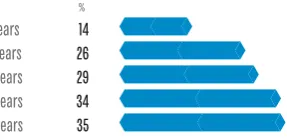
European elections are one of the paradoxes of European Union (EU) integration. The EU has responded to criticisms of its democratic deicit by increasingly empowering the European Parliament the institution that directly represents citizens at EU level. From its origins as an unelected, broadly powerless assem-bly in the 1950s, the Parliament has become a directly elected co-legislator. Throughout the history of EU integration, compe-tencies and political responsibilities have luctuated between EU institutions and the EU member states. The Parliament, however, is the one institution that has seen its authority increase with every reform of the Treaties of the EU since 1986. Yet, since 1979, voter turnout has declined in every single election. The 2009 European election was marked by a rate of youth absenteeism of almost 65%, a level rarely found in democratic politics. Figure 1, below, shows that the electoral participation of younger voters is almost 30% below that of older voters. This igure suggests that when young people grow older, they are more likely to vote.
Figure 1 Turnout per age group
15-24 years
25-34 years
35-44 years
45-54 years
55-64 years
65 years and older
Total
Turnout %
INTRODUCTION
Youth absenteeism in European elections needs to be put into a comparative context (Figure 2, below). Falling voter turnout is a common trend and young voters abstain more than the general population in all European democra-cies (Norris 2003). Total electoral turnout has declined in all
national elections in EU member states, from an average of 83% in the 1980s to 65% in the last elections recorded (igure 2 next page). This phenomenon is related inter alia to youth absenteeism, in that decreasing turnout among young peo-ple translates into absenteeism later in life.
Figure 2 1980-2013: Decreasing turnout in national elections in the EU since 1980 I
Austria
1+1+2+0+6+2+6+0+4+8+2+0
Bulgaria
1+1+1+1+3+5+8+6+5+0+2
Czech Republic
1+1+1+1+6+5+6+4+8+4+3
Denmark
8+8+7+6+3+4+6+7+5+7+8
Estonia
1+1+1+1+8+8+9+7+8+2+4
Finland
1+1+1+6+2+8+9+5+7+5+7
France
1+1+1+1+8+6+9+8+0+0+5
Germany
1+1+9+9+4+8+9+2+9+8+1
Hungary
1+1+1+1+1+4+5+7+3+4+7
Ireland
1+1+6+3+3+9+8+6+3+7+0
Italy
1+1+9+9+7+6+3+1+4+1+5
Latvia
1+1+1+1+0+2+2+1+1+5+9
Lithuania
1+1+1+1+1+5+3+8+0+2+6
Malta
1+1+1+5+6+6+7+5+6+3+3
Netherlands
1+7+1+6+0+9+3+9+0+0+5
Poland
1+9+9+2+3+2+8+6+1+4+9
Portugal
5+9+5+3+8+6+1+3+4+0+8
Romania
1+1+1+1+1+6+6+5+9+9+2
Slovakia
1+1+1+6+5+5+4+0+5+9+9
Slovenia
1+1+1+1+1+6+4+0+1+3+6
Spain
1+1+0+0+0+7+8+9+6+6+9
Sweden
1+1+1+0+6+7+7+1+0+2+5
United Kingdom
1+1+1+1+3+5+8+1+9+1+6
Average
7+8+4+2+0+5+3+1+7+7+5
— — 92 90 86 82 86 80 84 78 82 — — — — 84 75 59 67 56 61 52 — — — — 96 85 76 74 58 64 63 88 88 87 86 83 84 86 87 85 87 88 — — — — 78 68 69 57 58 62 64 — — — 76 72 68 69 65 67 65 67 — — — 71 78 66 69 68 60 60 55 — — 89 89 84 78 79 82 79 78 71 — — — — — 44 55 57 73 64 47 — — 76 73 73 69 68 66 63 67 70 — — 89 89 87 86 83 81 84 81 75 — — — 81 90 72 72 71 61 65 59
— — — 95 96 96 97 95 96 93 93 — 87 81 86 80 79 73 79 80 80 75 — 99 79 62 43 52 48 46 41 54 49 85 79 75 73 68 66 61 63 64 60 58 — — — — — 76 76 65 59 39 42 — — — 96 85 75 84 70 55 59 59 — — — — — 86 74 70 61 63 66 — — 80 70 70 77 78 69 76 76 69 — — 91 90 86 87 87 81 80 82 85 — — — — 73 75 78 71 59 61 66
Youth absenteeism in European elections is related to two signiicant political changes over the last two decades. The irst is the controversy about the legitimacy of the process of European integration. The EU has acquired competences and inluence more quickly than the pace at which the pub-lic has become involved in its decision-making. Absenteeism by members of the younger generations demonstrates that living in an increasingly integrated Europe is not a suicient incentive to persuade them to vote. Second, declining voter turnout in general, and in particular among young people, is directly related to changes in the forms of political sociali-sation and activism. Political socialisociali-sation is still pursued by formal and informal national political institutions, which means that youth absenteeism in European Parliamentary elections is also rooted in national politics. These two chang-es are taken into account in the study’s discussion of the issues; they suggest that EU institutions, national govern-ments and all levels of political players need to be involved in the process of bringing young people back to the ballot box.
This study is structured in four sections, seeking answers to the following questions: why are young people voting in such low numbers? What can be done to reverse this situa-tion? The problem is approached from two directions: exami-nation of the demand side, with an analysis of the sociologi-cal proile of young abstainers; and a review of the ofer side, in terms of what political parties ofer young voters in the context of European Parliamentary elections.
Section 1 examines the character proile of young abstainers;
Section 2 looks at the diferent aspects of young people’s political representation;
Section 3 examines the causes of youth absenteeism;
Section 4 summarises and proposes concrete recommendations.
INTRODUCTION
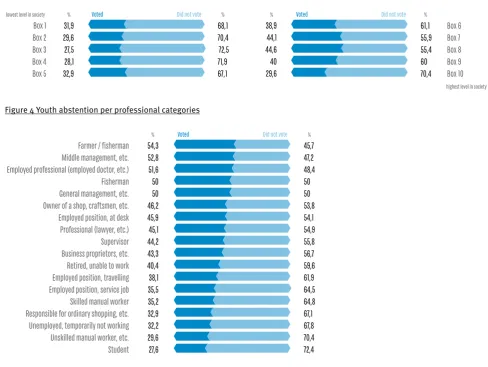
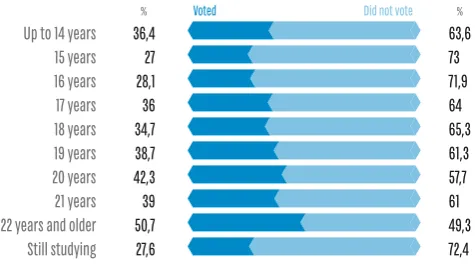
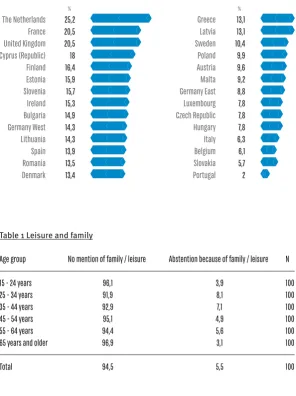
All the main socio-demographic factors (age, gender, social position and occupational situation) afect the likelihood of vot-ing. The sociological proile of the typical abstainer is a woman under 25, who perceives herself as belonging to the lower social class, having achieved secondary education only, not in active employment and living in a medium-size town (Annex, Figures 3 to 6). The principal factors that afect the absenteeism rate are:
• Age: 64% of 15 to 34 year olds abstained, of which 71% of
under 25 abstained, falling to 58% for those between 25 and 34;
• Gender: young women abstain from voting more than young
men do. This bias is more acute in the younger sub-group than in the older one, where igures of absenteeism among men and women are broadly similar;
• Social class: absenteeism is more frequent among those
members of the younger generation who perceive themselves as being on the bottom rungs of the social ladder. Rates
of absenteeism are signiicantly higher among students, the unemployed and manual workers, and lower among young professionals;
• Size of community: young voters absenteeism is higher in mid-size towns and lower in small towns, rural areas and larger urban areas.
The sociological proile of young abstainers in the European Parliamentary elections is thus characterised by forms of disad-vantage relecting the nature of social exclusion among young people. Emmenegger and Palier (2012: 44-45) show that in coun-tries where the Southern European and Liberal social models are prevalent – characterised by a strong duality between older people better integrated into the labour market and protected by social security programmes, and younger people that tend to be excluded – there is a strong diference in voting turnout between ‘insiders’ and ‘outsiders’.
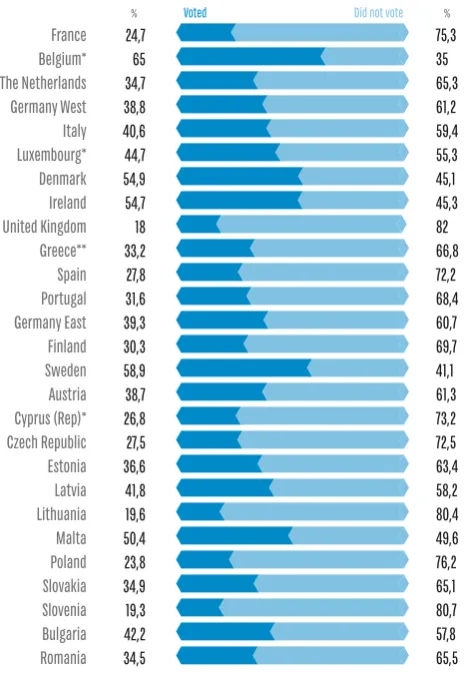
This is relected in the cross-country diferences in rates of youth turnout in the last European elections, where there
I
Methodology
The 2009 Eurobarometer Survey is used as the main source of quantitative data, as it is the sole pro-vider of detailed information about the reasons for absenteeism.
Two sources of qualitative information are used. First, ten interviews were carried out of staf of EU politi-cal parties, party youth branches and civil society activ-ists in Brussels.
Second, party manifestos, from ive new and old member states, were examined in detail to identify cross-national diferences. The manifestos were se-lected for their signiicant diferences in terms of youth absenteeism (the Netherlands, the United Kingdom, Spain, Sweden and Slovakia).
are signiicant diferences in absolute rates of absenteeism and in rates of absenteeism relative to age. The most extreme cases – excluding Belgium, Luxembourg, Cyprus and Greece, where voting is mandatory – are Sweden, where the absen-teeism rate was 41% for under 35s, and the United Kingdom,
where the absenteeism rate was a staggering 82% for the same group. In general, youth turnout was higher in some northern member states (Sweden, Denmark) and exception-ally low in France, the United Kingdom, Spain and some new
2.1
Background
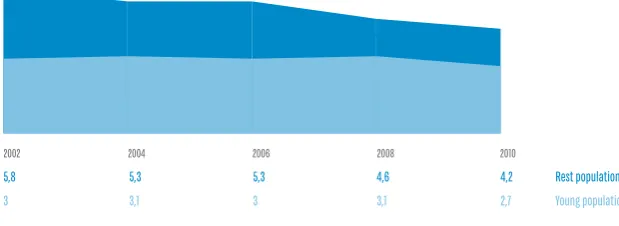
Political parties have been the main means for political participation and representation in Europe for more than a century. However, there is a widening gap between political parties and young people as evidenced by the strong decline in party membership over the last two decades (Whiteley: 2011): in Europe, as few as 2% of young people are members of a political party (Annex, igure 19). Research points to the efect that the growing distrust towards parties has to do with their ability to articulate the political participation of young people. Party membership is now so rare that it can no longer be considered as an indicator of people’s political commit-ment (Van Biezen, Mair, Poguntke: 2012). This is consistent with the cartel party thesis (Katz and Mair: 2009) that states
parties are becoming detached from their roots in society and are moving towards being part of the State apparatus, thanks to their control over key mechanisms of political competition. In this sense, they have abandoned several of the delibera-tive and participatory functions to emphasise the elite selec-tion ones.
This has only a partial efect on political competition in the context of the EU due to the intrinsic weakness of European political parties. European-level political parties do not fulil the same functions as their national counterparts: most of them are federations of parties relecting a minimum com-mon denominator acom-mong parties of a broadly similar fam-ily; and have no direct members (although this is starting to change). Even though European parties are increasingly co-hesive in votes within the European Parliament (Hix, Noury and Roland: 2005), their main weakness is their inability to structure political competition at the level of the EU as the selection of candidates and strategies remain entirely in the hands of national parties. For instance, the Members of the European Parliament (MEPs) sit as political and not national
II
YOUNG PEOPLE,
2014: The irst elections under the
Lisbon Treaty: the efect of the new
rules of the game.
The European Parliament has only recently acquired a say in the composition of the European Commission, as a result of incremental reforms to the Treaties. Parliament acquired the right to force the Commission’s resignation in the Maastricht Treaty (1993). The Lisbon Treaty (2009) linked the designation of the President of the Commission to the results of the European elections.
groups, but they have been elected not as candidates of a European but of a national party. The result is that key as-pects of EU political life – government and opposition, or the course to take in policy-making – are not structured by traditional political competition, such as the left / right and centre / periphery divisions (Bartolini, Hix: 2006) but rath-er by negotiation among the membrath-er states. The European Commission is formally a politically non-aligned body, as only the appointment of its President is made dependent on the result of European elections and the nomination of Commissioners is made by member states.
This section looks at three data sets to understand how the behaviour and strategies of the parties afect youth ab-senteeism: the number of young candidates in the 2009 Parliamentary elections; the presence of youth issues in the manifestos of the parties in ive selected countries; and in-terviews with Euro-parties’ oicials and civil society activists in Brussels.
2.2
Young candidates in 2009
Parties have diferent ways of addressing youth issues. One is to include young people in positions of responsibility in the organisation and, second, to nominate them as candi-dates to elected oice.
The PIREDEU (Providing an Infrastructure for Research on Electoral Democracy in the European Union) project survey data provides data about the age of candidates and their party ailiations in the 2009 election (Braun, Mikhaylov and Schmitt 2010).II The data show a gap between the proportion
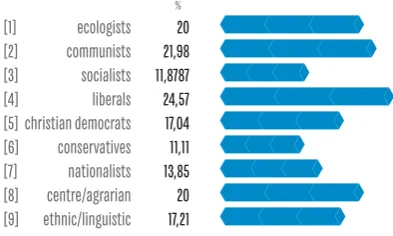
of young candidates and the proportion of young people in absolute terms. According to Eurostat,III 26% of the EU
popu-lation is aged between 16 and 35, but just 19% of candidates were in this age range.
The data also indicate that there are diferences between the political families, in that liberal parties have a higher pro-portion of young candidates, very close to the propro-portion of young people in the population of the EU. Communists, ecol-ogists and centre agrarians had a proportion of young can-didates around 20%, whereas all other parties were below these levels. In addition, the PIREDEU database ofers infor-mation about the extent to which candidates are representa-tive of younger voters: not surprisingly, young candidates give much more importance to the interests of the younger generation than older ones.
There is thus a signiicant under-representation of young people in elections for the European Parliament. This gap is signiicant for the political representation of young people in terms of three of the main categories of representation put forward by Pitkin (1972). MEPs are authorised representa-tives in that citizens appoint them in an election, so youth ab-senteeism means that young people are less represented in the authorisation dimension. The data above show, however, that they also participate less in two of the other categories. First, young people are under-represented in that there are fewer representatives to cater for their interests. Although there is no requirement to be young to stand for the inter-ests of young persons, the data demonstrate that younger candidates, more than older candidates, identify with and grant more importance to the interests of young people. The lack of interest of older candidates produces a bias against the representation of young people, which then contributes to disengagement or apathy, in so far as young people per-ceive their interests to be ignored. Second, young people are under-represented in the descriptive sense, as twice as many young people would need to be elected to achieve represen-tation in proportion to their population.
2.3
How parties address
the younger generation
Beyond these quantitative data, let us consider how politi-cal parties address youth issues by looking irst at the party manifestos and, second, by considering interviews with party oicials. First, most manifestos tend to pay only lip service to youth issues. In general, the shorter the manifestos, the less attention they devote to speciic youth issues. Only slightly more than half of the manifestos (17 of 30) refer to young people in any form at all. Even this already weak coverage of youth issues has to be qualiied: seven of these 17 mani-festos do not refer to young people speciically but rather mention them in the context of broader policy discussions. Four manifestos address youth issues in a horizontal way, by calling for comprehensive policies speciic to young people. This means that only around a third of the manifestos refer to young people directly while two-thirds of the manifestos refer to them as a social group whose interests have to be considered and balanced against those of other groups. In other words, only four of the 30 parties suggested a compre-hensive youth policy at EU level.
The tendency of the manifestos is instead to address youth issues as a speciic area of political competition. Of the manifestos discussing issues related to young people, around 70% refer to the need to improve education, which at the EU level very often comes together with the notion of student mobility and the improvement of language skills.
There are a further three youth issues in the manifestos that receive very similar coverage. The irst is participation and emancipation. This includes debates on the need to fa-cilitate young people’s participation in politics and in social life in the broadest sense. Some examples of forms of par-ticipation that are associated with youth parpar-ticipation poli-cies are the European Citizens’ Initiative (e.g. Groen Links)
transnational party lists (European Greens) or the strength-ening of youth involvement in associations and EU level organisations, including the European Young Forum (e.g. Convergencia i Unió). What these approaches have in com-mon is that they treat young people as active members of so-ciety and seek to empower them. This is in contrast to the sec-ond of the youth issues, where parties approach them from a more passive perspective, which seek to protect young peo-ple from dangers in society, such as crime, violence or abuse on the internet. A speciic dimension of this way of framing the problems of young people is a public health approach, where parties seek to protect young people from the efects of drugs and alcohol. The third youth issue is youth unem-ployment. Unsurprisingly, half of the references come from Spain, where youth unemployment was already soaring in 2009, and it has continued to increase steadily since. That said, Spanish parties did not propose European-level poli-cies, but proposed issues regulated at the national level. In contrast, the Dutch D66, Slovakian SDKU and Swedish Social Democrats referred to EU-speciic interventions in this area.
However not all interviewees agreed that addressing youth matters as a separate issue is the most appropriate strategy:
‘We want to keep the manifesto for 2014 as short as pos-sible, because in the past the party adopted 30 or 40 page long manifestos, which are useless because voters don’t read them and parties don’t use them in their programmes. So it will not necessarily address youth issues in a speciic way, but rather highlight liberal demands in three or four core areas. This will allow national members to complement it with their own contents. The economic crisis and unemployment will be one of these areas and youth unemployment may obtain a particular focus. We are currently running a small campaign, Jobs for Youth, under LYMEC’s (European Liberal Youth) web-site.’ (Interview with an oicial of the Alliance of Liberals and Democrats for Europe (ALDE).)
However, some interviewees suggested that this approach runs the risk of over-specialising and ‘ghettoising’ youth poli-tics, in that providing lip service to youth matters is easily turned into a box-ticking exercise. This risk was uttered in an interview with a member of the Young European Socialists (YES), the youth branch of the Party of European Socialists (PES), who suggests that this way of addressing youth issues risks turning them into a speciic minority question:
‘I am not sure that promoting more young people is a way to reconnect with young people. It can be problematic if ‘youth issues’ are systematically entrusted to young peo-ple in the party, as it can be a way of disenfranchisement or de-responsibilisation by the rest of the organisation, where youth issues are entrusted to a small and relatively weak sec-tor.’ (Interview with a member of YES.)
The issue was discussed at a roundtableIV with
representa-tives of European political parties and their youth branches; the general opinion was that parties had to avoid ‘ghettoisa-tion’. Instead, it was suggested that youth issues should be made relevant to the whole of society and that young candi-dates need to stand for not only young people but also for all other age categories.
2.4
Political parties
and youth absenteeism
2.4.1 Background
Interviews were conducted with oicials from European political parties in order to understand their perspectives on youth absenteeism, and the ways in which the parties viewed young voters. These interviews show that all parties are aware of the challenge of youth absenteeism for the fu-ture of democratic decision-making in the EU, but also that there is a strong possibility that the issue will not be seri-ously addressed. First, no party felt particularly concerned by the problem, so the commitment to speciic action was not strong. Second, and related to the weaknesses of European level parties, most of the solutions that European parties had considered needed to be endorsed by national parties, who clearly have more interest in national, rather than European, campaigns.
All interviewees expressed concern about youth absentee-ism as an issue that needs to be tackled in order to bolster the legitimacy of the EU. None of the parties, however, con-sidered itself to be particularly afected by absenteeism, and all of them tended to see it as a structural problem unrelated to political competition. Hence, not one party saw the reduc-tion of youth absenteeism as a matter of self-interest, which means that none of the parties has an incentive to act upon absenteeism on its own:
Common candidates:
a irst for European elections
The European elections of May 2014 are likely to see every EU political family propose a candidate for the po-sition of President of the Commission. This is partly the result of the Lisbon Treaty, but is a political rather than a legal or institutional decision. The Treaty establishes that the European Council will take into account the re-sults of the elections when nominating the President of the Commission. This means that he or she – but not necessarily the other 27 Commissioners – will belong to the majority of the new Parliament. This has led to all the major EU parties committing to announce a common candidate for the oice. This can be seen as bringing the EU closer to a parliamentary democracy where par-ties structure the competition for oice. To date, parpar-ties have followed diferent strategies in terms of nomina-tion dates and procedures.
‘Youth absenteeism is not a problem speciically for left-side parties … it is more a general trend, a generational prob-lem rather than a probprob-lem for only some parties. I irmly disa-gree with the perception that social democracy is something old-fashioned. Of course we would like to increase support among young people, we’re still working on this strategy.’ (Interview with a member of the PES.)
Interviewees were asked about their views on the causes of the problem. Most of them highlighted the lack of rel-evance of EU electoral campaigns, which is consistent with their position that an increased politicisation could make the campaign more relevant:
‘People really believe there is nothing at stake, and it will only change if they come to see that actually there is a lot at stake. Thus I am happy that the PES was the irst party to an-nounce that we will run the next EU election under a common candidate, because this would be an opportunity to politicise the debate a bit more.’ (Interview with an oicial of the PES.)
Interviewees all agreed that in the next European elections there would be more competition, because all parties would nominate a candidate for the oice of the President of the European Commission. Interviewees expected this to have a beneicial impact on young people’s voting turnout, because the Presidency personalises and politicises the campaign. When asked whether they felt that European parties had suf-iciently diferentiated positions towards young people to at-tract them to the ballot box, most interviewees agreed and said that the ield was wide enough for parties’ diferentiated proposals. Most interviewees acknowledged, however, that EU-level debate on youth issues is blurred by the fact that the policies that afect young people most – education, training and labour market regulation – are decided at the national level.
2.4.2 Issues
The principal problem is the diiculty European politi-cal parties have in coordinating European campaigns. All European parties report that their role is to coordinate their national members and establish commonly agreed upon goals and strategies. They equally acknowledge that parties often see elections in a national perspective, and that the European manifestos do not necessarily guide national ones. It is also interesting to note that the questionnaires that na-tional member parties completed for us conirm that they see 2014 as second-order elections, despite the European par-ties’ intentions to Europeanise them.
A second structural issue is the tension between mother parties and their youth branches. Not only are youth issues and young candidates given lower priority than youth branch-es would like it to be, but also the horizontal emphasis on youth issues within parties has been diicult. Interviewees suggested that most youth organisations see their lobbying of the mother parties, not the mobilisation of young people, as their main function. Could youth organisations transform themselves into lexible organisations that parties see as indispensable to young people’s political activism? Some of the interviewees from youth organisations did not agree with the perceived degree of their empowerment and demanded a more prominent role. Few of the mother-party interviewees were able to provide convincing details of concrete steps tak-en to make the campaign process more participative.
The third problem was young people’s disenchantment with political parties. Interviewees argued that, unlike older generations who have established voting preferences, young people do not wish to commit to long-term projects but do want to become involved in speciic ones:
‘Young people are less inclined to join political parties and to bind themselves into time-consuming long-term work. Younger generations are not apolitical, but tend to prefer clearly deined projects. It is a challenge for parties to identify these projects and to link them to the issues that the party wants to press at the upcoming elections.’ (Interview with an oicial of the ALDE Party.)
2.4.3 Addressing the issues
Empowerment The interviews showed that the party rep-resentatives were aware of the need to engage young peo-ple, in particular in relation to the promotion of young people within the party and the use of alternative forms of partici-pation. All European political parties agreed that they must promote more young people as candidates for oice. Each of the parties also claimed to be the most likely to nominate the most young candidates, hence raising inter-party competi-tion. That said, all the parties pointed out that in the end it is party members who decide on nominations. All interviewees said they would recommend a higher proportion of candi-dates between the ages of 18 and 35, but none was able to describe how this could be achieved. Due to the importance of nominating and electing young candidates, interviewees were asked if debates among young candidates were on the agenda; most admitted that this was unlikely to be the case. Only a proposal from the Youth of the European People’s Party (YEPP) to host a simulation of the European Parliament in Strasbourg was acknowledged, but had not been accepted.
Openness Some interviewees referred to the openness of their party in the processes of drafting manifestos and se-lecting candidates; they claimed to be open to participation by individuals and social groups, as a way of demonstrating that the party was active, not only in trying to gain votes, but also in providing opportunities to participate. How par-ties difered was in their degree of openness. This openness included: discussions with member parties and individual members; consultations with civil society organisations; open primaries to select the candidate for the Presidency of the European Commission. All parties reported that their youth branches were fully integrated into the process of drafting manifestos and selecting and training young candi-dates. However, as discussed later, the discussion with youth branches does not necessarily imply an open debate on youth issues, as in several countries youth branches tended to see themselves as intra-party lobbies rather than youth activists.
The selection of party candidates was one of the main ide-as in relation to openness, even though only the interviewee from the Greens emphasised the party’s commitment to an open primary (to be organised at the European level and in which all voters sympathising with Green policies would be able to vote onlineV). Most of the other interviewees argued
that this required the cooperation of national parties and governments, not just the EU parties, which had to agree on this measure. The following shows that the process of select-ing candidates is seen not only as an opportunity to open the party to other forms of participation, but also as a way of in-creasing competition and of attracting attention to the party:
‘A democratic procedure has been designed should there be more than one candidate. The procedure will start in October and will be inalised at a congress in February 2014; and because of this the other major political parties are going to do the same thing. It is a wonderful opportunity to try to po-liticise the debate, which could be a way of slightly increasing the turnout, although it may eventually not work.’ (Interview with an oicial of the PES.)
Policies Concerning policy development, all parties re-ported having had contact with organised civil society in the preparation of their 2014 manifestos. However, it is question-able whether these contacts were real openness and to what extent they would mobilise young citizens to participate; one of the criticisms of European civil society organisations is that they tend to be distant from their own grassroots (Kohler-Koch 2010). Furthermore, interviews revealed a surprising neglect of the new instruments of participation recognised in article 11 of the Treaty of the European Union. For instance, none of the interviewees had heard about the two European Citizens’ Initiatives that had been launched as part of the ErasmusVI programmeVII, despite parties’ frequent references
‘I’m not sure that the indignados movement is a movement of young people. I would be very careful with that classii-cation. You have several other movements, like people who work in healthcare, social care and education who walk on the streets with diferent colour schemes, and they are not spe-ciically young people. Again, if you look at the movement, which ights against the fact that people are put out of their houses, they are not young people. And for instance young people who are not able to access the job market have not assembled in a speciic movement, so I don’t think your ques-tion is valid.’
Social media The data on party communications suggest that candidates in the 2009 elections did not totally neglect social media and other internet tools (used by 17.5% of candi-dates). However, given the limited use of more conventional media (radio, TV) it can be assumed that candidates used social media principally for its cost advantages. The quali-tative data gathered from the interviews show that parties’ use of social media was far from sophisticated. During an interview, oicials of the EPP spoke of their aim to obtain a large audience that would spread its message: ‘The EPP is do-ing very well, we have 140,000 likes, makdo-ing us the biggest party on Facebook’. No reference was made to the reactivity of the audience, nor the extent to which the party used this medium to interact with its followers. Social media exposure is measured here by the size of the audience rather than by the party’s ability to engage in debate and conversation with its followers.
This study irst looks at this from a theoretical point of view. The starting point is that youth absenteeism challenges the traditional neo-functionalist expectation, especially prev-alent in the early days of the EU, that citizens transfer their loyalties from the national to the European level as the lat-ter gains more power (Haas: 1958, 524). Following this logic, generations born in an increasingly integrated Europe and having beneited from borderless experiences, such as the Schengen zone and the Erasmus programme, should show their interest in the process by participating in European elections. However, the evidence shows that this has not happened. It is thus necessary to consider other theoretical approaches.
3.1
Rational choice and minimalist
conceptions of democracy
A possible alternative builds on the traditional rational choice analysis, arguing that absenteeism and lack of interest in elections is a rational response by individuals. They think that their vote will not afect electoral outcomes, so decide that the cost of turning up on election day is greater than the expected utility of participation (Downs: 1957, but see Blais: 2000). It is thus expected that voters prefer to devote their time to other issues than to the efort of collecting political in-formation, choosing their preferred parties and candidates, and voting. Young people are often quoted as conforming to this stereotype (Franklin 2004). However, available data for European elections do not support this hypothesis, as young
III
THE CAUSES
people are the least likely electors to say they avoid elections in favour of private, family or leisure alternatives (Annex, Figure 1). Other available research on youth absenteeism fails to support the hypothesis of a younger generation uninter-ested in politics. Rather, research suggests that the younger generations’ political engagement has shifted from electoral politics to cause-orientated political action and networking (Norris: 2003). That being said, rational choice approaches may be appropriate to explain political parties’ disregard for younger voters. Youth absenteeism creates a vicious circle where parties neglect youth issues and young people react by voting in ever-smaller numbers.
Republican theorists argue that minimalist conceptions of democracy, such as those put forward by rational choice theorists, are at the core of parties’ and voters’ adaptation to low-intensity democracy (characterised by weak political participation, where political activity is delegated to political representatives chosen in elections at intervals (O’Donnell: 1984)). These theorists also argue that this conception of democracy is rooted in governments ofering general and universal welfare policies in exchange for the political demo-bilisation of citizens (Levi: 1996). For some of these authors, elections themselves have become ritualistic: as parties tend to converge towards the centre (Downs 1957) competition is less on issues of substance and more on the competence of candidates and the marketing ability of parties. This means that the act of voting is less and less one of political participa-tion and can be compared to an act of political consumpparticipa-tion, where those who vote choose between diferent brands of essentially the same product (Barber 2004). This contributes to apathy, dulling people’s motivation to turn out. We see this happening with the ‘permissive consensus on the EU’: citizens show a benign neglect as the EU deals with issues of ‘low politics’ such as the regulation of the single market.
Youth absenteeism has at least two major consequences for the future of the EU as a democratic polity. First, absen-teeism afects the sustainability of democracy. The data tell us that a majority of young people in the EU have massively decided not to be represented in the European Parliament. This creates a divide between citizens and the only directly
elected institution in the EU and, thus, is unsustainable from a democratic point of view. Today’s young abstainers may well be tomorrow’s mature abstainers, creating an even lower overall turnout. Second, youth absenteeism afects EU poli-cymaking. Young people’s failure to participate creates a bi-ased representation in the European Parliament, where polit-ical dynamics tend to favour older MEPs (Beauvallet, Michon: 2012). Recent concern about the availability of resources for the Erasmus programme (Keating: 2012) suggests that the EU is reproducing bias in policy production, directly afecting the young. Although member states regulate the policy areas with the most obvious inluence on young people – educa-tion, housing and labour markets – the European integration of iscal policies, through the governance of the euro area, is likely to further disadvantage this generation, as shown by high rates of youth unemployment.
3.2
Youth absenteeism
as an evaluation of the EU
A second interpretation is that absenteeism is in itself a form of political activism and protest. Hirschmann’s (1970) analytical scheme illustrates this view, in that dissatisied citizens can either opt to voice their concern or simply exit the process of voting in the EU. Citizens know that the legiti-macy of the political system requires that the majority of the population participate in political decision-making. By con-sciously deciding not to vote, citizens may well be showing their dissatisfaction with the course of European integration. However, yet again, survey data do not support this hypoth-esis, as young people are the age group least likely to ab-stain because of dissatisfaction with the EU (Annex, Figure 4). Recent Eurobarometer dataVIII suggest that up to 64% of young
data are, however, to be interpreted with care: irst, the dii-culty of predicting turnout so far in advance; second, because of inconsistencies with previous results. Ninety percent of those who say they are likely to vote do so because they al-ways vote, whereas we know that up to 40% of young voters who participated in national elections abstained from the European elections. Nevertheless, these results could sug-gest there is an increasing interest in the EU among young people.
An alternative explanation notes that elections for the European Parliament are seen as second-order elections. Voters have diiculty in seeing what is at stake, and do not see an immediate efect in terms of government formation - European elections are still run in a national context and con-tested by national political parties. And even the European Parliament’s increased power is unlikely to change this dy-namic; the euro crisis has conirmed that key decisions are not taken at the European Parliament, but elsewhere. As a consequence, voters abstaining in European elections send a message not to the EU, but to national governments (Teperoglu: 2010). The data show a very strong correlation between voting in national and European elections (Annex, Figure 5). Voters abstaining in national elections are almost certainly going to abstain in EU ones too, meaning that member states also have to assume responsibility for the re-engagement of young voters. Second-order voting and absenteeism have negative consequences beyond European Parliamentary elections: research suggests that they encour-age young citizens not to vote, which also depresses turnout in national electionsIX.
Proponents of the second-order election theory also re-late youth absenteeism to voters’ evaluation of the EU. They argue that turnout is afected by the context of the election, in particular the degree of competition between parties and the competition’s perceived efects. The formulation is that because the European Parliament used to have relatively few competencies, voters tend to see these elections as an op-portunity to change their political behaviour without visible consequences (Reif and Schmitt: 1980). Considering the rela-tively modest role of European parties and of the European
Parliament in the management of the euro crisis, there is rea-son to think that as long as the European Parliament is not at the centre of the EU’s political life, turnout will sufer. Recent research shows the perverse efect of second-order voting on young voters: European elections may even be considered one of the causes of youth absenteeism, as young people ‘learn’ not to vote, which translates into more frequent ab-senteeism later on in life (Franklin and Hobolt: 2011; Down and Darwin: 2013).
The EU can be understood as a consociational polity – meaning, a polity where the power is shared – which is made up of large coalitions and frequent elite arrangements (Ljphart: 1999). Together with the thin ideological common ground of European parties, it is diicult to imagine a bipolar partisan politicisation of EU political competition. There has been increasing concern in recent decades that consociation-al polities, with their tendency to compromise, may lead to in-diference among voters who do not have a irm political com-mitment. They may even foster anger against the elites and favour the emergence of populist parties and movements, as several typically consociational polities such as Denmark, the Netherlands, Belgium and Austria have shown in the last decade (Rose 2000). In this way, the perception of the sec-ond-order nature of European elections can also be associat-ed with the consensual nature of EU politics. Because of their low proile, European elections tend to be biased, because they will attract voters who are more interested in politics and have stronger cultural and social capital (Ljphart: 1997). The competition between the institutions and, in particular, the European Parliament’s endeavour to increase its inluence in European politics, has created incentives for cooperation between the diferent groups within it. This favours a cohe-sive Parliament, giving it a stronger voice versus the Council and the Commission, but fails to provide more visible compe-tition between diferent political alternatives at the EU level (Costa: 2009). Although the current majority of conservative and liberal parties in the European Parliament and the mem-ber states provide support for the hypothesis of an increas-ing politicisation of the EU, in fact it remains institutionally possible that the majority of Commissioners could belong to
a diferent political grouping from the majority of European Parliament.
3.3
Weakening socialisation,
misrepresentation and apathy
Youth absenteeism can also be approached from a com-parative point of view, pointing to the decline in participa-tion by all voters. This suggests that voting patterns are not acquired following key life events, such the start of university education, entry into work or the development of a family, as expected by life cycle theories. The increasing distance of young people from political institutions is thus an expres-sion of a broad transformation in social patterns. We need to view this in relation to changes in political culture and forms of political socialisation in European societies (Torcal 2010; Flanagan et al. 2012). Socialisation, in this context, is the process by which people gain knowledge of political reality in formal educational settings, such as the family, the media and school, as well as through practical experience, such as at the workplace or through membership of youth, political and trade union organisations.
The problem of absenteeism in European elections starts at the national level: the most signiicant predictor of absen-teeism in European elections is absenabsen-teeism at the national level (Annex, Figure 10). This correlation shows that most who abstain from national elections also abstain from European elections. Thus, youth absenteeism in European elections is related to a disconnection between young people and repre-sentative politics in general and is, to a large extent, also a relection of political socialisation deicits.
There are other socialisation deicits; for example, the decline in party membership and trust in parties. The extent to which young people are close to, or distant from, politi-cal parties has a clear efect on absenteeism, which is more
generalised among those who do not feel attached to political parties and also those in the centre of the political spectrum (Annex, Figures 11-13). Voters who are strongly attached to a political party, or who have a clearly deined ideology, vote in higher proportions. Distrust of political parties is general-ised among young voters (79%), but this does not seem to be a decisive factor in their likelihood to participate in politics (Annex, Figure 12). Those who distrust parties tend to abstain from elections, but those who do trust parties still do not vote in very high numbers. Even if trust in parties does not guaran-tee participation, distrust towards them tends to do so.
One of the aspects of young people’s alienation from politics is related to the diiculty in obtaining political in-formation. Access to political information about European elections, including exposure to information about the cam-paign, appears to positively, and signiicantly, contribute to participation (Down and Wilson: 2013). Eurobarometer also provides data on young people’s exposure to political mation and their attitudes towards parties. Exposure to infor-mation about the campaign, and memory of this inforinfor-mation, had a signiicant efect on young people’s likelihood of par-ticipating in the election (Annex, Figure 18).
III. THE CAUSES OF YOUTH ABSENTEEISM IN EUROPEAN ELECTIONS
Case study: Spanish political elite
and the ‘indignados’
On 15 May 2011, young people in Spain took to the streets. An unexpectedly large demonstration was fol-lowed by a surprise occupation of la Puerta del Sol, Madrid’s central square. This movement had high vis-ibility in Spanish politics because it coincided with an election campaign, its similarities with the Tahrir square occupation, and its demand for mainly politi-cal reform. The movement demanded constitutional reforms to make Spanish democracy more transparent and to increase social control over political parties and institutions.
The ‘15 Movement’ is undoubtedly a form of young people’s politics, in that most activists were aged 19-30. The fact that demands concentrated almost exclusively on political reforms, rather than on youth problems, is a further sign of the transformation of political activism among young people.
The political elite reacted negatively. First, the move-ment was suspected of trying to inluence the election result, or even of promoting absenteeism. However, the movement never called for participation, nor absen-teeism nor support for one party or another, although it was clearly much more sympathetic towards smaller parties than to the principal parties.
societies, who lack any real voice in electoral politics, so can be (and often have been) ignored, victimised or even viliied by politicians and policy-makers’ (Sloam: 2013, 17). In ageing societies, the absenteeism of young voters means that their interests are not as well represented as those of older gen-erations. The votes that actually decide elections tend to be those of older, not those of younger, people and the interests of these decisive voters are more likely to be better repre-sented in state spending and welfare policies (Lynch: 2007).
3.4
Parties are out of touch
with young people’s preferred
forms of activism
Interviewees’ arguments about young people’s distrust are consistent with research indicating their preference for diferent forms of political activism. Party political member-ship has declined to the point that political parties have be-come virtually irrelevant social organisations (Van Biezen, Mair and Poguntke: 2012). The structures of political par-ties in Europe once contributed to political socialisation by encompassing their ailiates’ lives, from cradle to grave; to-day, most parties have abandoned such a function in favour of election-winning techniques, which emphasise mediated and professionalised communication rather than the direct mobilisation of constituencies. Although ‘catch-all parties’ competing at the centre of the political spectrum ind these techniques particularly useful, these strategies produce a negative side-efect: parties lose contact with society and, as a consequence, neglect activities contributing to young peo-ple’s political socialisation. Some argue that the institution-alisation of political parties via States’ increasingly detailed regulation (Whiteley: 2011) have enabled parties to transform the nature of their political strength and to become relatively
independent of their supporters and civil society in general (Katz, Mair: 2009).
Even though the EU and several member states have de-veloped democratic innovations introducing forms of par-ticipatory democracy (Smith 2009, Geissel 2012), these have been used experimentally and insulated from politics, in that parties have rarely been actively pursuing these new forms of participation and activism. An example is the party oicials we interviewed who, despite the importance of the Erasmus programme for the socialisation of young people, had not had any contact with the promoters of two European Citizens’ Initiatives on the subject. Under these circumstances, it is not surprising that democratic innovations are not translat-ing into higher electoral turnout. It is important that parties and institutions engage more with these forms of activism, as research shows that the younger generations’ political engagement has shifted from electoral politics to cause-ori-entated political action and networking (Norris 2003, Sloam 2013). These forms of activism are particularly interesting in that they can cut across social exclusion-led absenteeism: ‘Young people from the poorest backgrounds participate more than those from the richest backgrounds (and above the average for all young people) in four types of political ac-tivity: working for a party or action group, displaying a badge or sticker, joining a boycott and participating in a demonstra-tion’ (Sloam 2013: 17).
Stronger links between party life and alternative forms of participation could bring parties back in touch with young people. However, the research interviews carried out for this study demonstrate that while European political parties are aware of this change, they have yet to ind a way of acting upon it. A case study (Calvo, Gómez-Pastrana, Mena: 2011) about the attitude of the Spanish political establishment to-wards the demands of the ‘indignados’ movement shows that national political parties consider their own activities as the only legitimate political realm and show suspicion of alterna-tive forms of political action.
Acting on absenteeism by young people in European elections is complex. On the one hand, the EU has a distinct problem in re-lation to youth absenteeism, as European elections are afected more than local and national elections. On the other, the EU can-not act on this problem alone, as it is can-not the only, and probably not the main, reason for youth absenteeism. Acting on the issue in European elections is a shared responsibility for EU institu-tions, member states and political parties at both national and EU levels. It also requires reforms of both institutions and the conduct of political competition if the EU, as a democratic pol-ity, and political parties as socially relevant organisations, are to survive. Based on the evidence and arguments in this study, and elsewhere, the following changes are recommended in three main areas.
4.1
Empowering young people
through participation
and representation
Young people are under-represented in politics. Because few-er young people vote, political parties nominate few young can-didates, which means that few young people are actually elected to Parliament, and supposedly representative institutions pro-duce biased results, focusing less on young people’s interests.
RECOMMENDATION 1:
Member states should propose a quota on party MEP candidates: 25% should be aged under 35
IV
European parties and member states should commit to achieving a level of representation of young people that is in pro-portion to the ration of young people in the European population. Member states should propose a quota on the number of young candidates in party candidacies. Young people are 25% of the population of the EU, so a quota of 25% relects their share of the EU population. This quota is particularly justiied considering the tendency to under-elect young candidates.
RECOMMENDATION 2:
Replace the existing methods of selecting candidates for election with open primaries
Young people are developing a preference for diferent forms of political activism and participation, such as demonstrating, volunteering in associations and socialising and expressing po-litical opinions through digital media. Because other forms of collective political action are not likely to replace political parties soon, it is important that parties remain the centre of political participation. For the parties’ own survival, they need to consider young people’s preference for alternative forms of political activ-ism. More legitimate and eicient forms of aggregating prefer-ences in a democracy than elections have yet to be found, but alternative forms of participation could become complementary forms of political engagement, contributing to the socialisation of young people into politics.
Despite the problems that primary elections pose for the po-litical systems of EU member states, there is evidence that young people have a preference for this form of candidate selection and parties should thus at least experiment. Parties need to open up part of their internal processes to society, not only members, and change their internal culture to promote the open exchange of ideas within the party and with society. This requires the usage of open primaries and online and oline interaction with young ac-tivists and organised civil society. How manifestos are prepared and the way of campaigning should also stop being an internal-ly focused process, and be open to young activists. All parties should engage in open and public debates with young citizens from outside their organisation in the run-up to the election.
4.2
Engaging with young people
Parties need to address youth disengagement from politics. Regardless of the type of manifesto, what all parties do is ignore youth issues. In one form or another, parties need to show con-cern about the efects of EU integration on young people and to propose ways of addressing this. This is not a call for the division of manifestos into separate ofers for diferent sections of the population, as this could be a way to further increase the margin-alisation of youth issues.
RECOMMENDATION 3:
Include youth issues clearly in party manifestos without ‘ghettoising’
Parties need to formulate their political project for young peo-ple in the EU, responding to questions such as: do we need more or less solidarity? More or less lexibility in the labour market? In doing so, they should also address long-term questions, such as speciic causes of youth social exclusion or the changing de-mographic structure of our societies. These two issues are im-portant for inter-generational solidarity and the sustainability of pension systems, showing how an increased attention to youth issues can contribute to drafting a political programme that is relevant for the whole of society.
RECOMMENDATION 4:
Target key groups of young people: students, the socially excluded and irst time voters
competing for the votes of older generations and see the absen-teeism from voting by young people as negative for democracy in the EU, but too diicult to address. They do not see a suiciently important gain to change their behaviour and, as a result, the generally desired outcome is unlikely to be produced.
This is a short-sighted strategy; there are clear gains to be obtained from a campaign that targets young people’s groups. The availability of political information has shown to inluence young people’s likelihood to vote, making it rational for parties to make that efort.
RECOMMENDATION 5:
Broadcast a high proile youth-focused TV debate among top candidates of the European elections, such as between the candidates nominated by the European political parties for the position of President of the European Commission;
The European institutions should provide economic and infra-structure support to the parties and youth civil society organisa-tions to come together and partner with broadcasters to organise a cross-partisan high proile TV debate between the main candi-dates of the European elections focused on issues of interest to young people. Research by the Reuters Institute for the Study of Journalism, based on YouGov survey data, showed that the 2010 debates in the UK helped ensure that a special relationship [was formed among 18- to 24-year-olds] with the TV debates compared with more jaded older people. 74% of irst-time voters said they had learned something, and 55% of the 18- to 24-year-olds sur-veyed said it had helped them make up their minds on voting. Such a debate would focus on issues of interest to and relevant to the every day lives of young people, and should include a high level of interactivity with young people through social media channels.
RECOMMENDATION 6:
Use social media to engage and network with the audience, instead of repeating slogans
Many of the current methods of campaigning fail either to reach, or to attract, young people. Yet it is self-evident that the young enthusiastically tap into and engage with enormously powerful communications methods, developed during the digital revolution, on a daily basis. Yet political parties scarcely scratch the surface of using the potential of such methods to communi-cate with the young.
Rather than simply reproduce the same message time and time again on social networks, parties must engage in a dialogue with party supporters and activists, who in turn would contrib-ute to grassroots campaigns and communication relays between peers and within their close networks.
4.3
Bringing young people into party
and European politics
It is clear that after the 2014 campaign, much work is required to continue to bring young people into European politics and po-litical activism if the EU is to be a sustainable democratic pol-ity. Political systems have used diferent measures, with varying degrees of success, to attract young voters. European elections would beneit from introducing some of these innovations. Civic and political education difers from one member state to the next. European integration is not clearly or systematically written into social science, history or civic education textbooks, regard-less of the member state where such textbooks are produced or taught from. Sweden is the country where young people are least likely to abstain in European elections. This is one of the coun-tries where civic education portfolios cover EU membership and where pupils show the highest knowledge on EU issues.
RECOMMENDATION 7:
Integrate the history and role of the EU into national educational systems
An earlier focus on the EU will help mitigate young voters’ view of European elections as second-order. The goal must be to inform young citizens of the importance of considering, favour-ably or not, the EU in their political decision-making. In this ex-ercise, cooperation with youth organisations should be sought. Complementary citizenship education, as in youth organisa-tions, leads to a development of skills, knowledge, and attitudes usually not acquired through the formal education system.
RECOMMENDATION 8: Simplify the process of voting
Voting systems and rules vary widely among member states. Some have voter registration requirements, while others auto-matically register voters. Voting days and times change from vot-ing on workvot-ing days or weekends and can take place over more than one day. Regardless of the system, simplicity and user-friendliness increase young people’s electoral turnout.
RECOMMENDATION 9:
Lower the voting age for European elections
Own elaboration on the basis of IDEA turnout database (http://www.idea.int/vt/) for EU member states parliamentary elections since 1980. The thick red line indicates average participation in EU member states in every election. Belgium, Cyprus, Luxembourg and Greece are excluded because of the practice of compulsory voting. For the sake of comparability, all elections in EU member states from 1980 to 2013 have been numbered from 1 to 11, with 1 being the irst election held since 1980.
The data were downloaded from the PIREDEU (Providing an Infrastructure for Research on Electoral Democracy in the European Union) project website. EES (2009), European Parliament Election Study 2009, Candidate Study and Euromanifesto Study: <http://www.piredeu.eu/public/Publications.asp>.
According to Eurostat data, available from: <http://epp.eurostat.ec.europa.eu/portal/page/portal/population/data/database>.
The roundtable took place on the 5th November 2013 at the European Parliament Information Oice to Belgium in Brussels.
It included a presentation of the study’s indings thus far, followed by a panel discussion on its recommendations made of representatives of the four largest European political parties (European People’s Party, Party of European Socialists, Alliance of Liberals and Democrats for Europe (ALDE) Party, and the European Greens). The audience consisted of civil society, European Institution oicials and young activists.
The vote took place on the following website: https://www.greenprimary.eu/
The Erasmus Programme is an EU exchange student programme that has been in existence since the late 1980. Its purpose is to provide foreign exchange options for students from within the European Union and it involves many of the best universities and seats of learning on the continent.
Available at the following websites: Fraternity 2020 http://ec.europa.eu/citizens-initiative/public/initiatives/obsolete/ details/2012/000001?lg=en and Teach for youth http://ec.europa.eu/citizens-initiative/public/initiatives/ongoing/ details/2013/000005
May 2013 Flash Eurobarometer 375, “European youth: participation in democratic life”, p. 21
Franklin, Mark N and Hobolt, Sara B. (2011) “The legacy of lethargy. How elections to the European Parliament depress turnout”, in: Electoral Studies 30(1), pp. 67-76.
I
II
III
IV
V
VI
VII
VIII
IX