Synthesis and characterization of refractory cordierite precursors
from rice husk silica
Simon Sembiringa, Wasinton Simanjuntakb, Rudi Situmeangb, Buhanib, Shellac
aDepartment of Physics, bDepartment of Chemistry,
cUnder Graduate Student of Physics Department,
Lampung University, Jl. Prof. Soemantri Brojonegoro No.1 Bandar Lampung 35145, Indonesia Email: *[email protected]
Abstract
This study describes the production of refractory cordierite ceramics by mixing silica extracted from rice husk, Al2O3and MgO powder. The mixture was sintered at different temperatures of 1050, 1110, 1170C for 4 h. The phases formed and structure change as a result of sintering were investigated using different characterisation technique of Fourier transform infrared (FTIR), X-ray diffraction (XRD) and scanning electron microscopy (SEM). Density, porosity, hardness and electrical resistivity were also measured. Cordierite, spinel and cristobalite were the major phases in the samples sintered at temperature range of 1050-1170C. µ-cordierite was formed through the intermediate phases of spinel and cristobalite at 1050C. The final phase-cordierite (indialite) was produced through µ-cordierite and cristobalite from 1110 to 1170C. The density, hardness and electrical resistivity were found to increase with increasing of sintering temperature, as they are strongly influenced by microstructure of the material.
Keywords cordierite, rice husk, sintering, structure, refractory
1. Introduction
It is well known that cordierite (Mg2Al4Si5O18) ceramics is excellent insulator and high-thermal resistant material, possessing low dielectric constant and high-thermal expansion coefficient. The cordierite ceramics is a promising material as refractory material with the highest melting temperature 1460C among silicate glass-ceramics (Hamzawy & Ali, 2006).
Due to its low thermal expansion coefficient (Kai et al., 2010), excellent thermal shock resistance (Oliveira & Fernandez 2002), high refractoriness (Zhu et al., 2007), therefore, cordierite ceramic is considered as a very promises for structural materials and finds applications as heat exchangers for gas turbine engines (Laokula & Maensirib, 2006), electrical and thermal insulation (Gonzalez-Velasco, 1999; Evans et al., 1980). In previous studies (Oliveira & Fernandez, 2002; Lim & Jang, 1993), have established that the excellent thermal shock resistant material when it is subjected to rapid changes in temperature. They found that fracture toughness increases with increasing sintering temperature from 1250 to 1300C.
C, cordierite is metastable and it is slowly transforms to -cordierite. It has also been
reported that -cordierite, MgAl2O4/spinel and cristobalite present at 1300 °C, while the only -cordierite phase was observed at 1350C and 1375C (Salje, 1987). By sol gel method, the
initiation of the cordierite transformation was achieved in the temperature range 1000-1100 °C and high stability -cordierite only at 1200 °C (Kumta, 1994).
Related to natural resources as raw materials for preparation of ceramics, rice husk is a waste material derived from agriculture residu, which makes its an alternative as silica source. In our previous research, active silica from rice husk was obtained by simple acid leaching, and has been used to produce borosilicate (Sembiring, 2011), cordierite (Simanjuntak & Sembiring, 2011), carboxyl (Simanjuntak et al., 2012), aluminosilicate (Simanjuntak et al., 2013), mullite (Sembiring & Simanjuntak, 2012; Sembiring et al., 2014). The present study was carried out with the aim of exploring the feasibility of rice husk silica to produce refractory cordierite precursor as an alternative to commonly used silica synthetics. The precursor produced was then subjected to thermal treatment to investigate the phase development, physical and thermal properties as refractory cordierite. The functionality change of as a function of heat treatments was investigated by FTIR spectroscopy, the structure was characterized by XRD and the microstructure was studied using SEM.
2. Materials and methods
2.1 Materials
Raw husk used as a source of silica (97.5%) was obtained from local rice milling industry in Bandar Lampung Province, Indonesia, and Al2O3(95%) and MgO (98%) powders were taken from PT ELO KARSA UTAMA (merck, kGaA, Damstadt, Germany). KOH, HCl, and absolute alcohol (C2H5OH) used are reagent grade obtained from Merck.
2.2 Procedure
Preparation of silica powder from rice husk
Rice husk silica was obtained using alkali extraction method adopting the procedure reported in literature (Sembiring et al., 2014). Typically, a sample of 50 g dried husk was mixed with 500 ml of 5% KOH solution in a beaker glass. The mixture was boiled for 30 minutes, and then allowed to cool to room temperature and left for 24 hours. The mixture was filtered through Millipore filter to separate the filtrate which contains silica (silica sol). To obtain solid silica, the sol was acidified by dropwise addition of 5% HCl solution until the sol was converted into gel. The gel was aged for three days, and then rinsed repeatedly with deionized water to remove the excess of acid. The gel was oven dried at 110 C for eight
hours and then ground into powder.
Preparation of cordierite
temperature programmed with a heating rate of 5oC /min and holding time of 4 hours at peak temperatures.
Characterization
A Perkin Elmer FTIR-1752 was used for the investigation of functional groups of the cordierite. The sample was mixed with KBr of spectroscopy grade, and scanned in the spectral range of 4000-400 cm-1. The structure of cordierite is examined using an automated Shimadzu XD-610 X-ray diffractometer at the Agency of Nuclear Energy National (BATAN), Serpong-Indonesia. The operating conditions used were CuK radiation ( = 0.15418),
produced at 40 kV and 30 mA, with a 0.15receiving slit. Patterns were recorded over
goniometric (2) ranges from 5-80with a step size of 0.02, counting time 1s/step, and using
post-diffraction graphite monochromator with a NaI detector. The diffraction data were analyzed using search-match method (Powder Diffraction File, 1997). Microstructural analysis was conducted using SEM Philips-XL, on polished and thermally-etched samples. The porosity and density were examined according to Archimedes method (Australian Standard, 1989). A Zwick tester was used to measure the Vickers hardness. At three measurements were made for each loading position. Electrical conductivity of the samples was studied at ambient temperature by the four-probe method. Measurement was carried out on a sample in the form of plate size of 2 cm x 2.5 cm x 1 cm, prepared by pressing sample placed in a stainless steel dics using hydraulic pressing 3 tones. The conduction was ohmic in nature and the electrical conductivity was given by the equation:= L/R A (Pantea, 2001), where R is the resistance (), A is the area of the sample (cm2) and L is the sample thickness (cm).
3 Results and discussions
3.1 Characteristics of synthesized refractory cordierite
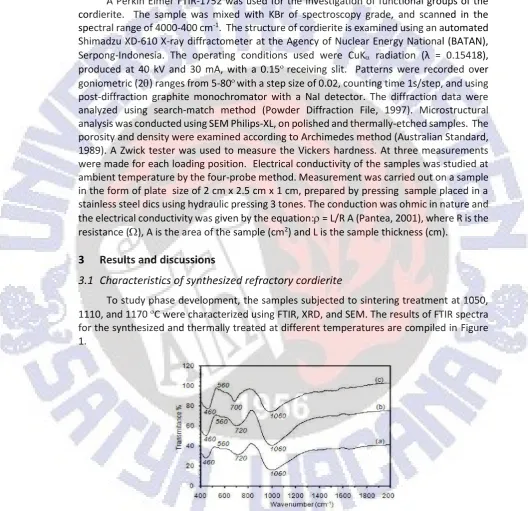
To study phase development, the samples subjected to sintering treatment at 1050, 1110, and 1170C were characterized using FTIR, XRD, and SEM. The results of FTIR spectra
for the synthesized and thermally treated at different temperatures are compiled in Figure 1.
Figure 1. FTIR spectra of sintered samples at different temperatures (a) 1050oC, (b) 1110oC, and (c) 1170oC.
(Nagai & Hashimoto, 2001). These bands decrease with increasing temperature of sintering indicating the formation of Si-O-Mg-Al.The band centered at 720 cm-1(Fig 1a-b) is broader than the band in the Fig 1c, probably corresponding to the vibration of Al-O and Mg-O indicating the presence of Si-O-Mg-Al bonding as supported by previously study (Janackovic et al., 1997; Petrovic et al., 2003).
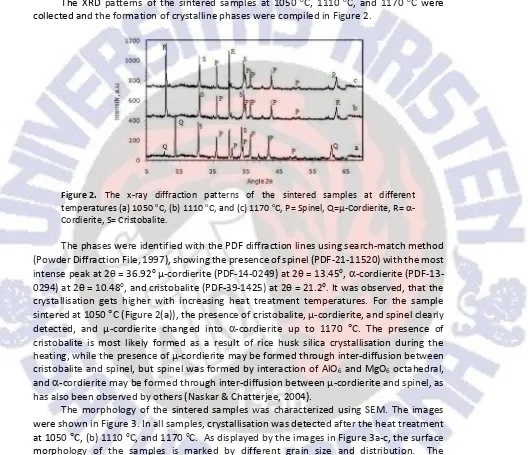
The XRD patterns of the sintered samples at 1050 oC, 1110 oC, and 1170 oC were collected and the formation of crystalline phases were compiled in Figure 2.
Figure 2. The x-ray diffraction patterns of the sintered samples at different temperatures (a) 1050oC, (b) 1110oC, and (c) 1170oC, P= Spinel, Q=µ-Cordierite, R= -Cordierite, S= Cristobalite.
The phases were identified with the PDF diffraction lines using search-match method (Powder Diffraction File, 1997), showing the presence of spinel (PDF-21-11520) with the most intense peak at 2 = 36.92µ-cordierite (PDF-14-0249) at 2 = 13.45,-cordierite
(PDF-13-0294) at 2 = 10.48, and cristobalite (PDF-39-1425) at 2 = 21.2. It was observed, that the
crystallisation gets higher with increasing heat treatment temperatures. For the sample sintered at 1050C (Figure 2(a)), the presence of cristobalite, µ-cordierite, and spinel clearly detected, and µ-cordierite changed into -cordierite up to 1170 C. The presence of cristobalite is most likely formed as a result of rice husk silica crystallisation during the heating, while the presence of µ-cordierite may be formed through inter-diffusion between cristobalite and spinel, but spinel was formed by interaction of AlO6and MgO6octahedral, and-cordierite may be formed through inter-diffusion between µ-cordierite and spinel, as has also been observed by others (Naskar & Chatterjee, 2004).
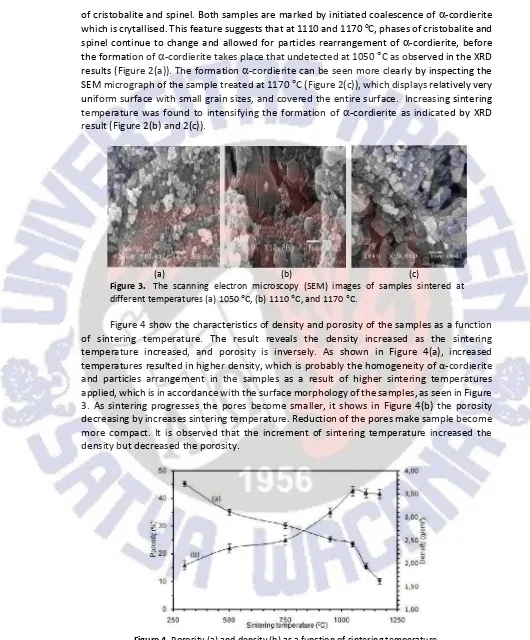
The morphology of the sintered samples was characterized using SEM. The images were shown in Figure 3. In all samples, crystallisation was detected after the heat treatment at 1050C, (b) 1110C, and 1170C. As displayed by the images in Figure 3a-c, the surface
morphology of the samples is marked by different grain size and distribution. The microstructure of the sample sintered at 1050C (Figure 3(a)) show quite difference to that of the sample treated at 1110C (Figure 3(b)). The sample prepared at 1050C (Figure 3(a)),
is marked by small grains with less evident grain boundaries, compared to those observed for the other two samples (Figures 3(b) and 3(c)). In addition, it is obvious that the clusters in the sample prepared at 1050C are surrounded by fine grains. The large clusters are most
likely composed of µ-cordierite, while the middle and fine grains are spinel and cristobalite. The surface of samples prepared at higher temperatures (1110 and 1170C) is most likely
of cristobalite and spinel. Both samples are marked by initiated coalescence of-cordierite which is crytallised. This feature suggests that at 1110 and 1170C, phases of cristobalite and
spinel continue to change and allowed for particles rearrangement of-cordierite, before the formation of-cordierite takes place that undetected at 1050C as observed in the XRD results (Figure 2(a)). The formation-cordierite can be seen more clearly by inspecting the SEM micrograph of the sample treated at 1170C (Figure 2(c)), which displays relatively very uniform surface with small grain sizes, and covered the entire surface. Increasing sintering temperature was found to intensifying the formation of -cordierite as indicated by XRD result (Figure 2(b) and 2(c)).
(a) (b) (c)
Figure 3. The scanning electron microscopy (SEM) images of samples sintered at different temperatures (a) 1050C, (b) 1110C, and 1170C.
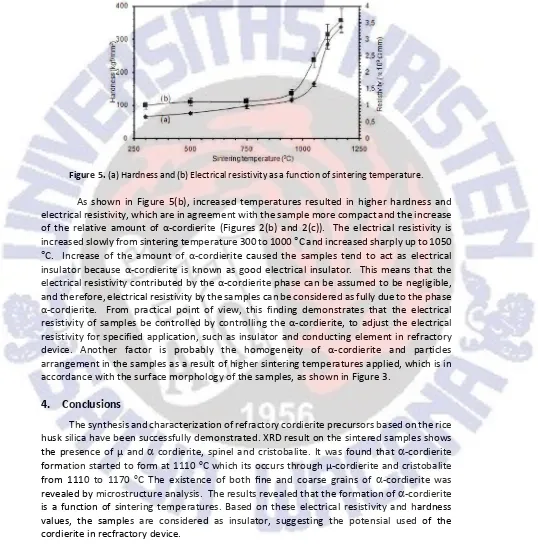
Figure 4 show the characteristics of density and porosity of the samples as a function of sintering temperature. The result reveals the density increased as the sintering temperature increased, and porosity is inversely. As shown in Figure 4(a), increased temperatures resulted in higher density, which is probably the homogeneity of -cordierite and particles arrangement in the samples as a result of higher sintering temperatures applied, which is in accordance with the surface morphology of the samples, as seen in Figure 3. As sintering progresses the pores become smaller, it shows in Figure 4(b) the porosity decreasing by increases sintering temperature. Reduction of the pores make sample become more compact. It is observed that the increment of sintering temperature increased the density but decreased the porosity.
Figure 5 shows the characteristics of hardness and electrical resistivity of the samples as a function of sintering temperature. The result reveals the hardness and electrical resistivity of the samples increased with increasing the sintering temperature.
Figure 5.(a) Hardness and (b) Electrical resistivity as a function of sintering temperature.
As shown in Figure 5(b), increased temperatures resulted in higher hardness and electrical resistivity, which are in agreement with the sample more compact and the increase of the relative amount of -cordierite (Figures 2(b) and 2(c)). The electrical resistivity is increased slowly from sintering temperature 300 to 1000C and increased sharply up to 1050 C. Increase of the amount of -cordierite caused the samples tend to act as electrical insulator because -cordierite is known as good electrical insulator. This means that the electrical resistivity contributed by the -cordierite phase can be assumed to be negligible, and therefore, electrical resistivity by the samples can be considered as fully due to the phase -cordierite. From practical point of view, this finding demonstrates that the electrical resistivity of samples be controlled by controlling the -cordierite, to adjust the electrical resistivity for specified application, such as insulator and conducting element in refractory device. Another factor is probably the homogeneity of -cordierite and particles arrangement in the samples as a result of higher sintering temperatures applied, which is in accordance with the surface morphology of the samples, as shown in Figure 3.
4. Conclusions
The synthesis and characterization of refractory cordierite precursors based on the rice husk silica have been successfully demonstrated. XRD result on the sintered samples shows the presence of µ and cordierite, spinel and cristobalite. It was found that-cordierite formation started to form at 1110C which its occurs through µ-cordierite and cristobalite
from 1110 to 1170 C The existence of both ne and coarse grains of -cordierite was
Acknowledgments
The authors wish to thank and appreciate the Directorate General Higher Education Republic of Indonesia (DIKTI) for research funding provided through Hibah Competence Research Grant Batch I No: no: 050/SPH2/PL/Dit. Litabmas/II/2015 Program in 2015.
References
Australian Standard (1989). Refractories and refractory material physical test methods: The determination of density, porosity and water adsorption, 1 4, 1774.
Evans, D.L., Fischer, G.R., Geiger, J.E., & Martin, F.W. (1980). Thermal expansions and chemical modifications of cordierite.Journal of The American Ceramic Society,63, 629 634.
Ghitulica, C., Andronescu, E., Nicola, O., Dicea, A., & Birsan, M. (2007). Preparation and characterization of cordierite powders.Journal of the European Ceramic Society,27, 711 713. Gonzalez-Velasco, J.R., Guterrez-Ortiz, M.A., Ferret, R., Aranzabal, A., & Botas J.A. (1999). Synthesis of
cordierite monolithic honeycomb by solid state reaction of precursors oxides.Journal of Material
Science,34, 1999 2002.
Hamzawy, E.M.A, & Ali, A.F. (2006). Sol-gel preparation of boron containing cordierite Mg2(Alx-4Bx)Si5O8 and its crystallization.Materials Characterization,57, 414 418.
Janackovic, D., Jokanovic, V., Gvozdenovic, L.K., Zec, S., & Uskokovic, D. (1997). Synthesis and formation mechanism of submicrometre spherical cordierite powder by ultrasonic spray pyrolysis.Journal of Material Science,32, 163 168.
Kai, Z., Yuan, Y.D., Juan, W., & Rui, Z. (2010). Synthesis of cordierite with low thermal expansion coefficient.Advanced Material,105 106, 802 804.
Kumta, P.N., Hackenberg, R.E., McMichael, P., & Johnson, W.C. (1994). Solution sol-gel synthesis and phase evolution studies of cordierite xerogels, aerogels and thin films.Materials Letters,20, 355 362.
Laokula, P., & Maensirib, S. (2006). Synthesis, characterisation and sintering behaviour of nanocrystalline cordierite ceramics.Advance in Science and Technology,45, 242 247.
Lim, B.C., & Jang, H.M. (1993). Homogeneous fabrication and densification of cordierite zirconia composite by a mixed colloidal processing route.Journal of American Ceramic Society,76, 1482 1490.
Nagai, N., & Hashimoto, H. (2001). FTIR-ATR study of depth profile of SiO2ultra-thin films.Applied
Surface Science,172(3 4), 307 311.
Naskar, M.K., & Chatterjee, M. (2004). A novel process for the synthesis of cordierite (Mg2M4Si5O18) powder from rice husk ash and other sources of silica and their comparative study.Journal of the
European Ceramic Society,24, 3499 3507.
Oliveira, F.A.C, & Fernandez, J.C. (2002). Mechanical and thermal behavior of cordierite-zirconia composites.Ceramic International,28, 79 91.
Pantea, D., Darmstadt, H., Kaliaguine, S., Summchen, L., & Roy, C. (2001). Electrical conductivity of thermal black. Influence of Surface Chemistry.Carbon,39, 1147 1158.
Petrovic, R., Janackovic, D.J., Zec, S., Dramanic, S., & Kostic-Gvozdenovic (2001). Phase transformation kinetics in triphasic cordierite gel.Material Research,16, 451 458.
Petrovic, R., Janackovic, D., Zec, S., Dramanic, S., & Gvozdenovic, J.K. (2003). Crystallization behavior of alkoxy-derived cordierite gels.Journal of Sol-gel Science Technology,28, 111 118.
Powder Diffraction File (Type PDF-2).Diffraction data for XRD identification. International Centre for Diffraction data, PA USA (1997).
Rohana, P., Neufussa, K., Mat jí eka, J., Dubskýa, J., L Prchl kb, L., & Holzgartnerb, C. (2004). Thermal and mechanical properties of cordierite, mullite and steatite produced by plasma spraying.
Ceramics International,30, 597 603.
Salje, E. (1987). Structural states of Mg-cordierite II: Landau theory.Physics Chemistry Minerals,14, 455 460.
Sembiring, S. (2011). Synthesis and characterisation of rice husk silica based borosilicate (B2SiO5) ceramic by sol gel routes.Indonesian Journal of Chemistry,11(1), 85 89.
Sembiring, S., & Simanjuntak, W. (2012). X-ray diffraction phase analyses of mullite derived from rice husk silica.Makara J. Sci., 16(2), 77 82.
Sembiring, S., Simanjuntak, W., Manurung, P., Asmi, D., & Low, I.M. (2014). Synthesis and characterisation of gel-derived mullite precursors from rice husk silica.Ceramics International,
40, 7067 7072.
Simanjuntak, W., & Sembiring, S (2011). The use of the Rietveld method to study the phase composition of cordierite (Mg2Al4Si5O18) ceramics prepared from rice husk silica.Makara Journal
Science,15(1), 97 100.
Simanjuntak, W., Sembiring, S., & Sebayang, K. (2012). Effect of pyrolysis temperature on composition and electrical conductivity of carbosil prepared from rice husk.Indonesian Journal of Chemistry,
12(1), 119 125.
Simanjuntak, W., Sembiring, S., Manurung, P., Situmeang, R., & Low, I.M. (2013). Characteristics of aluminosilicates prepared from rice husk silica and aluminum metal. Ceramics International,
39(8), 9369 9375.