KEMENTERIAN PENDIDIKAN MALAYSIA
HURAIAN SUKATAN PELAJARAN
KURIKULUM BERSEPADU SEKOLAH MENENGAH
BAHASA INGGERIS
2003
BAHAWASANYA negara kita Malaysia mendukung cita-cita hendak mencapai perpaduan yang lebih erat di kalangan seluruh masyarakatnya; memelihara satu cara hidup demokratik; mencipta masyarakat yang adil di mana kemakmuran negara akan dapat dinikmati bersama secara adil dan saksama; menjamin satu cara yang liberal terhadap tradisi-tradisi kebudayaan yang kaya dan berbagai-bagai corak; membina satu masyarakat progresif yang akan menggunakan sains dan teknologi moden;
MAKA KAMI, rakyat Malaysia, berikrar akan menumpukan seluruh tenaga dan usaha kami untuk mencapai cita-cita tersebut berdasarkan prinsip-prinsip berikut :
KEPERCAYAAN KEPA DA TUHAN
KESETIAAN KEPA DA RAJA DAN NEGARA
KELUHURAN PERLEMBAGAAN
KEDAULATAN UNDA NG- UNDANG
FALSAFAH PENDIDIKAN KEBANGSAAN
Pendidikan di Malaysia adalah suatu usaha berterusan ke arah
memperkembangkan lagi potensi individu secara menyeluruh dan
bersepadu untuk mewujudkan insan yang seimbang dan harmonis dari segi
intelek, rohani, emosi dan jasmani berdasarkan kepercayaan kepada
Tuhan. Usaha ini adalah bagi melahirkan rakyat Malaysia yang berilmu
pengetahuan, berketrampilan, berakhlak mulia, bertanggungjawab dan
berkeupayaan mencapai kesejahteraan diri serta memberi sumbangan
CONT ENT S
PAGE
1. RUKUN NEGARA i
2. FALSAFAH PENDIDIKAN NEGARA ii
3. CONTENTS iii
4. INTRODUCTION 1
5. CONTEXTS FOR TEA CHING 5
6. OBJECTIV ES 6
7. SECTION 1 : LEA RNING OUTCOMES AND SPECIFICATIONS
1.0 Language for interpersonal Purpose 7
2.0 Language for Informational Purpose 11
3.0 Language for Aesthetic Purpose 16
8. SECTION 2 : LA NGUAGE CONTENT
a) Grammatical Items 19
b) Suggested Sentence Patterns 28
c) Sound System 29
Huraian Sukatan Pelajaran Bahasa Inggeris Tingkatan 5
1. INT RODUCTION
English is taught as a second language in all primary and secondary schools in line w ith its status as a second language in the country.
Learners are taught the English language to enable them to use the language to further their studies and for w ork purposes. For those who have the facilities, the use of English in ICT has been included to enable learners to access know ledge on the Internet and to netw ork w ith people both locally and overseas. This is in keeping with the grow ing use of English in the field of Information and Communications Technology ( ICT).
AIMS
The English syllabus aims to extend learners’ English language proficiency in order to meet their needs for English in everyday life, for know ledge acquisition, and for future workplace needs.
OBJECTIVES
The English language curriculum enables learners to:
i. form and maintain relationships through conversation and correspondence; take part in social interaction; and interact to obtain goods and services;
ii. obtain, process and use information from various audio-visual and print sources; and present the information in spoken and w ritten form;
iii. listen to, view , read and respond to different texts, and express ideas, opinions, thoughts and feelings imaginatively and creatively in spoken and w ritten form; and
iv. show an awareness and appreciation of moral values and love tow ards the nation.
THE SYLLABUS
The English syllabus at the secondary level specifies the content to be taught from the Remove Class through to For m 5.
The English language curriculum is organized in a manner that reflects the w ay English is used in society in everyday life
The Learning Outcomes of the syllabus specify the skills to be achieved by learners in the three areas of language use, namely the interpersonal, the informational and the aesthetic. These areas incorporate the integration of the four language skills of listening, speaking, reading and writing. The Language Content outlines the grammar, the sound system, and the w ordlist to be taught, w hile the section on Educational Em phases (incorporated in the introduction) highlights thinking skills, ICT skills, values and citizenship education and others that are to be taken into account.
CURRICULUM SPECIFICATIONS
Curriculum Specifications for the English language syllabus have been prepared as separate documents for each year of the secondary school and these are termed as Huraian Sukatan Pelajaran. Each document serves as a guide to teachers w ith regard to the skills to be achieved, the topics or themes to be dealt with, and the vocabulary, grammar items, and the sound system to be taught.
This document is the Curriculum Specifications for Form 5. The first section states the Learning Outcomes to be achieved and these are set out in columns in the follow ing manner:
x the first column states the skills to be achieved by learners by the end of the year;
x the second column presents the learning outcomes for the year. These have been set out at three levels ranging from the simple to the more complex. Level 1 outlines the simpler skills to be achieved by all learners. Levels 2 and 3 represent more challenging skills that learners have to progress to after having mastered the skills at the earlier stage; and
x the third column is entitled Examples/Activities/Notes.
These are directed at the teacher and are suggestions which include teaching points, examples of activities and explanations.
LANGUAGE SKILLS
The four language skills of listening, speaking, reading and w riting do not appear as discrete items in the syllabus or in this document but are integrated into the areas of language use. Thus, w hen learners use the language, they not only engage in conversation by talking to and listening to each other, they also write to each other letters and messages. The second column entitled Specifications
Huraian Sukatan Pelajaran Bahasa Inggeris Tingkatan 5
THE L EARNING CONT ENT
In teaching learners to use the language for various purposes, the content or topic of the lesson can be sourced from various areas. Know ledge from subject disciplines such as science and geography can be utilized or content or topics be drawn from current issues. Learners begin w ith issues and concerns in their immediate surroundings, i.e. the school, tow n and country and later progress to issues and concerns outside the country. A list of contexts (themes) has been provided for For m 5.
GRAMMAR
Grammar items have been selected from the list provided in the syllabus and these are to be incorporated in the three areas of language use. In addition, sentence patterns have been listed to enable learners to master the structures of the English Language.
WORD LIST
The list of w ords selected for teaching is draw n from a sample of the more common or high frequency words used in daily life. This suggested w ord list is only the minimum for the year. Teachers are encouraged to w iden this list according to the level, ability and matur ity of their learners.
EDUCATIONAL EMPHASES
These outline current developments in education that w ill help learners prepare for the world of work and social life. In this respect, moral education, citizenship education, patriotis m and thinking skills will contribute tow ards the building of a modern and progressive society.
Thinking skills
Critical and creative thinking skills are incorporated in the learning outcomes to enable learners to analyse information, make decisions, solve problems, and express themselves accurately and creatively in the language.
Learning How to Learn Skills
Learning How to Learn Skills are also integrated in the learning outcomes and aim to enable learners to take responsibility for their ow n learning. These skills incorporate information skills, library skills and study skills to enable learners to locate sources of
information more efficiently and help them become independent life-long learners.
Values and Citizenship
The values contained in the secondary Moral syllabus have been incorporated in the learning outcomes and include patriotis m and good citizenship.
Multiple Intelligences
The learning outcomes also reflect the incorporation of the theory of Multiple Intelligences. This is illustrated, for example, in the interpersonal use of the language among people in social interaction, kinesthetic intelligence in the dramatization of texts, and spatial intelligence in the interpretation of maps and other such activities.
Preparation for the Real World
The learning outcomes prepare learners to meet the challenges pf the real w orld by focusing on language use in society. This is achieved through structuring the curriculum in ter ms of interpersonal, informational and aesthetic uses of language. It is also achieved by making use ofreal-life issues for obtaining information, making decisions and solving problems.
IMPORTANT CONSIDERATIONS FOR T EACHING
The follow ing considerations should be taken into account in teaching the curriculum specifications.
Planning and Organization of Lesson
These specifications must be organized in a manageable form for teaching taking into account the time allocated for teaching. The three areas of language use may be planned around a topic.
Learner-Centredness
The learner is at the center of the learning process. Teaching approaches, lessons and curriculum materials for learning must be adjusted to suit the differing needs and abilities of students.
Integration
The principle of integration can help teachers cover areas of the syllabus in several lessons. Once a topic is decided upon, teachers can plan tasks and activities reflecting the three areas of language use.
In all of these lessons, moral values should be infused. This can be done through the appropriate selection of materials and activities. Elements of patriotis m, environmental education, and health education should also be taken into account.
Repetition, Reinforcement and Consolidation
Huraian Sukatan Pelajaran Bahasa Inggeris Tingkatan 5
often so that they gradually develop the ability, know ledge and confidence to use them effectively.
Teaching-Learning Activities
In order to bring about effective learning, learners must be given every opportunity to take part in activities that require them to use the language they have learnt. In addition, teachers should also emphasize thinking skills and apply the principles of multiple intelligences.
Evaluation
Evaluation is an important aspect of the teaching-learning process. Continuous feedback is essential if learners are to keep track of their progress. After every lesson, teachers are encouraged to assess their set of learners through simple questioning techniques or some other simple exercise so that they can pace their lessons in accordance with their learners’ progress.
Other Considerations
As far as possible, teachers should use the Malaysian setting as a base to teach the language skills and language contents. Teachers should also use materials that emphasize the principles of good citizenship, moral values, and the Malaysian w ay of life.
2. CONT EXTS FOR T EACHING
The contexts for teaching the English language in For m 5 are listed below . These are broad contexts and need to be translated into topics to enable learners to read, write and talk about them. Learners are not expected to have a comprehensive academic know ledge of these topics. Rather, these topics serve as the subject matter through w hich the three areas of language use are taught and meaningful tasks and activities are set. Since values are embedded in these themes, teachers should take every opportunity to discuss socio-cultural and moral values related to them as w ell as in the activities that are set. Teachers should make use of the accompanying w ord list and also introduce other w ords that are essential to the topic at hand.
People : Planning for a career
- current careers and understanding the hard w ork and sacrifice involved in preparing for such careers
Environment : Protecting our rivers, lakes, and oceans in order that they continue to play a useful role in the lives of people living near them.
- e.g. protecting the environment from oil spills and acid rain
Social Issues : Social freedom and responsibility
- how young people can use the freedom given to them responsibly
Health : Dangers of getting into bad habits such as smoking and other
indisciplined behaviour
Curriculum Specifications for English Form 5
3. OBJECTIV ES FOR FORM 5
By the end of For m 5, learners should be able to
x Talk about their experiences and exchange ideas w ith friends and relatives;
x Ask questions and respond to questions w ith relevant answ ers;
x Make plans and arrangements w ith friends to do something or go somew here;
x Obtain information from various sources and present these ideas to friends orally and in w riting;
x Read w idely and enjoy poems and short stories; and
4. L EARNING OUTCOMES AND SPECIFICATIONS
LEARNING OUTCOM ES SPECIFICATIONS EXAMPLES / ACTIVITIES / NOT ES
1.0 LANGUAGE FOR
INT ERPERSONAL PURPOSES
1.1 Make friends and keep friendships by
a. introducing oneself;
b. taking part in conversations and discussions;
c. talking about self, family and friends, interests, part events, feelings, personal experiences and understanding w hen others talk about themselves;
d. exchanging ideas, information and opinions on topics of interest.
Level 1
i. Introducing oneself to a friendly stranger and initiating a conversation.
ii. Relating personal experiences.
iii. Keeping a record of events.
iv. Asking questions politely and responding politely to questions asked.
v. Listening to, repeating and knowing the difference between consonants, vowels, diphthongs, consonant clusters,
homophones, homographs, and w ords borrow ed from other languages.
x The context can be at a bus stop, at the clinic, at a pay ment queue in the post office.
x Talking about experiences
e.g. as a customer w ho got ‘cheated’.
x Noting significant changes
e.g. noting the dates and the nature of the problem of a product bought recently; the days the garbage w as not collected; of the time someone got ill and how he or she got better after that.
x Understanding a person’s mood
(e.g. anger, sadness, surprise) from the tone and volume of his speech.
x See Sound System at the back of this document.
Curriculum Specifications for English Form 5
LEARNING OUTCOM ES SPECIFICATIONS EXAMPLES / ACTIVITIES / NOT ES
Level 2
vi. Pronouncing words clearly and correctly and asking questions and making statements w ith the correct intonation, w ord stress and sentence rhythm.
vii. Reading topics of current interest and exchanging ideas.
Level 3
viii. Giving opinions on articles read or accounts heard.
x Current topics include for example: being aw are of AIDS; of the dangers of dangerous driving; oil spills and the cost to the environment.
x Activities include class and group discussions, and role-playing.
1.2 Take part in social interaction by
a. Carrying out a variety of language functions;
b. discussing plans and arrangements, solving problems, and making decisions.
iii. Persuading someone not to do something.
iv. Asking about satisfaction and
x E.g. w hen a friend does not look too w ell.
x E.g. one friend tells another friend to make up his/her mind as to w hat to buy as it is getting late.
x E.g. persuading one’s friend not to skip school to be w ith another group of friends.
LEARNING OUTCOM ES SPECIFICATIONS EXAMPLES / ACTIVITIES / NOT ES
Level 2
v. Participating in a conversation: - explaining one’ s view s - accepting the view s of others - defending one’ s point of view with
reasons.
vi. Making a decision based on agreement of all members of a group.
Level 3
vii. Responding to problem page letters in the newspaper or in popular magazines by first discussing them and then writing letters to the editor.
x E.g. discussing topical and moral issues: e.g. about AIDS - to tell or not to tell others.
x E.g. persuading others not to go to a certain place because of the dangers posed (e.g. the possibility of being
stranded because of landslides due to the heavy rains) and reaching a compromise.
x E.g. w hether to inform or not the parents of a friend w ho has joined a group of wayward boys and girls.
1.3 Obtain goods and services by
a. making enquir ies and ordering goods and services;
b. making complaints and responding to complaints.
Level 1
i. Making enquiries after reading the adverts column in the new spaper / yellow pages and identifying a number of similar services and products.
Level 2
ii. Com paring and contrasting the information obtained and deciding on a choice.
x E.g. enquiring about sports equipment such as badminton racquets, hockey sticks, footballs.
Curriculum Specifications for English Form 5
LEARNING OUTCOM ES SPECIFICATIONS EXAMPLES / ACTIVITIES / NOT ES
iii. Confirm ing the service/product and placing an order for it orally and in writing.
Level 3
iv. Expressing satisfaction and offering thanks about the service or product orally and in w riting.
v. Responding to a complimentary letter expressing satisfaction and thanking the writer orally and in w riting.
x E.g. by filling in a form or w riting a short note stating precisely w hat is required.
LEARNING OUTCOM ES SPECIFICATIONS EXAMPLES / ACTIVITIES / NOT ES
2.0 LANGUAGE FOR
INFORMATIONAL PURPOSES
2.1 Obtain inform ation for different purposes by
a. listening to spoken texts such as talks, speeches and view ing television documentar ies and multimedia;
b. interview ing and using questionnaires;
c. reading materials in print such as reports and articles and using other electronic media such as the Internet.
Levels 1, 2 and 3
i. Listening to and understanding a variety of texts.
ii. Reading silently a variety of m aterials in print and from the Internet.
Levels 2 and 3
iii. Interview ing people to get more information on topics under study.
x Examples include instructions,
advertisements, messages, descriptions, reports, speeches.
x Examples include instructions, passages, articles from new spapers and magazines, reports, speeches, brochures.
x When reading aloud, learners need to observe:
- correct pronunciation - intonation patterns - correct phrasing - pauses
- stress - emphases - fluency and rhythm
x Activities include role-playing and simulation.
x Get students to brainstor m on the types of questions they w ill ask.
Curriculum Specifications for English Form 5
LEARNING OUTCOM ES SPECIFICATIONS EXAMPLES / ACTIVITIES / NOT ES
2.2 Process inform ation by
a. skimming and scanning for specific information and ideas;
b. extracting main ideas and details;
c. discerning sequence of ideas;
d. Getting the explicit and implicit meaning of the text;
e. predicting outcomes;
f. draw ing conclusions;
g. identifying different points of view;
h. using print and electronic dictionaries;
i. interpreting non- linear texts such as maps, charts, diagrams, tables, graphs;
j. making short notes and mapping out ideas.
A. Processing texts listened to by:
Level 1
i. Listening to a text and recalling what the text is about.
ii. Listening to and recalling important details (e.g. place, date, time, number) of the text.
iii. Answering a variety of questions to demonstrate understanding of the text heard.
iv. Taking notes of the text heard.
Level 2
v. Identifying m ain ideas in the text heard.
vi. Predicting outcomes.
vii. Identifying different points of view.
x Teachers can prepare their students for the text they are going to listen to by providing them w ith key w ords or the title of the passage.
x Example of recall w ould be: “The text w as about how careful consumers should be when buying goods..”
x Questions can take many forms: completing information gaps; detecting errors; sequencing; filling in details, etc.
LEARNING OUTCOM ES SPECIFICATIONS EXAMPLES / ACTIVITIES / NOT ES
B. Processing texts read by
Level 1
i. Stating the type of text being read.
ii. Skimm ing for the gist of the text.
iii. Scanning for details.
iv. Follow ing the sequence of ideas.
v. Highlighting key words and phrases in a text.
vi. Using the dictionary to find the meanings of w ords.
vii. Acquiring vocabulary through
x word association
x word collocation.
Level 2
viii. Identifying m ain ideas in the text read.
ix. Listing important details.
x Example: a review of a book/ movie.
x Taking note of chapter headings, sub-titles, key w ords in a text.
x Taking note of important ideas is an important study skill.
x E.g. w ord association: Aquaculture= praw ns, fish, demand, high prices, disease, ruin
Curriculum Specifications for English Form 5
LEARNING OUTCOM ES SPECIFICATIONS EXAMPLES / ACTIVITIES / NOT ES
x. Acquiring meaning of words by understanding
x word formation through the use of prefix and suffix,
x contextual clues.
Level 3
xi. Predicting outcomes with reason.
xii. Identifying cause and effect.
xiii. Making inferences.
xiv. Draw ing conclusions.
xv. Identifying and discussing points of view .
xvi. Com paring and contrasting data collected from graphs, tables, charts and diagrams.
x Prefix: bi- il-
x Suffix: -able
x Encourage students to give logical reasons.
LEARNING OUTCOM ES SPECIFICATIONS EXAMPLES / ACTIVITIES / NOT ES
2.3 Present inform ation to different audiences by
a. writing descriptions, instructions, recounts, explanations, messages, letters, speeches, reports and articles;
b. instructing, describing, narrating, explaining and reporting orally;
c. responding to questions and comments orally and in w riting;
d. presenting information in non-linear forms including tables, graphs, diagrams, charts and vice-versa;
e. expanding notes and outlines;
f. composing, revising and editing drafts; and checking accuracy of spelling, punctuation and grammar;
g. summarising information;
h. reading aloud written materials such as instructions, directions and reports clearly and fluently;
i. using appropriate format , conventions, and grammar w hen presenting the information.
Level 1
i. Presenting inform ation in the form of tables, graphs and charts.
ii. Responding to questions and comments orally and in w riting.
iii. Making notes and outlines.
Level 2
iv. Expanding notes and outlines.
v. Summ arizing ideas in a text.
Level 3
vi. Writing reports on specific topics.
vii. Writing articles on specific areas.
viii. Writing a sim ple speech on a particular topic.
x Get students to use the process approach to w riting. Provide framew ork or structure of the intended report.
x Provide also the framew ork / structure / scaffolding of the text to be w ritten.
x Make students aw are of the purpose and the audience to w hom they are w riting for.
Curriculum Specifications for English Form 5
LEARNING OUTCOM ES SPECIFICATIONS EXAMPLES / ACTIVITIES / NOT ES
3.0 LANGUAGE FOR AEST HETIC PURPOSES
3.1 Listen to, read and respond to literary works by
a. understanding and telling in one’s ow n words the story and poem heard and read, and giving one’s opinion of the text;
b. recognizing elements in a story such as characters and setting;
c. explaining the message the w riter is trying to convey and discussing how this relates to one’ life;
d. understanding other people’s cultures, traditions, customs, and beliefs;
e. reciting poems w ith feeling and expression.
Level 1
i. Reciting poems w ith feeling and expression and w ith correct
pronunciation, intonation, stress and rhythm.
ii. Finding out the m eaning of words by using the dictionary and /or contextual clues.
vi. Describing characters and writing a paragraph or tw o about them.
x Students can only recite poems w ith feeling and expression, once they have
understood the poem w ell.
x Set group w ork for this activity.
x Get students to look for w ords and phrases that describe the place and location.
x Get students to look for w ords and phrases that describe characters – either w hat the author says or what the other characters say about these characters.
LEARNING OUTCOM ES SPECIFICATIONS EXAMPLES / ACTIVITIES / NOT ES
viii. Discussing values explored in the text.
ix. Relating events, characters and values to one’s life.
Level 3
x. Discussing the theme and message of stories and poems.
xi. Giving one’s opinion of the poem or story.
xii. Understanding the figurative language of the text.
x Draw students’ attention to the fact that some cultures have different customs and beliefs from our culture but they must be respected nevertheless.
x Encourage learners to tell how a certain character or event in the story reminds them of a certain character or event in real life. Get them to note the similarities and differences.
x Encourage learners to express views on the theme/message, character, events and values explored in the text.
Curriculum Specifications for English Form 5
LEARNING OUTCOM ES SPECIFICATIONS EXAMPLES / ACTIVITIES / NOT ES
3.2 Express themselves creatively and im aginatively by
a. Dramatizing texts and role-playing characters;
b. Retelling a story form a different point of view, and presenting it in another genre;
c. Composing simple poems, stories and dialogues.
Level 1
i. Dram atizing sections of a text and role-playing characters.
Level 2
ii. Retelling a story from another character’s point of view.
Level 3
iii. Presenting the text in another genre.
iv. Com posing simple poems, stories and dialogues.
x Get learners to choose the sections of the text they w ant to dramatize. Then get them to know the story thoroughly, interpreting how the characters behave and the kind of personalities they are. Then get learners to write out the dialogues w ith stage
directions if possible. Get them to practise reading out their parts w ith suitable
expression and emotion.
x Get learners to look at events and
characters from the perspective of another character’s point of view .
x E.g. rew riting a poem in prose form; looking at a cartoon strip and w riting a poem / story; writing a dialogue based on a story; representing a prose text in a series of pictures.
SECTION II: LANGUAGE CONT ENT
a) GRAMMATICAL ITEMS
Grammar forms part of the language contents in the Curriculum Specifications for Form 5. Grammar items are specified under the different grammar categories. To illustrate w hat is meant by each category and at the same time to specify the scope and depth of the items to be taught examples are given. Teachers are encouraged to teach these grammatical items in the context of topics. Items to be focused on in For m 5 are marked w ith an asterisk(*). If extra practice is required for better understanding or retention, items can be taught in isolation.
1. Nouns
i. Concrete nouns
a. Comm on nouns – e.g. book, house, school
b. Proper nouns – e.g. Ahmad, Malaysia
ii. Abstract nouns
x names of qualities, states, activities
e.g. health, poverty; laughter, arrival
iii. Countable nouns
e.g. girls, beakers, air conditioners
iv. Uncountable nouns
e.g. sand, sugar, *baggage, *advice, *damage
v. Num ber - Formation of the plural
a. Adding suffix -s, -es
x For regular words
e.g. birds, trees
x Words ending in -s -sh -ch -x
Curriculum Specifications for English Form 5
x Words ending in -y
e.g. toy - toys; lorry - lorries
b. Irregular plurals
Indicated by a change of vow el
e.g. man - men; mouse - mice; tooth - teeth
vi. Concord (subject-verb agreement)
a. Singular subject takes singular verb
* e.g. Of the 3 friends, Mary has ….
b. Plural subject takes plural verb * e.g. Peter, John and Paul are ….
vii. Gender – m asculine, fem inine
a. -er -or : traditionally used to mar k male
e.g. waiter, actor
b. -ess : traditionally used to mark female e.g. w aitress, heiress
2. Articles
i. With singular countable nouns – a an the
e.g. a book an oven the house
Note: ‘an’ is usually used before vow els but note ‘a university’ , ‘an hour ’
ii. With plural countable nouns
e.g. test tubes
3. Adjectives
i. Adjectives in terms of colour, size and shape e.g. a big boy a blue sky a round eraser
ii. Adjective that show qualities
e.g. an honest mechanic, a kind by-stander
iii. Form ation of the negative of adjectives by adding prefixes: un- dis- im - *il- *bi- e.g. an unkind person, a dishonest mechanic, an illegal entry, a bi-annual meeting
iv. Com parison adjectives – m y, your, his her, our
e.g. This is my/your/his/her/ our book.
v. Com parison adjectives – regular forms
e.g. big - bigger - biggest
* vi. Adjectives functioning as nouns
e.g. The blind are taught special skills.
The wounded from the crash were sent home after treatment.
* vii. Nouns functioning as adjectives
e.g. a stone wall, a leather jacket, a gold card
4. Pronouns
i. Personal Pronouns:
I - first person
You - second person
He/She/It - third person
Curriculum Specifications for English Form 5
ii. Possessive Pronouns :
m ine, yours, his, hers, ours, theirs
e.g. That book is mine / yours / his / hers.
iii. Dem onstrative Pronouns: this, that, these, those
iv. Interrogative Pronouns: Who, Which, What, Whose
5. Verbs
i. Regular and Irregular Verbs e.g. w alk – w alked; sw eep - swept
ii. Negative Verbs
x adding the w ord notafter the verb
e.g. He is not here.
They cannot go to the party.
x using the contracted form especially in conversation
e.g. He isn’t here.
They can’t go to the party.
iii. Tenses – present, past, continuous, * perfect a. Sim ple Present Tense
x For habitual actions
e.g. Every day we play football.
x Describing feelings and senses
e.g. “I feel upset over what has happened.”
b. Sim ple Present Tense – w as were
x Regular verbs, Irregular verbs
e.g. walk-walked; sit-sat; go-went
x Using w ords that signal the past tense
e.g. Yesterday, Last week
c. Present Continuous Tense
x The action is happening at the time of speaking
e.g. I am …… verb + -ing;
d. Present Perfect Tense
x e.g. has / have + past participle She has walked 5 miles.
e. Past Perfect Tense
x Had + past participle
e.g. They had changed the wheel in 10 minutes.
iv. Gerunds
a. Gerunds as com plements of verb to be
e.g. My favourite hobby is reading.
b. Gerunds as objects of preposition
e.g. They are not interested in buying the house.
c. Gerunds as subject
e.g. Jogging is my favourite activity.
Curriculum Specifications for English Form 5
v. Special Finites or Modals - * m ay, * m ight a. May or m ight - meaning ‘possibility’
e.g. It may be true. OR It might be true.
Negative: m ay notormight not
e.g. He may not be at home. OR He might not be at home.
b. For the past: use m ay have OR m ight have
e.g. A: I w onder why he did not answ er the telephone.
B: He may have been asleep. OR He might have been asleep. (=perhaps he w as asleep)
vi. Infinitives
a. As object of verbs
e.g. We want to know the ans wer. He must learn to save money.
b. As com plements of verb “to be”
e.g. This house is to let.
Jack and Jill are to be married soon.
* vii. Passive Construction – using * is done, *w as done
e.g. Somebody built this house in 1960. (= active)
This house was built in1960 (by somebody). (= passive) This room is cleaned every day (by somebody) (= passive)
6. Adverbs
Adverb of m anner, time, frequency, *degree,
- To show how an action w as done – using the suffix -ly.
7. Prepositions
i. Prepositions of place:
In, on, near, under, behind, in front of, by
e.g. The shop is next to the bank
ii. Prepositions of time – at, on, by, before, after, since, during, until, w ithin
iii. Prepositions of direction - * out of, * aw ay from
iv. Prepositions of purpose - for, so that, in order to
v. Prepositions of association - am ong, between
vi. * Verb and preposition com bination (Phrasal verbs)
e.g. put off, attend to, rely on
vii. * Adjective and preposition combination (Phrasal verbs)
e.g. proud of, happy w ith, famous for
8. Connectors
i. Conjunctions :
either …. or, neither ….. nor, although, however
ii. Logical connectors: * furthermore
iii. Sequence connectors:
Curriculum Specifications for English Form 5
9. *Reported Speech ( He /She /They said that….)
i. e.g. Jee Ann said “I am not feeling well”. ( direct speech)
Jee Ann said that she was not feeling well. (reported speech)
* In general, the rules are: am /is owas; are owere; do/doesodid; have/has ohad; w ill owould; can ocould.
10. Sentences
i. Sim ple sentence
e.g. They went to the exhibition early.
ii. Com pound sentence
e.g. They woke up early and went jogging.
iii. Com plex sentence
E.g. The volunteer, who is a retired engineer, comes to school once a week to tutor some boys who are weak in Mathematics.
iv. Positive statements
e.g. My name is ….
He/ She/It/They were …..
v. Negative statements e.g. They are not …. We w ere not …….
11. Punctuation
i. Capital letters – proper nouns, pronoun ‘I’, beginning of sentences
iii. Exclam ation m ark
e.g. For greetings - Hi! Hello!
iv.
v.
Full Stop – for end of statement
Question m ark
vi. Apostrophe - for contractions
e.g. Don’t allow the bacteria culture to grow for more than 4 days.
vii. Sem i-colon (;) - indicates a relationship between two pieces of inform ation in the same sentence.
e.g. The lawn needs mowing; I will do it this weekend.
viii. Underlining – for em phasis
e.g. The closing date is on the 15th of May.
ix. Brackets ( ) – used to separate extra information
e.g. The crash (between two goods trains) occurred at 7 o’clock in the evening yesterday.
x. Hyphen ( - )
x used to connect parts of a compound w ord
e.g. It’s not expensive because it’s a second-hand skate- board.
xi. Colon ( : )
x announces something (a fact or a list) that the first part of the sentence has led us to believe.
e.g. There were so many flavours to choose from: strawberry, chocolate, mint, vanilla, etc.
x serves to introduce a quotation or a report.
e.g. The Minister began his speech as follows:
“Ladies and gentlemen,
Huraian Sukatan Pelajaran Bahasa Inggeris Tingkatan 5
b. Suggested Sentence Patterns
In this section some suggested patterns have been listed for the language functions as stipulated in the Curriculum Specifications. It is important that teachers teach these sentence patterns (including responses) in context and in a meaningful w ay. Words underlined may be substituted.
1. Asking about one’s health
A: How do you feel, today? OR Do you feel all right?
. B: Not too w ell, I’m afraid.
2. Asking one to think about something
A: Think about it. B: Okay
3. Asking one to decide upon something. A: Make up your mind, please.
OR So w hat have you decided, now ?
B: Yes please and thank you.
4. Persuading someone not to do something.
A: Please don’t do that. It’s not good for you.
5. Asking about satisfaction
A: Is everything, OK? B: Fine, thank you.
6. Expressing satisfaction
A: Everything is fine, thank you.
(c) The Sound System
The Sound System forms part of the language contents in the Form 5 Curriculum Specifications. The items listed below are to be taught in Form 5. In each item, examples of sounds to be taught are provided and teachers should provide further examples of these sounds. The teaching of the sounds should be done in integration with other skills particularly with the Listening and Speaking skills.
4.0 Consonant Clusters
i. spr…/ spr/
-
spring; sprain6.0 Sentence Stress and Intonation
i. Sentence stress in statements ii. Sentence stress in questions iii. Stress in exclamations.
Huraian Sukatan Pelajaran Bahasa Inggeris Tingkatan 5
8.0 Words borrowed form other langugages
i. French
e.g. ballet /b ei/ bouquet / bu:ckei/
ii. Italian
e.g. pizza / pits / Spaghetti /sp geti/
iii. Germ an
e.g. kindergarten / kind ga:tn / marzipan /ma:z Ip n/
iv. Latin
e.g. vice-versa /vaIsI v3:s /
v. Malaysian
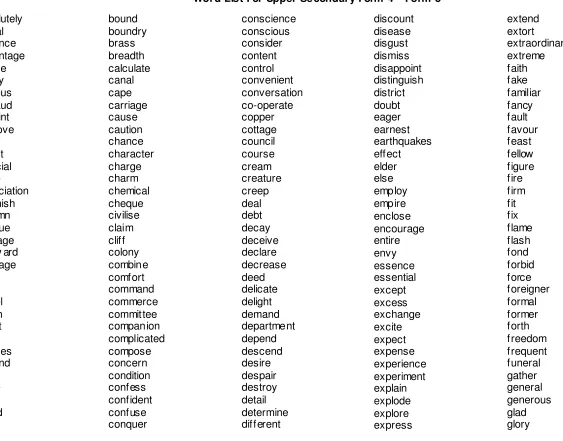
This suggested w ord list comprises general w ords in alphabetical order. These are base w ords and teachers are encouraged to use them w hen teaching the learning outcomes.
Some of these w ords have several meanings and the meanings are best made clear if they are illustrated in different passages/contexts. For example, boil can be taught as a verb (“to boil water”) or as a noun (“The boil on my shoulder is painful”).
Nouns are listed in their singular form. Their plural forms need to be taught as w ell (e.g. kite – kites)
Teachers are also encouraged to add prefixes and suffixes to w ords if the context so requires. For example, to teach adverbs the learner is told that the suffix –ly is added to the w ord sweet to get the sentence, “ The girls sang sweetly”. Similarly the prefixes un- or
dis- or im- can be added to w ords to mean not. e.g. unkind, disappointed, impossible.
Verbs are also given in their base word forms. To these teachers are expected to teach the various part of speech if the context so requires. For example, dig can be taught in its present tense form (digs), in its past tense form (dug) and in its –ing form (digging). As such w ord endings such as –ed, -ied, -s, -ies, -ing can be added to verbs. How ever derivatives from the base w ords should be used prudently, For example, (deliver) should be limited to delivered and delivers but the derivative deliverance should be omitted.