THE USE OF CARTOON FILMS TO IMPROVE STUDENTS’ SKILL IN WRITING NARRATIVE TEXTS
Vivit Kumala Dewi
English Education Study Program Sebelas Maret University Surakarta
Email: [email protected]
Abstract: The objectives of the research are: (1)to find out whether the students’ skill in writing narrative texts can be improved by using cartoon films. (2)to find out the effectiveness of the teaching and learning process when cartoon films are used in teaching writing narrative texts. The researcher collected the data using qualitative and quantitative data. The improvement of students’ writing skill includes: (1) having an abundance of vocabulary; (2) using correct capitalizations and spelling; (3) making sentences grammatically; (4) developing their ideas into coherent paragraphs. The effectiveness of using cartoon films shown in: (1) motivating students to write; (2) making the lesson more clearly (3) increasing their interest; (4) increasing their attention. The students’ score in pre-test was 61.77, post-test 1 in cycle 1 was 70.6, and post-test 2 in cycle 2 was 74.90. It can be concluded that the use of cartoon films can improve students’ skill in writing narrative text.
Key words: writing skill, narrative text, cartoon films, SMP N 1 Sidoharjo Sragen
In teaching learning English at Junior High School, there should be language practice in each language skill, including writing skill. Writing will help students master the other skills and of course in mastering English completely. Even Celce-Murcia (2001: 206) states that the major achievement of writing is the ability to express one’s idea in writing in a second foreign language and to do so with reasonable coherence and accuracy; that many native speakers of English never truly master this skill. According to Brown (2001: 335), the criteria of good writing are content, organization, vocabulary use, grammatical use and mechanical considerations such as spelling and punctuation. It means that writing is an ability to express one’s idea which should have good criteria, such as: good content and organization; correct grammar and mechanics; and also appropriate vocabulary. The ideal condition of writing
skill from this research is that the students of eight grades in SMP N 1 Sidoharjo Sragen can produce texts with a good content and organization; correct grammar and mechanical; and also appropriate vocabulary; with reasonable coherence and accuracy.
another student who had similar problems. They wrote ‘chity’ instead of ‘city’, ‘merid’ instead ‘marriage”. They were unaware with their own problems. (3) The students could not write correct sentences grammatically. (4) The students’ mastery in using grammar needed some guidance. They were unable to express an idea successfully because they were unable to use correct grammar. Some of them made ‘Malin Kundang is a kind person’ instead of ‘Malin Kundang was a kind person’. (5) The students were not able to develop their ideas into coherent paragraphs. Their paragraphs were not joined together. They also could not organize well their idea into narrative text.
Some factors caused the students had difficulties in writing narrative texts was the way of teacher taught in class. The class was not interesting as the teacher was not accustomed using interactive media such as picture and sound in his teaching. English writing in class VIII B taught using traditional methods. With a teacher-centered approach, students usually sit, listen and hopefully learn. It seems that the classroom activities in traditional method were listening to the explanations of rules to make a good paragraph with certain topic. When the teacher used inappropriate or monotonous techniques in teaching writing, the students could be bored and unmotivated to learn. It directly influenced the product of students’ achievement of writing. These factors made the unsuccessful of English learning and the students needed to get serious attention.
The researcher proposes Cartoon Films as teaching media to improve students’ skill in writing narrative texts. Cartoon Films as an audiovisual media can motivate students in learning process, especially in writing English. Cartoon Films also have significant advantages in
teaching- learning process especially in language teaching. Kemp (1963: 3) states when such audiovisual materials as slides, filmstrips, overhead transparencies, and motion pictures (film) are carefully prepared, they can: increase understanding; add interest to a subject; lengthen the memory of information; and teach a skill effectively. Cartoon, according to Wittich and Schuller (1953: 138), elicits great interest, builds confidence. The humor in cartoon has great benefits to stimulate students in teaching learning process, such as: making students feel relax and enjoyable in class; making students paid attention to the story of cartoon films.
Based on the background of the study, the writer formulates the problems of the study as follows: (1) Can and to what extent the use of cartoon films improve the students’ skill in writing narrative texts? (2) How effective is the teaching and learning process when cartoon films are used to teach writing narrative texts of class VIII B SMP Negeri 1 Sidoharjo Sragen?
Communication has an important role in human’s life because by doing it, they can express their idea or feeling to other people. Communication can be divided into two ways, written and oral. Written communication needs writing skill while oral one needs speaking skill.
the use of complex grammatical devices for focus and emphasis; and a careful choice of vocabulary, grammatical patterns, and sentence structures to create a style which is appropriate to the subject matter and the eventual readers.
While May (1996: 61) says that to be a succeeded in writing usually requires completing the task set with accurate grammar, spelling, and punctuation; adequate vocabulary; suitable layout and clear handwriting; cohesion within a text; and a style appropriate to the context. Based on some definitions above, it can be concluded that writing is an ability how to express one’s idea, develop his idea in detail, and express them in orderly sentences in form of written which needs particular aspects such as vocabulary, grammar, spelling, punctuation, and cohesion within a text. a story recorded as a set of moving pictures to be shown on television or the cinema. Meanwhile, Allen and Gomery (1985: 136) state that film is an art which portrays man’s interpretation of life. From that definition about film above, it can be concluded that film is a set of moving pictures which express a certain theme, idea, or story based on man’s interpretation of life. whether to educate, provide information or entertain.
Films are made in different kinds and different purposes. According to Bordwell and Thompson (1997: 50), kinds of film are broken down into: (1) Animated Films. They generally consist of drawing and paintings by artist called cartoons. (2) Documentary Films. Documentary films present information on many subjects. They show men life and work throughout the world. They explain events in science and processes in technology, and illustrate various aspects of life in nature. (3) Experimental and Avant- Garde Films. Experimental films are made for many reasons. The film maker may wish to express personal experiences or viewpoints in ways that would seem eccentric in mainstream context. The film maker may also use staging to express distinct feelings or ideas. Any sort of footage may be used for several avant- garde films.
Not surprisingly, young people like cartoons. Cartoon, according to Wittich and Schuller (1953: 138), elicits great interest, builds confidence. The humor in cartoon has great benefit to stimulate students in teaching learning process. For this reason, it stands that cartoon can increase the students’ interest and motivation in class.
a rabbit, even if we didn’t know their names.
Canning-Wilson (2000) notes that visuals, including cartoons, used to help one see an immediate meaning in the language may benefit the learner by helping to clarify the message, provided the visual works in a positive way to enhance or supplement the language point. According to some definition above, it can be concluded that cartoon is a pictorial representation or caricature of a person, idea, or situation by using moving drawings instead of real people and places that provided the visual works in a positive way to enhance or supplement the language point.
Harmer (2007: 118) states that cartoons can offer a wealth of possibilities. Teacher can ask the students to write description of one of a group of cartoons; their classmate then have guess which one it is. The aim of this activity is to get the students’ writing freely in an engaging ways.
Through the definition of film and cartoon above, it can be concluded that cartoon film is a set of moving pictures which express a certain theme, idea, or story based on man’s interpretation of life by using moving drawings instead of real people and places provided the visual works in a positive way to enhance or supplement the language point. The researcher used cartoon films with script dialogue in writing class. Cartoon film which contents audio and visual is a suitable media for Junior High School because it increases the students’ interest and motivation in teaching and learning process. By watching cartoon films as teaching media, the students will helped in getting the idea to write and to use an appropriate vocabulary that can be seen through the cartoon film.
Cartoon Films as audiovisual media have significant advantages in teaching-
learning process especially in language teaching. Kemp (1963: 3) states when such audiovisual materials as slides, filmstrips, overhead transparencies, and motion pictures (film) are carefully prepared they can: 1) Increase understanding; 2) Add interest to a subject; 3) Lengthen the memory of information; 4) Teach a skill effectively; 5) Contribute to a desirable attitude; 6) Stimulate people to action; 7) Offer experiences not easily obtained in other ways.
RESEARCH METHODS
This research was carried out in SMP Negeri 1 Sidoharjo Sragen. The research method used in this study is Classroom Action Research. There some definition of action research given by some expert. Mills (2000: 5) propose action research as systematic inquiry done by the teachers or other individuals in teaching or learning environment to gather information about and subsequently improve the ways their particular school operates, how they teach, and how well the students learn.
According to Cohen and Manion in Nunan (1992: 18), action research is being concerned with the identification and solution of problems in a specific context. McKay (1992) states action research is an effective strategy for engaging educators in the change process. Educators involved in action research think about a specific group in particular setting with the main goal of finding better ways to do their job.
Finally based on those definitions, above that action research is a systematic inquiry to overcome educational problems which covers observation, analysis, and adjustment where there the educators involves themselves in action to come into the goal of understanding teaching and learning process in the classroom, and to make improvement in classroom practice.
The action research’s procedure includes planning, action, observation, and reflection. They are as follows: (1) Planning. The researcher sets the procedures and prepares everything related to the action that will be implemented, that is, cartoon films. The forms of the cartoon films are taken from internet. (2) Action includes: giving pre test, teaching writing narrative texts by using cartoon films, asking the students that they face some difficulties or not, giving post test. (3) Observation. Observation is one of the instruments in collecting the data. The researcher observes the application of the lesson plans, students’ activities in teaching and learning process. (4) Reflection. The researcher analyzes the collected data, determines whether the action is successful or unsuccessful. The result of this step will be basic for the next activity or cycle and also will answer the hypothesis that has been proposed by the writer before the action carried out. In scoring the data of writing ability, the researcher needs help from one who is regarded to have enough evaluation of students writing, namely content, organization, language use or grammar, vocabulary, and mechanics. They
also proposed numerical scores for each of categories.
In this classroom action research, the researcher collected the data using qualitative and quantitative data. The qualitative data was collected from observations, interviews, while quantitative data collected from the students’ writing score in pretest and posttest. They explained as follows: (1) Observation. Observation was a kind of activities in action research that enables researchers to document and reflect systematically upon classroom interaction and events, as they actually occur rather than as we think they occur. During the implementation of interview technique in teaching speaking, the researcher was an active participant teacher and also observer. He observed the process of teaching and learning. The observation itself was done in five times. The result of the observation was written in the form of field notes. Field notes are descriptions and accounts of events in the research context that are written in relatively factual and objective style. The researcher made note to all activities during the lesson, and noted the students’ reaction and response to the learning. (2) Interview. The researcher made interview to the teacher and the students. In the pre- research, the researcher made interview to them in order to know what problems faced especially in writing. Interview to the teacher was done in the office. Interview to the students was done in the classroom. (3) Test. The researcher gave test of writing narrative text. There were pre test and post test which used to collect the data of the improvement.
interview is the qualitative data. The observation and interview describe how the process of teaching in writing narrative texts by using cartoon films runs in the classroom through qualitative methodology. The description shows how cartoon films can influence the students’ skill in writing narrative texts.
In analyzing quantitative data, the researcher used statistic descriptive technique. It was done by describing the tests results. The researcher gives test to measure students’ skill in writing narrative texts by using cartoon films. They are pre- test and post- test. The pre- test is given to the students before each of the cycles of classroom action research and the post- test is given after each of the cycle. The results of pre- test and post- test are analyzed to show the achievement data. This analysis to find out means can be used to prove whether or not teaching writing using cartoons films can improve the students’ skill in writing narrative texts.
RESEARCH FINDING AND DISCUSSION
The researcher had done some pre- observation by interviewing the English teacher and the students of VIII B of SMP Negeri 1 Sidoharjo Sragen to know their problem in teaching learning English. The researcher also observed the effectiveness of the way the teacher taught while teaching learning process was happening in class. In this pre- observation the researcher found some problems in the way of the English teacher taught in class. The researcher also found that most of students had low skill in writing because the students were lack of vocabulary, and they had low skill in using correct capitalization and spelling. In addition, the students could not write correct sentences grammatically, and the
students were not able to develop their ideas into coherent paragraphs. The researcher also found that the class was not interesting as the teacher was not accustomed using interactive media such as picture and sound. The students were passive and the way of the teacher delivered the material was boring. The teacher more concerned with LKS (Lembar Kerja Siswa) and did not use other kinds of media. In writing stage the teacher just asked the students to make a story based on the topic. Most of the students were confused because they did not really understand about the plot of the story and most of them did not have enough vocabulary related to the story that they were going to write. In the organization they also face some difficulties, they wrote only beginning and then ending without the middle of the story and there were some students who wrote the beginning, middle and without ending. It can be seen that they did not understand enough about the organization of the story.
By interviewing the English teacher, the researcher found some problems that were faced by the English teacher. She stated that only 60% of students in VIII B who passed the exam and the rest failed in writing section. She also stated that the students rarely practice writing and they asked to finish their writing at home. At their home, they did not get enough guidance when they do their task in writing skill.
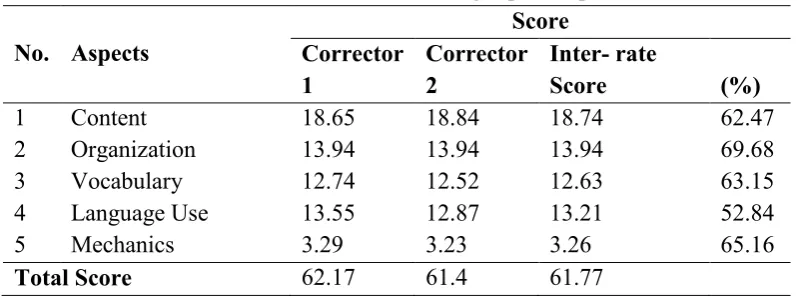
Table 1. Mean score of each writing aspect in pre- test No. Aspects
Score Corrector
1
Corrector 2
Inter- rate
Score (%)
1 Content 18.65 18.84 18.74 62.47
2 Organization 13.94 13.94 13.94 69.68
3 Vocabulary 12.74 12.52 12.63 63.15
4 Language Use 13.55 12.87 13.21 52.84
5 Mechanics 3.29 3.23 3.26 65.16
Total Score 62.17 61.4 61.77
Based on table 1, the students’ mean score for each aspect of writing was: 18.65 for content, 13.94 for organization, 12.74 for vocabulary, 13.55 for language use, and 3.29 for mechanics. The total score for each aspect was 61.77. This score came from two correctors that was look for it’s inter- rate score. From the result of the pre- test score, it could be seen that the students’ writing score (61.77) was lower than the KKM (68.0). So, it can be identified that writing skill of the eight grade students in SMP Negeri 1 Sidoharjo Sragen was low. They had little motivation and interest in English lesson. It should be improved by implementing the teaching learning process by using some media that can overcome the problems. In implementing the teaching learning process, the researcher used cartoon films to improve students’ skill in writing narrative texts. The target of this research was the improvement of students’ writing skill which concerns more in the vocabularies, the mechanics of writing, the grammatical system, organize the idea well, and develops the main idea into coherent text.
The result of the research showed that there were some improvements. The findings of the results showed (1) the improvement of students’ skill in writing narrative texts by using carton films, and (2) the effectiveness of the teaching learning process when cartoon films are used in teaching narrative texts.
The improvement of students’ skill in writing narrative texts by using cartoon films can be seen by doing more practices in writing using cartoon films, the students’ writing skill has improved. The students’ had an abundance of vocabulary and they used appropriate vocabulary in their writing. They could write a story with more detailed information based on the cartoon film and used correct capitalization and spelling; they produced longer paragraph with sufficient supporting details. The students could get the ideas and inspirations to write a narrative text after they had watched a cartoon film. The cartoon films give them a stimulus so that they could have something to write in their paper.
onto a paper in order to make a well-structured writing. It can be concluded that the students could produce writing in well-organized texts consist of orientation, complication, and resolution. They start their writing with opening sentences in various ways in the beginning of the story, such as; “One upon a time, there was a son called Malin Kundang.”; “A long time ago, there lived a fisherman. His named Sahala.”, etc. Cartoon films could guide the students to write the story in a good order because they present the systematically story line from the beginning, middle, and ending. The cartoon films contain simple story so that they can be easily understood by the Junior High School students. By watching the cartoon films which contain simple stories, the students can easily write a story until the end.
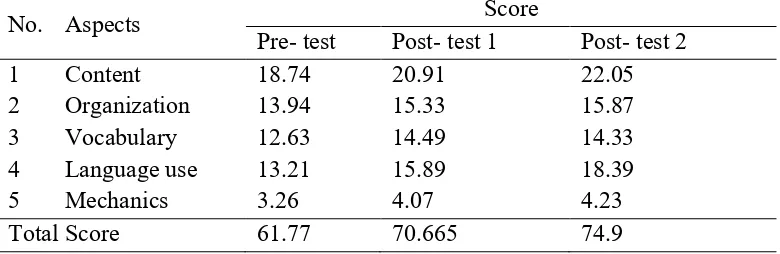
Besides, the students could apply the appropriate tense in their writing. In this action researcher gave enough opportunity to write, the teaching learning focused more on writing skill. Through this action, the students could have more practices in writing narrative texts using cartoon films. They could create a better writing than before including in constructing the past sentences by using simple past tense. The students could also change the verb1 into verb2 in correct forms. It could be seen in the students’ worksheets in which the mistakes were fewer than before. The results of the test also support the positive improvements. This table consist of the improvement the students’ achievement for each aspect.
Table 2. The Students’ Mean Score in Cycle 2
No. Aspects
Score
Corrector 1 Corrector 2 Inter- rate
Score (%)
1 Content 23.55 20.55 22.05 73.50
2 Organization 15.9 15.84 15.87 79.35
3 Vocabulary 14.52 14.13 14.33 71.63
4 Language use 19.9 16.87 18.39 73.54
5 Mechanics 4.29 4.16 4.23 84.50
Total Score 78.16 71.55 74.9
Table 3. The Improvements of the Students’ Achievement
No. Aspects Score
Pre- test Post- test 1 Post- test 2
1 Content 18.74 20.91 22.05
2 Organization 13.94 15.33 15.87
3 Vocabulary 12.63 14.49 14.33
4 Language use 13.21 15.89 18.39
5 Mechanics 3.26 4.07 4.23
Total Score 61.77 70.665 74.9
There are some effectiveness of the teaching learning process when cartoon films are used in teaching narrative texts. The
especially the students at the back. They did some other activities when starting their writing such as talking with other students; operate their phone cell to send a message.
The effectiveness of the teaching learning process of writing skill after the action research by using cartoon films showed that the students were motivated and confident when they were asked to write individually by watching the cartoon films first. They did their writing without being because the cartoon films could help them by presenting certain topic which can be written down. Some students discussed actively about the cartoon film in their own group after they watched the cartoon film.
Cartoon films also made the lesson more clarity. Cartoon films could be used to establish a positive ability of the students because its’ retain information in the long- term memory than when the information was only read. The students would be easier to write the story of the cartoon films on a paper because they still remembered what they saw and what they heard while the teacher played the cartoon films.
The use of discussion in small groups activities provide opportunity for students to clarify their understanding of the materials’ content to be learned in classroom. The discussion in small groups made students active to present their own opinion in their group and also in other groups. The class situation became lively with their discussion when they were doing their assignment. It indicated that the teaching and learning process by using cartoon films effective to improve students’ skill in writing narrative texts. In other words, the students’ attitude towards writing during teaching learning
process using carton films in the class was improved.
CONCLUSION
Based on the discussion above, the findings of the results show the positive improvements in students’ writing skill. The findings are as follows: (1) The Improvement of Students’ Skill in Writing Narrative Texts by Using Cartoon Films. The improvement in students’ writing skill, such as; the students’ had an abundance of vocabulary and used appropriate vocabulary in their writing; the students could write a story with more detailed information and used correct capitalization and spelling; the students could make longer paragraph with sufficient supporting details; the students could organize their story better from the beginning, middle, and ending; the students could finish their story until the end on time; the students could make some opening sentences in various ways better; the students could make past sentences better and were more careful in constructing past sentences; the students could change the verb1 into verb2 in correct forms and were able to use appropriate vocabulary better. In short, the students could write a narrative text well.
the students’ mean score was 70.66 and in the post- test 2, the students’ mean score was 74.90. (2) The Effectiveness of The Teaching Learning Process When Cartoon Films are Used in Teaching Narrative Texts. There is some effectiveness in teaching learning process using cartoon films. By using the cartoon films in the writing class, the students were more motivated in classroom. The students were more confident when they were asked to write the story of narrative texts individually. Cartoon films present attractive moving pictures and sounds so that they got feeling of relax before they write their story. They paid much attention when the cartoon films were played. The students always interest in the cartoon films while the researcher played the cartoon films.
Cartoon films also made the lesson more clarity. Cartoon films could be used to establish a positive ability of the students because its’ retain information in the long- term memory than when the information was only read. The students would be easier to write the story of the cartoon films on a paper because they still remembered what they saw and what they heard while the teacher played the cartoon films.
The use of discussion in small groups activities provide opportunity for students to clarify their understanding of the materials’ content to be learned in classroom. The discussion in small groups made students active to present their own opinion in their group and also in other groups. The class situation became lively with their discussion when they were doing their assignment. It indicated that the teaching and learning process by using cartoon films effective to improve students’ skill in writing narrative texts. In other words, the students’ attitude towards writing during teaching learning process using carton films in the class was improved.
BIBLIOGRAPHY
Allen, Robert C and Gomery, Doughlas. 1985. Film History and Practice. New York City: Mc. Graw- Hill Inc.
Bordwell and Thompson. 1997. Film Art: an Introduction Volume 3. Mcgraw- Hill Company Inc.
Brown, H.D. 2001. Teaching by Principle: An Interactive Approach to Language Pedagogy 2nd Ed. NewYork: Addison Wesley Longman, Inc.
Canning-Wilson, C. (2000). Practical Aspects of Using Video in the Foreign Language Classroom. The Internet TESL Journal, Vol. VI, No. 11.
Retrieved from
http://iteslj.org/Articles/Canning-video.html.
Celce- Mercia, M., and Olstain, E. 2001. Discorse and Context in language teaching. A guide for language teacher. Cambridge: Cambridge University Press.
Furchan, Arief. 2007. Pengantar Penelitian dalam Pendidikan. Surabaya: Usaha Nasional.
Kemp, Jarrold E. 1963. Planning and Producing Audiovisual Materials. California: Chandler Publising Company.
Maley, Alan. 1998. Writing. New York: Oxford University Press
Peter, May. 1996. Exam Classes. New York: Oxford University Press.
Wittich, Walter Arno and Schuller, Charles Francais. 1953. Audiovisual Materials: their nature and use. New York: Harper and Brothers Company. Poulson. 2006. Cartoon: Its Characteristic
and Benefits. Retrieved from:
http://www.cwrl.utexas.edu/tnelson/30 9k502/dictionary/poulson/
Katchen. 1999. Cartoon Fims for Teaching and Learning Process. Retrieved from: