NITROGEN, WATER AND BENZENE ADSORPTION IN MESOPOROUS CARBON (CMK-1)
AND COMMERCIAL ACTIVATED CARBON (NORIT SX22)
Paulina Taba
Department of Chemistry, Hasanuddin University, Jl. Perintis Kemerdekaan Km 10 Tamalanrea, Makassar, South Sulawesi, Indonesia 90245
Received July 31, 2009; Accepted November 3, 2009
ABSTRACT
Adsorption at various interfaces has attracted the attention of many scientists. This article discusses gas-solid and vapour-solid adsorption in CMK-1 and Norit SX22 using nitrogen, water and benzene as adsorbates. For comparison, MCM-48 used as template in synthesizing CMK-1 was also utilized as adsorbent. Results showed that the shape of nitrogen isotherm for CMK-1 is categorized as Type IV shape, whereas activated carbon (Norit SX2) has Type I shape with a hysteresis loop at P/P0 > 0.5, which is a H4 type of hysteresis. The shape of nitrogen
isotherm for MCM-48 is categorized as Type IV shape with small hysteresis loop observed at P/P0 above 0.45,
indicating that the larger pores are filled at high P/P0, which is typical of an H3 hysteresis loop The amount of nitrogen adsorbed in activated carbon at the high relative pressure is considerably smaller than that in CMK-1. The hydrophobicity feature of CMK-1 is the same as activated carbon (Norit SX2), but slightly different to the template MCM-48. The affinity of CMK-1 to benzene is considerably higher than activated carbon, suggesting the promising future of CMK-1 to be used as a selective adsorbent for the removal of organic compounds from water environment.
Keywords: Adsorption, water, benzene, CMK-1, activated carbon
INTRODUCTION
Carbon materials are technically important since they are widely used as adsorbents in the separation and purification processes. The pore size of these materials can be micro, meso or macro. Microporous carbons have been used for the adsorption of small gas molecules. However, when adsorbates are giant molecules, for instance polymers, dyes, or vitamins, adsorbents with larger pore sizes, such as mesoporous carbons are needed.
Mesoporous carbons have remarkable properties, for instance high specific surface area, large pore volumes, chemical inertness and good mechanical stability. Therefore, these materials have been used for many applications, such as adsorption, chromatographic separation, electrochemical double-layer capacitors, catalytic supports and electrode materials for batteries and cells.
Many methods for synthesizing mesoporous carbons have been reported. One method is a template carbonization consisting of impregnation of a carbon precursor into the template, carbonization of an organic compound and dissolution of the template [1]. There were various types of mesoporous carbons that have been synthesized using this method. Knox et al. [2] synthesized carbon material, called "porous glassy carbon" (PGC) by impregnating a silica gel template with a mixture of phenol and hexamine, polymerising this
mixture within the pore of silica gel, carbonization the polymer under nitrogen gas and dissolving out the silica template. Kyotani and co-workers [3-5] prepared ultra thin graphite film by means of this method. The authors used polyacrilonitrile, polyfurfuryl alchohol, polyvinyl acetate or propylene as a carbon source. Carbonization of organic compounds was performed in the two dimensional opening between the lamellae of layered clay, such as montmorillonite and taeniolite, the one dimensional template, anodic aluminium oxide film. Kyotani et al. [6] also made use of Y Zeolite, having three-dimensional framework, as a template for preparing mesoporous carbon with high surface area. To dissolve the template, HF and HCl solutions were utilized. The template carbonization method has also been applied by Bandosz et al [7] using furfuryl alcohol as a carbon precursor. The template was lithium form of taeniolite, intercalated with hydroxyaluminium and hydroxy aluminium-zirconium cations. Kamegawa and Yoshida [8] prepared swelling porous carbon beads using silica gel beads by means of two methods; ester and Chemical Vapour Deposition (CVD) methods. For the ester method, the carbon source was 1-tetradecanol or phenols, and benzene was used for the CVD method. The use of ordered mesoporous silica as
the template was reported by Ryoo et al[9]. The cubic
mesoporous carbon called CMK-1 was firstly synthesized by these researchers using the cubic
(Ia3d) mesoporous silica (MCM-48) as the template
* Corresponding author.
Email address : [email protected]
Paulina Taba
and sucrose as the carbon precursor. A catalyst, sulfuric acid, was utilized in the conversion of sucrose to carbon at high temperature. The silica framework was then dissolved by aqueous solution containing NaOH and ethanol.
Adsorption isotherms are commonly used to characterize mesoporous materials; especially, for evaluation of the specific surface area, pore size distribution [9-11], and hydrophobicity features. The discovery of ordered mesoporous materials increased significantly the importance of gas adsorption in material science in the past decade [12]. These materials have been successfully used for verification and/or improvement of the existing characterization methods as
well as to develop new ones [12-15]. The nitrogen
adsorption isoterm is commonly used for measuring the specific surface area and pore size distribution. Water vapour was used to study the hydrophobicity features of mesoporous materials. Benzene is a nonpolar aromatic adsorbate, which has some advantages as an alternative adsorbate to nitrogen. One advantage is that benzene can condense at a lower relative pressure therefore larger pores can be readily characterized by benzene adsorption [16].
In this study, CMK-1 was used as an adsorbent for nitrogen, water and benzene in the form of gas-solid and vapour-solid interactions. For comparison, the adsorption properties of activated carbon (Norit SX2) and MCM-48, a template for synthesizing CMK-1 were also discussed.
EXPERIMENTAL SECTION
Material
Materials used in this research are: MCM-48,
sucrose (Univar), sulphuric acid (H2SO4, Merck), NaOH
(Merck), ethanol (Merck), benzene Merck).
Instruments
Several instruments were used in this research. An oven and a set of reflux apparatus were utilized for synthesizing CMK-1 and removing the silica framework, respectively, X-ray diffraction (XRD) was used to monitor the structure order of CMK-1 and MCM-48 as well as to determine the hydrothermal stability of CMK-1. XRD patterns were measured in a Siemens D500
diffractometer using CuKα (λ = 1.5412 Å) as a radiation
source. The diffractometer was interfaced to a PC computer and the operating software used was Sietronic SIE 122D. Nitrogen adsorption was conducted in a Micromeritics AccuSorb model 2100D to obtain the adsorption isotherm and the surface area of samples. A microbalance connected to a vacuum line was used to
monitor the amount of water and benzene vapour adsorbed.
Procedure
Synthesis of CMK-1
The synthesis method of CMK-1 followed the procedure of Ryoo et al. [17] with some modification: one gram of dehydrated MCM-48, detail synthesized in otherwise [18-19], was mixed with an aqueous solution prepared from 1.25 g of sucrose (Univar), 0.07 g of
sulphuric acid, H2SO4 (Merck) and 3.0 g of H2O in a
Petri dish. The mixture was put in the oven at 373 K for 1 h and the temperature was subsequently increased to 433 K and maintained at that temperature for 30 min. The sucrose was partially decomposed by this treatment. After being heating at 433 K, the product was mixed again with aqueous solution containing
0.75 g of sucrose, 0.02 g of H2SO4 and 2.8 g of water.
The mixture was then dried in the oven with the same condition as before. After heating in the oven, the powder was heated in a quartz tube at 1173 K under flowing nitrogen gas for 3 h. The product, carbon-silica composite, was washed with 2.5 wt % of NaOH solution dissolved in 50 v/v % aqueous ethanol solution in order to remove the silica framework. 1 g of the carbon-silica composite was mixed with 60 mL of the NaOH solution and refluxed for 1.5 h at the boiling point of the solution. After that, the mixture was filtered and the refluxing procedure was repeated. The product of mesoporous carbon was then filtered, washed with 1:1 water-ethanol until the pH of the filtrate was 7 and dried.
X-Ray Diffraction
Samples were put into an aluminium holder of the XRD apparatus and the diffraction data were collected using a continuous scan mode with a scan rate of 1
degree 2-theta/min and a step size of 0.02 degree
2-theta. The slits used were 0.3° divergence slits and 0.05° receiving slit. A current setting of 30 mA and a accelerating voltage of 40 kV were used to scan a range from 0.8 to 10 degree 2-theta. The Sietronic XRD Trace software was used to process the data. The
d spacing of meso/micro porous materials was
calculated using Bragg’s equation, nλ = 2d sinθ.
Nitrogen Adsorption
Paulina Taba
observed. The process was repeated several times at increasing nitrogen pressure until the isotherm adsorption was obtained. The dead spaces of the sample flask were determined using helium gas.
Water and Benzene Adsorption
Experiments were performed in a vacuum line where the vapour of water and benzene was allowed to be in contact with the materials. Before measurement, samples were pressed at 5 kPa to obtain very thin pellets. The pellets were placed into the small quartz boat of the microbalance, which was connected to the computer for monitoring the weight changes. Samples were evacuated at 573 K and then cooled to room temperature. In addition, vapour of water or benzene was allowed to be adsorbed on the dehydrated material at different pressure and the weight gain along with the vapour pressure at equilibrium state was measured.
RESULT AND DISCUSSION
XRD Patterns
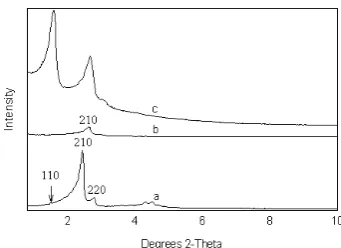
XRD patterns of mesoporous carbon and its silica template are illustrated in Figure 1. The XRD pattern results are in agreement with those reported in previous work [17]. It can be seen that there is a systematic transformation of structure during the removal of silica framework of MCM-48 after carbonization of sucrose impregnated in the pores of MCM-48. The XRD patterns of MCM-48 after complete carbonization within the pores is similar to that of MCM-48 except for slight changes associated with lattice contraction and intensity loss. According to Ryoo et al. [17], the lattice contraction was usually resulted from high temperature heating of MCM-48 even without sucrose, whereas the pore filling with carbon can cause the intensity loss. The later evidence shows that both enantiomeric channel systems, separated by the silica walls corresponding to periodic G-surface (gyroid surface), are statistically equally filled
with carbon, maintaining the cubic Ia3d space group with
inversion centers on the original G-surface. When the silica walls were removed, producing sample CMK-1, a new peak corresponding to the position of the (110)
reflection for Ia3d appears. The (110) reflection is
symmetry forbidden for Ia3d. This result shows that
there is a systematic transformation to a new ordered structure when silica walls were removed to allow the observation of the (110) reflection. One possibility for the
new structure observed is cubic I4132 [17]. Other
information that can be observed in the XRD pattern of CMK-1 is that there are no Bragg lines observed in the region 2-Theta where is greater than 10°, showing that the carbon framework was atomically disordered. For comparison, XRD pattern of activated carbon (Norit SX
Figure 1. The changes in XRD patterns during
synthesis of mesoporous carbon from silica template, MCM-48; (a) MCM-48, (b) MCM-48 after completing carbonization within pores and (c) mesoporous carbon (CMK-1) obtained by removing silica wall after carbonization
Figure 2. Adsorption isotherms of (a) CMK-1 and (b)
activated carbon (Norit SX 2), and (c) MCM-48
2) was also measured. There were no Bragg lines observed in the XRD pattern, showing that this material is amorphous.
Figure 1 illustrates the XRD patterns of CMK-1 after being heated at different temperatures in air for 4 h. It can be seen that CMK-1 is still stable after heating at 573 K, but the order of this material is less after heating at 623 K as shown in the decreasing intensity of the two Bragg lines.
Adsorption of Nitrogen in Materials
The nitrogen adsorption isotherms of mesoporous carbon, activated carbon and MCM-48 are presented in Figure 2. The shape of isotherm for CMK-1 is of Type IV, whereas activated carbon (Norit SX2) has Type I
shape with a hysteresis loop at P/P0 > 0.5, which is a
H4 type of hysteresis [18]. The shape of isotherm of MCM-48 is of Type IV as reported by other
researchers. No hysteresis is observed at P/P0 below
0.4, but a small hysteresis loop is observed at P/P0
above 0.45. This indicates that the larger pores are
filled at high P/P0, which is typical of an H3 hysteresis
Paulina Taba
Figure 3. Size distribution of CMK-1 and activated
carbon (Norit SX2) Figure 4.activated carbon (Norit SX 2) Water adsorption isotherm on CMK-1 and
Table 1. Pore structure parameters of CMK-1, activated carbon (Norit SX2) and MCM-48
Samples SBET
(m2/g) (mS2ex /g) (cmV3p/g) (cmV3t /g) wBJH 1)
(nm) Wall thickness, 2) nm
CMK-1 1864.1 ± 16.8 167.64 0.96 1.29 2.95 1.24
Activated
carbon 1103.6 ± 15.8 N/A N/A N/A N/A N/A
MCM-48 1230.7 ± 1.5 183.34 0.94 1.29 3.05 0.99
1) estimated from the BJH pore size distribution (adsorption branches) with the corrected form of the Kelvin equation for capillary condensation in cylindrical pores
2) estimated using an equation proposed by Ravikovitch and Neimark; b (wall thickness) =[1-{Vpρ/(1+ Vpρ)}](ao/xo) where ao is the unit cell size taken from XRD experiment and xo is a constant, i.e. 3.0919
Uncertainty in Vt = 0.05 nm
carbon at the high relative pressure is considerably smaller than that in CMK-1. The pore size distribution of both samples is presented in Figure 3 and their pore structural parameters are tabulated in Table 1. From Figure 4, it is obvious that activated carbon has broad pore size distribution. In the range of the pore diameter from 3.5 to 2.37, the curve tends to go upward with the smaller pore diameter, demonstrating the existence of samples with smaller pores. The BET surface area of CMK-1 is higher than that of activated carbon (Norit SX2). By comparing data of the pore structural properties of CMK-1 to the template MCM-48, it can be noted that the BET surface area of CMK-1 is 1.5 times higher than the template MCM-48. This large surface area of CMK-1 can be overestimated, which has been observed in previous studies [21-22] by using the BET method.
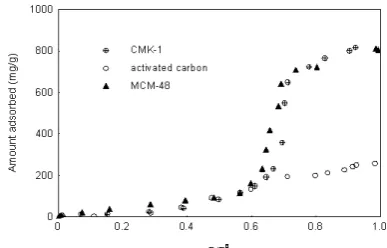
Figure 5. Benzene adsorption isotherm on CMK-1,
activated carbon (Norit SX 2) and MCM-48
features. The hydrophobicity of both materials is similar since the amount of water adsorbed at the low relative pressure is similar. The inflection point of CMK-1 is similar to that of the template MCM-48, which gives similar pore diameter. The amount of water adsorbed
at low P/P0 in CMK-1 is slightly lower than that in the
template MCM-48, indicating the former is slightly more hydrophobic than the latter. An explanation for this observation is that MCM-48 contains silanol groups which can interact with water molecules through hydrogen bonding. The silanol groups do not found in CMK-1 and activated carbon.
Adsorption of Water Vapour in Materials
Figure 4 illustrates the water adsorption isotherm of CMK-1 together with the isotherm of activated carbon and MCM-48. The isotherm of CMK-1 is of Type V, whereas activated carbon shows the Type III isotherm
without any pore filling. At the low P/P0 both CMK-1 and
Paulina Taba
Adsorption of Benzene Vapour in Materials
Benzene adsorption isotherms of CMK-1 and activated carbon are shown in Figure 5. The isotherm shape of CMK-1 is of Type IV, whereas activated carbon has a Type I isotherm. The amount of benzene adsorbed in CMK-1 is considerably higher than that in activated carbon, indicating that CMK-1 has a higher affinity to benzene than activated carbon. From Figure 5, it can be concluded that the adsorption capacities of benzene on the adsorbents at the low relative pressure follows the sequence of CMK-1 > activated carbon > MCM-48. At higher relative pressure, the sequence changes to CMK-1 > MCM-48 > activated carbon.
CONCLUSION
From the results above, it can be concluded that the hydrophobicity feature of CMK-1 is the same as activated carbon (Norit SX 2) but slightly different to the template MCM-48. The affinity of CMK-1 to benzene is considerably higher than that of activated carbon, suggesting the promising future of CMK-1 to be used as a selective adsorbent for the removal of organic compounds from water environment.
ACKNOWLEDGEMENT
This investigation was funded by AUSAID provided to carry out the research work in the University of New South Wales, Australia. Special thanks are given to Prof. Russell Howe and Ass. Prof. Grainne Moran for his guidance during this work.
REFERENCES
1. Ryoo, R., Joo, S.H., Kruk, M., and Jaroniec, M.,
2001, Adv. Mater. 13, 677-681.
2. Knox, J.H. and Kaur, B., 1986, J. Chromatogr,. 352,
3-25.
3. Kyotani, T., Sonobe, N., and Tomita, A., 1988, Nature,331, 331-333.
4. Sonobe, N., Kyotani, T., and Tomita, A., 1991, Carbon,29, 61-67.
5. Kyotani, T. Mori, T., and Tomita, A., 1994, Chem.
Mater., 6, 2138-2142.
6. Kyotani, T., Nagai, T., Inoue, S., and Tomita, A.,
1997, Chem. Mater., 9, 609-615.
7. Bandosz, T.J., Jagiello, J., Putyera, K., and
Schwarz, J.A., 1996, Chem. Mater., 8, 2023-2029.
8. Kamegawa, K. And Yoshida, H., 1997, Carbon, 35,
631-639.
9. Gauden, P.A., Terzyk, A.P., Rychlicki, G.,
Cwiertnia, M.S., and Garbacz, J.K., 2004, J. Colloid
Interf. Sci., 273, 39-63.
10. Dombrowski, R.J., Hyduke, D.R., and Lastoskie,
C.M., 2000, Langmuir, 16, 5041-5050.
11. Davies, G.M., Seaton, N.A., and Vassiliadis, V.S.,
1999, Langmuir, 15, 8235-8237.
12. Kruk, M. and Jaroniec, M., 2001, Chem. Mater., 13,
3169-3183.
13. Ravikovitch, P.I. and Neimark, A.V., 2002,
Langmuir, 18, 1550-1560.
14. Jaroniec, M. and Solovyov, L.A., 2006, Langmuir,
22, 6757-6760.
15. Kruk, M. and Jaroniec, M., 2002, J. Phys. Chem. B,
106, 4732-4739.
16. Nguyen, C., Sonwane, C.G., Bhatia, S.K.D., and
Do, D., 1998, Langmuir, 14, 4950-4960.
17. Ryoo, R., Joo, S.H., and Jun, S., 1999, J. Phys.
Chem. B,103, 7743-7746.
18. Ryoo, R., Joo, S.H. and Kim, J.M., 1999, J. Phys.
Chem. B, 103. 7435-7440.
19. Taba, P., 2008, Makara Seri Sains, 12, 2, 120-125.
20. Gregg, S.J. and Sing, K.S.W., 1982, Adsorption,
Surface Area and Porosity 2nd Ed,, Academic
Press, London,
21. Kruk, M., Jaroniec, M., and Gadkaree, K.P., 1999, Langmuir,15, 1442-1448.
22. Kruk, M., Jaroniec, M., Ryoo, R., and Joo, S.H.,