1
THE ACCULTURATION BETWEEN BALINESE AND
CHINESE ARCHITECTURAL
(Case Study at Pemedal Agung/Main Gate of The Semara Pura Royal Castle, Klungkung – Bali)
Balinese traditional architecture can be divided into some periods fallowing the history the region. It begins from pre-history period, the coming of Mpu Kuturan period by the year 1001, the attending of the other nations and up to now, the developed Balinese traditional architecture.
But one of it that need to be dated is the influence of Chinese architecture. Some buildings in Balinese traditional architecture show the Chinese style, especially on its ornament called
Patra Cina. The Chinese pattern generally dominates the building facade and it seldom
interferes the Balinese traditional architecture philosophy. Because on the Balinese traditional architecture, there are some regulations based on Hindu religion. It means that the form and symbols (as an ornament) have a special meaning and ethic, because according to Gelebet (1982), every architecture from the other nation that has a frictions with Balinese architecture, it will be adjusted by the ethic of Balinese architecture philosophy.
On the case of Pemedal Agung, the main gate of the Semara Pura royal castle, we will find that the Chinese’s influence architectural has a special acculturation, because the ornaments that available on the building facade are unique and quite different with the coast. Formerly the Chinese’s community who continued Cheng Hoo’s expedition came to Indonesia by trading only, but for a long time they tried to stay in Indonesia
Some of their descendants came to Bali with the similar mission and their social-cultural too. Some inheritances of Chinese social-social-cultural that left at Bali are divided into two types, a such as : a) non architectural : the story of Sampik Eng Tai, Chinese coins, and Chinese plates and bowls, b) architectural : The Balingkang temple of Warmadewa dynasty, the ornament of Chinese pattern and some sacred buildings are decorated by Chinese plates and bowls.
2
of the main gate, because there was a serious problem with the gate. The king ordered them to restore the it. Finally the gate was repaired perfectly till we can see up to now as a heritage of Balinese .traditional architectural. The two men was given an architectural
b) what is the variant cause factor to explain the acculturation ?
II. DISCUSSION.
2.1. The Main Gate Under Construction of Semara Pura Royal Castle.
The gate was built when The Semara Pura kingdom was governed by the King of Dewa Agung Jambe in XVII century. The story began when the Gelgel kingdom (Sueca Pura Castle) was demolished of the betrayal war. The commander in chief (I Gusti Agung Maruti) carried out of coup d’etat and conquered the kingdom. The two youth princes were escaped by the loyal servant to Sidemen village. From this place, One of the youth prince built a powerful troops with his partner to get his right back. On the heroic battle, Sueca Pura kingdom could be caught and finally the betrayer could be terminated.
After succeeding in his effort, The older youth prince is inaugurated as a new king named Ida Dewa Agung Jambe, unfortunately The new king (Dewa Agung Jambe) seemed to be unhappy of Sueca Pura kingdom, because of his felling that the kingdom had ever been under command of I Gusti Agung Maruti. (In Balinese terminology is called ketiben
durmenggala), so the king wanted to move his old king to a new one at Klungkung regency
called Semara Pura kingdom (Warna, 1989).
Some buildings that mentioning secondly have disappeared because of the Dutch attack on the biggest Klungkung battle known as Puputan Klungkung.
The interesting building constructed at the castle is the main gate or Pemedel Agung,
because it had a special history of its under construction.
The construction began when the King asked two brothers i.e. I Ungu and I Kidal for developing the main gate or the Pemedal Agung. The brother was the grandchildren of the
Sueca Pura kingdom architect at Gelgel. They had a unique relationship on his brotherhood
that they were not talking each other. So in under construction of the Pemdal Agung, I Kidal started form the south side and I Ungu from the north side. Since The foundation was constructed until finished, there was not any communication both of them. They were busy on their work and responsibility. The consequence was the main gate had an aslant of some degrees northward. The main gate position was not desperately right angle
3
merchants to met the king regarding the way out to set up the solution. Before They started giving the solution, they had an appointment to the King, if they succeeded in their effort, they asked only for some permissions from the King to put their Chinese architectural symbolic on Pemedal Agung façade.
By their suggestion, the two brother filled adequately the southern foundation with tin. The adding of tin as a foundation material was ever founded by some Japanese soldiers that they ordered the youths Balinese cultivating the empty land around the main gate with castor-oil plants. (Sidemen, 2004). When digging, their hatchet hit a hard material, and after analyzing it is a lot of tin. Because of this tin, the askew of Pemedal Agung was getting up right. Finally, the main gate does not leans anymore that we can see up to now.
2.2. The Acculturation of Balinese and Chinese Architectural.
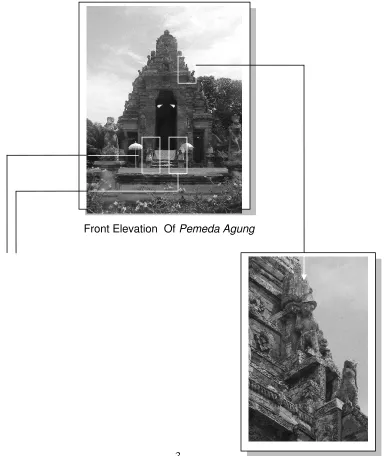
After solving the askew problem of the main gate, the two brother was released from their punishment and was given the best reward, meanwhile the two Chinese merchants was allowed to put four Chinese statues in front of main gate and some at upper part. ( Figure 2)
4
Four statues at front of the Pemedal Agung and at upper part
Figura 2. Chinese Statues Change The Balinese Symbolic Statues. Resource : Fieldwork observation (2004)
According to the Balinese architectural philosophy, any kind of the Balinese gate such as Kori Agung, Pemedal Agung and Candi Bentar are completed by two symbolic statues of Asura called Dwarapala in front of each gate. The Asura means the demigod of heaven gate guard. They have a duty to keep watch over anyone who wants to enter the inner level of the heaven. This symbolic is adopted and transformed on the Balinese traditional architectural. The logical reason is because the Balinese traditional gates have a similar meaning of the heaven gate.
For Instance, in a Pura or Hindu temple, anyone who wants to pray, when they are at Jaba
Tengah (lower level) they have to prepare and maintain their good attitude to enter Jaroan
(inner level) through the gate with the couple of Dwarapala. As the temple guard,
Dwarapala keeps the temple holiness and remains the prayer in other to be polite and in a
proper clothes. Analogically, anyone who wants to enter the castle of Semara Pura
kingdom, when He is at Jaba Sisi area, he has to change his mind and manner if he wants to meet the king. And the architectural symbolic that can remain him of the atmosphere above is the Dwarapala statue.
In the contex within the symbolic of Dwarapala statues above, at the fieldwork we find that there a specific phenomenon where the four Chinese statues change the Balinese architectural symbolic, that is the position and the role of dwarapala as the gate guard.
2.3. The Relationship between the Ethic and Symbolic on Balinese Architectural
5
also stated by the expert, such as Robi Sularto (1993) says that : ……” seni yang lahir dari ungkapan syukur, sungguh sangat kreatif dan mampu menggugah segala hal yang baru dan berkembang dalam kehidupan mereka tanpa kehilangan jati diri dan harga diri. Masing-masing desa menampilkan gaya serta ungkapan jati diri, pengaruh-pengaruh luar dikunyah
dengan melumatnya (lihat patra Cina, patra Walanda dan patra Mesir)……….”
(the art that was born from the grateful expression , it is a very creative and can realize everything that is new and developing in their lifestyle without losing their identity and pride. Each village shows its style and pride expression, the outside influences are chewed by pulverizing it ( see patra Cina, patra Walanda and patra Mesir).
In the case of Pemedal Agung, It seems that the influence of Chinese architectural replace the principals and symbolic of Balinese architectural. Because :
1. the Chinese statue at upper part of Pemedal Agung is not suitable according to the Ethic on Balinese traditional architectural. The only ornament that fitted properly to this part is a bird (or something can fly related to the philosophy of Hindu religion, such as the
Garuda as the vehicle of Sri Wisnu).
2. four Chinese statue in front of main gate change the role Dwarapala as the gate guard on Balinese traditional architectural. Dwarapala has a function to remain Balinese people to set up their attitude and manner when they want to enter the inner level. So the question, what is the role of four Chinese statue or Is the role of four Chinese stature as same as the Dwarapala ?. According to Tresnasih (1998), if we take a look at one of the four Chinese which is carrying a big-blade sword, He is a war demigod. I thing that the role both of them (The four Chinese statue and Dwarapala) are not same. The fact is someone who wants to enter the gate is not in war situation. Perhaps He wants to meet the King or something else.
In context within the era of Balinese kingdoms, the was a special terminology that we called “kultus desa-raja”. It means that the king was the descendant of god. Everything he said that was the law or order. Regarding the Pemedal Agung, the king owed to two Chinese merchants of repairing its askew. Because of them, the king was avoided of embarrassing situation. Then the King kept his promise to allow them putting four Chinese statue. Anyway, the Chinese merchants was a brilliant men because they put the statue at a strategic place that is at front of Pemedal Agung. So anybody can see it clearly. Anyhow, The king had decided it and his decision was the law. And as a “descendent” of god, it was no problem weather his policy to change the symbolic of Dwarapala to Chinese war statue was right or wrong, but the fact, the society consider that the king’s policy above was also a principal of Balinese traditional architectural.
III. CONCLUSION
From the discussion mentioned above, we can decide some conclusions as pointing below :
1. the part of Balinese architectural changed by Chinese architectural is the guard of the main gate or Dwarapala to four Chinese war-god statue. Both of the place and the role with its philosophy were moved.
6
REFERENCE :
Istanto, H. Freddy, 2003, Semangat Admiral Cheng Hood dan Ekspresi Toleransi Masjid
Muhammad Cheng Hoo Indonesia, Jurnal Dimensi Teknik Arsitektur Volume 31 No.
1 Juli 2003. LPM Univ. Kristen Petra Surabaya.
Tresnasih, I Gusti Ayu, 1998, Ikonograsi Arca-Arca Cina pada Masa Balingkang (Dinasti Warmadewa), Skripsi Jurusan Arkeologi Fakultas Sastra Universitas Udayana, Denpasar.
Ida Bagus Rai Pidada, 1990, Babad Dalem (manuskrip), edisi terjemahan, Gria Pidada, Klungkung.
Sidemen, Ida Bagus, dkk, 2001, Sejarah Klungkung,Dari Semarapura sampai Puputan,
Pemerintah Kabupaten Klungkung,
Gelebet, I Nyoman, 1982, Arsitektur Tradisional Daerah Bali, Depertemen Pendidikan dan Kebudayaan, Denpasar.