Conveners A. Uthairatanakij, F.C. Chen
CURRENT STATUS OF ORCHID PRODUCTION IN THAILAND (K. Thammasiri)
ORCHID BREEDING PROGRAMME IN MARDI (Z. Rozlaily, W.E. Wan Rozita, M.N. Farah Zaidat, M.S. Nor Hazlina)
SEED MORPHOMETRY IN COELOGYN LINDL., CYMBIDIUM SW. AND PHOLIDOTA LINDL. (ORCHIDACEAE) WITH SPECIAL REFERENCE TO THEIR INTERRELATIONSHIPS AND ECOLOGICA L SIGNIFICANCE (S.M. Khasim, J. Ramudu, S. Sakunthala)
DETERMINING ACCURATE HARVESTING TIMES OF COELOGYNE ASPERATA LINDL. SEED CAPSULES FOR PROPAGATION USING TISSUE CULTURE TECHNIQUE (N.K.D. Lestari) CRYOPRESERVATION OF COELOGYNE DAYANUM SEEDS BY VITRIFICATION (M.H. Hakim, C.A.M. Elwon, M.N. Norzahan, R. Ripin, Z.A. Aziz)
CRYOPRESERVATION OF SECONDARY PROTOCORMS, AN ALTERNATIVE PATHWAY FOR CONSERVATION OF WESTERN AUSTRALIAN TERRESTRIAL ORCHIDS (B.M. Bustam, K.W. Dixon, E. Bunn)
IN VITRO PROPAGATION OF NATIVE ORCHID DENDROBIUM SPECTABILE (BLUME) MIQ. (N.W. Deswiniyanti)
SHORT-TERM STORAGE OF ALGINATE-ENCAPSULATED PROTOCORM-LIKE BODIES OF PHALAENOPSIS CORNU-CERVI (BREDA) BLUME & RCHB. F. (S. Rittirat, S. Klaocheed, K. Thammasiri)
LIGHT DIFFERENTIALLY REGULATES CELL DIVISION AND ENDOREDUPLICATION IN THE REGENERATION OF THE PROTOCORM-LIKE BODY OF PHALAENOPSIS 'SPRING DANCER' (A.R. Kwon, K.J. Lee, K.Y. Paek, S.Y. Park)
EFFECTS OF LEDS ON CHLOROPHYLL FLUORESCENCE AND SECONDARY METABOLITES IN PHALAENOPSIS (T. Ouzounis, X. Fretté, E. Rosenqvist, C.O. Ottosen)
INFLUENCE OF FERTILIZATION AND A HIGH DAILY LIGHT INTEGRA L ON THE GROWTH AND FLOWERING OF PHALAENOPSIS (F. van Noort, T. Dueck)
RESPONSE OF DENDROBIUM 'PLANTY FUSHIA' TO ETHYLENE AND ETHYLENE INHIBITOR (R. Mohammadpour, M. Buanong, P. Jitareerat, C. Wongs -Aree , A. Uthairatanakij)
EFFECTS OF EVAPORATIVE COOLING GREENHOUSE GROWING ON FLOWERING OF VANDA (T. Sirisawad, N. Potapohn, S. Ruamrungsri)
EFFECT OF CARBON SOURCE ON PROTOCORM-LIKE BODY INDUCTION, PROLIFERATION AND REGENERATION IN DENDROBIUM SNOWFLAKE 'RED STAR' (W. Udomdee, P.J. Wen, S.W. Chin, F.C. Chen)
FORECASTING GLOBALG.A.P. ADOPTION AMONG THAI ORCHID PRODUCERS (R.S. Lippe, U. Grote)
EFFECTS OF SUCROSE CONCENTRATIONS ON SEEDLING GROWTH OF DENDROBIUM ANTENNATUM × DENDROBIUM BIGIBBUM (K. Obsuwan, S. Tharapan , C. Thepsithar)
POLLINATION SUCCESS AMONG STANDARD HYBRIDS AND INDONESIA N SPECIES OF PHALAENOPSIS (D. Sukma, S.A. Aziz, S. Sudarsono, A. Romeida, Fatimah)
MORPHOLOGICA L CHARACTERIZATION OF PHALAENOPSIS SPP. AND HYBRIDS FROM INDONESIA (S.A. Aziz, D. Sukma, A. Romeida)
IN VITRO PROPAGATION AND ACCLIMATIZATION OF BLACK ORCHID (COELOGYNE PANDURATE LINDL.) (I.A. Astarini, V. Claudia, N.K.A.P. Adi, S.K. Sudirga, N.P.A. Astiti)
A SUITABLE MEDIUM FOR IN VITRO SEED PROPAGATION OF DENDROBIUM HYBRIDS (K. Obsuwan, S. Tharapan, C. Thepsithar)
INTRODUCTION OF CYNAC3 TO PROTOCORM-LIKE BODIES IN CYMBIDIUM MEDIATED BY AGROBACTERIUM TUMEFACIENS (K. Yamamoto, H. Miyamoto, Y. Niimi, S. Mita)
A PRELIMINARY AMPLIFIED FRAGMENT LENGTH POLYMORPHISM (AFLP) PRIMERS SELECTION FOR SPATHOGLOTTIS SPECIES (F.C. Ginibun, S. Bhassu, N. Khalid , R.Y. Othman, P. Arens , B. Vosman)
COLCHICINE TREATMENT: A METHOD FOR GENETIC DIVERSITY INDUCTION OF DORITIS PULCHERRIMA LINDL. ORCHID OF THAILAND (K. Rungruchkanont, S. Apisitwanich)
THE COMBINATION OF ALUMINIUM SULPHATE, 8-HYDROXY QUINOLONE SULPHATE AND SUCROSE REDUCED LIPID PEROXIDATION IN DENDROBIUM SONIA 'EIA SAKUL' (K. Chanjirakul, W. Pamornkol)
THE OPTIMUM CUT STAGES FOR PROLONGING DISPLAY LIFE OF CUT DENDROBIUM ORCHIDS (K. Obsuwan, K. Chanjirakul , S. Yoodee, K. Seraypheap, Y. Bune Seraypheap)
NEW USAGE OF HABENARIA RADIATA AS A CUT FLOWER (P. Sinumporn, S. Fukai, T. Narumi, N. Potapohn)
BA IMPROVES THE POSTHARVEST QUALITY OF MOKARA ORCHID FLOWERS CULTIVAR 'NORA PINK' (S. Aiamla-or, P. Jitareerat, A. Uthairatanakij, M. Buanong)
EFFECT OF ELECTROLYZED ACIDIC WATER ON REDUCING MICROBIAL CONTENT IN VASE SOLUTION OF DENDROBIUM 'KHAO SANAN' FLOWERS (P. Tonboot, P. Boonyaritthongchai, M. Buanong)
THE APPROPRIATE CONCENTRATION OF ALUMINUM SULPHATE, 8-HYDROXYQUINOLINE SULPHATE AND SUCROSE AS A VASE SOLUTION FOR REPLACEM ENT OF A COMMERCIAL VASE SOLUTION FOR CUT DENDROBIUM (K. Chanjirakul, K. Sriboran, T. Satmitr )
155
In Vitro Propagation and Acclimatization of Black Orchid (
Coelogyne
pandurata
Lindl.)
I.A. Astarini1,2, V. Claudia1, N.K.A.P. Adi1, S.K. Sudirga1 and N.P.A. Astiti1
1
Biology Department, Udayana University, Bukit Jimbaran, Bali, 80364, Indonesia
2
Alumni Reference Group member, Australia Awards, Indonesia
Keywords: embryo rescue, Knudson C, W3 media, organic media, coconut husk
Abstract
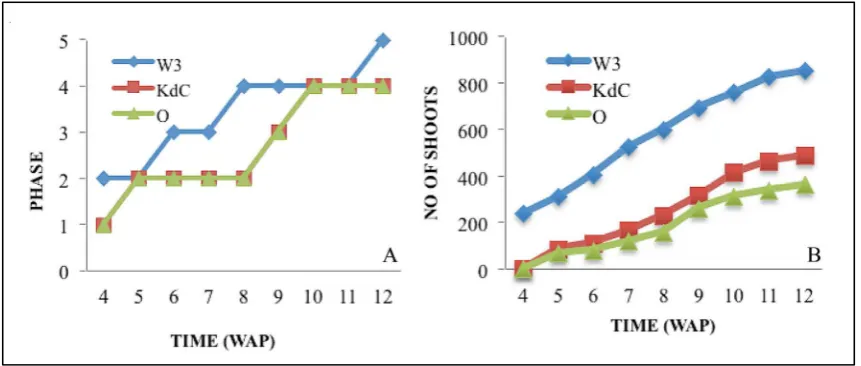
Black orchid is an epiphytic orchid found mainly in Borneo Island, Indonesia. This orchid currently is facing a large conservation problem and threatened to extinction due to human exploitation. It is therefore an urgent requirement to develop efficient propagation technique to conserve this species. This research aims to determine growth response and the ability of black orchid seeds to grow in different medium and to establish the best media for acclimatization. The experiment was divided into 2 stages, seed growth in vitro, and acclimatization. Three different media were employed during seed growth in vitro, i.e. Western 3 media (W3), Knudson C media (KdC) and organic media (O). Each treatment consists of eight replicates. Acclimatization stage used 4 types of media; moss, fern stem, charcoal and combination of charcoal and coconut husk. Each consists of 8 replicates. Results shows that seeds started to grow at 3 weeks after sowing in W3 media, and 5 weeks after sowing in other medium. At 12 WAP, seed growth reached phase 5 (third leaf formed) on W3 medium, whilst on KdC and organic media, reached phase 4 (second leaf formed embryo). Within 3 months, the highest shoot produced was on W3 media (581 shoots), whilst on KdC and organic media produced 255 and 191 shoots respectively. Almost all plantlets (98%) survived during acclimatization period. Plantlets grow best on moss, compared to other media.
INTRODUCTION
Indonesia has high diversity of orchids. It is estimated 1.400 species of native orchids found at Borneo, 1.126 species at Sumatera, 769 species in Java, 500 species in Sulawesi, 369 species in Molucca and 200 species in Nusa Tenggara (Semiarti et al., 2007). Popular orchids among consumers include Dendrobium (34%), Oncidium Golden Shower (26%), Cattleya (20%), Vanda (17%) and an increasing popularity orchid species, black orchid (Coelogyne pandurata Lindl.) (3%) (Martin et al., 2006).
Black orchid belong to sympodial ephypites from the Orchidaceae family. It has shrub type, where each plant connected by rhizome and usually has many pseudobulbs (Kartohardiprodjo and Prabowo, 2009). Flower of black orchid come in a 15-20 cm raceme, consisting approximately 14 flowers. Petal has light green color, and the labelum has a violin shape and black in color. The flower has sweet scent, with flowering period of March-June (Sastrapradja et al., 1976). This species currently has a serious conservation problem and threatened to extinction due to human exploitation, such as illegal harvest from the habitat, illegal logging and land clearing. Furthermore, it has a very short period of flowering, so it is difficult for natural hybridization to occur (Untari and Puspitaningtyas, 2006).
It is therefore an urgent requirement to develop efficient propagation technique to conserve this species. A number of media formulations have been employed on in vitro culture of orchids, for e.g. Vacin and Went (VW), Murashige and Skoog (MS), White, Gamborg (B5), Gautheret, Schenk and Hilderbrandt (SH), Nitch & Nitch, Lloyd & McCown (WPM), Knudson C (KdC), Western 3 (W3), alternative media (Hyponex/Gandasil D, Vitabloom D), and organic media using natural ingredients such as coconut water, banana, potato and sweet potato (Wattimena, 1988). The objective of this
Proc. IInd Intl. Orchid Symposium
156
research was to determine growth response and the ability of black orchid seeds to grow in different medium and to establish the best media for acclimatization.
MATERIAL AND METHODS
The experiment was divided into 2 stages, seed growth in vitro, and acclimatization.
1. Seed Growth In Vitro. Capsule of black orchid were collected from CV. Gede Ayu Bali Orchid, Kerobokan, Badung, Bali. Four months old black orchid capsules (9-10 cm length) were sowed in 3 different media, W3 + 60 g/L banana puree + 7.5 g/L agar + 20 g/L sucrose + 1 ppm BAP, Knudson C (KdC) + 20 g/L sucrose +1 ppm BAP, and organic media (O) which consist of banana puree 60 g/L + potato extract 150 ml/L + 20 g/L sugar + 7.5 g/L agar + 0.5 g/L active charcoal + 1 ppm BAP. Capsules were washed using detergen, followed by soaking in 2 g/100 ml fungicide for 30 min. Capsule were then washed 2 times using sterile water, brought inside the laminar and surface sterilized using alcohol for 10 s, followed by flaming 3 times, 2 second each. Sterile capsule were then placed in sterile petri dish, cut into half and culture on media. Each bottle/media consists of 5 scoop orchid seeds which were distributed evenly to all media surface (Fig. 1). There are 8 replicate to each treatment combination. Variable observed include start of growing time (measure when 25% of the seed produce green embryos), growing phase (1-5) (Semiarti et al., 2010) and number of shoot per week up to 12 week.
2. Acclimatization. Media were steamed for 30 min. before used. When it cooled down, all media were immersed in 2 g/L fungicide for 5 min., followed by dipping in Green Hyponex 2 g/L overnight. Media were then distributed to small pots and leaved for 3 days. Plantlets were removed from culture bottles, cleaned from agar and debris under running tap water, followed by immersing in 2 g/L fungicide for 5 min. to inhibit fungal growth and ready for transferred to pots. There are 4 media trialed; moss, fern stem, charcoal and combination of coconut husk and charcoal, each consists of 8 replicates. Transferred plantlets were kept inside tissue culture lab for 4 weeks before transferred to shade house with 80% paranet shade. Percent survival was observed every week for 8 week.
RESULTS AND DISCUSSION
Orchid seed started to grow 3 week after planting (WAP). At 12 WAP, seed growth reached phase 5 (third leaf formed) on W3 media, whilst on KdC and organic media, reached phase 4 (second leaf formed embryo) (Fig. 2a). Within 3 months, the highest shoot produced was on W3 media (581 shoots, Fig. 3a), whilst on KdC and organic media produced 255 and 191 shoot, respectively (Figs. 2b, 3b, 3c). W3 media contained 2 types of potassium, i.e. potassium dihydrogen phospate and potassium chloride which possibly induce faster growth compared to other media. Knudson C media was employed best to enhance growth of Dendrobium sp. (Sagawa and Shogi, 1977). Addition of organic compound play an important role since it contained vitamins, amino acid nucleic acid, phosphorous and growth hormone such as auxin and gibberelin that induce seedling growth and development (Widiastoety and Bahar, 1995).
157
CONCLUSIONS
In vitro propagation of black orchid was successfully achieved in all media. The best media was W3 in which faster growth and more shoots were produced within 12 weeks. Easily prepared organic media give good alternative to reduce cost of media. Acclimatization was successful in all type of media. Moss is the best media, but combination of coconut husk and charcoal will give a more affordable option for orchid grower.
ACKNOWLEDGEMENTS
Thanks to CV Gede Ayu Bali Orchid for providing sample and facility for this project. Kind help from Ari and Deswin are greatly appreciated.
Literature Cited
Kartohadiprodjo, N.S. and Prabowo, G. 2009. Asiknya Memelihara Anggrek. Gramedia Pustaka Utama. Jakarta.
Martin, K.P., Pachathundikandi, S.K., Zhang, C.L., Slater, A. and Madassery, J. 2006. RAPD analysis of a variant of banana (Musa sp.) cv. Grande Naine, and its propagation via shoot tip culture. In vitroCell. Dev. Biol. Plant. 42:188-192.
Sagawa, J. and Shogi, T. 1977. Clonal propagation of Dendrobium through shoot meristem culture. Orchid Society Bulletin America.
Sastrapradja, S., Nasution, R.E., Irawati, Soerojo, L., Imelda, M., Idris, S., Soerohaldoko, S. and Roedjito, W. 1976. Anggrek Indonesia. Bogor. Lembaga Biologi Nasional LIPI.
Semiarti, E., Indrianto, A., Suyono, E. A., Nurwulan, R. L., Restiani, R., Machida, Y. and Machida, C. 2010. Genetic transformation of the Indonesian black orchid(Coelogyne
pandurata Lindl.) through Agrobacterium tumefaciens for micropropagation. Japan
NIOC Nagoya Dome.
Semiarti, E., Indrianto, A., Purwantoko, A., Isminingsih, S., Suseno, N., Ishikawa, T., Yoshioka, Y., Machida, Y., Machida, C. 2007. Agrobacterium-mediated transformation of the wild orchid species Phalaenopsis amabilis. Plant Biotech. 2:265-272.
Untari, R. and Puspitaningtyas, D.W. 2006. Pengaruh Bahan Organik dan NAA terhadap Pertumbuhan Anggrek Hitam (Coelogyne pandurata Lindl.) dalam kultur in vitro. Biodiversitas 7(3):344-348.
Wattimena, G.A. 1988. Zat Pengatur Tumbuh Tanaman. Bogor: Pusat Antar Universitas Bioteknologi IPB dan Lembaga Sumberdaya Informasi IPB. Bogor, Indonesia
158
Figures
Fig. 1. Surface sterilization of black orchid capsule and seed culture in vitro.
Fig. 2. A. Growth phase of orchid seeds. B. Number of shoot produce on each media.