THE PSYDRAX DICOCCOS COMPLEX (RUBIACEAE) IN MALESIA,
WITH THREE NEW SPECIES
Ridha Mahyuni1,2, Tatik Chikmawati1, Nunik Sri Ariyanti1& Khoon Meng Wong3 1
Plant Biology Graduate Program, Bogor Agricultural University; Department of Biology, Faculty of Mathe-matics and Natural Sciences, Bogor Agricultural University, Indonesia
2
Herbarium Bogoriense, Botany Division, Research Center for Biology-LIPI, Cibinong Science Center, Jl. Raya Jakarta–Bogor km 46, Cibinong 16911, Bogor, Indonesia. E-mail: [email protected]
(corresponding author) 3
Singapore Botanic Gardens, National Parks Board, 1 Cluny Road, Singapore 259569
Ridha Mahyuni, Tatik Chikmawati, Nunik Sri Ariyanti & Khoon Meng Wong. 2018.Psydrax dicoccos kom-pleks (Rubiaceae) di Malesia, dengan tiga jenis baru. Floribunda 5(8): 322–331. —. Psydrax dicoccos Gaertn., merupakan jenis tipe dari Psydrax Gaertn., hanya mempunyai dua sampel buah sebagai bahan ti-penya. Terbatasnya material tipe menghasilkan kesalahan yang menyebabkan jenis yang berbeda diberikan namaP. dicoccos. Sebanyak 140 lembar spesimen herbarium yang diidentifikasi sebagaiP. dicoccosdi ka-wasan Malesia, ditentukan sebagai takson yang berbeda dan ditunjukkan dengan tiga jenis baru yaitu Psy-drax elmerianus,P. koordersianusdanP. sumatranus.Diagnostik karakter masing-masing jenis disediakan.
Kata Kunci: Malesia, jenis baru,Psydrax.
Ridha Mahyuni, Tatik Chikmawati, Nunik Sri Ariyanti & Khoon Meng Wong. 2018. The Psydrax dicoccos Complex (Rubiaceae) in Malesia, with Three New Species. Floribunda 5(8): 322–331. —.Psydrax dico-ccosGaertn., the type species ofPsydraxGaertn., is typified by a specimen consisting of two detached fruits. The limited type material has resulted in a number of distinct species being wrongly referred to that species. Approximately 140 herbarium specimens identified as P. dicoccosin the Malesian region are shown to re-present three new species,Psydrax elmerianus,P. koordersianusandP. sumatranus.The diagnostic charac-teristics of these species are provided.
Keywords: Malesia, new species,Psydrax.
Psydrax was first established by Gaertner (1788) in his treatise on plant fruits, seeds and pyrene form. The genus was based onPsydrax di-coccos Gaertn., the type species, represented by material from Ceylon (presently Sri Lanka). The namePsydrax had long been neglected because it had been considered synonymous with Canthium Lam.
It was Bridson (1985) who subsequently reinstated Psydrax when sorting out the Van-guerieaein Africa and this genus had to be applied to a number of African taxa. Although she did not treat the Malesian taxa, she noted that many speci-mens from this region had been misidentified and annonated as "Canthium dicoccum" or "C. didy-mum". In fact, the names C. dicoccum or P. dico-ccos (using Gaertner's original spelling) had never been directly applied to the Malesian region and only C. dicoccum has been variously listed as a synonym of Vangueria dicocca Miq. (Miquel 1856), Plectronia didyma Benth. & Hook. (Koorders & Valeton 1902, Koorders 1912) in Java, Sumatra and Borneo, C. dicoccum (Gaertn.)
T. & B. (Backer & Bakhuizen 1963) in Java andC. dicoccum Merr. (Merrill 1928) in the Philippines. In India, Wight & Arnott (1834) listed P. dicoccos Gaertn. as a synonym of C. didymum C.F.Gaertn. Until now, no special studies have been conducted to verify whether material from Malesia and Sri Lanka hitherto identified with P. dicoccos are indeed the same species. For the present study, our objective was to clarify the status of P. dicoccos Gaertn. and to attempt correct identification of the Malesian material.
MATERIALS AND METHODS
Berlin-Dahlem (B), Bangkok Herbarium of Thai-land's Department of Agriculture (BK), Natural History Museum London (BM), Royal Botanic Gardens Kew (K), Naturalis Biodiversity Centre, Leiden (L) and the Natural History Museum at Paris (P). Herbarium acronyms used follow Thiers (continuously updated). The study was carried out using conventional herbarium approaches. Key morphological attributes of both vegetative and reproductive parts (the latter including inflorescen-ces, flowers and fruits) were examined, compared and documented.
RESULTS AND DISCUSSION Psydrax dicoccosand its distinctive characters A).Gender and epithet terminations
The name P. dicoccos is of masculine gen-der but Bridson (1985), followed by Chen et al. (2011), have treated it as feminine. According to the ICN Art. 60.2 (McNeillet al. 2012), the origi-nal spelling of a name or epithet should be main-tained. Here, Psydrax is considered as masculine, and the nameP. dicoccosis retained.
B).Type material ofPsydrax dicoccos
In recent treatments, no information was given about where the type of P. dicoccos was kept. However, Stafleu (1969), in a monograph on Joseph Gaertner’s carpology collection, had stated that the type ofP. dicoccos was stored in the car-pology collection in the Leiden Herbarium (L), now administered under the Naturalis Biodiversity Centre in the Netherlands. Unfortunately, Gaert-ner’s monograph does not describe the vegetative characters forP. dicoccosso that the original mate-rial for this species is very incomplete, resulting in misidentifications. In addition, specimens of the same provenance, Ceylon, examined by Richard (1830, 1834) in the Paris Herbarium (barcodes P00836633, P00836634, P00836635) and by Rids-dale (1998) can become a reference for this spe-cies, although the specimens cited by Richard are not syntypes as indicated by herbarium labels pasted on them.
C).Status of the nameCanthium didymum We find that application of the name C. di-dymum is highly problematic. Although Wight & Arnott (1834) listed P. dicoccos Gaertn. as a synonym of C. didymum C.F.Gaertn., the latter was published later and therefore should not take precedence if they are indeed synonymous. Thus,
in the Flora of Ceylon, Ridsdale (1998) placed C. didymum in the synonymy of P. dicoccos; however, he interpreted the type of C. didymumas a specimen found in the Banks herbarium but could not indicate where this was deposited (presumably it had not been found).
The protologue ofC. didymum C.F.Gaertn., Gaertner (1806), refers to two taxa, the first listed was a plant known by its Indian name Kanden-kara (page 71 of volume 5) and illustration (Plate 36 in the same volume) in theHortus Malabaricus (Rheede 1685). As the second listed taxon was given as "Webera cymosa.Collect. Banksian." and followed by a brief discussion that states "Planta in collectione Bansiana sub nomine Webera cymosa WILLD. affervata certissime non eadem cum planta Willdevovii..." (i.e., the plant in Bank's collection is certainly not the same as Willdenow's plant), it would have referred to a specimen. As also recommended by the International Code of Nomenclature (McNeillet al. 2012), the preference should have been to choose a specimen rather than an illustration as the type of the taxon concerned. We have attempted searching databases of the BM and K herbaria as well as on JSTOR, and could not find such a specimen. In turning to the illustration in the Hortus Malabaricus, we found that the plant depicted had paired axillary spines in addition to producing cymes in the same leaf axils, which implies it may not be equated with P. dicoccos, an unarmed species.
Our conclusion is that while the name C. didymum C.F.Gaertn. has been variously regarded as synonymous with P. dicoccos in some past accounts, we do not find any firm evidence indicating that this is correct and, therefore, do not list it as such in the present context. Although the assignment of nomen dubium by itself is unin-dicative of the exact reason why a name is of uncertain application, C. didymum would be in such a category, with the reasons stated above.
D). Comparison of Psydrax dicoccos with the new species
Table1. Morphological comparison ofP. dicoccos,P. elmerianus,P. koordersianus,andP. sumatranus.
Characters P. dicoccos P. elmerianus P. koordersianus P. sumatranus
Leaf blade shape elliptic elliptic-obovate ovate-elliptic ovate-elliptic
Leaf texture coriaceous coriaceous
subcoriaceous-coriaceous
coriaceous
Petiole length (mm) 5–8(–15) 3–5 3–10 (3–)6–10
Tertiary venation on adaxial leaf sur-face
inconspicuous inconspicuous slightly raised inconspicuous
Tertiary venation on abaxial leaf sur-face
inconspicuous slightly raised slightly raised inconspicuous
Adaxial leaf surface reflectance
shiny shiny shiny dull (not shiny)
Peduncle length (mm)
8–17 5–10 2–5(–13) 0–3
Length of inflores-cence branches (mm)
6–12 2–3 1–2 0–1
Number of flowers per inflorescence
50–70 20–30 10–30 20–30
Corolla tube length (mm)
5.5–6 2.5–3 3 3
Corolla lobe length (mm)
3.5–4 2.5–3 2.5 2.5
From Table 1, it can be appreciated that all these taxa can hardly be distinguished by leaf shape and texture, as well as petiole length. Indi-vidual taxa were different from the others by their slightly raised tertiary venation on the abaxial leaf surface (P. koordersianus), or dull instead of shiny adaxial leaf surfaces (P. sumatranus). It is there-fore not surprising that these taxa may have seemed superficially similar enough to have been confused in the past. Notwithstanding,P. dicoccos is distinct from the other three taxa in consistently having distinctly longer inflorescence branches 6– 12 mm long (in the others the branches are not longer than 3 mm) and more flowers (50–70) per inflorescence (the other taxa do not have more than 30 flowers per inflorescence).
Descriptions of Psydrax dicoccosand three new species
Here we provide descriptions ofP. dicoccos and the new taxa thus distinguished.
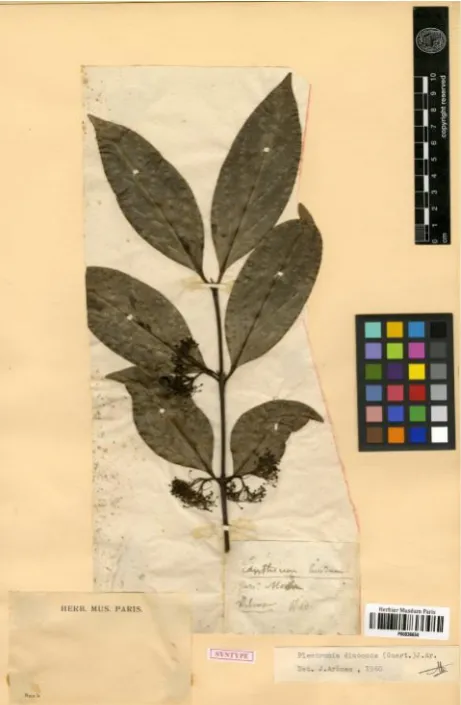
1.P. dicoccosGaertn. (Fig. 1)
P. dicoccosGaertn., Fruct. Sem. Pl. 1 (1788 [Dec 1788]) 125, t. 26, f. 2. — Type: Carpology collection no. 5495, Ceylon (holo L: barcode L0076334).
Figure 1.P. dicoccosfrom Sri Lanka (P00836634)
2. Psydrax elmerianus Mahyuni, spec. nov. (Fig. 2)
Like P. koordersianusMahyuni, except that the leaves are obovate-elliptic and coriaceous, and the corolla lobes are about the same length as the tube (in P. koordersianus the leaves are ovate-elliptic and subcoriaceous, and the corolla lobes are shorter than the tube). — Type: A.D.E. Elmer 6365, Philippines, Luzon, Benguet, Twin Peaks (holo BO).
Shrub or tree; twigs terete, glabrous, inter-nodes (2–)4–4.5 cm long; stipules ovate to
triangular, 2.5–3 mm long. Leaves: blade elliptic-obovate, 5.5–8.5 × 3.7–4.2 cm, glabrous, coria-ceous, attenuate at apex, acuminate to cuspidate at apex; lateral nerves 4–5 pairs, slightly raised; tertiary venation inconspicuous on adaxial side, slightly raised on abaxial side; domatia incon-spicuous in axils of lateral nerves; petioles 3–5mm long. Inflorescence a 2-branched cyme; peduncle 5 –10 mm long, puberulous, branch axes 2–3 mm long, 20–30 flowered. Flowers 5-merous; pedicels 5.5–8 mm long; calyx campanulate, limb 5-dentate, 2 mm × 1.5 mm, puberulous; corolla tube 2.5–3 mm long, lobes c. 2.5–3 mm long; disc hairy; stamens 5, exerted from corolla tube, fila-ments 2 mm long, anthers c. 1.5–2 mmlong; style 6.5–7 mm long; stigma cylindrical, bifid at apex, 9mm × 6 mm. Fruit unknown.
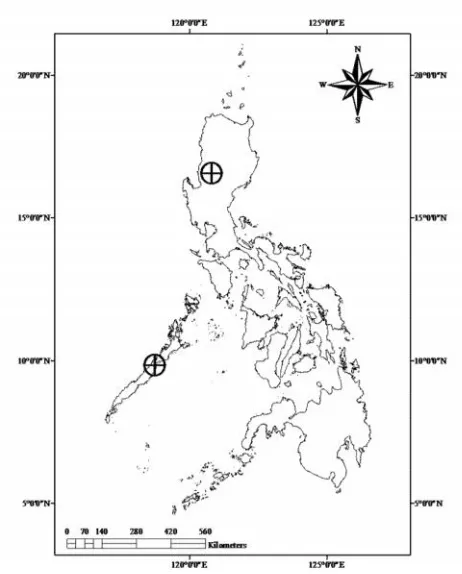
Distribution: Philippines (Luzon, Palawan) (Fig. 3).
Note: Elmer had previously identified this as Plectronia didyma.
Additional specimens examined:
PHILIPPINES: A.D.E. Elmer, 13180, Palawan, Puerto Princesa (Mt. Pulgar) May 1911 (BO); A.D.E. Merrill, 1399, May 1913 (BO).
Figure 2. P. elmerianus. (Elmer 6365) mm long, stigma cylindrical, bifid at apex, 0.8 mm
× 0.6 mm; disc hairy. Fruit a drupe, ellipsoid to globose, 5–7.2 mm × 5–6.4 mm; pedicels glabrous, 7.8–8.8 mm long. Pyrenes 1–2 with solitary seeds within.
Distribution: Sri Lanka and southern India.
Additional specimens examined:
Figure 3. Known distribution ofP. elmerianus.
3. Psydrax koordersianus Mahyuni, spec. nov. (Fig. 4)
Plectronia didyma auct. non Benth. & Hook.: Koorders, Bijdrage no. 8 (1902) 134–137; Koorders & Valeton, Exkursionsflora von Java (1912) 259–261.
Canthium dicoccum auct. non Gaertn.: Backer & Bakhuizenf., Flora of Java 2 (1965) 320.
ResemblingP. dicoccosGaertn. except in its much shorter (1–2 mm long) inflorescence branches and slightly raised tertiary vein reticula-tions on both leaf surfaces.—Type:S.H. Koorders, Kds 27259 β, Java, Semarang, Kedong Jati, 29 April 1897 (holo BO).
Shrub or tree, 10–48 m high, stem or trunk 20–46 cm diameter; bark grey to dark brown; twigs quadrangular or terete, glabrous, internodes 2.2–5 cm long; stipules ovate to triangular, 6–7 mm long. Leaves: blade elliptic, (6–)7.7–11.6 × (2–)3.5–6 (– 6.5) cm, glabrous, coriaceous, attenuate at apex, acuminate to cuspidate at apex; lateral nerves 3–5 pairs, slightly raised; tertiary venation slightly raised on both sides; domatia present in axils of lateral nerves; petioles 3–10 mm long. Inflores-cence a 2-branched cyme; peduncle 2–5(10–13) mm long, puberulous, branch axes 1–2 mm long, 10–30 flowered. Flowers 5-merous, green; pedicels
5–15 mm long; calyx campanulate, limb 5-dentate, 1.5–2 mm × 1–1.5 mm, puberulous; corolla tube 3 mm long, lobes c. 2.5 mm long; disc hairy; sta-mens 5, exerted from corolla tube, filaments 1 mm long, anthers c. 1 mm long; style 6–8(–10) mm long; stigma cylindrical, bifid at apex, 1.5 mm × 1 mm. Fruit a drupe, ellipsoid to obovoid, 6–8 mm × 5–6 mm, pedicel glabrous 8–17 mm long. Pyre-nes 1–2 with solitary seeds within.
Vernacular names: kikopi, kopen, kijanjoan (Sunda-West Java),rengit (Ujung Kulon) and ken-dal gamprit.
Distribution: Java and south Sumatra (Fig. 5). Etymology: The specific epithet honours Dr. S.H. Koorders for his many contributions, includ-ing interestinclud-ing collections made durinclud-ing his expedi-tions in Java from 1888 to 1910.
Figure 4. P. koordersianus Mahyuni. (Koorders 27259β)
Additional specimens examined: (All specimens cited BO)
JAVA: West Java, S.H. Koorders, Kds 12327 β, Sukabumi, Pelabuhan Ratu, 2 May 1893;Kds 6496
β,11 July 1890;Kds 6486β,17 August 1891;Kds 34230 β, 15 April 1899; Kds 1099 β; S.H. Koor-ders, Kds 34303β, 13 April 1899; S.H. Koorders, Kds 6488β,August 1899; Panoembahan, Jampang Kulon, Kds 6490 β, August 1899; Kds 6489 β, 2 August 2,1891; C.A. Backer, 13944, Purwakarta, 18 January 1914; Beumȇ e, 6804, Depok, 1927; J. G.B. Bumée, 6858, 1 May 1930; J.G.B. Bumée, 6804, Tjabak, 22 February 1914; Kds 42292 β, 1 May 1930;s.leg.18635,cult. in Hort. Bogor; S.H. Kooders, Kds 25253 β, 16 November 1896. — Central Java: S.H Koorders, Kds 6526 β, Nusa-kambangan, Cilacap, Banyumas, 5 December 1891;Kds 6227β,6 December 1891;Kds 24567β, 11 November 1896; S.H. Koorders, Kds 34109 β, 10 March 1910; S.H. Koorders, Kds 22029 β, 30 September 1895;Kds 24812β,October 1896;S.H. Koorders, Kds 21957β, August 1899; Soepadmo, 294β,Ujung Kulon, Peutjang Island, 18 December 1961; S.H. Koorders, Kds 6480β, Semarang,
Ke-dongdjati, 20 November 1888; Kds 6500β, 4 Sep-tember 1892; Kds 6501 β, August 1899; Kds 6502β,24 June 1889;Kds 6509β;S.H. Koorders, Kds 6510β, July 1899; Kds 6511β,1 April 1898; Kds 6513 β, 23 November 1888; Kds 6515β, Au-gust 1899;Kds 6517β,3 March 1892; Kds 6518β, Karangasem, 3 March 1892; S.H. Koorders, Kds 28391β,Karangasem, December 1900;Kds 26168
β, 27 October 1896;Kds 34776 β,1 August 1899; Kds 28379 β, 14 June 1897;J.G.B Beumée, 5127, 17 March 1920;A.C. Noldie,4632, May 1920;Kds 25447 β, 27 October 1896; S.H. Koorders, Kds 34777 β, Jepara, 1932;S.H. Koorders, Kds 13469
β, Pekalongan, August 1899; S.H. Koorders, Kds 22465 β, 16 May 1896; Hofmam, 6540, 2 August 1923; Kds 34852 β, Rembang, 21 June 1899; Le-gon T. Djarwaningsih, M. Amir & Supriatna, TD 433 Moto: TN. Karimun Jawa, 29 April 2004. — East JavaKds 23042β,Kediri: 16 June 1896; Jem-ber: Nusa Barong, 1899,Kds 6530β.
SUMATRA: W.Grashoff, 946, Palembang, Ba-nyuasin, January 22, 1916;Herb. Bot. Var.173, 22 February 1992.
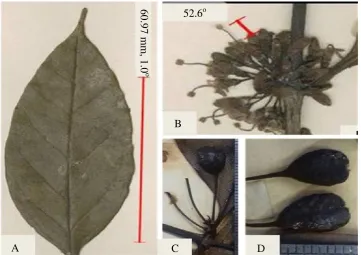
4. Psydrax sumatranus (Miq.) Mahyuni, comb. nov.(Fig. 6)
Canthium sumatranumMiq., Fl. Ned. Ind. 2 (1857) 254. — Type: F.W. Junghuhn, s.n., Sumatra (holo L: barcode L00001931).
Canthium dicoccumauct. non Merrill: Craib, Fl. Siam. Enum. 2 (1932) 137. Type:Kerr. 15593, Thailand (BK).
Canthium dicoccum var. impolitum Craib, Fl. Siam. Enum. 2 (1932) 138. Type: Kerr 14759, Thailand (BK, BM, K).
Shrub to tree, up to 15 m tall and 5–20 cm girth; bark smooth, cracked or fissured, purplish to greyish brown; inner bark fibrous, greyish brown to pale yellow; cambium yellow; sapwood cream, pink to pale yellow, very hard; twigs terete to quadrangular, glabrous, internodes 4.5–8(–12) cm long; stipules with a basal triangular portion 3–6 mm long, ending in a pointed apex or a short nar-row apical lobe 1–2 times as long. Leaves: blades ovate to elliptic, 5–15 cm × 2.3–6.2(–7.5) cm, gla-brous, coriaceous and shagreen, with apex acute to acuminate, base acute to attenuated down to the petiole, lateral nerves (3–)4–6 pairs; tertiary vena-tion not conspicuous on both sides; domatia pre-sent or abpre-sent in axils of lateral nerves; drying dull pale green to dark brown; petioles glabrous, (3–)6 –10 mm long. Inflorescences a cyme, main pedun-cle 0–3 mm long, branches 0–1 mm long, puberu-lous; 20–30 flowered. Flowers 5-merous, white to light yellow green, pedicels puberulous, 4–8 mm
long; calyx campanulate, limb 5-dentate, puberu-lous, 1–2 mm × 1–1.5 mm; corolla tube c. 3 mm long, lobes c. 2.5 mm long; stamens 5 exerted from corolla tube, filaments c. 1 mm long, anthers 1–1.5 mm long; disc hairy; style 6–8 mm long; stigma cylindrical, bifid at apex, 1 mm × 0.8 mm. Fruit a drupe, obovoid, green to blue green, strongly bilobed, 4–10 mm × 4–8 mm, pedicels 10–15 mm long. Pyrenes 1–2, exceedingly rugose on surface, with solitary seeds within.
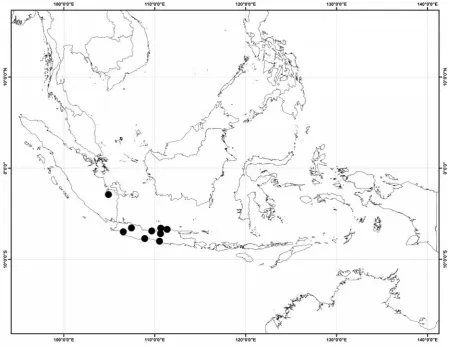
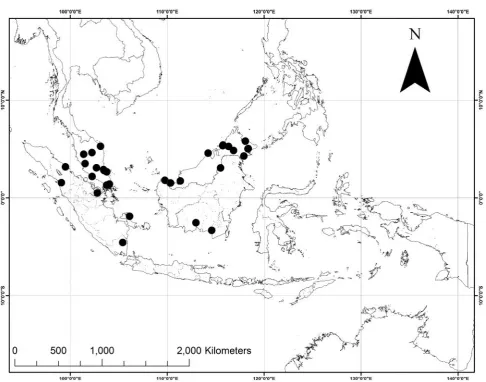
Distribution: Peninsular Thailand, Peninsu-lar Malaysia, Singapore, Sumatera and Borneo (Fig. 7).
Ecology: Primary to secondary mixed dip-terocarp forest, also heath forest including in white -sandy sites, at elevations up to c. 1500 m a.s.l.
Vernacular names: janti kering(Palembang, Sumatra), pirangka (Borneo), kayu tulang (Banjarmasin), kopi-kopi (Sabah), bintan (Sampit, Borneo), janang (Sarawak), tulang ular (Pulau Bruit-Sarawak, Borneo).
Note: P. sumatranus is characterised by ovate to elliptic blades with a dull shagreen texture on the adaxial surface and cymes with short pedun-cles 0–3 mm long and 20–30 flowers. Craib (1932) listed C. dicoccum Merrill for Thailand citing the specimen Kerr 15593 and also published C. dico-ccum var.impolitum Craib. Both are not different. This is the same as Psydrax sp. 5 of Wong (1989) andPsydraxsp. 3 of Coodeet al.(1996).
Figure 6.P. sumatranus.A. leaf blade, B. inflorescence, C. infructescence, D. fruits. (Kerr 14759)
A C D
B
60.97 m
m
, 1.0
o
Additional specimens examined:
BORNEO: Brunei Darusalam: B.E. Smythies et al.,SAN 17455,Kuala Belait, Badas State Land, 14 April 1957 (KEP, SAN); s.leg. S.880, 1932 (SING). Kalimantan: Dr. P. Buwalda7657, West Kalimantan, Sampit, 23 August 1940 (BO);Dr. P. Buwalda 7697,2 September 1940 (BO);G. Argent & Amiril Saridan 9394, Km 67 from Sangai, 6 February 1993 (BO);Mohd. Dahlan, 149, Banjar-mansin, 5 October 1921 (BO); Jaheri, s.n. (BO). Mandi 38, Pontianak, Sei Raja, 14 March 1931 (BO).Sabah:Talib Bidin, SAN 80714, Beaufort, 7 July 1976 (SAN); Talib Bidin & Marsal H, SAN 86112, 28 July 1980 (SAN); Talib Bidin, SAN 80566, Sungai Damit, Membakut, 17 May 1976 (SAN, SING); J. Singh, SAN 24332, Lumat, 17 May 1961 (SAN, SING);L. Madani, 36889, Beau-fort Hills, 6 November 1963 (SAN); F.R. Kinted, SAN 19053, Lupak camp 230 chains from Padas river, 1 January 1961 (SAN);J. Singh, SAN 24318, Lumat, 10 May 1965 (KEP, SAN); Francis Sa-Talip, 50954, 10 August 1967 (BO, SAN);Ahmad Talip, 55577, 13 October 1967 (SAN, SING); De-wol Sundaling, SAN 80795,20 May 1976 (SAN); P.F. Cockburn, J. Chow & Aban, SAN 64827, Penampang, 4th mile path from Kg. Babagon Ulu Terian, 18 October 1969 (SAN); P.F. Cockburn, SAN 66002, 5 52’ N, 116 11 E, 16 February 1969 (SAN); Fedilis Krispinus, SAN 105300, Keningau, Sungai Tobou Sepulut Forest Reserve, 24 July 1984 (SAN); Aban & Nicholas, SAN 65392, Sook Plain, Plot No.2, 17 April 1969 (SAN); E.J.H. Corner, 5342, Andulau Forest Reserve, 22 Febru-ary 1959 (BO); Bongsu Ahmad, 63042, Tawau, Tinagat FR, 16 July 1968 (SAN); Telupid, Tagku-lap Road, 1October 1993 (SAN); A. Cuadra, A2451,Selangan Island, 13 October 1949 (SING); G.H.S. Wood, SAN 17192, Tawau, 7 November 1955 (BO). Sarawak: Haviland, G. s.n., Kuching, 17 April 1989 (SING);Charles Hose,s.n.,Marudi, Baram, 1894–1895 (SING); H. Jacqualine, R.S. Shalih et al. S.90217,3°44’141” N, 115°30’23’, 11 September 2006 (SAR); s.leg. s.n., Maliau Basin, 18 April 1996; Muin Chai, SAN 29399, Lahat
Datu, N.T. Silam, 23 April 1962 (KEP, SAN); Ahmad & Sabirin, 52315, Virgin Jungle Res. Mt. Silam, 18 May 1965 (SAN);s.leg.,S.1560,17 Au-gust 1959, (KEP, SAR); s.leg, S. 0485, Loba Karang Suih(KEP, SING).
Figure 7. Distribution ofP. sumatranusbased on specimen localities.
ACKNOWLEDGEMENTS
This research was supported by the Ministry of Research, Technology and Higher Education of Indonesia; K.M. Wong's participation was made possible by the National Parks Board, Singapore. We are grateful to Prof. Dr. Mien A. Rifai, Prof. Dr. Tukirin Partomihardjo and for suggestions and guidance given in improving this manuscript.
REFERENCES
Backer CA & Bakhuizen van den Brink Jr. RC. 1963. Flora of Java.Vol II. Groningen): P. Noordhooff.
Bridson DM. 1985. The reinstatement of Psydrax (Rubiaceae, subfamily Cinchonoideae, tribe Vangueriae) and a revision of the African species.Kew Bulletin40: 687–725.
Chen T, Taylor CM & Lantz H. 2011. Psydrax
Gaertner. Flora of China. New York: Mis-souri Botanical Garden Press.
Coode MJE, Dransfield J, Forman LL, Kirkup DW & Said IM. 1996.A Checklist of the Flower-ing Plants and Gymnosperms of Brunei
Da-russalam. Brunei Darussalam: Ministry of
Industry and Primary Resources.
Craib WG. 1932.Florae Siamensis Enumeratio: A list of the plants known from Siam, with re-cords of their occurence. Bangkok: The Bangkok Times Press.
Elmer ADE. 1934. New Urticaceae and Rubiaceae. Leaflets of Philippine Botany 9: 3227–3272. Manila: Philippine Islands. Gaertner J. 1788.De Fructibus et Seminibus
Plan-tarum. Stutgardiae (DE): Typis Academiae Carolinae.
Koorders SH & Valeton TH. 1902.Bijdrage. Bata-via: G. Kolff & Co
Koorders SH. 1912. Exkursionsflora von Java. 3. Dikotyledonen (Metachlamydeae). Jena: Verlag von Gustav Fischer
McNeill J, Barrie FR, Demoulin VWR, Greuter W, Hawksworth DL, Herendeen PD, Knapp S & Marhold K. 2012. International Code of Nomenclature for Algae, Fungi, and Plants (Melbourne Code).Koeltz Scientific Books. Merrill ED. 1928. Rubiaceae: Genus Canthium
Lamark.Philipp. J. Sci: 35(1): 8.
Miquel FA.G. 1856. Flora van Nederlandsch In-dié. Vol 2. Amsterdam (NL): C.G. van der Post.
Miquel FAG. 1868. Rubiaceae. In: Miquel FAG, ed, Annales Musei Botanici Lugduno-Batavi. Amsterdam (NL): C.G. van der
P o s t . h t t p : / /
dx.doi.org/10.1007/500606020003
Rheede tot Drakenstein H van. 1685.Hortus Mala-baricus.Amsterdam: Johannis van Someren & Joannis van Dyck.
Richard A. 1830. Mémoire sur la famille des Rubiacées, Contenant la Description Gé-nérale de cette Familleet les Caractéres des Genres qui la Composent.Paris: Imprimerie de J. Tatsu.
Richard A. 1834. Mémoire sur la famille des Rubiacées, contenant la description générale
de cette famille et les caractéres des Genres qui la composent. Mém. Soc. Hist. Nat. 5: 1 9 0–1 9 1 . d o i : 1 0 . 1 1 1 1 / j . 1 0 9 5 -8339.2008.00779.x
Ridsdale CA. 1998.Psydrax.In: Dassanayake MD & Clayton WD (eds.).A Revised Handbook to the Flora of Ceylon. Rotterdam: A.A. Balkema Publishers.
Stafleu F.A. 1969. Joseph Gaertner and his car-pologia. Acta Bot. Neederlandica.18 (1): 2 2 3 . d o i : 1 0 . 1 1 1 1 / j . 1 4 3 8 -8677.1969.tb00586.x
Thiers B. [continuously updated]. Index Herbari-orum: A global directory of public herbaria and associated staff. New York Botanical Garden's Virtual Herbarium. http:// sweetgum.nybg.org/science/ih/
Wight R & Arnott GAW. 1834.Prodromus Florae Peninsulae Indiae Orientalis: Containing Abridged Descriptions of the Plants Found in the Peninsula of British India, Arranged According to the Natural System. Vol 1. London: Parbury, Allen & Co. http:// dx.doi.org/10.5962/bhl.title.252.