Kai Kow Joseph YEO (Ph.D) National Institute of Education Nanyang Technological University 1 Nanyang Walk
Singapore 637616 Tel: (65) 6790 3912 Fax: (65) 6896 9417
Email: [email protected]
Secondary 2
Students’ Difficulties in Solving
Non-Routine Problems
Abstract
As part of a study on mathematical problem solving of secondary 2 (13- to 14-yearsold) students in Singapore, 56 Secondary two students from ten secondary schools participated in this study. The purpose of this paper is to explore difficulties faced by 56 Secondary 2 students when solving problems. These interviews were analysed using the structure derived from Newman (1983) and Ransley (1979). From the interviews the difficulties experienced by Secondary 2 students who were prevented from obtaining a correct solution were: (a) lack of comprehension of the problem posed, (b) lack of strategy knowledge, (c) inability to translate the problem into mathematical form, and (d) inability to use the correct mathematics.
BACKGROUND
Problem solving in mathematics can be explained as “thinking and working mathematically”
mathematics which showed that students performed poorly on solving word problems (Kouba, Brown, Carpenter, Lindquist, Silver, & Swafford, 1988). Similarly, in a large scale study in Singapore, Kaur and Yap (1996, 1997, 1998) conducted a longitudinal study as part of the KASSEL project on about 2300 Secondary 3 (15 years old) students from different academic streams. They found that the students did not lack any effort in attempting the problems but they appeared to lack the motivation and confidence in attempting unfamiliar problems.
Although it has been widely reported that Singapore emerged top in Mathematics for the Trends in International Mathematics and Science Study or TIMSS, an in-depth analysis of the TIMSS items revealed that Singapore Lower Secondary (grade 7 and grade 8) students did not perform well for items that required them to solve non-routine problems (Kaur & Yap, 1999). A thorough study of the TIMSS test data had confirmed that Singaporean students have indeed performed very well on items that were routine to them and tested what they had been taught at school (Kaur, 2003; Kaur & Yap, 1999; Pereira-Mendoza, Kaur, & Yap, 1999). Moreover, in the 2003 TIMSS study, 44% of the Singapore‟s students attained the „Advanced International
Benchmark‟ in Mathematics, compared to 7% internationally (Tan, Chow & Goh, 2008). While
LITERATURE REVIEW
Lester and Kehle (2003, p. 510) typify problem solving as an activity that involves the students‟ engagement in a variety of cognitive actions including accessing and using previous knowledge and experience:
Successful problem solving involves coordinating previous experiences, knowledge, familiar representations and patterns of inference, and intuition in an effort to generate new representations and related patterns of inference that resolve the tension or ambiguity (i.e., lack of meaningful representations and supportive inferential moves) that prompted the original problem-solving activity.
What does it mean for students to organize previous knowledge and experiences to generate new knowledge? It is clear that if students are to be engaged in problem solving activities they need to develop a way of thinking consistent with mathematical practices, in which problems or tasks are seen as impasses that need to be examined in terms of questions. Thus, students need to problematize their own learning.
Mayer (1982, 1987) explained problem-solving processes as using different forms of knowledge leading to the goal of solving the problem. According to him, the types of knowledge applied in problem solving consisted of:
linguistic and factual knowledge – about how to encode statements, schema knowledge – about relations among problem types,
algorithmic knowledge – about how to present distinct procedures, and strategic knowledge – about how to approach problems.
skill and solution. Schoenfeld (1985) suggested four aspects that contributed to problem-solving performance. These are the problem solver‟s: (1) mathematical knowledge, (2) knowledge of heuristics, (3) affective factors which affect the way the problem solver views problem solving, and (4) managerial skills connected with selecting and carrying out appropriate strategies.
In their study of the problem-solving research literature, Kroll and Miller (1993) identified three major cognitive and affective factors; namely, knowledge, control (metacognition) and beliefs and affects that contributed to students‟ difficulties in problem
solving. Further Lester (1994) expressed that difficulties experienced during problem solving could also be caused by the problem solver‟s characteristics such as:
traits – such as spatial visualization ability and ability to attend to the structural features of problems,
dispositions – such as beliefs and attitudes, and
experiential background – such as instructional history and familiarity with types of problems.
In the early 1970s, research tended to attribute difficulties in solving problems to the various tasks variables such as content and context variables, structure variables, syntax variables, and heuristic behaviour variables (Goldin & McClintoch, 1979). However, Lester (1994) contended that there was a general agreement that problem difficulty is not so much a function of various task variables but rather a function of characteristics of the problem solver. In other words, the knowledge one possesses, one‟s disposition and one‟s experiential
posed, (2) lack of strategy knowledge, and (3) inability to translate the problem into a mathematical form. Lee who conducted a local study on first year undergraduate students solving routine and non-routine calculus problems, found that the difficulties faced by the students were: (1) lack of experience in defining problems, (2) a tendency to rush toward a solution before the problem has been clearly defined, (3) a tendency to think convergently, and (4) lack of domain-specific knowledge. Similarly, in a recent study which based on their first-person perspective on problem solving and first-personal experience with the problems, McGinn and Boote (2003) identified four primary factors that affected perceptions of problem difficulty:
categorisation – ability to recognise that a problem fits into an identifiable category of problems which run a continuum from easily categorisable to uncategorisable,
goal interpretation – figuring out how a solution would appear which runs a continuum from well defined to undefined,
resource relevance – referring to how readily resources were recognised as relevant, from highly relevant to peripherally relevant, and
complexity – performing a number of operations in a solution.
McGinn and Boote suggested that the level of difficulty of the problem depended on problem solvers‟ perceptions of whether they had suitably categorised the situation, interpreted the intended goal, identified the relevant resources and executed adequate operations to lead toward a solution.
this paper provides findings from interviews conducted with 56 Secondary 2 students related to their difficulties in solving problems. The specific research question to be answered from the analysis of results in this paper is:
What are the difficulties experienced by Secondary 2 students when solving problems? RESEARCH METHODOLOGY
It is often tough to analyse the difficulties experienced by students when solving mathematical problems through investigating their written solutions. It may be more productive, when analysing errors, to interview students, noting their verbalisations and thought patterns about the specific problems with which they were faced. It cannot be assumed that when an incorrect answer is given to a mathematical problem that the error occurred because the student lacked the necessary mathematical knowledge or skill (Newman, 1977). In written assignments an interview technique may be used to find out the errors which students have made. A key assumption in this interview technique is that the types of errors students make will be consistent from one session to another. Nevertheless, it seems possible that one-to-one interviews, despite their limitations, do give greater insights into students‟ thinking and difficulties which would not be possible purely from an analysis of paper and pencil solutions.
Sample
Instruments
An important criterion in choosing suitable mathematical tasks for this study was that they had to be “problems” for a majority of Secondary 2 students. By the definition of a
“problem” it had to be reasonably complex but approachable and requiring no specific high level
The Three Problems Time Problem
Miss Lee arrived at the concert hall 15 minutes before a concert began. However, due to some technical problems, the concert started 10 minutes later. The whole concert lasted for 2 hours 25 minutes. It was 10.30 pm when Miss Lee left the concert hall. At what time did Miss Lee arrive at the concert hall?
Show all your working and explain it.
Cat and Rabbit Problem
A cat is chasing a rabbit. They are 160 metres apart. For every 9 metres that the cat runs, the rabbit jumps 7 metres. How much further must the cat run in order to overtake the rabbit? Show all your working and explain it.
Number Problem
The sum of two numbers is 36 and their difference is 12. Find the two numbers. Show all your working and explain it.
Procedure
The interview structure was developed from the Newman Error Analysis Guidelines (Newman, 1983) and the Ransley‟s (1979) problem-solving model.
The format used for the interviews consisted of the following oral procedure: 1. Read the question aloud.
2. What do you need to find? What is the question asking for? (proceed to 3 if student is able to comprehend the problem, otherwise ask questions to ensure understanding and comprehension like “How long was the concert?” before proceeding to 3)
3. Without doing any working, tell me how are you going to solve this problem? What are you going to have to do in order to solve this problem?
(proceed to 4)
4. What will you have to use to work out (such and such)? How will you work out to solve the problem? Show me how you solve the problem. Explain to me what are you doing as you solve the problem.
(proceed to 5)
5. How can you check to see if your answer is sensible? Study the problem again and decide if your answer is sensible.
The interviews were conducted one-to-one by the researcher and were audio-taped. The researcher took approximately half an hour to interview each student.
Analysis of Interview Data
Reading
Comprehension
Strategy Know-How
Transformation
Process Skill
Solution
The following two-point categorisations in behavioral terms for each stage of the above structures were used to analyse the interview protocols.
Reading
1. The student was able to read the problem without any difficulty.
2. The student was not able to read the problem and was helped with some of the words and/or symbols in the question.
As none of the students interviewed had any reading difficulty, there are no examples of difficulties at this stage which may have led to the inability of the students to go beyond this stage during the interview.
Comprehension
1. The student (S) was able to comprehend the problem. This was confirmed by the responses to the questions the researcher (R) asked.
The following examples show a series of students‟ difficulties which hindered their progress in
solving the problem at this stage: Time Problem
R: Do you understand the problem?
S: No.
R: Did Miss Lee arrive before or after the concert began?
S: Before.
R: How long was the concert?
S: 2 hours and 25 minutes.
R: What time did Miss Lee leave the concert hall?
S: 10.30 pm.
R: Do you now understand the problem?
S: No, it is very confusing.
R: Why is it confusing?
S: Too many sentences.
Cat and Rabbit Problem
R: Do you understand the problem?
S: I really don’t understand what the question is wanting me to find.
R: How many animals are there?
S: Two.
R: How far apart were the two animals?
S: 160 metres.
S: 9 metres for the cat and 7 metres for the rabbit.
R: Do you understand this problem now?
S: I don’t know what it means by“for every 9 metres the cat runs, the rabbit jumps 7
metres.”
Numbers Problem
R: Do you understand the problem?
S: Maybe. Quite confusing?
R: Why is it confusing?
S: Don’t know how to say.
Strategy Know-How
1. The student was able to describe a “method” he or she would use to tackle the problem.
2. The student had no idea of how to approach the solution of the problem at all. The following examples show students‟ difficulties for some of the problems at this stage:
Time Problem
R: Do you understand the problem?
S: Yes.
R: Did Miss Lee arrive before or after the concert began?
S: Before.
R: How long was the concert?
S: 2 hours and 25 minutes.
R: Can you explain to me how you will find out what time Miss Lee arrived at the concert hall?
S: I don‟t know how to explain.
Cat and Rabbit Problem
R Do you understand the problem?
S: Yes.
R: How many animals are there?
S: Two.
R: How far apart were the two animals?
S: 160 metres.
R: For each step, how far did the cat run and how far did the rabbit jump?
S: 9 metres for the cat and 7 metres for the rabbit.
R: Do know how far must the cat run in order to overtake the rabbit?
S: ………….(silence)
R: Do you know how to do it?
S: I don’t know.
Number Problem
R: Do you understand the problem?
S: Yes.
R: How many numbers are there?
S: 2.
R: What is the sum of the two numbers?
R: What is the difference of the two numbers?
S: 12.
R: Can you explain to me what method you used to solve this problem?
S: Look easy at first but I don’t know what method to use.
R: Do you know how to do it?
S: No.
Transformation
1. The student was able to translate the problem into a mathematical form (equation or open sentence),
2. The student was not able to translate the problem into a mathematical form. The following are examples of students‟ difficulties for some of the problems at this stage:
Time Problem
R: Can you explain to me how you would find the solution?
S: Take 10.30 am, the duration of the concert, add 10 minutes and subtract 15
minutes.
R: How would you do this?
S: Don’t know.
Cat and Rabbit Problem
R: Can you explain to me how you would find the solution?
S: Cat run 7 metres and rabbit jump 9 metres. Difference is 2 metres. ... Not sure.
R: How would you do this?
Numbers Problem
R: Can you explain to me how you will try and solve the problem?
S: Factorisation. Let x be the smaller number and y be the bigger number. Don’t
know how to write the equations.
R: How will you find the solution?
S: Not sure.
Process Skill
1. The student was able to do the mathematics and reach a solution.
2. The student was not able to do the mathematics and couldn‟t continue with the solution.
As none of the students had any difficulty with the Cat and Rabbit problem at this stage, there are only two examples to illustrate the students‟ difficulties in the Time and Numbers problems.
Time Problem
R: Can you go over each step of your work and tell me what were you thinking?
S: First take 2 hours 25 minutes and add 10 minutes. It gives 2 hours 35 minutes. Then 10 hours and 30 minutes minus 2 hours and 35 minutes. 10 hours minus 2 hours equal 8 hours then 35 minutes minus 30 minutes is equal to 5 minutes. Answer is 8 hours 5 minutes. To minus 15 minutes, I take 8 hours 5 minutes minus 15 minutes. Cannot minus therefore I change 8 hours to 7 hours and 5 minutes become 95 minutes.
Numbers Problem
R: Ca n you go over ea ch step of your wor king a nd tell me wha t wer e you
S: Let the 2 numbers be x and y. There x plus y = 36 and x – y = 12. I don’t think I
am confident to solve this. Use trial and error. Don’t think can solve.
Solution
1. The solution obtained was correct. 2. The solution obtained was incorrect.
The following examples illustrate some of the many causes for incorrect solutions. Time Problem
R: Show me how you work out your answer? Explain to me what you are doing as
you work out your answer.
S: 10 hours 30 minutes minus 2 hours 25 minutes. 10 hours minus 2 hours equal 8
hours. 30 minutes minus 25 minutes equal 5 minutes. I have 8 hours and 5
minutes which 8.05pm. 8.05 minus 15 minutes equal 7.50 pm.
Cat and Rabbit Problem
R: Show me how you work out your answer. Explain to me what you are doing as
you work out your answer.
S: 9 metres minus 7 metres equal to 2 metres. 160 metres divide by 2 metres equal
80 metres. 80 times 9 equal 720 metres. A lot of working and steps. Quite fed
up.
Numbers Problem
R: Show me how you work out your answer? Explain to me what you are doing as
you work your answer.
(3) into equation (2). We get x minus 36 minus x equal 12 (x - 36 – x = 12). x
minus x equal 12 plus 36.
RESULTS AND DISCUSSION
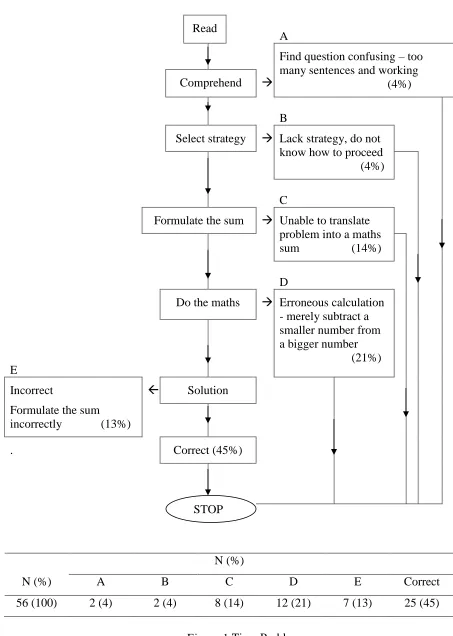
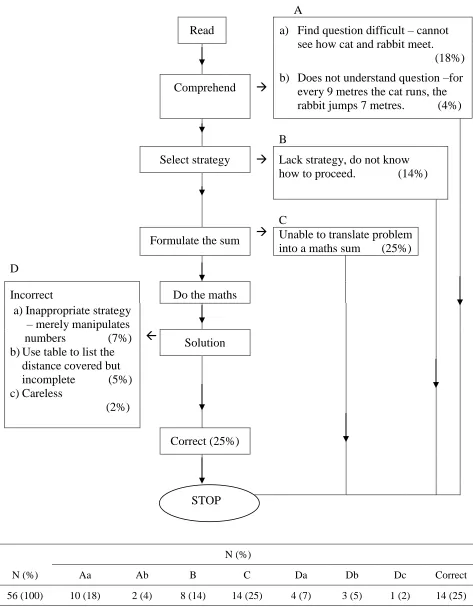
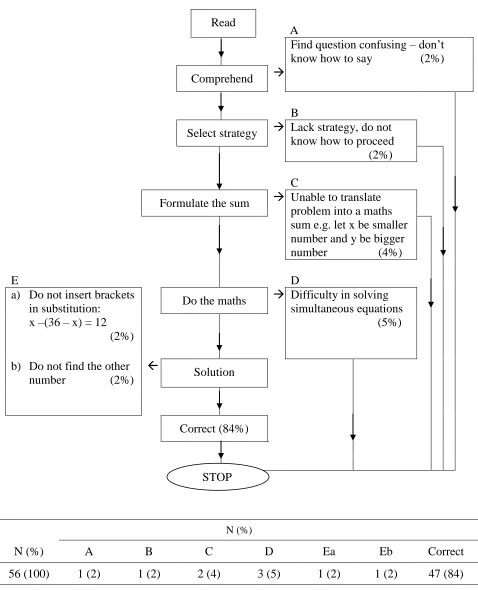
Figures 1, 2, and 3 show the flow charts and accompanying tables for the three problems: Time, Cat and Rabbit, and Numbers respectively. These flow charts provide a summary of the analysis of the interview data. They indicate at which stage the students were unable to proceed with the solution to a problem. The reasons found are also stated and the frequencies given as percentages. Each table gives the breakdown of the occurrences at the various stages for this group of 56 Secondary 2 students.
The table accompanying the flowchart in Figure 1 shows that the students were interviewed about their attempt to solve the Time problem. Of these 56 students, two (i.e., 4%) were classified as “A”. That is, they were unable to proceed beyond the „Comprehend‟ stage for
the reason that they found the question too confusing with “too many sentences and too many
workings”. Two (i.e., 4%) were unable to proceed beyond the „Select strategy‟ stage („B‟), as
they did not know how to proceed with the solution to the problem although they comprehended it. Eight (i.e., 14%) were unable to formulate the sum. The difficulties in using process skills were directly related to the problem rather than a general weakness in using this strategy. Of 12 (i.e., 21%) students, they merely subtracted a smaller number from a bigger number. Thirty-two (i.e., 58%) managed to obtain a solution to the problem. Of these 32 students, seven (i.e., 13%) obtained incorrect solutions and were classified as „E‟; that is, they “formulated the sum incorrectly”. Similarly, for the other two problems, Figures 2 and 3 show the numbers and
Read
A
Find question confusing – too many sentences and working
A
Read a) Find question difficult – cannot see how cat and rabbit meet.
(18%) b) Does not understand question –for
every 9 metres the cat runs, the rabbit jumps 7 metres. (4%) Formulate the sum Unable to translate problem
It was observed during the interviews that students were in the habit of trying to solve the current problem using only one strategy. They did not demonstrate any flexibility by trying a strategy and if it did not work, trying another. Students who worked their solutions using an inappropriate strategy were often not aware that the solution was incorrect. Furthermore, students made no attempt to check that their solutions were correct or whether the solutions satisfied the conditions in the problem. The results of the data analysis showed that students were not successful at obtaining solutions for the following reasons:
Lack of comprehension of the problem posed
Some students were impeded in their progress in solving the problem as they did not comprehend the problem; for example, they found the problem confusing as “too many sentences
and workings” were involved and did not “know how to say” what was involved in a problem.
They were unable to visualise how the cat and rabbit met, and did not comprehend the problem at all.
Lack of strategy knowledge
Some students, who had no difficulty comprehending the problem, were impeded in their progress in solving the problem as they appeared to have no knowledge of ways in which an unfamiliar or non-routine as well routine problem might be approached.
Inability to translate the problem into a mathematical form
Some students, who had a strategy to solve the problem, were impeded in their progress in solving the problem by their inability to translate the problem into a mathematical form (equations or open sentences). For example, for the Time problem, one student knew he had to “work backward” to find the solution but was not able to begin to work using the correct timing. For the
and the rabbit for further computation. As for the Numbers problem, a student was unable to form two linear equations.
Inability to use the correct mathematics
Some students, who were able to translate the problem, were impeded in their progress in solving the problem by their inability to use the correct mathematics to solve the problem. Some students identified an appropriate operation or sequence of operations but did not know the procedures necessary to carry out these operations accurately. For example, for the Time problem, a student merely subtracted a smaller number from a bigger number at the hour and minute place value. For the Number problem, one student who had correctly formed two linear equations was unable to solve the two equations simultaneously and did not grasp the procedures involved in solving two linear equations.
The results of the analysis of the data also showed that many times, the solution obtained by the students was incorrect and this could be attributed to the following reasons:
Inappropriate strategy used
The most common inappropriate strategy used to solve the three problems was number manipulation where students merely manipulated the data in the problem by trying to use the four operators (+, -, x, ) to arrive at an answer. The use of formulae and tables (incomplete listing) to find the solution to the Cat and Rabbit problem also resulted in a number of incorrect solutions.
Incorrect formulation of the mathematical form
Computational errors
Several students obtained incorrect solutions owing to careless computations. Imperfect mathematical knowledge
One student was not successful in obtaining the solution to the Number problem due to an imperfect knowledge of algebraic manipulations.
Misinterpretation of the problem
One student was not able to obtain the solution to the Number problem as he had interpreted that only one number was required to find in the problem.
Therefore, it may be inferred that the difficulties experienced by Secondary 2 students who were prevented from obtaining a correct solution were: (a) lack of comprehension of the problem posed, (b) lack of strategy knowledge, (c) inability to translate the problem into mathematical form, and (d) inability to use the correct mathematics. Students obtained incorrect solutions for the following reasons: (a) an inappropriate strategy used, (b) incorrect formulation of the mathematical form, (c) computational errors, (d) imperfect mathematical knowledge, and (e) misinterpretation of the problem.
LIMITATIONS
Three major limitations are perceived in this study. Firstly, the difficulties which were discovered in this study may be somewhat limited owing to the problem items which were used in the data collection and hence it cannot be said that the above difficulties are in any way an exhaustive list. Secondly, the interview technique used to document students‟ difficulties when solving problems has some shortcomings as some students are not likely to be able to construct accounts of their behaviours. The possibility of interviewer bias in making inferences from the interview protocols analysed in this paper cannot be denied which could have been developed in such a study, depending on the position adopted by the investigator on the phenomena under discussion. Thirdly, the qualitative analysis in this paper which involved small samples of Secondary 2 students resulted in most data being used for descriptive purposes only. The aim was to look for behaviours that were both striking and capable of interpretation within the framework adopted for the study. An attempt to consider statistical tests of significance for all the results was unrealistic. For such samples, even if a difference reaches significance statistically, it may not be interpretable or of practical importance.
CONCLUSIONS
Secondary 2 students have important implications for classroom teachers. The simple interview format used in this research is easy to implement and could be adapted and used by classroom teachers to analyse their students‟ difficulties and hence remediate their difficulties.
This study also shows that students must possess relevant knowledge and be able to coordinate their use of appropriate skills to solve problems. Furthermore, knowledge factors (Kroll & Miller, 1993) such as algorithmic knowledge, linguistic knowledge, conceptual knowledge, schematic knowledge and strategic knowledge are vital traits of problem-solving ability. For mathematics teachers to assist their students develop their problem-solving ability, it is essential that they aware of their difficulties first. As this study has shown that diagnostic interviewing (Lankford, 1974) can provided comprehensive knowledge of a student‟s thinking process. The interview responses are useful in that they can assist the mathematics teachers to focus on their students‟ difficulties during remediation.
REFERENCES
Baroody, A. J. (1993). Problem solving, reasoning and communicating, K-8: Helping children to think mathematically. New York: Merrill.
Fong, H. K. (1994). Bridging the gap between secondary and primary mathematics. Teaching and Learning, 14(2), 73-84.
Goldin, G. A., & McClintock, C. E. (Eds.). (1979). Task variables in mathematical problem solving. Columbus, Ohio:ERIC/SMEAC.
Kaur, B. (1995). An investigation of children’s knowledge and strategies in mathematical problem solving. Unpublished doctoral dissertation, Monash University , Australia.
Kaur, B., & Yap. S. F. (1996). KASSEL project report (NIE – Exeter joint study) first phase (January 95 – October 95). Unpublished research report. Division of Mathematics, National Institute of Education, Singapore.
Kaur, B., & Yap. S. F. (1997). KASSEL project report (NIE – Exeter joint study) second phase (October 95- June 96). Unpublished research report. Division of Mathematics, National Institute of Education, Singapore.
Kaur, B., & Yap, S. F. (1999). TIMSS – The strength and weaknesses of Singapore‟s lower secondary pupils performance in mathematics. In M. Waas (Ed.), Enhancing learning: Challenge of integrating thinking and information technology into the curriculum (pp.
436-444). Singapore: Educational Research Association.
Kaur, B., & Yap. S. F. (1998). KASSEL project report (NIE – Exeter joint study) third phase (June 96-November 96). Unpublished research report. Division of Mathematics,
National Institute of Education, Singapore.
Kouba, V. L., Brown, C. A., Carpenter, T. P., Lindquist, M. M., Silver, E. A., & Swafford, J. O. (1988). Results of the Fourth NAEP assessment of mathematics: Number, operations and word problems. Arithmetic Teacher, 35(8), 14-19.
Kroll, D. L., & Miller, T. (1993). Insights from research on mathematical problem solving in the middle grades. In D. T. Owens (Ed.), Research ideas for the classroom: Middle grades mathematics (pp. 58-77). NY: Macmillan.
Lankford, F. G. (1974). What can a teacher learn about a pupil‟s thinking through oral
interviews? The Arithmetic Teacher, 21(1), 26-32.
Lester, F. K. (1994). Musings about mathematical problem-solving research: 1970-1994. Journal for Research in Mathematics Education, 25(6), 660-675.
Lester, F. K., & Kehle, P. E. (2003). From problem solving to modeling: the evolution of thinking about research on complex mathematical activity. In: R. Lesh, & H. Doer (Eds.), Beyond constructivism. Models and modeling perspectives on mathematics problem solving, learning, and teaching (pp. 501–517). Mahwah, NJ: Lawrence Erlbaum Associates, Publishers.
Mandler, G. (1989). Affect and learning: Causes and consequences of emotional interactions. In D. B. McLeod, & V. M. Adams (Eds.), Affect and mathematical problem solving: A new perspective (pp. 3-19). New York: Springer-Verlag.
Mayer, R. E. (1982) The psychology of mathematical problem solving. In F. K. Lester, & J. Garofalo (Eds.), Mathematical problem-solving: Issues in research (pp.1-13). Philadelphia: The Franklin Institute Press.
Mayer, R. E. (1987). Learnable aspects of problem solving: some examples. In D. E. Berger, K. Pezdek, K, & W. P. Banks (Eds.), Applications of cognitive psychology: Problem Solving, education and computing. ERA, NJ: Hillsdale.
McGinn, M. K., & Boote, D. N. (2003). A first-person perspective on problem solving in a history of mathematics course, Mathematical Thinking and Learning, 5(1), 71-107. Ministry of Education (2006). Mathematics syllabus: Primary. Singapore: Curriculum
Planning and Development Division
Newman, A. (1983). The Newman language of mathematics kit - Strategies for diagnosis and remediation. Sydney, Australia: Harcourt Brace Jovanovich Group.
Pereira-Mendoza, L., Kaur, B & Yap, S. F. (1999). Some implications of the TIMSS data for primary mathematics teachers. In M. Waas (Ed.), Enhancing learning: Challenge of integrating thinking and information technology into the curriculum. (pp. 452- 457).
Singapore: Educational Research Association.
Polya, G. (1962). Mathematical Discovery. New York: John Wiley & Sons Inc.
Ransley, W. (1979). Problem solving and a mathematical diagnostic interview technique. Canberra, Australia: Canberra College of Advanced Education.
Schoenfeld, A. H. (1985). Mathematical problem solving. Orlando, FL: Academic Press.
Stacey, K., & Southwell, B. (1996). Teacher tactics for problem solving. Centre for Studies in Mathematics, Science and Environment Education, Deakin University.