RESIDENTIAL MOBILITY AND SOCIO-SPATIAL SORTING
IN KADUNA METROPOLIS, NIGERIA
Olumide Akinwumi Oluwole
Department of Geography, Nigerian Defence Academy
ABSTRACT
Residential mobility is a process which has significant effect on the urbanscape. The preferred directional bias of the mover households in Kaduna metropolis typifies the Schelling’s model of residential tipping which ultimately resulted in residential segregation. The level of the segregation was subjected to analysis by the use of multigroup analog, and was found to be 0.58. This index is moderately high. Also, residential mobility, amongst other factors led to the expansion of the metropolis, strengthen family ties and above all led to the socio-spatial sorting of the residents. This study recommends continuous research in residential mobility because it is very useful in the forecast of future landuse patterns which are critical to urban development.
Key words: residential mobility, urbanscape, households, residential tipping, residential segregation, multigroup analog, socio-spatial sorting, residents
ABSTRAK
Mobilitas penduduk merupakan sebuah proses yang berdampak signifikan pada daerah perkotaan. Bias yang terjadi pada arah perkembangan rumah tangga yang berpidah pada wilayah metropolis Kaduna menunjukan tipe model Schelling. Hal ini menghasilkan segregasi permukiman dengan tipe yang sangat berbeda. Level segregasi ini menjadi subjek analisis multigroup analog, dan menghasilkan nilai indek sebesar 0.58. Indek ini menunjukan segregasi yang terjadi di kota tersebut adalah sedang hingga tinggi. Mobilitas penduduk, apabila dibandingkan dengan beberapak faktor lain menghasilkan ekspansi dari kota, memperkuat ikatan kekeluargaan, dan terutama menghasilkan pemilahan penduduk secara spasio-temporal. Penelitian ini merekomendasikan bahwa studi berkelanjutan dalam bidang mobilitas penduduk sangat diperlukan, terutama dalam memprediksi pola penggunaan lahan di masa mendatang yang sangat berperan dalam perkembangan wilayah perkotaan.
Kata kunci: mobilitas perumahan, urbanscape, rumah tangga, tipe perumahan, segregasi perumahan, Multigrup analog, pemilahan sosio-spasial, warga.
INTRODUCTION
The movement of households within an area is an increasingly important issue which has attracted renewed research interest over the years [Ahmed, 1995;
Pawson and Bramley, 2000; Oishi, 2010].
Residential mobility is primarily a response to a change in housing needs
[Gobillon, 2008]. Clearly, changes in
neighborhoods arise mainly from shifts in the composition of the population and it is increasingly recognized that mobility rates may well have implications for the social stability of urban neighborhoods. This is because locally high rates of turnover are both a sympton, and a cause of social disorder, since housing supply is relatively
inelastic in the short run [van der Vlist et al., 2001; Pawson and Bramley, 2000].
Eluru et. al., [2008] viewed residential
mobility as a critical component of landuse dynamics; because landuse dynamics are driven by relocation decisions made by households and businesses. Models of landuse dynamics need to consider resi-dential relocation or mobility behavior of households to be able to forecast future landuse patterns which are critical to activity and travel demand forecasting.
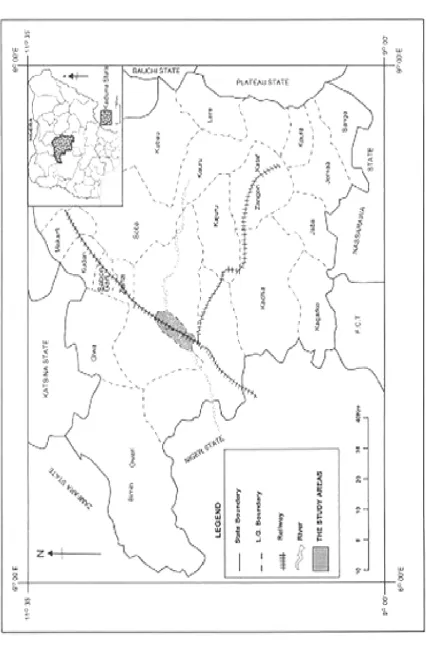
Kaduna metropolis is the capital of Kaduna State (Figure.1) of Nigeria. It is located between latitudes 10o 22’ 00’’ - 10o 40’ 00’’ N and longitudes 70 20’ 00’’ - 70 28’ 00’’ E [Adewuyi, 2008].
126
127 The metropolis occupies an area of about 260 km2, and the distance between the eastern and western limits of the city is approximately 13.7km though this keep changing as development increases. It is made up of four Local Government Areas: Kaduna North, Kaduna South, Igabi and Chikun. Historically, Kaduna metropolis became prominent as a result of being the administrative capital of Northern Nigeria Protectorate from 1912 to 1917 and head-quarters of North Central State from 1967 to 1975 (the North Central State was made up of Zaria and Katsina provinces). In 1975 the name changed from North Central State to Kaduna State but Kaduna metropolis remained the capital and maintained its sphere of influence. In 1987 Katsina State was created from Kaduna State and boundary adjustments were made. Kaduna metropolis attracted di-fferent types of individuals and groups from diverse socio-cultural backgrounds before, during and even after inde-pendence [Ajibuah, 2008].
Right from the period of colonial admi-nistration, Kaduna metropolis has recorded a steady growth in population from 10,653 in 1931, through 44,500 in 1952 to 149,910 in 1963 [Kore, 2000]. The census figures of 1991 put the population at 976,272 out of whom 518,180 (53%) were males and 458,092 (47%) were females
[Kaduna State of Nigeria, 1991]. The 1991
census gave a growth rate of 3.2% per annum for Kaduna State, which is greater than the national growth rate of 2.8% per annum. Going by this projection, Kaduna would have registered a population of 1,073,035 in 1994, 1,179,378 in 1997, 1,295,623 in 2000 and 1,487,454 in 2005. The population density of the city has recorded a steady growth from 155 people per km2 in 1931 to 1,077 people per km2 in 1960, by 2000 it had recorded 4,148 people per km2 and 4,540 people per km2 in 2005 [Adewuyi, 2005; Adewuyi, 2008].
The population of Kaduna State is distributed over the high, medium and low density residential areas of the city. The low density residential areas are the Go-vernment Residential Areas (GRAs) of Malali in the northern part of the city and Barnawa in the southern part of the city. The medium density residential areas are the areas located not far from the city centre, while the high density residential areas are typical of the Ungwas, for example, Ungwan-Sarki, Ungwan-Kana-wa, Ungwan Rimi, and Ungwan- Boro.
Kaduna is inhabited by various ethnic and religious groups. The low density and the medium density residential areas of the city are not dominated by any particular ethnic or religious group. However, some parts of the metropolis are dominated by certain ethnic and/or religious groups. For instance, Ungwan Boro, Ungwan Pama, Ungwan Makama, Ungwan Romi and Sabo areas of the metropolis are domi-nated by Christians and heterogeneous ethnic groups. On the contrary, Ungwan Rimi, Ungwan Sarki, Ungwan Muazu, Ungwan Kanawa, Tudunwada and Rigasa are dominated by Muslims and Hau-sa/Fulani ethnic groups.
THE METHODS
Data Types and Sources
128
Reconnaissance Survey
Reconnaissance survey was first carried out in the study area. This was done to get acquainted with the various census tracts and the neighborhoods were the research would take place. During the reconnai-ssance survey, the boundary of the four Local Government Areas (LGAs) and the Wards within them were identified. In the Kaduna North LGA, nine Wards were identified, in the Kaduna South LGA, seven Wards were identified, in Chikun
LGA, four Wards were identified, while in Igabi LGA, only one Ward was identified to be part of the study area.
Pilot Survey
A pilot survey was carried out at Janruwa (a census tract in the study area) to test the adequacy of the survey instruments for the research and to gain experience ahead of the main survey. During the survey, field assistants administered instruments for the study after intensive training on field work was conducted for them.
Sampling Technique
The National Population Commission (NPC) survey of locality and subsequent demarcation into Enumeration Areas (EAs) was used as the spatial frame for the hou-sehold sampling. The sample size for the study was 0.3 percent of households. The sample size was used because the house-holds’ number in the metropolis was fairly large; hence, the sample size of 0.3 percent gave a very large number of households which when carefully selected across the metropolis was representative enough for the opinion of the respondents. The sample size consists of 1036 households out of the total household’s number of 345,236. Ho-wever, 1020 were returned which is 98 percent of the sample size. The data from the field were eventually subjected to ana-lysis.
Stratified-systematic sampling technique was employed in selecting the respo-ndents. This design was used in order to
allow the respondents to be chosen only by chance so as to avoid any kind of bias and for a proper representation of the study area. This could not be divulged from the fact that the population of the study area is recorded along census tracts [NPC, 1991], thereby making each of the census tracts to stand as a stratum and due to the hetero-geneous nature of the study space in terms of ethnicity and religion.
Data Collection
Research assistants (RAs) were engaged for data collection. Two supervisors were employed to co-ordinate as revolving field assistants. Fourteen RAs were used for the data gathering and these comprise of ten males and four females, all who were con-versant with the local languages. The RAs
were divided into two groups (seven in a group) with each group having two fe-males. This structuring is essential because of the cultural space. The female RAs were made to enter into houses where entry is forbidden for men (“baa-shiga”) to inter-view the respondents while their male co-unterparts wait for them outside the house. Each group is answerable to a supervisor who coordinates their activities on a daily basis. The data collection sheet was de-signed to include both structured and unstructured questions. Data collection lasted for two weeks.
RESULTS AND DISCUSSION
Expansion of the City
Residential mobility amongst other factors led to the expansion of Kaduna metropolis.
129 accommodation in the areas people moved to, forced the movers to buy parcels of land and build their own houses. Further-more, the ever-increasing demand for housing against the limited number of hou-sing supply favors land-owners and house-owners. This has led to land and housing speculation in Kaduna metropolis to the detriment of tenants.
Strengthening of Family ties
Change of residence within the metropolis also resulted in the strengthening of family ties. As a family changes residence, it improves its networking with people that share the same faith and the same tribe. Most of the mover households are non-indigenes and as such they carefully move to areas inhabited by similar culture.
Afolayan [1994] posits that movements
within the city could be influenced by
social links and Hedman [2012] explains
that social ties are among the most im-portant factors explaining destination choi-ces of mover households. Social tie is a significant predictor of residential mobility within Kaduna metropolis.
Residential Segregation
The residential mobility in Kaduna metro-polis resulted in residential segregation of the metropolis. Cultural issues are impo-rtant in the conversations about the hou-sing segregation phenomenon [Clark, 20-09]. The issue of culture is better explai-ned by agent-based model. One of the first agent – based models was Schelling’s (19-71, 1972, 1974, 1978, 2006) model of residential tipping which showed how the preferences of autonomous individuals ab-out where to live give rise to (unantici-pated) aggregate patterns of residential se-gregation. Ajibuah [2008] explains that ethno religious issues are social and histo-rical phenomena. They are not just expe-riences of reality, which are personal and ultimate, but they have vision of reality and means of articulating those visions expressed in concepts. Ethno-religions are not only sources of identity but they are
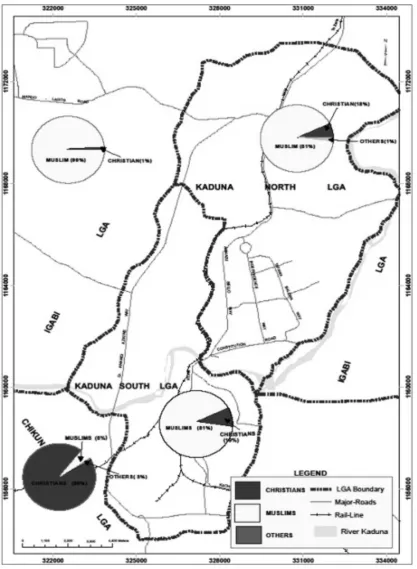
also ideological systems. Their visions in-corporate identity frames which weaken private identity because of their emphasis on collectivism. Residential mobility wi-thin the metropolis eventually led to socio spatial sorting of the residents in the me-tropolis (Figure.1.2)
Socio-Spatial Sorting of the Residents
Figure. 2 shows that socially determined local residential preferences can result to socio-spatial sorting in the long run. The socio-political dimension of religious ide-ntity is enormous. For instance, Komolafe
[2012] explains that religion and politics have been bedfellows throughout Nigeria’s history. He noted that this symbiotic rela-tionship has been the ground for conflict-ing ideological currents and the central factor that is shaping alignments and anta-gonisms. The most pervasive are those along the fault lines between Islam and Christianity, Nigeria’s two major religions.
In Kaduna political arrangements are sha-ped in such a way that religion serves as the ideological preference for national ide-ntity much more than any configuration along cultural or historical lines. For insta-nce, in the 2011 general elections, the Co-ngress for Progressive Change (CPC) with a Muslim as presidential candidate won larger number of votes at Igabi Local Go-vernment Area (Muslim dominated area), while the Peoples Democratic Party (PDP) with a Christian as presidential candidate won larger number of votes at Chikun Lo-cal Government Area (Christian domina-ted area) of the metropolis.
Multigroup Analog
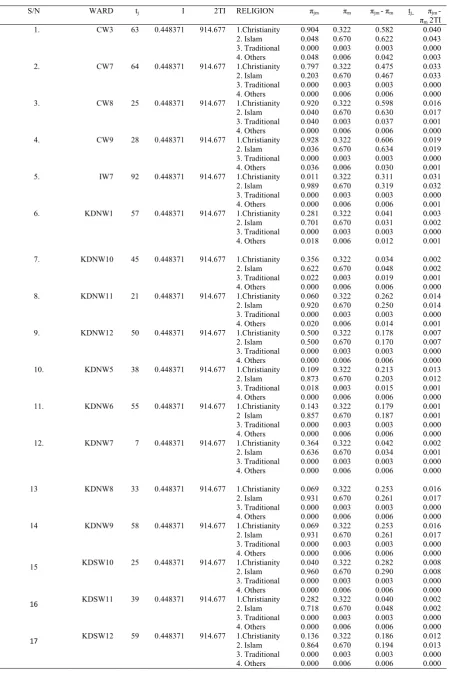
conceptual-130 lization of residential segregation is based on the dimension of evenness which refers to the differential distribution of the su-bject population, across neighborhoods in a metropolitan area. It ranges from 0 (co-mplete integration) to 1 (co(co-mplete
segrega-tion). Multigroup dissimilarity indices are ordered for universal interpretation. Basi-cally, the index value below 30 is consi-dered low, index between 30 and 60 is ta-ken to be moderate while the index above 60 is high.
131
Table 1. Multigroup Dissimilarity of Households in Kaduna Metropolis
S/N WARD tj I 2TI RELIGION πjm πm πjm - πm tj πjm -
πm 2TI
1. CW3 63 0.448371 914.677 1.Christianity
2. Islam 3. Traditional 4. Others
2. CW7 64 0.448371 914.677 1.Christianity
2. Islam 3. Traditional 4. Others 3. Traditional 4. Others 3. Traditional 4. Others 3. Traditional 4. Others 3. Traditional 4. Others 3. Traditional 4. Others 3. Traditional 4. Others 3. Traditional 4. Others 3. Traditional 4. Others 3. Traditional 4. Others 3. Traditional 4. Others
132 Source: Households Survey, 2011
Eva [2008] studied residential segregation of St Paul’s West Side and found that the residential segregation there was influenc-ed by ethnicity. Parisi and Lichter [2012] used secondary data and found that both in 1990 and 2000; the segregation index for “Hispanic segregation in America’s New Rural Boomtowns” was roughly 50 which is moderately high by conventional sta-ndard. The segregation Index of 0.58 for Kaduna metropolis is similar to the Index of 0.50 for “Hispanic Segregation in Ame-rica’s New Rural Boomtowns”. Hence, the segregation index of 0.58 for Kaduna me-tropolis is moderately high.
RECOMMENDATIONS
The findings of this research have shown that the pattern of movement of the house-holds depicts the Schelling’s model of residential tipping. The residents of Kadu-na metropolis are given to religious bigo-try which in turn influences the destination of movers. This is a bad trend for future urban development as it widens diffe-rences between neighbourhoods. Some neighbourhoods within the metropolis experiences rapid transformation while other neighborurhoods have degenerated from their original status. This negates pu-blic policies for housing at attempt to pro-mote integration among people. The magnitude of the residential mobility was fairly high as about 46 percent of the
respondents were known to have changed residence within the metropolis. This re-sulted in traffic hold-ups in some of the neighbourhoods, hence, increase work-tra-vel-time on daily basis. The residential sorting in Kaduna metropolis also influ-ence residential property values as varia-tions in the values of the available pro-perties in different neighbourhoods is very glaring. This in turn affects land and la-nded property investment in the metro-polis, whereby some neighbourhoods are experiencing rapid investment and trans-formation when compared to others. Ho-wever, there is land speculation in the neighbourhoods experiencing rapid invest-ment.
Public policies at attempt to promote equal development of the metropolis may have to address the improvement of infrastru-ctural facilities in the degenerated and less favoured neighbourhoods so as to encou-rage people to live there. There must also be additional incentives such as tax rebate on the properties in the less favourable neighbourhoods. Government should make adequate Mass Transit Buses (MTB) avai-lable and improve on road network of the various neighbourhoods in the metropolis so as to reduce the work-travel-time of the residents. Government should also esta-blish low cost housing schemes in descent socioeconomic neighbourhoods to mitigate
18. KDSW2 117 0.448371 914.677 1.Christianity
2. Islam 3. Traditional 4. Others
19. KDSW5 63 0.448371 914.677 1.Christianity
2. Islam 3. Traditional 4. Others
20. KDSW8 39 0.448371 914.677 1.Christianity
2. Islam 3. Traditional 4. Others
21. KDSW9 42 0.448371 914.677 1.Christianity
133 massive outflow of people from such neighbourhoods.
CONCLUSION
Residential mobility is a process which has significant effect on urbanscape. Its effect is highly noticeable in Kaduna metropolis. The residential mobility in the metropolis can better be explained by agent-based model of residential tipping which showed how the preferences of autonomous indi-viduals about where to live give rise to residential sorting. Religion is a major factor of cultural divide in the metropolis. Christians prefer to live in the Christians dominated neighbourhoods and Muslims
in the Muslims dominated neighbour-hoods. This led to socio spatial sorting of residences in the metropolis with its attendant effects. Knowledge of these effects would be useful in the forecast of future landuse patterns in the metropolis.
ACKNOWLEDGEMENT
This paper is part of my PhD research. Thanks due to my supervisor, Prof. Stanley, I. Okafor of Dept. of Geography, University of Ibadan, Mr. Bernard Helda of GIS Lab, Dept. of Geography, Nigerian Defence Academy, Kaduna and ano-nymous reviewers for their contributions.
REFERENCES
Adewuyi, T.O. (2005). Analysis of Cha-nges in Landuse and Landcover of some Parts of Kaduna Metropolis,
BEST, 2 (1), 9-14.
Adewuyi, T.O. (2008). Land Degradation in the Peri-Urban Area of Kaduna Metropolis, Nigeria, Unpublished
Ph.D. Thesis, Department of
Geo-graphy, Bayero University, Kano.
Afolayan, A.A. (1994). Migration, Social links and Residential Mobility in the Ibadan Region: A case study of Ojoo and of Sasa Residents, in Filani, M.O., Akintola, F.O. and Ikporukpo, C.O. (eds.) Ibadan
Region. Rex Charles Publication,
136-144, Ibadan
Ahmed, M. (1995). Pattern of Residential Mobility in Bahawalpur City,
Unpublished PhD Thesis,
Depart-ment of Geography, Islamia Uni-versity, Bahawalpur, 1-202.
Ajibuah, B.J. (2008). Ethno-Religious Conflicts and Residential Segrega-tion in Kaduna Metropolis,
Unpu-blished PhD Thesis, Dept. of
Geo-graphy, Faculty of Social and Management Sciences, Bayero University, Kano, 10-50, Kano.
Clark, W.A.V. (2009). Changing Resi-dential Preferences across Income, Education, and Age: Findings from the Multi-City Study of Urban Inequality, Urban Affairs Review, 44 (3), 334 – 355.
Eluru, N., Sener, I.N., Bhat, C.R., Pe-ndyala, R.M., and Axhausen, K.W. (2008). Understanding Residential Mobility: A joint model of the reason for residential relocation
and stay duration, 1-26
http://- www.ce.utexas.edu/prof/bhat/-ABSTRACTS/ResidentialMobility _1Aug2008.pdf.
Eva, D. (2008). Residential Segregation of Immigrants: A case study of the
Mexican Population on St Paul’s
West Side. Center for Urban and
134 Gobillon, L. (2008). Une Synthese de la
Litterature sur la consommation de
Logement des Menages. Working
Paper.
Hedman, L. (2012).Moving Near Family? The Influence of Extended Family on Neighbourhood Choice in an Intra-urban Context, Population,
Space and Place, January 31, doi:
10.1002/psp.1703.
Knox, P. (1987). Urban Social
Geogra-phy, An Introduction, 2nd ed.
Long-man Group, Harlow.
Komolafe, S. (2012). Politicization of reli-gion and the origins of funda-mentalisms in Nigeria (Part 1 of 3),
Nigeriaworld News, 12, 1 – 7.
Kore, W.M.J. (2000). Causes and Control of Road Accidents in the Kaduna Metropolis, Unpublished B.Sc.
Di-ssertation. Department of
Geogra-phy, NDA, Kaduna, 7 National Po-pulation Commission (NPC: 1991).
Oishi, S. (2010). The Psychology of Re-sidential Mobility: Implications for the Self, Social Relationships, and Well-Being, Perspectives on
Psy-chological Science, 5 (1), 5-21.
Parisi, D., and Lichter, D.T. (2012).
Hispanic Segregation in America’s
New Rural Boomtowns. Population
Reference Bureau.
Pawson, H., and Bramley, G. (2000). Understanding Recent Trends in
Residential Mobility in Council Housing in England, Urban Stu-dies, 37 (8), 1231 – 1259.
Reardon, S.F., and Firebaugh, G.(2002). Measures of multi-group segrega-tion, Sociology Methodology, 32, 33-7.
Schelling, T. (1971). Dynamic models of segregation, Journal of
Mathema-tical Sociology, 1, 143 – 186.
Schelling, T. (1972). A process of Resi-denti- al Segregation: Neigh-borhood Tipping, in Pascal, A. (ed.) Racial Discrimination in
Eco-nomic Life, Lexington, MA: D.C.
Heath, 157 – 184.
Schelling, T. (1974). on the ecology of micro-motives, In R. Marris (ed.),
The Corporate Society, Macmillan,
19-55, London.
Schelling, T. (1978). Micromotives and
Macrobehaviour, Norton and Co.,
New York.
Schelling, T. (2006). Some fun, thirty-five years ago, Handbook of
Computa-tional Economics, 2: 1639 – 1644.
van der Vlist, A.J., Gorter, C., Nijkamp, P., and Rietveld, P. (2001). Resi-dential Mobility and Local Hous-ing Market Differences, Discussion
Paper. Tinbergen Institute 1-8,