Introduction to Management Science
(8th Edition, Bernard W. Taylor III)
Chapter 12
Chapter Topics
The Shortest Route Problem
The Minimal Spanning Tree Problem
Overview
A network is an arrangement of paths connected at various points through which one or more items move from one
point to another. point to another.
The network is drawn as a diagram providing a picture of the system thus enabling visual interpretation and
enhanced understanding.
A large number of real-life systems can be modeled as networks which are relatively easy to conceive and
Network diagrams consist of nodes and branches.
Nodes (circles), represent junction points, or locations.
Branches (lines), connect nodes and represent flow.
Network Components (1 of 2)
Four nodes, four branches in figure.
“Atlanta”, node 1, termed origin, any of others destination.
Branches identified by beginning and ending node numbers.
Network Components (2 of 2)
Branches identified by beginning and ending node numbers.
Value assigned to each branch (distance, time, cost, etc.).
Problem: Determine the shortest routes from the origin to all destinations.
The Shortest Route Problem
Definition and Example Problem Data (1 of 2)
Figure 12.2
The Shortest Route Problem
Definition and Example Problem Data (2 of 2)
Figure 12.3
The Shortest Route Problem
Solution Approach (1 of 8)
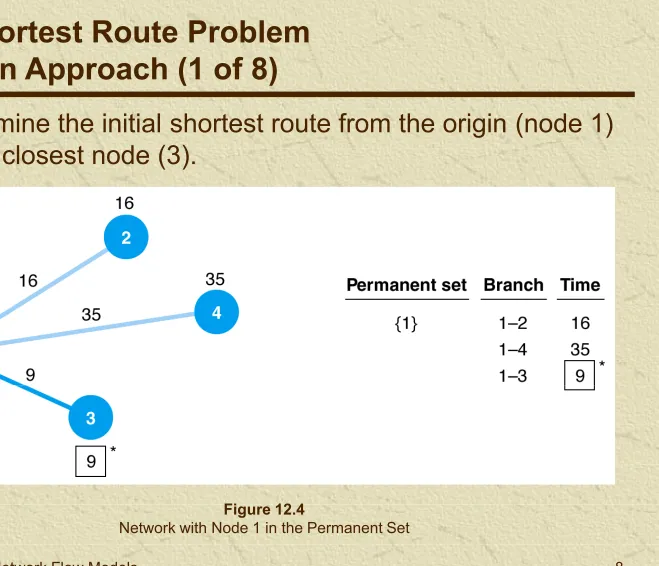
Determine the initial shortest route from the origin (node 1) to the closest node (3).
Figure 12.4
The Shortest Route Problem
Solution Approach (2 of 8)
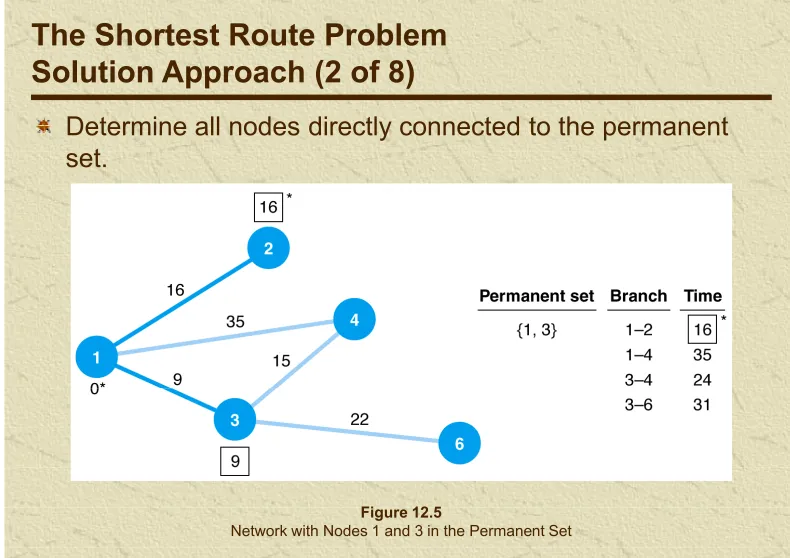
Determine all nodes directly connected to the permanent set.
Figure 12.5
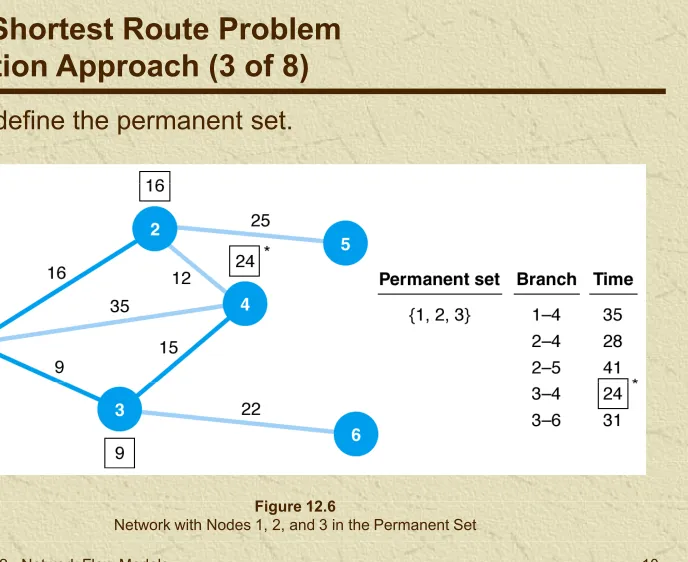
Redefine the permanent set.
The Shortest Route Problem
Solution Approach (3 of 8)
Figure 12.6
The Shortest Route Problem
Solution Approach (4 of 8)
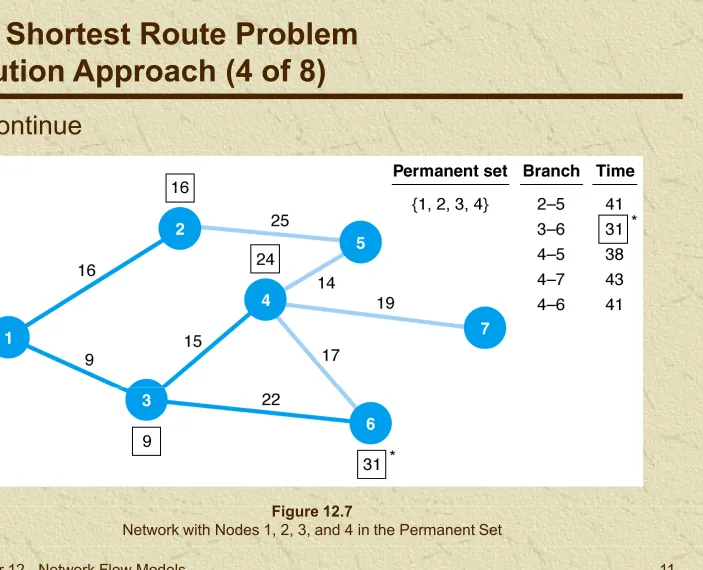
Continue
Figure 12.7
The Shortest Route Problem
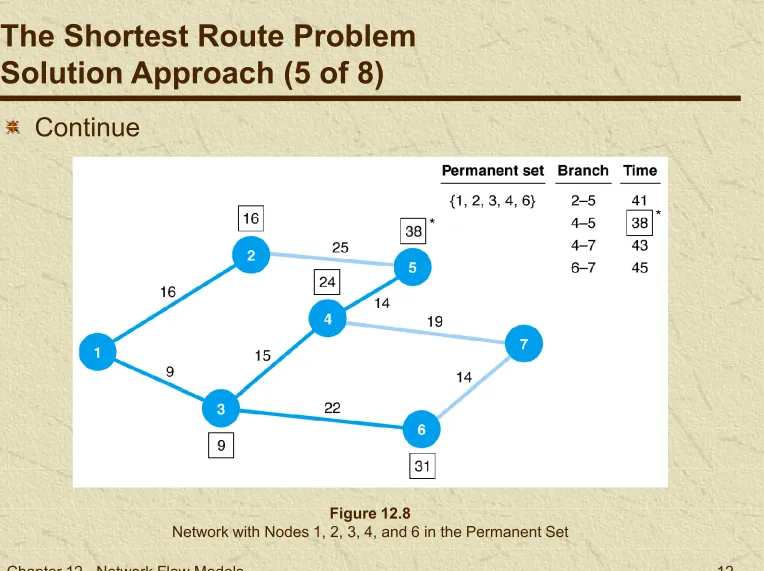
Solution Approach (5 of 8)
Continue
Figure 12.8
The Shortest Route Problem
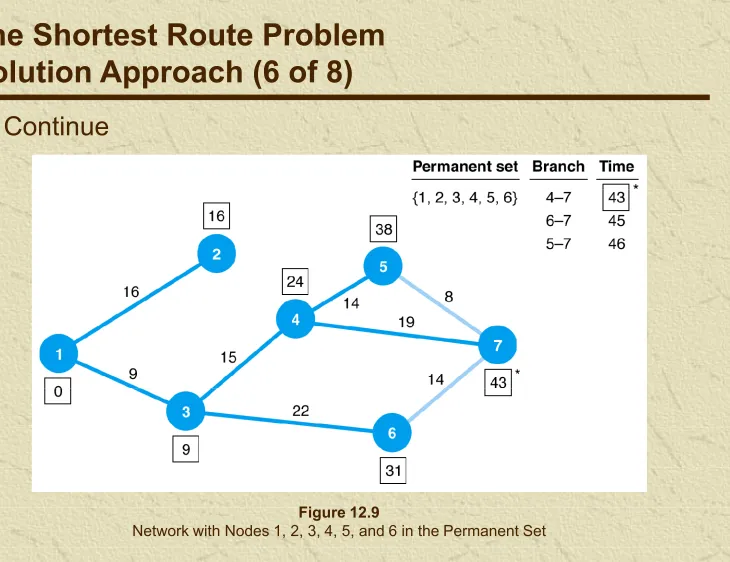
Solution Approach (6 of 8)
Continue
Figure 12.9
The Shortest Route Problem
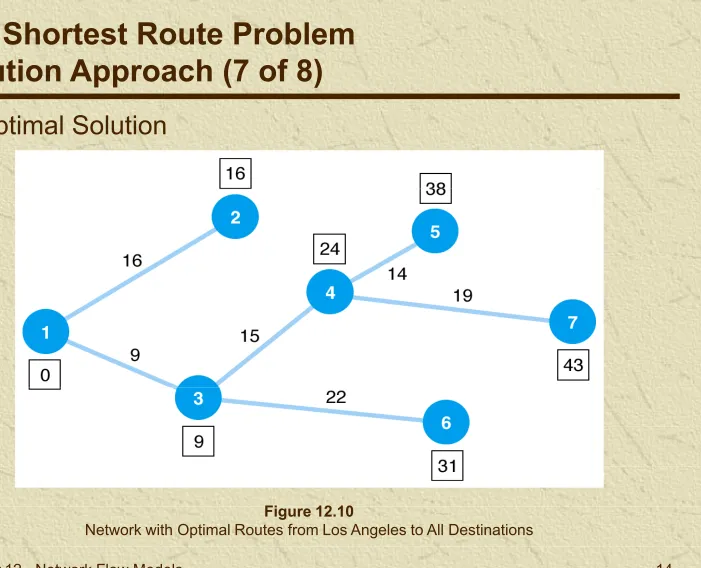
Solution Approach (7 of 8)
Optimal Solution
Figure 12.10
The Shortest Route Problem
Solution Approach (8 of 8)
Solution Summary
Table 7.1
The Shortest Route Problem
Solution Method Summary
Select the node with the shortest direct route from the origin.
Establish a permanent set with the origin node and the Establish a permanent set with the origin node and the node that was selected in step 1.
Determine all nodes directly connected to the permanent set nodes.
Select the node with the shortest route (branch) from the group of nodes directly connected to the permanent set group of nodes directly connected to the permanent set nodes.
The Shortest Route Problem
Computer Solution with QM for Windows (1 of 2)
The Shortest Route Problem
Computer Solution with QM for Windows (2 of 2)
Formulation as a 0 - 1 integer linear programming problem.
xij = 0 if branch i-j is not selected as part of the shortest route and 1 if it is selected.
The Shortest Route Problem
Computer Solution with Excel (1 of 4)
and 1 if it is selected.
The Shortest Route Problem
Computer Solution with Excel (2 of 4)
The Shortest Route Problem
Computer Solution with Excel (3 of 4)
The Shortest Route Problem
Computer Solution with Excel (4 of 4)
The Minimal Spanning Tree Problem
Definition and Example Problem Data
Problem: Connect all nodes in a network so that the total branch lengths are minimized.
Figure 12.11
The Minimal Spanning Tree Problem
Solution Approach (1 of 6)
Start with any node in the network and select the closest node to join the spanning tree.
Figure 12.12
The Minimal Spanning Tree Problem
Solution Approach (2 of 6)
Select the closest node not presently in the spanning area.
Figure 12.13
The Minimal Spanning Tree Problem
Solution Approach (3 of 6)
Continue
Figure 12.14
The Minimal Spanning Tree Problem
Solution Approach (4 of 6)
Continue
Figure 12.15
The Minimal Spanning Tree Problem
Solution Approach (5 of 6)
Continue
Figure 12.16
The Minimal Spanning Tree Problem
Solution Approach (6 of 6)
Optimal Solution
Figure 12.17
The Minimal Spanning Tree Problem
Solution Method Summary
Select any starting node (conventionally, node 1).
Select the node closest to the starting node to join the spanning tree.
spanning tree.
Select the closest node not presently in the spanning tree.
The Minimal Spanning Tree Problem
Computer Solution with QM for Windows
The Maximal Flow Problem
Definition and Example Problem Data
Problem: Maximize the amount of flow of items from an origin to a destination.
Figure 12.18
The Maximal Flow Problem
Solution Approach (1 of 5)
Arbitrarily choose any path through the network from origin to destination and ship as much as possible.
Figure 12.19
The Maximal Flow Problem
Solution Approach (2 of 5)
Re-compute branch flow in both directions and then select other feasible paths arbitrarily and determine maximum flow along the paths until flow is no longer possible.
along the paths until flow is no longer possible.
Figure 12.20
The Maximal Flow Problem
Solution Approach (3 of 5)
Continue
Figure 12.21
The Maximal Flow Problem
Solution Approach (4 of 5)
Continue
Figure 12.22
The Maximal Flow Problem
Solution Approach (5 of 5)
Optimal Solution
Figure 12.23
The Maximal Flow Problem
Solution Method Summary
Arbitrarily select any path in the network from origin to destination.
Adjust the capacities at each node by subtracting the Adjust the capacities at each node by subtracting the maximal flow for the path selected in step 1.
Add the maximal flow along the path to the flow in the opposite direction at each node.
Repeat steps 1, 2, and 3 until there are no more paths with available flow capacity.
The Maximal Flow Problem
Computer Solution with QM for Windows
iij = flow along branch i-j and integer Maximize Z = x61
The Maximal Flow Problem
Computer Solution with Excel (1 of 4)
The Maximal Flow Problem
Computer Solution with Excel (2 of 4)
The Maximal Flow Problem
Computer Solution with Excel (3 of 4)
The Maximal Flow Problem
Computer Solution with Excel (4 of 4)
The Maximal Flow Problem
Example Problem Statement and Data (1 of 2)
Determine the shortest route from Atlanta (node 1) to each of the other five nodes (branches show travel time between nodes).
nodes).
The Maximal Flow Problem
Step 1 (part A): Determine the Shortest Route Solution
1. Permanent Set Branch Time
{1} 1-2 [5]
The Maximal Flow Problem
Example Problem, Shortest Route Solution (1 of 2)
The Maximal Flow Problem
The Maximal Flow Problem
Example Problem, Minimal Spanning Tree (1 of 2)
The closest unconnected node to node 1 is node 2.
The closest to 1 and 2 is node 3.
The closest to 1, 2, and 3 is node 4.
The closest to 1, 2, 3, and 4 is node 6.
The closest to 1, 2, 3, 4 and 6 is 5.