3,4-DIHYDROXYBENZOIC ACID AND 3,4-DIHYDROXYBENZALDEHYDE FROM THE FERN
Trichomanes chinense
L.; ISOLATION, ANTIMICROBIAL AND ANTIOXIDANT PROPERTIES
Nova Syafni, Deddi Prima Putra, and Dayar Arbain*
Faculty of Pharmacy/Sumatran Biota Laboratory, Andalas University, Kampus Limau Manis, Padang, 25163, West Sumatera, Indonesia
Received May 1, 2012; Accepted September 5, 2012
ABSTRACT
3,4-dihydroxybenzoic acid (1) and 3,4-dihydroxybenzaldehyde (2) have been isolated from ethyl acetate fraction of methanolic fractions of leaves, stems and roots of the fern Trichomanes chinense L. (Hymenophyllaceae). These two compounds also showed significant antioxidant using DPPH and antimicrobial activities using the disc diffusion assay.
Keywords: Trichomanes chinense L.; 3,4-dihydroxybenzoic acid; 3,4-dihydroxybenzaldehyde; antioxidant; antimicrobial
ABSTRAK
Telah diisolasi asam 3,4-dihidroksibenzoat (1) dan 3,4-dihidroksibenzaldehid (2) dari fraksi etil asetat ekstrak metanol daun, batang dan akar paku Trichomanes chinense L. (Hymenophyllaceae). Kedua senyawa ini memperlihatkan sifat antioksidan yang signifikan ketika diuji dengan metoda DPPH dan antimiokroba ketika diuji dengan metoda diffusi agar.
Kata Kunci: Trichomanes chinense L.; asam 3,4-dihidroksibenzoat (1); 3,4-dihidroksibenzaldehid (2); antioksidan; antimikroba
INTRODUCTION
Based on a study on fossils particularly on that of Polypodiaceous family, it was considered that ferns have inhabited the earth as one of the pioneering plants since the ancient time [1]. It was estimated that there were more than 12,000 ferns in the world and more than 3,000 species were found in Indonesia [2]. However, researches on ferns in Indonesia particularly on their chemical constituents are still very limited. So far, only few reports are available on their botanical work [3] while from the chemical point of few there is only one report available on the constituent of Gleichenia linearis (Burm.) Clarke. [4].
Some ferns have been recorded as folk medicines in some countries such as in India, China and Greece [5]. In Indonesia, Diplazium esculentum Swartz [6], Asplenium prolongatum Hook, Lindsaea orbiculata (Lamk.) Mett., Microsorium fortune (Moore) Ching, M. buergerianum (Miq.) Ching., Neottopteris nidus (L.) J. Smith, Nephrolepis cordifolia (L.) Presl., Pteris ensiformis Burm. (all Polypodiaceae), Lycopodium cernuum L, (Lycopodinaceae), Dicranopteris dichotoma (Thunb.) Bernh. (Gleicheniaceae), Lygodium japonicum (Thunb.) SW, Lygodium scandens (L.) SW,
(Schizaeacee), Selaginella doederlinii Hieron, S. tamariscina(Bauv.) Spring,S. unsinata(Desv.) Spring. (Sellaginellaceae) are also recorded to have medicinal properties [7-8]. In continuation of our study on Sumatran ferns [6], chemical study, antimicrobial and antioxidant properties ofT. chinenseis described.
Cremastra appendiculata (D. Don) Makino (Orchidaceae) [14] and leaves of Vitis vinifera L. (Vitaceae) [15].
EXPERIMENTAL SECTION
Materials
Plant material:T. chinensewas collected in Alahan Panjang, Solok District, West Sumatra in May 2011. Herbarium specimen (F02) was identified by Dr. Ardinis Arbain from Herbarium Andalas University (ANDA) and Dr. Arif Hidayat from Herbarium Bogoriense (BO) and lodged at both herbaria. Sample were divided into three parts; leaves, stems and roots.
Testing microbes: Escherichia coli ATCC 25922 NCTC 1224, Staphylococcus aureus ATCC 25923, Vibrio choleraInaba andSalmonella thypimuriumATCC 14028 NCTCC 12023 were provided by Indonesian Food and Drug Administration (BPOM) Padang Office and pre cultured before being used.
Another materials are methanol p.a (Merck), nutrient agar (NA) (Merck), paper disc (Whatman), dimethyl sulfoxide (DMSO) (Merck), chloramphenicol (Sigma), and DPPH (2,2-diphenyl-1-picrylhydrazyl) free radical (Sigma).
Instrumentation
Melting points were measured on a Sybron Thermolyne Melting Point Apparatus MP-12615 and are uncorrected, FT-IR spectra on Perkin Elmer FT-IR Spectrum One Spectrophotometer. UV spectra recorded on Shimadzu Spectrophotometer UV-VIS Pharmaspec 1700, the1H and13C-NMR spectra were measured using Bruker DMX 500 instruments (500 MHz for 1H and 125 MHz for 13C). Mass spectra were obtained on a Varian MAT 311 mass spectrometer for electron spray and a Micromass ZABSpecTOF mass spectrometer. TLC was carried out using silica gel 60F254 (Merck) and visualized under UV light (254 nm). Column chromatography was performed on silica gel 60 (0.063-0.200 nm) (Merck). Radial chromatography was
performed on silica gel 60 PF254 containing gypsum (Merck).
Procedure
Extraction and isolation
Air dried samples ofT. chinense (leaves (6.0 kg), stems (4.3 kg) and roots (1.5 kg)) were macerated separately with MeOH for 5 days. After separation of solvents the process was repeated twice more. The combined methanolic extracts were evaporated in vacuo to give thick methanolic extracts. Water was added up to 1 L then fractionated in turn with hexane, EtOAc and butanol respectively and evaporated in vacuoto give fractions of hexane (leaves 67.6 g, stems 16.0 g, roots 7.0 g), EtOAc (leaves 69 g, stems 31.4 g, roots 10.7 g) and butanol (leaves 351.0 g, stems 53.2 g, roots 14.0 g) respectively. The EtOAc fractions (leaves, stems and roots: 60.0 g, 25.0 g and 10.0 g respectively) were preadsorbed on SiO2 then column chromatographed on the same adsorbent and eluted with step gradient polarity solvents started from hexane, hexane:EtOAc, EtOAc and EtOAc:MeOH to give series of two major spots on TLC. These were combined, evaporated and then radial chromatographed with an increasing amount of EtOAc in hexane.
The more polar series were combined, evaporated then crystallized from EtOAc-hexane to give reddish brown plates (100 mg from leaves (0.02% from dry weight), 22 mg from stems (0.0028% from dry weight) and 2 mg from roots (0.0003% from dry weight)). Based on its spectroscopic data this compound was identified as 3,4-dihydroxybenzoic acid (1), Mp: 198 °C, UV λmax(log ε): 294.2 nm (3.628),
Fig1.HMBC-correlation of (1)
Table 1.NMR data of 3,4-dihydroxybenzoic acid (1) and 3,4-dihydroxybenzaldehyde (2)
Compound 1 Compound 2
No. 13C-NMR 1H-NMR
δH, multiplicity, coupling
13
C-NMR 1H-NMR
δH, multiplicity, coupling
1 123.28 - 124.59
-2 117.85 7.44, 1H, d, J2,6= 2Hz 115.21 7.44, 1H, d, J2,6= 2Hz
3 146.18 - 145.44
-4 151.66 - 151.27
-5 124.03 7.42, 1H, d, J2.6= 2Hz,
J5.6= 6Hz
130.13 7.42, 1H, d, J2.6= 2Hz,
J5.6= 6Hz
6 115.89 6.79, 1H, d, J5.6= 6Hz 114.22 7.00, 1H, d, J5.6= 6Hz
-IR (KBr): 3210.73, 1675.42, 1299.78, 1096.45 cm-1, molecular ion at m/z (%) = 154.0267, C7H6O4. 13C and 1
H-NMR data of compound 1 (see Table 1).
The less polar series yielded compound (2) as colorless needles (35 mg from leaves (0.002% from dry weight), 33 mg from stems (0.003% from dry weight) and 8 mg from roots (0.0007% from dry weight)). As above, based on its spectroscopic data this compound was identified as 3,4-dihydroxybenzaldehyde (2), Mp: 148 °C, UV λmax(log ε): 312.2 nm (4.030); 278.2 nm (4.087); 232 nm, IR (KBr): 3238.70, 1651.83, 1589.94, 1455.25, 1304.50, 1154.17, 877.70, 814.16, 776.70 and 755.42 cm-1, molecular ion at m/z (%)= 138.0318, C7H6O3. 13C and1H-NMR data of compound (2) see Table 1.
Antimicrobial properties
Before being used each bacterium were grown separately in nutrient agar (NA) (Merck) and incubated at 37 °C for 24 h. These cultures were used for antimicrobial assay by modified agar disc diffusion method of Kirby and Bauer [16]. Single colony of the respective testing bacterium was transferred into NA medium and incubated for 24 h. Culture suspensions in sterile NaCl 0.9% with 25% transmittant were swabbed onto their respective agar plate. Each extract and fraction was prepared to the concentration of 200, 100, 50, 25, 12.5, 6.25 mg/mL, while compound 1 and 2 prepared from 2, 1, 0.5, 0.25, 0.125 and 0.0625 mg/mL in DMSO. Each 10 µL of extract, fraction and compound above was dropped onto paper disc (Whatman, 5 mm diameter) and carefully placed on the culture suspensions for cultivation plate. Control disc contained chloramphenicol 30 µg/mL was similarly prepared in DMSO. Each plate was incubated at 37 °C for 24 h. Inhibition zones (including the diameter of disc) were measured and recorded.
Antioxidant properties[17]
2 mg DPPH free radical was dissolved in 100 mL MeOH then scanned between 400-800 nm to get maximum absorption wavelength to be used to measure the absorbance of sample after being mixed with DPPH solution. Each sample diluted with MeOH to make the concentration of methanolic extracts 500, 250, 125 and 62.5 ppm; hexane 2000, 1000, 500 and 250 ppm; EtOAc 125, 62.5, 31.25 and 15.625 ppm; BuOH 250, 125, 62.5 and 31.25 ppm; pure isolated compounds as well as control gallic acid and ascorbic acid were prepared at the concentration of 50, 25, 12.5, 6.25 and 3.125 ppm. Each extract, fraction and isolated compound as well their dilution was pipetted 0.2 mL and mixed with 3.8 mL DPPH solution. The absorbance of mixing solutions was measured 30 min after the reaction. Data obtained were processed by using Finey Program and then corrected with regression equation.
RESULT AND DISCUSSION
Isolated Compounds
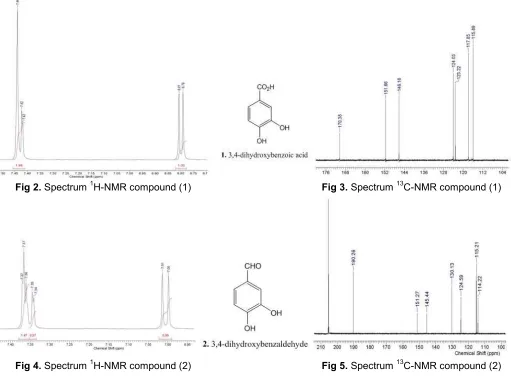
Compound (1) was obtained as reddish brown plates and gave molecular ion at m/z 154.0267 which was suitable with molecular formula C7H6O4. IR spectrum of (1) showed absorptions at (cm-1) 3210.73 (broad, OH); 1675.42 (C=O carboxylate); 1299.78 (C-H); 1096.45 (C=C); 764.7 (C=C-H). The presence of aromatic ring was supported by the UV data (λmaks 294.2 and 258.0 nm). Both of isolated compounds gave dark blue color when treated with ferric chloride indicated the presence of phenolic hydroxyl function. The 6 13C atom signals between 114-151 ppm also indicated the presence of aromatic ring. Signal at 170.38 ppm was due to carbonyl function of carboxylate.1H-NMR clearly indicated the presence of 3 protons coupled to each other either attached to C3, C5 and C6 with coupling constants J3.6= 2 Hz and J5.6= 6 Hz (see Fig. 2, Fig. 3 and Table 1) or attached to C2, 5, 6 with the same coupling constants. The long range coupling of C1 (123.28 ppm) in the HMBC experiment can be observed to H6 (6.79 ppm) and to H2 (7.44 ppm) which was slightly hindered by the signals of H5 (7.42 ppm) (see Fig. 1). Other HMBC correlation of C3-H2, C4-H5, C5-H6 as well as long range coupling of C carbonyl to H2 and H6 can also be observed clearly. Thus, based on these available data if the position of the carboxyl group was at C1, the protons of these compounds should be attached to C2, C5 and C6 and the two hydroxyl functions attached to C3 and C4. This compound could be identified as 3,4-dihydroxybenzoic acid (protocatechuic acid). Further comparison to physical data of this compound to that of reported data of 3,4-dihydroxybenzoic acid (1) in the literature [9] and to that of 2,4-dihydroxybenzoic acid [18] confirmed the above identification.
Compound (2) was obtained as a colorless needle and gave molecular ion at m/z 138.0318 and was considered to have molecular formula C7H6O3. IR spectrum of (1) showed absorptions at (cm-1) 3238.70 (OH), 1651.83 (C=O aldehyde), 1589.94 and 1455.25 (C=C aromatic), 1304.50 (C-H aldehyde), 1154.17 (O-H), 877.70 and 814.16 (C-(O-H), 776.70 (C=C) and 755.42 cm-1 (C=C). The presence of aromatic ring was supported by the UV absorption data (λmaks 312.2, 278.2 nm). The 13C-NMR signals indicated the presence of benzene ring, signals at 190.02 due to carbonyl of aldehyde. 1H-NMR clearly indicated the presence of 3 protons coupled to each other at position 2, 5, 6 with coupling constantsJ2.6= 2 Hz, and J5.6= 6 Hz. (see Fig. 4, Fig. 5 and Table 1). As above this
compound was identified as
Fig 2.Spectrum1H-NMR compound (1) Fig 3.Spectrum13C-NMR compound (1)
Fig 4.Spectrum1H-NMR compound (2) Fig 5.Spectrum13C-NMR compound (2)
Antimicrobial Properties
The antimicrobial potency of extracts and fractions of leaves stems and roots as well as two isolated compounds ofT. chinenseL. towardE. coliATCC 25922 NCTC 1224, Staphylococcus aureus ATCC 25923, Vibrio choleraInaba andSalmonella thypimuriumATCC 14028 NCTCC 12023 showed significant and dose– dependent inhibition towards used testing microbes (see Table 2). This result supports the traditional use of this plant to treat diarrhea. The experiments also revealed that the extracts and isolated compounds also active against Salmonella thypimurium ATCC 14028 NCTCC 12023 which was not only caused diarrhea but also salmonellosis with fever and abdominal cramp additional symptoms.
Interestingly at the working dose, antimicrobial activities of isolated compound (1) and (2) toward Escherichia coli ATCC 25922 NCTC 1224 was not significant compared to those of other testing bacteria, while extracts and fractions still showed significant
inhibitions compared to that of chloramphenicol. This means that even though the major compounds were not active there might be other minor active constituents present in the extracts and fractions. Our experiments also showed that the isolated compounds significantly inhibited the growth of Vibrio cholera but not significantly affected Escherichia coli which mean the extracts still can be used to treat diarrhea at the higher dose.
Table 2.Antimicrobial properties of extracts, fractions, two isolated compounds and chloramphenicol
Zone Inhibition (mm) (mg extract/disc) No. Sample
Escherichia coli Vibrio cholera Staphylococcusaureus thypimuriumSalmonella
1. Methanolic extr. leaves 7 (0.5a) 7.5 (0.125a) 7 (0.0625a) 7 (0.25a) 2. Methanolic extr. stems 10 (0.25a) 7 (0.25a) 6 (0.5a) 7 (0.25a) 3. Methanolic extr. roots 7 (0.5a) 7 (0.125a) 7 (0.25a) 7 (0.5a) 4. Hexane fr. leaves 6 (0.5a) 7 (0.5a) 6 (2a) 7 (1a) 5. Hexane fr. stems 6.5 (0.5a) 7 (0.5a) 6 (2a) 7 (0.25a) 6. Hexane fr. roots 6 (0.5a) 7 (0.5a) 8 (1a) 7 (0.25a) 7. EtOAc fr. leaves 7 (0.25a) 8 (0.125a) 8 (0.25a) 8 (0.25a) 8. EtOAc fr. stems 7 (0.25a) 7 (0.125a) 6 (0.5a) 7 (0.125a) 9. EtOAc fr. roots 6.5 (0.25a) 8 (0.125a) 7 (0.25a) 6 (0.25a) 10. BuOH fr. leaves 6 (1a) 7 (0.125a) 6.5 (0.25a) 6 (1a) 11. BuOH fr. stems 6 (0.5a) 6 (0.125a) 7 (0.25a) 6 (1a) 12. BuOH fr. roots 6 (0.5a) 8 (0.125a) 6 (0.5a) 6 (1a) 13. Compound 1 - (2.5b) 7 (2.5b) 5.5 (2.5b) 10 (2.5b) 14. Compound 2 5.5 (2.5b) 6 (2.5b) 5.5 (2.5b) 8 (1.25b) 15. Chloramphenicol 6.8±0.5(0.3)b 10.4±2(0.3)b 6.5±0.8(0.3)b 8.3±0.6(0.3)b
(a) concentration in mg/disc (b) concentration in µg/disc
Table 3. Data of antioxidant properties showed in concentration reaction
IC50(ppm)
Sample
Leaves Stems Roots MeOH extr. 5.83 4.52 5.15 Hexane fr. 14.32 31.35 25.63 EtOAc fr. 1.33 1.57 1.52
(1.78)* BuOH fr. 3.96 4.49 5.23
(6.69)*
*corrected with regression equation
Table 4. Data of antioxidant properties showed in concentration reaction
No. Sample IC50(nM)
1. Compound 1 0.86 2. Compound 2 0.58 3. Gallic acid 0.86 4. Ascorbic acid 1.57
Antioxidant Properties
Antioxidant screening of extracts and fractions of leaves, stems and roots of T. chinense showed the potential antioxidant properties in all of extracts and fractions (see Table 3). The highest antioxidant properties were showed by ethyl acetate fraction of methanolic extract of the leaves. Based on these results, further work was focused on the isolation of major constituents of the EtOAc fraction of leaves, stems and roots. Compound (1) showed significant antioxidant activity at 1.8 times stronger than ascorbic acid and about the same strength as gallic acid. Compound (2) was 2.7 times more potent than ascorbic acid and 1.5 times than gallic acid (see Table 3). The significant antioxidant activity can be understood due to the
presence of electronegative carbonyl function of carboxylic and aldehyde attached to C1 which facilitates the reductive ability of phenolic hydroxyl at C4.
In vitro mechanism of antioxidant activity of compound (1) has been reported using various antioxidant assay. From the results of this assay the effect as chemopreventive agent toward various cancer cells can be estimated. The strongest effect was observed toward skin squamous cell papilloma (PAP) at the doses 5, 10, 20 µM/locally on the skin of mice 5 min before being induced with 12-O-tetradecanoylphorbol 13-acetate (TPA) and transitional cell carcinoma (TCC) on buccal pouch of male Syrian golden hamster at the dose of 200 ppm in diet using 7,12-dimethylbenz[]anthracene (DMBA) as cancer promoter [21].
CONCLUSION
The isolation of constituents of ethyl acetate fraction of leaves, stems and roots gave the same major constituents identified as 3,4-dihydroxybenzoic acid and 3,4-dihydroxybenzaldehyde. The antimicrobial properties of extracts, fractions and compounds (1) and (2) support the traditional use of the fernT. chinenseto treat diarrhea, while their strong antioxidant properties might be developed into further use.
ACKNOWLEDGEMENT
Sciences Chimiques de Rennes, Equipe Produits Naturels Synthèses Chimie Médicinale, Universite de Rennes 1, France, for MS and NMR spectroscopic data; Dr. Ardinis Arbain from Andalas University Herbarium (ANDA) and Dr. Arif Hidayat from Herbarium Bogoriense (BO) for identification of the fern specimen; Indonesian Food and Drug Administration (BPOM) Padang for providing testing microbes.
REFERENCES
1. Preston, R.D., and Woolhause, H.W., “Advances in Botanical Research Vol. 4” in Evalutionary Patterns and Processes in Ferns., Lovis, J.D., Academic Press, London, New York, San Fransisco, 1977, 229–402.
2. Ardaka, I.M., Sudiatna, I.N., and Sukedana, I.K., 2005, Eksplorasi Tumbuhan Paku Potensial Kawasan Timur Indonesia di Kabupaten Jembrana. Bali: Kebun Raya ‘Eka Karya’ Bali-LIPI, 50–54. 3. Hartini, S., 2006,Biodiversitas,7, 3, 230–236. 4. Jubahar, J., Dachriyanus, Arbain, D., Bakhtiar, A.,
Mukhtar, M.H., and Sargent, M.V., 2006, ACGC Chem. Res. Commun., 20, 6–7.
5. Fernandez, H., Kumar, A., and Revilla, M.A., “Working with Ferns Issues and Applications”, in Studies on Folk Medicinal Fern: An Example of Gu-Sui-Bu, Chang, H-C., Gupta, S.K. and Tsay, H-S., Springer Science Business Media, New York, Dordrech, Heidelberg, London, 2011, 285–302. 6. Syafni, N., Rachmawati, V., Yenita, M., Putra, D.P.
and Arbain, D., 2011,Proceedings, International
Symposium on Natural Products and their
Applications in Health and Agriculture, Institute of Fundamental Studies, Kandy, Sri Lanka, 91.
7. Hutapea, J.R., “Inventaris Tanaman Obat Indonesia (III)”, Departemen Kesehatan RI; Badan Penelitian
dan Pengembangan Kesehatan, Jakarta, 1994, 9– 10.
8. Badan Penelitian dan Pengembangan Kesehatan, “Inventaris Tanaman Obat Indonesia (V)”, Departemen Kesehatan RI, Jakarta, 23–24, 47–48, 107–108, 115–120, 125–128, 133–136, 171–172, 187–192.
9. Naji, N.A., Shaari, K., Abas, F., and Lajis N.H., 2009,ACGC Chem. Res. Comm.,23, 44–47. 10. Li, X., Wang, X., Chen, D., and Chen, S., 2011,
Funct. Foods Health Disease, 1, 7, 232–244. 11. Zhao, H.R., Wang, M.S., and Zhou, G.P., 1993,
Zhongguo Zhong Yao Za Zhi., 18, 4, 226–8, 255. 12. Tseng, T-H., Kao, T-W., Chu, C-Y., Chou, F-P.,
Lin, W-L., and Wang, C-J., 2000, Biochem. Pharmacol., 60, 307–315.
13. Chang, Z.Q., Gebru, E., Lee, S.P., Rhee, M.H., Kim, J.C., Cheng, H., and Park, S.C., 2011,J. Nutr. Sci. Vitaminol, 57, 1, 118–122.
14. Zhang, Y., Huang, B., Zhao, Z., and Zhou, Y., 2011,Zhong Yao Cai, 34, 12,1882–3.
15. Weber, B., Hoesch, L., and Rast, D.M., 1995, Phytochem., 40, 2, 433–437.
16. Chen, I-N., Chang, C-C., Ng, C-C., Wang, C-Y., Shyu Y-T., and Chang, T-L., 2008, Plant Foods Hum. Nutr., 63, 1, 15–20.
17. Molyneux, P., 2004, Songklanakarin J. Sci. Technol., 26, 2, 211–219.
18. Li, N., Li, X., Feng, Z., Li, X., and Zhang, P., 2007, Zhongcaoyao, (SciFinder®, accessed on January 2012).
19. Chao, C-Y., and Yin, M-C., 2008, Foodborne
Pathog Dis., In press, DOI:
10.1089=fpd.2008.0187.
20. Mulvena, D., Webb, E.C., and Zerner, B., 1969, Phytochem., 8, 2, 393–395.