Rahmawati NT, Departement of Anatomy, Embriology and Anthropology, Faculty of Medicine Gadjah Mada University, Yogyakarta.
Somatotypes of children in different areas of
Indonesia
Rahmawati NT1., Hastuti J1., Yevita N2., and Ashizawa K3. 1Departement of Anatomy, Embriology and Anthropology
School of Medicine, Gadjah Mada University, Yogyakarta.
2Department of Anthropology, Faculty of Social and Politic, Andalas University, Padang. 3Otsuma Women’ University, Tokyo Japan.
ABSTRACT
Neni Trilusiana Rahmawati, Janatin Hastuti and Yevita Nurti – Somatotypes of children in different areas
of Indonesia.
Background: Human populations consist of individuals who differ widely in body shape and size. Somatotypes
are morpho-phenotypic ranges along continua of variation, which possess constantly recognizable characteristics and are the functional end products of the whole genetic and the developmental complex.
Objective: The objective of this cross-sectional study was to establish the somatotypes of urban, agricultural
and fishing village children in Indonesia.
Method: Anthropometric somatotypes of children are considered in a cross-sectional sample of
school-going, ranging in age from 7-15 years. A total numbers 1716 (816 boys and 900 girls) consist of children in urban Yogyakarta (340 boys and 371 girls), agricultural Bantul (222 boys and 243 girls), and fishing Padang (254 boys and 286 girls). Heath-Carter somatotypes were determined for all subjects.
Result: The Yogyakarta children were taller and heavier than their agricultural and fishing counterparts in
both sexes. The Yogyakarta children (urban) were more endomorphic, mesomorphic, and less ectomorphic than the Bantul and Padang children. The Padang children (fishing village) were more ectomorphic and less endomorphic than the Yogyakarta and Bantul children. The mean somatotype of boys and girls were 3.8 – 3.6 – 3.7 and 4.2 – 3.1 – 3.6 (in urban city, respectively), 2.8 – 3.2 – 4.1 and 3.5 – 2.9 – 3.9 (in an agricultural village, respectively), and 2.5 – 3.5 – 3.8 and 3.5 – 3.1 – 3.5 (in fishing village, respectively).
Conclusion: The finding indicated among the Indonesian children, the distribution of somatotype according
to age was different between urban Yogyakarta, agricultural Bantul and fishing Padang. In general, the well-off children were more endomorphic, and the low-income children were more ectomorphic.
Key words: somatotype anthropometric – urban, agricultural, and fishing village children
ABSTRAK
Neni Trilusiana Rahmawati, Janatin Hastuti and Yevita Nurti – Somatotipe anak-anak Indonesia di daerah
yang berbeda.
Latar belakang: Populasi manusia terdiri atas individu-individu yang berbeda secara luas dalam bentuk dan
ukuran badan. Somatotipe merupakan morfo-fenotip yang kisaran variasinya berlansung secara terus-menerus, sebagai hasil dari faktor genetik dan perkembangan yang kompleks, namun demikian ciri-ciri tersebut tetap dapat dikenali.
Tujuan: Tujuan dari penelitian cross-sectional ini adalah untuk mengetahui somatotipe pada anak-anak
urban, rural pertanian, dan nelayan di Indonesia.
Metoda: Somatotipe antropometris anak diperoleh dari penelitian secara cross-sectional pada
Hasil: Anak-anak di daerah urban Yogyakarta lebih tinggi, berat, endomorfik dan mesomorfik, serta kurang ektomorfik dibandingkan anak-anak Bantul dan Padang. Anak-anak Padang lebih ektomorfik dan kurang endomorfik daripada anak-anak Yogyakarta dan Bantul. Rerata somatotipe anak laki-laki dan perempuan adalah 3,8 – 3,6 – 3,7 dan 4,2 – 3,1 – 3,6 (pada anak-anak urban), 2,8 – 3,2 – 4,1 dan 3,5 – 2,9 – 3,9 (pada anak rural pertanian Bantul), and 2,5 – 3,5 – 3,8 dan 3,5 – 3,1 – 3,5 (pada anak-anak nelayan Padang).
Simpulan: Hasil penelitian menunjukkan bahwa pada anak-anak Indonesia, distribusi somatotipe menurut
umur berbeda antara anak-anak daerah urban Yogyakarta, pertanian rural Bantul, dan nelayan Padang. Secara umum, anak-anak dari kalangan mampu lebih endomorfik, sedangkan anak-anak dari kalangan kurang mampu cenderung lebih ektomorfik.
INTRODUCTION
Anthropometric somatotype studies have gained impetus in the last two decades following the introduction of a simplified method for somatotyping by Carter and Heath . The Heath-Carter phenotypic somatotype ratings, covering as they do wide variations in shape, absolute and relative size, and body composition, are well suited for analyzing the widely recognized changes in human beings during growth, maturation and the processes of aging1. Earlier research focused mainly on adults and athletes, and has indicated that the somatotype is influenced by a number of factors, such as age, sex, body composition, physical activity, smoking, and nutrition and high/low altitude2. Somatotypes vary among population groups as well as during growth in the same population1.3.
The somatotype during childhood is charac-terized as part of changing of the body according growth and development. The foregoing data show that somatotypes of individual children are subject to significant changes during childhood and adolescence. It also appears that the physiques of some children are fairly stable over some periods in their growth. In general, it is evident that boys are more mesomorphic and less endomorphic than girls; these differences increase after adolescence1. Somatotype research in children is important, because they exhibit different somatotype patterns from adults. Somatotype rating are well suited for analysing the widely recognized changes in human beings, during growth, maturation and process of aging1.3.4. However, so far as we know, studies on somatotypes children have been limited in number especially in Indonesia4.5.6. Although there are some changes in somatotype between ages 6 to 12, there
are greater changes during adolescence and into adulthood1. Several large cross-sectional somato-type studies have been done2.7.8.9.10.11, but there are no definitive data on the different ecological (urban, agricultural and fishing areas) on the somatotypes of Indonesian children. Therefore, the purpose of this study was to describe the somatotypes of children in urban, agricultural and fishing areas in Indonesia.
MATERIALS AND METHODS
The present cross-sectional data are based on sample of school-going, ranging in age from 7-15 years. A total number of 1716 (816 boys and 900 girls) from three different areas of Indonesian children, consisted of fishing, urban, and rural children. The data of urban and agricultural children in Yogyakarta (340 boys and 371 girls), and Bantul (222 boys and 243 girls) were obtained in November 1999 and 2001, and the data of fishing children in Padang (254 boys and 286 girls) were obtained in January 2006. In all groups, the majority of the children’s families were Islamic.
Stature and weight were measured in the morning as far as possible. As all of the children came from Islamic families, they could not to be examined wearing the minimum clothing during the examination; especially the girls had to keep the traditional scarf and long skirt. We measured the weight of their clothing, and subtracted this weight from the body weight for each child: i.e. 400 grams for the elementary school boys and girls, 450 grams for the high school boys, and 500 grams for the high school girls. The weight presented in the table in Results reflects incorporates takes into account of the subtraction.
Children deviating by more or fewer than +/-3SD in each age group and each sex in Yogyakarta, Bantul, and Padang respectively were excluded, and we executed again the descriptive statistics of which the results were given in the tables of the results and discussion in this chapter.
The following 10 body measurements were obtained for each subject employing the method described in Carter and Heath1, i.e. on right side measurements for four limbs. The distribution pattern was examined for 10 measurements in each age group and each sex in each examination area. When more than 2/3 of the age groups for a measurement and of a given sex was determined as normal, the distribution pattern of this measurement as a whole was considered as normal. As a result, all measurements presented normal distribution in both sexes. Therefore Scheffe multiple comparison was used to examine the regional difference, and the t-test for the sex difference.
The somatotype components of the individual subjects were calculated according to the Heath-Carter method (Heath-Carter12, Carter and Heath1).
RESULTS AND DISCUSSION
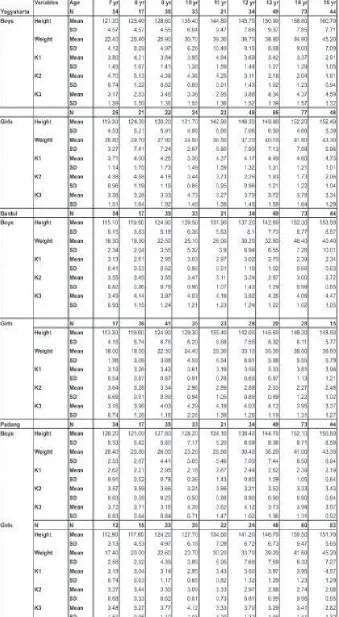
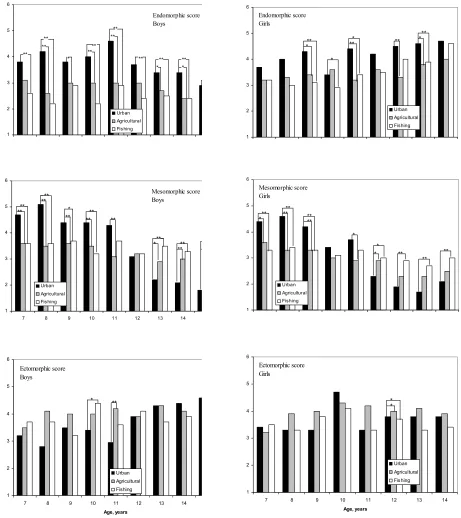
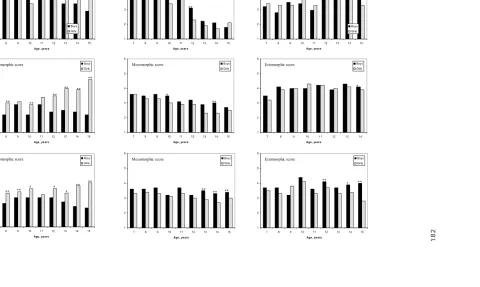
The descriptive statistics for the boys and the girls are presented in TABLE 1. FIGURE 1 shows the comparison of the three somatotype components of the boys and girls in the 3 areas. FIGURE 2 shows comparison of the three somatotype components between boys and girls in the three areas (Yogyakarta, Bantul, and Padang) children.
The age group somatotypes in each sample were plotted on a somatochart (FIGURE 3) and the patterns of somatotype group were observed.
TABLE 1 shows that the urban boys and girls were taller and heavier than their agricultural and fishing counterparts in both sexes. FIGURE 1 shows regional differences among urban (Yogyakarta), agricultural (Bantul) and fishing (Padang) for each somatotype component. We can see that the Yogyakarta children were more endomorphic from 7 to 15 years of age, except the girls at age 10. Concerning in the second component, the Yogyakarta children were the more mesomorphic until age 11 in both sexes than Bantul and Padang children. After age 12, the Padang boys were more mesomorphic than other two areas, the Bantul boys were more mesomorphic than the Yogyakarta boys, and the same tendency was found in the girls as well. As for the third component, the Padang boys were more ectomorphic than the Yogyakarta and Bantul boys at age 10. The Bantul boys were more ectomorphic than the Yogyakarta boys from age 8 to 11 years. As for the girls, the Yogyakarta girls were more ectomorphic only at 10 year than other two areas.
Concerning regional differences, we could summarize in brief that Yogyakarta children were more endomorphic than Bantul and Padang children from age 7 to age 15 in both sexes, but from 12 years the Yogyakarta children were less meso-morphic than Bantul and Padang children. As for the third, the Yogyakarta boys were less ectomor-phic than Bantul and Padang boys after age 13. In the three areas, for boys, there was a some tendency that at the second component decreased after age 11 years, and at the third component increased after 12 years. However, for the girls, there was a some tendency to increase at the first component from 11 years, and decrease at the second component from 12 years.
FIGURE 1. Regional difference of endomorphic, mesomorphic, and ectomorphic scores among Yogyakarta, Bantul, and Padang children (*p<0.05; **p<0.01).
1
Cig ."{g ctu
Boys
Cig ."{g ctu
As for the second component, mesomorphy decreased according to age in both sexes in both regions, i.e. Yogyakarta and Bantul. However, in Padang children, the mesomorphy score was relatively stable according to age in both sexes, the boys were significant difference and more mesomorphic than girls at ages 13 to 15. In Yogyakarta children, this decrease and the sex difference were emphasized. In Bantul, in contrast, the decrease was gentle and the sex difference was small, except at ages 10 and 14. As a result, we note that the sex difference, i.e. less endomorphy in boys and more endomorphic in girls.
Concerning the third component in Yogyakarta, the girls of age 10 were more ectomorphic, but after age 12 the boys were more so. This sex difference at age 10 was paired with that of the mesomorphic scores of the same group, that is to say, the presence of more mesomorphic and less ectomorphic in boys than in girls. Moreover, the sex difference after age 12 was paired with that of the endomorphy score; namely, the presence of less endomorphic and more ecto-morpic in boys than in girls. In the Bantul children, no significant sex difference in the ectomorphic score was detected, except at age 15. From figure 5, we observe that in Padang children, this sex difference at ages 12, 14, and 15 years, the girls were consistently less ectomorphic than the boys, where the boys were greater than the girls on ectomorphy were 0.9 units at age12, 0.3 units at age 14, and 1.7 units at age 15.
Most of the differences between the means of the somatotype components seem to be attributable to Yogyakarta urban children, the well-of groups of children, while Bantul and Padang children were lived in low socio-economic status. The apparently greater endomorphy and sum of skin folds of Yogyakarta children might be explained in terms of the higher socio-economic status. Yogyakarta children were more affluent than the children from agricultural and fishing area.
On the basis of the statistical analysis and the graphs of the means of the component for all groups, some general tendencies can be observed. Endomorphy appeared to be lowest at 15 years in the boys, and higher before of this age. In contrast, endomorphy was highest at 15 years, and lower before this age in the girls. These observations were predictable because the girls were greater in weight than in the boys during puberty, and girls tend to accumulate more fat than boys. The results of the
study was supported by Forbes13 suggested that the boys and girls both gain body fat in early adolescence; later the gain stops, even reverses temporarily in boys, while girls continue to put on fat as adolescence proceeds.
On mesomorphy, that is interesting to note at age 12 in all groups, a tendency to drop and increase again through year 15. As the skeleton is increasing more rapidly in length than in breadth during mid-adolescence, and as the hormonal influence on the development of muscle tissue is only beginning to have its effect.
In all groups, the general trend in ectomorphy was for the highest values at age 15 years for the boys occured in mid-adolescence when the maximum growth spurt was present. Contrast with the girls the trend for the highest values in ectomorphy was at age 10 in the beginning of puberty.
In brief, with regard to regional differences we can summarize that Yogyakarta children were more endomorphic, mesomorphic, and less ectomorphic than Bantul and Padang children. However, the Padang children were more ectomorphic and less endomorphic than Yogyakarta and Bantul children. With regard to sex difference, the Yogyakarta girls had higher endomorphic and lower ectomorphic scores than the boys from the same region. The Bantul girls had higher endomorphic and lower mesomorphic and ectomorphic scores than the boys, while the Padang girls had higher endomorphic and lower mesomorphic and ectomorphic than the boys from the same region. Similar results were presented in several studies1.7.14.15.
Somatotype
We notice also that the elder children in Bantul were more ectomorphic than the younger ones in both sexes, except the girls of age 15.
As for Padang children, the mean somatotypes of the boys shifted from ecto-mesomorphy to meso-ectomorphy, while the girls shifted from center to meso-endomorphy. A comparison of Padang and
Bantul village with data in Stepnicka 1976 (mean somatotypes for Czecholovak children at 8-14 years) and Szmodis 1977 on 1400 children of both sexes aged between 5-17 years (in Heath & Carter1) show similar somatotype pathways, espe-cially in later ages, slightly lower in mesomorphy.
FIGURE 3. Mean somatotype of children in Yogyakarta, Bantul, and Padang village by age, 7 to 15 years old.
Yogyakarta
Dq{u Iktnu
9
32 33
35 36 ;
34 :
37 37
36 ;
35 32
33 :
7
34
Bantul
Dq{u Iktnu
9 33
: ; 34
35 9
32 36 37 :
;32 33 34
35 36 37
Padang
Dq{u Iktnu
9
32 ; 35 36
34 : 33 37
9 : ;
32 33
34 35
3637
These cross-sectional observations suggest three phenomena. First, the somatotype of well-off children shifts in puberty from endo-mesomorph to ectomorphy in boys, and to endomorphy in the girls. Second, the somatotype of lower-income children remains ectomorphic both before and after puberty, but the girls after puberty seem to shift to endomorphy while the boys become more and more
between Bantul and Padang villages. There was wide range of environment between those villages, the lifestyle i.e. physical activity, diet, and the samples had different ethnic backgrounds.
CONCLUSIONS
On the basis of the analysis and within the limitations of the study, the following findings appear to be concluded that:
1. The Yogyakarta children were taller and heavier than their agricultural and fishing counterparts in both sexes.
2. The Yogyakarta children (urban) were more endomorphic, mesomorphic, and less ectomorphic than the Bantul and Padang chil-dren.
3. The Padang children (fishing village) were more ectomorphic and less endomorphic than the Yogyakarta and Bantul children.
4. Among the Indonesian children, the distribu-tion of somatotype according to age was dif-ferent between urban Yogyakarta, agricultural Bantul and fishing Padang.
5. The mean somatotype of boys and girls were 3.8 – 3.6 – 3.7 and 4.2 – 3.1 – 3.6 (in urban city, respectively), 2.8 – 3.2 – 4.1 and 3.5 – 2.9 – 3.9 (in an agricultural village, respectively), and 2.5 – 3.5 – 3.8 and 3.5 – 3.1 – 3.5 (in fishing village, respectively).
6. In general, the well-off children were more endomorphic, and the low-income children were more ectomorphic.
ACKNOWLEDGMENTS
The authors are grateful to express heartfelt thank to Prof. Kumi ASHIZAWA, Prof. Teuku Jacob, and the Dean of Medical Faculty, Gadjah Mada University for providing the necessary facilities to carry out this study. I am also thankful to the pupils, teachers and headmasters of the following schools i.e. SD Ungaran 2 and SMPN 12 Yogyakarta, SD and SMP 2 Imogiri Bantul, and SDN 1 and SMPN 9 Bungus Teluk Kabung, Padang for their kind participation during this research.
REFERENCES
1. Carter JEL, Heath BH. Somatotyping, Development and Applications. Cambridge: Cambridge Univ. Press, 1990. 2. Pandey AK, Malik SL. Anthropometric somatotype of Bod girls. A comparison of high and low altitude populations. Am.J. Hum.Biol, 1990; 2:467-73 3. Singh SP, Sidhu LS. Changes in somatotypes during 4 to
20 years in Gaddi Rajput boys. Zeitschrit Fur Morphol Anthropol, 1980; 71, 285-93.
4. Rahmawati NT, 1999 Anthropmetric characteristics, somatotype, and body composition of Yogyakarta athletes. Yogyakarta: School of Medicine, Gadjah Mada Univ. (Master thesis).
5. Rahmawati NT, Budiharjo S, Ashizawa K. Somatotypes of young male athletes and non-athlete students in Yogyakarta, Indonesia. Anthropol. Sci, 2007; 115:1-7. 6. Rahmawati NT, Hastuti J, Ashizawa K. Growth and
somatotype of urban and rural Javanese children in Yogyakarta and Bantul, Indonesia. Anthropol. Sci, 2004; 112: 99-108.
7. Walker RN. Pre-school physique and late adolescent somatotype. Ann. Hum.Biol, 1978; 5(2): 113-29. 8. Claessens A, Beunen G, Simons J. Stability of
anthro-poscopic and anthropometric estimates of physique in Belgian boys followed longitudinally from 13 to 18 years of age. Hum. Biol, 1986; 13:235-44.
9. Carter JEL, Mirwald RL, Heath-Roll BH, Bailey DA. Somatotypes of 7 to 16 years old boys in Saskatchewan, Canada. Am. J. Hum. Biol, 1997; 9: 257-72.
10. Gaur R, Sing RP. Age differences in somatotypes of Garhwali males 17 – 60 years of ages. Am. J. Hum. Biol, 1997; 9:285-90.
11. Takai S, Wu XH. Somatotypes of children in Japan and China. Proseedings of 13th Annual Meeting of Auxology
Nagoya, 2002; 15.
12. Carter JEL. The Heath-Carter Somatotype Method. San Diego State University San Diego 1980: Syllabus Service. 13. Forbess GB. Body composition in adolescence. In: Falkner, F. and JM. Tanner (eds.) “Human Growth a Comprehensive Treatise, Volume 2,” New York: Plenum Press, 1987; 119-33.
14. Parizkova J, Carter JEL. Influence of physical activity on stability of somatotypes in boys. American Journal of Pysical Anthropology, 1976; 44:327-39.