The Effect of Liquidity Ratio, Profitability Ratio, Company Size, and
Leverage on Bond Rating in Construction and Real Estate Company
Rindi Kumala Sari1, Siti Nurlaela2, Kartika Hendra Titisari3
Faculty of Economics Islamic University of Batik Surakarta, Indonesia
e-mail: [email protected]
Abstract: This research aims to determine the significance influence of liquidity ratio, profitability ratio, company size and leverage to bond’s rating on construction and real estate companies. The data in this research is secondary data obtained from Indonesia Stock Exchange. The sample used in this study was 16 companies that issue obligation and listed on Indonesia Stock Exchange in 2014-2016, with purposive sampling method. Methods of data analysis used in this study was multiple linear regression test. The data processed by using SPSS 17. Based on the result of the research that has been done, then it can be taken a few conclusions, namely: Liquidity ratio does not affect the bond’s rating. Profitability ratio affect the bond’s rating. Company size does not affect the bond’s rating. And Leverage also does not affect the bond’s rating.
Keywords : Bond’s rating, Liquidity, Profitability, Size, Leverage.
1. INTRODUCTION
A company in doing operation and production activities will need capital. This capital can be obtained in various ways, among others by borrowing money in banks, issuing shares in the capital market or issuing bonds. Bonds offerings in Indonesia in 2012 reached 67.76 trillion, in 2013 decreased to 57.76 trillion, in 2014 decreased again to 48.64 trillion and increased again in 2015 to 63.27 trillion and jumped on in 2016 and 2017 amounting to 116.37 trillion and 121.74 trillion, for each. From these, we can concluded that public interest in bonds in Indonesia is increasing every year.
Bonds are one of the securities in the capital market that many investors demand although the risk of default when the company or issuer can not
fulfill the obligation of payment of coupon or bond interest upon maturity.
People or investors need to pay attention to various aspects in deciding to invest bonds to a company so they can enjoy the proceeds from the investment, one of them by considering the bond rating. The bond rating represents the risk-security scale of a bond issued by a company and provides an informative statement about the probability of a debt default.
bond rating agencies in Indonesia is accurate?
According to (Cohen, 2014) the rating or rating of bonds will also have a positive impact on the stock price of a company. In the research (Bhojraj & Sengupta, 2003) also explains if good corporate governance also has a positive impact on bond ratings as well as for profit levels from the bond itself. The bond rating agency is an independent institution that provides information on the rating scale of the debt ratio as a guide to how secure the bonds are for investors. In Indonesia there are several debt securities rating agencies that is Fitch Ratings, Moody’s Investor Service, Standard and Poor’s, PT. Fitch Ratings Indonesia, Pemeringkat Efek Indonesia (PT PEFINDO), dan PT Kasnic Credit Rating Indonesia.
Before this research is done there have been some previous research that examines the rating of bonds as well, but in some research there are several research gap among others
Based on research (Sari & Badjra, 2016) liquidity has a negative and significant impact on the rating of bonds. The size of the firm has a positive and significant influence on the rating of bonds. Leverage has positive and insignificant effect on the rating of bonds. But in research Research by (Rosa & Musdholifah, 2016) research results show that profitability, growth, and size of the company affect bond rating. On the other hand, leverage, liquidity, and coverage have no effect on the bond rating. There is a difference with research conducted by (Sari &
Badjra, 2016) where leverage has a positive influence on the bond rating.
The first variable in this study is the liquidity ratio. Liquidity ratio is used to evaluate the ability to meet the short-term obligations of the company (Kasmir, 2009). The second variable is the profitability ratio. Profitability ratios are used to assess financial compensation to equity and debt financing providers. Third Variable is company size. Company size helps investor to know ability of company to pay interest of bond periodically and pay off principal of loan (Prasmesti and Dkk 2016). The fourth variable used in this research is leverage. Leverage represents a proportion in the use of debt to finance investments in owned capital (Fauziah 2014).
As explained in the description above, that the ratios and variables can be used to analyze the condition of the company and because of the research gap of some previous research as described above, the authors are interested to propose research with the title "Influence Liquidity Ratio, Profitability Ratio, Company Size, And Leverage Against Bond Rating "
2. THEORITICAL FRAMEWORK
The theoritica framework of this research is illustrated as follows:
Picture 1 : Conceptual Framework
Likuidit as (X1) Profit abilit as (X2) Uk.
Leverage (X4)
Based on this framework, it is known that the model in this research is to examine the partial influence of likudity ratio, profitability ratio, firm size, and leverage to bond rating by rating bond as dependent variable while likudity ratio, profitability ratio, firm size, and leverage as an independent variable
3. RESEARCH METHODS
The type of research used is quantitative research (Sugiono, 2015). The data source of this study is secondary data that is the financial statements and corporate bond rating reports obtained on the website of the Indonesian stock exchange and PEFINDO namely www.idx.co.id and www.pefindo.com. The popoulasi of this research is all construction and real estate companies that issue bonds. The sampling technique was done by purposive sampling method which aimed to get the sample according to the criteria.
The criteria of the companies to be sampled are: 1) Construction and real estate companies have issued and published their audited financial statements as of December 31, 2014,2015,2016. 2) Real Estate and Construction Company that issued bonds rated by PEFINDO. With these criteria ultimately obtained sample research as many as 16 companies. Data analysis techniques used are multiple linear regression analysis.
Data Analysis Technique
Data analysis techniques used in this study are as follows:
a. Classic Assumption Test consisting of: Normality Test,
Autokolerasi Test,
Heteroskedasitisitas Test, Multicolinearity Test.
b. Multiple Linear Regression Analysis
1) Multiple Regression Model Multiple linear regression analysis is a technique through the coefficient parameters to determine the amount of independent variables to the dependent variable.
2) Model Feasibility Test is an early stage to identify the regression model is feasible or not
3) Hypothesis Test
used to see the influence of independent variables to the
dependent variable
partially).
4) Determination Coefficient Test
is used to measure the extent
to which modeling
capabilities explain
variations of dependent variables
4. RESEARCH RESULT
Result of Data Collection
required in this study is secondary data in the form of audited annual financial statements of companies obtained from the official website of the Indonesia Stock Exchange that is www.idx .co.id
Classic Assumption Test
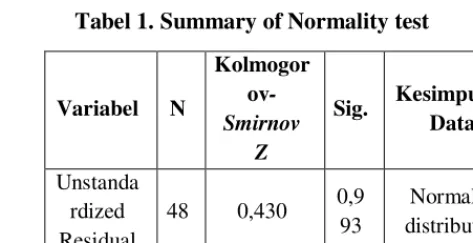
a test of Normality, Multicollinearity, Heteroskedastic, and Autocorrelation are presented in the table below:
Tabel 1. Summary of Normality test
Variabel N
Kolmogor ov -Smirnov
Z
Sig. Kesimpulan Data
Unstanda rdized Residual
48 0,430 0,9 93
Normally distributed
Source : The data processed by author
Based on the results of normality test with one sample kolmogorov- smirnov test, can be seen significant value is 0.993> 0.05, then the result is normal.
Tabel 2. Summary of Autocorrelation
D-W Du dL 4-dU 4-dL Kesimpulan
2,087 1,7206 1,3619 2,6381 2,2794 No problem Autocorrelation Source : The data processed by author
Based on table 3 it can be seen that the DW value of 2,087 lies between dU = 1,7206 and 4-dU = 2,2794, it can be
concluded that there is no
autocorrelation
Tabel 3. Summary of Multicollinearity
Variabel
Variance
Inflation Kesimpulan
Tolerance
Factor (VIP) Likuidity
(X1) 0,907 1.103
No
Multicollinearity Profitabili
ty
0,796 1.256
No
(X2) Multicollinearity
Size
0,963 1.039
No
(X3) Multicollinearity
Leverage
0,845 1.183
No
(X4)
Multicollinearity
Source : The data processed by author
Based on the above table, the value of tolerance all variables are above 0.1 and the value of VIF is less than 10 so that it can be concluded there is no Multicollinearity, between the variables.
Summary of Heteroskedastic
Heteroscedasticity test results can be seen from the following picture 2:
Picture 2 Heteroscedasticity Test Source: The data processed by
Based on the picture above by using scatterplot seen that the distribution of dots declared no heteroskedastisitas occur in the regression model.
Multiple Linear Regression Analysis
This analysis is used to determine the effect of liquidity ratio, profitability ratio, firm size, and leverage to bond rating.
Tabel 4. Summary of Multiple linear Regression
Unstandar dized
Model
Coeficients
T Sig
St B d.
Error
(Constant) 8,837 2,309 3,826 0,000
Likuidity 0,652 0,323 2,016 0,050
Profitability 15,331 5,294, 2,896 0,006
Size 0,130 0,079 1,642 0,108
Leverage -0,172 0,122 -1,407 0,167
Source : The data processed by author
Based on the result of regression analysis obtained by the following equation:
Rto = 8,837 + 0,652 Likuid + 15,331 Profit + 0,130 size – 0,172 Leverage + e
The constant value is 8.837: it means that if the liquidity, profitability, firm size, and leverage are 0, then the rating will be fixed to 8.837. The regression coefficient value of the liquidity, profitability and firm size variables is positive, meaning any increase of 1% will increase the bond
rating by 0.652, 15.331, and 0.130. The value of leverage variable coefficient is negative, that is -0.172, it means that every leverage increase of 1% will decrease the bond rating by 0,172.
Tabel 5. Summary of F test
F hitung Sig. F tabel Kesimpulan 7,769
0,000 2,589 Accepted Source : The data processed by author
This test measures whether all the independent variables present in the
study have a simultaneous
(simultaneous) effect on the dependent variable. The test results show that the value of F arithmetic> F table (7,769> 2,589), so it can be concluded that liquidity, profitability, firm size and leverage simultaneously affect the rating of bonds.
Tabel 6. Summary of t test
T
Hitun T Stan Kesim
Model g Tabel Sig. dar pulan Likuidity 2,016 2,017 0,050 0,05 Reject ed Profita 2,896 2,017 0,006 0,05 Accep
bility ted
Size 1,642 2,017 0,108 0,05 Reject ed
Leverag 1,407 2,017 0,167 0,05 Reject
e ed
Source : The data processed by author
ratio of liquidity, firm size and leverage does not affect the rating of bonds. While H2 is accepted, the profitability ratios affect the rating of bonds
Tabel 7. Summary of Adjusted R
Source : The data processed by author
Detergination Coefficient Test aims to measure how far the regression model can explain the dependent variable of the study. From table 7 above can be seen that the coefficient of determination (R2) is 0.366, so it can be seen that the dependent variable in this bond rating can be affected by 36.6% by independent variables. This can be seen from the adjusted R Square of 0.366. While 63.4% of dependent variable of bond rating is influenced by other variables not included in this research.
5. DISCUSSION
a. The influence of Likuidity ratio to Bond Rating
Testing of hypothesis 1 on the influence of liquidity ratio to bond rating (H1), states that liquidity testing does not affect the rating of bonds. Based on the t-test, the value of t arithmetic of hypothesis 1 is 2.016 and t table is 2.017. Because t arithmetic <t table (2.016 <2.017), then the result of H1 is rejected. Thus it
can be concluded that the liquidity ratio does not affect the rating of bonds.
Liquidity is the company's ability to pay off its short-term debt. Liquidity has no significant effect on prediction of bond rating. This is because Pefindo in assessing liquidity uses the latest financial statements published by the company prior to the rating process, for example using quarterly or even monthly reports to obtain the latest liquidity rating according to current circumstances.
The results of this study are in line with research (Prasmesti and Dkk 2016), which states that liquidity does not affect the rating of bonds. This is different from the research conducted by Malia and Andayani 2015 and (Sari & Badjra, 2016), (Sufiyanti et al. 2012) which states that liquidity positively affects the bond rating.
b. The influence of Profitability Ratio to Bond Rating
bonds. The results of this study indicate that profitability is one of the main factors into consideration in rating bonds.
The results of this study indicate that profitability is one of the main factors into consideration in rating bonds. This is in line with research and (Amalia, 2013) stating that profitability ratios have a positive effect on bond ratings. However, it is not in line with research by (Malia and Andayani 2015) and (Ariana 2017) which in his research stated that profitability ratio has no effect on bond rating.
c. The influence Company Size to Bond Rating
Hypothesis 3 testing on the effect of firm size on bond rating (H3), stated that testing firm size does not affect the rating of bonds. Based on the t test, the value of t arithmetic of hypothesis 1 is 1.642 and t table of 2.017. Because t arithmetic <t table (1.642 <2.017), then the result of H3 is rejected. It can be concluded that firm size has no effect on bond rating.
The size of the Company in expected to increasingly have the ability to pay off the obligations in the future. Given the large amount of assets can be used as
collateral for the issuance of bonds. However, firm size is not a major factor in bond rating, although the company has a relatively small asset, but its profitability and liquidity level will be good.
The results of this study indicate that firm size is not one of the main factors into consideration in rating bonds. This is in line with the research (Yudiaatmaja et al. 2016) which states that firm size has no effect on bond rating, but is not in line with research by (Sari and Badjra 2016) and (Ariana 2017) which states that firm size influences bond ratings .
d. The influence of Leverage to Bond Rating
Hypothesis 4 testing on the effect of leverage on bond rating (H4), states that leverage test concluded that leverage does not affect the rating of bonds.
for production activity then the big debt is not a problem for bond rating done by PT.Pefindo. in this study, although the level of corporate leverage is high but the level of liquidity, profitability is good. This is in line with research (Ariana 2017) which states that leverage has no effect on the rating of bonds, but contrary to research by (Sari and Badjra 2016)and (Amalia, 2013) which in his research stated that leverage affects the bond rating.
6. CONCLUSION
Based on the results of research that has been done, it can be taken some conclusions, namely: profitability ratios affect the rating of bonds. the ratio of liquidity, firm size and leverage does not affect the rating of the bonds this occurs because Pefindo in assessing the size of the company using the latest financial statements issued by the company prior to the rating process, for example using quarterly or even monthly reports to obtain the results of the latest liquidity assessment in accordance current state.
7. REFERENCE
Amalia, N. (2013). Pemeringkatan Obligasi PT Pefindo Berdasarkan Informasi Keuangan. Accounting
Analysis Journal, 140-147.
Ariana, Devy. 2017. “Analisis Pengaruh Size, Profitabilitas, Likuiditas dan Leverage Terhadap Peringkat Obligasi” Bisnis Manajemen XVI (1):13-21.
Bhojraj, S., & Sengupta, P. (2003). Effect of Corporate Governance on Bond Rating and Yields: The Role of Intitutional Investors and Outside Directors. Journal The University of
Chicago Press, 1-28.
Cohen, G. (2014). On the impact of bond's rating changes on the firm's stock price. internasional journal of financial research carmel academic
center, haifa, israel, 1-8.
Fauziah, Yossy. 2014. “Pengaruh Likuiditas, Leverage Dan Umur Obligasi Terhadap Prediksi Peringkat Obligasi (Studi Empiris Pada Perusahaan Yang Terdaftar Di Bursa Efek Indonesia Tahun 2009-2012).” Jurnal Akuntansi 2(1).
Kasmir. (2009). Analisys Laporan
Keuangan. Jakarta: Rajawali Pers.
Malia, Lidiya and Andayani. 2015. “Pengaruh Rasio Keuangan Terhadap Peringkat Sukuk.” Jurnal
Prasmesti, Dian and Dkk. 2016. “Pengaruh Rasio Likuiditas, Leverage, Aktivitas Dan Firm Size Terhadap Profitabilitas Perusahaan Sub Sektor Otomotif Dan Komponen Di Bursa Efek Indonesia.” Seminar Nasional
IENACO (2012):810–17. Retrieved
(https://publikasiilmiah.ums.ac.id/bi tstream/handle/11617/7162/IENAC O_105-Dian Pramesti %2C Anita
Wijayanti %2C Siti
Nurlaela.pdf?sequence=1&isAllow ed=y).
Rosa, V. M., & Musdholifah. (2016). Pengaruh Leverage, Likuiditas, Profitabilitas, Coverage, Pertumbuhan, dan Ukuran Perusahaan dengan Reputasi Auditor sebagai Moderating Untuk Peringkat Obligasi dari Badan Perbankan. Jurnal Bisnis &
Manajemen Vol XVII, 48-57.
Sari, Ni Made Sri Kristina and Ida Bagus Badjra. 2016. “Pengaruh Likuiditas , Ukuran Perusahaan , Leverage Dan Jaminan Terhadap Peringkat Obligasi Pada Sektor Keuangan.” Managemen Unud 5(8):5041–69.
Sufiyanti, Fenni et al. 2012. “Dampak Rasio Keuangan Terhadap Peringkat Obligasi Pada Perusahaan Yang Terdaftar Di Bursa Efek Indonesia.” Seminar Nasional Dan The 3rd Call for Syariah Pape 8:332–39.
Sugiono. (2015). Metode Penelitian
Pendidikan. Bandung: Alfa beta.
Yudiaatmaja, Fridayana, Wayan Cipta, Jurusan Manajemen, and
Universitas Pendidikan Ganesha. 2016. “Pengaruh Ukuran