NS
P
Angela Carpenter
INTERNATIONAL PROTECTION
OF THE MARINE ENVIRONMENT
In: "The Marine Environment"
Editor: Adam D. Nemeth
ISBN: 978-1-61209-265-2 2011
400 Oser Avenue, Suite 1600Hauppauge, N. Y. 11788-3619 Phone (631) 231-7269 Fax (631) 231-8175
E-mail: [email protected] http://www.novapublishers.com
Science Publishers, Inc.
Editors: Adam D. Nemeth, pp. 51-86 ©2011 Nova Science Publishers, Inc.
Chapter 2
I
NTERNATIONAL
P
ROTECTION
OF THE
M
ARINE
E
NVIRONMENT
Angela Carpenter
*University of Leeds, LEEDS, United Kingdom
A
BSTRACTThis chapter will consider how the marine environment is managed and protected at an international level. It will set out a brief history of how governance of the marine
environment has developed since the doctrine of Freedom of the Seas was set out by
Hugo Grotius in the early 1600s through to the post World War II period where developments and triggers ultimately led to a global Law of the Sea Convention. It will then specifically examine the role of the United Nations, including discussion of the 1982 Law of the Sea Convention (LOSC), which set out to produce a comprehensive legal framework to promote the peaceful use of the oceans and its resource, together with other UN conventions related to the marine environment. The chapter will then examine the role and responsibilities of the International Maritime Organization (IMO) and its various committees, as the body responsible for establishing a comprehensive framework of legislation for shipping, including protection of the marine environment from pollution from shipping and the safety of vessels, their crews and passengers, at sea. It will then examine the contribution made by a range of Memoranda on Port State Control organisations (MOUs) which have a role in ensuring that vessels comply with the various international conventions established by the IMO and others. These MOUs, the first of which was established in 1982, provide a framework for vessel inspections to ensure that those vessels which fail to adhere to international standards, or are sub-standard in any way, can be monitored. Vessels which are found to be sub-standard can, ultimately, be prevented from operating until all deficiencies are rectified.
* Dr Angela Carpenter, Research Fellow, School of Earth and Environment, University of Leeds, LEEDS LS2 9JT, United Kingdom, Email: [email protected]
1.
I
NTRODUCTION–
A
B
RIEFH
ISTORY OFG
OVERNANCEOF THE
M
ARINEE
NVIRONMENTThe United Nations (1998)1 notes that the oceans and seas have long been subject to the
doctrine of the Freedom of the Seas. In 1609 the Dutch Philosopher and Jurist Hugo Grotius wrote about that doctrine in his treatise Mare Liberum, setting down the concept that the seas
and oceans were freely available for all states to use – every nation being free to travel to (and
trade with) every other nation. Grotius argued that God created the oceans, that the oceans were mobile and, therefore, that they should be accessible by every nation. The concept was developed at a time when the Netherlands sought to join in the lucrative trade for spices, woods and other goods and resources only obtainable in the East Indies. However, Portugal sought to prevent the Netherlands from doing so by claiming sole jurisdiction to trade in the East Indies, citing as justification a Papal Bull of Pope Alexander VI of 1493 (and subsequently agreed by Spain and Portugal in the Treaty of Tordesillas, Spain in June 1494). That Papal Bull followed the discovery of the West Indies by Christopher Columbus and subsequent disputes over territorial rights between Portugal and the King of Castile (Spain) in the West Indies and wider Latin American area. The Papal Bull allowed Christian countries to claim jurisdiction over trade with non-Christian countries and was originally intended to partition the right to control trade west of the Azores between Portugal and Spain. However, it resulted in Spain claiming the sole right of navigation in the western Atlantic Ocean (to try and prevent access to the region by British ships, while Portugal claimed a similar right in the South Atlantic and Indian Oceans.
Cincin-Sain and Knecht (1998, pp 68-69)2 note that Grotius‟ concept of Freedom of the
Seas was eventually accepted by coastal nations wishing to trade with other nations around the globe. Subsequently, in the 1700s, the concept of the territorial waters was developed and, by tacit agreement of all coastal states, these extended 3 miles out from the coastline. The idea of territorial waters was to allow coastal states the right to establish specific controls on customs, fishing rights and protection of coastal areas but it did not give those states the right to prevent foreign vessels from passing through their territorial waters. Subsequently, there was little change in governance of the marine environment until the period post World War II since which there have been many significant developments in international and national laws relating to the marine environment. Cincin-Sain and Knecht (1998, page 69) indicate that one of the main reasons for this new activity was the discovery of major oil and gas deposits in the Gulf of Mexico leading to the United States (and subsequently a number of South American countries) setting out claims to hold jurisdiction over resources on the continental shelf contiguous with their coastlines and, subsequently, to acceptance of national jurisdiction over ocean zones 200 nautical miles from the coastline.
The UN (1998) indicates that pressure from domestic oil interests led President Truman, in 1945, to unilaterally declare US jurisdiction over all oil, gas and mineral rights on its continental shelf, closely followed by Argentina, Chile, Peru, and Ecuador (which claimed sovereign rights to a 200 mile zone in order to protect fish stocks from distant water fishing
1 United Nations (1998). The United Nations Convention on the Law of the Sea (An historical perspective). Originally prepared for the International Year of the Ocean 1998. Pub: Oceans and Law of the Sea: Division for Ocean Affairs and the Law of the Sea. Available online at: http://www.un.org/Depts/los/convention 2 Cincin-Sain, B and Knecht, R W (1998). Integrated Coastal and Ocean Management: Concepts and Practices.
fleets). Other countries went on to claim a 12 mile territorial sea zone (increasing the distance from the 3 miles that had previously been common practice). The main purpose for extending territorial waters was to gain access to rich mineral, oil and fishing resources of the seas and oceans from being used by other countries which either also bounded the sea in that region (therefore requiring treaties to agree specific territorial boundaries) or from countries from further afield. As oil and other companies identified rich mineral, ore and oil deposits, the financial benefits to a nation on whose continental shelf those resources were identified become ever more important. Fishing stocks also became an issue of contention as many nations have deep water fishing fleets which need to travel further and further afield as fishing stocks decline in one region and so those fleets move on to another region.
Between the 1950s and 1970s there were growing disputes over what countries could claim to be the limits of their territorial waters and later over the development of the idea of Exclusive Economic Zones (EEZ). An EEZ is a sea zone over which a state has specific rights to natural resources including fisheries. Table 1 outlines the limits for different areas as set out under international law. One example of a dispute, and an early conflict over access to an EEZ arose in the early 1970s between the United Kingdom and Iceland over access to rich fishing grounds in the North Atlantic. In 1972 Iceland declared an EEZ of 200 nautical miles
in an action which led to the so-called “Cod →ars”, during which the nets of British trawlers
fishing in the region were cut and vessels from the British Navy had to be sent to the area to protect them. This dispute ended in 1974 following a threat by Iceland to close a NATO base used by the British Navy. The UK government declared the area off limits to British fishing vessels from December 1976.
Table 1. Scope of coastal waters by distance from coastline
Zone type Distance from the coastal baseline mean water mark
Internal waters Any waters, including estuaries, inland from baseline
Territorial waters 12 nautical miles offshore from the baseline
Contiguous zone Between 12 and 24 nautical miles from baseline
Exclusive Economic Zone 200 nautical miles from baseline
International waters Waters outside any waters claimed by a country
Note: 1 nautical mile = 2,025.372 yards (1,852 metres) compared to a standard mile which is 1,760 yards (1,609.344 metres). The nautical mile is approximately 15% longer than a standard mile.
creation of the UN Environment Programme (UNEP), together with the 1992 UN Conference on Environment and Development (UNCED) and its outputs on Climate Change, Biodiversity and Agenda 21.
This introduction has provided a brief history of how marine environmental governance has developed over time, particularly since the end of World War II, and many of the most significant International Conventions that have been developed to protect the environment will be considered in more detail in Section 2. However, in order to further illustrate the complex nature of marine environmental governance, and to provide an example of just some
of the actors involved in one specific issue, Figure 2.1 from Carpenter (20053, page 22) has
been updated and appears as Figure 14.
Carpenter (2005) set out an example of the complex relationship between regulators at international, regional and national levels and examined some of the many stakeholders responsible for dealing with, or which were impacted by the issue of marine pollution from ships in the North Sea region of the European Union (EU).
Figure I. Some Participants in North Sea Pollution Prevention (amended from Carpenter, 2005, Figure 2.1, page 22)
3 Carpenter, A (2005). The Reduction of Ship-Generated Waste in the North Sea: A Contemporary Analysis. PhD Thesis. Leeds, UK: University of Leeds.
2.
T
HER
OLE OF THEU
NITEDN
ATIONSIN THE
M
ARINEE
NVIRONMENTAs discussed in the introduction, the United Nations plays a major role in governing and protecting the marine environment, through its various committees and conventions. This section will examine one of the most significant UN Conventions with relevance to the marine environment - the UN Convention on the Law of the Sea (UNCLOS) covering the background and history of the development of that Convention and providing an overview of the scope of that Convention. It will also examine two of the most significant UN
Conferences of the last few decades and their relevance to the marine environment – the 1972
UN Conference on the Human Environment (UNHCE) and the 1992 UN Conference on the Environment and Development (UNCED).
2.1. The 1982 UN Convention on the Law of the Sea: Its Development
and Scope
The UNCLOS Convention was adopted on 10 December 1982 at Montego Bay, Jamaica and entered into force on 16 November 1994. It is the main Convention dealing globally with issues of protecting the marine environment, the rights of coastal states to maintain jurisdiction in areas such as customs, fishing and access to mineral and other resources within their territorial and contiguous waters and EEZs (see Table 1), and also the need to protect the marine environment from pollution and misuse. However, the process of developing the Convention took several decades, starting with meetings to convene a UN Conference on the Law of the Sea until its final entry into force in 1994. This section will look first at developments which took place at an international level to first establish the need for a Convention and will then describe some of the main elements of the Convention itself.
2.1.1. Developments Leading to UNCLOS Convention
Between 1949 and 1956 an International Law Commission (ILC) met to discuss the issues of territorial waters, the high seas and territorial seas with draft articles on the continental shelf, fisheries and contiguous zones being submitted to the UN General Assembly fifth session in 1953. A final report on the territorial sea was adopted by the ILC in 1956 and a final draft of the Law of the Sea Convention was agreed at the same time. In February 1957 the UN General Assembly met and adopted Resolution 1105(XI) which agreed to convene a UN Conference on the draft convention.
The first UN Conference on the Law of the Sea took place in Geneva, Switzerland, between 24 February and 27 April 1957. That Conference adopted 4 separate Conventions and an Optional Protocol which were open for signature by member states between 29 April and 31 October in 1958. Following on from that, other states and also certain specialized agencies were invited to become signatories to the Conventions as follows:
Convention on Territorial Sea and The Contiguous Zone (Entered Into Force 10 September 1964):
be delimited by an individual state and included what constituted the baseline low water line for making that determination (for example how it should be calculated for straight coastlines, or for those fringed by islands). It also set out that such a baseline should appear on official charts produced by the state and outlined how territorial waters should be decided between adjacent coastal states. What this Convention did not do, however, was to set an actual distance from the baseline for the limit of such a territorial sea. Part I, Section III, identified the requirement that states maintain a right of innocent passage for vessels travelling through territorial seas, while subsections C and D set out rules for government ships and for warships specifically. Part II of the Convention then outlined what constituted a contiguous zone which could be up to a further 12 miles out from the boundary to the territorial sea zone of a state.
Convention on the High Seas (Entered Into Force 30 September 1962):
Article 1 of this convention indicates that the high seas are any parts of the sea which are not part of the internal or territorial seas of a state. Article 2 sets out the right of freedom of the seas for all states, whether coastal or non-coastal, to have freedom of navigation, to fish, to lay submarine cables and pipelines and to fly over the high seas. States with no sea coast are granted access to the high seas under Article 3. The Convention then goes on to set out specific articles including the right of vessels to fly the flag of, and be registered in, any state, articles on piracy including seizure of pirate vessels by states, and articles allowing a nations warships to pursue and board foreign flagged merchant vessels for inspection etc. The convention also, at Articles 24 and 25, sets out requirements on the prevention of pollution from vessels, which later forms the basis of the International Maritime Organization (IMO) Convention on the Prevention of Pollution from Ships (1973) and its Protocols (1978), known more commonly as MARPOL 73/78 and discussed in Section 3 of this chapter.
Convention on Fishing and Conservation of Living Resources of the High Seas (Entered into Force 20 March 1966)
This Convention set out the rights and duties of states with respect to fishing and the exploitation of living resources of the seas, irrespective of whether a state had a coastline adjacent to the area where, for example, fishing was taking place, or even if they had any coastline at all. Articles within this Convention include issues such as fishery conservation and on how states competing for the same fish stocks and other resources should enter negotiations to reach agreement on conservation (Article 4). Further Articles set out how the UN should be notified, via the UN Food and Agriculture Organization, if there is a failure to reach agreement between states, while dispute between States over certain Articles could be put before a special commission to try and achieve a peaceful resolution of such a dispute.
Convention of the Continental Shelf (Entry into Force 10 June 1964)
This Convention defined, in Article 1, what was meant by the term “continental shelf”
Optional Protocol of Signature Concerning the Compulsory Settlement of Disputes (Entry into Force 30 September 1962)
This protocol was open for signature by any state which had already signed one or more of the Conventions adopted by the UN Conference on the Law of the Sea. Its main purpose was to set out how disputes over interpretation of the Conventions should be resolved, whether through the use of an arbitration tribunal or via the International Court of Justice (ICJ). Where disputes arose between states over the interpretation of the four Conventions outlined above, and where a settlement of that dispute was not possible, states adopting the optional protocol were able to take that dispute to the ICJ for settlement. Where states agreed that there was a dispute between them, a case could go before an arbitration tribunal for settlement as long as there was agreement (within a 2 month period following notification by one to the other) that a dispute existed. However, if there was no agreement within 2 months the dispute would have to be heard by the ICJ. This protocol excluded, however, disputes arising from specific articles, mainly relating to the conservation of fishing stocks, as set out in the Convention on Fishing etc.
In addition to the Conventions and optional protocol discussed above, the 1957 Conference also adopted other resolutions including ones relating to nuclear testing and on pollution of the high seas by radioactive materials, together with various agreements on fishery conservation and other conservation measures, and on historic waters. It also convened a second UN Conference and paid tribute to the work of the ILC.
The second Conference on the Law of the Sea in 1960 was convened at the request of the UN General Assembly to consider issues of what constituted a territorial sea and on fishery limits, as no agreement had been reached at the first Conference. While the second Conference, held in Geneva between 17 March and 26 April 1960, did adopt two resolutions
in its Final Act5, it still did not reach a final decision on the breadth of the territorial seas or
on fishery limits, these two issues again being deferred to a future meeting.
The third Conference on the Law of the Sea in 1973 finally led to the creation of UNCLOS. It was convened in New York and lasted for 9 years until 1982 when the Convention was adopted. Meetings were held in both New York and Geneva and over 160 states participated in the negotiations. The Convention arising from the third Conference superseded the four Conventions adopted in 1958 (discussed previously) and established a set of rules on governance of the oceans and seas. It included the agreement on the maximum width of territorial seas (12 nautical miles), an issue over which no agreement had been reached during the first and second Conferences. It also included the concept of 200 nautical mile EEZs.
2.1.2. Scope of the UNCLOS Convention
The UN Convention on the Law of the Sea finally entered into force in November 1994, following ratification by 60 states, and some 12 years after it was adopted in 1982. In part, the delay in ratification was due to differences in opinion and interpretation over articles relating to mineral resources and to governance of the deep seabed. There was a requirement that the Convention be accepted as a complete package with all aspects being agreed to and no
outs from any of its articles. In order to overcome the disputes which caused the delay in ratification, an Agreement Relating to the Implementation of Part XI of UNCLOS was
produced in December 1982 which overcame most of the remaining differences6. The
Convention itself is made up of 17 Parts containing a total of 320 Articles and has 9 Annexes. As such it is far too complex to go into specific detail on all aspects of the Convention in this Chapter. However, some of the key components are described below.
Paragraph 4 of the Preamble to the Convention7 identifies that the main objectives of the
Convention were to create a legal order for the seas, facilitate international communication and also to promote the peaceful use of the seas and oceans. This would, it was hoped, result in equitable and efficient use of marine resources, the conservation of living organisms and the promotion of study, protection and preservation of the marine environment.
Part I sets out the terms and scope and, in particular, outlines what constitutes pollution of the marine environment, i.e. the introduction of any substances, directly or indirectly, by man that has a damaging effect on marine life, provides a hazard to human health and which can damage marine activities such as fishing, and which may impair the quality of sea water in some way. It also sets out what does and does not constitute dumping of waste at sea.
Parts II to X codify previous conventions with Part II setting out what constitutes the limits of territorial seas and contiguous zones, the right of innocent passage through territorial waters and the rules for government vessels and military vessels. Parts III to X include Articles on: use of Straits for international navigation; Archipelagic States (states made up of many small islands being seen as a single geographic, political or economic entity); EEZ; Continental Shelf; High Seas; Regime for Islands; Enclosed or Semi-Enclosed Seas; and the right of access of land-locked states to and from the sea, including freedom of transit.
Parts XI to XV have been categorised, according to Cincin-Sain and Knecht (1998, page 70), as introducing new concepts, new laws and new institutions in the area of marine governance. Part XI, Section 2, a set of Principles governing the area, were developed and emphasize that the oceans and their resources are the common heritage of mankind (Article 136), further noting that the oceans should be used to the benefit of all mankind (Article 140) and exclusively for peaceful purposes (Article 141). It notes that marine scientific research should be carried out for peaceful purposes (Article 143) and that all necessary measures should be taken to protect the marine environment from the harmful effects of any activities that are undertaken (Article 145).
Part XI, Section 3 sets out policies on how the marine environment should be developed while Section 4 outlines the different levels of a newly established International Seabed Authority (ISA) with an associated Assembly, Council and Secretariat. The Assembly is
made up of all members of the ISA – signatories to the Convention are members. It can
establish general policies on any relevant provisions of the Convention falling under its competency (Article 160). The ISA Council consists for 36 members made up of representatives from different types of states (Article 161) elected to the Council at Assembly meetings. Reporting to the Council are an Economic Planning Commission (EPC) and a
6 Full details of the Status of UNCLOS, the Agreement on Part X1 and also the 1995 UN Fish Stocks Agreement by State or Entity are available from the UN Website. Available online at: http://www.un.org/Depts/los/ convention
Legal and Technical Commission (LTC), both made up of 15 members. A Secretariat, led by an elected Secretary-General provides support to the various bodies of the ISA, produces an annual report on its work, and is a conduit for consultations and cooperation with international and non-governmental organizations. Part XI also covers financial arrangements of the ISA, legal status, privileges and immunities of the state parties (including how those rights and privileges may be suspended) and sets out how disputes may be settled.
Part XII deals with protection and preservation of the marine environment, states having an obligation to protect and preserve that environment (Article 192). While states have a right to exploit the natural resources of the marine environment, they are also expected to take measures to prevent, reduce and control pollution, to not transfer damage or hazards from one area to another, and to minimise the impact of technologies operating in their seas including preventing activities which may, intentionally or unintentionally, introduce alien species that could cause significant or harmful changes. In order to ensure that the marine environment receives the necessary protection, Sections 2 to 11 (Articles 197 to 237) include requirements in the areas of: technical assistance for developing states; monitoring and environmental assessment measures; international rules and national legislation to prevent, reduce and control pollution from sources including land-based or seabed activities, from dumping, and from vessels or from (or through) the atmosphere; and also enforcement measures for pollution from the different sources. Specific rules are also set out for ice-covered areas
falling within the limits of a coastal state‟s EEZ (article βγ4), particularly where climatic
conditions for most of the year cause hazards to navigation and also where pollution could cause irreversible disturbance of the ecological balance.
Of the remaining 5 parts to the Convention, Parts XIII to XV cover issues around marine scientific research, the development and transfer of marine technology and the settlement of disputes, the latter including the obligation that disputes should be settled by peaceful means and setting out the procedures in place to do so. Parts XVI and XVII set out general and final provisions including Articles on ratification, entry into force, procedures for amending the convention and Status of the Conventions. Finally, the Annexes to the Convention provide additional information on a range of issues including: the establishment of a Commission on the Limits of the Continental Shelf; basic conditions of prospecting, exploration and exploitation of mineral resources; conciliation procedures; arbitration procedures; and participation by international organizations.
Although UNCLOS has now been in force for over 15 years, it is important to note that with increasing awareness of global issues such as climate change, and increasing scientific knowledge of the impacts of different chemicals entering the marine environment, as just two examples, the Convention and the United Nations will play a continuing role in ensuring that state responses to those issues. As such, regular meetings of all State Parties to UNCLOS are held annually under Article 319 Paragraph 2(e) at which members of the International Tribunal for the Law of the Sea and members of the Commission on the Limits of the Continental Shelf are elected and reports from the Secretary-General on issues relevant to parties to UNCLOS are received, among other activities.
Human Environment (UNCHE) in 1972, leading to the establishment of the UN Environment Programme (UNEP), and the second of which was the UN Conference on the Environment and Development (UNCED) in 1992 which resulted in outputs including Agenda 21, the Rio Declaration and other outputs relevant to governance of the marine environment. These two Conferences are considered in more detail below.
2.2. The 1972 UN Conference on the Human Environment (UNCHE) and the
United Nations Environment Programme (UNEP)
Cincin-Sain and Knecht (1998, page 73) note that the ocean and coastal issues and the need for marine environmental protection were emphasized at the 1972 UN Conference on the Human Environment in Stockholm. That conference, attended by representatives of over 100 nations, was also attended by a range of NGOs campaigning on issues including the protection of whales and other cetaceans from being hunted by countries such as Japan and Norway, and also campaigners calling for greater protection of the environment from oil pollution. Two major events in 1965 and 1969 highlighted the significant damage which can be caused by oil spills and, with headlines in the press around the world together with increasing levels of television ownership and access to the broadcast media, the issue of oil pollution in the marine environment was one that had captured global attention.
In 1965 the vessel Torrey Canyon grounded on Seven Stones Reef between the Scilly Isles and Lands End in the United Kingdom. The vessel which, at the time of the accident, had a capacity of 120,000 tons was fully laden with crude oil from the Middle East. Once aground, vast quantities of oil entered the seas around southern England and spread widely with the prevailing wind and tides to land on beaches in Cornwall and Devon in the UK and on beaches in Normandy, France. There was little that could be done to prevent the spread of the oil, despite vessels spraying chemical dispersants to try and break up the oil slick which it was estimated measured 35 miles by 20 miles. The vessel remained grounded for 11 days, starting to break up after 8 days. By day 11 – 29 March 1967 – it was decided that action should be taken to speed up the sinking of the vessel and so it was bombed by the RAF and Royal Navy in an attempt to burn off tens of thousands of tons of crude oil. Images of the grounded vessel, and of the oil fires resulting from the bombing, appeared in newsprint and broadcast media around the globe.
The Torrey Canyon had been chartered by British Petroleum from a US tanker company which was a subsidiary of Union Oil Company of California. Coincidentally, another major oil disaster was associated with Union Oil when, in January 1969, there was a blow-out on
Union Oil‟s Platform A in the Dos Cuadras Offshore Oil Field in the Santa Barbara Channel,
6 miles off the coast of Santa Barbara in California. That blow-out resulted in around 80,000 to 100,000 barrels of oil (equivalent to 13,000 to 16,000 cubic metres of oil) being spilled into the Santa Barbara Channel over a 10 day period. This spill resulted in the deaths of numerous sea birds and also animals such as seals and dolphins. It received significant publicity in the US in particular and resulted in the development of measures to protect the marine environment of the US over the next several years.
works by authors such as Rachel Carson (19628) in her book “Silent Spring” and Garrett
Hardin (19689) in his essay “The Tragedy of the Commons”, many of the nations attending
the 1972 UNCHE had prepared national reports setting out the current status of the environment in those countries.
A significant outcome of the 1972 Conference was the creation of a new UN body, the United Nations Environment Programme (UNEP) which, with its governing Council, was given responsibility to co-ordinate the environmental activities across the whole of the United Nations. UNEP also went on to establish a Regional Seas Programme which promotes sound
environmental management of enclosed or semi-enclosed seas – seas which Article 122 of
UNCLOS defines as being a “gulf, basin or sea surrounded by two or more States and
connected to another sea or ocean by a narrow outlet [through the] territorial seas and [EEZs]
of two or more coastal states” (see footnote 7). At the current time UNEP operates 1γ
Regional Sea programmes globally, with over 140 countries participating in those schemes10.
Two Conventions directly related to protection of the marine environment also resulted from the 1972 UNCHE. The first of these was the Convention on the Prevention of Marine Pollution by Dumping of Wastes and Other Matter 1972 (also known as the London Dumping Convention - LDC), a global convention which entered into force in 1975 and which was designed to protect the marine environment from human activities resulting in all types of marine pollution and more than 80 states are currently parties to the convention. The second convention arising from the 1972 Conference is the International Convention for the Prevention of Pollution Ships 1973 (also known as MARPOL) and this Convention, together with its amendments and protocols (and now known as MARPOL 73/78), is discussed in more detail in Section 3 of this chapter.
2.2.2. Impacts of 1972 UNCHE and the Need for a New UN Conference on Environment and Development
The 1972 UNCHE and its outcomes had a positive effect through specific measures to protect the environment, including the marine environment. However, by the late 1970s and early 1980s it became clear that environmental degradation was still a significant problem. There was increasing awareness of links between poverty, illness and social deprivation and environmental degradation, particularly with the publication of the Brundtland Report
(198711). This report, also known as “Our Common Future”, was named after the Chairman
of the World Commission on Environment and Development (WCED), Gro Harlem Brundtland, the then Prime Minister of Norway. The Commission was established by the UN
General Assembly in 1983 under Resolution 38/16112. The report of the Commission was
8 Carson, R. (1962). Silent Spring. Pub: Houghton Mifflin, Boston. Originally serialised in the New Yorker Magazine, issues of 16, 23 and 30 June, 1960. More recently this book has been published by Penguin Classics in a new edition of September 2000 (ISBN-10: 0141184949) and by Mariner Books in 2002 (ISBN: 0-618-24906-0)
9 Hardin, G. (1968). The Tragedy of the Commons. Essay published in Science, Vol. 162, No. 3859 of 13 December 1968. Full Text available online at: http://www.sciencemag.org/cgi/reprint/162/3859/1243.pdf 10 Further details of the UNEP Regional Sea Programmes can be obtained from the UNEP Regional Seas website.
Available online at:: http://www.unep.org/regionalseas/about/default.asp
11 Brundtland Report (1987). Report of the World Commission on Environment and Development. UN General Assembly Resolution 42/197 of 11 December 1987. Full Report available via the Table of Contents. Available online from UN Documents at: http://www.un-documents.net/wced-ocf.htm
published in December 1987 and was particularly notable in that it examined the need to protect the environment at the same time as recognising that industrialisation and
development would continue to take place, particularly in “third world” and developing
countries. The report is also famous for its definition on what constitutes Sustainable Development, where any development undertaken to meet current needs should not
compromise or prevent the needs of future generations from being met13.
In addition to the activities of the Brundtland Commission and the publication of its
report, evidence was being presented – and appearing in the media – highlighting possible
links between emissions of manmade pollutants such as chlorofluorocarbons (CFCs) and the destruction of the ozone layer over Antarctica, and how the use of greenhouse gases (GHGs) was linked to climate change impacts including the possibility of increasingly severe flooding in coastal regions. New scientific knowledge, together with increasing public awareness and concern over how the environment was being used by man, meant that renewed action was needed to protect the environment as a whole. In addition, there was recognition of the ongoing threat to both mankind and the environment through the testing of nuclear weapons, tests which had the potential to cause significant damage to the marine environment and marine biota (everything living in the marine environment), together with the dumping of some radioactive wastes at sea.
In the case of nuclear testing, an attempt had been made to prevent this through the
Limited Test Ban Treaty of 196314 which sought to ban nuclear weapons testing in the
atmosphere, outer space and under water, although underground testing was still permissible. Testing under water and in the atmosphere both had a detrimental effect of the marine environment and there was also the issue of dumping of radioactive wastes at sea. While the
London Dumping Convention (LDC) 1972 (see Section 2.β) had prohibited dumping of „high
risk‟ nuclear wastes, the definition of what constituted high risk being determined by the International Atomic Energy Agency (IAEA). Dumping of low risk wastes was still permissible, with IAEA guidelines becoming a minimum standard to be used in developing national legislation. However, there was growing opposition among both signatories of the LDC and from non-governmental organisations which eventually resulted in a moratorium on dumping of any nuclear waste at sea in 1983.
A number of measures were set in place in preparation for a new Conference on the environment - the United Nations Conference on Environment and Development (UNCED) held in Rio de Janeiro in June 1992, also known as the Earth Summit. Preparatory Committee meetings, open to any member of the UN, were held in various locations between 1990 and 1992. The Preparatory Committee established three working parties, one of which looked at environmental issues including those relating to coasts and oceans.
Three Intergovernmental Committees/Panels were also established: the
Intergovernmental Negotiating Committee for a Framework Convention on Climate Change; the Intergovernmental Negotiating Committee on Biological Diversity; and the
http://www.un.org/documents/ga/res/38/a38r161.htm
13 Our Common Future, Chapter 2: Towards Sustainable Development. Definition at Paragraph 1. Available online at http://www.un-documents.net/ocf-02.htm
Intergovernmental Panel on Climate Change. Of these the most significant in respect of the marine environment was the Intergovernmental Panel on Climate Change (IPCC) which was created in 1989 by the World Meteorological Organization (WMO) and UNEP as a scientific intergovernmental body to provide independent scientific advice on the issue of climate change. The IPCC is open to all UN member countries and 194 participating countries in 2010.
UN General Assembly Resolution 45/5315 of December 1988 endorsed the establishment
of the IPCC by the WMO and UNEP (Para. 5) and called for the IPCC to conduct a comprehensive review of climate change and to provide recommendations on the scientific, social and economic aspects of climate change including the development of response strategies which might be included in any future international legislation on climate change. As a result of this remit, the IPPC played, and continues to play, a significant role particularly in the areas of climate change but also looking at the potential impacts on low-lying coastal areas and nations of sea-level rises associated with climate change. For its ongoing work on climate change, the IPPC received the Nobel Peace Prize in 2007
2.3. The United Nations Conference on Environment and Development 1992:
Background and Key Outputs:
The United Nations Conference on Environment and Development took place between
3rd and 14th June 1992 at Rio de Janeiro in order to build upon the Declaration of the 1972 UN
Conference on the Human Environment (UNCHE), Stockholm. Also known more informally the Earth Summit, the UNCED Conference resulted in outputs on Climate Change, on Biodiversity and to the document entitled Agenda 21. The Conference was attended by representatives of 172 nations including 108 Heads of State, together with representatives of
over 2,400 non-governmental organisations and a vast array of the world‟s print and
broadcast media. There were five main outputs from the Rio Conference: the Rio Declaration on Environment and Development; Agenda 21; the Framework Convention on Climate Change; the Convention on Biological Diversity; and the set of Forest Principles. The relevance to the marine environment of the first four of these outputs is discussed below.
2.3.1. Rio Declaration 1992
The Rio Declaration on Environment and Development 199216 is a non-binding
document which set out 27 principles intended to guide future sustainable development around the world. The first ten principles are mainly related to the issue of sustainable development and helping developing countries, acknowledging that all countries have responsibility for resolving environmental problems, and that any actions must promote a supporting and open international economic system. While none of the principles make direct reference to the marine environment, some of the key principles are outlined briefly.
15 UN General Assembly Resolution 45/53 of 6 December 1988. Resolution of the 70th Plenary Session
“Protection of global climate for present and future generations of mankind”. Available online at http://www.un.org/documents/ga/res/43/a43r053.htm
Principles 10 sets out that that resolution of environmental issues is best handled at a national level, with public participation and access to information being very important, while Principle 11 notes that states should enact legislation on environmental standards, management and priorities within the context of that state, since some countries will be unable to achieve similar standards without unwarranted economic and social costs. Principle 13 sets out information on liability and compensation issues arising from pollution including international cooperation. Principle 15 sets out a precautionary approach (sometimes known
as the “Precautionary Principle” which indicates that action should be taken by states when protecting the environment, even if scientific evidence is not currently available to confirm the risk of serious or irreversible damage, and that this does not mean that those states can postpone measures to prevent environmental degradation. Principle 16, sometimes known as
the “Polluter Pays Principle” sets out that the polluter should bear the costs of the pollution
they cause, that this should be in the public interest and that it should not have an impact on international trade or investment.
2.3.2. Agenda 21 – The United Nations Programme for Action from Rio, 1992
Agenda 21 (199217) was a 40 chapter action plan, which Cincin-Sain and Knecht (1998,
page 80) liken to a “road map pointing the direction towards sustainable development”. Although non-binding on the part of signatories, there was an assumption that any nation signing up to the Agenda would take note of its principles. The Preamble to the Action Plan,
paragraph 1.1, noted that “Humanity stands at a defining moment in history… [being faced
with issues of] a worsening of poverty, hunger, ill health and illiteracy, and the continuing
deterioration of the ecosystems on which we depend for our well-being”. The Action plan
was set out in four sections: Social and Economic Dimensions (Chapters 1 to 8); Conservation and Management of Resources for Development (Chapters 9 to 22); Strengthening the Role of Major Groups (Chapters 23 to 32); and Means of Implementation (Chapters 33 to 40). It covered areas as diverse as combating poverty (Chapter 3), protection of the atmosphere (Chapter 9), conservation of biological diversity (Chapter 15), children and youth in sustainable development (Chapter 25), and promoting education, public awareness and training (Chapter 36).
A number of Chapters from Agenda 21 specifically relate to the marine environment and these are described briefly below. However, many other chapters are applicable to the marine
environment in some way. For example, Chapter 15 – Conservation of Biological Diversity –
noted that action should be taken to conserve biological diversity and ecosystems including marine and aquatic areas (Section A, part (g)) and that surveys should be established to obtain baseline information on biological and genetic resources including in aquatic, coastal and marine environments (Section B, part (c )).
Chapter 17 – Protection of the Oceans, all kinds of seas etc. – noted the importance of the
oceans as a “global life support system” (Para 17.1). This chapter set out the need for a range
of approaches in seven sections covering: integrated management and sustainable development of coastal areas including EEZs; marine environmental protection; sustainable use and conservation of marine living resources of the high seas (and similarly for resources
under national jurisdiction); analysing uncertainties for the management of the marine environment; strengthening international cooperation and coordination, including at a regional level; and the sustainable development of small islands.
There are many requirements set out in each Chapter of Agenda 21. As an example, Chapter 17, Section 17.30 set out requirements for states, acting at different levels (individually, bilaterally, regionally, multilaterally) to protect the marine environment from degradation caused by shipping (12 activities including cooperation in monitoring vessels for illegal discharges and enforcing MARPOL discharge provisions (see Section 3.3.3); promoting safe navigation by adequately charting coasts and shipping routes; and assessing the need for stricter regulations to reduce the risk of accidents from different types of vessels, for example). There are also additional sections covering the prevention of dumping, pollution coming from offshore oil and gas platforms, and pollution from ports through the provision of facilities in ports to collect oily wastes, chemical wastes and garbage from ships (again a requirement of the MARPOL Convention)
While Chapters 19 to 22 covered the environmentally sound management of toxic chemicals, hazardous wastes (including illegal trafficking of toxic wastes), solid wastes and sewage wastes, and finally radioactive wastes, it is only the last chapter that contains explicit
mention to the marine environment. Chapter 22 – Managing Radioactive Wastes called for
nations to take measures and cooperate in the area of managing these wastes, including a Code of Practice on trans-boundary movement of those wastes (Para. 22.5(a)). In addition, the Principle also set out the need for further research on the disposal of low-level radioactive wastes at sea to determine whether the moratorium in place at that time should be replaced by a ban (Para. 22.5 (b)). It also notes that radioactive waste should not be stored near sea coasts or open seas unless evidence is provided to show it does not provide an unacceptable risk to people and the marine environment (Para 22.5(c)).
Arising from Agenda 21, in 1997 the UN General Assembly adopted a Programme of
Further Implementation of Agenda 2118. Section 36 sets out achievements in the area of
oceans and seas since UNCED. It notes progress in negotiations for agreements and voluntary instruments in the areas of conservation and management of fishery resources and for the protection of the marine environment, including progress on the utilisation of fish stocks. It did, however, highlight that there was still a decline in fish stocks and that levels of marine pollution were rising, and called for Governments to take action, during the International Year of the Ocean 1998, to: improve decision making at national, regional and global levels; to implement Decision 4/15 of the Commission for Sustainable Development (CSD) which called for periodic review by the CSD of all aspects of the marine environment (as described in Agenda 21, Chapter 17); and to improve cooperation in assisting developing countries to implement relevant agreements etc. so that they could fully participate in the sustainable use, management and conservation of fishery resources and achieve integrated coastal zone management (ICZM).
2.3.3. The F ramework Convention on Climate Change 1992
Page 2 of the Framework Convention 199219 notes that the Parties to the Convention are
18 UN General Assembly (1997). “Resolution Adopted by the General Assembly: S/19-2. Programme for the
Further Implementation of Agenda β1”. UN General Assembly Document A/RES/S-192 of 19 September 1997. Available online at: http://www.un.org/documents/ga/res/spec/aress19-2.htm
aware that the seas and oceans play a role in providing sinks or reservoirs for greenhouse gases (page 2). In the case of the marine environment, carbon sinks are marine sediments which can absorb and sequester (remove) greenhouse gases including carbon dioxide from the atmosphere in order to help or reduce the global warming effects of those gases. As a result of the recognition of the marine ecosystem as a carbon sink, Article 4 - Commitments (page 5) notes that all parties to the Framework Convention must take account of their common responsibility to (d) promote sustainable management and cooperation in the conservation of sinks and reservoirs including oceans and coastal marine environments while part (e) sets out the need for cooperation in preparing for adaptation to impacts of climate change, which includes developing ICZM plans and also protecting areas affected by flooding. Coastlines of low lying areas and islands would be particularly threatened by any sea-level rise resulting from climate change.
2.3.4. Convention on Biological Diversity, 1992
The Convention on Biological Diversity 199220 entered into force on 29 December 1993
and, by June 2000, had 168 signatories. Article 1 of the Convention sets out its aims as being to conserve biological diversity, sustainably use its components, and equitably share the benefits of using genetic resources. There is very limited reference to the marine environment in this Convention. Article 2 indicates that biological diversity covers living organisms from all sources including marine and other aquatic ecosystems. Article 22, Part 2, indicates that all contracting parties to the convention should implement it with respect to the marine environment and consistent with the rights and obligations of those states set out under the Law of the Sea Convention.
2.3.5. Other Outputs of UNCED 1992:
The UN General Assembly (1995) adopted a Fish Stocks Agreement21 which entered into
force in December 2000. This agreement, which in part was negotiated as a result of discussions at the Earth Summit, aimed to prevent overfishing and also sought to ensure the long-term conservation and sustainable use of fish stocks, including highly migratory fish stocks.
A Global Conference on the Sustainable Development of Small Island Developing States
(SIDS22) was held in Bridgetown, Barbados between 25 April and 6 May 1994, following
which 111 Governments adopted the Barbados Declaration and Programme of Action which
2000705. Document available from the UN FCCC website. Available online at: http://unfccc.int/not_assigned/b/items/1417txt.php
20 UN Convention on Biological Diversity, 1992. Published on the Convention on Biodiversity website. Links to full text available online at http://www.cbd.int/convention
21 UN General Assembly (1995). “Agreement for the Implementation of the Provisions of the United Nations Convention on the Law of the Sea of 19 December 1982 relating to the Conservation and Management of straddling fish stocks and highly migratory fish stocks”. UN Document Ref. A/CONF.164/37 of 8 September 1995. Available online at: http://www.un.org/Depts/los/convention
22 Further details of the Barbados Programme of Action are available from the Conference Website, administered by the UN Department of Environmental and Social Affairs, Division for Sustainable Development. Available online at:
set out strategies that would deal with issues of concern to small island states including: climate change and sea-level rise; management of wastes; coastal, marine, freshwater and land resources; biodiversity resources; and human resource development, The Barbados Conference was considered the first conference to translate Agenda 21 into a programme of action for a group of countries.
2.4. Summary
This section has provided an historical background and overview of the development of the UN Convention on the Law of the Sea 1982, including precursor conventions. It has also examined the background to, and outputs from, two major United Nations Conferences, the first in 1972 on the Human Environment (Stockholm Conference) and the second, in 1992, on Environment and Development (Rio Conference). Many significant developments have taken place over the last four decades, partly resulting from the growing demands from nations to gain economic and other advantages from resources such as oil, precious metals and minerals found under the sea-beds of coastal waters and continental shelves and to lay claim to fishing stocks and other marine life in coastal and wider waters. At the same time, growing knowledge of the environmental impacts of greenhouse gases, the issue of climate change, and the need to protect fragile environments pushed forward the development of new international conventions and agreements.
One of the main agencies of the UN responsible for developing and implementing conventions covering the marine environment is the International Maritime Organization and the roles and responsibilities of that organization, together with the main conventions administered by it, are examined in Section 3.
3.
I
NTERNATIONALM
ARITIMEO
RGANIZATION(IMO):
H
ISTORY,
S
TRUCTURE ANDM
AINC
ONVENTIONS3.1. History of the Convention on the International Maritime Organization
At the end of a UN Conference held in Geneva between February and March 1948, the Convention establishing the Inter-Governmental Maritime Consultative Organization (IMCO) was adopted. The name of the organization being changed to IMO in 1982 following entry into force of the 1975 amendments to the original convention to remove the word
“Consultative” from its title. The aims of IMCO as set out in Article 123
of the original Convention included: provision of machinery for cooperation between Governments on all aspects of the international shipping trade; encouraging the adoption of highest practicable standards for maritime safety and navigation; promoting the international shipping trade; and removing unfair restrictive practices on shipping. However, the original Convention text made no mention of marine pollution or of the environment and it was only in 1975 that
Article 1 of the Convention was changed to include the aim of “prevention and control of
marine pollution from ships”.
The Convention finally entered into force in March 1959, 12 months after it was accepted
by the 21st state – the terms of entry into force required signature by 21 states, of which 7 had
to have a shipping industry with not less than 1,000,000 gross tonnes. Adoption of the Convention had been delayed for 11 years, much of the delay being due to some countries seeing Article 1 as being unacceptable to their national needs. During the 11 years prior to the adoption of the Convention concern about the marine environment and maritime safety continued to grow and two Conventions were adopted, the implementation of which was to become the responsibility of the IMO once it was established. These were the 1954 International Convention for Prevention of Pollution by Oil and the 1948 International Convention on Safety of Life at Sea (SOLAS). This latter Convention had originally been adopted in 1914, following the sinking of the Titanic, and had been subsequently been amended in 1929 and in 1948. Between entry into force in 1958 and September 2010, the IMO Convention had been amended 8 times. This was the result of increased membership necessitating increasing the size of the Council, and also as a result of the need to introduce new Committees or change the status or make-up of existing Committees, for example.
The IMO is a specialized agency of the United Nations. At June 2010 it had 169 Member
States (Contracting Parties) and three Associate Members24. Member Governments are
responsible for implementing and enforcing global regulations on safety, security and marine
pollution from ships. The United Nations (199825) Review of Maritime Transport notes that
over 80% of world merchandise is carried by sea, amounting to some 8.02 billion tons in 2007 (Executive Summary, page xiii). This includes transport of food, oil, raw materials and manufactured goods, for example. Maritime transport is of vital importance to the global economy. The effective governance of that mode of transport - and of the seas and oceans - particularly in the areas of environment, safety and security, are also vital. The IMO plays a significant role in ensuring that international standards, Conventions and regulations are adhered to by member and non-member states.
3.2. Structure of the IMO and its Committees:
The IMO was originally established as having an Assembly, a Council and a Maritime Safety Committee (MSC), the latter having responsibility for vessel safety including: aids to navigation; prevention of collisions; handling of dangerous cargoes; and any other matters relating to maritime safety. At the current time the IMO has an Assembly consisting of all Member States which meets every two years. At each of those meetings, a Council is elected by the Assembly and this Council, which is the Executive organ of the IMO, supervises the work of the organization. The Council is made up of 40 states from three different categories, and with no duplication between categories. The categories are: 10 states with the largest interest in providing international shipping services; 10 states with the largest interest in international seaborne trade; and 20 states with special interest in maritime transport or
24 Full details of IMO Membership can be found via the IMO website. Available online at: http://www.imo.org/About/mainframe.asp?topic_id=315
navigation. In addition to the Assembly and Council, the IMO also has a Secretariat led by a Secretary-General and has its offices based in London. The structure of the IMO, including details of those Member States that are Council Members, is available from the IMO website26.
Following entry into force in 1959, the IMO Convention was amended several times between 1964 and 1993 as the number of countries becoming members increased. A number of additional Committees were also established to assist the work of the IMO. These were:
Legal Committee - established in 1967 (originally as a sub-committee of the MSC)
and becoming a full committee under the 1975 amendments to the convention.
Technical Co-operation Committee - established in 1969 and was raised to full
Committee status in 1984 under the 1977 amendments.
Marine Environmental Protection Committee (MEPC) - established under Article
A.358(IX) of the 1975 amendments to the Convention as a subsidiary body of the IMO to consider environmental issues, and raised to full constitutional status in 1985.
Facilitation Committee - established in 1972 and was raised to full committee status
under the 1991 amendments.
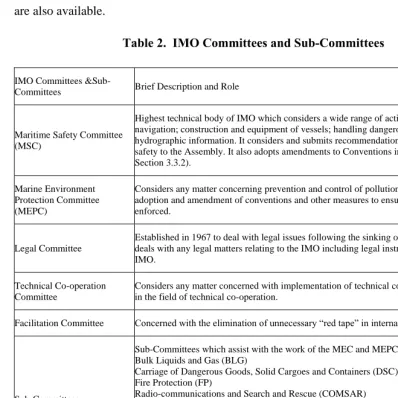
A brief description of the various IMO Committees and Sub-Committees, together with their role within the organization, is provided in Table 2.
The Committees and Sub-Committees of the IMO are responsible for updating existing regulations and the development and adoption of new regulations. IMO Committees and Sub-Committees are made up of all member states and meetings are open to marine experts from any member government. They are also open to a diverse range of Non-Governmental and Inter-Governmental Organizations (currently 78 NGOs and 61 IGOs, the latter including the 9
Memoranda of Understanding (MOU) Organizations discussed in Section 4)27. International
NGOs can gain consultative status with the IMO Council and contribute to the work of its Committees while IGOs can enter into agreements of co-operation with other IGOs in areas of common interest, as is the case with the MOUs. The range of IGOs and NGOs include the International Association of Maritime Universities (IAMU), The International Association of Ports and Harbors (IAPH), the World Wide Fund for Nature (WWF), and the International Criminal Police Organization (INTERPOL).
3.3. The Main Conventions Administered by the IMO
The IMO has responsibility for 29 Conventions and related Protocols under the headings of Maritime Safety, Marine Pollution, Liability and Compensation, and Other Subjects. A
26 Details of the NGOs and IGOs and their relationships with other organizations can be found via the IMO website. Available online at:: http://www.imo.org/About/mainframe.asp?topic_id=1639 for relationships; http://www.imo.org/About/mainframe.asp?topic_id=851 for NGOs which have been granted consultative status with the IMO; and http://www.imo.org/About/mainframe.asp?topic_id=846 for IGOs which have concluded agreements of cooperation with the IMO
complete list of Conventions is available from the IMO website28, with links to further details of the individual Conventions also available. A Summary of Status of the various Conventions is also available and identifies date of entry into force of convention and any related protocols, the number of Contracting States (signatories to the specific Convention)
and the percentage of world tonnage (world shipping fleet) represented by those states29. For
example, the IMO Convention, which entered into force on 17 March 1958, has 169 Contracting States which represent 97.34% of world shipping tonnage. Details of the
individual states which have acceded to or ratified the various Conventions and Protocols30
are also available.
Highest technical body of IMO which considers a wide range of activities including: aids to navigation; construction and equipment of vessels; handling dangerous cargoes; and hydrographic information. It considers and submits recommendations and guidelines on safety to the Assembly. It also adopts amendments to Conventions including SOLAS (see Section 3.3.2).
Marine Environment Protection Committee (MEPC)
Considers any matter concerning prevention and control of pollution from ships, including adoption and amendment of conventions and other measures to ensure that regulations are enforced.
Legal Committee
Established in 1967 to deal with legal issues following the sinking of the Torrey Canyon – deals with any legal matters relating to the IMO including legal instruments adopted by the IMO.
Technical Co-operation Committee
Considers any matter concerned with implementation of technical co-operation projects or in the field of technical co-operation.
Facilitation Committee Concerned with the elimination of unnecessary “red tape” in international shipping. Sub-Committees
Sub-Committees which assist with the work of the MEC and MEPC: Bulk Liquids and Gas (BLG)
Carriage of Dangerous Goods, Solid Cargoes and Containers (DSC) Fire Protection (FP)
Radio-communications and Search and Rescue (COMSAR) Safety of Navigation (NAV)
Ship Design and Equipment (DE)
Stability and Load Lines and Fishing Vessels Safety (SLF) Standards of Training and Watchkeeping (STW) Flag State Implementation (FSI)
28 A Complete List of Conventions for which the IMO has responsibility is available from the IMO website. Available online at: http://www.imo.org/About/mainframe.asp?topic_id=260 with links to individual Conventions being available via a quick link on the left of the IMO homepage at http://www.imo.org/ Hard copies and other documents are also available from the IMO website publications section and from distributors worldwide.
29 A Summary of Status of Convention at 30 June 2010, including details of the number of Contracting States and
the % of world tonnage (as measured by Lloyd‟s Register/Fairplay →orld Fleet Statistics in December β009)
is available from the IMO website. Available online at: http://www.imo.org/Conventions/mainframe.asp?topic_id=247
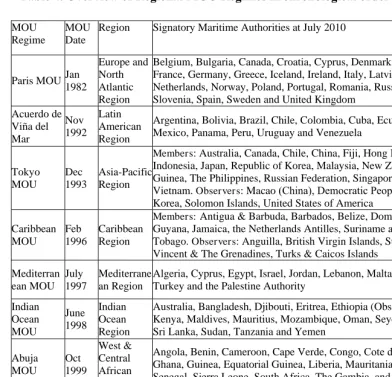
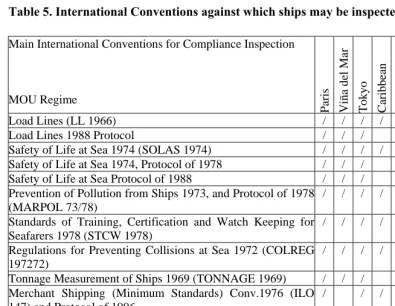
This section will examine five Conventions out of 29 administered by the IMO (at September 2010). These Conventions, together with their various Protocols and amendments, are monitored for compliance under a system of vessel inspections conducted by a number of regional Memoranda on Port State Control regimes, the scope and main activities of which are discussed in Section 4 of this chapter.
3.3.1. International Convention on Load Lines 1966 and its Protocol of 1988 (LLC):
The Load Lines Convention was adopted in April 1966 and entered into force in July 1968 and at June 2010 had 159 Contracting States representing 99.04% of world tonnage. A subsequent Protocol of November 1988 (which entered into force in February 2000) was adopted in order to bring the LLC certification requirement in line with requirements contained in the SOLAS and MARPOL Conventions discussed below. An earlier version of this Convention had been adopted in 1930 but even prior to that there was a long history of using such marks on vessels over many centuries. For example, the United Kingdom had introduced a system of lines though a Merchant Shipping Act of 1876 and these lines are
sometimes known as Plimsoll Lines after the British MP of the 1860‟s who developed them.
The LLC was introduced to help ensure the safety of vessels by preventing them from being over-loaded and to ensure they remained watertight and did not sink if they were damaged. Highly visible markings are placed amidships on vessels and these provide an easily visible indication that a vessel is weather and water-tight. Load lines are calculated based on a principle known as reserve buoyancy (the difference between the volume of a vessel below the waterline and below the lowest opening which cannot be made watertight). It takes into account the salinity and temperature of water in different regions to ensure that a vessel will remain watertight when sailing in those waters. The types of seawater represented by load lines are: tropical fresh water (TF); fresh water (F); tropical seawater (T); summer temperate seawater (S); winter temperate seawater (W); and winter North Atlantic (WNA). A similar system is used for vessels specifically transporting timber.
3.3.2. International Convention on Safety of Life at Sea 1974 and its Protocols of 1978 and 1988 (SOLAS):
The SOLAS Convention was originally adopted in 1914 following the sinking of the
Titanic, which subsequent versions being adopted in 1929, 1948 and 196034. The 1974
Convention entered into force in May 1980 and, at June 2010, had 159 Contracting Parties. SOLAS 1974, together with its 1978 and 1988 Protocols, was developed specifically so that it could be kept up to date in light of new technological developments, and uses a system of
“tacit acceptance”. Under this system, any amendments will automatically enter into force by
a specified date unless sufficient objections have been received from an agreed number of states to prevent this from occurring. Amendments to SOLAS can come from meetings of the Maritime Safety Committee or following a Conference of Contracting Governments of the IMO.