Solar2011, the 49thAuSESAnnual Conference
1 November -2 December 2011
OUTCOMES OF AN ADRA RESEARCH PROJECT TO
OVERCOME BARRIERS TO RENEWABLE ENERGY IN RURAL
INDONESIA BY COMMUNITY CAPACITY BUILDING
Maria Retnanestri(1,2), Hugh Outhred(2)
(1)
Department of Electrical Engineering, STTNAS College, Jogjakarta 55281, Indonesia (2)
School of Electrical Engineering and Telecommunications, University of New South Wales Sydney 2052, Australia
[email protected], [email protected]
ABSTRACT
This paper reports on the design and outcomes of an Australian Development Research Award (ADRA) project conducted in 2008-2011 by Australian and Indonesian researchers. Early outcomes of this interdisciplinary research project were reported in the ISESAP08 Conference (Retnanestri et al 2008a). Many institutions have actively promoted and installed RE systems in Indonesia since the 1970s. In addition to 4.2 GW of large hydro, by 2009 more than 1.9 GW of geothermal, solar photovoltaic (PV), biomass, mini and micro hydro, and wind power systems had been installed in Indonesia, a 46% increase from 2005 (the baseline data year for this project). Moreover, in 2010, the Government of Indonesia (GOI) announced its 25/25 vision: a 25% RE target by 2025 (EBTKE 2010). Despite this progress, more than 80 million Indonesians remained without electricity in 2009. This research project focused on the Nusa Tenggara Timur (NTT) province in Eastern Indonesia, which has a low electrification ratio as well as low Human Development Indices (HDI) and a high poverty level. By 2010 more than 1.7 MWp of PV power, 270 kW of micro hydro, 175 kW of wind power and 13 biogas digesters had been installed in off-grid areas of NTT. However, many of these projects failed and many other communities still lack basic electricity supply. Improved RE project design and capacity building are required for RE to contribute to sustainable energy provision in Indonesia. The aims of this three-year project were to identify and disseminate ways to use renewable energy (RE) resources to facilitate sustainable development for communities in rural Indonesia without access to electricity grids. Project activities designed for capacity building included a series of seminars, workshops, study tours and fieldwork. This paper reports on the outcomes of study tours in Java and a workshop in Kupang, the capital city of NTT province. The study tours involved staff and students from various engineering background and visited photovoltaic, micro hydro, geothermal, bio energy installations, factories and research agencies in Jakarta and the provinces of West Java, Central Java and Jogjakarta. Seminars were held in Jogjakarta in 2009 and 2010 to report the outcomes. The objective of the study tours and seminars was to develop a model for RE capacity building for educational institutions to facilitate RE acculturation. The KPDAC continuum (Knowledge, Persuasion, Decision, Adoption and Confirmation – see Retnanestri 2007) was used as a methodology to understand the RE acculturation process and design capacity building activities. The objectives of the workshop in Kupang were to assess past practices and promote a more sustainable approach to RE projects in NTT province. The workshop used the I3A methodology (Implementation that achieves RE Accessibility, Availability and Acceptability – see Retnanestri et al 2008b). Diversified groups of workshop participants used the 21-step I3A process to analyse the renewable energy situation in NTT and develop recommendations for stakeholders in NTT and the Government of Indonesia.
Keywords: ADRA research project, I3A framework, RE capacity building
Solar2011, the 49th AuSES Annual Conference 30th November -2nd December 2011
Solar2011, the 49thAuSESAnnual Conference 2
RESEARCH PROJECT DESCRIPTION, OBJECTIVES AND BACKGROUND
As reported in Retnanestri et al 2008a, the UNSW’s ADRA EFCC 011project is an interdisciplinary research project involving UNSW staff and Indonesian collaborators. Its objective is to identify and disseminate ways to overcome barriers to the use of renewable energy (RE) resources to facilitate sustainable development for communities in rural Eastern Indonesia that do not have access to conventional electricity supply. In particular, the project aims to develop a better understanding of why some RE projects succeed while others fail to facilitate sustainable rural development, and to transfer the practical know-how generated to policy makers, those involved in project design and implementation and rural communities. This project is consistent with the aims and recommendations of a recent United Nations Report (UN Secretary General, 2011).
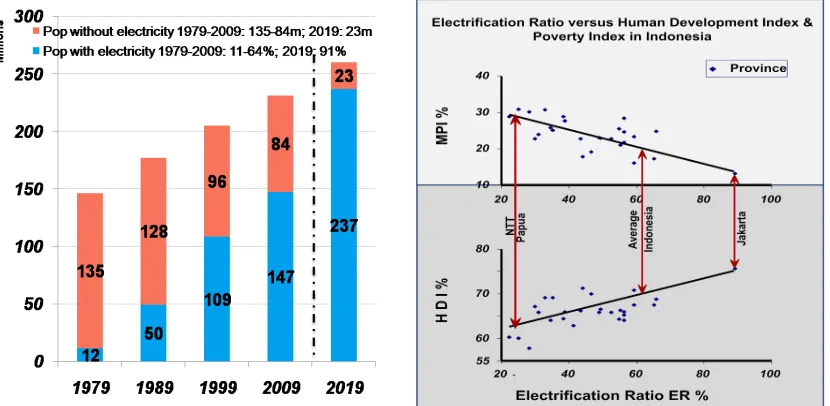
As shown in Figure 1a, the Indonesian electrification ratio has grown rapidly, from 11% in 1979 to 64% in 2009, providing electricity supply to 135 million people in three decades. PLN (the state utility) plans to increase the electrification ratio to 91% by 2019 (PLN 2010). Even then, approximately 23 million Indonesians will remain without grid connection due to the archipelagic nature of Indonesia. Uneven access to electricity has social and economic implication as shown in Figure 1b. Of the 33 Indonesian provinces, Papua and NTT in Eastern Indonesia have the lowest electrification ratios, low Human Development Indices (HDI) and high Multi-dimension Poverty Indices (MPI)1.
Fig.1a: Indonesian electrification ratio 1979-2009 and plan for 2019 (PLN 2010). Fig. 1b: Relationships between electrification ratio, HDI and MPI by Indonesian
Province (BPS 2010, PLN 2010).
NTT is an archipelagic province comprising 566 islands, with only 42 islands being inhabited by 4.6 million people and an electrification ratio of 24%, leaving more than three million people without grid supply. In 2009, average annual per capita consumption was 83 kWh, compared to the Indonesian average of 582 kWh, and lower
than the WHO’s energy poverty standard of 120 kWh
(http://en.wikipedia.org/wiki/Energy_poverty). Economic growth was 4.2%/yr; lower than the national average of 7%/yr. The poverty level was 24%, higher than the Indonesian average of 14%. In 2009, installed generating capacity was 112 MW and NTT PLN plans to install further 6.9 GW during 2010-2019 (Januwarsono 2010) using
1 HDI is a measure of life expectancy, educational attainment and standard of living while MPI is a measure of poor health, education and standard of living (www.hrd.undp.org).
Solar2011, the 49thAuSESAnnual Conference
1-3 December 2011
3 coal, combined cycle gas, diesel fuel, geothermal and hydro power. However, in 2019, many remote communities will remain isolated due to the archipelagic nature of NTT.
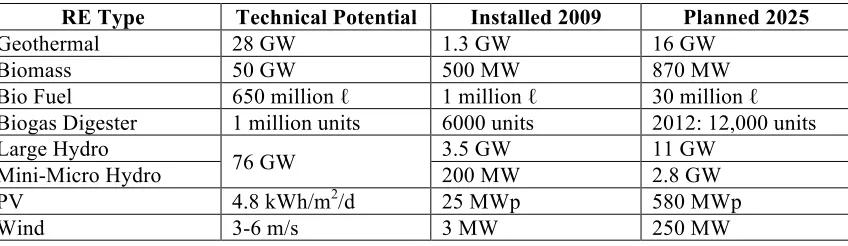
Indonesia has solar, hydro, geothermal, biomass and wind in certain areas (Table 1), which could play an important role in remote energy supply. Many institutions (government, donors, international energy companies, domestic enterprises, NGOs and universities) have promoted and installed RE systems in Indonesia since the 1970s. By 2010, in addition to 4.2 GW of large hydro, more than 1.9 GW geothermal, solar photovoltaic (PV), biomass, mini and micro hydro, and wind power systems had been installed, a 46% increase from 2005 (the data baseline year for this project). Of those, more than 1.7 MWp of PV, 270 kW of micro hydro, 175 kW of wind power and 13 biogas digesters had been installed in off-grid areas of NTT (Yohanes 2010).
In 2010, the GOI announced its 25/25 vision: a 25% RE target by 2025 (EBTKE 2010). In grid-connected areas, RE promotion includes geothermal and PV. In off-grid areas, RE programs include Listrik Pedesaan (Lisdes, village electrification) and the Desa Mandiri Energi (DME, energy self-sufficient village) using local RE sources. The DME target is 2,000 energy self-sufficient villages in 33 provinces by 2014. Table 1 summarized RE potential in Indonesia, progress to date and plan for 2025.
Table 1. RE potential, 2009 capacity & 2025 plan (ESDM 2006, PLN 2010; SNV 2009)
RE Type Technical Potential Installed 2009 Planned 2025
Geothermal 28 GW 1.3 GW 16 GW
Biomass 50 GW 500 MW 870 MW
Bio Fuel 650 million ℓ 1 million ℓ 30 million ℓ
Biogas Digester 1 million units 6000 units 2012: 12,000 units
Large Hydro
76 GW 3.5 GW 11 GW
Mini-Micro Hydro 200 MW 2.8 GW
PV 4.8 kWh/m2/d 25 MWp 580 MWp
Wind 3-6 m/s 3 MW 250 MW
Geothermal and large hydro are the major RE contributors to date and are expected to remain so in 2025. All other RE systems face institutional, financial, technological or social barriers such as lack of coordination among implementation agencies, high cost, lack of technical capacity and lack of social acceptance. Many projects pay insufficient attention to software (skill, knowledge) and orgware (institution, rules) potentially threatening the long-term sustainability of RE system operation.
Thus there is a need to understand RE barriers in a systematic way to reduce the likelihood of bad project outcomes and increase the likelihood of good outcomes. The I3A (Implementation to achieve RE Accessibility, Availability and Acceptability) framework (Retnanestri 2007) was used in this project as an analytical tool to assess existing RE projects and design new ones, by considering institutional, financial, technological, social and ecological aspects of PVES delivery, and addressing issues related to the hardware, software and orgware aspects of RE technology. There is also a need to understand capacity building requirements to facilitate RE acculturation in the target community. We used the KPDAC (knowledge, persuasion, diffusion, adoption and confirmation) continuum (Retnanestri 2007) for this purpose.
This paper focuses on two ADRA EFCC 011 research project activities: 1) Workshop and focused group discussion in Kupang, NTT, using the I3A framework to identify RE barriers and ways to overcome those barriers in the NTT context, and 2) Study tour and field work by students and staffs of STTNAS College designed as a model for RE capacity building by educational institutions.
Solar2011, the 49th AuSES Annual Conference 30th November -2nd December 2011
Solar2011, the 49thAuSESAnnual Conference 4
PROJECT DESIGN, METHODOLOGIES AND ACTIVITIES
Research Design and Timeline
Figure 2 summarizes the three-year project activities, timeline and expected outcomes. Activities include a sequence of seminars, workshops and site visits, and the use of the I3A framework as research methodology. Research activities and outcomes are reported through www.ceem.unsw.edu.au for dissemination purposes.
Fig.2: Project activities and timeline (adapted from Retnanestri et al 2008a).
The I3A Framework and NTT Workshop
Figure 3 presents the I3A framework in 21 steps for analyzing or designing a sustainable RE service delivery system. The premise of the I3A framework is that to be sustainable and equitable, RE projects should be implemented in an institutional framework that addresses RE accessibility (financial, institutional and technological), availability (technical quality and continuity) and acceptability (social and ecological). For a more detailed discussion on this see (Retnanestri et al 2008b). The I3A framework was used in a workshop in Kupang, NTT, to assess past practices and identify a more sustainable approach to RE projects in NTT province as well as to provide recommendations for stakeholders in NTT and the Government of Indonesia.
Fig.3: The 21-step I3A procedure for analyzing and designing sustainable RE service delivery systems (adapted from Retnanestri et al 2008b).
RET Acculturation, the KPDAC Continuum and Capacity Building Activities
Figure 4 presents the KPDAC continuum that illustrates a progression in the RE technology (RET) diffusion or acculturation process from: 0) Prior Condition (previous practices) to Knowledge (awareness of RET), Persuasion (formation of favourable or unfavourable attitude to RET), Decision (to adopt or reject RET), Adoption of RET and finally Confirmation (decision to continue or discontinue the adoption of RET). The KPDAC continuum is based on the work of Rogers (2003) on diffusion of innovations and is discussed in detail in Retnanestri (2007).
Solar2011, the 49thAuSESAnnual Conference
Role of facilitators in each stage of the RET acculturation process
Diagnose problems,
Fig.4: The KPDAC continuum and the RE technology acculturation process
Each stage has its own question (Q0 – Q5) and facilitators play a crucial role in assisting the target community to answer these questions, thus facilitating the acculturation process. Their roles include diagnosing problems with previous energy practices and suggesting improvements, providing information on alternatives (RE technology in this context), assisting in implementation and suggesting ways in which users can continue to harness benefits, thus stabilizing adoption. Capacity building aims to create agents (facilitators) able to facilitate the RET acculturation process. The study tour by students and staffs of STTNAS College was designed as a model for educational institutions to engage in RE capacity building.
DISCUSSION 1: ASSESSMENT OF RE SUSTAINABILITY IN NTT USING I3A
On 8-9 June 2010, in collaboration with the Kupang-based University of Nusa Cendana
(UNDANA www.undana.ac.id), the NTT regional government and NTT PLN (the NTT
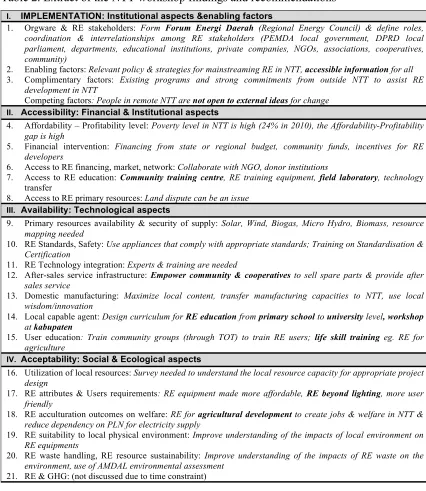
electricity utility), we ran a two-day seminar and workshop attended by participants from government, utility, business, academic and NGOs, in which local stakeholders made presentations looking at the potential, progress, challenges and perception of RE in NTT (Figure 5). Focused group discussions followed in which participants were divided into three diversified groups of government officials, utility representatives, academics and NGO personnel. Each group discussed NTT’s situation using the I3A Framework as a 21-step methodology for developing a plan to enhance the sustainability of RE service delivery in NTT. At the end of the discussion session each group reported to a plenary session the final outcomes, which were later compiled as workshop findings. Table 2 presents an extract from the findings, which are discussed in the following sub-sections.
Fig.5: The workshop in Kupang, NTT province, to identify barriers to RE in NTT using the I3A framework in 21 steps, June 2010
Solar2011, the 49th AuSES Annual Conference 30th November -2nd December 2011
Solar2011, the 49thAuSESAnnual Conference 6
Table 2. Extract of the NTT workshop findings and recommendations
I. IMPLEMENTATION: Institutional aspects &enabling factors
1. Orgware & RE stakeholders: Form Forum Energi Daerah (Regional Energy Council) & define roles, coordination & interrelationships among RE stakeholders (PEMDA local government, DPRD local parliament, departments, educational institutions, private companies, NGOs, associations, cooperatives, community)
2. Enabling factors: Relevant policy & strategies for mainstreaming RE in NTT, accessible information for all
3. Complimentary factors: Existing programs and strong commitments from outside NTT to assist RE development in NTT
Competing factors: People in remote NTT are not open to external ideas for change
II. Accessibility: Financial & Institutional aspects
4. Affordability – Profitability level: Poverty level in NTT is high (24% in 2010), the Affordability-Profitability gap is high
5. Financial intervention: Financing from state or regional budget, community funds, incentives for RE developers
6. Access to RE financing, market, network: Collaborate with NGO, donor institutions
7. Access to RE education: Community training centre, RE training equipment, field laboratory, technology transfer
8. Access to RE primary resources: Land dispute can be an issue
III. Availability: Technological aspects
9. Primary resources availability & security of supply: Solar, Wind, Biogas, Micro Hydro, Biomass, resource mapping needed
10. RE Standards, Safety: Use appliances that comply with appropriate standards; Training on Standardisation & Certification
11. RE Technology integration: Experts & training are needed
12. After-sales service infrastructure: Empower community & cooperatives to sell spare parts & provide after sales service
13. Domestic manufacturing: Maximize local content, transfer manufacturing capacities to NTT, use local wisdom/innovation
14. Local capable agent: Design curriculum for RE education from primary school to university level, workshop
at kabupaten
15. User education: Train community groups (through TOT) to train RE users; life skill training eg. RE for agriculture
IV. Acceptability: Social & Ecological aspects
16. Utilization of local resources: Survey needed to understand the local resource capacity for appropriate project design
17. RE attributes & Users requirements: RE equipment made more affordable, RE beyond lighting, more user friendly
18. RE acculturation outcomes on welfare: RE for agricultural development to create jobs & welfare in NTT & reduce dependency on PLN for electricity supply
19. RE suitability to local physical environment: Improve understanding of the impacts of local environment on RE equipments
20. RE waste handling, RE resource sustainability: Improve understanding of the impacts of RE waste on the environment, use of AMDAL environmental assessment
21. RE & GHG: (not discussed due to time constraint)
Implementation: Orgware and enabling factors
The workshop concluded that in order to deal with the energy situation in NTT province, NTT should form a Forum Energi Daerah or Regional Energy Council comprising various stakeholders from the NTT government, parliament, relevant government departments, educational institutions, business sectors, NGOs, cooperatives and community associations. The roles of stakeholders and their interrelationships need to be defined, and coordination is required. Enabling factors such as defining relevant policies and strategies are imperative for mainstreaming RE in NTT in which information that is available and accessible to all is of key importance. Federal, provincial and local governments, and local and international NGOs have run many RE programs in NTT with strong commitment but varying degrees of success. Workshop participants noted that remote NTT communities are not open to external advocacy for change, which has been a barrier to RE acculturation in NTT. They felt that
Solar2011, the 49thAuSESAnnual Conference
1-3 December 2011
7 strengthening RE orgware and building a local RE stakeholder network would help to overcome such barriers to successful RE project implementation.
Accessibility: Financial, technological and resource accessibilities
Given that 24% of NTT people are poor and RE prices are high by their standards, the gap between RE affordability and RE profitability is large. Thus it is not yet possible to rely on unsubsidised commercial delivery of RE projects. Participants considered that Federal or Provincial financial subsidies, the formation of community funds and incentives for RE developers were important options to consider. They identified a need for RE education and training to support technology transfer, for example by establishing community training centres, and providing RE training equipment and field laboratories. They also identified the possibility of land-use conflicts over access to renewable energy resources (for example water for a micro hydro system) and thus a need for conflict resolution procedures.
Availability: Primary resource availability, RE hardware & service reliability
NTT has solar, wind, biogas, micro hydro, biomass and geothermal resources, however resource mapping is required to quantify these resources and ensure long-term security of supply. RE equipment should comply with appropriate standards to ensure safety and longevity. Training is required on standards and testing and certification procedures as well as on grid integration requirements and procedures. Local cooperatives could provide after sales service but they will need training on technical and organisational skills. Policies should be implemented to create or strengthen local manufacturing capability, transfer know-how, maximize local content and benefit from local wisdom and innovation. Educational institutions should design curricula from primary to tertiary level to educate local capable agents, supplemented by short-term activities such as workshops and short-courses at kabupaten (regency) level. There is also a need for “train the trainer” programs to develop community-level knowledge and skills in RE technologies and associated income generating activities, for example in agriculture and crafts.
Acceptability: Social acceptance and environmental aspects
Participants identified the use of local resources (natural resources, local institutions, customs) as key to RE acceptance; however surveys are needed to establish inventories of such resources. RE equipment should have attributes that meet local requirements. It should be affordable, user friendly, support a range of end-use activities as well as lighting, and thus boost job opportunities and welfare in NTT’s agricultural communities. If operating well, RE could reduce community dependency on PLN for
electricity supply. Environmental impact studies (AMDAL – Analisa Mengenai
Dampak Lingkungan) should assess the impacts of RE systems on the local environment and vice-versa (for example, the effect of salty coastal environments on RE equipment and the environmental impacts of RE wastes, for example batteries). Due to time constraints, RE resource sustainability and GHG (greenhouse gases) reduction potential were not discussed.
DISCUSSION 2: RE CAPACITY BUILDING AND ACCULTURATION
STTNAS, a private engineering college based in Jogjakarta, is a collaborator in this project and participated in developing a model for RE capacity building by an educational institution. In 2009 and 2010, groups of STTNAS students and staff (35 people in each group) undertook study tours to geothermal, photovoltaic, micro hydro,
Solar2011, the 49th AuSES Annual Conference 30th November -2nd December 2011
Solar2011, the 49thAuSESAnnual Conference 8
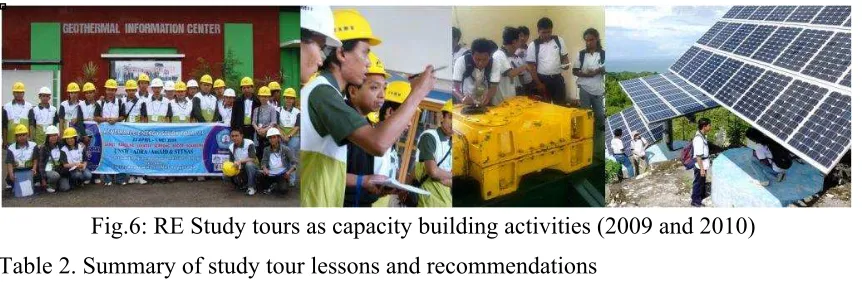
wind, jatropha and biogas sites, factories and research facilities in Jakarta and the Indonesian provinces of West Java, Central Java and Jogjakarta. Study tour participants were organised in mixed teams of Electrical, Mechanical and Civil Engineering, Chemistry and Geology to expose and explore the interdisciplinary nature of RE technology. Outcomes were reported in seminars in which students presented their findings. Figure 6 illustrates study tour activities and Table 2 presents extracts from the student reports.
Fig.6: RE Study tours as capacity building activities (2009 and 2010)
Table 2. Summary of study tour lessons and recommendations
Institutional (orgware) aspect: An important opportunity to access professional RE networks for industrial practice and to obtain final year thesis topics; An important experience in interdisciplinary team work; A recommendation to include RE education in the engineering curriculum; RE study tour to be conducted on an annual basis
Financial aspect: The high unit price of RE is a barrier; The importance of using locally available materials and components to reduce installation and maintenance costs
Technological (hardware & software) aspect: The working principle of RE (geothermal, micro hydro, PV, bio energy); how RE components are fabricated (PV, micro hydro); Different types of RE applications (PV: centralised and stand alone; geothermal: large scale and small scale/direct use); The physical manifestation of geothermal; The challenges in exploration for and exploitation of geothermal steam; The physical installation of RE (geothermal, micro hydro, PV) power plants; The gap between potential RE resource and actual utilization; The lack of domestic manufacturing capability; The maintenance challenges for PV in urban areas for example cleaning dust on the panels; The importance of strong commitment from technicians to maintain continued operation; The lack of resources (manpower, finance, expertise) for post-project service management; The importance of RE post project evaluation. Universities can undertake this role with proper capacity building
Social aspect: The contribution of RE to Indonesian electricity supply and its potential to improve Indonesian electrification ratio for national development and to reduce fossil fuel dependency; The importance of combining geothermal power plants, resource preservation (forest maintenance) and socio-economic development (eg. development of local tourism and employing local people; direct use of geothermal for agricultural process); The potential and challenges of using PV for community water pumping; The benefit of community involvement in a centralised PV project; The role of micro hydro for socio-economic development in off-grid areas; The need for socialisation/familiarisation and community awareness; The importance of raising community awareness (RE is not attractive compared to cheaper fossil fuel, difficulties in changing habit from AC to DC electricity)
Ecological aspect: The impact of salty environment on coastal RE installations and the importance of selecting robust components to avoid corrosion of RE structures; The potential role of RE to reduce GHG emission
Within the KPDAC continuum (Figure 4), Knowledge, the entry point to the RE acculturation process, is a stage where one gains understanding of what RE is and how and why it works. The study tour provided participants with an opportunity to gain knowledge of RE hardware and software from visits to manufacturers (PV, micro hydro) and sites to understand the operation and maintenance of RE installations.
As listed in Table 2, participants valued the knowledge gained such as the working principle of RE, the physical manifestation of RE source (geothermal), how RE components were fabricated, how RE works in the field (operation and maintenance) and the importance of post-project service management. Participants also gained knowledge of the benefits of RE such as the abundant availability of RE resource (geothermal, solar, hydro, biomass), the potential role that RE could play in the Indonesian energy sector to improve the electrification ratio, reduce fossil fuel dependency and reduce carbon dioxide emissions, as well as challenges such as
Solar2011, the 49thAuSESAnnual Conference
1-3 December 2011
9 harnessing the resource (exploration and exploitation of geothermal steam), RE maintenance (cleaning up dust from PV installation in urban areas), lack of domestic manufacturing capability, the high price of RE and the lack of resources (manpower, finance, expertise) for post-project service management. Participants also gained broader knowledge of the role of RE such as the importance of community involvement in RE project installation and operation (micro hydro and PV water pumping) and the importance of combining RE utilization with ecosystem preservation and local socioeconomic development (for example forest maintenance and employment of local people for geothermal tourism). From the knowledge they gained, participants could suggest ways to overcome RE challenges, for example by using locally available materials and components to reduce installation and maintenance costs, the importance of using robust materials and equipment in harsh environments (for example corrosion of PV structures installed in coastal areas), the important roles of technicians and managers in achieving continued RE operation and the importance of RE post project evaluation and community awareness raising, which universities can undertake with appropriate capacity building. The mixed discipline teams gave participants an interdisciplinary teamwork experience and an understanding of the interdisciplinary nature of RE. The study tour activities also provided participants with ideas to undertake industrial practice for their final year thesis, which was welcomed by RE manufacturers and operators. This illustrates the benefits of accessing a professional RE network (orgware). As the study tour activities were considered instrumental in gaining RE knowledge, participants recommended that study tours be conducted on an annual basis.
CONCLUSIONS AND RECOMMENDATIONS
1. NTT Workshop & the I3A framework: The NTT workshop demonstrated the use of
I3A framework as a systematic diagnostic tool to identify RE potential and barriers. Used in a workshop setting in NTT, which actively engaged diverse stakeholders, the I3A framework was used to understand the potential and barriers to RE from various stakeholder perspectives which, when collated together, can represent a form of consensus in identifying issues and formulating recommendations. The workshop outcomes could be followed-up by relevant authorities to define a future strategy for RE to contribute to RE sustainability in NTT. The I3A process provided qualitative outcomes that could be broken down further or complemented with quantitative enquiries. External organisations, in collaboration with local institutions, can play a positive role in facilitating local networking, in itself a community empowerment or capacity building activity necessary to create an enabling environment for RE. This particular activity was consistent with the project objectives of disseminating ways to overcome RE barriers and transferring practical know-how generated to policy-makers and to those involved in project design and implementation. Further development of the I3A framework will enhance its value. 2. RE study tour and capacity building activities: Local agents require RE knowledge
and the ability to work on interdisciplinary basis to facilitate the RE acculturation process. Recalling Figure 4, RE knowledge (with further training) will be instrumental for diagnosing problems with current energy practice and identifying alternatives, providing information and education, supervising RE system installations and troubleshooting to keep RE systems operating. RE is acculturated if the system remains in operation such that user can continue to harness energy services. Despite potential benefits of RE, Indonesia lacks people with the requisite knowledge and practical experience in the design, manufacture, installation, operation and maintenance of RE systems. Engineering colleges have the potential
Solar2011, the 49th AuSES Annual Conference 30th November -2nd December 2011
Solar2011, the 49thAuSESAnnual Conference 10
to play an important role in filling this gap, by providing education and practical experience in RE engineering. Support of similar capacity building initiatives at other Indonesian universities would facilitate RE acculturation, taking into account the lessons learned from the ADRA capacity building program.
ACKNOWLEDGMENT
AusAID provided ADRA funding for this project. STTNAS College, the University of Nusa Cendana, the NTT government and NTT PLN collaborated in workshop planning and implementation and provided partial funding for the workshop and study tour activities. RE sites, factories and research agencies provided access and hospitality for the study tours and contributed to participant RE knowledge and experience.
REFERENCES
BPS, (2010), Statistik Indonesia2010 (Indonesian Statistics 2010), Jakarta, ISBN 0126-2912
EBTKE, (2010), Alternative Fuels and the Environment, Directorate General for New Renewable Energy and Energy Conservation (EBTKE) of Ministry of Energy and Mineral Resources of Indonesia, Talk show on Implementation of Sustainable Energy Policies, Alternative Fuels and the Environment, Jakarta, 27 September 2010
ESDM, (2006), Blue Print PengelolaanEnergiNasional (Blue Print of National Energy
Management), www.esdm.go.id
Januwarsono, S., (2010), Perencanaan Pembangunan Kelistrikan sebagai Upaya
Pemenuhan Kebutuhan Energi Listrik di NTT (Electricity Planning Development for NTT Province), UNDANA/STTNAS/UNSW-ADRA Joint Workshop on Renewable Energy & Sustainable Development in NTT, Kupang, 8-9 June 2010, Online
www.ceem.unsw.edu.au
PLN, (2010a), Rencana Usaha Penyediaan Tenaga Listrik (Planning for Electricity Utilization), Seminar PLN, Jakarta 3 November 2010
PLN, (2010b), PLN Statistics 2009, PT PLN Persero, Jakarta, ISSN 0852-8179
Retnanestri, M., (2007), The I3A Framework – Enhancing the Sustainability of Off-grid Photovoltaic Energy Service Delivery in Indonesia, PhD thesis submitted to UNSW,
Online www.library.unsw.edu.au
Retnanestri, M., Outhred, H., Tugino.,Astuti, B., Rezavidi, A., Prastawa, A., (2008a), An ADRA Research Project to Overcome Barriers to Renewable Energy in Rural Indonesia by Community Capacity Building using the I3A Framework, The 3rd International Solar Energy Society–Asia Pacific Region Conference 2008, Sydney, Australia, 26-28 November 2011, ISBN 978-0-646-50593-0
Retnanestri, M., Outhred, H., Healy, S., (2008b), The I3A Framework – Enhancing the Sustainability of Off-grid Photovoltaic Energy Service Delivery in Indonesia, The 3rd International Solar Energy Society–Asia Pacific Region Conference 2008, Sydney, Australia, 26-28 November 2011, ISBN 978-0-646-50593-0
Rogers, EM., (2003), The Diffusion of Innovations, Fifth Edition (1962, 1971, 1983, 1995, 2003), Free Press, New York, ISBN 0-7432-2209-1.
SNV (2009), Feasibility of a National Programme on Domestic Biogas in Indonesia, Final Report, SNV Netherlands Development Organisation, January 2009
UN Secretary General (2011), Promotion of New and Renewable Sources of Energy, United Nations General Assembly, Sixty-sixth Session, August.
Yohanes, B., (2010), Peta Potensi Energi Baru Terbarukan di Propinsi Nusa Tenggara Timur (Map of New and Renewable Energy Potentials in the Nusa Tenggara Timur Province), UNDANA/STTNAS/UNSW-ADRA Joint Workshop on Renewable Energy & Sustainable Development in NTT, Kupang, 8-9 June 2010, Online
www.ceem.unsw.edu.au