Global Conference on Business and Social Science Series
conference homepage: www.gcbss.org
Discovering the Relationship among V
rooms’
Motivational
Factors Perceived by Generation Y
(A Case Study in Corporate Service Organizations within the Greater
Jakarta Area, Indonesia)
Dr. Nurianna Thoha, MBA1*, Daniel Adiputra Rasidi2
1International Business/Faculty of Business BINA NUSANTARA University,
JWC Campus – Jl. Hang Lekir I no 6, Senayan, 10270, Jakarta, Indonesia
2 International Business/Faculty of Business BINA NUSANTARA University,
JWC Campus – Jl. Hang Lekir I no 6, Senayan, 10270, Jakarta, Indonesia
ABSTRACT
Generation Y has started to dominate the workplace, including in Indonesia. It is expected that 75% of the workforce globally will consist of Generation Y by the year 2025. Therefore, it is urgent to look upon the different needs and motivations of this new generation, since they bring unique values, cultures, and motivations which are different from those of previous generations.
Discovering Generation Y’s unique characteristics will allow a more in-depth and well-prepared
motivation plan to be developed and implemented. Vroom’s Motivation Theory was examined and used
as the fundamental theory for this research.
This research applied quantitative studies. The pre-test questionnaire was analyzed through Cronbach’s Alpha and Kaiser–Meyer–Olkin as a reliability and validity test. The distributed questionnaires were then analyzed using T-test, Pearson Correlation, and Multiple Regression Stepwise. The final regression formula adapted was from stepwise regression.
The research found that ‘salary’, ‘accessibility’, and ‘importance’ have the highest correlations for the
‘expectancy’, ‘instrumentality’, and ‘valence’ variables respectively.
The implications are a person’s motivation can be driven through salary increases, provide access to a higher-level manager, and create a job that is perceived to be important by him/her. Therefore, companies might motivate and retain Generation Y by incorporating these research findings when developing companies’ rules and policies.
Type of Paper: Empirical
Keywords:Expectancy; Generation Y; Instrumentality; Job-Motivation; Valence; Vroom’s Theory of Motivation.
*
Corresponding author:
E-mail: [email protected]
2 | P a g e
_________________________________________________________________________________
1.Introduction
The rapid growth of Generation Y employees that are pouring into the labor market, create the
need for attention with reference to the employees’ generational conditions. In 2015 Generation
Y surpassed the number of Baby Boomers generation (Fry, 2015) and it is expected that 75%
of workforce globally will consist of Generation Y by the year of 2025 (Schawbel, 2012).
In Asia, the growth of the workforce is considered the highest in the world (Allen, Ahmed,
Yip, & Switzer, 2014). It is estimated that around 90% of this workforce are living in
developing or under-developed countries, in which they could not accommodate the large
amount of labor (Sparreboom & Ernst, 2013). Furthermore, according to Sparreboom & Ernst
(2013), there is an increasing percentage of Generation Y that started to get into a higher
positions in the workplace from 12% to 87%.
The purpose of this research is to discover and explore Vroom’s Motivation factors; such as
valence; which is perceived important by Generation Y who work in corporate service
organizations. The goal of this research is to allow managers to gain insights and formulate
strategic planning and carefuly planned decisions towards the employees’ motivation in the
workplace (Legault, 2002).
2. Literature Review
A generation cohort in social science is defined as a group of people within a delineated
population that experience the same significant events in the time of their birth (Pilcher & Jane,
2012). The individuals that have been grouped into a specific generation population may have
developed common norms and moral values that are different from generations before or after
them (Kowske, Rasch, & Wiley, 2010).
2.1 Generation Y
This generation is also called the Millennials; that is a group of individuals who were born
between the years 1981 – 2000 (Nisen, 2013). This generation is known for their exposure to
technology, multi-cultural environments, and multi-tasking work (Unsworth, 2008). They are
also interested in business, computing, teaching, law, medicine, and hotels and tourism
(Zemke, Raines, & Filipczak, 2000). This generation are slowly replacing the older generations
in the workplace, and as pointed out by Park (2011) they value more meaningful and
2.2 Vroom’s Expectancy Theory
Vroom suggests that motivation is driven by behaviors from conscious choices among many
alternatives that are available. He developed what is known now as ‘Vroom’s Motivation
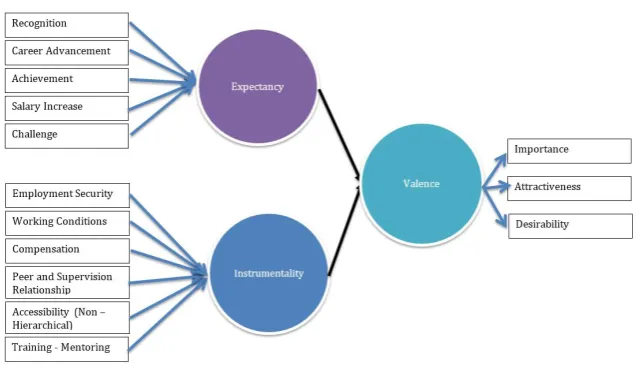
Theory’, which comprises ‘valence’, ‘instrumentality’, and ‘expectancy’.
Valence refers to emotional orientation that people have in relation to outcomes or results. This
orientation has two extreme points, which are positive and negative (Vroom, 1964). But, this
does not eliminate the possibilities of other outcomes such as in the middle, or to a certain
extent. Valence is a consolidation of three parameters that are ‘importance’, ‘attractiveness’,
and ‘desirability’ (Thierry, 1996).
The second term, ‘instrumentality’ explores the factors which shape and allow the expectation
within a person. It is highly dependent on expectation which comes from past experiences, that
implies certain efforts may result in certain outcomes (Brewis et al., 2007).
The third term in Vroom’s model is called ‘expectancy’, that is simply the ‘action outcome’
association in a person’s mind. Several things can shape and change the ideals of expectancy,
which has implications on the confidence of a person to achieve and accomplish his/her job.
The main strength of Vroom’s theory of expectancy is that all the variables are not in control
of managers. All three factors; expectancy, instrumentality, and valence, are connected to one
another yet independent from external motives. This theory fits directly with Generation Y’s
characteristics. This generation does want involvement that includes personal expressions.
2.3 Hypothesis development
Based on the discussion above, the research question is: “Which of the independent Vroom
factors are perceived more significant on Valences’ variables by Generation Y workers in
corporate service organizations within the Greater Jakarta area?”
Thus, the hypotheses are:
• H1: There is a significant relationship between independent Vroom factors towards importance perceived by Generation Y workers in corporate service organizations within the Greater Jakarta area.
• H2: There is a significant relationship between independent Vroom factors towards attractiveness perceived by Generation Y workers in corporate service organizations within the Greater Jakarta area.
• H3: There is a significant relationship between independent Vroom factors towards desirability perceived by Generation Y workers in corporate service organizations within the Greater Jakarta area.
4 | P a g e
Figure 1. Research framework
3. Research Methodology
This research is explanatory research, where it is intended to discover and explain the
relationship between variables in the research. The focus of this research is to investigate the
variables within Vroom’s theory of motivation factors; that is valence, which may or may not
be perceived as important by Generation Y.
The pool for this research is Generation Y workers who are working in corporate service
organizations. The company had to be a start – up, that had a maximum three years after
founding, and under a venture or bigger corporate group. The research is done through
purposive and quota-sampling methods.
The total sample for this research are 108 respondents. These respondents represent four
companies, with similar business practices, which still exist in the corporate service
organization. The companies’ details are as follows; company A - offer services in a form of
customer services towards individuals; company B is a cluster of companies that are under a
venture; company C is a branding and activation company for new start – ups; company D is a
start – up consultant in marketing and product engagement
4. Results
The data was analyzed using an Independent T-test and Multiple Regression.
4.1 Regression
Multiple Linear Regression was used to find the contribution and significance of an independent
4.1.1 Mean Regression
This section discusses the regression from Mean of Expectancy and Mean of Instrumentality
towards Mean of Valence. This give a bird’s-eye view of the research itself.
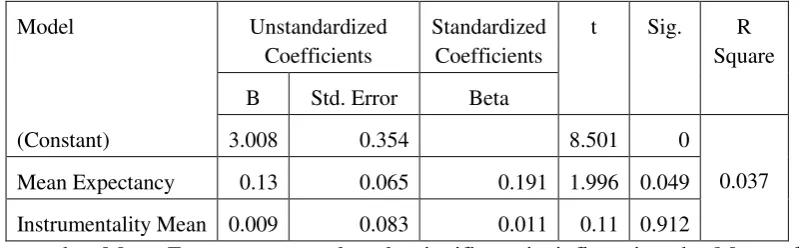
Table 1. Mean regression coefficients
Valence. On the other hand, Mean Instrumentality had no significant influence on the Mean of
Valence. In short, a quick depiction in terms of regression formula would be as follows:
Vm = 3.008 + 0.130 Em + 0.009 Im (1)
A more in-depth look on the results of Model Summary shows that there was only 3.7% in
Mean of Valence that can be explained in Mean of Expectancy and Instrumentality.
4.1.2 Hypothesis 1 – Importance Regression
Table 2. Importance (Valence) factor regression step wise coefficients
Model Unstandardized
Based on the result in table 2 and the four model, the new and Step Wise method of regression
formula was:
I = 0.103 + 0.290 EXCha + 0.300 INCom + 0.256 INEmp + 0.124 INRel (2)
In addition, this Step Wise method result showed that there were 21.6% of variability in
6 | P a g e
4.1.3 Hypothesis 2 – Attractiveness Regression
Table 3. Attractiveness (Valence) factor regression step wise coefficients
Model Unstandardized
Taking from the table 3 and four final model, it would yield the following Regression Formula:
A = 4.225 + 0.290 EXRec + 0.172 EXCar − 0.302 INTra − 0.315 INWor (3)
In addition, the model showed that 28.1% variability in attractiveness can be explained through
these four most significant variables.
4.1.4 Hypothesis 3 – Desirability Regression
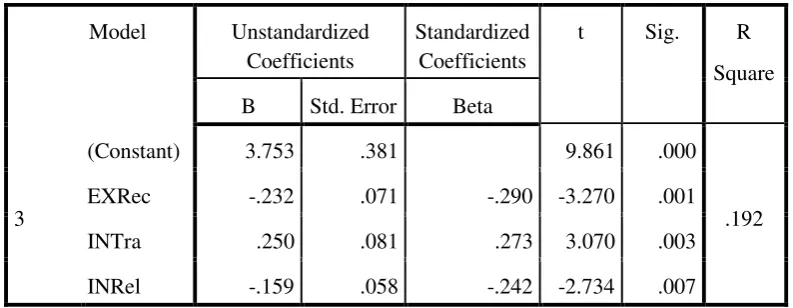
Table 4. Desirability (Valence) factor regression step wise coefficients
Model Unstandardized
Besides that, the model showed that 19.2% of variability in desirability can be explained by
4.2 Correlations
The simplified correlations are listed below as ‘expectancy’, ‘instrumentality’, and ‘valence’
variables are correlated to each mean correlation respectively.
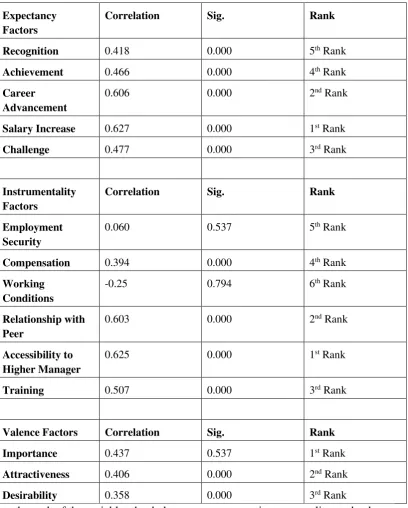
Table 5. Expectancy Correlation
Expectancy Factors
Correlation Sig. Rank
Recognition 0.418 0.000 5th Rank
Achievement 0.466 0.000 4th Rank
Career Advancement
0.606 0.000 2nd Rank
Salary Increase 0.627 0.000 1st Rank
Challenge 0.477 0.000 3rd Rank
Instrumentality Factors
Correlation Sig. Rank
Employment Security
0.060 0.537 5th Rank
Compensation 0.394 0.000 4th Rank
Working Conditions
-0.25 0.794 6th Rank
Relationship with Peer
0.603 0.000 2nd Rank
Accessibility to Higher Manager
0.625 0.000 1st Rank
Training 0.507 0.000 3rd Rank
Valence Factors Correlation Sig. Rank
Importance 0.437 0.537 1st Rank
Attractiveness 0.406 0.000 2nd Rank
Desirability 0.358 0.000 3rd Rank
Table 5 shows the rank of the variables that belong to expectancy, instrumentality, and valence
factors. Salary increase, accessibility to higher manager, and importance of the job are the most
important variables perceived by Generation Y.
8 | P a g e
5.1 Importance factor
The result indicate that importance is highly influenced by challenges in the expectancy area.
Furthermore, it is also supported by employment security, relationship with peers, and
compensation. It can be inferred that the importance of valence is motivated through different
challenges that individuals are going to do while being compensated and supported with the
instrumentality such as employment security and relationship with peers.
5.2 Attractiveness factor
In attractiveness, it shows that most variables that have a positive correlation come from
expectancy, which can be implied as the attractiveness of a job or task to be done through
motivation from the individual with the expectation of recognition and career advancement.
5.3 Desirability factor
The final factor of valence which was tested was desirability. In this factor, most of the results
were negative while the positive correlation is only training, which comes from instrumentality.
A quick implication is that an individual believes that the company could provide training in
which he/she would learn to gain and use these skills in his/her tasks in the future. An important
thing to note was the individuals tested had already got the job (s).
6. Conclusion
The Vroom’s motivational factors that are perceived important by Gen Y and the implications
are as follows: for the ‘expectancy’ variables, salary is one of the highest correlations, followed
by ‘career advancement’, and then ‘challenge’. The implication is a person’s expectation
through ‘expectancy’ is most likely be driven through salary increases, because the person
needs to fulfill his/her desires through monetization since money can fulfill his/her general
living needs.
For the variables of ‘instrumentality’, ‘accessibility’ is the highest, followed by ‘relationship’
and ‘training’. This finding can be interpreted as; a person will feel more motivated when
he/she can have access to a higher-level manager. This depicts Generation Y as disliking
hierarchical structures. Moreover, it also puts the onus on the employee to seek training and
even mentorship from the higher levels.
Companies and organization could also motivate and retain their employees by providing the
followed by ‘attractiveness’, and ‘desirability’. It can be inferred that as a person will seek out the importance of the job first, then in return he/she will look for any other interests that may
be valuable to him/her. This will then boost the attractiveness of the job and thus build up
desirability towards the opportunity(ies) it may offer. These findings apply to Generation Y
that work in corporate service organization in the Greater Jakarta area. It is hoped that
companies will consider including measures in the companies’ rules and policies based on these
findings.
References
Allen, A., Ahmed, S., Yip, G., & Switzer, C. (2014). The future-ready organization: reinventing work in ASEAN.
Brewis, J., Contu, A., Grey, C., Kerfoot, D., Knights, D., Odih, P., & O'Doherty, D. (2007).
Introducing Organizational Behavior and Management (2nd Edition ed.). (D. Knights, & H.
Willmott, Eds.) Hampshire, United Kingdom: Cengage Learning.
Fry, R. (2015, January 16). This year, Millennials will overtake Baby Boomers. Retrieved February 16, 2016, from Pew Research Center: http://www.pewresearch.org/fact-tank/2015/01/16/this-year-millennials-will-overtake-baby-boomers/
Kowske, B. J., Rasch, R., & Wiley, J. (2010). Millennials’(lack of) attitude problem: an empirical examination of generational effects on work attitudes. Journal of Business and Psychology, 25(2), 265 - 279 .
Legault, M. (2002). Bringing People Together: A study of generational diversity and organizational
culture. Miami: University of Miami.
Nisen, M. (2013, May 25). Definition of Generation Cohort. Retrieved March 26, 2016, from Business Insider: http://www.businessinsider.com/definition-of-generational-cohorts-2013-5?IR=T&r=US&IR=T
Park, J., & Gursoy, D. (2011). Generation Effect on the Relationship between Work Engagement, Satisfaction, and Turnover Intention among US Hotel Employees. Journal of Hospitality
Business Management.
Pilcher, & Jane. (2012, October 10). Mannheim's Sociology of Generation: An Undervalued Legacy.
British Journal of Sociology, 45(3), 481 - 495.
PWC. (2013). PwC’s NextGen: A global generational Study. California: University of Southern California.
Schawbel, D. (2012, March 29). Career Strategies. Retrieved January 14, 2016, from TIME Inc.: http://business.time.com/2012/03/29/millennials-vs-baby- boomers-who-would-you-rather-hire/
Sparreboom, T., & Ernst, E. (2013). Global Employment Trends for Youth 2013 - A generation at risk.
Youth Employement Program. United States: International Labor Organization. Thierry, H. (1996). Vroom's Expectancy Models and Work-Related Criteria: A Meta Analysis.
Journal of Applied Psychology, 575.
Unsworth, L. (2008). Four Generation Working Together. Retrieved March 1, 2016, from Ecu Education: http://www.ecu.edu/cs- lib/trc/upload/Four_Generations_Working_Together.pdf. Vroom, V. H. (1964). Work and Motivation. New York: Wiley.