A THESIS
Submitted to the Faculty of Teacher Training and Education Makassar Muhammdiyah University in Partial Fulfillment of the Requirement for the
Degree of Education in English Department
SRI MUTMAINNAH RONI
10535638415
ENGLISH EDUCATION DEPARTMENT
FACULTY OF TEACHER TRAINING AND EDUCATION
MUHAMMADIYAH UNIVERSITY OF MAKASSAR
v
SURAT PERNYATAAN Saya yang bertandatangan di bawah ini:
Nama : SRI MUTMAINNAH RONI
NIM : 10535 6384 15
Jurusan : Pendidikan Bahasa Inggris
Judul Skripsi : The Students’ Perception On The Use Of Video Call In Teaching And Learning Process
(A Study At The Seventh Semester Of English Department At Muhammadiyah University
Of Makassar)
Dengan ini menyatakan bahwa skripsi yang saya buat di depan Tim pengujia dalah hasil karya saya sendiri bukan hasil ciptaan orang lain dan dibuatkan oleh siapapun.
Demikianlah pernyataaan ini saya buat dengan sebenar-benarnya dan saya bersedia menerima sanksi apabila pernyataan ini tidak benar.
Makassar, 2020
Yang Membuat Pernyataan
vi
SURAT PERJANJIAN
Saya yang bertandatangan di bawahini:
Nama : SRI MUTMAINNAH RONI
NIM : 10535 6384 15
Jurusan : Pendidikan Bahasa Inggris Fakultas : Keguruan dan Ilmu Pendidikan Dengan ini menyatakan perjanjian sebagai berikut:
1. Mulai dari penyusunan proposal sampai dengan selesainya skripsi saya, saya akan menyusun sendiri skripsi saya, tidak dibuatkan oleh siapapun. 2. Dalam menyusun skripsi, saya akan selalu melakukan konsultasi dengan
pembimbing.
3. Saya tidak akan melakukan penjiplakan (plagiat) dalam menyusun skripsi ini.
4. Apabila saya melanggar perjanjian saya seperti yang tertera pada butir 1, 2 dan 3 maka saya bersedia menerima sanksi sesuai dengan aturan yang berlaku.
Demikian perjanjian ini saya buat dengan penuh kesadaran.
Makassar, 2020 Yang Membuat Perjanjian
vii
Kehidupan Tidak Menawarkan Kenikmatan Melainkan Penderitaan
“Life offers no pleasure but misery”
DEDICATIONS
In the name of Allah, I dedicated my thesis for: My beloved parents, Gustan Tasbih and Hanasia.
To my eight siblings as my support team.
For the someone special who always helping and giving best for me. Thanks for always praying me, supporting me and standing by my side.
viii
This research aimed to know the students‟ perception on the used of video call in teaching and learning process. The method of this reasearch was descriptive qualitative as a linear method with the research instrument used by conducting interview with 27 students who had used video call of English Department at Muhammadiyah University of Makassar in teaching and learning process.
Researchers' findings referring to the results of student interviews showed that most students gave negative perceptions on the used of video call (Hangout) application in teaching and learning process. There were some constraints which cause the learning process to be ineffective, it starting with a bad network connection that causes students didn‟t focus on the learning process and can cause an accounts out of the application, then the capacity of students to join in application when the learning process is limited, only 25 people so it tends to adverse some students. However, the new innovation that used of video call video call (Hangout) in teaching and learning process, made students felt happy and enjoy because the learning process can be done anytime and anywhere, then as a reference material for students majoring in education, and gave the students insight into the benefits and uses of the Hangout application.
ix Andi Tenri Ampa dan Firman.
Tujuan dari penelitian ini adalah untuk mengetahui bagaimana persepsi mahasiswa tentang penggunaan video call dalam proses belajar mengajar pada pelajar semester tujuh jurusan bahasa inggris di universitas muhammadiyah Makassar. Metode penelitian yang digunakan peniliti adalah dekriptif qualitatif sebagai metode yang linier dengan instrument penelitian yang digunakan yaitu melakukan interview kepada 27 mahasiswa bahasa inggris di Universitas Muhammadiyah Makassar yang pernah menggunakan video call dalam proses belajar mengajar.
Temuan peneliti yang merujuk dari hasil interview mahasiswa menunjukkan bahwa sebagian besar mahasiswa memberikan persepsi negatif pada penggunaan aplikasi video call (Hangout) dalam proses belajar mengajar. Adanya beberapa kendala yang menyebabkan proses pembelajaran berjalan tidak efektif, mulai dari permasalahan koneksi jaringan yang buruk sehingga menyebabkan mahasiswa tidak fokus mengikuti proses pembelajaran dan dapat menyebabkan akun keluar dari aplikasi, kemudian kapasitas mahasiswa yang bisa join pada aplikasi saat proses pembelajaran terbatas, hanya 25 orang sehingga cenderung merugikan sebagian mahasiswa. Namun, tentu juga dengan adanya inovasi baru yaitu penggunaan video call (Hangout) dalam proses belajar mengajar membuat mahasiswa merasa senang dan santai karena proses pembelajaran bisa dilakukan kapan dan dimana saja, kemudian sebagai bahan referensi bagi mahasiswa jurusan pendidikan, dan menambah wawasan bagi mahasiswa tentang manfaat dan kegunaan dari aplikasi Hangout.
x
In the name of Allah, Most Gracious, Most Merciful
Alhamdulillah, the researcher expressed thank you very much for the gratitude Allah SWT for blessing and mercy on the writer during the process until the finished writing this Thesis. Shalawat and salam are addressed to the final chosen religious messenger, the Prophet Muhammad SAW, who has bring us from the darkness to the brightness.
In writing this thesis the writer found many difficulties, so the writer realized that the Thesis has a lot of mistakes and weakness. In order to become perfect, the writer needs correction and suggestion. The writer would like to say thank you so much for the people who gave spirit, advice, suggestion, and helping to write as follows :
1. My highest appreciation and deepest thankful to my beloved parents, Gustan Tasbih and Hanasia who always be my best parents, my eight siblings, and all of my family for the attention , support and their love. 2. My highest appreciation and deepest thankful are due to Dr. Hj. Andi
Tenri Ampa, M.Hum. as my first consultant and Firman, S.Pd., M.Pd. as my second consultant who had guided me very well during my Thesis.
3. My highest appreciation for the Rector at Muhammadiyah University of Makassar, Dr H. Abd. Rahman Rahim, S.E., M.M.
xi
Dekan of FKIP Muhammadiyah University of Makassar.
6. The last gratitude also goes to all of Edelweiss Class in 2015 that cannot mention one by one, my beloved siblings from KER-Organization, and especially for my friends from CIS. It never been forgotten, I love you all.
The words were not enough to say many appreciation for their help and contribution in finishing this Thesis. May Allah SWT guides and give them the happiness throughout your life. Finally the writer realizes that this “Thesis” was far from being perfect. So, it was a pleasure for him to accept constructive critiques and suggestions for improving this Thesis.
May Allah, The Almighty, bless them all.
Makassar, February 2020
xii
APPROVAL SHEET ... iii
CONSELLING SHEET ... iv SURAT PERNYATAAN ... v SURAT PERJANJIAN ... vi MOTTO ... vii ABSTRACT ... viii ACNOWLEDGMENTS ... x
LIST OF CONTENT ... xii
CHAPTER I INTRODUCTION ... 1
A. Background ... 1
B. Problem Statement... 4
C. Objectives of the Research ... 5
D. Significances of the Research ... 5
E. Scope of the Research ... 6
CHAPTER II REVIEW OF RELATED LITERATURE ... 7
A. Definition of vidio Call ... 7
B. Definition of Perception ... 15
a. Types of Perception ... 17
b. Indicator of Perception ... 19
c. Factors Influencing Perception ... 21
d. Aspect of Perception ... 22
e. Measurement of perception ... 23
xiii
A. Research Design ... 27
B. The Subject of the Research ... 27
C. Research Instrumen ... 28
D. Procedure of Collecting Data ... 29
CHAPTER IV FINDINGS AND DISCUSSION ... 31
A. Research Findings ... 31
B. Discussion ... 45
CHAPTER IV CONCLUSION AND SUGGESTION ... 61
A. Conclusion ... 61
B. Suggestion ... 62
BIBILOGRAPHY ... 64 APPENDIX
1 CHAPTER 1
INTRODUCTION
A. Background
Modern times, human life is almost all support by technology, including communication technology that is growing rapidly. If you look back, first people can only communicate by mail or face to face directly
(face-to-face). Then it developed with the existence of telephones to create
cellphones and the internet which further facilitated the communication process, then a smartphone appeared (smartphone) where cellphones can connect to the internet so that we can access the internet wherever and whenever. In other words, distance is not a problem to communicate. As technology develops today, people also communicate. Humans can communicate easily, quickly, and not spend a lot of money.
The growing dependence on the use of information and communication technology can no longer be avoided. Because technology, information, and communication have entered into all areas of broad modern human life such as business, entertainment, education, and others. In the context of everyday life, the use of information and communication technology has turned into an inevitable need. Of course, in its development, technology is always changing every time and will be integrated into the community where it is difficult to follow and adapt quickly to its renewal, let alone reflect on the effects or effects on real life. Of course, there are many things are done and require less time to adapt to catch up with renewal and
development. Technological developments show that humans can create something that has never been imagined before to become a breakthrough that helps various things, provides many conveniences in human life.
The 21st century is a century marked by advances in science and technology. This century is believed to be able to change the way humans work, interact, be religious and cultured. The more advanced the culture, the more technology develops because technology is the development of a culture that is advancing rapidly. The development of technology does not get there, with the discovery of internet innovations for the sake of increasingly sophisticated innovations that make people communicate increasingly diverse and easy, even long distances. With the increasing demand for the use of technology, information, and communication (ICT), it has also changed the model of language teaching and learning in a useful way and will continue to do so in line with technological advancements in the future. Language learning applies several teaching methods and guidance with online or technology-based activities to make learning meaningful as an active, authentic, and cooperative activity.
Start with the presence of online social media and media chat. For the people of Indonesia, especially among teenagers, social media seems to have been addictive, there is no day without opening social media, even almost 24 hours can not be separated from smartphones. The largest social media most commonly used today include Facebook, Twitter, Path, Youtube, Instagram, Hang Out, LINE, and Whatsapp. With the presence of innovation,
one of the current technologies has made it easier for someone to communicate face-to-face, even with great distances, the innovation is Video Calls.
Video Call is a telephone that uses a cellphone with a video screen and is capable of capturing video (images) as well as the sound transmitted. The function of video telephony as a means of communication between one person and another in real time (Lubis and Arman, 2014: 76). Video calls make it easy for humans to be able to communicate remotely by telephone face to face, this proves that communication innovations are now sophisticated and even long distances are not a problem. Communication using video calls is one of the effective communication alternatives to find out someone's situation far away, but to solve the problem there is nothing better than face-to-face to avoid misunderstandings, especially in terms of education or teaching and learning.
Kumar and Tammelin (2008) assert that the decision to take course design depends on the type of course offerings planned by an institution. When deciding to implement ICT institutions or at different levels in different subject matter fields, it is important to consider whether the proposed ICT integration, for example, video call meetings, online offers, have a negative or positive impact. In many educational institutions, departments, teachers, faculties, or certain subjects may be available to be more conducive to the introduction of ICT. Institutions often test the implementation of ICT in one field of study, learn from the results, and then expand it to other fields of
study taught by the institution. In educational institutions, we find many application features that are used to facilitate interaction in the learning process. No more so in the educational institutions of the University of Muhammadiyah Makassar in English education study programs. One of the applications or media used in interacting is the Hang Hout application, in which the entire learning series has been Automated in an application that makes it easier for lecturers and students.
During the ICT in learning process there are many new things that are known especially on the use of video calls in hang out applications so that writers interested in researching the use of video calls during the process of learning English because researchers assume that the learning process runs less effective in terms of some disadvantages Its use is only about 25 people who can join the video call, besides that with the video call it also triggers student seriousness during the learning process and until now the guidance on the use of video calls is still lacking so many students still don't understand about their use especially when making presentations through video calls, besides the most common obstacles are networks that are less supportive so that the learning process is often not well followed. Consequently, based on the background above, the researcher carried out a research under the title
"The Students' Perception of the Use of Video Call in Teaching and Learning Process."
B. Problem Statement
Referring to the previous background, the researcher formula a research question as follow:
“How are the students‟ perceptions on the use of video call in teaching and learning process a study at the seventh semester of English Department at Muhammadiyah University of Makassar?”
C. Objectives of the Research
The objectives of this research is focus on found out the students‟ perception on the used of video call in teaching and learning process a study at the seventh semester of English Department at Muhammadiyah University of Makassar.
D. Significances of the Research
The outcomes of the research are expected to be useful and helpful information for the English lecturer, especially in using video call in teaching and learning process. For students, the result of this research, it is expected to be useful information in developing students skill, and also it is hoped that any obstacles faced by the researcher would be consideration in finding any better ways to make improvement for the better learning condition. This research may also be useful information as the basic of the research for any researchers who wants to conduct in the same topic or something that related with this research
E. The Scope of the Research
This research restricted to identify the students' perception on the used of video call in teaching and learning process. In this research, the researcher gave questions with interview that related using video call. From these interview, we would got any perception about the students‟ perception on the used of video call in teaching and learning process.
7 CHAPTER II
REVIEW OF RELATED LITERATURE
This chapter deals with some theories about the definition of the video call, some theories about the definition perception, and conceptual framework.
A. Definition of Video Call
The word technology for ordinary people is often related to something related to matters relating to electrical equipment, industrialization and automotive. Far from that, technology as something that is very opposed to the development of human civilization, technology has penetrated a world that cannot be supported by human reasoning. First, the first technology began to be known since the industrial revolution in England (1750) with the discovery of steam engines to accelerate the production process. The following year, technology continued to increase with support from the industrialization sector and global market growth. The conditions that drive the discovery of renewable technologies and continuous innovation for the convenience of human work. (Andhini, 2012)
Entering the third millennium of Technology, a new chapter has been published since the discovery of the internet and its role in the social world. The internet (international network) was first conceived in 1969 by the United States Department of Defense through the ARPANET (Advanced Research Project Agency Networking) project. demonstrating how
Unix-based computer hardware and software can communicate very long distances without a cable connection.
The era of the Internet is characterized as a human civilization phase where all aspects have been based on information and communication technology (ICT) called revolution 4.0. breakthrough ideas that kicked off social order into a world called virtual space. Cyber face developments, artificial intelligence (AI), Internet of Things (IoT), Unnamed Vehicles (UAV), Mobile Technology (5G), Share Platforms, BlockChain Robotics and Bio-Technology. Its contribution to various sectors including business, politics, and education. Has given a new nuance in social life, especially in the world of education. (Yasraf, 2011)
In the twentieth century was the first time the term ICT emerged with the formation of an information society. Regarding the term information technology that uses the word, information is very related to the term TK (Communication Technology) which was known first before the term ICT existed. The development of ICT moves very quickly, including in Indonesia, commonly known as the Information and Communication Technology (ICT).
Information and Communication Technology is another digital or analog technology that allows each user to create, store, display, and communicate information between one another in unlimited distances. With the rapid development of ICT in the millennial era, this provides a broad opportunity for everyone to be creative and develop the potential that exists in everyone. On the one hand, it can be used to destroy the world or the purpose
of evil. On the other hand, it can also be used for good things such as for humanity and including education as well.
From here it can be concluded that with the development and progress of Information and Communication Technology is the advancement of computing, television, radio, and telephone into a single entity as a global Information and Communication revolution in which this revolution is realized from advances in technology in the field of personal computers, data communications and data access, integration of multimedia and computer networks. So that information technology can be one of the most important tools as a driver of the nation's progress through education.
ICT is also a term that can be referred to as multimedia. Because actually, multimedia is a generic term for a media that combines various kinds of media both for learning purposes and not. This diversity of media includes text, audio, animation, video, and even simulation. Tay (2000) defines multimedia as A combination of text, graphics, sound, animation, and video.
ICT is defined as 'any technology used to support the collection, processing, distribution, and use of information' (Beckinsale and Ram, 2006). The definitions taken in this paper classify ICT into information technology, telecommunications technology and network technology (Nicol, 2003). This includes all forms of technology such as computers, the internet, websites, and cable telephones, cellular phones and other wireless communication
devices, networks, broadband, and various special devices (Manueli et al, 2007).
Focusing exclusively on small businesses, Mpofu (2012) argues that ICTs represent progress in absorbing technology among small businesses in developing countries. According to Melody et al (1986; In Mpofu, 2012), the phrase ICT has been used by academic researchers since the 1980s but became popular after being used in reports to the British government by Stevenson in 1997. ICT is a technology that supports activities that involve information, namely activities that involve collecting, processing, storing, and presenting data.
In the classroom learning process utilizing ICT to facilitate obtaining information because of the existence of ICTs to facilitate human beings, so that the learning process can be carried out without face-to-face in class because there is already a hangout application that aims to process English learning in fulfilling video calls. Technology that is growing rapidly certainly has a big influence on humans in communicating. With the discovery of the internet, communication technology also facilitates people to communicate with someone far away, one of which is Video Call.
Video Call is a phone using a mobile phone with a video screen and capable of capturing video (images) as well as transmitted sound. The function of a video phone as a communication tool between one person and another in realtime. According to Mukhlis Hadi Lubis and Arman Sani in the Journal of Video Call Quality Analysis Using the NSN Flexi Packet Radio
Device (2014: 77), Video call is a telephone with a video screen and capable of capturing video (images) as well as the transmitted voice.
According to the encyclopedia in Wahyu Cahyawidi Sutanto (2011), video calls are communicating visually with other people through computers and mobile phones. This understanding comes from the chat system that develops from typing text to merging two-way videos. Fill in video chat, namely "video calling" and "video conferencing" are terms that have the same meaning.
Initially, physical video calls such as computer monitors were integrated with wired telephones, so that long-distance calls and communications to be carried out required a large number of devices and were not flexible. Along with the development of technology, especially internet technology, voice and images which are often called videos can be transmitted through internet networks, so that costs become cheaper. This is the concept, the internet can be used to communicate in real-time, two-way and present images and sounds simultaneous. The tools needed are even more practical. Now, people just need to connect a computer that has video input facilities such as a webcam, video output (monitor), audio input (microphone) and audio output (loudspeaker) with an internet network or WAN to be able to communicate directly and real-time, and face to face despite distance far.
Communication through the internet certainly requires applications that can be user interfaces with computers such as web browsers, or 13 applications that provide video call features, such as Yahoo! Messenger, Bee
Messenger, Skype, Google Duo, Facebook, Instagram, Line, WhatsApp and so on. These applications can be downloaded for free or paid on the internet and their use is currently very broad ranging from personal interests, school (campus), to business interests.
Now, humans tend to be mobile and dynamic in their activities and activities. This causes all forms of communication to have shifted to mobile communication which causes communication and information access to be carried out whenever and wherever the person is located. Of course, this is accompanied by the development of wireless or wireless technology that is more flexible and easily built and configured. Cellular technology which is part of wireless technology has expanded from sending voice, data and finally to moving images (video). 14 Video calls via cell phones are often misunderstood by 3G. 3G stands for English terms: third-generation technology. This term is generally used to refer to the development of wireless telephone technology. 3G is facilitated by cellphone providers while video calls are video phone calls that can be done with 3G networks which are now developing into 4G (fourth-generation technology) so that callers and recipients can meet each other face to face. The development and spread of video calls over the telephone began to expand because almost all cellular phones that support UMTS (Universal Mobile Telecommunication System) networks can make video calls with camera facilities that are input devices.
Video call is the most effective media in building efficient long-distance communication. This is what underlies the teaching staff using
online application access to facilitate the teaching process of teaching and the distribution of knowledge to their students. But this is not a controversy, many people consider that this method will hinder students' cognitive development and make them lazy.
The method of learning by using video call facilities was first applied by well-known campus campuses in the United States. The tightness of academic activities and distance which sometimes isolates students and lecturers to hold meetings directly encourages the campus to implement online-based education. This aims to make it easier for students to access education. In Indonesia, the use of video calls to support academic activities was first carried out in 2007. This activity was initiated by the Bandung Technology Institute (ITB) to help students affected by the Acehnese tsunami.
In its development, video call technology is used for distance learning. The establishment of the Asian School of Internet (SOI) by Keio University Japan, the program is intended to conduct research and comparison between various universities, one of which is universities in Indonesia. There are 27 universities in Asia that join and include four universities in Indonesia including Hasanuddin University, Syria Kuala University, Brawijaya University, Samratulangi University, and Bandung Technology Institute.
1. Kinds of Video Call
The development of technology in the 21st century seems to make people stunned and confused. Confusion is caused by the many types of applications that have sprung up. Not only that, the types of applications that are present also continue to change content every time and ask to continue to be upgraded. No more than the type of application using video various features, styles, and forms of the application are reconstructed in such a way that quality, comfort, and facilitate users in communicating through the use of videos. According to Rudy Kipkal, the website kompasiana.com (2014) divides the types of video calls that can be used to make video calls with other people including:
1) Tango
Tango is an application that can be downloaded for free through the Google Play Store. Apart from functioning as a video call, this application can also send messages like chat and also send data such as photos.
2) FRING
The FRING application can also be downloaded via the Google Play Store. This multifunctional application is very fading to do chat, call, and of course video calls. Everything can be done easily with friends through the FRING application.
3) Skype
The Skype application is a very familiar application for smartphones. Not much different from other video call applications, Skype is an application for chatting, telephone, and also video calls with the use of the internet. For this application, you can use it on mobile or desktop computers or laptops.
4) OOVOO
The OOVOO application can also support up to four people at a time. With HD video call quality, the resulting image is sharper and clearer.
5) Seen
Seen is a video call application that is connected to Facebook, so there is no need to register to use it. The video quality is also HD.
6) Yahoo Messenger
This video call application is also very often used by internet users. Using this application can directly greet friends, family, or lovers who are far apart.
7) Google Hangouts
Google Hangout is a unified communications service that allows members to initiate and participate in text, voice or video chats, either one-on-one or in a group. Hangouts are built into
Google+ and Gmail, and mobile Hangouts apps are available for iOS and Android devices.
Google Hangouts can also be a useful and cost-effective collaboration platform for enterprise customers. Hangouts have an option called Google Hangouts on Air, which allows Google+ users to broadcast video calls directly on YouTube. Hangouts Broadcast has gained appeal as a freeway for organizations to conduct online seminars and talk shows, Hangouts has also been widely applied by lecturers in the learning process, both in material explanations and presentations using PowerPoint through this application.
Google Hangouts also replaces the previous chat capabilities built on Google+ and Gmail, as well as the standalone Google Talk application, then Hangouts can integrate with Google Voice, allowing service users to make free domestic phone calls from their computing devices.
The kinds of video calls have advantages and disadvantages, especially in the use of applications. For example, in the Video Call application, this application has the advantage that by using the video call feature we can see the face of the other person so that we can know the activity and whereabouts of the other person. However, when using the Video Call application feature, we need an internet connection that is strong enough because a weak
network will hamper communication on the Video Call and make the image of the other person look bad.
B. Definition of Perception
Perception in psychology very important to know many cases in process learning, There are many definitions of perception over that but we will see the definition of perception according to the psychology world : Gibson, (1987:1-6) states perception is the way you think about or understand someone or something, the ability to understand or notice something easily the way that you notice or understand something using one of your senses. Perception (from the Latin perception, percipio) is the organization, identification, and interpretation of sensory information to represent and understand the environment. All perception involves signals in the nervous system, which in turn result from physical or chemical stimulation of the sense organs. For example, vision involves light striking the retina of the eye, the is mediated by odor molecules, and hearing involves pressure waves. Perception is not the passive receipt of these signals but is shaped by learning, memory, expectation, and attention.
Perception involves these "top-down" effects as well as the "bottom-up" process of processing sensory input. The "bottom-up" processing transforms low-level information to higher-level information (e.g., extracts shapes for object recognition). The "top-down" processing refers to a person's concept and expectations (knowledge), and selective mechanisms (attention) that influence perception. Perception depends on complex functions of the
nervous system but subjectively seems mostly effortless because this processing happens outside conscious awareness.
According to Barry, in the Rina Research Proposal (2019: 14), states that perception is a series of processes by which we recognize, regulate, and make stimuli in our environment, the main difference between the two main theories of perception is the emphasis each gives to the role of sensation and cognitive processes that are higher in perception. Another definition of Lindsay and Norman, (1977: 67) states perception as a process in which organisms interpret and regulate sensations to produce meaningful world experiences. The sensation usually refers to the results of direct sensory stimulation in the eyes, ears, nose, tongue, or skin which is direct and relatively unprocessed.
Perception, on the other hand, better describes one's ultimate experience of the world and typically involves further processing of sensory input. In practice, sensation and perception are virtually impossible to separate, because they are part of one continuous process. Slameto, (2003:12) states perception processes to input message or information to the human brain by the human perception that continuously make relation with the environment. This relation is done by the five senses those are senses of sight, sense of hearing, sense of feeling, sense of smell, and sense of touch. And Romanov (2011:6) it includes senses, feelings, ideas, thoughts, theories. The concept is its "final point" and allows you to see differences. Perception is "your ability to understand the difference." Perception can be concluded
perception is a process to recognize and understand something as a form to express human reason and experience or to regulate their interpretations to produce meaningful experiences in making relations between human beings in life.
According to Websters' International Dictionary of English to in Pattola (2019), perception is defined as follows:
1) The act of perceiving, organize by the act of the intellect, apprehension by the bodily organs, or by the mind of what is present to them, discernment, apprehension, and cognition.
2) The faculty of perception: the faculty or peculiar part, of men's constitution by which he is knowledge through medium or instrumentality of the body organs: the act of apprehending material objects or qualities through the senses: distinguish from conception.
3) The quality, state, capability of being affected by something external: sensation, sensibility. This experiment discovered perception in plans. 4) An idea; a motion
Perception can be concluded as the process when people express their sense and experiment or when the people organize their interpretation to produce a meaningful experience.
1. Types of Perception
Based on the explanation from perception Zanden (1984:109) divides perception into three types as follow:
1) People's Perception
Personal perception refers to these two processes that we know and think about other people. Characteristics, qualities, and their inner conditions. We build the image of others in a way that serves to satisfy, make predictions, and make our management's view of the social world broader to where we associate a stable strait and hold dispositions to others. We feel we can understand their behavior and predict their actions in the future and we use these countries to guide our interactions they do. 2) Social Perception
Social Perception means trying to understand people whether they are professional, political, leader, criminal, defendant, entertainer or someone close to home is not an easy task.
Perception does not occur in a vacuum, on the contrary, we bring prior knowledge that we have structure and are stored in our heads for processing new information about individuals. The social life that something more than creatures of the moment. Sustainable patterns of interaction or social relationships require to retain information, as the situation requires. Without memory, we should react to every event as if we unique, and if we do not remember that fact, we should capable to think or reasoning.
3) Perception of the situation
Social psycholinguistics views a situation as all the social factors that influence a person's experience or behavior are give time and give a place. It is an interaction of time and space within which we act in specific ways.
The situation in which stimuli occur is a consequence of their interpretation. Anyone of multiple words may emerge depends on which stimuli we register. The linkage we make among these stimuli and our interpretation of the stimuli.
With several types of perceptions that can infer perceptions about when and where we are, as with people's perceptions, humans consider self-quality, while social perception is a process of mutual understanding and perception of situations that are intended to find out and close to us. 2. Indicators of Perception
According to Robbin (2003), there are two kinds of perception indicators, namely:
1) Acceptance
The process of acceptance is an indicator of perception at the psychological stage, namely the functioning of the senses to capture stimuli from within.
2) Evaluation
External stimuli have been captured by the senses then evaluated by individuals. This evaluation is very subjective. One individual considers
stimulation as difficult and boring, but another individual values the same excitement as something pleasant and pleasant.
From some of the indicators of perception above, it can be concluded that in order to provide positive and negative judgments, happiness or unhappiness, it is necessary to first observe and understand after giving an assessment.
According to Walgito (1990), perception has indicators as follows: 1) Absorption of stimuli or objects from outside of the individual.
Stimulation or objection is absorbing or received by the five senses, both vision, hearing, touch, smell and taste separately or together. The result of the absorption or reception by the sensory devices will get an image, responses, or impression in the brain. This image can be singular or plural, depending on the object of perception observed. In the brain, images or impressions are collect, both old newly form. Whether the picture is clear or not depends on whether or not stimuli are clear, sensory normality and time, just or long ago.
2) Understanding
After the images or impressions occur in the brain, the picture is organized, classified, compare, interpret, so that understanding is formed. The process of understanding is very unique and fast. Understanding is formed also on the old images that have been own by the individual before.
3) Assessment or Evaluation
After understanding is formed, individual judgment takes place. Individuals compare the understanding that has just been obtained with the criteria or norms possess individually in a subject. Individual reasoning varies even though the object is the same. Perception is an individual.
3). Aspect of Perception
According to Walgito (1990) presents three main aspects of perception, namely:
1) Cognition
This aspect concerns the components of knowledge, views, expectations, ways of thinking or gaining knowledge, and past experiences, as well as everything that is obtained from the results of individual thoughts of the prospective actors.
2) Affection
This aspect concerns the components of feelings and the individual‟s emotional state towards a particular object and everything that concerns good evaluation based on one‟s emotional factors.
3) Conation or Psychomotor
This aspect concerns the motivation, attitudes, behaviors or activities of individuals by following their perception of an object or certain condition.
From the three perceptual aspects above, it can be concluded that perceptions cannot be separated from experiences that involve feelings and motivation in living life, perceptions can affect actions and human actions.
4). Students’ Perception
Sidhu in Hasib 2018:14 state that the students' perception is students' point of view toward something that happens in learning process class and produced it with suggestion or argument for teacher or classmate to improve their learning process. They evaluate and respond to what they have done or about what they learn. The observation process can be so challenging and interesting experience for students that can increase their awareness of the whole process of teaching.
Devlin in Delaney et. Al 2010 students' perception is student evaluation the strengths and weaknesses of a survey. The strength is the positive result of students' perception. They agree or get benefit from the teaching process that contrast by their teacher. While the weakness is the negative result of students' perception. They disagree or get some problems from the students' evaluation of the teaching effectiveness that construct by their teachers.
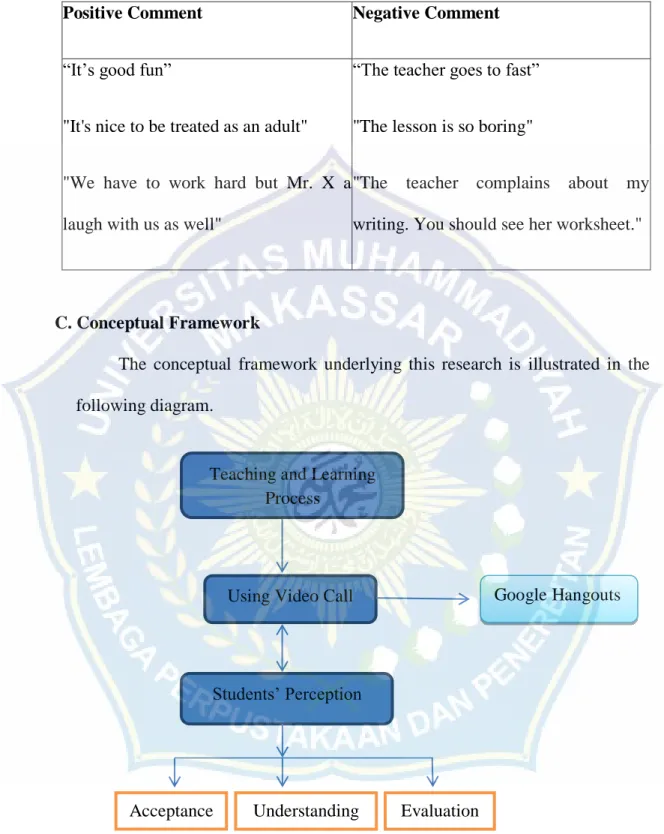
The description above has a close relationship with the result of Galloway's research in Taufik 2015:16-17 about the students' perception of their teacher in teaching. He researched German. He divided the result of students' answers research into a positive and negative comment.
Positive Comment Negative Comment
“It‟s good fun”
"It's nice to be treated as an adult"
"We have to work hard but Mr. X a laugh with us as well"
“The teacher goes to fast”
"The lesson is so boring"
"The teacher complains about my writing. You should see her worksheet."
C. Conceptual Framework
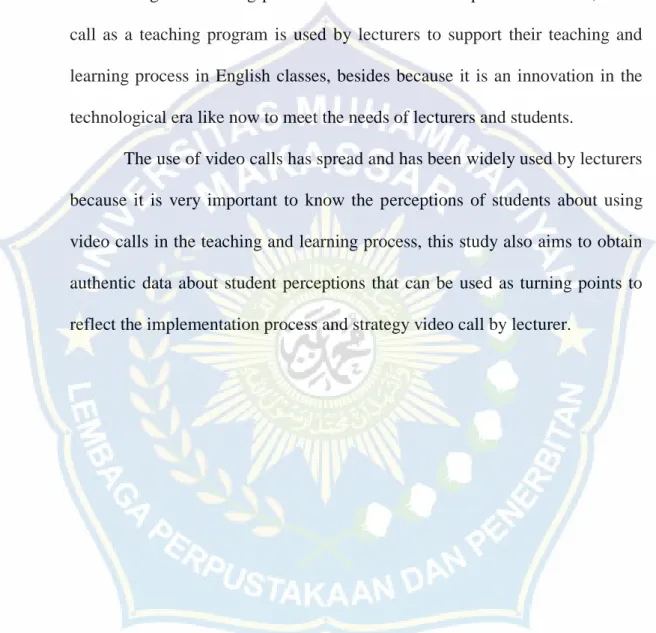
The conceptual framework underlying this research is illustrated in the following diagram.
Figure 2.1 Conceptual Framework
Teaching and Learning Process
Using Video Call
Students‟ Perception
Google Hangouts
Understanding
Figure 2.1 is the conceptual framework that shows that conducive teaching and learning processes in English will lead to student perceptions, whether positive or negative perceptions to maximize the use of video calls in the teaching and learning process. Based on the conceptual framework, video call as a teaching program is used by lecturers to support their teaching and learning process in English classes, besides because it is an innovation in the technological era like now to meet the needs of lecturers and students.
The use of video calls has spread and has been widely used by lecturers because it is very important to know the perceptions of students about using video calls in the teaching and learning process, this study also aims to obtain authentic data about student perceptions that can be used as turning points to reflect the implementation process and strategy video call by lecturer.
27 CHAPTER III
RESEARCH METHOD
A. Research Design
The method used in this research was a descriptive qualitative method, to found out the students' perception on the used of video call in teaching and learning process. The type of the research "refers to the meanings, concept definitions, characteristics, metaphors, symbols, and description of things" and did not to their "counts or measures". Qualitative research approaches used employed across many academic disciplines, focusing and particularly on the human elements of the social and natural sciences, in less academic contexts, areas of application include qualitative market research.
Qualitative research refers to process-orient methods used to understanding, interpret, describe and develop a theory on a phenomenon or set. It was a systematic, subjective approach used to describe life experience. Qualitative research approaches were employed across many academic disciplines, focusing and particularly on the human elements of the social and natural sciences, in less academic contexts, areas of application include qualitative market research.
B. The Subject of the Research
The subjects of the research were the 27 students in the seventh-semester of English Department who had studied using the video call
application in Muhammadiyah University of Makassar. The participants consisted of 22 famale and 5 male students.
C. Research Instrument
The instrument used interview to cellected the data. Interview was a meeting of two people to exchange information and ideas about questions and answers so that meaning could be built in a particular topic (Sugiyono, 2009: 317) and by interviewing, researchers found out participants in interpreting specifically about "Students' Perception on the Used of Video Call in Teaching and Learning Process". Situations and phenomena that occur that can not found through observation (Sugiyono, 2009: 318).
The data collected from indoor that students, there were interviews and field notes. The researches gave some questions to the students and got descriptive qualitative, the researcher used a structured interview, the researcher prepared the interview questions in the form of papers. The researcher shared the papers to the student respondents that participate in this research. The interview questions consist of 10 questions that response by the participants. The question related to the students' perception on the used of video call in teaching and learning process of a study in the seventh semester. D. Procedure Of Collecting Data
In collecting the data, the researcher presents some procedures, as follow:
2) The researcher met the students and gave explained the purpose of the interview and how to answer it.
3) The researcher interviewed the students by face to face and records their answers.
4) The researcher collected the data about students' perception on the use of video call in teaching and learning process.
E. The technique of Data Analysis
The data analysis technique used in this research was an interactive model of analysis. According to Miles and Huberman (1992:16) in this model, there were four analysis components, namely: data collection, data reduction, data display, and conclusion drawing. The four activities in interactive model analysis can be explained as follows:
1) Data Collection
The researcher collected the data by interviewing students as a information to gain more supporting data. All the recording data collected and then researcher analyzed the students' perception on the used of video call in teaching and learning process by made a description based on the real recording from the students interview.
2) Data reduction
In this step, the researcher selected data obtained at the time of research regarding the students' perception on the used of video call in teaching and learning process, and then the researcher would make
summary from main points arranging and categorizing data base on it classification.
3) Data display
In this step, the researcher made describe and discusses the finding of the researcher in the form systematically. Therefore, it is easy to be analyzed. Display the data means to present data into organization.
4) Conclusion Drawing
The last step, the researcher made conclusion and suggestion based on the data analysis.
31 CHAPTER IV
FINDINGS AND DISCUSSION
This chapter reports the findings and the discussion of the research. The chapter is arranged chronologically based on the two research questions‟. The chapter consists of research findings and discussion of the study.
A. Research Findings
1. Students’ perception on the used of video call in teaching and learning process
In this study the point of discussion was how to found out students' perceptions related to the use of video call in the application (hangout) on learning media. Each student's perception will be described in accordance with the indicators of perception in answering the formulation of the problem in accordance with the existing framework of thought.
As where the results of interviewed conducted by researchers to students showed that the learning process used the video call (hangout) application tended to be negative because many of the students were confused when they first heard about the used of video call in the teaching and learning process.
a. Students being confused
It has been explained above that the absorption or reception of information through sensory devices that will get responses and impressions in the brain will give reactions, judgments, or perceptions
of how they are. The presence of video call in the learning process had an impact on student psychology in terms of accepting a change of change, both changes in things that are good or changes that are bad. The learning process by used video call had given birth to a variety of perceptions among students who incidentally are both users and actors on the used of video call. The appearance made the students confused when they first heard that the learning process would be carried out using a video call. It can be seen from the extract as follows:
Extract 1
S1.1 : When the first time I heard about that saya merasa confused but I am happy because itu mempermudah kita untuk belajar tanpa harus kita pergi ke kampus atau masuk ke dalam ruangan kelas.
Extract 2
S3.1 : I’m Confused dan yang pertama kali saya pikirkan adalah masalah jaringan.
Some other students responses can be seen in the appendices by looking at the code as follows: S2.1, S4.1, S5.1, S6.1, S7.1, S8.1, S9.1, S12.1, S18.1, S19.1, S20.1, S21.1, S23.1, S24.1, S26.1.
Based on the above quote, when asked to students about their opinions when they first listened that the learning process would be done using Video Calls, some students responded positively by answering happy questions that learning would be done using video calls in learning. But most of the students answer the question with the word confused when they first hear that the lecture process will be carried out by using a video call (Hangout) application. They were confused because so far the application in the learning process was
done directly in the classroom. One of the S4.1 students also stated that "I am confused because this is the first time. I heard about that
and I didn't think about how to use that application and is that effective for the teaching and learning process?" they in accepting a
learning method using video calls.
Not only that, besides confusion about the effectiveness of the learning process, they were also confused about how to used the application (hangout). This indicates that students are not ready for the learning process by using video calls and students also think about network constraints during the learning process as extracted in S3.1 in addition to confusion also thinking about network constraints.
b. Students did not listen clearly to the material presented
Lack of massive escort to students and unsupported network connections was often the reason and cause so students did not receive learning well because they did not listen to the material delivered by lecturers properly. It is shown in the extract below:
Extract 3
S5.2: Actually, sometimes I didn’t hear the voice my lecturer because sometimes the voice of my lecture is lost and not clear. So, eee… sometimes I didn‟t listen well the material that deliver my lecturer.
Extract 4
S7.2: When the lecture deliver his material I am not really listen well his voice because of poor connection.
Some other students responses can be seen in the appendices by looking at the code as follows: S3.2, S4.2, S6.2, S8.2, S9.2, S11.2, S12.2, S13.2, S16.2, S19.2, S20.2, S21.2, S22.2, S23.2, S26.2, S27.2.
Based on the interview excerpt above it can be concluded that students do not really listen well to lecturer explanations due to networks that do not support, this is stated by S5.2 and S7.2 so that the material delivered by lecturers is not clear. This was also triggered because students lacked focus on listening to the material and also because sometimes the voice of the lecturer could not be heard while presenting the material, this was stated by S9.2 that: “Sometimes the
explanation is clear and usually I don't hear well because sometimes there are friends who don't turn off the speakers in their respective applications so that their voices become audible so the lecturers' explanations are unclear or normal because of the network factor we have." Which means that there are still some students who do not
understand about using the HangOut application so that it sometimes makes other friends feel annoyed because there are other sounds besides the voice of the lecturer explaining.
c. The activeness of students in teaching and learning
Regarding online-based learning media, namely video calls used by lecturers, it was certainly expected to make students more active in the learning process. But in reality some students are not active in the teaching and learning process. it is shown in the extract below:
Extract 5
S19.3: Not really, because the teaching and learning process passive.
Extract 6
S21.3: No, It doesn't. Because, I just keep silent listen to the lecture's explanation
Some other students responses can be seen in the appendices by looking at the code as follows: S2.3, S3.3 S4.3, S5.3, S6.3, S7.3, S8.3,
S9.3, S10.3, S11.3, S12.3, S13.3, S14.3, S15.3, S16.3, S17.3, S18.3,
S20.3, S22.3, S23.3, S24.3, S25.3, S26.3, S27.3.
Based on the extract above, the researcher can conclude that the learning process using the video call (hangout) application is less effective with several obstacles that cause it to occur, one of which is due to the problem of the student just following the lesson passively, this was stated in extract 5 by S19.3 or just listen to the material without any feedback or question and answer session orally but in writing in the comments column which is also rarely answered, as stated by S21.3 and S25.3, that: "No, I think learning with video call
can not make me more active in the study. Because I can't talk too much with my lecture, while there is something I don't underts." So
that makes students only enthusiastic at the beginning of learning as stated by S25.3 that using video calls does not make it more active in following the process learn how to teach.
d. Being happy in teaching and learning process
Happiness in the teaching and learning process was very important because it very influential on the effective or ineffective learning that takes place. It can be seen from the extract as follow:
Extract 7
S5.4: Umm… Using video call in teaching and learning process. I think, its so fun because we can enjoyble in teaching and learning process.
Extract 8
S8.4: I don't think so because we can't meet our friend and I can't really get the knowledge.
Some other students responses can be seen in the appendices by looking at the code as follows: S2.4, S3.4, S4.4, S10.4, S11.4, S12.4, S15.4, S18.4, S19.4, S22.4, S23.4, S25.4.
Based on the above quote, when asked students about their feelings on using the video call (Hangout) application. Some of the students felt happy because they were enjoy in teachinhg and learning process and some of the students felt unhappy because they feel bored, in addition did not be able to meet with their friends as well as being unable to gain knowledge, this was stated in extract 8 by S8.4 also not too encouraging in following learning as stated by S14.4, that: "In
my personal opinion, learning by using video calls does not really support the learning process automatically it's not make me feel happy." So that makes students not feel happy but instead makes them
feel bored. However, some students actually feel happy because it makes them enjoy participating in the teaching and learning process, as stated by S5.4 who feels happy with the use of video calls in the teaching and learning process.
e. The good impact on the used of video calls in the learning process Students‟ perceptions about the good (positive) impact of using video call (Hangout) applications. It is shown in the extract below:
Extract 9
S6.5: Automatically have a impact. The first think is we just stay at home and join on Hangout application and we didn't need go to campus and we can save our money. Hehe
Extract 10
S18.5: I think yes, if the teachers do the best socializaion to the students.
Some other students responses can be seen in the appendices by looking at the code as follows: S2.5, S3.5, S4.5, S5.5, S8.5, S9.5, S10.5, S12.5, S22.5, S25.5.
Based on the quote above the results of interviews with the students concerned. When asked how the impact of using video calls in the learning process most of the questions answered had a good impact because with the application of the use of video calls can facilitate students in following the learning process and also save costs As revealed by S6.5 " Automatically have an impact. The first think is
we just stay at home and join the Hangout application and we didn't need to go to campus and we can save our money. Hehe…" However,
students really expect a socialization about how important it is to update on technological developments as revealed by S18.5, this aims to make students able to utilize the use of video calls in teaching and learning process properly.
f. The advantages of video calls in the learning process
Knowing the advantages of using video calls in the teaching and learning process was very important as students' motivation in learning to use video call (Hangout) applications. That was stated in the answers to the students' interviews. It can be seen from the extract as follow:
Extract 11
S10.6: The adventage is we can do it everywhere as long as the internet connection well.
Extract 12
S11.6: We can learn everywhere and we can know the new something about technology specially about the hangout application.
Extract 13
S17.6: Make student’s easy to follow the study even they were sick.
Some other students responses can be seen in the appendices by looking at the code as follows: S1.6, S2.6, S3.6, S4.6, S5.6, S6.6,
S7.6, S8.6, S9.6, S12.6, S13.6, S14.6, S15.6, S16.6, S17.6, S18.6,
S19.6, S20.6, S21.6, S22.6, S23.6, S24.6, S25.6, S26.6, S27.6.
Based on the above quotation, researchers can find out that students feel some of the advantages of using video calls in the learning process as said by S10.6 and S17.6 is that we can use it or learn when and wherever we are during the place there is a network, even though students it hurts to be able to take part in the learning process because you don't have to go to campus anymore. Students' knowledge about the technology, usage, and functions of the application (hangout) used is certainly growing from those who do not
know the function of the application to the point of being able to use it, as revealed by S11.6. The advantages of using the video call application (Hangout) as well as one of the innovations in the world of education so as not to lag behind the rapid development of technology, as well as offers and solutions from the saturation of learning that has been waiting for this.
g. Constraints on the used of video calls in the teaching process Knowing the obstacles of students regarding the used of video calls was very important as a reference to improve the quality of escort that was good in using video call (Hangout) applications. It is shown in the extract below:
Extract 14
S12.7: Jaringan yang tidak begitu baik sehingga apa yang di katakan dosen terkadang tidak jelas dan terputus-putus.
Extract 15
S13.7: Poor connection and we dont know how the teacher assess we are, and the capasitas video call is limit.
Some other students responses can be seen in the appendices by looking at the code as follows: S1.7, S2.7, S3.7, S4.7, S5.7, S6.7,
S7.7, S8.7, S9.7, S10.7, S11.7, S14.7, S15.7, S16.7, S17.7, S18.7,
S19.7, S20.7, S21.7, S22.7, S23.7, S24.7, S25.7, S26.7, S27.7.
Based on the above quotation related to the constraints in using video calls in the learning process we can know that the constraints found are quite varied as revealed by S12.7, S13.7 starting from network constraints, unclear sound, and limited number or power accommodated during the learning process. S23.7 also revealed that:
during the learning process, the number of students is limited to only 25 people who can join in the learning process, sometimes the voice of lecturers is unclear during the learning process, we are not free to ask because sometimes we want to ask questions but the network is not very supportive." So that makes some students lazy to follow the
learning process and not serious in listening to the material explained by the lecturer during the teaching and learning process.
h. Being Ineffective in teaching and learning process
Students' perceptions about effective or ineffective in applying learning media was very important to increase student motivation, so learning can run well. It can be identified from the extract below:
Extract 16
S19.8: I don't think so because banyak siswa yang tidak serius dalam mengikuti proses pembelajaran
Extract 17
S25.8: I think it is not really efective, since the classroom for video call is limited, the poor signal also make it more bad. But, in the other side it's also a good innovation, it's just need more develope.
Some other students responses can be seen in the appendices by looking at the code as follows: S3.8, S4.8, S5.8, S6.8, S7.8, S8.8,
S9.8, S10.8, S11.8, S12.8, S13.8, S14.8, S15.8, S16.8, S20.8, S21.8,
S22.8, S23.8, S24.8, S26.8, S27.8.
Based on the quotations from the student interview answers above, we can found out that learning done using the video call
(Hangout) application was less effective. As found in extract 16 by
S19.8 where many students did not serious in participating in the learning process. this is also due to various obstacles, one of which
was the capacity of members who can join the application only 25 people, as revealed by S25.8. meaning that some of these students do not follow the learning process.
i. Effects on the used of Video Calls in the educational word
Students' perceptions about the effect of using video call was very important to know whether or to used video call in the learning process. It can be seen from the extract as follow:
Extract 18
S4.9: Tentu saja penggunaan teknologi sangat bermanfaat dalam dunia pendidikan khususnya penggunaan vidio call karena dapat memudahkan dosen dan mahasiswa.
Extract 19
S7.9: Yes, that is give influence for education same as we know we are in globalization era. So, eee... Technology give a big influence for education like a video call. But, penggunaan Video Call bisa lebih baik lagi.
Some other students responses can be seen in the appendices by looking at the code as follows: S1.9, S2.9, S3.9, S5.9, S6.9, S8.9, S9.9, S10.9, S11.9, S17.9, S19.9, S.23.9.
Based on excerpts from interviews with students, researchers can found out there were still many students who are still confused about the influence of the used of video call in teaching and learning, but from extract by S4.9, S7.9 reveals that the used of technology based on video call certainly provides a very good impact in the world of education as a new innovation as well as a form of education so that Indonesia is not left behind, it's just that it was still very necessary to escort and introduce a good introduction to the used of video call applications (Hangout). The existence of a video call also makes it