61
GC-MS SCREENING OF METABOLITES AND
ANTIOXIDANT PROPERTIES IN FOUR VARIANTS
OF SOLANUM LYCOPERSICUM (TOMATO)
Nadzirah Md Yusopa*, Muhammad Zhafir Hishammudinb, Nazariyah Yahayab,
Nadiah Ishaka, Nurul Farhana Ramleea, Zuraida Hanim Zainia aDepartment of Science and Technology, Kolej Universiti Islam Melaka,
bFaculty of Science and Technology, Universiti Sains Islam Malaysia.
Abstract
Consumption of Solanum lycopersicum or known as tomato has been associated with the decreased risk of some cancer types. Epidemiological findings confirmed the observed health effects due to the presence of varied antioxidants in tomato. This is due to variations of antioxidants presence in tomatoes. Therefore, it is important to know which types of tomatoes species contain the highest number of antioxidants and antioxidant activity. In this study, antioxidant content and antioxidant activity of four tomato variants was studied. The objectives of this research was to screen for metabolites and to compare number of metabolites by using two different extraction method. A comparison of the antioxidant activity and total phenolic content between four tomato variants was conducted based on the results. Tomatoes that are used in this study includes tomato, truss tomato, yellow cherry tomato and red cherry tomato. These tomatoes were subjected to metabolite extraction using two different solvents which is methanol and methanol-chloroform. Following that, screening of metabolites were performed using Gas Chromatography-Mass Spectrometry (GCMS) and metabolites were detected and analysed. The total antioxidant activity of the tomatoes was measured using 2,2’-diphenyl-1-picrylhydrazyl (DPPH) and ferric reducing power (FRAP) assays. The Total Phenolic Content (TPC) was determined spectrophotometrically according to the Folin-Ciocalteau procedure. The number of metabolites detected using GCMS are higher in methanol-chloroform extract as compared to methanol extract. Methanolic extracts of all four tomatoes were shown to have free radical scavenging activity. However, red cherry tomato showed to have the highest antioxidant activity with IC50 value of 1.7 mg/ml,
followed by truss tomato with IC50 2.1 mg/ml, yellow cherry tomato with IC50 4.0
mg/ml and finally tomato with IC50 5.6 mg/ml. The highest value of FRAP in
Gallic Acid Equivalent was 4.3 mg/g in red cherry tomato, followed by 3.8 mg/g in truss tomato, 2.9 mg/g in yellow cherry tomato and 2.4 mg/g in tomato. The total phenolic content ranges from 0.44 to 3.73 mg/ml. In conclusion, red cherry tomato shown to have the highest total phenolic content and antioxidant activity
62
compared to the other three variants. The findings of this research provide some valuable information to consumers when choosing the best type of tomatoes for good wellbeing and as well to set the basis of future research.
Keywords: Solanum lycopersicum; Gas Chromatography-Mass Spectrometry;
tomato; metabolite; phenolic.
SARINGAN GC-MS TERHADAP METABOLIT DAN
CIRI ANTIOXIDAN DALAM EMPAT VARIAN
SOLANUM LYCOPERSICUM (TOMATO)
AbstrakPengambilan Solanum lycopersicum atau dikenali sebagai tomato telah dikaitkan dengan penurunan risiko beberapa jenis kanser. Penemuan epidemiologi mengesahkan kesan kesihatan yang diperhatikan kerana adanya pelbagai antioksidan dalam tomato. Ini disebabkan oleh variasi kehadiran antioksidan dalam tomato. Oleh itu, penting untuk mengetahui jenis spesies tomato mana yang mengandungi jumlah antioksidan dan aktiviti antioksidan tertinggi. Dalam kajian ini, kandungan antioksidan dan aktiviti antioksidan dari empat varian tomato dikaji. Objektif penyelidikan ini adalah untuk menyaring metabolit dan membandingkan jumlah metabolit dengan menggunakan dua kaedah pengekstrakan yang berbeza. Perbandingan aktiviti antioksidan dan kandungan jumlah fenolik antara empat varian tomato dilakukan berdasarkan hasilnya. Tomato yang digunakan dalam kajian ini merangkumi tomato, tomato truss, tomato ceri kuning dan tomato ceri merah. Tomato ini mengalami pengekstrakan metabolit menggunakan dua pelarut yang berbeza iaitu metanol dan metanol-kloroform. Setelah itu, pemeriksaan metabolit dilakukan dengan menggunakan Gas Chromatography-Mass Spectrometry (GCMS) dan metabolit dikesan dan dianalisis. Keseluruhan aktiviti antioksidan tomato diukur menggunakan ujian 2,2’-diphenyl-1-picrylhydrazyl (DPPH) dan ferric reduction power (FRAP). Jumlah Kandungan Fenolik (TPC) ditentukan secara spektrofotometrik mengikut prosedur Folin-Ciocalteau. Bilangan metabolit yang dikesan menggunakan GCMS lebih tinggi dalam ekstrak metanol-kloroform berbanding dengan ekstrak metanol. Ekstrak metanol dari keempat-empat tomato terbukti mempunyai aktiviti memerangkap radikal bebas. Walau bagaimanapun, tomato ceri merah menunjukkan aktiviti antioksidan tertinggi dengan nilai IC50 1.7 mg/ml, diikuti
dengan tomato truss dengan IC50 2.1 mg/ml, tomato ceri kuning dengan IC50 4.0
63
Gallic Acid Equivalent ialah 4.3 m/ pada tomato ceri merah, diikuti oleh 3.8 mg/g pada tomato truss, 2.9 mg/g pada tomato ceri kuning dan 2.4 mg/g pada tomato. Jumlah kandungan fenolik berkisar antara 0.44 hingga 3.73 mg/ml. Kesimpulannya, tomato ceri merah terbukti mempunyai jumlah kandungan fenolik dan aktiviti antioksidan tertinggi berbanding tiga varian lain. Hasil kajianini memberikan beberapa maklumat berharga kepada pengguna ketika memilih jenis tomato terbaik untuk kesejahteraan dan juga menjadi asas penyelidikan masa depan.
Kata kunci: Solanum lycopersicum; Gas Chromatography-Mass Spectrometry;
64
1.0 INTRODUCTION
Solanum lycopersicum, or known as tomatoes are an integral part of diet worldwide and consists an abundant source of bioactive compounds. Consumers worldwide not only use tomatoes for its flavour and texture in cooking, but they also starting to become aware about the health benefits that they can get by consuming tomatoes. Lots of studies has been conducted globally to study the bioactive compounds contained in tomatoes. In tomato, the main bioactive compounds identified are carotenoids, phenolics, and L-ascorbic acid that act as antioxidants (Kopsell and Kopsell, 2006). Carotenoids such as β-carotene, a precursor of vitamin A, and mainly lycopene, which is largely responsible for the red colour of the fruit, vitamins such as ascorbic acid and tocopherols, and phenolic compounds such as flavonoids and hydroxycinnamic acid derivatives (Borguini and Torres, 2009; Clinton, 1998; Kotkov et al., 2009; Kotkov et al., 2011; Moco et al., 2006; Vallverdú-Queralt et al., 2011).
Many population studies have established a link between dietary intake of tomatoes, a major source of the antioxidant lycopene, and a reduced risk of cancer and cardiovascular diseases (Agarwa and Aai, 2000). Another study conducted shown that the beneficial effects of tomato consumption are generally attributed to carotenoids, which are able to reduce the risk of certain types of cancer, arteriosclerosis and cataract formation (H. W. John, 1998).
There are approximately 7000 varieties of tomatoes exists worldwide. Each variety have different concentrations of metabolites and antioxidants. For example, lycopene is found in higher concentrations in red tomatoes. A study shown that one cherry tomato of the variety ‘Favorita’ contained 1.39 mg of lycopene, compared with 0.14 mg found in a ‘Golden Cherry’ fruit. However, orange tomatoes have their own benefits – they have been found to contain much more vitamin A, in the form of beta-carotene, than red tomatoes. This proves the differences in antioxidant potential among varieties of tomatoes and the needs to study these variations.
In this study, screening of metabolites were conducted in four variations of tomatoes bought from local market which are tomato, truss tomato, red cherry tomato and yellow cherry tomato. The screening was done using Gas Chromatography-Mass Spectrometry (GCMS). Following that, antioxidant capacity of each tomato variants were determined using Total Phenolic Content, α, α-diphenyl-β-picrylhydrazyl (DPPH) assay and lastly Ferric Reducing Antioxidant Power (FRAP) assay.
65
2.0 LITERATURE REVIEW
2.1 Tomato
Solanum lycopersicum or commonly known as tomato, is a popular plant and in high demand from local and foreign markets. Tomato is a plant-vegetable fruit under the category of family Solanoceae. Tomato is a native of South America and began to spread throughout the world by the Spaniards. There are about 7,000 species of tomato cultivars worldwide. Although tomato breeding is a long process, thousands of cultivars have been available produced by botanists. Most of the tomatoes are red in colour. However it can also be found in black, purple, yellow and orange colour (Rahim et al., 2017).
The popular cultivar of varieties in Malaysia are round, oblong and angular varieties. The local type round tomato L24 commonly planted in Cameron Highlands aparts few other varieties. For low soil tomato, the varieties are MT1, T11, Serdang 2 and King Kong. Malaysian Agricultural Research and Development Institute (MARDI) produces new varieties of tomato MT1 while the other types of hybrid like pink 26, Local White, Ehsan 1, Ehsan 2 and many types of cherry tomatoes were grown (Rahim et al., 2017).
Tomato production in Malaysia is largely concentrated in the highlands such as in Cameron Highlands and Kundasang. The main areas of production of tomatoes are in Kelantan Lodging (368 ha), Cameron Highlands (627 ha) and Sabah (85 ha). Other tomato planting areas are in Sarawak, Selangor, Johor and Melaka. These locations provide the environment and temperature of the highlands that are conducive for cultivating tomatoes. Hence, most of producers in Malaysia concentrated in cultivating their tomatoes in highland areas (Rahim et al., 2017).
2.1 Physical and compositional characteristics of Tomato
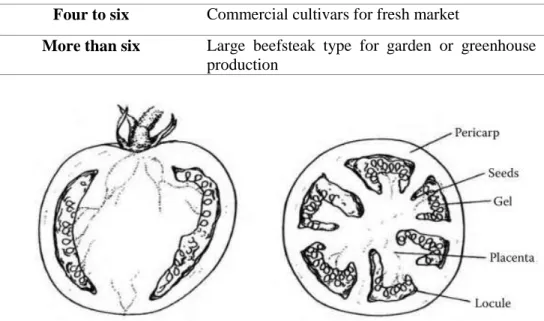
The tomato fruit is classified botanically as a berry, the size varying from small cherry types with only two divisions of the ovary (locules) to large multilocular beefsteak types. The number of locules defines the fruit type as follows:
Table 2.1 The relationship between number of locules and tomato types (J.
Benton Jones, 2008)
Number of Locules Fruit Type
66
Figure 2.1 Tomato fruit showing two locules (left-hand size) and multiple
locules (right-hand size). Included are identifications of the tomato fruit parts. Fruit diameter is related to its designation as being either a cherry, cocktail, or small, medium and large beefsteak fruit. The diameter of a fruit is also related to its weight, although there is no official weight designation for fruit type. In general, a cherry tomato weighs 14 to 56.7 gram, cocktail from 56.7 to 113.4 gram, small beefsteak from 170 to 227 gram, medium beefsteak from 255 to 311 gram and large beefsteak from 340 to 425 gram. The physical shape of a tomato fruit is determined by its variety as being either completely round, or oxheart or plum shaped (Jones, 2008).
Most tomato varieties are red in colour because of the red carotenoid lycopene. Different single genes are known to produce various shades of yellow, orange, or green fruit. The yellow colour is not related to the acidity of the fruit. Pink fruit is due to a single gene (Y) that prevents the formation of yellow pigment in the epidermis of the fruit. Other fruit colours are orange, striped (bicolour), purple, black, brown and green (Jones, 2008). More than 90% of the fresh weight of the tomato fruit is water, and the availability of water to the plant can influence both fruit size and weight. As the tomato fruit develops, the percentage of fresh weight that is sucrose decreases, while starch and reducing sugars increase (Jones, 2008).
Four to six Commercial cultivars for fresh market
More than six Large beefsteak type for garden or greenhouse
67
2.2 Metabolites in Tomato
Metabolites are classified into primary and secondary, though the boundaries between these groups can sometimes are unclear (Hounsome et al., 2008). Primary metabolites, such as organic acids, fatty acids, nucleotides and amino acids, play essential roles in growth and development, respiration and photosynthesis and hormone and protein synthesis. Secondary metabolites, including phenolic acids, flavonoids and terpenoid, play key roles in protecting plants from herbivores, microorganisms and UV radiation, in attracting pollinators or seed-dispersing animals and acting as stress-condition signalling molecules, among other important functions (Crozier et al., 2007).
Over the past decade, significant amounts of information have been accumulated on identification, biochemical characterization, localization, and health benefits of plant metabolites. All these previous studies represents an attempt to summarize the information about metabolites, which determine the nutritional value of vegetables, their occurrence in plants, role in the human diet, and advances in their analysis (Hounsome et al., 2008).
2.3 Phenolic Content and Antioxidants in Tomato
Phenolics are phytochemicals abundantly found in fruits, vegetables and grains. The biological roles of phenolics in plants include attracting pollinators, protecting plants against infections caused by microorganisms and injuries by insects (Bravo, 2009). Tomato fruit has been known for its abundant content of phenolic compounds, including phenolic acids and flavonoids. The chemical structure of phenolic compounds is a group of phytochemicals composed of an aromatic ring and one or more hydroxyl substitutes. The basic structure of a phenolic compound is known as aglycone, which can associate with various carbohydrates and organic acids to form glycosides. Many phenolic compounds can also join together to form polymers. So far at least 10 classes of phenolics have been identified based on the number of phenolic rings and the structural elements linking these rings (Kaufman et al., 2013).
The most common phenolics found in tomato fruit include flavonoids, phenolic acids and tannin which are effective free radical scavengers. Recent studies have pointed to the antioxidant functionality of phenolics in human health benefits. Phenolic compounds have been ascribed to their antioxidant activity in protecting humans from cancer and coronary heart disease, which are mainly induced by oxidative stress (Karacabey & Mazza, 2010).
68
Phenolic compounds are widely distributed phytochemicals composed of an aromatic ring and one or more hydroxyl substituents. Most common phenolics in tomato fruit include flavonoids, phenolic acids and tannins, which are effective free radical scavengers. In recent years, the antioxidant activity of phenolics has been found to play important roles in human health. Phenolic compounds have been ascribed to their antioxidant activity in protecting humans from cancer and coronary heart disease, which are mainly induced by oxidative stress (Karacabey & Mazza, 2010).
A great variety of studies has been carried out to determine the factors affecting the level of phenolic compounds in fruits and other plant foods. However, only a few have been conducted particularly for tomatoes. Environmental factors are known to affect the total phenolic content in tomato fruits. Light, temperature, fertilization, irrigation, origins of the cultivars and ripening stage at harvest may all contribute to the variations of phenolic contents in tomatoes. For example, plants effectively synthesize flavonoids and other phenolics under stimulation by ultraviolet (UV-B) light. These phenolic compounds act as protectors against further solar ultraviolet B radiation (280-320 nm). In a study with two Roma tomato varieties, tomato fruits had two-fold increase in flavonoid and other phenolic content due to the effect of UV-B light exposure (Du, Avena-Bustillos, Breksa, & McHugh, 2014).
Phenolic compounds are excellent oxygen radical scavengers because the electron reduction potential of the phenolic radical is lower than the reduction potential of oxygen radicals, and also because phenoxyl radicals are generally less reactive than oxygen radicals (Bors, Michel, & Saran, 1994). Therefore, phenolic compounds can scavenge reactive oxygen intermediates without promoting further oxidative reactions. It follows that many environmental stresses that cause oxidative stress often induce the synthesis of phenolic metabolites (Dixon & Paiva, 2007).
Antioxidant metabolites are a group of vitamins, carotenoids, phenolic compounds, and phenolic acid, with health-enhancing effects on our body (Canene-Adams et al., 2005). Among the vegetables, tomatoes represent the predominant source of antioxidants, and besides the carotenoids (lycopene, β-carotene, and lutein), the flavonoids have been confirmed as a group of polyphenols important in conferring antioxidant benefits (Stewart et al., 2000). It has been established that the antioxidant activity of tomato extracts varies with the tomato variety and the assay method used (Martínez-Valverde, Periago, Provan, & Chesson, 2002). Antioxidant compounds may be water-soluble, lipid-soluble, and insoluble or bound to cell walls. Hence, extraction efficiency is an
69 important factor in quantification of antioxidant activity of foods (Prakash, Rigelhof, & Miller, 2001).
Tomatoes constitute the predominant source of lycopene in most diets, and this compound has been associated with a range of health benefits (George, Kaur, Khurdiya, & Kapoor, 2004). Tomatoes also contain lower amounts of other carotenoids such as β-carotene, which is known for its provitamin A activity (Amorim-Carrilho, Cepeda, Fente, & Regal, 2014). Individual compounds found to be significantly related to antioxidant capacity are lycopene and ferulic and caffeic acids (Martínez-Valverde et al., 2002).
In addition to the particular interest in lycopene, an awareness of other more or less well-known tomato constitutes has emerged in recent years. Ascorbic acid is important in the protection of the tomato itself against oxidative damage that might increase with ripening due to enhanced respiration. This maintains firmness and improves shelf life of the fruit.
3.0 METHODOLOGY
3.1 Sampling of tomatoes
Four tomato variants were used in this study which is tomato, truss tomato, yellow cherry tomato and red cherry tomato. The tomatoes were bought from the supermarket and was then washed, dried and ground into fine powder.
3.2 Metabolite extraction for GCMS
In this study, two methods of metabolite extraction were carried out. The first method uses 75% methanol acidified with 0.1% formic acid as the solvent according to De Vos et al., 2007 and the second method uses mixture of methanol, chloroform and water as the solvent as according to Cadahia et al., 2015.
3.2.1 Methanol extraction method
This method was obtained from De Vos et al., 2007 with slight modifications. 200mg of grounded sample powder was mixed with freshly prepared ice-cold extraction solution (599 μl of 75% methanol acidified with 1.0 μl of 1.0% formic acid) in a volume per fresh weight ratio of three to one. The mixture was immediately vortexed for 10 seconds. The mixture was then sonicated for 20 minutes at maximum frequency (40 kHz) continuously, in a water bath at room temperature. After that, the mixture was centrifuged for 10 minutes at maximum speed (16,100x g) at room temperature and the supernatant was collected in a fresh tube leaving the pellet out.
70
3.2.2 Methanol-chloroform extraction method
The second metabolite extraction method was conducted based on Cadahía et al., 2015 with slight modifications. Approximately 200 mg of sample powder was mixed with 400 μl of 100% ice-cold chloroform and sonicated in an ultrasonication bath for 20 minutes at room temperature. Then, 1600 μl of ice-cold water and 100% methanol (1:3 v/v) was added and the mixture was sonicated again for 20 minutes. The mixture was centrifuged at maximum speed (16,100x g) for 10 minutes and then the supernatant was extracted.
3.3 Gas Chromatography-Mass Spectrometry (GC-MS) parameter
Following metabolite extraction,samples were analyzed using Agilent J&W Gas Chromatography Column with Triple Quadrapole mass spectrometry operated at 70eV. An aliquot of 1.0 μl sample was injected into DB-35MS (30m length x 0.250 mm diameter x 0.25 μm film thickness) column. Helium was used as a carrier gas and the scan range was set to 40 to 500 Da. The initial oven temperature was set to 60oC for 10 minutes and was increased by 40oC/min to
280oC, then held for 10 minutes and increased by 40oC/min until 310oC. Both
injector and transfer temperatures were set to 250oC while the source temperature
was adjusted to 300oC. The full scan range was acquired after 30 minutes with
the split ratio 10:1. Finally, each compound was compared with National Institute of Standards and Technology (NIST) as the standard mass spectra library for identification of them. For each peak, the software generated a list of similarities; the similarity indexes more than 60% were assigned compound names.
3.4 Preparation of methanolic tomato extracts for antioxidant tests by
Ultrasound Assisted Extraction (UAE) method
The preparation of methanolic tomato extracts was prepared according to Balaswamy et al. (2015) with slight modifications. 2 grams of tomato powder was mixed with 100 ml of methanol and was subjected to mixing in ultrasonication for 2 hours at room temperature. Finally, the extracts were centrifuged at 8000 rpm and the supernatant was collected for analysing total phenolic content (TPC) and antioxidant activity which includes DPPH and FRAP assay.
3.5 Determination of Total Phenolic Content (TPC)
The determination of total phenolic content was carried out according to Norra, Aminah, & Suri, 2016 with slight modifications. About 200 μl of sample extract (20.0 mg/ml) was mixed with 1 ml of Folin Ciocalteu reagent, which was pre-diluted 10-fold with distilled water and was put into amber bottles. After mixing for 5 minutes, 2 ml of 7.5% (w/v) sodium carbonate was added. The mixture was
71 vortexed for 1 minutes and was allowed to stand in the dark at room temperature for about 120 minutes. The absorbance of the extracts and a prepared blank were measured at 765 nm using a spectrophotometer. The total phenolic content was expressed as Gallic Acid Equivalent (GAE mg/g) dry weight from a known concentration of gallic acid standard. Data were reported as a mean ± standard deviation for three replications.
3.6 Determination of antioxidant activity
To measure the antioxidant activity of the four tomato variants, two antioxidant assay was carried out which is 2, 2-Diphenyl-1-picrylhydrazyl (DPPH) assay to measure the free radical scavenging activity by the tomato extract and Ferric Reducing Power (FRAP) assay.
3.6.1 Preparation of standard solution and construction of standard curve
for DPPH assay
1 gram of gallic acid was dissolved in 100 ml of methanol to get 1% solution of gallic acid (10 mg/ml) termed as standard 1 solution. A standard gallic acid curve was constructed by preparing the dilutions of 20, 40, 60, 80 and 100 μg/ml in methanol from standard 1 solution of gallic acid. A calibration curve of percentage inhibition of gallic acid was drawn for concentrations 20, 40, 60, 80 and 100 μg/ml to determine the IC50 values of extracts that is the concentration at
which 50% of DPPH solution is scavenged.
3.6.2 Measurement of DPPH radical scavenging activity (DPPH assay)
DPPH radical scavenging activity was measured following the method of Norra et al. (2016) with slight modification. 100 μl of the extracts was added to 2.9 ml of a 0.0037% methanol solution of DPPH. After a 120 min incubation period at room temperature, the absorbance was read against a blank at 517 nm. The measurements were performed in triplicates. The percentage of inhibition of DPPH radical by the tomato extracts was calculated as follow:
Inhibition (%) = (A blank – A sample) x 100
A blank
Where;
A blank = Absorbance of the control reaction containing all the test
reagents except the test compound. A sample = Absorbance of the test compound.
72
3.6.3 Ferric Reducing Antioxidant Power (FRAP) Assay
The FRAP reagent was prepared by mixing 300 mM acetate buffer, 10 ml TPTZ in 40 mM HCl and 20 mM iron (III) chloride in the proportion of 10:1:1 at 37oC.
3 ml of freshly prepared FRAP reagent were mixed with 100 μl (20 mg/ml) of sample methanolic extract in an amber bottle. The mixture was mixed thoroughly and was then incubated in water bath at 37oC for 30 minutes. An intense blue
color complex was formed when ferric tripyridyl triazine (Fe3+) complex was
reduced to ferrous (Fe2+) form and the absorbance at 593 nm was recorded.
3.7 Data processing and statistical analysis
All of the tests conducted were replicated three times unless stated otherwise. The results were expressed as means ± standard deviation. Correlation of total phenolic content, with the IC50 of DPPH scavenging activities and FRAP assay
was represented by Pearson’s correlation coefficient. P ≤ 0.05 was considered statistically significant. All the statistical analysis was done by using Microsoft Excel 2013 and Minitab 16.
4.0 RESULTS AND DISCUSSION
4.1 Screening of metabolites using GC-MS
Two different extraction methods involving different solvent mixtures, solvent ratios and sonication step were compared and evaluated. Briefly, the metabolite content of tomatoes were extracted with either methanol solvent or methanol-chloroform solvent.
In the methanolic extract, there were 13 metabolites detected in tomato, 9 metabolites detected in truss tomato, 35 metabolites detected in yellow cherry tomato and 44 metabolites detected in red cherry tomato. In the methanol-chloroform extract, 26 metabolites were detected in tomato, 11 metabolites were detected in truss tomato, 50 metabolites detected in yellow cherry tomato and 31 metabolites detected in red cherry tomato (Table 4.1).
Comparing the numbers of metabolites detected in both methanol and methanol-chloroform extracts, it can be observed that methanol-chloroform extracts produces more metabolite detection as compared to methanol extracts. This is in synergy with the findings by Mamat et al., 2018, where the number of metabolites detected in mangosteen pericarp using methanolic extraction is lower as compared to using methanol-chloroform extraction method.
73 The metabolites in the metabolome comprise a variety of compounds with a wide range of physical and chemical properties. To follow and define the metabolome experimentally, an extraction method is required that can extract the maximum number of metabolites in their original state and in a quantitative manner (Maharjan & Ferenci, 2006). The influence of extraction methodology on metabolite screening was clearly demonstrated by the results with the two method used. However, only metabolites detected with probability more than 60% will be discussed further.
Table 4.1: Summary of the two metabolite extraction methods
4.2 Measurement of total phenolic content
The total phenolic content was expressed as Gallic Acid Equivalents (GAE) in milligrams per gram dry material. The total phenolic content of tomato, truss tomato, yellow cherry tomato and red cherry tomato is shown in Table 4.4 and Figure 4.2. Red cherry tomato shows the highest concentration of phenolic compound with 3.73 mg/g, followed by tomato with 0.44 mg/g, truss tomato with 0.31 mg/g and yellow cherry tomato with 0.27 mg/g.
It was reported that extract yields and resulting activities of the plant materials are strongly dependent on the nature of extracting solvent, due to the presence of different antioxidant compound of varied chemical characteristics and polarities that may or may not be soluble in a particular solvent. Aqueous organic of tested plant material exhibiting greater phenolic content due to the fact that phenolics are often extracted in higher
Extraction Method
Solvent Ratio Sonication Number of identified
metabolites De Vos et al. (2007) Methanol (75%) acidified with 0.1% formic acid 599:1 Yes 1) Tomato 13 2) Truss tomato 9 3) Yellow cherry tomato 35 4) Red cherry tomato 44 Cadahia et al. (2015) Methanol: Chloroform: Water 3:1:1 Yes 1) Tomato 26 2) Truss tomato 11 3) Yellow cherry tomato 50 4) Red cherry tomato 31
74
amounts in more polar solvents, and therefore great reducing power (Sultana, Anwar, & Ashraf, 2009).
4.3 Measurement of DPPH radical scavenging activity
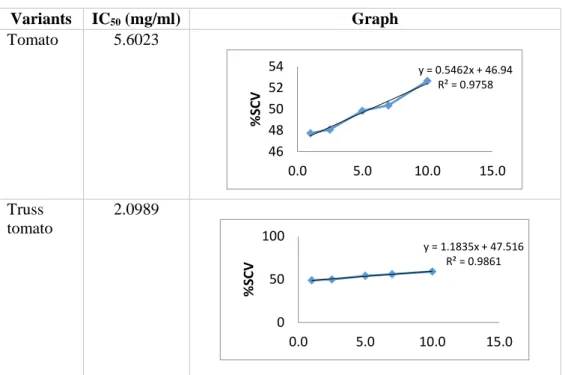
The DPPH free radical scavenging method is colorimetric assay and can be used to evaluate the radical scavenging capacity of specific compounds or extract. IC50
was determined from the plotted graph of scavenging activity against concentration of samples, which is defined as the amount of antioxidant necessary to decrease the initial DPPH radical concentration by 50%. The lowest indicates the strongest ability of samples to act as DPPH scavengers (Noor Atiqah, Maisarah, & Asmah, 2014).
Table 4.2 Summary of DPPH Assay
Variants IC50 (mg/ml) Graph Tomato 5.6023 Truss tomato 2.0989 y = 0.5462x + 46.94 R² = 0.9758 46 48 50 52 54 0.0 5.0 10.0 15.0 % SCV y = 1.1835x + 47.516 R² = 0.9861 0 50 100 0.0 5.0 10.0 15.0 % SCV
75 Table 4.2 shown that among the four variants, red cherry tomato shows the lowest IC50 with 1.7078 followed by truss tomato with IC50 2.0989, yellow
cherry tomato with IC50 3.9869 and finally tomato with IC50 5.6023. The results
shown that red cherry tomato have the highest ability to scavenge free radicals. This finding proves that there are differences in
antioxidant capacity among the four tomato variants and is supported by the statement of Pinela, Barros, Carvalho, & Ferreira, (2012) that all the differences observed in the antioxidant contents of tomato varieties are related to genotype, but also several factors such as ripening stage, cultivation practices and climatic environment.
Other than genotypic, growth stage and environmental factors, Marinova & Batchvarov, 2011 stated that there were substantial differences in used solvents, concentration of DPPH working solutions, ratio between volumes of sample/reagent, duration of reaction, wavelength of absorbance measurement, standard solutions and equations for calculation of the result. Marinova & Batchvarov, 2011 also stated that the most utilized solvents for determination of the radical scavenging activity by DPPH are methanol and ethanol. It is evident that 22 cited methods used methanol, while 12 prepared the DPPH solutions and samples with ethanol. This experiment utilizes methanol as solvent because
Yellow cherry tomato 3.9869 Red cherry tomato 1.7078 y = 0.3958x + 48.422 R² = 0.68 46 48 50 52 54 0.0 5.0 10.0 15.0 % SCV y = 1.4352x + 47.549 R² = 0.9924 0 20 40 60 80 0.0 5.0 10.0 15.0 % SCV
76
according to Boeing et al., (2014) among the pure solvents, methanol was the most efficient solvent for extraction of antioxidant compounds, followed by water, ethanol and acetone. Another study conducted by Moure et al., (2001) confirmed that the antioxidant capacities of the extracts have a strong relationship with the solvent employed, mainly due to the different antioxidant potential of compounds with different polarities.
As shown in Table 4.3, there was no significant correlation existed between total phenolic content and DPPH scavenging activity with r = -0.583 (p = 0.417). Therefore, this study may indicate that scavenging ability on DPPH could not due to polyphenolic compounds found in tomato, truss tomato, yellow cherry tomato and red cherry tomato extracts. Noor Atiqah et al., (2014) also reported that there are no significant correlation between DPPH scavenging activity with total phenolic content in ethanol and water extracts of four variants of tomatoes namely tamarillo, yellow cherry tomato, red cherry tomato and tomato.
Table 4.3: r and p value of Pearson Correlation test
DPPH FRAP
TPC r = -0.583
p = 0.417
r = 0.729 p = 0.271
4.4 Measurement of Ferric Reducing/Antioxidant Power Assay
FRAP assay measures the reducing potential of an antioxidant reacting with a ferric tripyridyltriazine (Fe3+-TPTZ) complex and producing a coloured ferrous
tripyridyltriazine (Fe2+-TPTZ). Generally, the reducing properties are associated
with the presence of compounds, which exert their action by breaking the free radical chain through donating a hydrogen atom (Noor Atiqah et al., 2014).
Table 4.4 shows the mean FRAP values for all four tomato samples. The red cherry tomato exhibited the highest antioxidant potential on the FRAP assay, and followed by truss tomato, yellow cherry tomato and lastly tomato.
77
Table 4.4 Mean FRAP values of tomato samples
Dragovic-Uzelac et al., 2007 stated that the higher phenolic content have shown to exert greater reducing power. Therefore, as the reducing power was determined with the Fe3+ to Fe2+ transformation, the reducing power increased
with increasing concentrations of phenolics in the sample extracts. This is true for red cherry tomato as previously it has shown to have the highest total phenolic content of 3.73 GAE mg/g and having the highest antioxidant potential for FRAP assay. However, Table 4.7 shown that there was no significant correlation between ferric reducing activity and total phenolic content with r = 0.729 (p = 0.271).
5.0 CONCLUSIONS
In this thesis, the differences in metabolites screened by GCMS using two different extraction method namely methanol and methanol-chloroform in four tomato variants which are tomato, truss tomato, yellow cherry tomato and red cherry tomato was addressed. Overall, methanol-chloroform extraction method produces more metabolites detection as compared to using methanol only.
Following that the total phenolic content was measured as well as its antioxidant capacity through DPPH and FRAP assay. From this research and supported by literature, we can say that the antioxidant activity of various foods can be determined accurately, conveniently, and rapidly using DPPH and FRAP assay. Overall, it can be concluding that red cherry tomato have the highest total phenolic content and antioxidant potential as compared to the other three variants. For future work on this topic, I would like to suggest on using a non-thermal extraction method to avoid the risk of metabolites denaturation by heat. I would also like to suggest on using tomato variants that are planted at the same condition to ensure that climate and growth conditions does not cause differences in metabolites development in the tomato, thus providing a more accurate data on metabolites comparison between different tomato variants.
Samples μg Fe (II)/ml
Tomato 2.37 ± 0.10
Truss tomato 3.79 ± 0.02
Yellow cherry tomato 2.91 ± 0.15
78
REFERENCES
Alam, M. N., Bristi, N. J., & Rafiquzzaman, M. (2013). Review on in vivo and in vitro methods evaluation of antioxidant activity. Saudi Pharmaceutical Journal, 21(2), 143–152. https://doi.org/10.1016/j.jsps.2012.05.002
Amorim-Carrilho, K. T., Cepeda, A., Fente, C., & Regal, P. (2014). Review of methods for analysis of carotenoids. TrAC - Trends in Analytical Chemistry,
56, 49–73. https://doi.org/10.1016/j.trac.2013.12.011
Benzie, I., & Strain, J. (1996). the ferric reducing ability of plasma(FRAP)as a measure of “Antioxidan power”:the FRAP assay analytical biochemistry.
Analytical Biochemistry, 239, 70–76. https://doi.org/10.1006/abio.1996.0292
Boeing, J. S., Barizão, É. O., e Silva, B. C., Montanher, P. F., de Cinque Almeida, V., & Visentainer, J. V. (2014). Evaluation of solvent effect on the extraction of phenolic compounds and antioxidant capacities from the berries: Application of principal component analysis. Chemistry Central Journal, 8(1), 1–9. https://doi.org/10.1186/s13065-014-0048-1
Bors, W., Michel, C., & Saran, M. (1994). Flavonoid antioxidants: rate constants for reactions. Methods in Enzymology, 234(1983), 420–429. Retrieved from http://www.sciencedirect.com/science/article/pii/0076687994341125 Bravo, L. (2009). Polyphenols: Chemistry, Dietary Sources, Metabolism, and
Nutritional Significance. Nutrition Reviews, 56(11), 317–333. https://doi.org/10.1111/j.1753-4887.1998.tb01670.x
Burton-Freeman, B., & Reimers, K. (2011). Tomato Consumption and Health: Emerging Benefits. American Journal of Lifestyle Medicine, 5(2), 182–191. https://doi.org/10.1177/1559827610387488
Cadahía, E., De Simón, B. F., Aranda, I., Sanz, M., Sánchez-Gómez, D., & Pinto, E. (2015). Non-targeted metabolomic profile of Fagus Sylvatica l. leaves using liquid chromatography with mass spectrometry and gas chromatography with mass spectrometry. Phytochemical Analysis, 26(2), 171–182. https://doi.org/10.1002/pca.2549
Crozier, A., Yokota, T., Jaganath, I. B., Marks, S., Saltmarsh, M., & Clifford, M. N. (2007). Secondary Metabolites in Fruits, Vegetables, Beverages and Other Plant-based Dietary Components. Plant Secondary Metabolites: Occurrence, Structure and Role in the Human Diet. https://doi.org/10.1002/9780470988558.ch7
79 De Vos, R. C. H., Moco, S., Lommen, A., Keurentjes, J. J. B., Bino, R. J., & Hall, R. D. (2007). Untargeted large-scale plant metabolomics using liquid chromatography coupled to mass spectrometry. Nature Protocols, 2(4), 778–791. https://doi.org/10.1038/nprot.2007.95
Dixon, R. A., & Paiva, N. L. (2007). Stress-Induced Phenylpropanoid Metabolism. The Plant Cell, 7(7), 1085. https://doi.org/10.2307/3870059 Dragovic-Uzelac, V., Levaj, B., Mrkic, V., Bursac, D., & Boras, M. (2007). The
content of polyphenols and carotenoids in three apricot cultivars depending on stage of maturity and geographical region. Food Chemistry, 102(3), 966– 975. https://doi.org/10.1016/j.foodchem.2006.04.001
Du, W. X., Avena-Bustillos, R. J., Breksa, A. P., & McHugh, T. H. (2014). UV-B light as a factor affecting total soluble phenolic contents of various whole and fresh-cut specialty crops. Postharvest Biology and Technology, 93, 72– 82. https://doi.org/10.1016/j.postharvbio.2014.02.004
Eunok, C., & David, B. M. (2009). Mechanisms of Antioxidants in the Oxidation of Foods. Comprehensive Reviews in Food Science and Food Safety, 8(4), 345–358. https://doi.org/10.1111/j.1541-4337.2009.00085.x
Fialkov, A. B., Steiner, U., Lehotay, S. J., & Amirav, A. (2007). Sensitivity and noise in GC-MS: Achieving low limits of detection for difficult analytes.
International Journal of Mass Spectrometry, 260(1), 31–48. https://doi.org/10.1016/j.ijms.2006.07.002
Fiehn, O., Kopka, J., Dörmann, P., Altmann, T., Trethewey, R. N., & Willmitzer, L. (2000). Metabolite profiling for plant functional genomics. Nature Biotechnology, 18(11), 1157–1161. https://doi.org/10.1038/81137
Frei, B. (1994). Reactive oxygen species and antioxidant vitamins: Mechanisms of action. The American Journal of Medicine, 97(3 SUPPL. 1), 5–13. https://doi.org/10.1016/0002-9343(94)90292-5
George, B., Kaur, C., Khurdiya, D. S., & Kapoor, H. C. (2004). Antioxidants in tomato (Lycopersium esculentum) as a function of genotype. Food Chemistry, 84(1), 45–51. https://doi.org/10.1016/S0308-8146(03)00165-1 H. W. John. (1998). Evaluation of the Evidence on the Role of Tomato Products
in Disease Prevention.
Hounsome, N., Hounsome, B., Tomos, D., & Edwards-Jones, G. (2008). Plant metabolites and nutritional quality of vegetables. Journal of Food Science,
80
J. Benton Jones, J. (2008). Tomato Plant Culture: In the Field, Greenhouse and Home Garden (Second Edi). CRC Press.
Karacabey, E., & Mazza, G. (2010). Optimisation of antioxidant activity of grape cane extracts using response surface methodology. Food Chemistry, 119(1), 343–348. https://doi.org/10.1016/j.foodchem.2009.06.029
Kaufman, R. C., Herald, T. J., Bean, S. R., Wilson, J. D., & Tuinstra, M. R. (2013). Variability in tannin content, chemistry and activity in a diverse group of tannin containing sorghum cultivars. Journal of the Science of Food and Agriculture, 93(5), 1233–1241. https://doi.org/10.1002/jsfa.5890 M, M.-C. (1995). Oxygen free radicals and human disease. Biochimie, 77(3),
147–61.
Maharjan, R. P., & Ferenci, T. (2006). Global metabolite analysis: the in uence of extraction methodology on metabolome pro les of Escherichia coli. Cell,
313(2003), 145–154.
Mamat, S. F., Azizan, K. A., Baharum, S. N., Noor, N. M., & Aizat, W. M. (2018). Metabolomics analysis of mangosteen (Garcinia mangostana Linn.) fruit pericarp using different extraction methods and GC-MS. Plant OMICS,
11(2), 89–97. https://doi.org/10.21475/poj.11.02.18.pne1191
Marinova, G., & Batchvarov, V. (2011). Evaluation of the Methods of Determination of Free Radical Scavenging By DPPH. Bulgarian Journal of Agricultural Science, 17(1), 11–24. https://doi.org/10.3390/molecules15118111
Martínez-Valverde, I., Periago, M. J., Provan, G., & Chesson, A. (2002). Phenolic compounds, lycopene and antioxidant activity in commercial varieties of tomato ( Lycopersicum esculentum ) . Journal of the Science of Food and Agriculture, 82(3), 323–330. https://doi.org/10.1002/jsfa.1035 Marxen, K., Vanselow, K. H., Lippemeier, S., Hintze, R., Ruser, A., & Hansen,
U. (2007). S7102080.Pdf, 2080–2095.
Moure, A., Cruz, J. M., Franco, D., Manuel Domínguez, J., Sineiro, J., Domínguez, H., … Carlos Parajó, J. (2001). Natural antioxidants from residual sources. Food Chemistry, 72(2), 145–171. https://doi.org/10.1016/S0308-8146(00)00223-5
81 Noor Atiqah, A. A. K., Maisarah, A. M., & Asmah, R. (2014). Comparison of antioxidant properties of tamarillo (Cyphomandra betacea), cherry tomato (Solanumly copersicum var. cerasiform) and tomato (Lyopersicon esulentum). International Food Research Journal, 21(6), 2355–2362. Norra, I., Aminah, A., & Suri, R. (2016). Effects of drying methods, solvent
extraction and particle size of Malaysian brown seaweed, Sargassum sp. on the total phenolic and free radical scavenging activity. International Food Research Journal, 23(4), 1558–1563.
Pérez-Jiménez, J., Arranz, S., Tabernero, M., Díaz- Rubio, M. E., Serrano, J., Goñi, I., & Saura-Calixto, F. (2008). Updated methodology to determine antioxidant capacity in plant foods, oils and beverages: Extraction, measurement and expression of results. Food Research International, 41(3), 274–285. https://doi.org/10.1016/j.foodres.2007.12.004
Pérez-Jiménez, J., & Saura-Calixto, F. (2008). Anti-oxidant capacity of dietary polyphenols determined by ABTS assay: A kinetic expression of the results.
International Journal of Food Science and Technology, 43(1), 185–191. https://doi.org/10.1111/j.1365-2621.2006.01425.x
Pinela, J., Barros, L., Carvalho, A. M., & Ferreira, I. C. F. R. (2012). Nutritional composition and antioxidant activity of four tomato (Lycopersicon esculentum L.) farmer’ varieties in Northeastern Portugal homegardens.
Food and Chemical Toxicology, 50(3–4), 829–834. https://doi.org/10.1016/j.fct.2011.11.045
Prakash, A., Rigelhof, F., & Miller, E. (2001). Prakash A, Fred R, Eugene M. Antioxidant activity. Medallion Laboratories Analitycal Progress. Tersedia dari:http://www.medallionlabs.com/Downloads/Antiox_acti_pdf. Diakses pada 26 November 2015., (4). https://doi.org/10.1016/j.bmcl.2010.12.025 Rahim, H., Amirul, M., Abdul, M., Zaffrie, M., Amin, M., & Haimid, M. T.
(2017). Technological adoption evaluation of agricultural and food sectors towards modern agriculture : Tomato, 41–53.
Raiola, A., Rigano, M. M., Calafiore, R., Frusciante, L., & Barone, A. (2014). Enhancing the health-promoting effects of tomato fruit for biofortified food.
Mediators of Inflammation, 2014. https://doi.org/10.1155/2014/139873 Sen, S., & Chakraborty, R. (2011). The Role of Antioxidants in Human Health,
82
Sharma, O. P., & Bhat, T. K. (2009). DPPH antioxidant assay revisited. Food Chemistry, 113(4), 1202–1205. https://doi.org/10.1016/j.foodchem.2008.08.008
Sies, H. (2014). Impaired Endothelial and Smooth Muscle Cell Function in Oxidative Stres. The Journal of Physiology, 491(suppl), 1–5. https://doi.org/10.1113/jphysiol.1996.sp021281
Silaste, M. L., Alfthan, G., Aro, A., Kesäniemi, Y. A., & Hörkkö, S. (2007). Tomato juice decreases LDL cholesterol levels and increases LDL resistance to oxidation. British Journal of Nutrition, 98(6), 1251–1258. https://doi.org/10.1017/S0007114507787445
Sneddon, J., Masuram, S., & Richert, J. C. (2007). Gas chromatography-mass spectrometry-basic principles, instrumentation and selected applications for detection of organic compounds. Analytical Letters, 40(6), 1003–1012. https://doi.org/10.1080/00032710701300648
Soheili, M., Oskouie, A., Tavirani, M. R., & Salami, M. (2018). Original Article : A method of GC-MS analysis of serum metabolites, 9, 1–6.
Stewart, A. J., Bozonnet, S., Mullen, W., Jenkins, G. I., Lean, M. E. J., & Crozier, A. (2000). Occurrence of Flavonols in Tomatoes and Tomato-Based Products.
Sultana, B., Anwar, F., & Ashraf, M. (2009). Effect of Extraction Solvent/Technique on the Antioxidant Activity of Selected Medicinal Plant
Extracts. Molecules, 14(6), 2167–2180.
https://doi.org/10.3390/molecules14062167
Sumner, L. W., Mendes, P., & Dixon, R. A. (2003). Plant metabolomics: Large-scale phytochemistry in the functional genomics era. Phytochemistry, 62(6), 817–836. https://doi.org/10.1016/S0031-9422(02)00708-2
Valko, M., Rhodes, C. J., Moncol, J., Izakovic, M., & Mazur, M. (2006). Free radicals, metals and antioxidants in oxidative stress-induced cancer.
Chemico-Biological Interactions, 160(1), 1–40. https://doi.org/10.1016/j.cbi.2005.12.009
Zameer Hussain, S., & Maqbool, K. (2014). GC-MS: Principle, Technique and its application in Food Science. Int J Curr Sci, 13, 116–126. https://doi.org/10.1039/C5SC03208C