Optimum ultrasound extraction of stevioside and rebaudioside a from
Stevia rebaudiana
leaves on isocratic RP-HPLC analysis
Yohanes Martonoa,c*,Sugeng Riyantob,Abdul Rohmanb, Sudibyo Martonob
aDoctorate Student of Faculty of Pharmacy, Gadjah Mada University,
Sekip Utara, Yogyakarta 55221, Indonesia
bFaculty of Pharmacy, Gadjah Mada University, Sekip Utara, Yogyakarta 55221, Indonesia cChemistry Department, Satya Wacana Christian University,
Jl. Diponegoro No. 52 60, Salatiga 50733, Indonesia
Abstract
The important factor on HPLC analysis is sample preparation. Optimum sample extraction yield accurate quantitation of respected compounds. This study evaluated the application of ultrasound extraction method for solid-liquid extraction of stevioside and rebaudioside A from Stevia rebaudiana leaves. Different solvents extraction (water, methanol, ethanol 40 70%, v/v in water, and mobile phase), times (5, 15, 30, and 60 minutes), and frequent of re-extraction (2 times) were used. The extraction was done on 40 C. Stevioside and rebaudioside A content were determined using isocratic RP-HPLC. The result showed that the optimum condition for stevioside and rebaudioside A extraction was using ethanol 60% (v/v in water) for 15 minutes in twice extraction. There were optimal time and re-extraction frequent in ultrasound re-extraction to yield maximum respected compounds on isocratic RP-HPLC sample preparation.
Keywords stevioside, rebaudioside A, Stevia rebaudiana, extraction, RP-HPLC
1. Introduction
Stevioside and rebaudioside A were dominant steviol glycoside inStevia rebaudiana
leaves. These compounds were widespread used as natural low calorie sweetener in various food and beverages product (Liu et al., 2010). Even, stevioside was the potential drug candidate for diabetes type 2 (Gregersen et al., 2004; Kujur et al., 2010). Purified extract or isolate of stevioside and rebaudioside A has marketing value if contained more than 80% and 90% of stevioside and rebaudioside A respectively (Gardana et al., 2010). Due to marketing value, Stevia rebaudiana leaves were needed to be guaranteed for quality in stevioside and rebaudioside A content. High quality leaves will yield high marketing value of stevioside and rebaudioside A purified extract. Stevioside and rebaudioside A content inStevia rebaudiana
leaves were 6 10% and 2 4% respectively (Londhe & Nanaware, 2013) .
HPLC method was developed to determine stevioside and rebaudioside A content in Stevia rebaudiana leaves (Bergs et al., 2012; Cacciola et al., 2011; Catharino & Santos, 2012; Dacome et al., 2005; Gardana et al., 2010; Jaworska et al., 2012; Kolb et al., 2001; Minne et al., 2004; Pól et al., 2007; Shafii et al., 2012; Well et al., 2013; Yang & Chen, 2009; Zhao et al., 2013). One point different among the developed methods was sample preparation. (Kolb et
al., 2001) used ethanol 70% (v/v in water) for solid-liquid extraction at 70 C. (Dacome et al., 2005) used boiling water in sample preparation to extract respected compounds. (Yang & Chen, 2009) and (Shafii et al., 2012) used ethanol 50% and 60% respectively to yield maximum respected compounds content in sample preparation. Different with others, (Jaworska et al., 2012) used acetonitrile : water (80 : 20, v/v) for extracting respected compounds fromStevia rebaudianaleaves. The different conditions of sample preparation method showed that it needed the optimization on sample preparation method. Perische et al.(2015) and Liu et al. (2010) reported that ultrasound extraction could extract steviol glycoside higher than conventional extraction.
Due to sample preparation is one important factor that can influence the accurate content determination of respected compounds on HPLC analysis, it needed to optimize the condition of sample preparation. This study evaluated solvent extraction, time, and frequent of extraction in ultrasound extraction for extracting stevioside and rebaudioside A from
Stevia rebaudianaleaves.
2. Materials and methods
2.1 Sample and chemicals
Stevia rebaudiana Bert. leaves were obtained from Tawangmangu, Karanganyar, Central Java, Indonesia. Stevioside and rebaudioside A standard were purchased from WAKO, Japan with purity > 99.0%. Methanol (HPLC grade), ethanol (Pro-Analysis), Trifluoro acetic acid (TFA, pro-analysis) and acetonitrile (HPLC grade) were purchased from Merck.
2.2 Instruments
Stevioside and rebaudioside A content was determined using Reverse Phase-HPLC. Stationary phase was using Eurosphere (250 × 4.6 mm, 5 µm) column with pre-column. HPLC analysis was performed by Knauer GmBH-Germany Smart Line Series HPLC with Smart Line UV 2500 A5140 detector, Smart Line Pump 1000 V 7603, sample injector 20 µL Rheodyne Loop model A1357. Sonicator Krisbow DSA50-GL2-2.5L was used during ultrasound extraction.
2.3 Chromatographic conditions
Chromatography analysis was performed in isocratic elusion system. Reverse-phase HPLC analysis was done using Eurosphere (250 mm × 4.6 mm i.d × 5 µm) column with pre-column. Separation of respected compounds was using methanol : water (90 : 10, v/v, pH = 3.0) : acetonitrile : TFA (65 : 35 : 0.01, v/v/v) as mobile phase. Stevioside and rebaudioside A separation was accomplished at constant flow of 0.6 mL.min-1. The column was thermostated at 30oC. Detection of respected compounds was set at 210 nm and the injection volume was 20 µL. Running times analysis system did not exceed 15 min.
2.4 Quantitation
was used to determine stevioside and rebaudioside A content in Stevia rebaudianaleaves extract.
2.5 Optimization of ultrasound extraction
Dried Stevia rebaudiana leaves were ground with grinder untill formed fine powder. Extraction was done by sonicating 0.5 gram fine leaves powder and extracting at 40 oC in various solvent, times, and twice re-extraction. Optimization was performed by varying some variable:
1. Polarity solvent extraction was optimzed by varying ethanol concentration from 40, 60, 70% and mobile phase to extract respected compounds. Each solvents was used as solvent extraction in ultrasound extraction for 1 hour at 40oC. Each extract was filtered using 0.45 nylon microfilter (Whatman Inc.) before injected to HPLC system. 2. Based on certain solvent extraction from previous optimization, period (times) extraction was optimzed by sonicating dried fine powder sample in various times, 5, 15, 30, and 60 minutes. Each remaining residue was re-extracted in twice with same procedure on first extraction before. Each fractions from various times and consecutive extraction was filtered with 0.45 µm microfilter (Whatman Inc.) before injected to HPLC system.
3. Suitable solvent extraction was ensured by varying solvent extraction with methanol 50%, boiling water and certain concentration of ethanol. Extraction was done by sonicating dried powder with each solvents for certain times and re-extraction cycle at 40oC . After sonication, the filtrate was adjusted in 100 mL volumetric flask with certain solvent. Each extract was filtered using nylon microfiltered (Whatman Inc.) before injected to HPLC system.
3. Results and discussion
3.1 External standard callibration curve
Stevioside and rebaudioside A determination was done by using externall standar curve callibration method. Developed RP-HPLC method gave linear standard curve with R2 > 0.9994 (see Figure 1). This result showed that standard curve used was in good linearity to determine respected compounds.
(a) (b)
3.2 Optimization of ultrasound extraction
Every solvent has different polarity. The suitability of solvent polarity with respected compounds to be extracted was important factor in extraction. Beside, time and cycle extraction were also influence the optimum yield of extraction. Different method of extraction will give different result in quantity of respected compounds. Perische et al. (2015) showed that microwave and ultrasound extraction methods gave higher extraction yield than maceration method in stevioside and rebaudioside A content. Different extraction methods were also has different optimum time to extract respected compunds. Extraction in over time of optimum time extraction will not give better result in respected compounds content. Residue after first extraction was still containing respected compounds. The first extraction could yield 86% of steviol glycoside compounds and reached maximum extraction in second extraction as far there was no steviol quantifiable in third extraction (less than Limit of Quantitation, LOQ) (Jentzer et al., 2015).
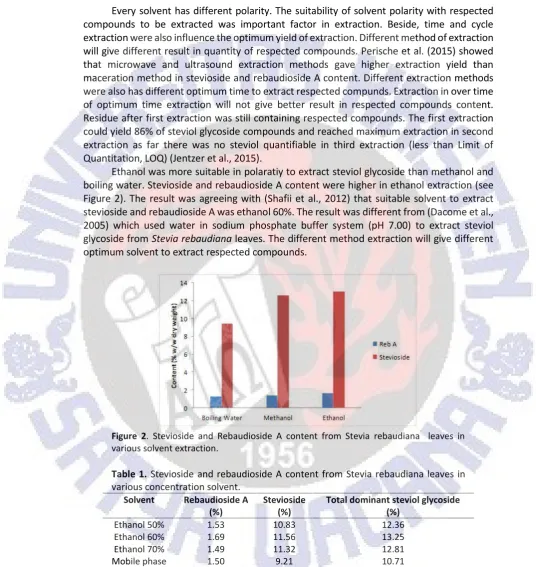
Ethanol was more suitable in polaratiy to extract steviol glycoside than methanol and boiling water. Stevioside and rebaudioside A content were higher in ethanol extraction (see Figure 2). The result was agreeing with (Shafii et al., 2012) that suitable solvent to extract stevioside and rebaudioside A was ethanol 60%. The result was different from (Dacome et al., 2005) which used water in sodium phosphate buffer system (pH 7.00) to extract steviol glycoside fromStevia rebaudianaleaves. The different method extraction will give different optimum solvent to extract respected compounds.
Figure 2. Stevioside and Rebaudioside A content from Stevia rebaudiana leaves in various solvent extraction.
Table 1.Stevioside and rebaudioside A content from Stevia rebaudiana leaves in various concentration solvent.
Solvent Rebaudioside A Stevioside Total dominant steviol glycoside
(%) (%) (%)
Ethanol 50% 1.53 10.83 12.36
Ethanol 60% 1.69 11.56 13.25
Ethanol 70% 1.49 11.32 12.81
Mobile phase 1.50 9.21 10.71
modify its polarity and increase suitability to extract stevioside and rebaudioside A from Stevia rebaudiana leaves. Compiring with ethanol 50%, 70% and mobile phase, ethanol 60% was more suitable in polarity to extract stevioside and rebaudioside A. This result indicated that there was optimum concentration of solvent in ultrasound extraction.
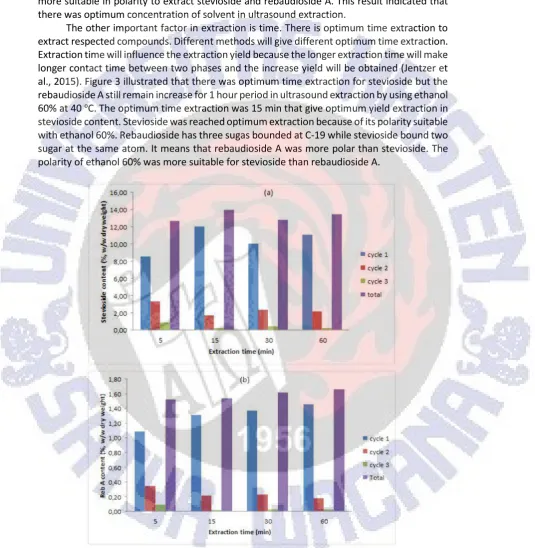
The other important factor in extraction is time. There is optimum time extraction to extract respected compounds. Different methods will give different optimum time extraction. Extraction time will influence the extraction yield because the longer extraction time will make longer contact time between two phases and the increase yield will be obtained (Jentzer et al., 2015). Figure 3 illustrated that there was optimum time extraction for stevioside but the rebaudioside A still remain increase for 1 hour period in ultrasound extraction by using ethanol 60% at 40oC. The optimum time extraction was 15 min that give optimum yield extraction in stevioside content. Stevioside was reached optimum extraction because of its polarity suitable with ethanol 60%. Rebaudioside has three sugas bounded at C-19 while stevioside bound two sugar at the same atom. It means that rebaudioside A was more polar than stevioside. The polarity of ethanol 60% was more suitable for stevioside than rebaudioside A.
Figure 3 also illustrated the influence of extraction cycles. The cycles will influence diffusion equillibrium of respected compounds. The addition of new solvent in cycles addition will disturb diffusion equillbrium and make longer time to diffuse the respected compounds from matrix sample to extraction solvent (Jentzer et al., 2015). Addition cycles untill 3 cycles can increase extraction yield of stevioside and rebaudioside A content. In stevioside extraction, the first cycle extraction for 15 min could extract approximately 86% stevioside. The third cycles of extraction remain only 1.65% for 15 min extraction. In other hand, effectivenes rebaudioside A extraction was lower than stevioside for 15 min extraction. Rebaudioside A still increase for 60 min extraction. The first cycle of 60 min extraction could yield 87.96% and the third cycle remain 1.28% rebaudioside A. The compound s polarity influenced extractable ability. There for stevioside was faster extracted than rebaudioside A because its polarity was suitable with ethanol 60%. The longer contact time will increase disolution of respected compounds from matrix to sample and increase the content of respected compounds.
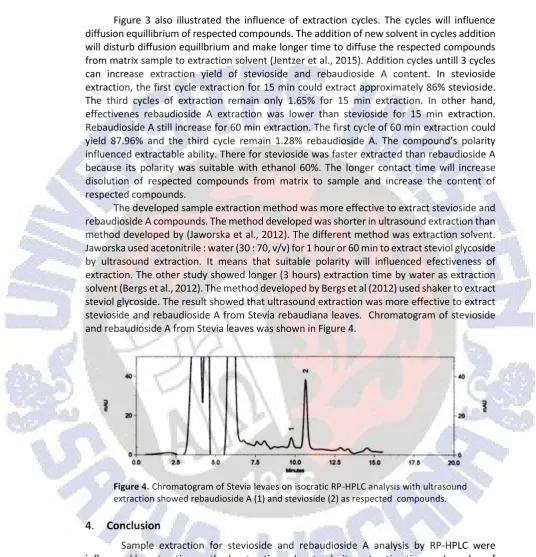
The developed sample extraction method was more effective to extract stevioside and rebaudioside A compounds. The method developed was shorter in ultrasound extraction than method developed by (Jaworska et al., 2012). The different method was extraction solvent. Jaworska used acetonitrile : water (30 : 70, v/v) for 1 hour or 60 min to extract steviol glycoside by ultrasound extraction. It means that suitable polarity will influenced efectiveness of extraction. The other study showed longer (3 hours) extraction time by water as extraction solvent (Bergs et al., 2012). The method developed by Bergs et al (2012) used shaker to extract steviol glycoside. The result showed that ultrasound extraction was more effective to extract stevioside and rebaudioside A from Stevia rebaudiana leaves. Chromatogram of stevioside and rebaudioside A from Stevia leaves was shown in Figure 4.
Figure 4.Chromatogram of Stevia levaes on isocratic RP-HPLC analysis with ultrasound extraction showed rebaudioside A (1) and stevioside (2) as respected compounds.
4
.
Conclusion
References
Bergs, D., Burghoff, B., Joehnck, M., Martin, G., & Schembecker, G. (2012). Fast and isocratic HPLC-method for steviol glycosides analysis from Stevia rebaudiana leaves. J. Für Verbraucherschutz Leb.,7, 147 154.
Cacciola, F., Delmonte, P., Jaworska, K., Dugo, P., Mondello, L., & Rader, J.I. (2011). Employing ultra high pressure liquid chromatography as the second dimension in a comprehensive two-dimensional system for analysis of Stevia rebaudianaextracts.J. Chromatogr. A, 1218, 2012 2018.
Catharino, R.R., & Santos, L.S. (2012). On-line monitoring of stevioside sweetener hydrolysis to steviol in acidic aqueous solutions.Food Chem.,133, 1632 1635.
Dacome, A.S., Da Silva, C.C., Da Costa, C.E., Fontana, J.D., Adelmann, J., & Da Costa, S.C., (2005). Sweet diterpenic glycosides balance of a new cultivar ofStevia rebaudiana(Bert.) Bertoni: Isolation and quantitative distribution by chromatographic, spectroscopic, and electrophoretic methods. Process Biochem.,40, 3587 3594.
Gardana, C., Scaglianti, M., & Simonetti, P., (2010). Evaluation of steviol and its glycosides inStevia rebaudiana leaves and commercial sweetener by ultra-high-performance liquid chromatography-mass spectrometry.J. Chromatogr. A,1217, 1463 1470.
Gregersen, S., Jeppesen, P.B., Holst, J.J., & Hermansen, K., (2004). Antihyperglycemic effects of stevioside in type 2 diabetic subjects.Metabolism,53, 73 76.
Jaworska, K., Krynitsky, A.J., Rader, J.I., (2012). Simultaneous analysis of steviol and steviol glycosides by liquid chromatography with ultraviolet detection on a mixed-mode column: application to Stevia plant material and Stevia-containing dietary supplements.J. AOAC Int.,95, 1588 1596. Jentzer, J.-B., Alignan, M., Vaca-Garcia, C., Rigal, L., Vilarem, G., (2015). Response surface methodology
to optimise Accelerated Solvent Extraction of steviol glycosides from Stevia rebaudiana Bertoni leaves.Food Chem.,166, 561 567. doi:10.1016/j.foodchem.2014.06.078.
Kolb, N., Herrera, J.L., Ferreyra, D.J., Uliana, R.F., (2001). Analysis of sweet diterpene glycosides from Stevia rebaudiana: Improved HPLC method.J. Agric. Food Chem.,49, 4538 4541.
Kujur, R.S., Singh, V., Ram, M., Yadava, H.K., Singh, K.K., Kumari, S., and et al., (2010). Antidiabetic Activity and Phytochemical Screening of Crude Extract of Stevia Rebaudiana in Alloxan-induced Diabetiis Rats.Pharmacogn. J.,2, 27 32.
Liu, J., Li, J., Tang, J., (2010). Ultrasonically assisted extraction of total carbohydrates from Stevia rebaudianaBertoni and identification of extracts.Food Bioprod. Process.,88, 215 221.
Londhe, S.V., Nanaware, S.M., (2013). HPTLC Method for Simultaneous Analysis of Stevioside and Rebaudioside-A in Stevia rebaudiana.J. AOAC Int.,96, 24 26.
Minne, V.J., Compernolle, F., Toppet, S., Geuns, J.M., (2004). Steviol quantification at the picomole level by high-performance liquid chromatography.J. Agric. Food Chem.,52, 2445 2449.
Periche, A., Castelló, M.L., Heredia, A & Isabel Escriche. (2015). Influence of Extraction Methods on the Yield of Steviol Glycosides and Antioxidants inStevia rebaudianaExtracts. PlantFoods Hum Nutr, 70, 119 127. DOI 10.1007/s11130-015-0475-8.
Pól, J., Hohnová, B., Hyötyläinen, T., (2007). Characterisation ofStevia rebaudiana by comprehensive two-dimensional liquid chromatography time-of-flight mass spectrometry. J. Chromatogr. A, 1150, 85 92.
Shafii, B., Vismeh, R., Beaudry, R., Warner, R., Jones, A.D., (2012). Large-scale profiling of diterpenoid glycosides from Stevia rebaudiana using ultrahigh performance liquid chromatography/tandem mass spectrometry.Anal. Bioanal. Chem.,403, 2683 2690.
Well, C., Frank, O., Hofmann, T., (2013). Quantitation of Sweet Steviol Glycosides by Means of a HILIC-MS/MS-SIDA Approach.J. Agric. Food Chem.,61, 11312 11320.
Yang, D., Chen, B., (2009). Simultaneous determination of nonnutritive sweeteners in foods by HPLC/ESI-MS.J. Agric. Food Chem.,57, 3022 3027.